ISSN: 2067-533X
INTERNATIONAL JOURNAL
OF
CONSERVATION SCIENCE
Volume 2, Issue 2, April-June: 117-126 www.ijcs.uaic.ro
A SCIENTIFIC INVESTIGATION OF THE ANCIENT JEWELS
FOUND IN THE IBIDA SITE, ROMANIA
Viorica VASILACHE1*, Dan APARASCHIVEI2, Ion SANDU1
1) ARHEOINVEST Interdisciplinary Platform, „Al.I.Cuza” University of Iaşi 2) Institute of Archaeology Iasi
Abstract
A scientific investigation of objects discovered in archaeological dig sites involves a high interdisciplinary intake of methods and techniques of related disciplines, such as chemistry, physics, archeology, art history, geology, biology, etc. The present paper presents the results of the analysis, carried out by corroborating SEM-EDX and micro-FTIR techniques, of jewels discovered during the archaeological excavations from Ibida in the village Slava Rusa, the city of Tulcea, Romania. These studies helped establish the characteristics of the materials the jewelry were made of, to identify the type of alloy, in order to determine the area of origin of the raw materials and the processing technology, based on which one can evaluate the economic and social changes over time, with their integration into the cultural space.
Keywords: jewelry; SEM-EDX; micro-FTIR; archaeology.
Introduction
The evolution of human culture and civilization has always excited both scholars and persons with a passion for the mysteries of archaeological discoveries.
Archaeologists, those researchers of unknown past which exploit material traces recovered from dig sites, focus a lot on issues relating to the artifacts discovered. Their main aim is to know the material and whether it suffered the effects of the implementation works of the discovery. They are also interested in the processes of elaboration and processing of material and of the implementation work and subsequent interventions to preserve and restore the objects. In collaboration, the archaeologist and the scientific investigator can easily reach those objectives. Today we have modern systems of analysis, involving disciplinary techniques that allow an interdisciplinary, exhaustive interpretation.
One of the largest Roman-Byzantine fortified complex in the Lower Danube region is the settlement in the Slava Rusa village, Tulcea county, a site of an outstanding archaeological interest, mentioned by Procopius of Ceasarea as the Ibida [1] .
Excavations at Ibida revealed a suite of objects with different uses. This study selected some of them, grouped by area of use. In this paper we will present the results of the SEM-EDX and micro-FTIR analysis carried out on only some of the jewels, namely the bracelets, earrings and rings found at Ibida. The study will continue with a series of notes to determine the composition of alloys and their archaeometric features.
Experimental
The items selected for investigation were discovered by specialists from the Institute of Eco-Museum Research, Tulcea, The Institute of Archaeology Iasi and Institute of Anthropology in Bucharest, in the excavations made in the archaeological site of Ibida of the village Slava Rusa. For the purpose of this study, we took three bracelets, four earrings and two rings discovered in the site from Ibida, Tulcea.
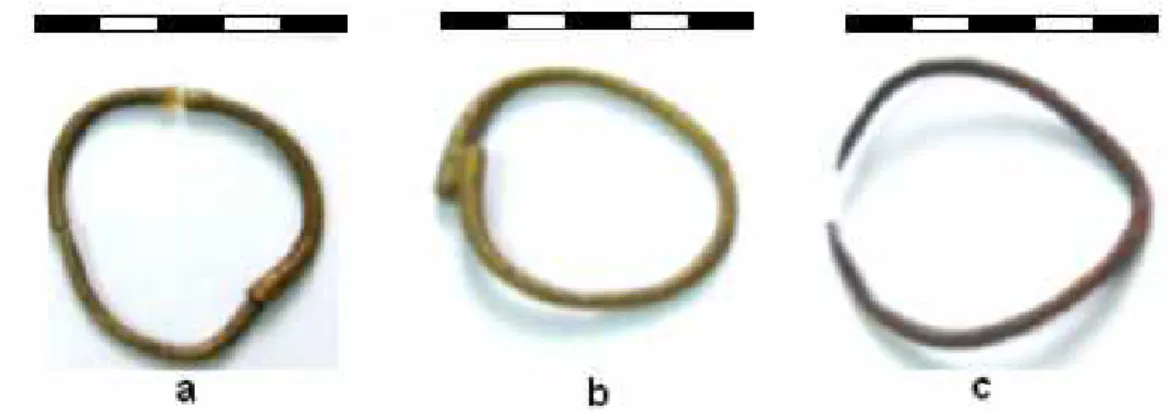
The three bracelets (Fig. 1), discovered in 2006 are:
- Metal bracelet - B1 (Fig. 1a), discovered in the Necropolis area, S2, square 3, M (grave 116) at -2.90 m with the no. inv. 48,290, of which three fragments were preserved. This presents a setting in the terminal parts consisting of three concentric circles. Sectional diameter of the metal bar in the middle part is 3.15 mm, and the piece ends up about 4.10 mm thick. Its length is 138 mm . Maximum opening of the piece is 36.30 mm. The bracelet weighs 6.25 g.
This bracelet is a model often found in sites in the Danube region, being almost identical in type to the other wrist bracelets (B2), discovered in the same grave. Both could be placed chronologically in the IV-V century AD.
- Metal Bracelet - B2 (Fig. 1b), discovered in the same grave with the previous one is no. inv. 48,291 and in a better state of conservation than the first (being intact).
This bracelet is decorated on the ends with four concentric circles. Sectional diameter of the middle metal bar is 3.15 mm and the piece ends are thicker than the previous piece, up to about 4.25 mm. Maximum opening is of 36.37 mm. Weight is 7.66 g.
These two components are part of the inventory in a tomb of a young person in Ibida, dating from the fourth or fifth century AD.
- Metal Bracelet - B3 (Fig. 1c), discovered in the Necropolis area, M1 (more to the West) is no. inv 48235 and is also in a good preservation state.
The piece is common, without decoration, with sharp ends. It is made of a material of lesser quality than the previous ones, suggesting that the social condition of the bearer was lower. The sectional diameter is of about 3.30 mm and a 53 mm maximum opening, which may mean that it was worn by a mature female. It weighs 7.42 g. Due to lack of specific dating elements, we can assume it belongs to the IV-VI centuries AD.
Fig. 1. Bracelets discovered during archaeological excavations in 2006 in Ibida: a – Bracelet of Necropolis sector, S2, square 3, M (grave 116), inv. 48290, (B1); b – Bracelet of Necropolis sector, S2, square 3, M (grave 116), inv. 48291, (B2);
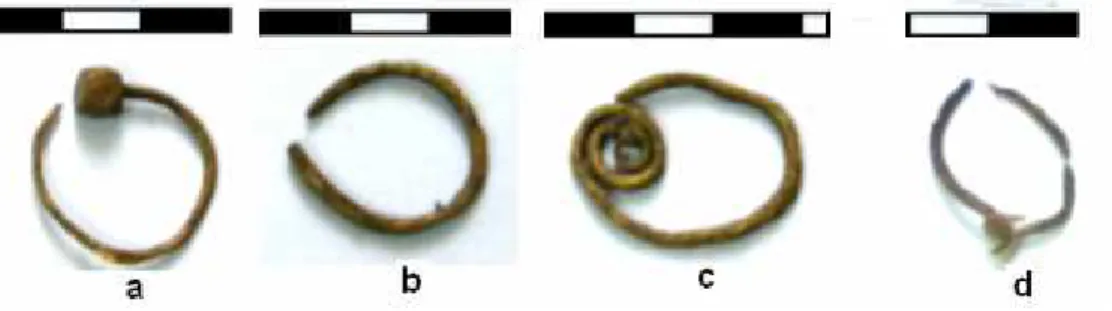
Another set of objects analyzed are various earrings from four graves, two of which were taken from the vault Tudorca (Fig. 2).
- Earring - E1 (Fig. 2a), discovered in 2002, Necropolis, S3, M 18, 1 square, at -1.23 m, no. inv. 45843 being a very good state of preservation.
The piece has a diameter of 21.40 mm, the bottom has a polyhedral shape with a size of about 5.88 mm per side, with the corners cut and in the center of the each part we noticed a simple decoration, circular. Its weight is 1.97 g. It is part of a fairly common type of earrings for the ladies of IV-VI centuries AD. The closing was very simply by twisting the sharp side.
- Earring - E2 (Fig. 2b), discovered in 2001, the crypt (vault Tudorca), no. inv. 45844 having relatively good state of preservation.
Its diameter is 15.28 mm and it weighs 0.48 g. It is a simple piece in the form of rings, common for women in the Lower Danube region. It was part of the inventory of one of the female tombs (the Tudorca) with 39 bodies identified by anthropologists, dating from the IV-VI centuries AD.
- Earring - E3 (Fig. 2c), discovered in 2001 in a crypt (vault Tudorca), no. inv. 45845 are in good preservation.
The piece is ovoid in shape, decorated with a simple spiral. In addition to the main spiral, with a maximum diameter of 22.38 mm, which is present at the bottom, there are two other concentric spirals, almost linked together. It weighs 0.93 g and can be classified as dating from the IV-V century AD.
- Earring - E4 (Fig. 2d), discovered in 2006 in the necropolis, S2, M 116, square 3, at -2.90 m and no. inv. 48294, being in a poor state of preservation.
This earring was found with bracelets B1 and B2. The item is quite simple, consisting of a knotted metal bar. A small part of that earring is missing, but we appreciate that the diameter of the piece was about 15 mm and it weighs 0.30 grams. The piece can be placed in the IV-V century AD.
Fig. 2. Earring discovered in archaeological excavations at Ibida: a. Earring discovered in 2002, Necropolis, S3, M 18, 1 square, inv. 45843, (E1);
b. Earring discovered in 2001, Crypt (vault Tudorca), inv. 45844, (E2); c. Earring discovered in 2001, Crypt (vault Tudorca), inv. 45845, (E3); d. Earring discovered in 2006, Necropolis, S2, M 116, 3 square, inv. 48294, (E4).
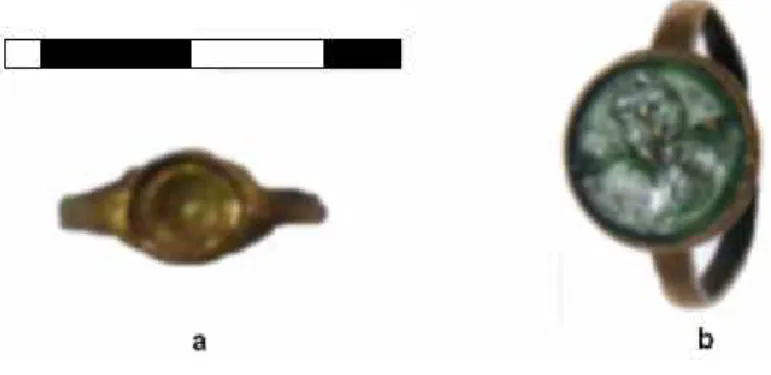
The rings we selected for investigation are shown in Figure 3.
- Ring - R1 (Fig. 3a), discovered in 2001, Fortress, Curtin G, S1, square 6, at -3.00 m, no. inv. 45637 being in a very good state of preservation.
and the minimum of 6.69 mm. The ring is not very spectacular, and can be included chronologically in the II-IV centuries AD.
- Ring - R2 (Fig. 3b), discovered in 2006, Necropolis, S2, M 107, square1-2, no. inv. 48297, decorated with a glass paste shape. The shape presents a female figure in negative (intaglio). The maximum diameter of the ring is 17.68 mm and the stone is 11.68 mm in diameter. The ring is very well preserved, lacking only a small part (about 4.45 mm). It weighs (complete with cameo) 2 g.
There is a small crack in the middle of the glass shape, affecting feminine representation.
Fig. 3. Rings found in archaeological excavations at Ibida: a. Ring discovered in 2001, Curtin G, S1, square 6, inv. 45637, (R1); b. Ring discovered in 2006, Necropolis, S2, M 107, square1-2, inv. 48297, (R2).
The objects were analyzed by SEM-EDX and micro-FTIR techniques without sampling.
The SEM-EDX Analysis
The review used a scanning electron microscope, SEM VEGA II LSH model, produced by TESCAN, coupled with an EDX detector QX2 QUANTAX type, manufactured by Brüker/ ROENTEC Germany.
The microscope, controlled entirely by computer, has an electron gun with a tungsten filament, which can achieve a resolution of 3nm to 30kVA, with magnification of 30 X and 1,000,000 X operating mode “resolution” of acceleration voltage between 200 V to 30 kV, scanning speed of 200 ns and 10 ms per pixel. The pressure is less than 1x10⁻² Pa. The resulting image can be formed by secondary electrons (SE) and backscatter electron (BSE).
The Quantax QX2 EDX detector was used for qualitative and quantitative micro-analysis. The EDX detector is the third generation, the X-Flash, that does not require liquid nitrogen cooling and is about. 10 times faster than conventional detectors Si (Li).
The technique, with micro-photogram view, imaging plays mapping (layout) investigated the surface atoms, and X-ray spectrum based on elemental composition determination (gravimetric or molar percentage of a microstructure or a selected area and assessment of composition variation ordered along a vector in the area or section analyzed.
micro-FT-IR Analysis
FT-IR spectrophotometer TENS is type 27, which is mainly suitable for close IR measurements. DLaTGS standard detector covering the spectral range 7500 - 370 cm-1 and working at room temperature. The resolution is typically 4 cm-1 , but may reach 1 cm-1 . TENS 27 is equipped with a laser He-Ne emitting at 633 nm and a power of 1 mW and has a ROCKSOLID alignment of the interferometer. Signal to noise ratio of this device is very good. Tensor is completely controlled by OPUS software.
HYPERION 1000 microscope is an accessory that can be paired with almost any FT-IR Bruker spectrophotometer. For completely non-destructive measurements it is coupled with a microscope spectrophotometer HYPERION 27 TENS 1000 and for solid samples one usually works in reflection.
The software type is OPUS/video interactive video data acquisition. It can work both in transmission and in reflection. Type MCT detector is cooled with liquid nitrogen (-196oC). Spectral range 600-7500 cm-1 is measured and the area is optimized to a diameter of 250 mm with the potential to achieve a minimum of 20 mm. The microscope is equipped with a 15X lens.
Analyses were performed in the Laboratory of Scientific Investigation and Conservation of Culturale Heritage Assets in the Platform of Interdisciplinary Training and Research, „Al.I.Cuza” University of Iaşi.
Results and discussion
The SEM-EDX analysis on the structures and cross-sectional area was obtained by mass elemental composition of the patina residual (remaining after cleaning the parts) and the structure of alloys of objects discovered in archaeological excavations.
It is known that after the abandonment in the archaeological site, pieces of bronze and brass undergo a series of processes of degradation and damage from the surface to the inside and from the inside to the surface. The first is influenced by both the alloy composition and the processes incurred during usage and the surrounding environment , which often formed on the workpiece surface a layered effect known as Liessegang [2, 3]. The second group is affected only by the nature and composition of chemical constituents in the base alloy structure and the manner and extent of their dispersion volume phase. For example, it is known that zinc, iron and other metals, very active in copper alloys, segregate while the volume of the alloy phases to the surface, where, after the dissolution process they disperse in the environment or form a complex crust on the surface of the item [4, 5, 6, 7, 8].
Table 1. The chemical composition of surface structures Elemental composition – weight percent (%) Index
Object/No. inv.
Cu Sn Zn Fe Ag O C S Cl Ca Al Si
B1 Bracelet /48290 30,336 - 13,602 - - 23,311 32,749 - - - - -
B2 Bracelet /48291 32,780 - 14,993 0,781 - 22,607 20,889 - 4,932 0,387 2,203 -
B3 Bracelet /48235 37,844 - - - - 24,348 37,806 - - - - -
E1 Earring/45843 16,675 - 4,243 - - 53,922 23,187 0,189 0,204 0,275 0,533 0,768
E2 Earring /45844 31,712 - 9,860 1,122 - 39,793 16,432 - 0,399 0,331 - 0,444
E3 Earring /45845 25,648 - 12,339 - - 39,930 21,006 - - - 0,776 0,298
E4 Earring /48294 43,094 - 12,034 - - 18,354 25,648 - - - 0,867 0,488
R1 Ring/45637 44,873 1,595 9,339 - - 26,614 15,173 0,161 0,279 0,364 1,108 -
R2 Ring/48297 40,312 - 17,995 0,592 0,644 15,293 24,628 0,097 - - 0,178 0,256
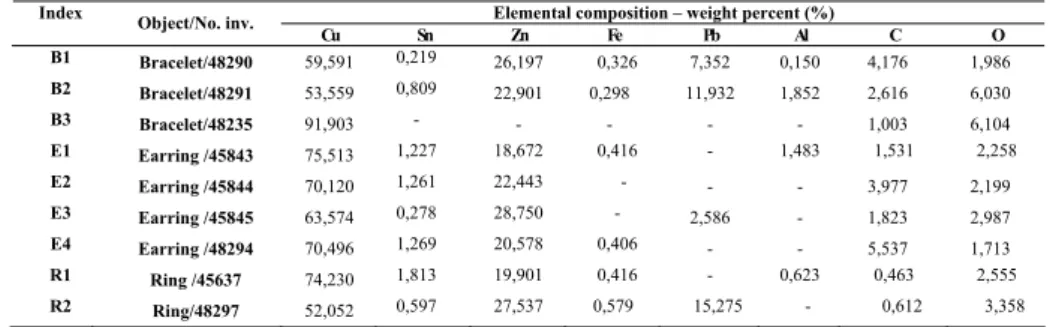
Table 2 presents the chemical composition of the alloy core, which differs from the original one, due the process of segregation of active metals to the surface and the inward diffusion through cracks and crevices of active metals, particularly the chlorine, oxygen and sulfur, formed as corrosion products [4, 5, 6, 8]. These effects are strongly influenced by the distribution of tin in the phase volume of the piece. Due to its amphoteric character and tendency to cluster in the form of microlens, it somehow controls both the processes of segregation and the corrosion [4, 5, 9]. Table 2 presents the chemical composition of the metal core, made according to case in stratigraphic section or on a polished area. There is good correlation between the core composition and surface structures. We noted the fairly advanced state of degradation of the metallic core to all parts. In addition to the porous structure (B3, E1, E2, E4. E4) cracks, some pieces have deep crevices, pitting areas and diffused compounds. The degree of segregation of active metals onto the surface of the piece is quite high. Interesting to note is that, except for bracelet B3, which is copper, the rest are from an old bronze with a high content of zinc. Some contain iron and lead, as micro-elements, aluminum, carbon and oxygen from contamination. The basic alloy composition shows that the raw material (ore) came from the Altântepe - Dobrogea area and from ancient Greece.
Table 2. The chemical composition of the metal core. Elemental composition – weight percent (%) Index
Object/No. inv.
Cu Sn Zn Fe Pb Al C O B1 Bracelet/48290 59,591 0,219 26,197 0,326 7,352 0,150 4,176 1,986
B2 Bracelet/48291 53,559 0,809 22,901 0,298 11,932 1,852 2,616 6,030
B3 Bracelet/48235 91,903 - - - - - 1,003 6,104
E1 Earring /45843 75,513 1,227 18,672 0,416 - 1,483 1,531 2,258
E2 Earring /45844 70,120 1,261 22,443 - - - 3,977 2,199
E3 Earring /45845 63,574 0,278 28,750 - 2,586 - 1,823 2,987
E4 Earring /48294 70,496 1,269 20,578 0,406 - - 5,537 1,713
R1 Ring /45637 74,230 1,813 19,901 0,416 - 0,623 0,463 2,555
R2 Ring/48297 52,052 0,597 27,537 0,579 15,275 - 0,612 3,358
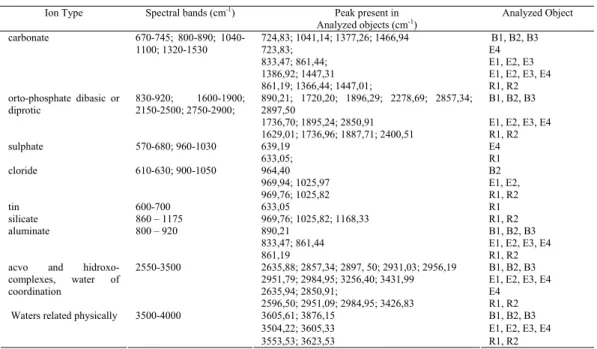
The micro-FTIR analysis, based on group characteristic vibrations were confirmed from the corrosive nature of the surface structures.
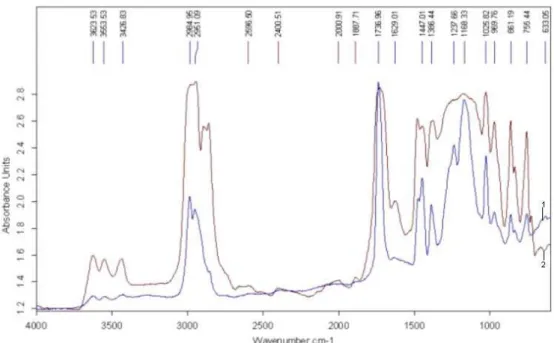
Comparing the spectral bands obtained (Fig. 4, Fig. 5 and Fig. 6) with those of reference materials [10, 11, 12] we identified the main component parts formed on the surface, forming a residual patina remaining after the cleaning operations.
Table 3. Representative peaks and spectral bands of the ions identified in the analyzed objects.
Ion Type Spectral bands (cm-1
) Peak present in
Analyzed objects (cm-1 )
Analyzed Object
724,83; 1041,14; 1377,26; 1466,94 B1, B2, B3
723,83; E4
833,47; 861,44; E1, E2, E3
1386,92; 1447,31 E1, E2, E3, E4
carbonate 670-745; 800-890;
1040-1100; 1320-1530
861,19; 1366,44; 1447,01; R1, R2
890,21; 1720,20; 1896,29; 2278,69; 2857,34; 2897,50
B1, B2, B3
1736,70; 1895,24; 2850,91 E1, E2, E3, E4
orto-phosphate dibasic or diprotic
830-920; 1600-1900; 2150-2500; 2750-2900;
1629,01; 1736,96; 1887,71; 2400,51 R1, R2
639,19 E4
sulphate 570-680; 960-1030
633,05; R1
964,40 B2
969,94; 1025,97 E1, E2,
cloride 610-630; 900-1050
969,76; 1025,82 R1, R2
tin 600-700 633,05 R1
silicate 860 – 1175 969,76; 1025,82; 1168,33 R1, R2
890,21 B1, B2, B3
833,47; 861,44 E1, E2, E3, E4
aluminate 800 – 920
861,19 R1, R2
2635,88; 2857,34; 2897, 50; 2931,03; 2956,19 B1, B2, B3 2951,79; 2984,95; 3256,40; 3431,99 E1, E2, E3, E4
2635,94; 2850,91; E4
acvo and hidroxo-complexes, water of coordination
2550-3500
2596,50; 2951,09; 2984,95; 3426,83 R1, R2
3605,61; 3876,15 B1, B2, B3
3504,22; 3605,33 E1, E2, E3, E4
Waters related physically 3500-4000
3553,53; 3623,53 R1, R2
The study analyzed the bracelets spectral bands and identified the presence of carbonate groups and alumininate in all, and for B2 bracelet there was chloride anion.
Fig. 4. The micro-FTIR spectra of the bracelet discovered in archaeological excavations in 2006 in Ibida: 1 – Bracelet of Necropolis sector, S2, square 3, M (grave 116), inv. 48290, (B1);
2 – Bracelet of Necropolis sector, S2, square 3, M (grave 116), inv. 48291, (B2); 3 - Bracelet of Necropolis sector, M1 (best western), inv. 48235, (B3).
- the earring E1, sulfates, chlorides and alumina; - the earring E2 chlorides;
- the earring E3, alumina.
Fig. 5. The micro-FTIR spectra of the earring discovered in archaeological excavations at Ibida: 1. Earring discovered in 2002, Necropolis, S3, M 18, 1 square, inv. 45843, (E1);
2. Earring discovered in 2001, Crypt (vault Tudorca), inv. 45844, (E2); 3. Earring discovered in 2001, Crypt (vault Tudorca), inv. 45845, (E3); 4. Earring discovered in 2006, Necropolis, S2, M 116, 3 square, inv. 48294, (E4).
Fig. 6. The micro-FTIR spectra of the ring discovere in archaeological excavations at Ibida: 1. Ring discovered in 2001, Curtin G, S1, square 6, inv. 45637, (R1);
A comparative analysis of FTIR spectra for the compounds in the surface layers of the rings investigated identified clusters characteristic spectral bands for carbonate, sulfate and aluminate in both rings. Moreover, in ring R1 there were tinned chloride anions and in R2 silicate.
Conclusions
In collating the results obtained by SEM-EDX analysis and micro-FTIR we can say definitely that the objects investigated are copper-based alloys, which suffered while a strong processes of segregation to the surface of active metals and the effects of degradation and deterioration of inward surface redox processes, acid-base and complexing monolithization aided by the inclusion of the elements of contamination. This demonstrates the considerable age of these pieces. The alloy composition indicated the indigenous ores from Altântepe-Dobrogea (România) and the ancient Greek ones. The presence of silver on the surface of the ring structures shows that R2 was subjected to a process of silvering.
The type of chemical compounds: oxides (CuO, Cu2O, Fe2O3, Fe3O4, SiO2, etc.), basic
hydrated carbonates (CuCO3.Cu(OH)2, CuSO4.3Cu(OH)6, etc.) chlorine compounds
(Cu2(OH)Cl3, CuCl2.3Cu(OH)2 etc.) formed from the alteration processes caused by the
surrounding environment [6, 7].
Acknowledgements
This work was possible with the financial support of the Sectorial Operational Programme for Human Resources Development 2007-2013, co-financed by the European Social Fund, under the project number POSDRU/89/1.5/S/61104 with the title „Social sciences and humanities in the context of global development - development and implementation of postdoctoral research”.
References
[1] D. Aparaschivei, Cercetările arheologice de la (L?)Ibida (Slava Rusă, jud. Tulcea), Sector
X (campania 2008) (I), Arheologia Moldovei, XXXII, 2009, pp.167-182;
[2] M. Quaranta, I. Sandu, On the Degradation Mechanisms under Infuence of Pedological Factors through the Study of Archaeological Bronze Patina, ”Al.I.Cuza” University Publishing House, Iaşi, 2010;
[3] M. Quaranta, I. Sandu, Microstratigraphy of copper-based archaeological objects: description of degradation mechanisms by means of an integrated approach, in
Proceedings of the ART 2008-9, Ed. ISAS, Jerusalem, Israel, (2008), Paper. no. 147, www.ndt.net/article/art2008/papers/147Quaranta.pdf.;
[4] I. Sandu, Degradation and Deterioration of the Cultural Heritage, Vol. I and II, ”Al.I.Cuza” University Publishing House, Iaşi, 2008;
[5] I. Sandu, N. Ursulescu, I.G. Sandu, O. Bounegru, I.C.A. Sandu, A. Alexianu, „The pedological stratification effect of corrosion and contamination products on byzantine bronze artefacts”, Corrosoon Engineering Science and Technology, Maney Publishing, vol. 43, 3, (2008), p. 256-266;
objects, in Proceding of 5th International Conference ARTCAST 2010 (Casting from rigor of technique to art), Galaţi University Press, Galati, 2010, pp. 7-19;
[7] I. Sandu, M. Quaranta, C. Bejinariu, I.G. Sandu, D. Luca., A.V. Sandu, Study on the specific effects of corrosion processes on ancient bronze artefacts, The Annals of “Dunărea de Jos” University of Galaţi, Fasc. IX Metalurgy and Materials Science, 1, 2007, p. 64-73;
[8] I.G. Sandu, S., Stoleriu, I. Sandu, M. Brebu, A.V. Sandu, Authentication of ancient bronze coins by the study of the archaeological patina. I. Composition and structure, Rev Chim (Bucharest), vol. 56, nr. 10 (2005), p. 981-994;
[9] I. Sandu, V. Vasilache, I.C.A. Sandu, M. Brânzilă, O. Mircea, „Archaeometric structures from ancient bronzes”, XVIIIe Colloque D'Archéométrie Du GMPCA, Liège, Belgique, 2011, p. 303;
[10] I. Sandu, C. Marutoiu, I.G. Sandu, A. Alexandru and A.V. Sandu, Authentication of Old Bronze Coins I. Study on Archaeological Patina, Acta Universitatis Cibiniensis Seria F, Chemia, 9(2006-1), pp. 39-53;
[11] K. Nakamoto, Infrared and Raman Spectra of Inorganic and Coordination Compounds, Parts A and B, John Wiley & Sons, New York, 1997;
[12] J. Coates, Interpretation of Infrared Spectra, A Practical Approach, Encyclopedia of Analytical Chemistry (Editor R.A. Meyers), John Wiley & Sons Ltd, Chichester, 2000, pp. 10815–10837;