Review Article
Copyright © 2015 Revista Latino-Americana de Enfermagem This is an Open Access article distributed under the terms of the Creative Commons Attribution Non-Commercial License (CC BY-NC).
This license lets others distribute, remix, tweak, and build upon your work non-commercially, and although their new works must also acknowledge you and be non-commercial, they don’t have to license their derivative works on the same terms.
Corresponding Author: Maria Juan-Porcar
Departament d’Infermeria. Universitat Jaume I Av. Vicent Sos Baynat, s/n
Facultat de Ciències de la Salut 12071, Castelló de la Plana, España E-mail: [email protected]
1 Doctoral student, Departament d’Infermeria, Facultat de Ciències de la Salut, Universitat Jaume I, Castelló, Spain. Associate Professor,
Departament d’Infermeria, Universitat Jaume I, Castelló, Spain.
2 MSc, Associate Professor, Departament d’Infermeria, Universitat Jaume I, Castelló, Spain.
3 PhD, Full Professor, Sección Departamenta de Enfermería, Universidad Autónoma de Madrid, Madrid, Spain.
Family care of people with severe mental disorders: an integrative
review
Maria Juan-Porcar
1Lledó Guillamón-Gimeno
2Azucena Pedraz-Marcos
3Ana María Palmar-Santos
3Objective: to analyze the scientific literature on home-based family care of people with severe
mental illness. Method: integrative review of 14 databases (CINALH, Cochrane Plus, Cuidatge,
CUIDEN, Eric, IBECS, EMI, ISOC, JBI COnNECT, LILACS, PsycINFO, PubMed, SciELO, and Scopus)
searched with the key words “family caregivers”, “severe mental illness”, and “home” between
2003 and 2013. Results: of 787 articles retrieved, only 85 met the inclusion criteria. The articles
appeared in 61 journals from different areas and disciplines, mainly from nursing (36%). The
countries producing the most scientific literature on nursing were Brazil, the UK, and the US,
and authorship predominantly belonged to university centers. A total of 54.12% of the studies
presented quantitative designs, with descriptive ones standing out. Work overload, subjective
perspectives, and resources were the main topics of these papers. Conclusions: the international
scientific literature on home-based, informal family care of people with severe mental disorder
is limited. Nursing research stands out in this field. The prevalent topics coincide with the
evolution of the mental health system. The expansion of the scientific approach to family care is
promoted to create evidence-based guidelines for family caregivers and for the clinical practice
of professional caregivers.
Descriptors: Nursing; Caregivers; Mental Disorders; Review.
Rev. Latino-Am. Enfermagem 2015 Mar.-Apr.;23(2):352-60
Introduction
Mental illnesses or disorders can be classiied into two major groups: common mental disorders (CMDs)
and severe mental illness (SMI)(1-3). CMDs are more
frequent and less disabling for individuals and are usually
treated by a single health care professional(1). SMIs are
more disabling and meet three conditions: (a) a medical
diagnosis that includes a psychotic disorder (excluding
organic) or certain personality disorder, b) a disease
and treatment duration greater than two years, and, (c)
the presence of disability, understood as moderate or severe dificulty with overall functioning (work, social, and family)(4). Examples of SMIs include schizophrenia,
bipolar disorder, delusional disorder, and schizoaffective
disorder.
Epidemiological data on the prevalence of SMI in the general population are dificult to obtain because of variability among information sources. However, the international scientiic community agreed that between 2.5 and 3% of the adult population presents
an SMI(1). The global disease burden from disability
attributable to mental, neurological and substance use
disorders reaches 14%(5). The economic cost of mental
disorders in countries with a market economy is close
to 3% of the GDP(6). The cost of mental disorders in the
European Union is estimated to range between 3 and
4% of the GDP(7).
During the history of humankind, the societal
treatment of individuals with SMI has included mainly
imprisonment in institutions, such as nursing homes
or mental asylums. This trend was reversed during
the second half of the twentieth century, a period in
international history that witnessed great changes
that enabled the integration of people with SMI into
society. According to the World Health Organization
(WHO), these changes included the discovery of new
drugs that permitted novel social interventions, the
rise of movements defending human rights, and the
incorporation of mental and social components into the deinition of mental health(8). This so-called psychiatric reform set aside the old model of asylum care and
emphasized a new model centered on community
mental health care(9-11). Furthermore, the development
of primary care driven by WHO in the Declaration of
Alma-Ata(12) gained renewed strength.
Gradually, people with SMI have been integrated
into society, meaning that the responsibilities of caring
for them have been transferred from institutions to the
community(13). Estimates indicate that between 40 and
90% of people who suffer from mental problems live
with or retain close contact with relatives(14). This new
model of community mental health care entails shared
care of the person with SMI. The agents in charge of
this care are health care professionals (formal care)
and family caregivers (informal care). Families take an
active role in caring for sick family members, making it
a workable and unavoidable remedy in the community
context(15-17).
A European study(18), which included 442 caregivers
of people with SMI, offers information on caregivers’ proiles, revealing the following data: caregivers are primarily women (73-88%), the mean age of caregivers
is 51-66 years, 21-84% of them live with the sick family
member, 25% work outside the home, 48-61% provide
care for longer than 10 years, and 13-48% devote a
minimum of 31 hours a week to care.
Changes from the model of asylum mental health
care to the community care model have impacts on
the service provided. People with SMI coexist mostly
with their family; thus, health professionals and family
members take care of them. Formal and informal shared
care is a key point in the positive development of the
individual in the community; for this reason, primary
health care professionals need informal caregivers.
The mental health nursing professional cares for the
individual with SMI with the help of the family caregiver.
Therefore, we ask ourselves the following question:
what do we know regarding home-based family care for
people with SMI? This is a reality that must be more
carefully examined, and such an examination is the
purpose of the present study.
Method
Using a qualitative approach, the present study analyzed the scientiic literature during the last decade on the home-based family care of people with SMI. The
implementation of the study involved an integrative
review of the literature using a process of systematizing
and analyzing results from independent studies aimed at
understanding a particular topic(19).
The following steps are required to complete
such a review (there are small variations among
different authors)(19-22): the selection of the research
The selection of the question resulted from the need to determine the scientiic literature on the home-based family care of people with SMI. The research was conducted
in February and March 2013, as part of a broader study on
the home-based family care of people with SMI.
The strategy for article identiication and selection consisted of searching for scientiic articles indexed in databases (DBs) from several ields of scientiic knowledge (nursing, psychiatry, psychology, and
education) in sources that were both statewide
(Cuidatge, CUIDEN, IME and ISOC) and international
(CINALH, Cochrane, Eric, IBECS, JBI COnNECT, LILACS,
PsycINFO and PubMed, SciELO, Scopus).
The search strategy was based on the appearance
of the key words “family caregivers,” “severe mental
illness”, and “home” in the title or abstract in searches
based on natural language (Spanish and English) and
controlled vocabulary (Health Sciences Descriptors,
(DeCS) and Medical Subject Headings (MeSH). The
searches were limited to the years 2003-2013 and the
following languages: Spanish, English, and Portuguese.
To meet the inclusion criteria, articles had to contain
the three combinations of key words, investigate a
population of legal age (at least 18 years of age), and
be written in any of the three languages listed. Articles
that did not meet the above criteria were excluded.
Once consensus was reached regarding the
relevant information from each article, researchers
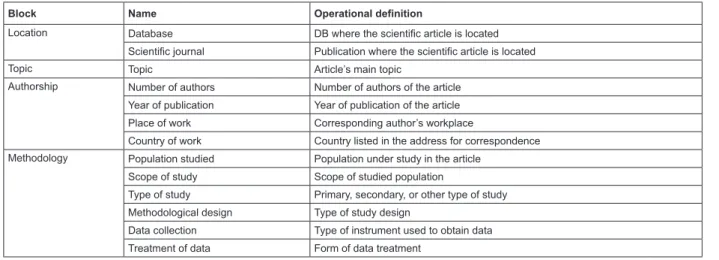
synthesized the information. The research variables and an operational deinition of the information gathered are presented in Figure 1. The variables are categorical/
qualitative and polytomous(23).
The articles were selected according to the inclusion criteria, and the research variables were deined through peer reviews. Next, the information was entered into a spreadsheet created speciically for the purpose. Discrepancies among the reviewers were resolved by
consensus. The gathered data were summarized in the
form of a frequency distribution and treated statistically
using a computer spreadsheet.
Block Name Operational definition
Location Database DB where the scientific article is located
Scientific journal Publication where the scientific article is located
Topic Topic Article’s main topic
Authorship Number of authors Number of authors of the article
Year of publication Year of publication of the article
Place of work Corresponding author’s workplace
Country of work Country listed in the address for correspondence
Methodology Population studied Population under study in the article
Scope of study Scope of studied population
Type of study Primary, secondary, or other type of study
Methodological design Type of study design
Data collection Type of instrument used to obtain data
Treatment of data Form of data treatment
Figure 1 - Relationship of variables investigated in scientiic articles. Castelló de la Plana, Spain, 2013
Results
The search strategy located 787 articles. Only 85 (10.80%) fulilled the inclusion criteria. The article distribution by DB is presented in Table 1. Of the 85
articles selected, only one (1.18%) appeared in three
DBs, eight (9.41%) were found in two DBs, and 76
(89.41%) occurred in only a single DB.
The DBs with the greatest precision and speciicity regarding the search strategy and inclusion criteria were
JBI COnNECT and Cochrane Plus, with 100 and 81.81%,
respectively, of detected articles selected. Overall,
33% of the articles detected by SciELO were selected,
followed by IBECS with 25.71%, CINAHL (12.82%),
Scopus (11.29%), LILACS (12%), PubMed (6.82%),
CUIDEN (5%), and Cuidatge (2.7%).
The selected articles were found in 61 scientiic journals covering different areas (health, social,
economic, and educational areas) and disciplines
(nursing, medicine, psychology, and sociology). There
were 22 (36%) nursing journals. Brazil with eight
journals was the country with the largest number,
followed by Great Britain with four and the US with three
Table 1 - Location of articles in the consulted DBs.
Castelló de la Plana, Spain, 2013
Database Detected articles
Selected
articles %
PubMed 381 26 30.59
Scopus 124 14 16.47
Cochrane Plus 11 9 10.59
IBECS 35 9 10.59
SciELO 27 9 10.59
LILACS 69 8 9.41
CINAHL 39 5 5.88
CUIDEN 40 2 2.35
JBI COnNECT 2 2 2.35
Cuidatge 37 1 1.17
ISOC 1 0 0
IME 0 0 0
PsycINFO 10 0 0
Eric 11 0 0
TOTAL 787 85 100%
In all, nine topics related to family caregivers were identiied based on the contents of the articles. These topics are presented in Table 2.
There were 20 (23.52%) articles written by three
authors, 15 (17.65%) by two authors, 13 (15.29%) by
four authors, 13 (15.29%) by more than six authors, 10 (11.76%) by ive authors, and seven (8.23%) by six authors as well as by a single author. Most of the articles
were published in 2012, 12 in total, followed by 2007
with 11 and 2010 with 10.
Note that only 38 (44.7%) articles were written by authors afiliated with educational institutions (universities), followed by nine (10.59%) articles written jointly by authors afiliated with educational institutions and hospitals. In 31 (36.47%) articles, no
data were found for this variable. The countries with the greatest scientiic contributions were Brazil, with
16 papers (18.8%); the US, with 15 (17.6%); Spain, with six (7%); and the United Kingdom, with ive (5.9%). When grouped by continent, America stands
out with 37 (43.6%) articles, followed by Europe with
21 (24.7%).
In 98.82% of the articles, the population studied
was represented by informal caregivers in their
community or place of residence. The individuals with
SMI were the subject of study in only 1.18% of the
cases. Even when caregivers were the only population
studied, as occurred in 57.64% of the papers, they were not the only subjects of study in this ield. Both family caregivers and people with SMI appeared in 35.3% of
the studies, whereas 3.53% of the articles focused on
both family and formal caregivers. Finally, 2.35% of the
articles analyzed focused on people with SMI along with
both types of caregivers.
Regarding the type of study, 71 (83.54%) of them
were primary, and seven (8.23%) were secondary.
The remaining articles dealt with the validation of
assessment instruments (7.06%) or provided no data
on the type of study (1.17%). Regarding methodological
design, 25 (29.42%) and 46 (54.12%) of the studies
presented qualitative and quantitative analyses,
respectively. The studies with qualitative methodology were classiied as follows: three (12%) ethnographic, seven (28%) phenomenological, ive (20%) grounded theory, one (4%) participatory action research, three (12%) biographical, and six (24%) unspeciied. Of the studies using quantitative methodology, eight (17.39%)
were randomized clinical trials, 31 (67.40%) were
descriptive, three (6.52%) used cohorts, one (2.17%)
was a case-control study, and three (6.52%) were
quasi-experimental papers.
Table 2 - Main topics in articles. FC represents family caregiver. Castelló de la Plana, Spain, 2013
Main topic Topics included (number of items)
Working overload 25 (29.5%)
Objective overload (15)
Subjective overload (2)
Assessment instruments (5)
Economic aspects (2)
Mental health models and impact on caregivers (1)
Subjective perspectives 15 (17.6%)
FC experiences (1)
FC perceptions (5)
Coping (2)
Perceived needs and shortcomings of the caregiver (2)
Needs of the caregiver assessed with instrument (1)
Caregiver expectations (2)
Use requirements or standards of mental health services (1)
FC perspective (1)
For data collection, 38.14% of the studies used
questionnaires; 37.11% used scales, and 12.37%
used semistructured interviews. Only 4.12% used
a DB for this purpose. The qualitative techniques
used in the remaining studies accounted for no more
than 4%, and 2.58% of the articles provided no data
collection information. The most commonly used data
treatments were univariate (28.57%) and bivariate
(27.82%) statistical tests, whereas content analysis and
multivariate analysis were used in 17.30 and 12.78% of
the studies, respectively. A total of 9.02% of the articles
provided no data.
Discussion
Integrative reviews constitute a type of research
that combines experimental and nonexperimental
approaches to achieve a complete understanding of the
phenomenon analyzed, integrating data from empirical
and theoretical literature(21). For the topic studied, this
type of research provides not only expanded knowledge
but also a state-of-the-art synthesis and the detection of
knowledge gaps for future analyses.
Investigating the scientiic literature related to home-based family caregivers of people with SMI requires
a multidisciplinary approach because of the involvement
of different areas and disciplines. Such an approach is
implemented by consulting different databases. In the
present study, consulting 14 multidisciplinary DBs allowed
for the retrieval of the maximum number of articles.
Additionally, by restricting the research scope to SMI
within the family home, only one-tenth of the retrieved
articles met the inclusion criteria (85 of 787 studies).
Focusing on home family care entails precise and speciic DB searches and the use of search strategies and inclusion criteria(24). In the present case, the DBs
were JBI COnNECT and Cochrane Plus, both crucial to
evidence-based clinical practice. Nonetheless, this study
should not obstruct further investigation into other
types of descriptive studies in different DBs(21) that
would advance the understanding of home-based family
caregiving for people with SMI.
The 85 scientiic articles retrieved were published in 61 different scientiic journals. Such a breadth of publications relects the importance of home-based care of people with SMI in both social and health disciplines.
The meticulous study of these publications showed
that more than one-third of the journals examined fell
within the scope of nursing knowledge. This constitutes a signiicant inding because the search strategy did not include such key words as “enfermería” (DeCS) and “nursing” (MeSH) and was not limited to databases speciic to the nursing discipline.
Of the 22 (100%) journals in the scientiic ield of nursing, 11 (50%) had an impact factor(25). This
fact shows that the home-based family care of people
with SMI is a topic of interest to both new nursing
researchers and nurses with a well-established
research trajectory.
More than half of the journals in the nursing ield were published on the American continent, followed
by Europe and Australia. The main editor country was
Brazil, followed by the United Kingdom and the US. A
study by Juve Udina et al.(26) on scientiic literature in
the ield of nursing states that Anglo-Saxon countries are the world’s largest producers of publications in this Main topic Topics included (number of items)
Resources 12 (14.1%)
New technologies (4)
Instruments/scales that help FC (1)
Program for SMI acute phase care (1)
Psychoeducational programs (2)
Breathing devices (3)
Support groups (1)
Formal/informal caregiver relationship 8 (9.4%)
FC as case manager (1)
FC as resource evaluator (3)
FC as formal caregiver’s informant (1)
FC as recipient of care (2)
FC and his or her perception of participation in the care (1)
Quality of life (8.2%) 7 Articles
FC profile (7.1%) 6 Articles
Sociocultural aspects (5.9%) 5 Articles
Health prevention/care (5.9%) 5 Articles
area (known as the Nightingale effect), and emerging
countries, particularly China, Taiwan and Brazil, take
second place (as an effect of economic development).
These results differ from those of the present study, possibly because of the speciicity of the topic researched. The aforementioned study(26) examines the
scientiic literature of nursing in general, whereas the present review is limited to that concerning the
home-based family care of people with SMI. In this sense,
Brazil could be the main producer of articles, particularly
because Brazil was implementing psychiatric reform
during the development of this study. By contrast, the absence of publications on this topic in speciic Asian countries, such as China and Taiwan, could point to a
different rate of evolution in mental health reform or
stem from the inclusion criteria used in the present
review.
There was a steady increase in the publication
of articles during the period under investigation,
presenting an upward trend from 2005 to 2012. Such
an increase could be due to the visibility of family care
and the evident need of joint work between health care professionals and informal caregivers in the ield of mental health. Formal and informal collaborative
work represents progress toward system sustainability.
Most articles on family care were written by several
authors, indicating that this topic has usually been
examined by teams. Furthermore, university centers
predominated in the publication of articles. However,
collaboration between authors from clinical and teaching
settings is becoming a reality. This pedagogical-clinical
collaboration is essential for obtaining the best evidence
and applying it to clinical practice.
The majority of articles analyzed here are primary
studies. These studies serve as a basis for future
research, including secondary research, which facilitates
data production for clinical practice. Research on the
home-based family care of people with SMI mainly
presented quantitative designs, relegating qualitative
methodology to the background. In addition, there was
a conspicuous lack of long-term studies (longitudinal
studies) that follow-up on family care and explore
its strengths and weaknesses to identify areas that
require improvement in the future. Given this inding,
the nature of nursing as a discipline should be reviewed
in the light of potential contributions from the use of
qualitative methodology. Providing care for individuals
in a holistic way requires qualitative research capable
of exploring the complexity and the sociocultural
context of the individual(23). For further understanding
on experiences related to family care, close attention
is required, and nursing professionals are fully trained
for this purpose. Qualitative methodology has the
potential to provide a better understanding of family
care practice(27).
For subject matter, the most studied topic was
work overload, particularly that of the family caregiver.
The concern for this topic may result from changes
internationally in the model of mental health care(11),
shifting from formal to informal care. In Spain, family
caregivers provide 88% of care, whereas formal
caregivers provide 12%(28-29).
Analyzing the subjective perspective of family
caregivers, the second most researched topic, allows
health professionals to gain a better understanding
of family care. As a result, this increased knowledge
can be used in the development of guidelines and training speciications for family caregivers, whether novice or not, of people with SMI in the family
home, thus applying research knowledge to clinical
practice. Different authors(14,30-32) have pointed to
the importance of analyzing caregiver perception in
evaluating the impact of family care and the positive
aspects of tending a family member. Expanding the
horizon of health care in nursing will bring a new
perspective focused on the positive aspects and
effects of home-based family care as well as on
well-researched negative aspects, such as caregiver
burnout(30,33). Additionally, more studies are needed
on burnout prevention and the maintenance of family
caregivers’ health(31).
Finally, regarding resources, the current study
demonstrated that articles analyzing the implementation of new technologies stand out in the mental health ield.
One limitation of this study is that international
variability in the meaning of the keyword home/hogar
interfered with the selection of articles by introducing
articles that did not correspond to the topic of study.
Differences between mental health systems and their
varied development in primary health care are additional
limitations that were encountered(11,34 ). Each country
presents different degrees of development regarding
health resources, despite the recommendations made
by international agencies.
The varied social, political, economic, and
developmental factors of health professions in each
country should be considered as well. These factors may
in turn inluence the scientiic literature. Finally, gray
literature (doctoral theses, unpublished reports, etc) on
Conclusions
The databases with greater experience in the ield hosted more articles on the topic of this study. Moreover, searching speciic databases in education, social sciences, or psychology did not contribute articles to this review.
A wide range of journals was sensitive to the subject
matter, and one-third of them belonged in the nursing ield. This fact shows the interest of nursing researchers in home-based family care of people with SMI. This
interest highlights the importance of care in nursing
science, and both new and experienced researchers should focus scientiic production on caregiving.
Primary research studies constituted much of the
research analyzed. In accordance with the prevailing
paradigm in health sciences, quantitative methodology
carried greater weight in this review.
Family overload was the topic most thoroughly
studied; nonetheless, research related to subjective
perspectives on family care and the professional
caregiver-family caregiver relationship was represented
in research regarding the home-based family care of
those with SMI. A more exhaustive understanding of
home-based family care of people with SMI—through
increased research in all disciplines—can facilitate the
documentation of progress and obstacles in family care
as well as the redirection of resources to better meet
the needs of the family caregiver of people with SMI.
Nursing professionals and formal caregivers who already
cater to informal caregivers or families—or those that
will increasingly be obligated to do so by mental health
reform—can apply this analysis in the development of
their clinical practice.
References
1. Ministerio de Sanidad y Consumo – MSC (ES).
Estrategia de Salud Mental del Sistema Nacional de
Salud. Madrid: Ministerio de Salud y Consumo; 2006.
2. Retolaza A. Trastornos mentales comunes: manual
de orientación. Madrid: Asociación Española de
Neuropsiquiatría; 2009.
3. Organización Mundial de la Salud (OMS). Carga
mundial de trastornos mentales y necesidad de que el
sector de la salud y el sector social respondan de modo
integral y coordinado a escala de país. Informe de la
Secretaría. Consejo Ejecutivo. Ginebra: Organización
Mundial de la Salud; 2011. [acesso em: 1 dez 2013].
Disponível em: http://apps.who.int/gb/ebwha/pdf_files/
EB130/B130_9-sp.pdf
4. National Institute of Mental Health (NIMH). Towards
a model for a comprehensive community based mental
health system. Washington (DC): National Institute of
Mental Health; 1987.
5. Organización Mundial de la Salud (OMS). mhGAP.
Programa de acción para superar las brechas en salud
mental. Mejora y ampliación de la atención de los
trastornos mentales, neurológicos y por abuso de
sustancias. Ginebra: Organización Mundial de la Salud;
2008. [acesso em: 1 dez 2013]. Disponível em: http://
www.who.int/mental_health/evidence/mhgap_spanish.
pdf?ua=1
6. Lehtinen V, Riikonen E, Lahtinen E. Promotion
of Mental Health on the European Agenda. Report.
Helsinky: Finnish Ministry of Social Affairs and Health,
Dpt. For Prevention and Promotion; 2000.
7. Comisión de las Comunidades Europeas (CCE). Libro
Verde. Mejorar la salud mental de la población. Hacia
una estrategia de la Unión Europea en materia de
salud mental. Bruselas: Comisión de las Comunidades
Europeas; 2005. [acesso em: 3 dez 2013]. Disponível
em: http://ec.europa.eu/health/ph_determinants/life_
style/mental/green_paper/mental_gp_es.pdf
8. Organización Mundial de la Salud (OMS). Informe
sobre la salud en el mundo. Salud Mental: Nuevos
conocimientos, nuevas esperanzas. Ginebra:
Organización Mundial de la Salud; 2001. [acesso em: 1
dez 2013]. Disponível em:
http://www.who.int/whr/2001/es/Índex.html
9. Organización Panamericana de la Salud (OPS).
Estrategia y plan de acción sobre salud mental.
Washington (DC) EUA: Organización Panamericana de la
Salud; 2009. [acesso em: 1 dez 2013]. Disponível em:
http://www2.paho.org/hq/dmdocuments/2009/SALUD_
MENTAL_final_web.pdf
10. Desviat M, Moreno A. La reforma psiquiátrica.
In: Desviat M, Moreno A. Acciones de salud mental
en la comunidad. Madrid: Asociación Española de
Neuropsiquiatría; 2012. p. 28-36.
11. Desviat M, Moreno A. Las reformas tardías. In: Desviat
M, Moreno A. Acciones de salud mental en la comunidad.
Madrid: Asociación Española de Neuropsiquiatría; 2012.
12. Organización Mundial de la Salud (OMS). Atención
Primaria de Salud: Informe de la Conferencia
Internacional sobre Atención Primaria de Salud,
Alma-Ata, URSS, 6-12 de septiembre de 1978. Ginebra:
Organización Mundial de la Salud, Serie Salud para
todos, nº1; 1978.
13. Mendiondo Osinaga VL, Ferreira Furegato AR, Ferreira
Santos JL. Users of three psychiatric services: profile and
opinion. Rev. Latino-Am. Enfermagem.
2007;15(1):70-7. doi: 10.1590/S0104-11692007000100011.
14. Salud Mental en Europa (Internet). Cuidadores y
familiares de las personas con problemas mentales. En:
Salud Mental en Europa. Políticas y prácticas. Líneas
futuras en Salud Mental [internet]. Barcelona: Ministerio
de Sanidad y Consumo, Observatorio del Sistema
Nacional de Salud de la Dirección General de la Agencia
de Calidad del Sistema Nacional de Salud; 2007; [acesso
em: 3 dez 2013]; p. 417-40. Disponível em: http://
www.msc.es/organizacion/sns/planCalidadSNS/pdf/
equidad/saludMentalEuropa.pdf
15. Fornés Vives J. Plan de cuidados de apoyo al cuidador
informal. In: Fornés Vives J. Enfermería de salud mental
y psiquiátrica: planes de cuidados. Madrid: Médica
Panamericana; 2005. p. 211-21.
16. Jorge MSB, Ramírez ARA, Lopes CHAF, Queiroz MVO,
Bastos VB. Representações sociais das famílias e dos
usuários sobre participação de pessoas com transtorno
mental. Rev Esc Enferm USP. 2008;42(1):135-42. doi:
10.1590/S0080-62342008000100018.
17. Silva MB, Sadigursky D. Representações sociais
sobre o cuidar do doente mental no domicílio. Rev Bras
Enferm 2008;61(4):428-34. doi:
10.1590/S0034-71672008000400005.
18. European Federation of Associations of Families of
People with Mental Illness (EUFAMI). The silent partners:
The needs of the caring family of people with a severe
mental illness. A European perspective. An overview of
the EUFAMI survey into carers’ needs. EUFAMI; 1996.
[acesso em: 3 dez 2013]. Disponível em: http://www.
eufami.org/images/eufami/main/file/silent_partners.
19. Ganong LH. Integrative reviews of nursing research.
Res Nurs Health. 1987;10(1):1-11.
20. Whittemore R, Knafl K. The integrative review:
update methodology. J Adv Nurs. 2005;52(5):546-53.
21. Mendes KDS, Silveira RCCP, Galvão CM. Revisão
integrativa: método de pesquisa para a incorporação de
evidências na saude e na enfermagem. Texto Contexto
Enferm. 2008;17(4):758-64. doi:
0.1590/S0104-07072008000400018
22. Souza MT, Silva MD, Carvalho R. Integrative review:
what is it? How to do it?. Rev Einstein. 2010;
8(1):102-6.
23. Salamanca Castro AB. El aeiou de la investigación en
enfermería. Madrid: FUDEN; 2011.
24. Rodríguez Yunta L. Evaluación e indicadores de
calidad en bases de datos. Rev Esp Doc Cient. 1998;
21(1):9-23. [acesso em: 21 jan 2014]. Disponível
em: http://redc.revistas.csic.es/index.php/redc/issue/
view/40
25. ISI Web of Knowledge [internet]. New York: Thomson
Reuters; 2013 [acesso em: 18 jan 2014]. Disponível
em: http://admin-apps.webofknowledge.com/JCR/JCR
26. Juvé Udina ME, Pastor Mailing L, Estrem Cuesta MM,
Blanco Aguilar C, Verge Monedero JM, Coiduras Charles
A, et al. ¿De qué se ocupan las enfermeras? Estudio
Transversal de la Producción científica Enfermera.
Nursing. 2011;29(10):56-9.
27. De La Cuesta Benjumea, C. El cuidado familiar:
una revisión crítica. Invest. educ. enferm [Internet].
2009;27(1):96-102. [acesso em: 21 jan 2014]. Disponível
em: http://www.scielo.org.co/scielo.php?script=sci_
arttext&pid=S0120-53072009000100010&lng=en&nrm
=iso
28. Megías-Lizancos F, Serrano Parra MD. Enfermería en
psiquiatría y salud mental. Madrid: DAE; 2002.
29. Sociedad Española de Salud Púbica y Administración
Sanitaria (SESPAS). Informe; 2002. Invertir para la
salud. Prioridades en salud pública. [acesso em: 18 jan
2014]. Disponível em: http://www.sespas.es/ind_lib06.
html
30. Schulz R, Sherwood PR. Physical and mental health
effects of family caregiving. Am J Nurs.
2008;108(9):23-7.
31. Rogero-García, J. Las consecuencias del cuidado
familiar sobre el cuidador: Una valoración compleja y
necesaria. Index Enferm. 2010;19(1):47-50. [acesso
em: 28 jan 2014]. Disponível em: <http://www.index-f.
com/index-enfermeria/v19n1/7060.php>
32. Caussa A. Formación y prácticas significativas.
Revista de Educación Social, 2011; julio 13: 1-14.
[acesso em: 31 jan 2014]. Disponível em: http://www.
33. Tweedell D, Forchuk C, Jewell J, Steinnagel L.
Families’ experience during recovery or nonrecovery
from psychosis. Arch Psychiatr Nurs. 2004;18(1):17-25.
34. Rodríguez J, González R, editors. La Reforma de
la Servicios de Salud Mental: 15 años después de la
Declaración de Caracas. Washington (DC): OPS; 2007.
331 p.
Received: May 2nd 2014