MUSCULARCYSTICERCOSIS: CASEREPORTANDIMAGINGFINDINGS
REV ASSOC MED BRAS 2016; 62(8):725-727 725
IMAGE IN MEDICINE
Muscular cysticercosis: Case report and imaging findings
NEIDE REGINA SIMÕES OLMO1,2*, ULYSSES FERREIRA FIORIO1, EDER AMARAL BASTOS3,4, MARCEL ANDREAZZA CLEMENTE5,
GUSTAVO GOMES MENDES6
1Radiology Trainee at Clínica Mult Imagem, Santos, SP, Brazil
2PhD in Sciences from Faculdade de Medicina da Universidade de São Paulo (FMUSP), São Paulo, SP, Brazil
3MD, Specialist Degree in Radiology and Diagnostic Imaging from Colégio Brasileiro de Radiologia e Diagnóstico por Imagem (CBR)/Associação Médica Brasileira (AMB), São Paulo, SP, Brazil 4MSc Student, Masters in Health and Environment from Universidade Metropolitana de Santos (Unimes), Santos, SP, Brazil
5Medical Coordinator at Clínica Mult Imagem, Santos, SP, Brazil
6Full Member of the Imaging Department at A.C.Camargo Cancer Center, São Paulo, SP, Brazil
S
UMMARYStudy conducted at Clínica Mult Imagem, Santos, SP, Brazil
Article received: 9/11/2015 Accepted for publication: 9/28/2015 *Correspondence: Address: Rua Victor de Lamare, 25 Santos, SP – Brazil Postal code: 11045-340 [email protected]
http://dx.doi.org/10.1590/1806-9282.62.08.725
Cysticercosis is a parasitic disease caused by a worm of the Cestoda class. The most prevalent form affects the nervous system. This case report is from a 78-year-old female patient evaluated at Clínica Mult Imagem, in the city of Santos, Brazil, who presented a form of the disease that differed from the classic neuro-cysticercosis, in this case muscular cysticercosis. This and other forms of mani-festation justify further studies to ensure adequate recognition, diagnosis and treatment of this parasitic disease.
Keywords: muscular cysticercosis, Taenia solium, Taenia saginata, parasitosis, hip arthroplasty.
INTRODUCTION
The incidence of cysticercosis in Latin America is high. The most prevalent clinical form is that with intracra-nial location.1 Due to migration lows, cysticercosis
transcends borders, invades systems, and reaches new territories.2
In the imaging service of Clínica Mult Imagem, lo-cated in the city of Santos, we are faced with a case of muscular cysticercosis.
This is a case report obtained from imaging studies performed in March 2015. A computed tomography (CT) scan subjected to analysis at Clínica Mult Imagem revealed the presence of numerous riziform calciications in mus-cle tissue of a patient.
Since this is not a form of cysticercosis prevalent in our country, we report this case for the purpose of study and image observation.
CASE REPORT
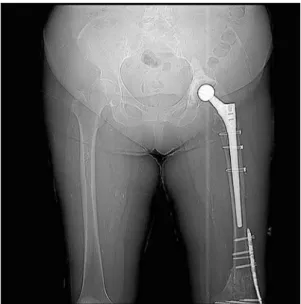
IRB, 78 years old, female, Brazilian, married, born in the São Paulo state capital, a resident of the city of Peruíbe, referred to Clínica Mult Imagem for a CT with complaint of pain in the topography of left femoral hip prosthesis. A mult-slice CT scan with image acquisition through volumetric sequences without intravenous contrast ad-ministration showed: “(...) Numerous foci of riziform
calciications (‘rice grains’) spread over all the muscle groups of the pelvis and thigh, leading to the main diag-nostic hypothesis of muscular cysticercosis (...)” (Figures 1, 2, and 3).
DISCUSSION
Teniasis and cysticercosis, although caused by a worm of the Cestode class, refer to different stages of the life cycle of these parasites. The worm that lodges in the small intestine of the deinitive host (human being) is the adult form of Taenia solium or Taenia saginata. Cysticercosis, in turn, is caused by the presence of the parasite in its larval stage in tissues of intermediate hosts (pork and cattle). In cysticercosis, man is an accidental intermediate host due to poor habits of hygiene, poor sanitation, and im-proper preparation and cooking of food.3
Clinical manifestations vary according to the affect-ed system. Regarding muscular cysticercosis, we can men-tion some signs/symptoms classiied in the literature as types: myalgia, appearance of nodules or pseudomasses, and muscle pseudohypertrophy.2
On X-ray, depending on the stage of the parasite, riziform calciications or a “starry sky” can be identiied.2
inlamma-OLMO NRS ETAL.
726 REV ASSOC MED BRAS 2016; 62(8):725-727
FIGURE 1 Panoramic X-ray showing numerous radiopaque riziform images in the soft tissues of the thighs.
FIGURE 2 Coronal view of multi-slice CT scan showing calcifications in the muscle groups of the thighs in more detail.
tory mass resulting from the larval death; 2. irregular cyst with minimal luid and indication of leakage, as well as scolex; 3. large irregular collection of exudative luid, with scolex within it, resembling an abscess; 4. calciied cysticerci, with the identiication of multiple elliptical calciications.8
On MRI, cysts can be described along the muscles’ ibers, presenting hyposignal on T1-weighted sequence, and hypersignal on T2-weighted sequences.2,7
CONCLUSION
Cysticercosis, as a subject, although linked to tropical medicine, reaches other regions due to migratory lows and cultural habits that arise from these lows, ceasing to be restricted to/exclusive of the poorest countries.
MUSCULARCYSTICERCOSIS: CASEREPORTANDIMAGINGFINDINGS
REV ASSOC MED BRAS 2016; 62(8):725-727 727
The image-based investigation plays a key role in cor-rect diagnosis.
RESUMO
Cisticercose muscular: relato de caso e aspectos de imagem
A cisticercose é uma parasitose causada pela classe Ces-toda. A forma mais prevalente acomete o sistema nervo-so. Este relato de caso, obtido da Clínica Mult Imagem, em Santos, é de uma paciente do sexo feminino de 78 anos que apresentou uma forma diversa de neurocisticer-cose, a muscular. Outras formas de manifestação da doen-ça, como a apresentada neste relato, justiicam a realiza-ção de mais estudos para assegurar o reconhecimento, o diagnóstico e o tratamento adequados dessa parasitose.
Palavras-chave: cisticercose muscular, Taenia solium,
Taenia saginata, parasitose, artroplastia de quadril.
REFERENCES
1. Vianna LO, Macedo V, Costa JM. Cisticercose musculo cutânea e Visceral – doença rara? Rev Inst Med Trop S Paulo. 1991; 33(2):129-36.
2. Liu H, Juan YH, Wang W, Liang C, Zhou H, Ghonge NP, et al. Intramuscular cysticercosis: starry sky appearance. QJM. 2014; 107(6):459-61.
3. Lino Jr RS, Reis MA, Teixeira VPA. Ocorrência de cisticercose (Cysticerus cellulosae) encefálica e cardíaca em necropsias. Rev Saúde Pública. 1999; 33(5):495-8. 4. Arriola CS, Gonzalez AE, Gomez-Puerta LA, Lopez-Urbina MT, Garcia HH,
Gilman RH. New insights in cysticercosis transmission. PLoS Negl Trop Dis. 2014; 8(10):e3247.
5. Chaudhary S. Cysticercosis of deltoid muscle. BMJ Case Rep. 2014; 2014:bcr2014204578.
6. Singh RP. Intramuscular cysticercosis – the solitary reaper. Ann Afr Med. 2014; 13(1):53-4.
7. Vijayaraghavan SB. Sonographic appearances in cisticercosis. J Ultrasound Med. 2004; 23(3):423-7.
8. Asrani A, Morani A. Primary sonographic diagnosis of disseminated muscular cysticercosis. J Ultrasound Med. 2004; 23(9):1245-8.