SUMMARY
Objective: To analyze the maternal mortality in the ABC Region, comparing indica-tors from the Committee for the Study of Maternal Mortality in the Great ABC Region (CEMM) of the II Regional Health Center of Santo Andre (DIR II), and the State Data Analysis System Foundation (SEADE). Methods: his is a cross sectional study. he information was obtained from the database of CEMM DIR II – Santo André, which includes data from seven counties of the ABC Region. We analyzed all deaths of child-bearing-age women that occurred from 1997 to 2005 in that region. he paired t test,
Wilcoxon and Kruskal-Wallis tests were used for statistical analysis. Results: here were diferences regarding the maternal mortality rates in the towns of Diadema, São Bernar-do Bernar-do Campo, Santo André and DIR II, with the coeicients calculated by CEMM being higher than those provided by the SEADE (p < 0.001). Concerning the towns of Mauá, Rio Grande da Serra, Ribeirão Pires and São Caetano do Sul, no signiicant diferences were observed between these two coeicients (p > 0.05), although the coeicients pro-vided by CEMM were higher than the coeicients obtained from SEADE. Conclusion: Our results demonstrate that the oicial data of maternal mortality in Brazil are still underestimated and point to the lack of healthcare quality during pregnancy, childbirth and postpartum.
Keywords: Mortality coeicient; mortality; maternal mortality; mortality registries; cross-sectional studies.
Study conducted at the Post-graduation Program in Health Sciences, Faculdade de Medicina do ABC (M.Sc. Dissertation), Brazil
Submitted on: 11/28/2010
Approved on: 05/25/2011
Correspondence to:
Lourdes Conceição Martins Rua Abraham Bloemaert, 126 Jd. das Vertentes São Paulo, SP, Brazil CEP: 05541-320 [email protected]
Conlict of interest: None.
©2011 Elsevier Editora Ltda. All rights reserved.
Maternal mortality proile in Great ABC Region from 1997 to 2005
SILVANA TOGNINI1, MARIA LÚCIA BUENO GARCIA2, ALFÉSIO LUÍS FERREIRA BRAGA3, LOURDES CONCEIÇÃO MARTINS4
1 Health Secretary of the State os São Paulo (SES-SP); Post-graduation Program in Health Sciences, Faculdade de Medicina do ABC (FMABC), São Paulo, SP, Brazil
2 Professor, Internal Medicine Clinic, Medical School, Universidade de São Paulo (USP); Post-graduation Program in Health Sciences, Medical School, USP; Environmental Epidemiology Study Center, Experimental Air Pollution Laboratory, Medical School, USP, São Paulo, SP, Brazil
3 Environmental Epidemiology Study Center, Experimental Air Pollution Laboratory, Medical School, USP; Environmental Exposure and Risk Assessment Group, Post-graduation Program in Collective Health, Universidade Católica de Santos (UNISANTOS), Santos, SP, Brazil
INTRODUCTION
Maternal mortality is a good indicator of the socioeconom-ic status of a country and the quality of life of its popula-tion. Worldwide, every minute a woman dies in childbirth or due to pregnancy-related complications and in Brazil this problem afects the several regions of the country dif-ferently1-3. A pregnant woman from a developing country
has a 100 to 200-fold higher risk of death due to pregnan-cy-related causes than another from a developed country4.
In 2000, the United Nations (UN) gathered world lead-ers from 192 countries and deined the Millennium De-velopment Goals, aiming at decreasing the socioeconomic inequality in 68 developing countries and among them, in Brazil. One of the main objectives of this program is the reduction in child mortality by two-thirds and maternal mortality by three-fourths in a 15-year period5.
According to the World Health Organization (WHO), approximately 585,000 women die annually worldwide due to complications related to pregnancy and childbirth and 95% of these deaths occur in developing countries4.
For the WHO, calculation of the maternal mortality rate must include only deaths that occur within the 42-day period ater the end of pregnancy. In Brazil, calculation of maternal mortality rate includes all deaths that occur during an 11-month and 29-day period ater the end of pregnancy1,4.
It was only ater the mid-80s that maternal mortality started to receive due attention as a public health problem in developing countries6. Brazil declared maternal
mortal-ity a priormortal-ity problem only in March 1994, as established by Law #663 of the Ministry of Health (MH)1.
In Brazil, the real magnitude of maternal mortality remains unknown and it is estimated that 5,000 deaths occur annually related to pregnancy-childbirth complica-tions, with mortality rates varying in diferent cities and states3,7,8.
It is believed that access to the healthcare system, prenatal care, assistance during childbirth and the pu-erperal period, well-equipped hospitals and a structured healthcare service would lead to a lower rate of mater-nal mortality1,3. Deicient prenatal care due to too few
consultations and/or patient low adherence to follow-up contribute to the lack of diagnosis of diseases that can ap-pear at the end of the pregnancy or have a late onset, thus increasing the risk of maternal death1,4,9,10.
Regarding the mortality rate in the city of São Paulo, it was veriied that most maternal deaths occur within the hospital environment and that most deliveries in the capital city of São Paulo State take place in private hos-pitals or those associated with health-insurance compa-nies11,12.
Maternal mortality ratio (MMR) is the ratio between the number of maternal deaths (direct and indirect ones) within a certain period of time and the number of live
births within the same period generally multiplied by 100,000 live births. Given the importance of this indica-tor (MMR), the Committee for Study of Maternal Mortal-ity of the ABC region (CEMM-ABC) was created, which included the seven cities that comprise the ABC region (Santo André, São Bernardo do Campo, São Caetano do Sul, Diadema, Mauá, Ribeirão Pires and Rio Grande da Serra). he committee objective was to identify all mater-nal deaths, construct a regiomater-nal MMR and indicate inter-vention measures to decrease maternal mortality1.
he CEMM-ABC developed its activities between 1997 and 2006 and during this period, it produced infor-mation on maternal mortality in the region in parallel to that routinely produced by the State Data Analysis System Foundation (SEADE)13.
he objective of the present study is to analyze the ma-ternal mortality situation in the ABC region through data produced by the CEMM-ABC and SEADE for the period of 1997 to 2005.
METHODS
his is a cross-sectional study, in which the information was obtained directly from the CEMM-ABC. All deaths of women (female population) of child-bearing age (10 to 49 years) that occurred from 1997 to 2005 in the Great ABC Region were analyzed.
CEMM-ABC collected the information on maternal mortality for the study period and used two distinct meth-odologies for that purpose. Between the years 1996 and 2000, death reports (DR) of women of child-bearing age were obtained directly from Civil Registry Oices in the Great ABC Region, and between 2001 and 2005, the DR were extracted from the SIM (Mortality Information Sys-tem) Database.
Other sources of information were used, such as the SEADE and IBGE (Instituto Brasileiro de Geograia e Es-tatística) databases, for comparison between the oicial sources and the CEMM-ABC research, in order to iden-tify the under-notiication of maternal deaths. CEMM-ABC obtained the information on live births directly from the Live Birth Information System (SINASC), to carry out the annual calculation of the MMR according to the MH standardization. he data obtained by the CEMM-ABC included all deaths of women that were found in death certiicates, which were individually veriied by the CEMM-ABC team. hat ensured a higher quality of these registries.
CEMM-ABC used research tools (questionnaires) rec-ommended by the Ministry of Health for home and hospi-tal visits (Manual of Maternal Morhospi-tality Committees of the Ministry of Health)1.
Data normality and homogeneity of variances were veriied by Kolmogorov-Smirnov and Levene tests, re-spectively14. To compare the variables that met these two
principles, paired t test was used; otherwise, Wilcoxon and Kruskal-Wallis tests were used, followed by Dunn’s mul-tiple comparisons14,15. he signiicance level was set at 5%.
Statistical package SPSS 17.0 for Windows was used for the statistical analysis.
his study was approved by the Ethics Committee of Faculdade de Medicina do ABC, under the No. 390/2007.
RESULTS
Signiicant diferences were observed between maternal mortality rates obtained by CEMM and SEADE in some municipalities of the Great ABC for the period 1997 to 2005. Following are the means ± standard deviations and ranges (minimum and maximum values) by obtained coeicient (CEMM and SEAD) for each municipality in the ABC region. For Diadema it was observed, by paired t test, that the maternal mortality rate obtained by CEMM (53.8 ± 24.5, ranging from 22.1 to 93.1) was sta-tistically higher than the coeicient obtained by SEADE (26.6 ± 11.6, ranging between 11.1 and 43.6) (p < 0.001). No diferences were observed in Mauá by Wilcoxon test between the maternal mortality rate obtained by CEMM (45.4 ± 26.2, ranging from 14.3 to 88.13) and SEADE (36.8 ± 16, 7, ranging from 0 to 50.4) (p = 0.08). Moreover, there were no signiicant diferences, by Wilcoxon test, between the maternal mortality rate obtained by CEMM (108.1 ± 106.5; ranging from 0 to 279.7) and SEADE (72.3 ± 108.1; ranging from 0 to 265.3) for the municipal-ity of Rio Grande da Serra (p = 0.15).
he same pattern is repeated for Ribeirão Pires, where there were no signiicant diferences (Wilcox-on test) between the maternal mortality rate obtained by CEMM (69.2 ± 59.4, ranging from 0 to 172.9) and SEADE (55.3 ± 37.9, ranging from 0 to 119.9) (p = 0.11).
As for the municipality of São Bernardo do Cam-po, by the paired t test, significant differences were observed between these two coefficients (p < 0.001), where the maternal mortality rate obtained by CEMM (41.5 ± 17.8, ranging from 14.4 to 64.6) was statisti-cally higher than the coefficient obtained by SEADE (19.8 ± 13.8, ranging from 0 to 43.1) (p < 0.001). This significant difference is also observed for the mu-nicipality of Santo André, where paired t test showed that the maternal mortality rate obtained by CEMM (54.9 ± 11.7, ranging from 30.6 to 71.7) was statistically higher than that obtained by SEADE (38.3 ± 18.1, rang-ing from 20.9 and 72.5) (p < 0.001).
In São Caetano do Sul there were no signiicant difer-ences between the two coeicients (CEMM: 39.4 ± 39.6, ranging from 0 to 114.0 and SEADE: 55.7 ± 52.6, ranging from 0 to 167.6) (Wilcoxon test, p = 0.08).
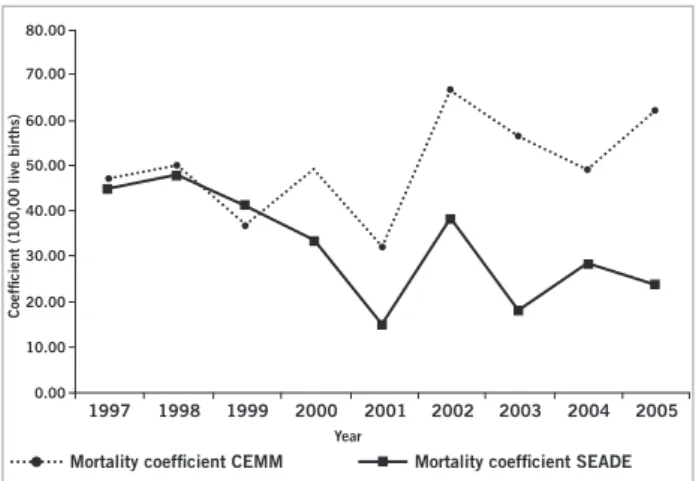
However, when one considers the region as a whole by the results obtained by DIR II, paired t test shows signiicant diference between the two maternal mortal-ity rates (p < 0.001). he coeicient obtained by CEMM (50.0 ± 10.6, ranging from 32.1 to 66.8) was statisti-cally higher than the coeicient obtained by SEADE (32.3 ± 11.4, ranging from 14.7 to 48.0).
Figure 1 presents the analysis of maternal mortality coeicients obtained by CEMM and SEADE for munici-palities of Diadema, Mauá, Rio Grande da Serra and Ri-beirão Pires in the period 1997 to 2005. Kruskal-Wallis test showed the years difered between them (p < 0.001) in Diadema, Mauá and Ribeirão Pires. Dunn’s multiple com-parison test showed that for the municipality of Diadema there was an increase of two maternal mortality coei-cients (CEMM and SEAD) in 2002 (p < 0.001) and 2005 (p < 0.001). As for the municipality of Mauá, we observed increases in the coeicients in 2000 (p < 0.001) and 2003 (p < 0.001). No increases in maternal mortality coeicients were observed for the municipality of Ribeirão Pires in 2002 (p < 0.001). For Rio Grande da Serra, no diferences were observed throughout the period (p > 0.05).
Figure 2 shows the maternal mortality coeicients obtained by SEADE and CEMM for Santo Andre, São Bernardo do Campo and São Caetano do Sul. Kruskal-Wallis test showed signiicant diferences for each of the coeicients throughout this period, for both São Bernardo do Campo and Santo André (p < 0.001). Dunn’s test showed that the municipality of São Bernardo do Campo had peaks in 1998 (p < 0.05) and 2002 (p < 0.001), where maternal mortality coeicients obtained by CEMM were always higher than those obtained by SEADE (p < 0.05). For Santo André, coeicient increases occurred in 2000 (p < 0.05) and from 2003 on (p < 0.05). In São Caetano do Sul, there were no signiicant diferences between the study years (Kruskal-Wallis, p > 0.05).
Figure 3 shows the maternal mortality coeicients ob-tained by CEMM and SEADE for DIR II, which includes all municipalities in the Great ABC Region for the study period. Kruskal-Wallis test showed signiicant diferenc-es between the coeicients that were accentuated during the period from the year 2000 on. In the series of data supplied by CEMM, 2002 was the year that presented the highest maternal mortality coeicient (Dunn’s test, p < 0.05).
DISCUSSION
Figure 1 – Maternal mortality coeficients (100,000 live births) for the towns of Mauá, Rio Grande da Serra, Ribeirão Pires and Diadema from 1997 to 2005.
Figure 2 – Maternal mortality coeficients (100,000 live births) for the towns of São Caetano do Sul São Bernardo do Campo, and Santo André from 1997 to 2005
Mortality coeficient CEMM Mortality coeficient SEADE
Mortality coeficient CEMM Mortality coeficient SEADE
1997 1998 1999 2000 2001 2002 2003 2004 2005
100.00
80.00
60.00
40.00
20.00
0.00
1997 1998 1999 2000 2001 2002 2003 2004 2005
300.00
250.00
200.00
150.00
100.00
0.00 50.00
1997 1998 1999 2000 2001 2002 2003 2004 2005
200.00 180.00 160.00 140.00 120.00 100.00 80.00 60.00 40.00 20.00 0.00
1997 1998 1999 2000 2001 2002 2003 2004 2005
100.00
80.00
60.00
40.00
20.00
0.00
Year
Year
Mauá
RP
SCS
RGS
Diadema
SBC
SA
Coeficient (100,000 live births)
Coeficient (100,000 live births)
1997 1998 1999 2000 2001 2002 2003 2004 2005
180.00
140.00 160.00
120.00
100.00 80.00
60.00 40.00
20.00
0.00
1997 1998 1999 2000 2001 2002 2003 2004 2005
70.00
60.00
50.00
40.00
30.00
0.00 20.00
10.00
1997 1998 1999 2000 2001 2002 2003 2004 2005
80.00
70.00
60.00
50.00
40.00
30.00
0.00 20.00
Figure 3 – Maternal mortality coeficients (100,000 live births) for DIR2 from 1997 to 2005.
of the deaths registries and review of several databases that contained the same information. hus, data from CEMM better relect the reality of maternal mortality in the stud-ied region.
CEMM-ABC developed a work that had a greater precision in MMR estimates for the region, which was accompanied every year and supplied annual reports to the managers, allowing a more intense work for maternal mortality prevention.
Maternal death in developing countries is a silent epi-demic and a public health problem, not only due to its magnitude, but because 90% of the causes of death dur-ing pregnancy and childbirth are preventable16.
In Brazil, maternal mortality has been a concern of health authorities, both at federal, state and munici-pal levels. According to the Ministry of Health, mater-nal mortality constitutes a violation of human rights of women and children, unequally afecting those from the lower social classes, with lower access to social beneits in the several Brazilian regions3,7,17,18. herefore, its more
accurate detection provides the rationale for intervention regarding this important health issue.
Estimates by the World Bank and WHO show that wide variations in maternal mortality are observed in de-veloping countries in diferent regions of the world and that it may vary from 1 to 15 up to 1 to 70 women of child-bearing age; in developed countries it ranges from 1 to 3,000 women to up to 1 to 10,0001.
According to the Millennium Development Goals es-timates, Brazil has reduced child mortality and maternal mortality rates by decreasing regional and socioeconom-ic inequalities in health, through publsocioeconom-ic healthcare poli-cies implemented in the last 20 years5,19.
he maternal mortality statistics are used in epidemi-ology and public health as an indicator of health status, in health program evaluations and population studies, in order to compare temporal trends and geographic dif-ferences. he main variable used in this statistic is cause
of death20. Research on maternal mortality should be
en-couraged, especially in developing countries, which have high mortality rates when compared with developed countries.
Childhood mortality has been used as an indicator of social and economic development for many years by diferent countries. his is considered a classic indicator of health. Maternal mortality, on the other hand, has not been duly recognized by the public and health authori-ties, despite the adverse conditions observed in the poor-est communities and even in certain poorer zones in de-veloped areas, such as metropolitan areas in the Brazilian southeast5.
To study maternal mortality rates and registries it is necessary not only to know about the potential risks of pregnancy, childbirth and puerperium, but also to learn about women’s health in general and their social and cul-tural status5,19,21.
According to Victora5, 10 years ater the start of
Mil-lennium Program several factors are determinants of ma-ternal and childhood mortality in developing countries. In his editorial, the author points out that developing countries follow Hartman’s proposal, where socioeco-nomic status is inversely proportional to the health needs of the population.
Death of women before, during and ater childbirth, due to direct or indirect causes related to pregnancy, represents a huge proportion of deaths among adults worldwide, especially in developing countries and among these, Brazil. Direct causes are related to obstetric deaths in pregnancy, childbirth and puerperium, caused by in-terventions, omissions, incorrect treatment or sequence of events resulting from any of these situations. Indirect deaths are those resulting from diseases that are present before or that develop during pregnancy and not due to direct obstetric causes, but which are aggravated by the physiological efects of pregnancy6,11.
Our results demonstrate that the oicial igures of maternal mortality in Brazil are still underestimated and point out the lack of healthcare quality received during pregnancy, childbirth and postpartum. his characteris-tic is common in developing countries, where pregnant women are most in need and have more diicult access to quality care6,21.
Knowledge of actual maternal mortality situation is necessary to ensure the government’s sensitization to pri-oritize integrated assistance to women’s health programs and to raise awareness among the population regarding the need for efective healthcare services and decrease in mortality rates.
Moreover, this study contributes to demonstrate the need for better discrimination and homogenization when obtaining actual health-related data in developing countries, such as Brazil.
Coeficient (100,00 live births)
1997 1998 1999 2000 2001 2002 2003 2004 2005
80.00
70.00
60.00
50.00
40.00
30.00
0.00 20.00
10.00
Mortality coeficient CEMM Mortality coeficient SEADE
REFERENCES
1. Brasil. Ministério da Saúde. Secretaria de Políticas de Saúde, Área Técnica de Saúde da Mulher. Manual dos Comitês de Mortalidade Materna. 2ª ed. Brasília (DF): Ministério da Saúde; 2002.
2. Tanaka ACA. Mortalidade materna: relexo da má qualidade e da desintegração dos serviços de saúde. J Rede Saúde 2000;20:5-8. 3. Laurenti R, Mello-Jorge MHP, Gotlieb SLD. A mortalidade materna
nas Capitais Brasileiras: algumas características e estimativa de um fator de ajuste. Rev Bras Epidemiol 2004;7(4):449-60.
4. OMS. Organização Mundial da Saúde. Classiicação Internacional de Doenças e de Problemas Relacionados à Saúde: décima revisão: manual de instrução. 7ª ed. São Paulo: Edusp; 2004. v. 2.
5. Victora CG. he millennium development goals and the inverse care law: no progress where it is most needed? J Epidemiol Community Health 2008;62(11):938-9.
6. Laurenti R. Mortalidade materna nos países subdesenvolvidos ou em desenvolvimento. Rev Assoc Med Bras 2002;48(1):1-25.
7. Martins AL. Mortalidade materna de mulheres negras no Brasil. Cad Saúde Pública 2006; 22(11):2473-9.
8. Melo ECP, Knupp VMAO. Mortalidade materna no município do Rio de Janeiro: magnitude e distribuição. Esc Anna Nery Rev Enferm 2008;12(4):773-9.
9. Calderon IMP, Cecatti JG, Vega CEP. Intervenções benéicas no pré- natal para prevenção da mortalidade materna. Rev Bras Ginecol Obstet 2006;28(5):310-5.
10. Nagahama EEI, Santiago, Silvia Maria. Cuidado pré-natal em hos-pital universitário: uma avaliação de processo. Cad Saúde Pública 2006;22(1):173-9.
11. Haddad N, Silva MB. Mortalidade feminina em idade reprodutiva no Estado de São Paulo, Brasil, 1991-1995: causas básicas de óbito e mortalidade materna. Rev Saúde Pública 2000; 34(1):64-70.
12. Luz AG, Tiago DB, Silva JCG, Amaral E. Morbidade materna grave em um hospital universitário de referência municipal em Campinas, Estado de São Paulo. Rev Bras Ginecol Obstet 2008;30(6):281-6. 13. SEADE - Fundação Sistema Estadual de Análise de Dados.
Institu-cional. 2010. [cited 24 Jun 2010]. Available at:http://www.seade.gov. br/master.php?opt=ins.
14. Callegari-Jacques, SM. Bioestatística: princípios e aplicações. Porto Alegre: Ed. ARTMED, 2003.
15. Siegel S. Estatística não paramétrica. São Paulo: McGraw-Hill do Brasil; 1981.
16. Oba MDV, Tavares MSG. Análise da mortalidade materna do muni-cípio de Ribeirão Preto - SP - no período de 1991 a 1995. Rev Latino-am Enferm 2001;9(3):70-6.
17. Rezende CHA, Moreli D, Rezende IMAA. Mortalidade mater-na em cidade de médio porte, Brasil, 1997. Rev Saúde Pública 2000;34(4):323-8.
18. Amaral E, Luz AG, Souza JPD. A morbidade materna grave na quali-icação da assistência: utopia ou necessidade. Rev Bras Ginecol Obs-tet 2007;29(9):484-9.
19. Bhutta ZA, Chopra M, Axelson H, Berman P, Boerma T, Bryce J et al. Countdown to 2015 decade report (2000-10): taking stock of ma-ternal, newborn, and child survival. Lancet 2010;375(9730):2032-44. 20. Laurenti R, Jorge MHPM, Gotlieb SLD. Mortalidade segundo cau-sas: considerações sobre a idedignidade dos dados. Rev Panam Sa-lud Publica 2008;23(5):349-56.