ANALYSIS OF THE INTERNATIONAL SCIENTIFIC
PUBLICATIONS ON STUTTERING
Análise da produção cientíica internacional sobre gagueira
Audrey Vendramini de Carvalho (1), Silvia Friedman (2)
(1) Speech Therapist; currently in Graduate School seeking Master’s Degree in Speech Pathology at Pontiical Catholic University of São Paulo – PUC-SP, São Paulo, SP.
(2) Speech Pathologist; Full Professor at Speech Pathology Graduate School at Pontiical Catholic University of São Paulo – PUC-SP, São Paulo/SP; PhD in Social Psychology by Pontiical Catholic University of São Paulo – PUC-SP, São Paulo/SP.
Support source: Scholarship CAPES Conlict of interest: non-existent
of exceptional growth in the production of publica -tions concerning stuttering, a ive-fold increase compared to the sum of the two prior decades; this kind of growth was not observed in other areas of Brazilian Speech Pathology.
Regarding the characteristics of this scientiic publications, the authors showed that most of the reports referred to issues related to clinical care; that the studies were distributed between the speech-pathology areas of Language and Oral Motricity, and the majority of works were produced in three epistemological paradigms: positivist, phenom-enological, and dialectical-historical. Based on this distribution, the authors discussed the complexity of stuttering.
In the international scenario, several authors, with backgrounds in speech pathology, medicine, and psychology, reviewed the scientiic knowledge published on stuttering. In the 2000’s there are a INTRODUCTION
In a preliminary study¹ of Brazilian scientiic reports on the subject of stuttering published between 1980 and 2008, a signiicant growth in production of articles, books, and book chapters was observed that correlated with other areas of Speech Therapy. This trend increased in the 90’s and it was also noticed that starting in 2000, there was a period
ABSTRACT
Purpose: to describe the international scientiic literature on stuttering published between 2005 and 2010. Method: selection and analysis of online, peer reviewed publications. The organized data
highlighted the following characteristics: 1) number of publications per period; 2) addressed themes; 3) epistemological afiliation of contributors; 4) methodological procedures, and 5) age group of the subjects studied. Results: 339 articles found in 76 journals were analyzed. The Journal of Fluency Disorders was the most frequent contributor (94;27.73%). Two themes stood out: Characteristics of Stuttering, with 150(44.25%) articles, and Treatment of Stuttering, with 106(31.27%) articles. The
research method most used was Survey (157; 46.31%). The majority of research featured the Positivist
(324;95.57%) paradigm. The most studied age group was Adult (174;45.31%). Conclusion: there is a discreet growth in studies about stuttering, mostly featuring the positivistic approach. A signiicant
development within the Positivistic studies is the emergence of studies that frame qualitative data in
a quantitative mode, supporting the view of stuttering as a multifactorial phenomenon. Many studies have further reined the identiication of aspects present in stuttering by distinguishing factors viewed simply as characteristic of stuttering from those viewed as possibly causative. Altogether, these indings endorse stuttering as a complex subject which poses a challenge to scientists, calling for new epistemological approaches in order to unveil these newly identiied distinctions. There is need for more research on stuttering for preventive health and wellness promotion, as well as studies using
Clinical Case Study as method of investigation, and also studies focused on adolescents.
large number of studies focused on the validation of experiences and protocols. Many of these works point to the best ways to measure evidence scientii -cally2-9. Besides those, additional studies questioned
the adequacy of a purely scientiic approach, in spite of its prestige, due to the multi-factorial nature of stuttering10-15.
Studies of published scientiic reports show that journals have become the main source of formal diffusion of Science and the very means through which knowledge is disseminated; hence, is essential for its growth16,17.
The value given to the published journals, whether in databases or in paper sources, is based on the fact that they are legitimatized by the process of peer evaluation that selects the work, validates the applied methodology and ensures the quality and signiicance of the information, which is submitted for review. This formalization process is oriented by the notion of improvement according to standardized quality criteria16-20. Thus, an eficient communication structure is consolidated through the exchange of specialized knowledge on a large scale, accelerating the study of this literature21-24.
Scientiic production studies facilitate the management of the abundant low of publications via analysis and sorting the points of convergence that articulate the produced knowledge, guided by principles of synthesis, organization and reference25. Therefore, scientiic production studies corre -sponding to different periods inform altogether how the network of knowledge on a subject developed up to its current coniguration20,24,25.
Regarding these points of convergence, of critical importance is the selection of themes to be grouped together within a speciic segment of publication, which allows one to observe the speciic path of the focus area, as well as the contrast between this path and that of related areas16,17.
In such a context, the purpose of this study is to describe the characteristics of the international scientiic production on stuttering, published in journals during the period between 2005 and 2010.
METHODS
This is a descriptive documentary study that examines articles on stuttering published in interna -tional journals available online, in the period from 2005 to 2010.
The adopted technique was the content analysis technique proposed by Bardin26, which allows the analysis of content of all kinds of messages (articles, books, memoranda, speeches, etc.) and is organized in three stages: (1) pre-analysis, (2)
exploration of the material, (3) treatment of results,
inference and interpretation.
In the pre-analysis of the available material phase, journals were surveyed in all the inter -national speech pathology databases available on the internet and also those related to speech pathology, namely: Linguistics, Education, Medicine and Psychology. The researched databases were: ERIC (Education Resources Information Center), PubMed/MEDLINE, PsycINFO and Scirus.
The consultation was made by means of an advanced form. On the item “word”, a search was made through the entries stuttering, stammering,
luency disorders, disluency and perseverations. In the item “language”, the search was made in English and in Spanish. Further, articles on speech luency disorders were selected.
With regard to the procedures for the exploration of the material26, indicators were set forth which guided the characterization of the documents. For that purpose, the analysis of the publications was organized starting from the distribution of their frequency, taking into consideration: the period of publication; the distribution frequency by period; the theme addressed; the methodological procedure; the epistemological approach to which they belong; the age groupof the studied subjects.
In order to organize the production around the thematic axes and the prevailing epistemological approaches, the articles were fully read.
The deinition of the thematic categories met the scope criteria so as to encompass the largest number of works in each of them1,16,17,23,27.
The thematic categories deined after initial evaluation26 were: Attitude towards Stuttering,
Assessment of Stuttering, Cause of Stuttering, Characteristics of Stuttering, Judgment of Stuttering, Spontaneous Recovery from Stuttering, Stuttering and Quality of Life, and Treatment of Stuttering.
The classiication by the epistemological approaches was based on the three paradigms deined in the ield of Scientiic Philosophy at the end of the 19th century, namely: Positivism, Phenomenology and Dialectical-Historical paradigms28. The positivist approach in the health
Regarding the age range, based on the production characteristics, ive groups were organized: Child;
Adolescent;Adult;Not-speciied and Not-Applicable.
As children were considered subjects up to 10 years and 11 months old; adolescents, subjects between 11 and 18 years old and adults, subjects above 18 years old29. The Not-speciied category includes
articles that do not mention the age of the subjects and the category Not-Applicable includes articles of the bibliographic review kind.
As regard to the methodological procedure, the articles were classiied as: Experiment, which refers to studies that show the inluence between variables; Survey, which refers to studies that describe events, aspects or characteristics chosen randomly or intentionally; Bibliographic Documentary Study, which addresses the research questions by means of a survey of the published scientiic literature or documents of medical records or anamnesis; Clinical Case Study, which refers to thorough empirical investigation of unique cases or few cases28.
For the treatment of the results, the data were organized in tables that show the frequencies of distribution of the listed variables (addressed thematic categories, epistemological afiliation of contributors, methodological procedures and age group). The data were statistically examined based on the chi-squared test (X2), taking 5% as signii -cance level.
RESULTS
From 2005 to 2010, 339 articles were found, distributed in 76 international scientiic journals available online.
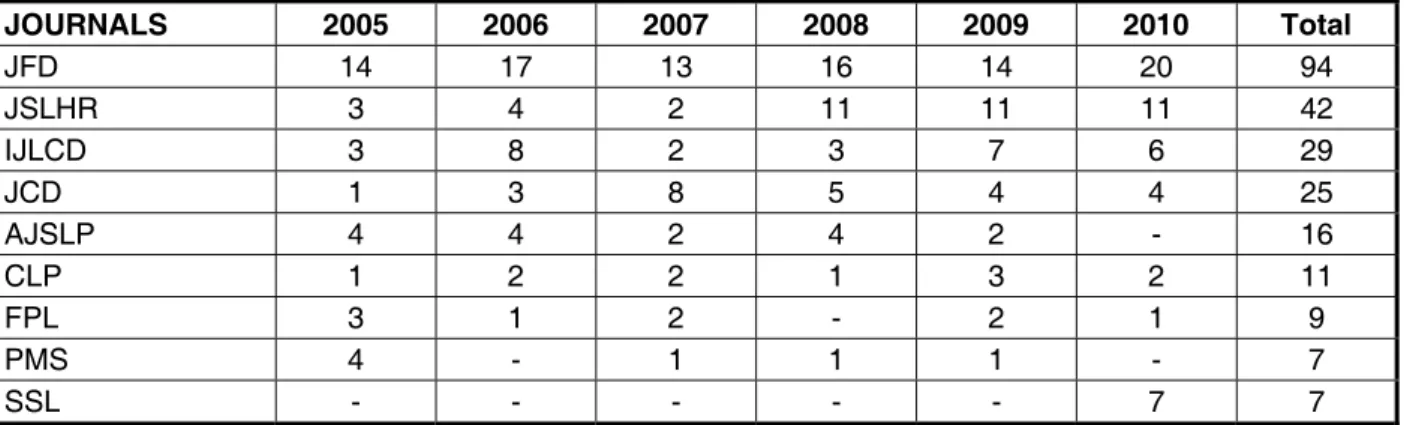
The distribution of the journals according to time, considering absolute numbers, showed a small growth of publications on stuttering between 2005 and 2010. The year 2010 produced the largest number of publications, 72 articles (21.22%) as compared to the other years. Most publications were found in Journal of Fluency Disorders, 94 articles (27.73%), which is specialized in stuttering, followed by Journal of Speech, Language and Hearing Research, 42 articles (12.39%), and in third place the International Journal of Language and Communication Disorders, 29 articles (8.55%). In order to make the statistical calculation signif-icant, journals with less than 9 articles, published throughout the studied period, were excluded, since the recursive partitioning of the chi-squared test showed this to be a good criterion to maximize the selected journals (Figure 1). Yet the growth of the research on stuttering along the studied period did not show a statistical signiicance (p-value=0.21). When using the linear regression method for the data studied by the chi-squared test, it is observed that there was an average growth of 2.7 publications per year (Figure 2). A Linear Regression Analysis using all the journals shows an average growth of 4.8 publications per year.
The distribution of the thematic categories in the journals showed that the main thematic categories were Characteristics of Stuttering, with 150 articles
(44.19%) and the Treatment of Stuttering, with 106
articles (31.25%), which are concentrated mainly in the above-mentioned journals. Given the number of null occurrences, only the ive irst journals were considered for the statistical calculation of the chi-squared test (Figure 3). The difference in the distribution of the categories shows a statistical signiicance (p-value = 0.0007).
JFD= Journal of Fluency Disorders; JSLHR= Journal of Speech, Language and Hearing Research; IJLCD= International Journal of Language & Communication Disorders; JCD= Journal of Communication Disorders; AJSLP= American Journal of Speech-Language Pathology; CLP = Clinical Linguistics and Phonetics; FPL= Folia Phoniatrica et Logopaedica; PMS= Perceptual and Motor Skills; SSL= Seminars in Speech and Language.
Figure 1 – International scientiic publications on stuttering by period (2005 – 2010): distribution of the main journals publishing.
JOURNALS 2005 2006 2007 2008 2009 2010 Total
JFD 14 17 13 16 14 20 94
JSLHR 3 4 2 11 11 11 42
IJLCD 3 8 2 3 7 6 29
JCD 1 3 8 5 4 4 25
AJSLP 4 4 2 4 2 - 16
CLP 1 2 2 1 3 2 11
FPL 3 1 2 - 2 1 9
PMS 4 - 1 1 1 - 7
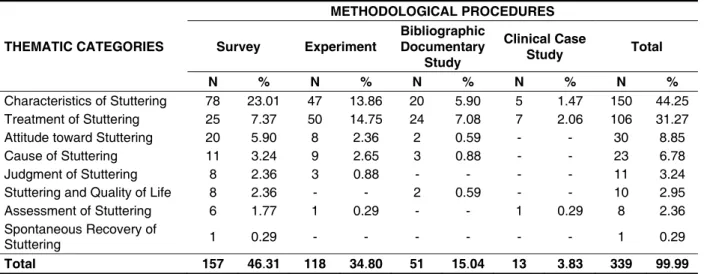
By comparing the thematic categories with methodological procedures (Table 1), Survey is the most frequently used procedure in research, 157 articles (46.31%), followed by Experiment, 118 articles (34.8%). In view of the number of null occurrences, the statistical calculation considered only the four irst categories and excluded the procedure Clinical Case Study. The difference in the distribution of methodological procedures has a statistical signiicance (p-value=0.0002).
Most publications were developed within the
Positivistic paradigm, 324 articles (95.57%).
This preponderance does not offer a base for the chi-squared test that, basically, compares proportions. Thus, the distribution of the thematic categories among the positivistic articles is shown by means of Figure 4.
Figure 2 – Number of publications per year: linear regression of Table 1 data after chi-square analysis
(1) JFD= Journal of Fluency Disorders; JSLHR= Journal of Speech, Language and Hearing Research; IJLCD= International Journal of Language & Communication Disorders; JCD= Journal of Communication Disorders; AJSLP= American Journal of Speech-Language Pathology; CLP = Clinical Linguistics and Phonetics; FPL= Folia Phoniatrica et Logopaedica; PMS= Perceptual and Motor Skills; SSL= Seminars in Speech and Language.
(2) Assess. = Assessment of Stuttering; Attit. = Attitude toward Stuttering; Charact. = Characteristics of Stuttering; Cause = Cause of Stuttering; Judg. = Judgment of Stuttering; Q. L. = Stuttering and Quality of Life; Rec. = Spontaneous Recovery of Stuttering; Treat. = Treatment of Treatment.
Figure 3 – international scientiic publications on stuttering (2005 – 2010): distribution of the main
journals within thematic categories
JOURNALS (1)
THEMATIC CATEGORIES (2)
Charact. Treat. Attit. Cause Judg. Q. L. Assess
. Rec. Total
JFD 37 28 14 7 1 5 1 1 94
JSLHR 16 15 2 5 13 - 1 - 52
IJLCD 2 18 4 - 1 1 3 - 29
JCD 13 4 3 2 1 2 - - 25
AJSLP 1 7 3 1 1 - 3 - 16
CLP 9 - - 1 1 - - - 11
FPL 3 3 - 1 1 1 - - 9
PMS 1 5 - 1 - - - - 7
By comparing the thematic categories with age groups (Table 2), the most researched group was
Adult, 174 articles (45.31%), followed by Child, 120 articles(31.25%). Due to the same reasons explained above, the statistical calculation shows that there is no signiicance in this distribution (p-value=0.27).
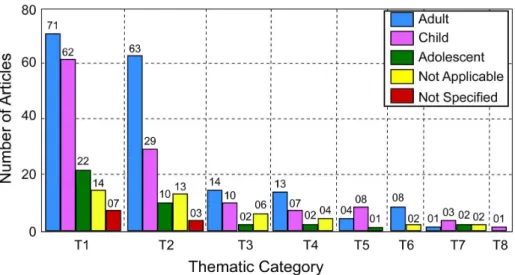
For a better visualization of this distribution Figure 5
was designed, which shows the preponderance of adults in the majority of the thematic categories and also that, in the categories Judgment on Stuttering
and Assessmentof Stuttering, in spite of the small number of studies, the preponderance was of children.
Table 1 – International scientiic publications on stuttering (2005 – 2010): Distribution of thematic
categories according to methodological procedures
X2 = 26.6
degrees of freedom = 6 p-value = 0.0002 (< 0.05)
T1 = Characteristics of Stuttering; T2 = Treatment of Stuttering; T3 = Attitude toward Stuttering; T4 = Cause of Stuttering;
T5 = Judgment of Stuttering; T6 = Stuttering and Quality of Life; T7 = Assessment of Stuttering; T8 = Spontaneous Recovery of Stuttering.
Figure 4 – Distribution of positivistic articles into thematic categories THEMATIC CATEGORIES
METHODOLOGICAL PROCEDURES
Survey Experiment
Bibliographic Documentary
Study
Clinical Case
Study Total
N % N % N % N % N %
Characteristics of Stuttering 78 23.01 47 13.86 20 5.90 5 1.47 150 44.25
Treatment of Stuttering 25 7.37 50 14.75 24 7.08 7 2.06 106 31.27
Attitude toward Stuttering 20 5.90 8 2.36 2 0.59 - - 30 8.85
Cause of Stuttering 11 3.24 9 2.65 3 0.88 - - 23 6.78
Judgment of Stuttering 8 2.36 3 0.88 - - - - 11 3.24
Stuttering and Quality of Life 8 2.36 - - 2 0.59 - - 10 2.95
Assessment of Stuttering 6 1.77 1 0.29 - - 1 0.29 8 2.36
Spontaneous Recovery of
Stuttering 1 0.29 - - - 1 0.29
Figure 6 shows the increase of research on
Treatment of Stuttering for children and adults over time. It shows that in 2006 the studies with adults were more than the double of that with children
and that in the following year, 2007, in anapparent compensation, the publications with children outnumbered those with adults.
Table 2 – International scientiic publication on stuttering (2005-2010): Distribution of thematic
categories according to age groups
X2 = 11.1
degrees of freedom = 9 p-value = 0.27(> 0.05)
T1 = Characteristics of Stuttering; T2 = Treatment of Stuttering; T3 = Attitude toward Stuttering; T4 = Cause of Stuttering; T5 = Judgment of Stuttering; T6 = Stuttering and Quality of Life; T7 = Assessment of Stuttering; T8 = Spontaneous Recovery of Stuttering.
Figure 5 – Distribution of thematic categories by age groups THEMATIC CATEGORIES
AGE GROUPS
Adult Child Not
Applicable Adolescent Not-Specified Total
N % N % N % N % N % N %
Characteristics of Stuttering 71 18.49 62 16.15 14 3.65 22 5.73 7 1.82 176 45.83
Treatment of Stuttering 63 16.41 29 7.55 13 3.39 10 2.60 3 0.78 118 30.73
Attitude toward Stuttering 14 3.65 10 2.60 6 1.56 2 0.52 - - 32 8.33
Cause of Stuttering 13 3.39 7 1.82 4 1.04 2 0.52 - - 26 6.77
Judgment of Stuttering 4 1.04 8 2.08 - - 1 0.26 - - 13 3.39
Stuttering and Quality of Life 8 2.08 - - 2 0.52 - - - - 10 2.60
Assessment of Stuttering 1 0.26 3 0.78 2 0.52 2 0.52 - - 8 2.08
Spontaneous Recovery of
Stuttering - - 1 0.26 - - - 1 0.26
Figure 6 – Number of Publications (2005 – 2010) on treatment of stuttering: comparison between
adult and child age groups
DISCUSSION
Our analysis of publications on stuttering revealed several emergent trends that characterize the growth in this ield of speech pathology. Considering the international scientiic literature, articles on stuttering were more frequently distributed in the journal specialized in speech luency disorders, as expected, followed by journals dedicated to language disorders. Further interest for the subject was shown, dispersed mainly throughout medical journals, consistent with the understanding that stuttering is considered to be primarily an organic disorder from the etiological point of view.
We found there was a very discreet – yet effective – growth in international production of stuttering articles, of about 2 to 4 per year during in the six years here researched (2005 to 2010) (Figure 2). This differs from the results of a Brazilian article1 that investigated the period from 1980 to 2008 and which showed that the greatest growth had happened in the 21st century.
Publications in the categories Characteristics of Stuttering and Treatment of Stuttering were the most
frequent,and overall stressed the importance that a clinic, in order to be effective, needs homogeneity and co-variance among its four elements, namely: semiology, etiology, diagnostics and therapeutics30. Thus, in a general sense, the majority of publica-tions concerning the study of stuttering charac-teristics and its treatment emphasize the intent in building a consistent clinical perspective focused on the problems of speech luency.
Characteristics of Stutteringstands out as to the most frequently researched category, represented in
150 articles, of which one third, 51 articles (34%) are focused on the neurological characteristics; then 40 articles (26.66%) which focused on linguistic charac -teristics;20 articles (13.33%) relating to speech; 14 articles (9.33%) with a psychological or 10 articles (6.66%) with a genetic focus, with the remaining 16 articles (10.66%) spread among the other types of characteristics. Our indings differ greatly from the previous Brazilian study, in which the category
Characteristics of Stuttering, as a whole, was the
least frequent, with only 6publications among the 131 surveyed.
Treatment of Stuttering was the second most
frequent category, present in 106 articles. The largest group of these studies with 40 articles (37.73%) referred to the behavioral approach, basically describing strategies for luency modeling. Most of these strategies concerned training for the control of stuttering intensity and frequency. Examples of these training proposals were the following: the
Lidcombe Program, the Camperdown Program,
Coordinated Interpersonal Timing, Demand and Capacities Model, and Comprehensive Approach. In second place, the studies referred to the use of
technological resources, 25 articles (23.58%). These resources discussed the effectiveness of using support devices to increase speech luency, with special emphasis on auditory feedback prosthetic devices: Altered Auditory Feedback (AAF); Delayed Auditory Feedback (DAF); Frequency Altered Feedback (FAF), and Masking Auditory Feedback
(MAF). In the Brazilian study the category Treatment of Stuttering, referred to by the authors¹ as Speech Pathology Clinic, was the most frequent, found in 69
although the types of treatment were not detailed by the authors. Within the category Treatment of Stuttering, 21 articles (19.89%) focused on the
importance of measuring the eficacy of the treat -ments. This portrays a very current trend: to base the treatment on the results of evidence after data analysis. The Brazilian study did not refer to any articles of this nature.
Remarkably, in two of the main categories,
Characteristics of Stuttering, 150 articles (44.25%)
and Cause of Stuttering, 23 articles (6.78%),
the understanding of stuttering was based on its linguistic, neurological, psychological, and genetic aspects. Such aspects were assumed either a cause, or a characteristic of the stuttering, with the latter prevailing. This assumption seems consistent with the lack of deinition observed in the scientiic literature concerning the exact origin of stuttering. In considering the purpose of different types of scientiic research – descriptive, exploratory, and explanatory, the last two are the most compro -mising for the researcher, because they permit disagreements and controversies. In contrast, with descriptive research, as the name itself denotes, the study is limited to simply describe the object of the investigation without conjecture29. Hence, the
inter-pretation still remains a choice of the researcher. The majority of researchers chose to interpret the above aspects as characteristics of stuttering, and a minority explicitly took them as being its cause.
When the different thematic categories are evaluated for trends corresponding to the age of affected individuals, there is preponderance of studies on the Characteristics of Stuttering (150) in adults, 71 articles (47.33%). Although there are more studies with adults than with children, 62 articles (41.33%), both age groups were largely explored, showing great interest of researchers on them. It is possible that the prevalence of studies with adults stems from the fact that in this age group there are more options for controlling the variables.
When the Treatment of Stuttering category is evaluated across different age groups, the authors frequently question, in cases of research with children, whether good results were due to the treatment or to a spontaneous recovery. This makes it dificult to determine accurately the effectiveness of the treatment. With the adults, the conclusions were more often correlated with the eficacy of treatment, consistent with the greater number of adult studies. The number of articles about adults revealed a tendency to consistently increase after 2007 (Figure 6), while those with children were generally half as frequent, more variable and did not show a steady increase. This is consistent with the fact that
it is easier to control variables in the research with adults.
Among the methodologies used, Survey and
Experiment stand out as the most frequent. These
studies are generally made with large or sample populations and, therefore, the results permit a greater degree of generalization. Signiicantly less frequent, the Clinical CaseStudy is performed with
few subjects and leads to uniqueness. This suggests that the researchers have been more concerned aboutproducing knowledge that may be generalized towards the purpose of reaching a consensus about the origin and the nature of stuttering that would guide and facilitate the research progress for an eficient treatment.
The prevalence of the Positivist epistemo-logical paradigm, 320 articles (94.37%) shows that stuttering has been preferably studied from the organic and quantitative point of view. Such preva -lence aligns the analyzed publications on stuttering within the worldwide hegemonic approach in health science, as the researcher updated with the scien -tiic publications in this ield can easily verify. As it can be understood, this is the consequence of the preponderance of the positivistic point of view either in the academic training of the researchers,either in theproile ofarticles preferably accepted for publi-cation by theeditorial boards, both at domestic and international levels.
As an illustration of the impact of this, the publi-cations of 2010 (72 articles) display a prominent number of studies (28) pointing out the importance of conceiving stuttering in a holistic or multifactorial perspective, by considering its relation with issues of psychological, cultural, and social nature. However, this required the development of instruments to examine the qualitative data in a quantitative manner, that is, based on the positivistic pattern. These research efforts focused on aspects such as: the satisfaction of the client; the importance of the client’s perception of the healing; the basis of the
stutterer’s identity; andthe importance of the thera-peutic alliance to obtain the best evidence of results. It was also noted that the studies that quantify quality measures had increased. It is valid to ask if the quantiication of qualitative data will allow a more formal understanding of the holistic aspects of stuttering. Clearly, the observed increases in knowledge about the nature of stuttering emphasize the need for changes in the paradigms regarding its treatment.
In this sense, the low frequency of articles in the Phenomenological and Dialectical-Historical
non-hegemonic perspectives in future studies may shed light on unsolved aspects on the origin, nature and treatment eficacy of stuttering.
CONCLUSION
In absolute numbers, the survey and the charac-terization of the international scientiic production on stuttering, between the years 2005 and 2010, has shown a discreet growth. From the epistemological point of view, this increase is prevailingly within the scientiic positivistic paradigm.
Our analysis revealed several themes in the stuttering literature. The Positivistic approach produces scientiic studies that attempt to quantify qualitative data in order to frame stuttering as a multifactorial phenomenon. Linguistic, neurological, psychological, and genetic aspects of stuttering are sometimes interpreted as characteristics and other times as causes. Finally, exponents of the Phenomenological and Dialectical-Historical
paradigms persist in the literature. Collectively,
these themes point to: 1. the complexity of stuttering; 2. the challenge that understanding stuttering has represented to researchers; and 3. the need to seek new epistemological paths to decipher it.
Furthermore, as noted in a prior Brazilian analysis, there is a deicit of studies on preventive medicine, publications featuring clinic case studies, and also studies focused on adolescents.
We hope that these aspects may guide the decisions about future research concerning stuttering.
ACKNOWLEDGEMENTS
Profa. Dra. Maria Isis Marinho Meira (MS Examining Committee Member – PUC/SP)
Profa. Dra. Emilse Aparecida Merlin Servilha (MS Examining Committee Member –PUC/ Campinas)
Coordination for the Improvement of Higher Education Personnel (CAPES)
RESUMO
Objetivo: descrever as características da produção cientíica internacional sobre gagueira publicada em periódicos no período entre 2005 e 2010.Métodos: pesquisa documental em que se analisa -ram artigos online, considerando-se: 1) distribuição da frequência por período; 2) temática; 3) vertente
epistemológica; 4) procedimento metodológico; 5) faixa etária. Resultados: foram analisados 339 arti -gos, distribuídos em 76 revistas, estando a maioriano Journal of Fluency Disorders (94;27,73%). As
temáticas mais frequentes foram: Características da Gagueira (150;44,25%) e Tratamento da Gagueira (106;31,27%). O método de pesquisa mais utilizado foi Levantamento (157;46,31%). A
maioria das pesquisas pertenceu à vertente Positivista (324;95,57%). A faixa etária mais estudada foi Adultos (174;45,31%). Conclusão: a produção internacional sobre gagueira apresenta crescimento discreto. Prepondera o paradigma Positivista. Dois fatos chamam atenção nos estudos positivistas: a emergência de pesquisas que quantiicam aspectos qualitativos para olhar a gagueira como fenô -meno multifatorial; os mesmos aspectos sendo tratados ora como característica, ora como causa da gagueira. Conjuntamente, esses fatos apontam para a complexidade do tema e para o desaio que a compreensão da gagueira tem representado aos pesquisadores, o que pode indicar a necessidade de se buscar novos caminhos epistemológicos para decifrá-la. Faltam pesquisas sobre prevenção e promoção de saúde; delineamentos de Estudo de Caso Clínico, e estudos sobre adolescentes. DESCRITORES: Gagueira; Fonoaudiologia; Indicadores de Produção Cientíica
REFERENCES
1. Damasceno W, Friedman S. Análise da produção cientíica fonoaudiológica nacional sobre gagueira. Rev. CEFAC, 2011 Jan-Fev;13(1):41-7.
2. Block S, Onslow M, Packman A, Dacakis G. Connecting stuttering management and
measurement: IV. Predictors of outcome for a behavioural treatment for stuttering. [periódico online]. Int J Lang Comm Disord. 2006 Jul-Aug;41(4):395-406.
quality assessment of pharmacological approaches. [periódico online]. Am J Speech Lang Pathol. 2006 Nov;15(4):342-52.
4. Bothe AK, Davidow JH, Bramlett RE, Ingham RJ. Stuttering treatment research 1970-2005: I. Systematic review incorporating trial quality assessment of behavioral, cognitive, and related approaches. [periódico online]. Am J Speech Lang Pathol. 2006 Nov;15(4):321-41.
5. Cook F, Fry J. Connecting stuttering measurement and management: III. Accountable therapy. [periódico online]. Int J Lang Comm Disord. 2006 Jul-Aug; 41(4):379-94.
6. Onslow M. Connecting stuttering management and measurement: V. Deduction and induction in the development of stuttering treatment outcome measures and stuttering treatments. [periódico online]. Int J Lang Comm Disord. 2006 Jul-Aug; 41(4):407-21.
7. Shenker RC. Connecting stuttering management and measurement: I. Core speech measures of clinical process and outcome. [periódico online]. Int J Lang Comm Disord. 2006 Jul-Aug;41(4):355-64. 8. Onslow M, Jones M, O’Brian S, Menzies R, Packman A. Deining, identifying, and evaluating clinical trials of stuttering treatments: a tutorial for clinicians. [periódico online]. Am J Speech Lang Pathol. 2008 Nov;17(4):401-15. Epub 2008 Oct 7. 9. Prins D, Ingham RJ. Evidence-based treatment and stuttering-historical perspective. [periódico online]. J Speech Lang Hear Res. 2009 Feb;52(1):254-63.
10. Saltuklaroglu T, Kalinowski J. How effective is therapy for childhood stuttering? Dissecting and reinterpreting the evidence in light of spontaneous recovery rates. [periódico online]. Int J Lang Comm Disord. 2005 Jul-Sep;40(3):359-74.
11. Susca M. Connecting stuttering measurement and management: II. Measures of cognition and affect. [periódico online]. Int J Lang Comm Disord. 2006 Jul-Aug; 41(4):365-77.
12. Guntupalli VK, Kalinowski J, Saltuklaroglu T. The need for self-report data in the assessment of stuttering therapy eficacy: repetitions and prolongations of speech. The stuttering syndrome. [periódico online]. Int J Lang Comm Disord. 2006 Jan-Feb;41(1):1-18.
13. Manning WH. Evidence of clinically signiicant change: the therapeutic alliance and the possibilities of outcomes-informed care. [periódico online]. Semin Speech Lang. 2010 Nov;31(4):207-16. Epub 2010 Nov 15.
14. Quesal RW. Empathy: perhaps the most important E in EBP. [periódico online]. Semin Speech Lang. 2010 Nov;31(4):217-26. Epub 2010 Nov 15.
15. Yaruss JS. Assessing quality of life in stuttering treatment outcomes research. [periódico online]. J Fluency Disord. 2010 Sep;35(3):190-202. Epub 2010 Jun 9. Review.
16. Berberian AP, Ferreira LP, Corteletti LCBJ, Azevedo JBM, Marques JM. A produção do conhecimento em distúrbios da comunicação: análise de periódicos (2000-2005). Rev. soc. bras. fonoaudiol. 2009;14(2):153-9. Disponível em: http://www.scielo.br/scielo.php?script=sci_ arttext&pid=S1516-80342009000200003&lng=e. doi: 10.1590/S1516-80342009000200003. Acesso em 2010/2011.
17. Berberian AP, Kruger S, Guarinello AC, Massi GAA. A produção do conhecimento em fonoaudiologia em comunicação suplementar e/ ou alternativa: análise de periódicos. Rev. CEFAC. 2009;11(supl. 2):258-66.
18. Campanatti-Ostiz H, Andrade CRF. Periódicos nacionais em fonoaudiologia: caracterização estrutural. Rev. soc. bras. fonoaudiol. 2005;10(3):147-54.
19. _______ Periódicos nacionais em fonoaudiologia: caracterização de indicador de impacto. Pró-Fono R. Atual. Cient. 2006;18(1):99-110. Disponível em: http://www.scielo.br/scielo.php?script=sci_ arttext&pid=S0104-56872006000100012&lng=pt&n rm=iso. Acesso em 2010/2011.
20. Plobacion DA, Witter GP, Silva JFM. Comunicação e produção cientíica – contexto, indicadores e avaliação. São Paulo, Angellara, 2006.
21. Patussi MP, Freire MCM. Leitura crítica de artigos cientíicos. In: Estrela C. Metodologia Cientíica: ensino e pesquisa em odontologia. São Paulo: Artes Médicas; 2001. p. 307-25.
Received on: December 02, 2011 Accepted on: March 15, 2012
Mailing Addresses:
Audrey Vendramini de Carvalho Rua Lins, 424 – Jardim Marília Salto / SP – Brasil
CEP: 13322-023
E-mail: [email protected]
Audrey V.C. Fredericks 640 Linden Circle
Kennett Square/ PA – USA 19348
revistaseletronicas.pucrs.br/fo/ojs/viewarticle. php?id=179-18k. Acesso em 2010/2011.
25. Moreira W. Revisão de Literatura e Desenvolvimento Cientíico: conceitos e estratégias para confecção. Janus, Lorena, ano 1, nº 1, 2º semestre de 2004. Disponível em: http://www.fatea. br/janus/pdfs/1/artgo01.pdf. Acesso em 2010/2011. 26. Bardin L. Análise de Conteúdo, Lisboa, Edições 70, 2009.
27. Friedman S, Pereira ASC, Pires IP. Análise da produção cientíica fonoaudiológica brasileira sobre família. Distúrb Comum. 2010 Abr;22(1):15-23. 28. Gil AC. Métodos e Técnicas em Pesquisa Social. São Paulo: Atlas; 2000.
29. Pierini DT, Carrascosa APMP, Fornazari AC, Watanabe MT, Catalani MCT, Fukuju MM et alli. Composição corporal, atividade física e consumo alimentar de alunos do ensino fundamental e médio [periódico online]. Motriz: rev. educ. is. UNESP [citado em 02 Junho 2008]; 2006;12(12):113-24. Disponível em: http://cecemca.rc.unesp.br/ojs/ index.php/motriz/article/view/101/79. Acesso em 2010/2011.