Effect of light curing tip distance and resin shade on
microhardness of a hybrid resin composite
Efeito da distância da ponta do aparelho de fotoativação
e da cor na microdureza superficial de um compósito híbrido
Flávio Henrique Baggio Aguiar* Carolina Rodrigues Lazzari** Débora Alves Nunes Leite Lima*** Glaucia Maria Bovi Ambrosano**** José Roberto Lovadino*****
ABSTRACT: Resin composite shades and resin composite polymerization performed with a distanced light tip are factors that can affect polymerization effectiveness. This in vitro study aimed to evaluate the inluence of curing
tip distance and resin shade on the microhardness of a hybrid resin composite (Z250 – 3M ESPE). Forty-ive resin
composite specimens were randomly prepared and divided into nine experimental groups (n = 5): three curing tip distances (2 mm, 4 mm, and 8 mm) and three resin shades (A1, A3.5, and C2). All samples were polymerized with a continuous output at 550 mW/cm2. After 24 hours, Knoop microhardness measurements were obtained on the
top and bottom surfaces of the sample, with a load of 25 grams for 10 seconds. Five indentations were performed on each surface of each sample. Results showed that bottom surface samples light-cured at 2 mm and 4 mm
presented signiicantly higher hardness values than samples light-cured at 8 mm. The resin shade A1 presented
higher hardness values and was statistically different from C2. The resin shade A3.5 did not present statistical dif-ferences from A1 and C2. For the top surface, there were no statistical difdif-ferences among the curing tip distances. For all experimental conditions, the top surface showed higher hardness values than the bottom surface. It was concluded that light curing tip distance and resin shade are important factors to be considered for obtaining ad-equate polymerization.
DESCRIPTORS: Composite resins; Hardness.
RESUMO: A cor do compósito e a polimerização realizada com a ponta do aparelho de fotoativação distante da
superfície do compósito são fatores que podem afetar a efetividade de polimerização. Assim, o objetivo deste estu
-do in vitro foi avaliar a inluência desses fatores na microdureza supericial de um compósito híbrido (Z250 – 3M ESPE). Quarenta e cinco espécimes de compósito foram aleatoriamente preparados de acordo com os nove grupos experimentais (n = 5): três distâncias de fotoativação (2 mm, 4 mm e 8 mm) e três cores de compósito (A1, A3,5 e
C2). Todas as amostras foram fotoativadas com aparelho de fotoativação ajustado com intensidade contínua de
550 mW/cm2. Após 24 horas, dez medidas de dureza Knoop foram obtidas nas superfícies de topo e fundo de cada
amostra, com carga de 25 gramas por um tempo de 10 segundos. Resultados mostraram que, para a superfície de fundo, os grupos com a fotoativação realizada com distância de 2 e 4 mm apresentaram maiores médias do que os grupos com distância de 8 mm, e os grupos de cor A1 apresentaram maiores médias e com diferenças estatísticas que os grupos de cor C2, e o grupo A3,5 não apresentou diferenças estatísticas quando comparado aos outros
grupos. Para a superfície de topo, não houve diferenças estatísticas signiicantes para os fatores estudados. Para
todas as condições experimentais, a superfície de fundo apresentou médias de durezas estatisticamente menores do que as da superfície de topo. Pode-se concluir que os fatores cor do compósito e distância de polimerização são importantes fatores a serem considerados para a obtenção de adequada polimerização.
DESCRITORES: Resinas compostas; Dureza.
* PhD, Assistant Researcher, Department of Restorative Dentistry; **Undergraduate Student, Department of Restorative Den-tistry; ***PhD Student, Department of Restorative DenDen-tistry; ****Assistant Professor, Department of Social Dentistry/Statistics; *****Chairperson, Department of Restorative Dentistry – Piracicaba School of Dentistry, Campinas State University.
INTRODUCTION
Light-activated resin composite, introduced in the 1970s, revolutionized clinical dentistry by
mechani-cal properties and light curing devices have per-mitted their use in posterior teeth with greater reliability than was the case some years ago7,9. In
order to obtain optimal physical properties and clinical performance in resin composite restora-tions, it is necessary for a dental resin composite to have the most possible quantity of its monomer converted to polymer during the polymerization reaction19. Effective polymerization of the adhesive
bond system and resin composite is required to obtain long-term clinical success.
However, there are many variables that affect the amount of light energy received at the top and bottom surfaces of a resin composite restoration, resulting in ineffective polymerization, such as the design and size of the light guide, distance of the light guide tip from the resin composite, power density, exposure duration, shade and opacity of the resin composite, increment thickness and ma-terial composition4,11,16. If the restoration does not
receive sufficient total energy, various problems may arise, e.g., reduced degree of conversion, in-creased cytotoxicity, reduced hardness, inin-creased pigmentation, decreased dynamic elasticity modu-lus, increased wear, increased marginal break-down and weak bond among the tooth, adhesive and the restoration5,11,16.
The distance of the light guide tip from the resin composite is a factor that is difficult to con-trol, because it depends on the caries progression, the cavity size and cavity position. When the dis-tance is greater than 2 mm, the light dispersion of the light curing unit increases, and it becomes difficult to obtain effective polymerization. Clinical-ly, deficient polymerization can happen in deeper Class I and Class II cavities, due to the dispersion of light energy that occurs because of the distance between the light curing tip and the first resin composite increment10.
In a deeper Class II cavity, the interface be-tween the first increment of resin composite and the tooth structure may be less polymerized, and exposure of this interface to the oral environment can generate marginal discoloration, restoration fractures and resin composite and adhesive solu-bility, leading to microleakage and secondary car-ies. If the less polymerized resin composite comes into contact with the pulpal and axial walls of the cavity, the remaining monomer can result in post-restorative sensitivity, because of its toxicity. These monomers can easily diffuse inward beyond the dentin and cause an inflammatory reaction in the pulp, resulting in sensitivity. If this process
con-tinues unchecked, the inflammatory process can cause pulp necrosis2.
Few studies have been carried out to determine the depth of resin composite cure in situations in which the light curing tip is distanced from the filling material, as in the above-mentioned clini-cal situations. Thus, this study hypothesizes that in the deeper increments of a cavity, light shade resin composites can be used to obtain adequate polymerization, since they do not have any esthetic involvement. When the increment is close to the light curing tip (last increment), the correct resin composite shade (usually darker shades) can be used. The aim of this in vitro study was to evalu-ate the effect of light curing tip distance and resin shade on the hardness of the top and bottom resin composite surfaces.
MATERIAL AND METHODS
To conduct this study, a hybrid resin compos-ite Z250 (3M-ESPE Dental Products, St. Paul, MN, USA) was used. Forty five cylindrical specimens were prepared in Teflon ring molds, 4.0 mm in in-ternal diameter and 2 mm in depth, held between two glass slabs separated by milar matrix strips (Dentsply, Petrópolis, Brazil), and then pressed with a 500 g static load. The cavity was randomly filled in one increment and polymerized according to nine experimental groups (n = 5): three curing tip distances (2 mm, 4 mm, and 8 mm) and three resin shades (A1, A3.5, and C2). All samples were polymerized with a continuous output at 550 mW/ cm2 (XL 3000 – 3M Espe – Grafenau, Germany) for
20 seconds. Polymerization was performed with the light tip positioned in a device, the light curing tip being 2 mm, 4 mm or 8 mm distant from the top surface of the sample (controlled by an electronic digital caliper – 3M Corporate Headquarters, St. Paul, USA).
Each specimen was removed from the mold and stored in a lightproof container at 37°C and 95% ± 5 relative humidity for 24 hours. After this period, the samples were washed and the hardness on the bottom and top surfaces of each specimen was tested using a Knoop hardness test (FM - Fu-ture Tech Corp., Tokio, Japan) under a 25 g load for 10 s. Five measurements were taken at the approximate center of the specimen9. The values
obtained in micrometers were converted to Knoop Hardness Number (KHN) in a computer software (Excel for Windows® - Microsoft Ind., CA, USA).
par-cels ANOVA (Split Plot) test (p = 0.05) and Tukey’s test at the 5% significance level. The factors light curing tip distance and resin shade were consid-ered in the parcels and the factor surface (top or bottom) was considered in the sub-parcel.
RESULTS
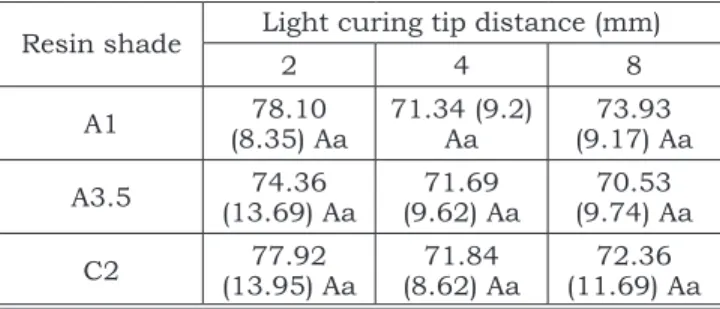
The microhardness test results are presented in Tables 1 and 2 and Graph 1. ANOVA revealed significant differences among the factors light cur-ing tip distance and resin shade, and a double in-teraction between curing tip distance and surface. Tukey’s test was applied to individual comparisons (p = 0.05). Within the light curing tip distance, bottom surface samples light-cured at 2 mm and 4 mm presented higher hardness values than samples light-cured at 8 mm (Table 2). For the top surface, there were no statistical differences among the curing tip distances (Table 1). Within the factor resin shade, there were statistical
dif-ferences only on the bottom surface (Tables 1 and 2). A1 showed higher hardness values which were statistically different from those of C2. A3.5 did not show any statistical differences from A1 and C2 (Table 2). For all experimental conditions, the top surface showed higher hardness values than the bottom surface.
DISCUSSION
This investigation evaluated the influence of the resin composite shades and the distance be-tween the resin composite and the light-curing tip on the microhardness of the top and the bottom resin composite surfaces. The results showed that for the top surface, there were no statistical dif-ferences for the studied factors. However, for the bottom surface, there were differences in the two factors studied. For all experimental conditions, the top surface showed higher hardness values than the bottom surface. These results demon-strated that there was a need to use light resin composite shades in all experimental distances of the light-curing tip from the top surface of the resin composite.
Adequate polymerization is a crucial factor in obtaining an optimal physical performance of these materials6, and it is related to better clinical
performance. However, there are many variables that affect the amount of light energy received at the top and bottom surfaces of a resin composite restoration. Among these factors, the distance of the light guide tip from the resin composite and TABLE 1 - Hardness means (KHN) for top surface
(± SD).
Resin shade Light curing tip distance (mm)
2 4 8
A1 78.10 (8.35) Aa 71.34 (9.2) Aa 73.93 (9.17) Aa
A3.5 (13.69) Aa74.36 (9.62) Aa71.69 (9.74) Aa70.53
C2 (13.95) Aa77.92 (8.62) Aa71.84 (11.69) Aa72.36
Mean values with the same letter were not statistically different (p > 0.05) (same lower case letter indicates lack of statistical difference for the comparison among the same tip distance groups, and same upper case letter indicates lack of statistical difference for the comparison among different resin shades).
TABLE 2 - Hardness means (KHN) for bottom surface
(± SD).
Resin shade
Light curing tip distance (mm)
2 4 8
A1 37.35 (6.52)
Aa
34.18 (7.06) Aa
23.39 (7.75) Ab
A3.5 36.72 (7.55)
ABa
33.55 (6.66) ABa
22.72 (6.63) ABb
C2 33.05 (6.22) Ba 32.19 (5.64) Ba 20.15 (7.76) Bb
Mean values with the same letter were not statistically different (p > 0.05) (same lower case letter indicate lack of statistical dif-ference for the comparison among the same tip distance groups, and same upper case letter indicate lack of statistical difference for the comparison among different resin shades).
0 10 20 30 40 50 60 70 80 Top Bottom 2 mm Top Bottom 4 mm Top Bottom 8 mm
A1 A3.5 C2
H a rd n e ss me a n (KH N ) 7 8 .1 0 7 4 .3 6 7 7 .9 2 3 7 .3 5 3 6 .7 2 3 3 .0 5 7 1 .3 4 7 1 .6 9 7 1 .8 4 3 4 .1 8 3 3 .5 5 3 2 .1 9 7 3 .9 3 7 0 .5 3 7 2 .3 6 2 3 .3 9 2 2 .7 2 2 0 .1 5
shade and opacity of the resin composite were analyzed in this study. The results of this study showed that these two factors were capable of af-fecting polymerization microhardness. Clinicians must be careful when they are faced with a clinical situation in which the pulpal, axial or the gingival walls of the cavity are distant from the light guide tip and a dark resin shade is to be used.
Results showed that resin shade is a fac-tor that can alter polymerization efficacy. In this study, for the bottom surface, A1 showed highest hardness means and was statistically different from C2. A3.5 resin shade presented intermedi-ate hardness means and did not show statistical differences from A1 and C2. Light transmission through the dark shades is diminished because of opacity13. Opaque shades decrease the capacity
of the light to penetrate into the bulk of the resin composite8. However, different resin composites
of the same Vita shade have different color val-ues, and large quantitative color differences were detected among different resin composites of the same Vita shade14. Thus, it is possible to find
dif-ferent results in the literature, and these results can vary according to the composition of the resin composite used.
Another factor studied was the light guide tip distance. Results showed that, for the bottom surface, the 2 mm and 4 mm light tip guide dis-tances did not show significant differences, but both distances were statistically different from the 8 mm light tip distance. These results are in agreement with those of Correr Sobrinho et al.4
(2000) and Caldas et al.3 (2003), who stated that
resin composite polymerization depends greatly on the distance from the curing tip. Prati et al.10
(1999) demonstrated that the distance between the light guide and the resin composite can affect the light intensity, and that 1 mm of air reduces light intensity by approximately 10%. In addition to the distance, another factor that attenuates light intensity is the resin composite. This may explain why only the bottom surface was affected by the two factors studied.
On the top surface, no significant difference in hardness was observed among the experimental groups. This statement is in agreement with the Yap et al.18 (2003) study, which concluded that the
top surface hardness of resin composites was less dependent on light intensity than the bottom sur-face. In this study, both factors did not influence the hardness of the top surface. However, the re-sults showed that, on the bottom surface, the dis-tance of 8 mm and the C2 resin shade significantly decreased the hardness of the resin composite. The resin composite has the property of dispersing the light of the light curing unit, thus when the light passes through the bulk of the composite, light intensity is reduced due to the light being scattered by filler particles and the resin matrix4,10,18,19.
Yap et al.18 (2003) stated that the hardness
ratio between bottom and top surface should be “1” in order to consider the polymerization completely effective, but a ratio of up to “around 0.8” could be considered as an adequate polymerization. In this study, the results showed that the ratio was between 0.49 and 0.42 for groups in which the light guide was 2 and 4 mm distant, and between 0.32 and 0.27 for groups in which the light guide was 8 mm distant (Table 3).
This lower ratio was affected both by resin composite increment (2 mm) and the high distance from the resin composite to the light source. Both the studies by Soh et al.15 (2003) and Yap et al.18
(2003) showed ratios between bottom and top sur-faces of 1 to 0.84 for the former and 0.97 to 0.69 for the latter, but in both studies the light guide tip was closed to the resin composite top surface. In some situations, clinicians can be faced with cavities 8 mm deep or more, and as the distance between the light guide and the floor of the cav-ity is a factor that is difficult to control, mainly in Class II cavities, the 2 mm increment should be reconsidered. Rueggeberg et al.12 (1994) suggested
an increment of 1 mm as a way of improving resin composite polymerization and Atmadja, Bryant1
(1990) concluded that optimum polymerization is obtained with a greater degree of certainty by
re-TABLE 3 - Hardness ratio between bottom and top surface hardness means (KHN).
2 mm 4 mm 8 mm
Top Bottom Ratio Top Bottom Ratio Top Bottom Ratio
A1 78.10 37.35 0.4782 71.34 34.18 0.4791 73.93 23.39 0.3164
A3.5 74.36 36.72 0.4938 71.69 33.55 0.4679 70.53 22.72 0.3221
ducing the thickness of the increment rather than by increasing the exposure time. Atmadja, Bryant1
(1990) and Prati et al.10 (1999) recommended
in-creasing the polymerization time when the cavity is deep. The present study suggested that in deep cavities, dark shade resin composites should be avoided, and that the dark shade should only be used for the last increment when it is esthetically necessary.
CONCLUSIONS
Within the limits of this study, it can be con-cluded that:
• For all experimental conditions, the top sur-face showed higher hardness than the bottom surface.
• Light curing tip distance and resin shade are important factors to be considered for obtain-ing adequate polymerization.
REFERENCES
1. Atmadja G, Bryant RW. Some factors influencing the depth
of cure of visible light-activated resin composite. Aust Dent J 1990;35:213-8.
2. Brännström M. The cause of post-restorative sensitivity and its prevention. J Endod 1986;12:475-81.
3. Caldas DBM, Almeida JB, Correr-Sobrinho L, Sinhoreti MAC, Consani S. Influence of curing tip distance on resin composite Knoop hardness number, using three different light curing units. Oper Dent 2003;28:315-20.
4. Correr Sobrinho L, Lima AA, Consani S, Sinhoreti MAC, Knowles JC. Influence of curing tip distance on composite Knoop hardness values. Braz Dent J 2000;11:11-7. 5. Ferracane JL, Greener EH. Fourier transform infrared
anal-ysis of degree of polymerization of unfilled resins: methods comparison. J Dent Res 1984;63:1093.
6. Knezevic A, Tarle Z, Meniga A, Sutalo J, Pichler G. Degree of conversion and temperature rise during polymerization of resin composite samples with blue diodes. J Oral Rehabil 2001;28:586-91.
7. Leinfelder KF, Bayne SC, Swift Jr EJ. Packable compos-ites: Overview and technical considerations. J Esthet Dent 1999;11:234-49.
8. Leloup G, Holvoet PE, Bebelman S, Devaux J. Raman scat-tering determination of the depth of cure of light-activated composites: influence of different clinically relevant param-eters. J Oral Rehabil 2002;29:510-5.
9. Manhart J, Kunzelmann K-H, Chen HY, Hickel R. Mechani-cal properties and wear behavior of light-cured packable resin composites. Dent Mater 2000;16:33-40.
10. Prati C, Chersoni S, Montebugnoli L, Montanari G. Ef-fect of the air, dentin and resin-based composite thickness on light intensity reduction. Am J Dent 1999;12:231-4. 11. Price RB, Dérand T, Lonev RW, Andreou P. Effect of
light source and specimen thickness on the surface hard-ness of resin composite. Am J Dent 2002;15:47-53. 12. Rueggeberg FA, Caughman WF, Curtis Jr JW. Effect
of light intensity and exposure duration on cure of resin composite. Oper Dent 1994;19:26-32.
13. Sakagushi RL, Douglas WH, Peters MCRB. Curing light performance and polymerization of composite restor-ative materials. J Dent 1992;20:183-8.
14. Shortall AC, Wilson HJ, Harrington E. Depth of cure of radiation-activated composite restoratives – Influence of shade and opacity. J Oral Rehabil 1995;22:337-42. 15. Soh MS, Yap AUJ, Siow KS. Effectiveness of composite
cure associated with different curing modes of LED lights. Oper Dent 2003;28:371-7.
16. Yap AUJ. Effectiveness of polymerization in compos-ite restoratives claiming bulk placement: impact of cavity depth and exposure time. Oper Dent 2000;25:113-20. 17. Yap AUJ, Seneviratne C. Influence of light energy
density on effectiveness of composite cure. Oper Dent 2001;26:460-6.
18. Yap AUJ, Wong NY, Siow KS. Composite cure and shrinkage associated with high intensity curing light. Oper Dent 2003;28:357-64.
19. Yoon TH, Lee YK, Lim BS, Kim CW. Degree of polym-erization of resin composite by different light sources. J Oral Rehabil 2002;29:1165-73.