*Correspondence: S. S. Panda. Department of Pharmaceutical Analysis and Quality Assurance, Roland Institute of Pharmaceutical Sciences, Ambapua, Berhampur, 760010 - Odisha, India. E-mail: [email protected]
A
vol. 49, n. 3, jul./sep., 2013
Stability-indicating RP-HPLC method for simultaneous estimation of
levosalbutamol sulfate and theophylline in combined dosage form
Sagar Suman Panda
*, Bera VenkataVaraha Ravi Kumar, Ganeswar Mohanta
Department of Pharmaceutical Analysis and Quality Assurance, Roland Institute of Pharmaceutical Sciences, Odisha, India
A novel, simple, accurate and precise RP-HPLC method for simultaneous determination of levosalbutamol sulfate and theophylline has been developed and validated. Separation was achieved on a Phenomenex; C18 column (250 mm × 4.6 mm i.d., 5 μm) using methanol: 10 mM TBAHS(tetrabutyl ammonium hydrogen sulfate) (50:50, v/v) as mobile phase at low rate of 1.0 mL.min-1. The UV detection wavelength was 274 nm. The linearity is obeyed over a concentration range of 0.5-150 μg.mL-1 with correlation coeficient of 0.999 for both the drugs. The proposed method was validated by determining accuracy, precision, stability and system suitability parameters. The method was found to be robust. Speciicity of the method was determined by subjecting the drugs to various stress conditions like acid, alkali, oxidation, thermal and photolytic degradation. The method was used successfully for the simultaneous determination of levosalbutamol sulfate and theophylline in syrup dosage form.
Uniterms: Levosalbutamol/determination. Theophylline/determination. Stability-indicating. RP-High performance liquid chromatography/qualitative analysis Syrup/qualitative analysis.
Desenvolveu-se e validou-se método de RP-HPLC novo, simples, exato e preciso de determinação simultânea do sulfato de levossalbutamol e teoilina.. A separação foi efetuada em uma coluna Phenomenex; C18 (250 mm x 4,6 mm d.i., 5 μm) utilizando metanol: TBAHS (hidrogenossulfato de tetrabutilamônio) 10 mM (50:50, v/v) como fase móvel, com luxo de 1,0 mL.min-1. O comprimento de onda de detecção no UV foi 274 nm. Observou-se linearidade na faixa de concentração de 0,5-150 μg mL-1, com coeiciente de correlação de 0,999 para ambos os fármacos. O método proposto foi validado determinando-se exatidão, precisão, estabilidade e parâmetros de adequação do sistema. O método mostrou-se robusto. A especiicidade do método foi determinada submetendo os fármacos a várias condições de estresse, como ácido, álcali, oxidação, degradação térmica e fotolítica. O método foi usado com sucesso para a determinação simultânea do sulfato de levossalbutamol e teoilina na forma de xarope.
Unitermos: Levosalbutamol/determinação. Teofilina/determinação. Indicador de estabilidade.
RP-Cromatograia líquida de alto desempenho. Xarope/análise qualitativa
INTRODUCTION
Levosalbutamol sulfate (levalbuterol), (R)-α´-[(tert
-butylamino)-4-hydroxy-m-xylene-αα´-diol sulfate(2:1) is a bronchodilator indicated for management of asthma. It is preferred over racemic salbutamol sulfate for increased
eficacy and safety after use (Berger, 2003). Theophylline, 3,7-dihydro-1,3-dimethyl purine-2,6(1H)-dione is a
xanthine derivative used for management of asthma and
related obstructive respiratory conditions(Persson,1986).
The chemical structure of both the drugs are shown in Figure 1.
Literature review shows that no stability-indicating RP-HPLC methods are present so far for simultaneous estimation of levosalbutamol sulfate and theophylline in combined syrup dosage form using methanol: 10 mM
TBAHS (tetra butyl ammonium hydrogen sulfate) as the
mobile phase. Some of the reported methods for racemic
salbutamol sulfate includes titrimetric (Basavaiah et al.,
2006, 2007), potentiometric (Abdel-Ghani et al., 2002),
spectrophotometric (Basavaiah et al., 2003, 2006, 2007;
FIGURE 1 - Chemical Structure of (A) levosalbutamol sulfate
and (B) theophylline.
al., 1989; Habib et al., 2004; Jain et al., 2011; Mishra
et al., 2010; Parimoo et al., 1993; Rathore etal., 1993),
spectroluorimetric (Pandya et al., 2010), HPLC (Bernal et al., 1996; Boulton et al., 1995; Chitlange et al., 2011;
Erram et al., 2006; Jain et al., 2011; Kasawar et al., 2010;
Kountourellis et al., 1990; Martis et al., 2011; Murtaza
et al., 2009; Pai et al., 2009) and LC-MS(Joyce et al.,
1998; Wu et al., 2004, 2011; Yee et al., 2011). Whereas
for levosalbutamol sulfate a few spectrophotometric
(Prasanna et al., 2012; Thulasama et al., 2009) and HPLC
(Ghemud et al., 2012; Halabi et al., 2004; Prasanna et al., 2012) methods are reported. The reported methods
for theophylline includes spectrophotometric (Abuirjeie
et al., 1992; Bermejo et al., 1985; Carter et al., 1985;
Fellenberg et al., 1979; Hohnadel et al., 1978; Jatlow,
1975; Kumar et al., 2011; Plavsic, 1978; Vasiliades et al.,
1976), HPLC (Abuirjeie et al., 1992; Boberic-Borojevic et al., 1999; Greenberg et al., 1979; Lauff, 1987; Moncrieff,
1991; Papadoyannis et al., 1993; Shidhaye et al., 2009),
GC (Chrzanowski et al., 1974; Schwertner, 1979; Shah
et al., 1974) and LC-MS (Abdel-Hamid et al., 2003;
Babu et al., 2011; Kanazawa et al., 2000; Song et al.,
2004). The literature survey suggests there is lack of a
stability indicating RP-HPLC method for simultaneous determination of levosalbutamol sulfate and theophylline in combined syrup dosage forms. Only one RP-HPLC method has been reported so far for simultaneous estimation of the racemic salbutamol sulfate and
theophylline in combined tablet dosage form (Maithani et
al., 2011). But the reported method has several drawbacks
like maintaining pH of buffer, increased retention times of the drugs, narrow range of linearity and higher mobile
phase low rate etc. So, an attempt was made to overcome
these drawbacks and develop a novel, simple, accurate
and precise, stability-indicating RP-HPLC method for simultaneous determination of levosalbutamol sulfate and theophylline in syrup dosage form. To prove the stability-indicating nature of the method forced degradation of drug substances and drug product was performed under stress
conditions (acid, alkali, oxidation, thermal and photolysis), and the stressed samples were analyzed by the developed
method. The method was also validated according to requirements of ICH (International Conference on
Harmonization of Technical Requirements for Registration of Pharmaceuticals for Human Use, 2005) guideline.
MATERIAL AND METHODS
Material
Methanol used was of HPLC grade (Merck Ltd.,
Mumbai, India).Water for chromatography was obtained using TKA water purification system (Germany). Standard drug of levosalbutamol sulfate (purity>99.5%) and theophylline (purity>99%) were received from Cipla Ltd., India and Glenmark Pharmaceuticals Ltd.,
India, respectively. AR grade Tetra Butyl Ammonium
Hydrogen Sulfate (TBAHS) was procured from HiMedia
Laboratories Pvt. Ltd., India. Marketed syrup formulation was bought from the local market.
Chromatographic conditions
Quantitative HPLC was performed on a binary
gradient HPLC with Shimadzu LC-10AT and LC-10AT VP
Series HPLC pumps, with a 20 µL sample injection loop
(manual) and SPD 10A VP series UV-Visible detector. The signal was monitored and integrated using Shimadzu
Class-VP Version 6.12 SP1 Software. A Phenomenex; C18 column
(250 mm× 4.6 mm i.d., 5 μm) was used for separation.
Methanol: 10 mM TBAHS in the ratio (50:50, v/v) was
used as the mobile phase. The 10 mM TBAHS solution
was prepared by accurately weighing 3.3954 g of TBAHS
salt and dissolving it in 1000 mL of HPLC grade water. Afterwards, both the methanol and TBAHS solution were
ultrasonicated up to 30 min for degassing and were iltered
through a 0.45 µm membrane ilter, prior to use. The low
rate was 1.0 mL.min-1 and UV detection was carried out at
274 nm. The separation was achieved at room temperature.
Preparation of standard stock solution
Standard stock solutions for both the drugs were prepared separately by dissolving 25 mg of drugs in
10 mL of mobile phase with the drugs were shaken and finally volume was made up to get a concentration of
1000 µg.mL-1. Both the standard drug solutions were
filtered through a 0.2 µm membrane filter. The stock solutions were stored at 2-8 ºC.
Method validation
Linearity and preparation of analytical curve
Suitable aliquots of the standard stock solutions of
levosalbutamol sulfate (1000 µg.mL-1) and theophylline
(1000 µg.mL-1) were transferred into a series of 10 mL
volumetric lasks to get inal concentrations of 0.5, 1.0, 5.0,
10, 20, 40, 80,100,150 μg.mL-1(9 points). Final volume
was made up with mobile phase. Each mixed standard solution was injected and chromatograms were recorded. The linearity of analytical curves was plotted for peak area of each drug against concentrations of drug.
Analysis of syrup dosage form
Five mL of the syrup containing levosalbutamol sulfate and theophylline equivalent to 5mg and 50mg of the standard drugs respectively was measured accurately and dissolved in 50 mL of mobile phase. It was ultrasonicated for 25 minutes and volume was made
up with the mobile phase, followed by iltration through
0.2 µm membrane ilter. The syrup solution was further diluted with the mobile phase to get sample solutions within the linearity range. The sample solutions were injected and chromatograms were obtained. The amount of drug present in the sample solution was calculated using the analytical curves of standard drugs.
Precision
The precision (intraday and interday) of the
method was ascertained from the peak areas obtained by
determination of six replicates of ixed amount of drugs.
The system precision was ascertained by carrying out six
injections of a ixed amount of drug solution. The percent
relative standard deviations were calculated.
Accuracy
To check the accuracy of the proposed method, recovery studies were carried out at 80, 100 and 120% of the test concentration according to ICH guidelines. The recovery study was performed three times at each level.
Robustness
Robustness of the method was studied by deliberately
changing the UV detection wavelength (±5 nm), mobile
phase low rate (±0.2 mL) and organic phase composition
(±5%).The effect was studied in terms of various system suitability parameters like retention time, resolution, theoretical plates and tailing factor for both the drugs. Solution stability study was also carried out by keeping the sample solutions at 25±2 ºC for 24 h.
Forced degradation study
Specificity of the method was determined by checking interference of any of the possible degradation products produced during the forced degradation study. The forced degradation was carried out with 0.1 M HCl,
0.1 M NaOH, 3% v/v hydrogen peroxide, thermal (80 ºC) and photolysis (365 nm) for inding out the stability nature
of the drugs. The degradation samples were prepared by taking suitable aliquots of the drug and drug product solutions, and then undertaking the respective stress testing procedures for each solution. After the fixed time period the treated drug solutions were diluted with mobile phase. For every stress condition three solutions
were prepared as 1 µg.mL-1 of levosalbutamol sulfate,
10 µg.mL-1 of theophylline and drug product solution
containing 1 µg.mL-1 of levosalbutamol sulfate with
10 µg.mL-1 of theophylline. The speciic stress conditions
are described as follows.
A) Acidic degradation
Acidic degradation was carried out by adding 1.0 mL
of 0.1 M HCl, and after 1hr neutralizing the mixture by
adding 0.1 M NaOH.
B) Alkali degradation
Alkali degradation was carried out by adding 1.0 mL
of 0.1 M NaOH, and after 1 h neutralizing the mixture by
adding 0.1 M HCl.
C) Oxidative degradation
Oxidative degradation was performed by exposing
the drug to 1.0 mL of 3% (v/v) H2O2 1 h.
D) Thermal degradation
Thermal degradation was performed by heating the drug solutions at 80 ºC on a thermostatically controlled water bath for 1 h.
E) Photolytic degradation condition
Photolytic degradation was carried out by exposing
the drug solutions to UV light (365 nm) inside an UV
chamber for 5 h.
System suitability
The System Suitability was calculated for different parameters like theoretical plates, resolution, tailing factor, LOD and LOQ. The LOD and LOQ were separately determined based on the Signal to Noise ratio. For LOD
RESULTS AND DISCUSSION
Method development and optimization
Method development process was carried out
by examining conditions like flow rate (0.8 mL.min-1,
1.0 mL.min-1 and 1.2 mL.min-1), mobile phase compositions
like acetonitrile:water, acetonitrile:buffer, methanol:water, methanol: 10 mM TBAHS and ratios (50:50, 60:40 and
45:60, v/v) were used. Both the drugs levosalbutamol sulfate and theophylline were found showing a signiicant
UV absorbance at 274 nm in methanol: 10 mM TBAHS
(50:50, v/v), so this wavelength was chosen for UV
detection. By use of a C18 column it was found the mobile
phase consisting of methanol: 10mM TBAHS (50:50, v/v) provided well deined peak shape with good resolution.
Levosalbutamol sulfate was eluted at 2.558 min where as theophylline eluted at 4.867 min. The representative chromatograms of pure drug and combined drug product
are shown in Figure 2 (A) and (B), respectively.
Method validation
Linearity
Levosalbutamol sulfate and theophylline have
linearity over concentrations ranging from 0.5 to
150.0 µg.mL-1. The slope (a) and intercept (b) were found
to be 6103 and 4583 for levosalbutamol sulfate and 63827 and -2793 for theophylline. Correlation coeficient (r2) was
found to be 0.999 for both the drugs. These results suggest a good linear relationship between peak area and analytes in the range studied.
Analysis of syrup dosage forms
The % recovery was more than 100% for syrup
dosage form. Good % recovery and noninterference
in separation of both the drugs because of formulation components suggests that; the method is selective and excipients present in the formulation have no affect in the determination. The results are given in Table I.
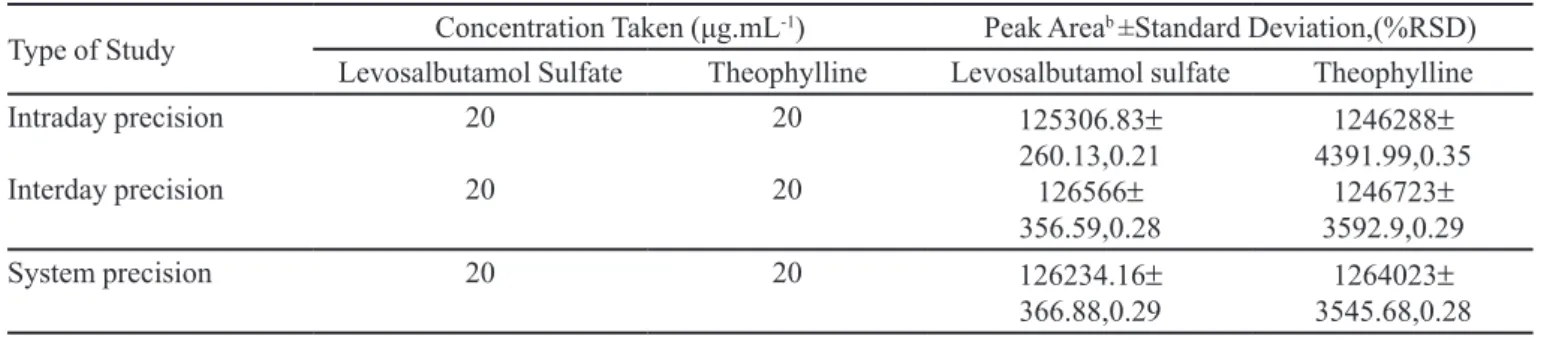
Precision
The RSD for method (intraday and interday) and
system precision were found to be less than 2% showing high degree of preciseness as shown in Table II.
Accuracy
Accuracy was checked by preparing mixtures containing different amounts of pure drugs and fixed
amount of formulation; analyzing the mixtures by use
FIGURE 2 - Representative chromatograms of levosalbutamol sulfate and theophylline. (A) combined standard drugs[ratio 1:1]
TABLE I - Analysis of syrup dosage form
Formulation
Type Labeled Amount (mg)
Recovery by proposed methoda (%)±S.D.,
R.S.D (%)
Levosalbutamol sulfate Theophylline
Syrup
Each 5 mL contains
levosalbutamol sulfate≈5 mg theophylline≈50 mg
101.6±1.4106,
1.38 101.43±0.9237,0.91
a average of three determinations
TABLE II -Intraday, interday and system precision studies(n=6)
Type of Study Concentration Taken (μg.mL
-1) Peak Areab ±Standard Deviation,(%RSD)
Levosalbutamol Sulfate Theophylline Levosalbutamol sulfate Theophylline
Intraday precision Interday precision 20 20 20 20 125306.83± 260.13,0.21 126566± 356.59,0.28 1246288± 4391.99,0.35 1246723± 3592.9,0.29
System precision 20 20 126234.16±
366.88,0.29 3545.68,0.281264023±
b average of six determinations
TABLE III - Accuracy of the method
Different concentration level comparing to sample
concentration (%)
Amount Added Pure Drug
(µg.mL-1)
Recoveryc(%)
Pure Drug
±SD, RSD (%)
Levosalbutamol Sulfate Theophylline Levosalbutamol Sulfate Theophylline
80 100 120 4 5 6 40 50 60 100.5±0.4330,0.43 100.43±0.1571,0.16 100.33±0.33,0.33 101.11±0.5478,0.54 100.61±0.2402,0.24 100.81±0.4463,0.44
c average of three determinations at each level
of developed method. Percentage recovery and relative standard deviation were also calculated. The results obtained suggest the recoveries were excellent, and relative standard deviations were less than 2%.The results of recovery study are given in Table III.
Robustness
The method was found to be robust under deliberate changes made in mobile phase flow rate, composition of organic phase and UV detection wavelength. Various
system suitability parameters were evaluated to ind out the
robustness of the method. The results for system suitability parameters are presented in Table IV. The results of solution stability for both the drugs was satisfactory with a recovery
more than 99% after 24 h, showing no signiicant loss of the
analytes in the selected mobile phase.
Specificity
Speciicity of the method was ascertained by checking
any interference because of excipients or degradation products produced after subjecting levosalbutamol sulfate and theophylline to forced degradation. No extra peaks were obtained either from the excipients used in the drug product or from the stress conditions applied on the drugs
and drug product. Therefore the method was found speciic
and stability-indicating. Forced degradation conditions
were optimized in order to get degradation of the drugs up to 30%. The stress conditions like 0.1 M HCl, 0.1 M NaOH, 3% v/v H2O2, 80 ºC temperature and 365 nm UV
radiation were applied to check the degradation nature of
stress conditions. Levosalbutamol was found to be stable in the applied acidic and UV stress conditions. The drug theophylline was found to be more stable towards the applied stress conditions than compared to levosalbutamol. Theophylline undergoes moderate
degradation in alkaline (7.57%) and oxidative (2.47%)
stress conditions, and the drug was found to be stable in the applied acidic, thermal and UV stress conditions.
Figure 3-(A), (B),(C),(D),(E) and (F) represents
the chromatograms of untreated drugs; acid, alkali, oxidation, thermal and photolysis degraded drugs with combined drug product, respectively.
System suitability
A critical evaluation of the method was performed. A higher resolution value indicates better separation of both the drugs. Also the LOD and LOQ values show superior sensitivity of the method. The System suitability parameters are shown in Table V.
CONCLUSION
This simple and accurate RP-HPLC method has been developed and validated for determining levosalbutamol sulfate and theophylline in syrup dosage form. Lack of a stability-indicating method for determination of both the drugs in a combined syrup dosage form is the driving cause for development of this novel method. The sample preparation technique is also very simple for the syrup dosage form making it suitable for routine laboratory
testing. Major advantage of this method is the analytes do not interfere with each other’s elution with a good
difference in retention times. Speciicity study carried out by forced degradation ensures that the method is speciic
and able to describe the stability nature of both the drugs in a combined drug formulation. The mobile phase is simple to prepare. Results of precision study demonstrate the superior preciseness of the method as the RSD values were well within the limits. The recovery value of more than 100% shows higher levels accuracy of the method. So it can be concluded that the developed RP-HPLC method is novel, simple, accurate, precise, sensitive, and stability-indicating and can be employed successfully for the simultaneous determination of levosalbutamol sulfate and theophylline in syrup dosage form. Further the developed method may be applied for bioavailability and bioequivalence study of both the drugs in different biological samples.
TABLE IV- Robustness of the method
Parameter
RetentionTime(Rt),min
Resolution
(Rs)
Theoretical Plates(N) Tailing Factor(T)
Levosalbutamol sulfate Theophylline Levosalbutamol sulfate Theophylline Levosalbutamol sulfate Theophylline Flow rate
(mL.min-1)
0.8 1.0 1.2 Methanol (%) 45 50 55 Wavelength (nm) 269 274 279 3.167 2.575 2.142 2.592 2.575 2.533 2.575 2.575 2.558 6.042 4.967 4.083 5.433 4.967 4.483 4.975 4.967 4.875 5.75 5.98 5.54 6.31 5.98 5.57 6.0 5.98 5.79 2938 2926 2838 2899 2926 2992 2941 2969 2895 5945 5989 5427 5685 5989 5673 5900 5989 5695 1.39 1.36 1.36 1.31 1.36 1.31 1.31 1.36 1.34 1.33 1.33 1.33 1.39 1.33 1.36 1.34 1.33 1.37
TABLE V- System suitability
Parameter Obtained Values Levosalbutamol sulfate Theophylline Retention time Theoretical plates Tailing factor Resolution
LOD(µg.mL-1)
LOQ(µg.mL-1)
FIGURE 3A - Representative chromatograms of untreated drugs. Each chromatogram represents (i) levosalbutamol sulfate
(1 μg.mL-1), (ii) theophylline (10 μg.mL-1), (iii) dosage form having levosalbutamol sulfate (1 μg.mL-1) and theophylline
FIGURE 3B - Representative chromatograms of acid degraded drugs. Each chromatogram represents (i) levosalbutamol sulfate
(1 μg.mL-1), (ii) theophylline (10 μg.mL-1), (iii) dosage form having levosalbutamol sulfate (1 μg.mL-1) and theophylline
FIGURE 3C - Representative chromatograms of alkali degraded drugs. Each chromatogram represents (i) levosalbutamol sulfate
(1 μg.mL-1), (ii) theophylline (10 μg.mL-1), (iii) dosage form having levosalbutamol sulfate (1 μg.mL-1) and theophylline
FIGURE 3D - Representative chromatograms of oxidation degraded drugs. Each chromatogram represents (i) levosalbutamol
sulfate (1 μg.mL-1), (ii) theophylline (10 μg.mL-1), (iii) dosage form having levosalbutamol sulfate (1 μg.mL-1) and theophylline
FIGURE 3E - Representative chromatograms of thermally degraded drugs. Each chromatogram represents (i) levosalbutamol
sulfate (1 μg.mL-1), (ii) theophylline (10 μg.mL-1), (iii) dosage form having levosalbutamol sulfate (1 μg.mL-1) and theophylline
FIGURE 3F - Representative chromatograms of photolysed drugs. Each chromatogram represents (i) levosalbutamol sulfate
(1 μg.mL-1), (ii) theophylline (10 μg.mL-1), (iii) dosage form having levosalbutamol sulfate (1 μg.mL-1) and theophylline
ACKNOWLEDGEMENTS
The authors are thankful to Cipla Ltd., India and
Glenmark Pharmaceuticals Ltd., India for providing the
standard drugs of levosalbutamol sulfate and theophylline,
respectively, and M/S Roland Institute of Pharmaceutical
Sciences, Berhampur-10, Odisha, India for providing the research facilities.
REFERENCES
ABUIRJEIE, M.A.; EL-DIN, M.S.; MAHMOUD, I.I. Determination of theobromine, theophylline and caffeine in various food products using derivative UV-Spectrophotometric techniques and high performance liquid
chromatography. J. Liq. Chromatogr., v.15, n.1, p.101-125,
1992.
ABDEL-GHANI, N.T.; RIZK, M.S.; EL-NASHAR, R.M. Potentiometric low injection determination of salbutamol.
Anal. Lett., v.35, n.1, p.39-52, 2002.
ABDEL-HAMID, M.E.; PHILLIPS, O.A. LC-MS/MS determination of carbamazepine and theophylline in human
serum. J. Liq. Chromatogr. Related Technol., v.26, n.12,
p.1937-1957, 2003.
BABU, A.R.S.; THIPPESWAMY, B.; VINOD, A.B.;
RAMAKISHORE, E.G.; ANAND, S.; SENTHIL, D.
Determination of theophylline in rabbit plasma by triple
quadrupole LC/MS. Pharm. Methods,v.2, n.4, p.211-217, 2011.
BASAVAIAH, K.; SOMASHEKAR, B.C.; RAMAKRISHNA, V. Rapid titrimetric and spectrophotometric methods for salbutamol sulphate in pharmaceuticals using
N-bromosuccinimide. Acta Pharm., v.57, n.1, p.87-98,
2007.
BASAVAIAH, K.; PRAMEELA, H.C. Spectrophotometric
determination of salbutamol sulfate(SBS) and pyrantel pamoate(PRP) in bulk drugs and pharmaceuticals. Chem. Anal., v.48, n.2, p.327, 2003.
BASAVAIAH, K.; SOMASHEKAR, B.C.; RAMAKRISHNA, V. Titrimetric and spectrophotometric determination of salbutamol sulphate in pharmaceuticals using chloramines-T
and two dyes. Anal. Chem. Ind. J., v.2, n.5-6, p.179-186,
2006.
BERGER, W.W. Levalbuterol; pharmacologic properties and
use in the treatment of pediatric and adult asthma. Ann.
Allergy Asthma In., v.90, n.6, p.583-592, 2003.
BERMEJO, A.; LOPEZ-RIVADULLA, M.; FERNANDEZ, P.;
CONCHEIRO, L. Application of derivative spectroscopy to the determination of plasma theophylline in the presence
of phenobarbital. J. Anal. Toxicol., v.9, n.2, p.76-80, 1985.
BERNAL, J.L.; DEL NOZAL, M.J.; VELASCO, H.; TORIBIO,
L. HPLC versus SFC for the determination of salbutamol
sulphate and its impurities in pharmaceuticals. J. Liq.
Chromatogr. Related Technol., v.19, n.10, p.1579-1589, 1996.
BOBERIC-BOROJEVIC, D.; RADULOVIC, D.; IVANOVIC, D.; RISTIC, P. Simultaneous assay of ephedrine hydrochlor
ide,theophylline,papaverine hydrochloride and hydroxyzine
hydrochloride in tablets using rp-lc. J. Pharm. Biomed.
Anal., v.21, n.1, p.15-22, 1999.
BOULTON, D.W.; FAWCETT, J.P. Determination of salbutamol enantiomers in human plasma and urine by chiral
high-performance liquid chromatography. J. Chromatogr. B.,
v.672, n.1, p.103-109, 1995.
CARTER, P.; WALLACE, J.E.; BLUM, K. Improved ultraviolet
spectrophotometry of serum theophylline. Clin. Chem.,
v.24, n.2, p.360-361, 1978.
CHITLANGE, S.S.; CHATURVEDI, K.K.; WANHEDE, S.B.
Development and validation of spectrophotometric and HPLC method for simultaneous estimation of salbutamol
sulphate and prednisolone in tablet dosage form. J. Anal.
Bioanal. Techniques., v.2, n.1, p.117, 2011.
CHRZANOWSKI, F.A.; NIEBERGALL, P.J.; NIKELLY, J.G.; SUGITA, E.T.; SCHNAARE, R.L. Gas chromatographic
analysis of theophylline in human serum. Biochem. Med.,
v.11, n.1, p.26-31, 1974.
CULZONI, M.J.; DE ZAN, M.M.; ROBLES, J.C.; MANTOVANI, V.E.; GOICOECHEA, H.C. Chemometrics
-assisted UV-spectroscopic strategies for the determination
of theophylline in syrups. J. Pharm. Biomed. Anal., v.39,
n.5, p.1068-1074, 2005.
ERRAM, S.V.; FANSKA, C.B.; ASIF, M. Determination of albuterol sulfate and its related substances in albuterol
sulfate inhalation solution,0.5% by RP-LC. J. Pharm.
FELLENBERG, A.J.; POLLARD, A.C. A rapid ultraviolet
spectrophotometric procedure for the microdetermination
of theophylline(1,3-dimethylxanthine) in plasma or serum.
Clin. Chim. Acta,, v.92, n.2, p.267-272, 1979.
GEETA, N.; BAGGI, T.R. An improved spectrophotometric
method for the determination of salbutamol sulfate with
3-methylbenzthiazolinone-2-hydrazone. Microchem. J.,
v.39, n.2, p.137-144, 1989.
GHEMUD, A.S.; SANTHAKUMARI, B.; PHARNE,
A.B.; JADHAV, M.M.; JAIN, K.S.; KULKARNI, M.J. Bioanalytical method development and validation of
levalbuterol aβ2-adrenergic agonist by rp-hplc method. Int. J. Pharm. Pharm. Sci., v.4, suppl.1, p.249-253, 2012.
GREENBERG, M.S.; MAYER, W.J .High performance liquid
chromatographic determination of theophylline and its
derivatives with electrochemical detection. J. Chromatogr.
A., v.169, p.321-327, 1979.
HABIB, I.H.I.; HASSOUNA, M.E.M.; ZAKI, G.A.
Simultaneous spectrophotometric determination of
salbutamol and bromhexine in tablets. Farmaco, v.60, n.3,
p.249-254, 2005.
HALABI, A.; FERRAYOLI, C.; PALACIO, M.; DABBENE, V.; PALACIOS, S. Validation of a chiral HPLC assay for
(R) – salbutamol sulfate. J. Pharm. Biomed. Anal., v.34, n.45, p.45-51, 2004.
HOHNADEL, D.C.; GROVE, T.H.; ALONZO, P. A micro
method for the ultraviolet spectrophotometric determination
of theophylline. J. Anal. Toxicol., v.2, n.4, p.141-145, 1978.
ICH HARMONISED TRIPARTITE GUIDELINE. Validation of analytical procedures: text and methodology Q2(R1). Available at: <http://www.ich.org/ileadmin/Public_Web_ Site/ICH_Products/Guidelines/Quality/Q2_R1/Step4/ Q2_R1__Guideline.pdf>. Accessed on: 10 Jan 2012.
JAIN, D.K.; PATEL, P.; KUSHWAHA, A.; RAGHUWANSHI,
R.S.; JAIN, N. Simultaneous determination of salbutamol sulphate and doxophylline in tablets by reverse phase liquid
chromatography. Pharmacia Lettre., v.3, n.4, p.56-62, 2011.
JATLOW, P. Ultraviolet spectrophotometry of theophylline in
plasma in the presence of barbiturates. Clin. Chem., v.21,
n.10, p.1518-1520, 1975.
JOYCE, K.B.; JONES, A.E.; SCOTT, R.J.; BIDDLECOMBE, R.A.; PLEASANCE, S. Determination of the enantiomers of salbutamol and its 4-O-sulfate metabolites in biological matrices by chiral liquid chromatography tandem mass
spectrometry. Rapid Commun. Mass Spectrom., v.12, n.23,
p.1899-1910, 1998.
KANAZAWA, H.; ATSUMI, R.; MATSUSHIMA, Y.; KIZU, Z. Determination of theophylline and its metabolites
in biological samples by liquid chromatography-mass
spectrometry. J. Chromatogr. A., v.870, n.1-2, p.87-96,
2000.
KASAWAR, G.B.; FAROOQUI, M. Development and
validation of a stability indicating RP-HPLC method for the simultaneous determination of related substances of albuterol sulfate and ipratropium bromide in nasal solution. J. Pharm. Biomed. Anal., v.52, n.1, p.19-29, 2010.
KUMAR, V.; SHARMA, A.; ARORA, S.; DHILLON, V. Use of simple spectrophotometric method for estimation of
theophylline (TH) in saliva and urine of healthy human
volunteer. Int. J. Pharm. Bio Sci., v.2, n.3, p.36-41, 2011.
K O U N T O U R E L L I S , J . E . ; M A R K O P O U L O U , C . ;
GEORGAKOPOULOS, P.P. Separation and simultaneous
determination of bamipine and salbutamol in dosage
forms by high-performance liquid chromatography. J.
Chromatogr. A., v.502, n.1, p.189-192, 1990.
LAUFF, J.J. Ion-pair high-performance liquid chromatographic procedure for the quantitative analysis of theophylline in
serum samples. J. Chromatogr., v.417, n.1, p.99-109, 1987.
MAITHANI, M.; SINGH, R. Development and validation of
a stability-indicating HPLC method for the simultaneous determination of salbutamol sulfate and theophylline in
pharmaceutical dosage forms. J. Anal. Bioanal. Techniques.,
v.2, n.1, p.1-5, 2011.
MALLU, U.R.; BOBBARALA, V.; PENUMAJJI, S. Analysis of cough and analgesic range of pharmaceutical active
ingredients using rp-hplc method. Int. J. Pharm. Bio. Sci.,
v.2, n.3, p.439-452, 2011.
MARTIS, E.; GANGRADE, D.M. Reverse phase isocratic
HPLC method for simultaneous estimation of salbutamol sulphate and beclomethasone dipropionate in rotacaps
formulation dosage forms. Int. J. Pharm. Pharm. Sci., v.3,
MISHRA, A.K.; KUMAR, M.; MISHRA, A.; VERMA, A; CHATTOPAHYAY, P. Validated UV spectroscopic method
for estimation of salbutamol from tablet formulations. Arch.
Appl. Sci. Res., v.2, n.3, p.207-211, 2010.
MONCRIEFF, J. Determination of theophylline in serum and
saliva in the presence of caffeine and its metabolites. J.
Chromatogr. B Biomed. Sci. Appl., v.568, n.1, p.177-185, 1991.
MURTAZA, G.; AHMAD, M.; MADNI, M.A.; ASGHAR, M.W. A new reverse phase hplc method with luorescent
detection for the determination of salbutamol sulfate in
human plasma. Bull. Chem. Soc. Ethiop., v.23, n.1, p.1-8,
2009.
PAI, P.N.S.; RAO, G.K.; MURTHY, M.S.; AGARWAL, A.;
PURANIK, S. Simultaneous determination of salbutamol sulphate and bromhexine hydrochloride in tablets by reverse
phase liquid chromatography. Ind. J. Pharm. Sci., v.71, n.1,
p.53-55, 2009.
PANDYA, H.N.; BERAWALA, H.H.; KHATRI, D.M.; MEHTA,
P.J. Spectroluorimetric estimation of salbutamol sulphate in
different dosage forms by formation of inclusion complex
with β-cyclodextrin. Pharm. Methods, v.1, n.1, p.49-53, 2010.
PAPADOYANNIS, I.N.; SAMANIDOU, V.F.; TSOUKALI, H.; EPIVATIANOU, F. Comparison of a rp-hplc method with the therapeutic drug monitoring system TDx for the
determination of theophylline in blood serum. Anal. Lett.,
v.26, n.10, p.2127-2142, 1993.
PARIMOO, P.; UMAPATHI, P.; ILANGO, K. Simultaneous
quantitative determination of salbutamol sulfate and bromhexine hydrochloride in drug preparations by
difference spectrophotometry. Int. J. Pharm., v.100, n.1-3,
p.227-231,1993.
PERSSON, C.G.A. Overview of effects of theophylline. J.
Allergy Clin. Immunol., v.78, n.4, p.780-787, 1986.
PLAVSIC, F. A simple UV spectrophotometric method for
theophylline serum level determination. Clin. Chim. Acta.,
v.88, n.3, p.551-558, 1978.
P R A S A N N A , B . L . ; S H E T T Y, A . S . K . ; N A D H , T. P. ;
GOPINATH, B.; AHMED, M. Simultaneous estimation of
levosalbutamol sulphate and beclomethasone dipropionate
in combined rotacap dosage form by rp-hplc method. Int. J.
Biol. Pharm. Res., v.3, n.3, p.320-326, 2012.
PRASANNA, B.L.; SHETTY, A.S.K.; NADH, T.P.; GOPINATH,
B.; AHMED, M. Development of new spectrophotometric methods for the simultaneous estimation of levosalbutamol sulfate and beclomethasone dipropionate in bulk drug and
pharmaceutical formulations(rotacap). Int. J. PharmTech
Res., v.4, n.2, p.791-798, 2012.
RATHORE, Y.K.S.; MURUGESAN, N.; MATHUR, S.C.;
KUMAR, Y; SETHI, P.D. Simultaneous spectrophotometric determination of salbutamol sulphate and bromhexine
hydrochloride in tablets. Ind. J. Pharm. Sci., v.55, n.5,
p.206-208, 1993.
SCHWERTNER, H.A. Analysis for underivatized theophylline
by gas-chromatography on a silicone stationary phase
SP-2510-DA. Clin. Chem., v.25, n.2, p.212-214, 1979.
SHAH, V.P.; RIEGELMAN, S. GLC determination of theophylline in biological luids. J. Pharm. Sci., v.63, n.8,
p.1283-1285, 1974.
SHIDHAYE, S.; MALKE, S.; KADAM, V. Validated stability indicating hplc method for estimation of theophylline from
a novel microsphere formulation. Asian J. Pharm., v.3, n.1,
p.13-17, 2009.
SONG, J.; UNPARK, K.; PARK, H.D.; YOON, Y.; KIM,
J.Q. High throughput liquid chromatography-tandem mass spectrometry assay for plasma theophylline and its
metabolites. Clin. Chem., v.50, n.11, p.2176-2179, 2004.
T H U L A S A M A , P . ; K I S H O R E K U M A R , R . ; VENKATESWARULU, P. Development and validation of new spectrophotometric methods for the estimation of
levosalbutamol in tablet dosage forms. Anal. Chem. Ind. J.,
v.8, n.4, p.222-231, 2009.
VASILIADES, J.; TURNER, T. A modiied spectrophotometric
method for the determination of theophylline in serum in
the presence of barbiturates. Clin. Chim. Acta, v.69, n.3,
p.491-495, 1976.
WU, S.T.; XING, J.; APEDO, A.; WANG-IVERSON, D.B.; OLAH, T.V.; TYMIAK, A.A.; ZHAO, N. High-throughput
chiral analysis of albuterol enanantiomers in dog plasma
using on-line sample extraction/polar organic mode chiral
liquid chromatography with tandem mass spectrometric
detection. Rapid Commun. Mass Spectrom., v.18, n.21,
WU, J.; DING, C.; GE, Q.; LI, Z.; ZHOU, Z.; ZHI, Z.
Simultaneous determination of ipatropium and salbutamol
in rat plasma by LC-MS/MS and its application to a
pharmacokinetic study. J. Chromatogr. B Analyt. Technol.
Biomed. Life Sci., v.879, n.30, p.3475-3483, 2011.
YEE, K.C.; JACOBSON, G.A.; WOOD-BAKER, R.;
WALTERS, E.H. Albuterol enantiomer levels,lung function and QTc interval in patients with acute severe asthma and
COPD in the emergency department. Int. J. Emergency
Med., v.4, n.1, p.30, 2011.
Received for publication on 28 May 2012

![FIGURE 2 - Representative chromatograms of levosalbutamol sulfate and theophylline. (A) combined standard drugs[ratio 1:1]](https://thumb-eu.123doks.com/thumbv2/123dok_br/15413185.587027/4.892.72.832.635.1062/figure-representative-chromatograms-levosalbutamol-sulfate-theophylline-combined-standard.webp)