INTRODUCTION
Microorganisms and microbial products present in root canal systems are responsible for progression or maintenance of periradicular inlammatory lesions (1). Improvements in chemo-mechanical techniques and illing materials containing chemicals to eradicate microorganisms from dentinal walls have enhanced the success of endodontic therapy in the last 30 years. Several investigations (2) have shown advantages in one-visit endodontic treatment, reducing the need of two or more appointments, thus eliminating the use of intracanal medications between sessions, which is an additional step performed with the use of chemicals with antimicrobial properties.
Correspondence: Prof. Raphael Hirata Júnior, Avenida 28 de Setembro, 87, Fundos, Edifício Américo Piquet Carneiro, 3o andar, Vila Isabel, 20551-030 Rio de Janeiro, RJ, Brasil. Tel: +55-21-2587-6380. Fax: +55-21-2587-6476. e mail: [email protected]
Antimicrobial Activity of Calcium Hydroxide
Pastes on
Enterococcus faecalis Cultivated
in Root Canal Systems
Patricia Elaine Panicali LANA1 Miriam Fatima Záccaro SCELZA1
Licínio Esmeraldo SILVA2 Ana Luíza de MATTOS-GUARALDI3
Raphael HIRATA JÚNIOR3
1Department of Endodontics, Fluminense Federal University, Niterói, RJ, Brazil 2Institute of Mathematics, Fluminense Federal University, Niterói, RJ, Brazil 3Department of Microbiology, Immunology and Parasitology, School of Medical Sciences,
State University of Rio de Janeiro, Rio de Janeiro, RJ, Brazil
The effectiveness of calcium hydroxide pastes: Calen™ and PMCC-Calen™ associated to chemo-mechanical preparation was assessed on Enterococcus faecalis grown within root canals. Seventy incisors were inserted into TSB medium, sterilized and contaminated with
E. faecalis. Culture medium was replaced each 24 h and incubated at 37oC for 72 h. After chemo-mechanical preparation, root canals
were illed with Calen™ or PMCC-Calen™ (7 or 14 days). Pastes were removed and teeth were inserted into test tubes containing
Enterococcosel broth. Calen™ paste (maintained for 7 and 14 days) induced 70% elimination of enterococci and PMCC-Calen™ 100%
elimination only after maintenance for 14 days. These medications were signiicantly more effective (p<0.001) than chemo-mechanical
protocol alone and PMCC-Calen™ maintained for 7 days, both incapable to eliminate the viability of enterococci. Calcium hydroxide pastes demonstrated important adjuvant effects in the elimination of enterococci during chemo-mechanical preparation of root canal systems. When associated with PMCC, calcium hydroxide pastes should be maintained for at least 14 days.
Key Words: calcium hydroxide, chemo-mechanical preparation, Enterococcus faecalis.
The persistence of microorganisms after endodon-tic therapy can be responsible for treatment failure. En-terococcus faecalis are enteric facultative Gram-positive cocci frequently associated with persistent endodontic infections (3). In addition to several virulence factors displayed by this species, E. faecalis isolates expressed varied resistance patterns to some agents used as intra-canal medications including calcium hydroxide pastes (4). Resistance was particularly observed when tests were performed with planktonic cells grown in liquid media or in agar plates (5). E. faecalis grown in bioilms
Calcium hydroxide based intracanal medications are recommended for varied clinical situations includ-ing treatment of apical periodontitis. Although previous studies have established that enterococci are generally resistant to calcium hydroxide dressings (4), attempts to enhance the effectiveness of calcium hydroxide pastes have been proposed with addition of chemicals such as p-chlorophenol and chlorhexidine (7).
The aim of this study was to analyze the in vitro
antimicrobial activity of 2 formulations of calcium hy-droxide pastes (Calen™ and Calen with p-chlorophenol - PMCC-Calen™) as adjuvant medications to chemo-mechanical procedures on E. faecalis grown in contact with dentinal walls of root canal systems.
MATERIAL AND METHODS
The intracanal medications tested in this study were: calcium hydroxide paste with propylene glycol vehicle (PEG) - Calen™ (SS White Artigos Dentários Ltda., Rio de Janeiro, RJ, Brazil); and calcium hydroxide paste with propylene glycol and p-chlorophenol - PMCC Calen™ (SS White Artigos Dentários Ltda.). The cal-cium hydroxide pastes were commercially obtained and used in this investigation in such a way to avoid variations during handling procedures.
Enterococcus faecalis strain ATCC 29212 was maintained in stock culture at -80ºC in Tripticase Soy Broth (TSB; Difco Laboratories Inc., Detroit, MI, USA) containing 25% glycerol (Merck, Darmstadt, Germany). Microorganisms were grown on Tripticase Soy Agar (TSA- Difco Laboratories) plates, and checked for purity before contamination of teeth.
Seventy extracted single- rooted teeth (mandibu-lar incisors) were cleaned and stored until use in 0.1% thymol solution. Root canals were accessed and working length was determined radiographically by inserting size10 K-ile (Maillefer, Ballaigues, Switzerland) into the canals, which were then enlarged up to a 25 K-ile (Maillefer). The external tooth surfaces were sealed with 2 layers of quick-setting cyanoacrylate ester adhesive (Super Bonder® Instant Adhesive, Loctite Corp., Rocky Hill, CT, USA).
Contamination of teeth was based on experi-ments performed as described elsewhere (8). Briely, the teeth were inserted into test tubes, covered with TSB and autoclaved. Test tubes were contaminated with E. faecalis (109 cfu mL-1) and incubated 36ºC for 24 h. The
culture media were removed with sterile plastic pipettes and substituted 3 times each 24 h incubation to ensure the growth of bacterial strain within root canals in the presence of freshly prepared culture media.
The experiments were performed in a laminar low chamber. Teeth with E. faecalis growth were re-moved from test tubes, pulp chambers were sealed with a temporary sealer agent (Coltosol; Coltene-Whaledent Cuyahoga Falls, OH, USA), and teeth were immersed in a 5.25% NaOCl solution (Formula & Ação Farmácia, São Paulo, SP, Brazil) for 2 min, cleaned externally with sterile gauze to remove external bacterial accumulation and immersed in sterile 1% sodium tiosulphate solution, for 1 min to neutralize residual NaOCl.
The temporary pulp chamber sealer agent was removed and canal instrumentation was performed according to a crown-down technique with K-iles (Maillefer) up to a size 45 master apical ile with irrigation between iles with 5.25% NaOCl solution. After instrumentation, smear layer was removed with 20 mL of 10% citric acid followed by a inal irrigation with 20 mL of distilled water (Formula & Ação Farmácia).
Intracanal medication agents were also tested by agar diffusion method (10). Briely, calcium hydroxide pastes were dispensed into 6 mm wells performed with a puncher. Substances were tested on Mueller-Hinton agar plates (Difco) previously inoculated with an E. faecalis
suspension adjusted to 0.5 MacFarland nephelometer. Inhibition zones around medications were measured after incubation for 37ºC for 24 h.
The study protocol was approved by the Re-search Ethics Committee of Fluminense Federal Uni-versity, Brazil. Statistical analysis was performed for
E. faecalis elimination groups (i.e., positive results and negative elimination groups) using the chi-square test. Comparisons of the inhibition zones obtained by
the different formulations of calcium hydroxide pastes (with or without p-chlorophenol) were evaluated by the Student’s t-test using Graphpad Prism software, version 4.0; Graph-Pad Software Inc., San Diego, CA, USA). Signiicance level was set at 5% for all analyses.
RESULTS
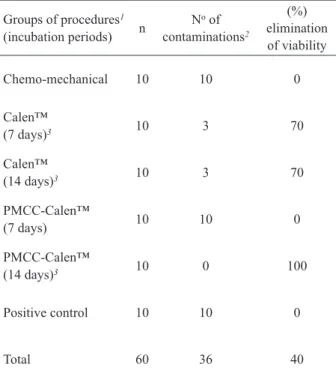
The presence of viable microorganisms after the chemo-mechanical procedures, with or without incuba-tion with intracanal medicaincuba-tions, is shown in Table 1. Crown-down instrumentation allied to the chemo-me-chanical protocol did not eliminate the enterococci grown inside dentine tissue. The chemo-mechanical treatment associated with intracanal medications presented varied capability to eliminate enterococci grown in contact with the dentin walls of the root canal system.
The use of Calen™ paste for 7 and 14 days induced the elimination of enterococci from 7 out of 10 teeth. PMCC-Calen™ demonstrated 100% elimina-tion of enterococci viability only after maintenance of paste for 14 days. There were no statistically signiicant differences (p>0.05) among these groups. However, PMCC-Calen™ maintained for 7 days was not capable to eliminate the viability of enterococci from the root canal systems. Statistically signiicant differences (p<0.00001) were observed between the groups of Calen™ for 7 and 14 days and PMCC Calen™ for 14 days, and the groups of chemo-mechanical preparation alone, control group, and PMCC-Calen™ maintained for 7 days.
Table 2 presents the diameter of growth inhibition zones observed by agar diffusion method. There were no signiicant differences (p>0.05) in zone inhibition diameters when p-chlorophenol was incorporated to calcium hydroxide pastes.
Table 1. Elimination (%) of E. faecalis from root canal systems after the different procedures.
Groups of procedures1
(incubation periods) n
No of
contaminations2
(%) elimination of viability
Chemo-mechanical 10 10 0
Calen™
(7 days)3 10 3 70
Calen™
(14 days)3 10 3 70
PMCC-Calen™
(7 days) 10 10 0
PMCC-Calen™
(14 days)3 10 0 100
Positive control 10 10 0
Total 60 36 40
1Control (n= 10 teeth) used to evaluate the external decontamination
and chamber sealing procedures performed during experiments were not included in the Table. No growth was detected in this group; 2 Number of teeth that remained with viable E. faecalis after
the indicated procedures; 3No statistically signiicant differences
were observed within the groups presenting elimination of E. faecalis viability (p >0.05). Signiicant differences were observed
between groups presenting elimination of E. faecalis viability and groups without elimination of bacterial viability (p<0.00001), calculated by chi-square test.
Table 2. Diameter of inhibition zones of Calen™ and PMCC Calen™ obtained by agar diffusion method1.
Medications Zone inhibition
(mm) 2
Standard deviation
Calen™ (n=10) 8.6 0.70
PMCC Calen™ (n=10) 9.0 0.82
1Total of ten independent experiments; 2 Differences between
DISCUSSION
Microorganisms may remain viable after end-odontic treatment inside dentinal tubules or in bioilms formed on apex area, and constitute a major cause of refractory diseases, requiring retreatment or other interventions to resolve endodontic infections (11). E. faecalis is a major bacterial species isolated from re-fractory endodontic infections (3) and was used in this study due to its high resistance to several antimicrobial agents (12). Unlike other studies in which bacterial cells grown in liquid media were used to contaminate endodontic space or agar plates for testing antimicrobial activity of pastes and cements (13), in this investiga-tion the microorganisms were grown in liquid medium containing opened teeth to permit the penetration of the bacterial strain into root canal walls and tubular dentin matrix. The subsequent changes of fresh liquid medium every 24 h within 72 h might also have allowed the microorganisms to rearrange in bioilms, which is a structure known to confer resistance of microbial cells to different antimicrobial agents (6).
In this study, the presence of even undetectable (by usual microbiological methods) viable microorgan-isms that remained encased in distal regions of dentin tubules or accessory canals, after instrumentation and insertion of calcium hydroxide pastes, were able to grow in enterococcosel broth, a selective medium for enterococci.
Different procedures make part of endodontic treatment. Progressive instrumentation and shaping of root canal are capable to eliminate a large number of viable bacteria in root canal systems (14). In the pres-ent investigation, root canal shaping along with the use of 5.25% sodium hypochlorite as an irrigant was not capable to totally eliminate the viability of enterococci, that is 100% of growth, as reported elsewhere (15). Root canal illing represents an important step of endodontic therapy, due to its sealing properties, alongside the an-timicrobial activity offered by some endodontic sealers and intracanal pastes (16). The use of sealers used in the obturation of root canal systems are object for fu-ture investigations. Due to the importance of calcium hydroxide pastes in endodontic treatment, and its use as interappointment medication, the present investiga-tion demonstrated that calcium hydroxide pastes were capable to act synergistically to shaping and chemo-mechanical preparation. Inclusion of p-chlorophenol
rendered the PMCC-Calen™ paste more effective when maintained for at least 14 days. Once phenolics are slightly acidic, the inal pH of PMCC-Calen™ might interfere with dissociation of Ca(OH)2 on its lethal form
to microorganisms (10), i.e. hydroxyl ions, inluenc -ing the viability of enterococci (17). In addition, PEG, used in both formulations employed in this study, have been used in sequestration of by products of enzyme oxidation of phenols in remediation of environmental phenol contaminations (18), and our results suggest that formulations containing PEG might also permit a slower release of the phenolic group, rendering the paste less active in initial periods of incubation in interior of root canal systems.
In the present investigation, due to the divergent results obtained with ex vivo experiments using different calcium hydroxide compositions, agar diffusion method was employed to ascertain the antimicrobial properties of both Calen™ and PMCC-Calen™ pastes. Unlike the effects observed after maintenance within the pulp space of contaminated teeth, the calcium hydroxide pastes with or without p-chlorophenol showed no dif-ferences in bacterial growth inhibition zones by the agar diffusion method, demonstrating that divergent results may be obtained by different techniques used in vitro
to evaluate the antimicrobial activity among calcium hydroxide pastes.
Controversy in the clinical use of cresol, orma-line, and p-chlorophenol compounds has arisen in the last years. In a previous study, formocresol proved to be one of the most genotoxic compounds to Syrian hamster embryo cells. Nonetheless, no signs of chromosomal aberrations were detected after incubation of Syrian hamster embryo cells with p-chlorophenol (19). Thus, association of p-chlorophenol and calcium hydroxide pastes seem to be clinically safe when used as an inter-appointment medication, and is corroborated by the fact that cultured ibroblast cells demonstrated tolerance to calcium hydroxide used as an irrigant (20). Nevertheless, studies evaluating cytotoxicity of calcium hydroxide pastes with PEG and p-chlorophenol remain necessary to ascertain the clinical safety of calcium hydroxide formulations used as interappointment medications.
In conclusion, using this in vitro methodology, calcium hydroxide pastes can be considered as impor-tant adjuvant medications in the chemo-mechanical preparation of root canals, and are capable to eliminate
resistant to calcium hydroxide. When associated with p-chlorophenol, Ca(OH)2 paste should be maintained for at least 14 days.
RESUMO
A eicácia das pastas de hidróxido de cálcio: Calen® e
Calen-PMCC® associadas ao preparo químico-mecânico, foi avaliada
sobre Enterococcus faecalis cultivados no interior dos canais radiculares. Setenta incisivos foram inseridos em caldo TSB, esterilizados e contaminados com E. faecalis. O meio de cultivo foi substituído a cada 24 h, sendo incubados a 37oC por 72 h.
Após o preparo químico-mecânico, os canais radiculares foram
preenchidos com Calen® ou Calen-PMCC® (7 ou 14 dias). As
pastas foram removidas e os dentes inseridos em tubos contendo caldo Enterococcosel. A pasta Calen® (mantida por 7 ou 14
dias) induziu a eliminação dos enterococos em 70% dos dentes, enquanto a pasta Calen-PMCC® induziu a eliminação em 100%
dos dentes, somente após a manutenção por 14 dias. Tais medi
-cações foram signiicativamente mais efetivas (p<0,001) do que
o protocolo do preparo químico-mecânico e o Calen-PMCC®
mantido por 7 dias, ambos incapazes de eliminar os enterococos.
As pastas de hidróxido de cálcio demonstraram efeitos adjuvantes
importantes na eliminação dos enterococos durante o preparo químico-mecânico dos sistemas de canais radiculares. Quando
associada ao PMCC, as pastas de hidróxido de cálcio devem ser
mantidas por pelo menos 14 dias.
ACKNOWLEDGEMENTS
This is work was supported by FAPERJ, CNPq, and CAPES. The authors Patricia E.P. Lana and Miriam F.Z. Scelza contributed equally to the study and to the preparation of this manuscript.
REFERENCES
1. Kakehashi S, Stanley HR, Fitzgerald RJ. The effects of surgical exposures of dental pulps in germ-free and conventional laboratory rats. Oral Surg Oral Med Oral Pathol 1965;20:340-349.
2. Jurcak JJ, Bellizzi R, Loushine J.Succesful single-visit
endodon-tics during operation desert ield.J Endod 1993;19:412-413.
3. Sunde PT, Olsen I, Debelian GJ, Tronstad L. Microbiota of periapi-cal lesions refractory to endodontic therapy. J Endod 2002;28:304-310.
4. Byström A, Claesson R, Sundqvist G. The antibacterial effect
of camphorated paramonoclorofenol, camphorated phenol and calcium hydroxide in the treatment of infected root canals. Endod Dent Traumatol 1985;1:170-175.
5. Estrela C, Bamman LL, Pimenta FC, Pécora JD. Control of mi-croorganisms in vitro by calcium hydroxide pastes. Int Endod J 2001;34:341-345.
6. Dunavant TR, Regan JD, Glickman GN, Solomon ES, Honey-man AL. Comparative evalution of endodontic irrigants against
Enterococcus faecalis Bioilms. J Endod2006;32:527-531. 7. Soares JA, Leonardo MR, Tanomaru Filho M, Silva LA, Ito IY.
Residual antibacterial activity of chlorhexidine digluconate and camphorated p-monochlorophenol in calcium hydroxide-based root canal dressings. Braz Dent J 2007;18:8-15.
8. Ørstavik D, Haapasalo M. Disinfection by endodontic irrigants and dressings of experimentally infected dentinal tubules. Endod Dent Traumatol 1990;6:142-149.
9. Isenberg HD, Goldberg D, Sampson J. Laboratory studies with a selective Enterococcus medium. Appl Microbiol 1970;20:433-436.
10. Gomes BPFA, Ferraz CCR, Garrido FD, Rosalen PL. Micro-bial susceptibility to Ca(OH)2 pastes and their vehicles. J Endod 2002;28:758-761.
11. Noguchi N, Noiri Y, Narimatsu M, Ebisu S. Identiication and localization of extraradicular bioilm-forming bacteria associated with refractory endodontic pathogens. Appl Environ Microbiol 2005;71:8738-8743.
12. Hunt CP. The emergence of enterococci as a cause of nosocomial infection. Br J of Biomed Sci1998;55:149-156.
13. Sedgley CM, Lennan SL, Appelbe OK. Survival of Enterococcus faecalis in root canals ex vivo. Int Endod J2005;38:735-742. 14. Card S, Sigurdsson A, Orstavik D, Trope M. The effectiveness
of increased apical enlargement in reducing intracanal bacteria. J Endod2002;28:779-83.
15. Shuping G, Ørstavik D, Sigurdsson A, Trope M. Reduction of intracanal bacteria using nickel-titanium rotary instrumentation various medications. J Endod2000;26:751-755.
16. Leonardo MR, da Silva LA, Tanomaru Filho M, Bonifácio KC. In vitro evaluation of antimicrobial activity of sealers and pastes used in endodontics. J Endod2000;26:391-394.
17. Tronstad L, Andreasen NJ, Hasselgren G, Kristerson L, Riis I. pH changes in dental tissues after root illing with calcium hydroxide. Int Endod J 1981;7:17-21.
18. Tonegawa M, Dec J, Bollag JM. Use of additive to enhance the removal of phenols from water treated with horseradish and hy-drogen peroxide. J Environl Qual2003;32:1222-1227.
19. Hagiwara M, Watanabe E, Barrett JC, Tsutsui T. Assessment of genotoxicity of 14 chemical agents used in dental practice: ability to induce chromosome aberrations in Syrian hamster embryo cells. Mutat Res2006;28:111-120.
20. Desai S, Chandler N. Calcium hydroxide-based root canal sealers: a review. J Endod 2009;35:475-480.