ABSTRACT
http://dx.doi.org/10.1590/1678-775720140032
Antibacterial effect of calcium hydroxide combined
with chlorhexidine on
Enterococcus faecalis
: a
systematic review and meta-analysis
Masoud SAATCHI
1, Ali SHOKRANEH
1, Hooman NAVAEI
2, Mohammad Reza MARACY
3, Hasan SHOJAEI
41- Torabinejad Dental Research Center, Department of Endodontics, School of Dentistry, Isfahan University of Medical Sciences, Isfahan, Iran. 2- Torabinejad Dental Research Center, School of Dentistry, Isfahan University of Medical Sciences, Isfahan, Iran.
3- Department of Biostatistics and Epidemiology, School of Public Health, Isfahan University of Medical Sciences, Isfahan, Iran. 4- Department of Microbiology, School of Medicine, Isfahan University of Medical Sciences, Isfahan, Iran.
Corresponding address: Ali Shokraneh - Department of Endodontics, School of Dentistry, Isfahan University of Medical Sciences, Isfahan, Iran. Zip Code: 8174755153 - Phone: +98-311-7922846 - Fax: +98-311-6687080 - e-mail: [email protected]
O
bjective:
Enterococcus faecalis
(
E. faecalis
) is the most frequently isolated strain in
failed endodontic therapy cases since it is resistant to calcium hydroxide (CH). Whether
a combination of CH and chlorhexidine (CHX) is more effective than CH alone against E.
faecalis is a matter of controversy. Thus, the aim of this study was to conduct a systematic
review and meta-analysis of the literature. Material and Methods: A comprehensive search
in PubMed, EMbase, EBSCOhost, The Cochrane Library, SciELO, and BBO databases,
Clinical trials registers, Open Grey, and conference proceedings from the earliest available
independent reviewers. Backward and forward search was performed and then inclusion
and exclusion criteria were applied. The included studies were divided into “comparisons”
according to the depth of sampling and dressing period of each medicament. Meta-analysis
!!"!#!$%
&' *+!'
/#
in vivo
, 18
in vitro
, 18
ex vivo
, and 4 review
articles). Nine studies were included for meta-analysis. Inter-observer agreement (Cohen
kappa) was 0.93. The included studies were divided into 21 comparisons for meta-analysis.
Chi-square test showed the comparisons were heterogeneous (p<0.001). Random effect
56+567;56
their effect on
E. faecalis
(p=0.115). Conclusions: According to the evidence available now,
;56567 56
E. faecalis
. It appears that mixing CH with CHX does not improve its
ex vivo
antibacterial
property as an intracanal medicament against
E. faecalis
. Further
in vivo
studies are
!
Keywords:
Products with antimicrobial action. Calcium hydroxide. Chlorhexidine.
Enterococcus faecalis
. Meta-analysis.
INTRODUCTION
Microbial invasion of the root canal system has an
important role in initiating and sustaining periapical
disease
41. The aim of root canal therapy is to eliminate
bacteria and their by-products from the root canal
system
74. Although chemomechanical cleaning and
Calcium hydroxide (CH) is the most commonly
used intracanal medicament in endodontics
93. It
dissociates into calcium and hydroxyl ions in an
aqueous solution. The antimicrobial property of CH is
attributed to the release of hydroxyl ions and provides
a highly alkaline environment with a pH value of
approximately 12.5
93,101. Most of the microorganisms
in infected root canals are unable to survive in the
alkaline environment
37. However, CH is not equally
effective against all the bacteria found in the root
canal
70.
Chlorhexidine gluconate (CHX) can be used in
endodontics as an irrigant and intracanal medicament
due to its biocompatibility, substantivity and wide
antimicrobial activity
17,18. The antimicrobial property
of CHX is attributed to its cationic molecule, which
is adsorbed to the negatively charged inner cell
membrane, resulting in the leakage of intracellular
components. It is an effective agent against
gram-positive and gram-negative bacteria
39. Importantly, it
is effective against microorganisms resistant to CH
90.
Enterococcus faecalis
(
E. faecalis
) is a
gram-positive facultative anaerobic bacteria species. It
is one of the most CH-resistant microorganisms
of the root canal system
100. Although it comprises
@
endodontic infections, environmental changes can be
advantageous to
E. faecalis
, resulting in persistent
infections
99. Some resistance factors of this bacterial
species are deep dentinal penetration ability
33,
high pH tolerance
19, surviving in food deprivation
condition
100, and surviving without any support from
other microbial species
70.
Many studies have attempted to compare
antibacterial effect of CH alone or in combination
with CHX. Some studies have shown an increased
antibacterial effect when CHX is added to CH
8,14,15,20,80,
in incorporating CHX
4,55,85,98. It seems that the
usefulness of mixing CH with CHX remains unclear and
controversial
61. Therefore, the aim of this systematic
review and meta-analysis was to determine whether
567 56 56
against
E. faecalis
in dentinal tubules or not.
MATERIAL AND METHODS
Review question
" ' J
developed by using the Population, Intervention,
Comparison, and Outcome (PICO) framework: Does
CH/CHX mixture (I), compared to CH alone (C), result
/UV
E. faecalis
(P) in infected dentin? Therefore, the key words
for search strategy were “
Enterococcus faecalis
”
and “
E. faecalis
” as Population, “chlorhexidine” as
Intervention, “calcium hydroxide” as Comparison,
and “antimicrobial” and “antibacterial” as Outcome.
Search strategy
A comprehensive search of the literature was
performed in Medline (PubMed), EMbase, EBSCOhost,
The Cochrane Library SciELO, and BBO databases
from the earliest available date to February 1, 2013
by an expert researcher in health and medical
sciences (HN). Also, unpublished data, abstracts,
and gray literature were sought through clinical trials
registries (Australian New Zealand Clinical Trials
Registry, Brazilian Clinical Trials Registry, Iranian
Registry of Clinical Trials, United States National
Institutes of Health, ClinicalTrials.gov, World Health
Organization International Clinical Trials Registry
Platform, and European Union EU Clinical Trials
Registry), Open Grey, and conference proceedings.
The key words were organized according to the
PICO model and were [“
Enterococcus faecalis
” OR “
E.
faecalis
”] AND chlorhexidine AND “calcium hydroxide”
AND [antimicrobial OR antibacterial]. No limitations
were implemented by country of origin, language
!"
the bibliographic software EndNote X4 (Thomson
Reuters, Carlsbad, CA, USA).
Study selection and data extraction
Two independent reviewers (MS, AS) screened
determine relevant studies which met predetermined
!^
make a clear decision, the full text was considered.
Backward and forward searches from the relevant
studies were also conducted, and the references of
relevant studies were checked as backward search.
Also, a forward search was undertaken on the titles
of the relevant studies. Articles that had cited these
%++!
scholar.google.com to identify potentially relevant
subsequent primary research.
These two independent reviewers assessed the
full texts of relevant studies based on inclusion and
exclusion criteria, which were proposed by three
professionals related to each part of the study: two
endodontists (MS, AS), an epidemiologist (MM), and
a microbiologist (HS).
Inclusion criteria were as follows:
In vivo
or
ex vivo
study using dentin block model
microbiological assessment
Human or bovine dentin
CH in combination with CHX in the CH/CHX group
CH in combination with distilled water or saline in
the CH-alone group
E. faecalis
as a strain for microbiological
assessment
Dressing period of at least 1 day
Quantitative results provided
Exclusion criteria were as follows:
Review article
Vehicles other than distilled water or saline for
CH-alone group
CH or CHX as medicament in other materials
Any intervention except medicament dressing for
bacterial elimination
Qualitative results or invalid means and standard
deviations (SD) reported
Any disagreements on study inclusion and
exclusion criteria were discussed and resolved by
consulting a third reviewer.
Data extraction, synthesis and analysis
The included studies were reviewed and divided
into “comparisons” according to dressing periods and
depths of sampling. Sample size, microbiologic unit,
depth of sampling, type and concentration of CHX,
/{V
comparison individually. A microbiological unit for two
included studies
8,98was optical density (OD) and for
other included studies it was the colony forming unit
(CFU). In order to identify the measurement scale,
the results of these two studies were transformed
from OD to CFU according to microbiological equation
(OD of 0.5 corresponding to ~5×10
8CFU/mL)
36.
The results of six included studies
4,8,15,20,55,98were
converted to the logarithm of CFU in order to achieve
identical data for meta-analysis. Since SD had not
been reported in some studies
15,55,98, it was estimated
and used for further analysis by using formula of
t-test and application of means, sample size, and p
value of each study.
Statistical analysis was performed using Stata
software version 10.0 for Windows (Stata Corp LP,
5";|}V!"
was set at 0.05. After checking the heterogeneity of
comparisons using Chi-square analysis,
Random-effect meta-analysis model was used to estimate the
combined effect. The results of these comparisons
were represented by Forest plot. The potential risk
of publication bias was evaluated using Begg’s and
Egger’s tests.
Although the antibacterial effect of medicaments
was evaluated with different depths of sampling
ranges (from 0.05 mm to 0.45 mm) in the included
studies, subgroup analysis was performed based on
the depth of sampling. Therefore, the comparisons
/!
mm) and deep (depth of sampling >0.2 mm) dentin
groups.
RESULTS
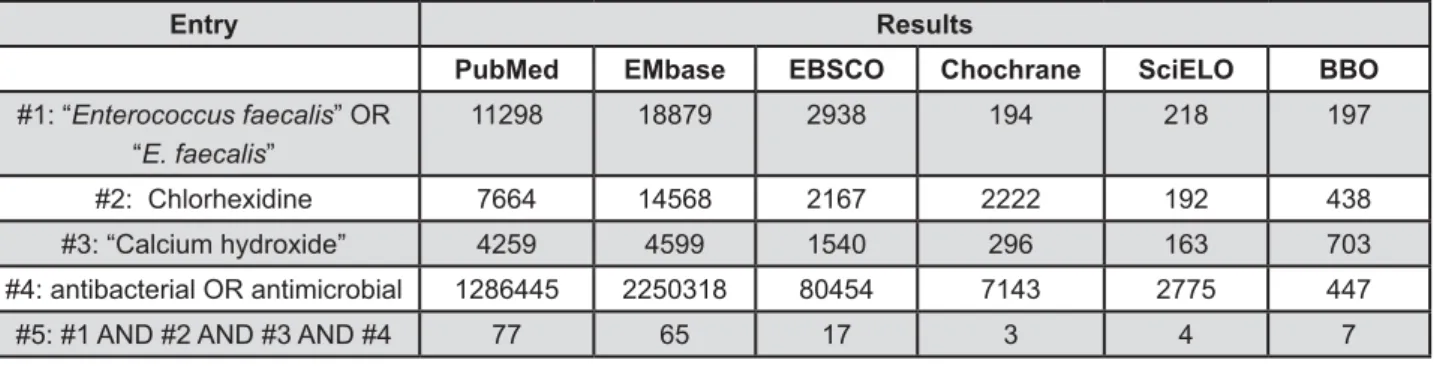
The results of the search strategy are presented in
!@
!"
(via PubMed), EMbase, EBSCOhost, The Cochrane
Library, SciELO, and BBO were 77, 65, 17, 3, 4, and
7 studies, respectively. After the primary review,
44 studies
2-8,14-16,20,22,26-30,35,40,50,52,55-57,62-64,67,68,71,72,80,85, 89,95,97,98,102,104,105,107,113-115were considered relevant,
and 40 studies
1,9,10,13,19,24,25,31,34,38,42-44,46-49,51,53,54,58-60, 65,66,69,75-79,81,83,86,94,103,106,110-112were irrelevant.
Inter-observer agreement (Cohen kappa) was 0.93.
One additional study
82was considered relevant by
backward and forward search. Thus, 45 studies
were considered as irrelevant (5
in vivo
, 18
in vitro
, 18
ex vivo
, and 4 review articles). By
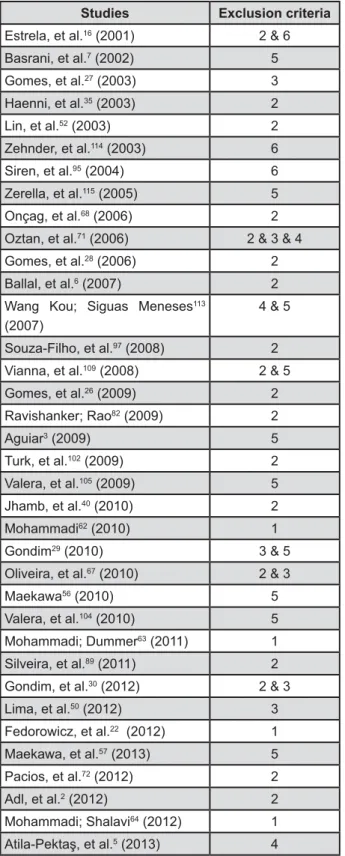
implementation of inclusion and exclusion criteria,
nine studies
4,8,14,15,20,55,80,85,98were included and 36
studies
2,3,5-7,16,22,26-30,35,40,50,52,56,57,62-64,67,68,71,72,82,89,95,97, 102,104,105,107,113-115were excluded (Figure 3).
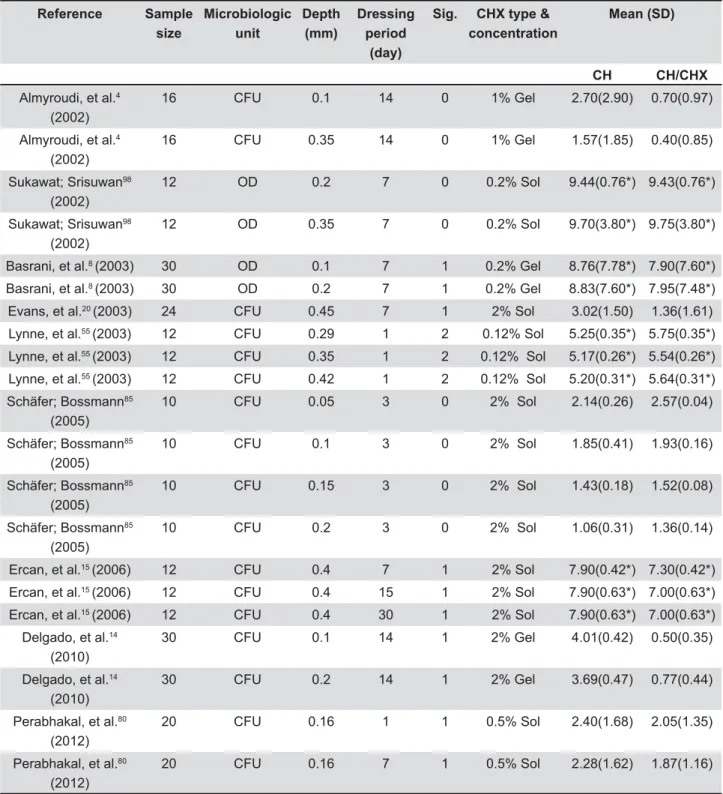
Twenty-one comparisons from the nine included
studies were extracted (Table 1). Eight comparisons
effects between CH and CH/CHX mixture; ten
of CH/CHX mixture; and 3 comparisons showed
56
E. faecalis
. The 21 comparisons were heterogeneous
/5 " 6 /V !
df=20, p<0.001). Therefore, random effect method
for combining comparison estimates was used and
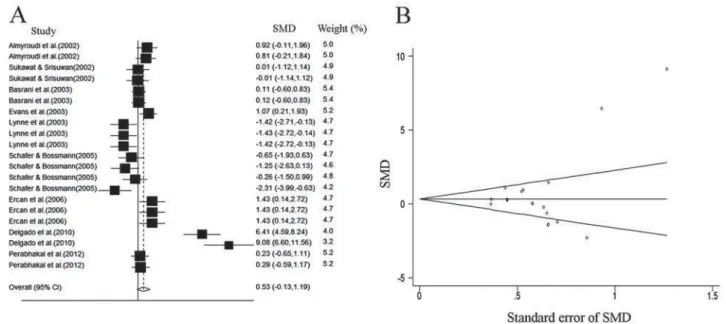
an overall estimate was produced. There were no
CH/CHX mixture and CH alone against
E. faecalis
(p=0.115) (Figure 4A).
"*
Begg’s and Egger’s tests were 0.21 (p=0.809) and
0.23 (p=0.215), respectively, which means that there
is no evidence for considerable publication bias in this
study (Figure 4B).
In addition, subgroup analysis showed no
Entry
Results
PubMed
EMbase
EBSCO
Chochrane
SciELO
BBO
#1: “
Enterococcus faecalis
” OR
“
E. faecalis
”
11298
18879
2938
194
218
197
#2: Chlorhexidine
7664
14568
2167
2222
192
438
#3: “Calcium hydroxide”
4259
4599
1540
296
163
703
#4: antibacterial OR antimicrobial
1286445
2250318
80454
7143
2775
447
#5: #1 AND #2 AND #3 AND #4
77
65
17
3
4
7
CH/CHX mixture and CH alone against
E. faecalis
in the surface (p=0.11) and deep (p=0.57) dentin
(Figures 5A and 5B).
DISCUSSION
" ; 56 567
the antibacterial property of CH as an intracanal
medicament in elimination of
E. faecalis
remains
a matter of controversy. The possible reasons for
this controversy are the differences in the methods
and materials used, including microbiological
assessments (i.e. agar diffusion method, dentin block
model etc.), concentrations and physical forms of
CHX (i.e. gel, solution), time periods of experiments,
strains and concentrations of
E. faecalis
, methods of
bacterial inoculation, methods used for placing the
medicaments, and depths of sampling.
the antimicrobial effects of intracanal medicaments,
such as dentin powder model, dentin block model,
agar diffusion method, and broth dilution method.
Agar diffusion is an
in vitro
model which has been
the most commonly used technique
91. However, it
has some critical disadvantages, including
“carry-over” effect, unknown reactions between agar plate
ingredients and the antimicrobial agent, absence of a
true correlation between the results of agar diffusion
method and the
in vivo
environment, the buffering
capacity of the agar plate compromising the capacity
of antimicrobial agent, and absence of differentiation
between bactericidal and bacteriostatic agents
33,91.
Therefore, agar diffusion method was considered as
an exclusion criterion. Dentin powder is an
ex vivo
model that has also some disadvantages, including
partial loss of microanatomical structure of the
33
,
therefore, it was also set as an exclusion criterion.
Dentin block model, another
ex vivo
model, is the
most standard method, and a statistical comparison is
somehow feasible
34. Penetration into dentinal tubules
is the most important resistance mechanism of
E.
faecalis
against antibacterial agents in endodontic
treatment
32,92. This model provides reconstruction
of the microanatomy of dentin, especially dentinal
tubules. Dentin block model also simulates the
chemical environment of the root canal and the ability
33
, therefore, it was set as an
inclusion criterion.
In general, three types of vehicles are used for
preparing CH: aqueous, viscous, and oil
21!"
group promotes a high degree of solubility when
the paste remains in direct contact with tissues and
@
21. The two other types result in the
lower solubility and diffusion of the paste within the
tissues
21. In addition, some aqueous vehicles such
as camphorated monochlorophenol have antibacterial
effect on microorganisms, therefore, vehicles other
than distilled water or saline solution for CH-alone
group was set as exclusion criteria.
Since the evaluation of antibacterial effect of
CH as an intracanal dressing was the aim of this
meta-analysis, the use of antimicrobial irrigants
in addition to the CH intracanal medication were
considered confounding factors. Some relevant
articles have presented this confounding factor as
chemomechanical preparation of the canal before CH
dressing and after microbial suspension inoculation
into the canal
3,29,56,57,104,105,108,113,115. In addition, one
study has applied chemomechanical preparation
after CH dressing
7, leading to the exclusion of these
studies.
The time needed for CH to optimally disinfect
the root canal system is still unknown and might be
related to root canal exudate, the microorganism
type, microorganism location in the root canal system,
the smear layer, and the degree of susceptibility to
the medication
28. Although Shuping, et al.
88(2000)
reported that use of CH in the canals for 1 week
resulted in a 92.5% reduction, evidence shows that
CHX has antibacterial activity against
E. faecalis
after 1 day
27,34,45. In addition, two studies showed
that CH can be effective against enterococci after
24 hours
84,96. Therefore, at least one day of dressing
period was set as an inclusion criterion. Furthermore,
the main dentinal structure of human and bovine
32. Therefore, the
results of studies using both of them were used in
the meta-analysis.
Evans, et al.
20(2003) evaluated the antibacterial
effect of CH/CHX mixture with two different depths
of sampling, but they reported one mean and
SD. Therefore, this study was considered as one
comparison and was included in the meta-analysis.
Another included study
4was divided into nine
comparisons according to different dressing periods
and depths of sampling, but seven comparisons were
excluded because of invalid means and standard
deviations.
Qualitative data are not suitable for
meta-analysis. Despite meeting all the inclusion criteria,
Studies
Exclusion criteria
Estrela, et al.
16(2001)
2 & 6
Basrani, et al.
7(2002)
5
Gomes, et al.
27(2003)
3
Haenni, et al.
35(2003)
2
Lin, et al.
52(2003)
2
Zehnder, et al.
114(2003)
6
Siren, et al.
95(2004)
6
Zerella, et al.
115(2005)
5
Onçag, et al.
68(2006)
2
Oztan, et al.
71(2006)
2 & 3 & 4
Gomes, et al.
28(2006)
2
Ballal, et al.
6(2007)
2
Wang Kou; Siguas Meneses
113(2007)
4 & 5
Souza-Filho, et al.
97(2008)
2
Vianna, et al.
109(2008)
2 & 5
Gomes, et al.
26(2009)
2
Ravishanker; Rao
82(2009)
2
Aguiar
3(2009)
5
Turk, et al.
102(2009)
2
Valera, et al.
105(2009)
5
Jhamb, et al.
40(2010)
2
Mohammadi
62(2010)
1
Gondim
29(2010)
3 & 5
Oliveira, et al.
67(2010)
2 & 3
Maekawa
56(2010)
5
Valera, et al.
104(2010)
5
Mohammadi; Dummer
63(2011)
1
Silveira, et al.
89(2011)
2
Gondim, et al.
30(2012)
2 & 3
Lima, et al.
50(2012)
3
Fedorowicz, et al.
22(2012)
1
Maekawa, et al.
57(2013)
5
Pacios, et al.
72(2012)
2
Adl, et al.
2(2012)
2
Mohammadi; Shalavi
64(2012)
1
5
(2013)
4
Figure 3-
Excluded studies with reasons for exclusion
1=Review article, 2=
In vitro
study, 3=Vehicles other than
two relevant studies
95,114were excluded because
they did not provide quantitative data. The results
of four included studies
8,14,55,98were illustrated in
charts. Therefore, quantitative data were extracted
from the illustrated charts using Adobe Photoshop
software 5.0 (Adobe Systems, Mountain View, CA,
USA) for Windows. To achieve more reliable data, a
300% zoom was used.
The greatest difference in the antibacterial activity
of CH/CHX and CH groups has been reported in the
study performed by Delgado, et al.
14(2010). This
might be due to longer dressing period, sample size,
type and concentration of CHX compared with other
studies.
In the present study, Cochran Q Test of
Homogeneity showed that the 21 comparisons were
Reference
Sample
size
Microbiologic
unit
Depth
(mm)
Dressing
period
(day)
Sig.
CHX type &
concentration
Mean (SD)
CH
CH/CHX
Almyroudi, et al.
4(2002)
16
CFU
0.1
14
0
1% Gel
2.70(2.90)
0.70(0.97)
Almyroudi, et al.
4(2002)
16
CFU
0.35
14
0
1% Gel
1.57(1.85)
0.40(0.85)
Sukawat; Srisuwan
98(2002)
12
OD
0.2
7
0
0.2% Sol
9.44(0.76*)
9.43(0.76*)
Sukawat; Srisuwan
98(2002)
12
OD
0.35
7
0
0.2% Sol
9.70(3.80*)
9.75(3.80*)
Basrani, et al.
8(2003)
30
OD
0.1
7
1
0.2% Gel
8.76(7.78*)
7.90(7.60*)
Basrani, et al.
8(2003)
30
OD
0.2
7
1
0.2% Gel
8.83(7.60*)
7.95(7.48*)
Evans, et al.
20(2003)
24
CFU
0.45
7
1
2% Sol
3.02(1.50)
1.36(1.61)
Lynne, et al.
55(2003)
12
CFU
0.29
1
2
0.12% Sol
5.25(0.35*)
5.75(0.35*)
Lynne, et al.
55(2003)
12
CFU
0.35
1
2
0.12% Sol
5.17(0.26*)
5.54(0.26*)
Lynne, et al.
55(2003)
12
CFU
0.42
1
2
0.12% Sol
5.20(0.31*)
5.64(0.31*)
Schäfer; Bossmann
85(2005)
10
CFU
0.05
3
0
2% Sol
2.14(0.26)
2.57(0.04)
Schäfer; Bossmann
85(2005)
10
CFU
0.1
3
0
2% Sol
1.85(0.41)
1.93(0.16)
Schäfer; Bossmann
85(2005)
10
CFU
0.15
3
0
2% Sol
1.43(0.18)
1.52(0.08)
Schäfer; Bossmann
85(2005)
10
CFU
0.2
3
0
2% Sol
1.06(0.31)
1.36(0.14)
Ercan, et al.
15(2006)
12
CFU
0.4
7
1
2% Sol
7.90(0.42*)
7.30(0.42*)
Ercan, et al.
15(2006)
12
CFU
0.4
15
1
2% Sol
7.90(0.63*)
7.00(0.63*)
Ercan, et al.
15(2006)
12
CFU
0.4
30
1
2% Sol
7.90(0.63*)
7.00(0.63*)
Delgado, et al.
14(2010)
30
CFU
0.1
14
1
2% Gel
4.01(0.42)
0.50(0.35)
Delgado, et al.
14(2010)
30
CFU
0.2
14
1
2% Gel
3.69(0.47)
0.77(0.44)
Perabhakal, et al.
80(2012)
20
CFU
0.16
1
1
0.5% Sol
2.40(1.68)
2.05(1.35)
Perabhakal, et al.
80(2012)
20
CFU
0.16
7
1
0.5% Sol
2.28(1.62)
1.87(1.16)
Table 1-
Comparisons within 9 included studies
heterogeneous. This might be due to differences
in subjects (human or bovine dentin), method of
medicament placement, dressing period, depth of
sampling, and type and concentration of CHX.
Meta-analysis is a research tool designed to
analyze and combine the inconsistent results of
controversial subjects, particularly with those of
randomized clinical trials. However, this method
has been applied to
in vitro
studies
23,73,87,107. Since
there were no clinical trials on the subject of this
systematic review,
in vitro
studies had to be selected.
Therefore, only
ex vivo
dentin block model studies
were selected, which have the greatest similarity
to clinical conditions. This model, in comparison
to other microbiological assessment models, is of
high methodological quality and can simulate the
clinical situation in the best way possible. On the
other hand, the effectiveness of the medicament
in
vivo
can be reduced by a variety of factors. These
include problems in delivery, low overall volume,
poor/incomplete penetration in the main root canal
system, poor penetration into dentin, short contact
time, or inactivation of the activity of the antibacterial
agent by one or more of the chemical compounds
present in the necrotic root canal.
The results of the present meta-analysis showed
that CHX does not increase the antibacterial effect
of CH. This may be due to deprotonation of CHX at
high pH, which reduces its solubility and alters its
interaction with bacterial surfaces as a result of the
altered charge of the molecule
64.
In conclusion it appears that mixing CH with CHX
does not improve its
ex vivo
antibacterial property as
an intracanal medicament against
E. faecalis
. Further
in vivo
!
Figure 4-
A: Forest plot for antibacterial effect of medicaments on
E. faecalis
. The box, its size and the horizontal line show
/[ <<<] q{| ?[ /< </ ? }
\[ < < \ [[ [[ ~ <! ]q{|
limit for antibacterial effect of medicaments on
E. faecalis
. The plot shows a low risk of publication bias among the included
articles. SMD: Standardized Mean Differentiation
Figure 5-
A and B: Forest plots for antibacterial effect of medicaments against
E. faecalis
in surface and deep dentin
ACKNOWLEDGMENTS
This study was supported by Isfahan University
of Medical Sciences, Iran (grant no. 291230). The
@!
REFERENCES
1- Abdullah M, Ng YL, Gulabivala K, Moles DR, Spratt DA. Susceptibilties of two Enterococcus faecalis phenotypes to root canal medications. J Endod. 2005;31:30-6.
2- Adl A, Shojaee NS, Motamedifar M. A comparison between the antimicrobial effects of triple antibiotic paste and calcium hydroxide against Enterococcus faecalis. Iran Endod J. 2012;7:149-55. 3- Aguiar APS. Ação in vitro do extrato glicólico de gengibre e medicamentos sobre Candida albicans, Enterococcus faecalis,
Escherichia coli e sua endotoxina em canais radiculares [Masters
Degree]. São José dos Campos: Univ. Estadual Paulista - UNESP; 2009. Available from: http://www.athena.biblioteca.unesp.br/ exlibris/bd/bsj/33004145070P8/2009/aguiar_aps_me_sjc.pdf. 4- Almyroudi A, Mackenzie D, McHugh S, Saunders WP. The effectiveness of various disinfectants used as endodontic intracanal medications: an in vitro study. J Endod. 2002;28:163-7.
#'}'**{U!} effects of root canal medicaments against Enterococcus faecalis and
Streptococcus mutans. Int Endod J. 2013;46:413-8.
6- Ballal V, Kundabala M, Acharya S, Ballal M. Antimicrobial action of calcium hydroxide, chlorhexidine and their combination on endodontic pathogens. Aust Dent J. 2007;52:118-21.
7- Basrani B, Santos JM, Tjäderhane L, Grad H, Gorduysus O, Huang J, et al. Substantive antimicrobial activity in chlorhexidine-treated human root dentin. Oral Surg Oral Med Oral Pathol Oral Radiol Endod. 2002;94:240-5.
8- Basrani B, Tjäderhane L, Santos JM, Pascon E, Grad H, Lawrence 6!&;';' medicaments against Enterococcus faecalis in vitro. Oral Surg Oral Med Oral Pathol Oral Radiol Endod. 2003;96:618-24.
9- Bhardwaj A, Ballal S, Velmurugan N. Comparative evaluation of the antimicrobial activity of natural extracts of Morinda citrifolia, papain and aloe vera (all in gel formulation), 2% chlorhexidine gel and calcium hydroxide, against Enterococcus faecalis: an in vitro study. J Conserv Dent. 2012;15:293-7.
10- Bozza FL, Molgatini SL, Pérez SB, Tejerina DP, Pérez Tito RI, Kaplan AE. Antimicrobial effect in vitro of chlorhexidine and calcium hydroxide impregnated gutta-percha points. Acta Odontol Latinoam. 2005;18:51-6.
'}5$J!" of camphorated paramonochlorophenol, camphorated phenol and calcium hydroxide in the treatment of infected root canals. Dent Traumatol. 1985;1:170-5.
'}J! of mechanical root canal instrumentation in endodontic therapy. Scand J Dent Res. 1981;89:321-8.
13- Cook J, Nandakumar R, Fouad AF. Molecular- and culture-based comparison of the effects of antimicrobial agents on bacterial survival in infected dentinal tubules. J Endod. 2007;33:690-2.
14- Delgado RJ, Gasparoto TH, Sipert CR, Pinheiro CR, Moraes IG, Garcia RB, et al. Antimicrobial effects of calcium hydroxide and chlorhexidine on Enterococcus faecalis. J Endod. 2010;36:1389-93. #' & & { { 5"!In vitro assessment of the effectiveness of chlorhexidine gel and calcium hydroxide paste with chlorhexidine against Enterococcus faecalis and Candida albicans. Oral Surg Oral Med Oral Pathol Oral Radiol Endod. 2006;102:e27-31. 16- Estrela C, Bammann LL, Pimenta FC, Pécora JD. Control of microorganisms in vitro by calcium hydroxide pastes. Int Endod J. 2001;34:341-5.
17- Estrela CR, Estrela C, Reis C, Bammann LL, Pécora JD. Control of microorganisms in vitro by endodontic irrigants. Braz Dent J. 2003;14:187-92.
'&5;"}!} of calcium hydroxide and chlorhexidine gluconate irrigants at 37 degrees C and 46 degrees C. J Endod. 2004;30:653-7.
19- Evans M, Davies J, Sundqvist G, Figdor D. Mechanisms involved in the resistance of Enterococcus faecalis to calcium hydroxide. Int Endod J. 2002;35:221-8.
'&{5*|7"!& calcium hydroxide: chlorhexidine paste as an intracanal medication in bovine dentin. J Endod. 2003;29:338-9.
'$!5;% and clinical indications. Int Endod J. 1999;32:257-82.
22- Fedorowicz Z, Nasser M, Sequeira-Byron P, Souza RF, Carter B, Heft M. Irrigants for non-surgical root canal treatment in mature permanent teeth. Cochrane Database Syst Rev 2012;9:CD008948. 23- Finnema KJ, Özcan M, Post WJ, Ren Y, Dijkstra PU. In-vitro orthodontic bond strength testing: a systematic review and meta-analysis. Am J Orthod Dentofac Orthop. 2010;137:615-22. e3. 24- Fouad AF, Barry J. The effect of antibiotics and endodontic antimicrobials on the polymerase chain reaction. J Endod. 2005;31:510-3.
25- Gomes BP, Ferraz CC, Garrido FD, Rosalen PL, Zaia AA, Teixeira FB, et al. Microbial susceptibility to calcium hydroxide pastes and their vehicles. J Endod. 2002;28:758-61.
26- Gomes BP, Montagner F, Berber VB, Zaia AA, Ferraz CC, Almeida JF, et al. Antimicrobial action of intracanal medicaments on the external root surface. J Dent. 2009;37:76-81.
27- Gomes BP, Souza SF, Ferraz CC, Teixeira FB, Zaia AA, Valdrighi L, et al. Effectiveness of 2% chlorhexidine gel and calcium hydroxide against Enterococcus faecalis in bovine root dentine in vitro. Int Endod J. 2003;36:267-75.
28- Gomes BP, Vianna ME, Sena NT, Zaia AA, Ferraz CC, Souza Filho FJ. In vitro evaluation of the antimicrobial activity of calcium hydroxide combined with chlorhexidine gel used as intracanal medicament. Oral Surg Oral Med Oral Pathol Oral Radiol Endod. 2006;102:544-50.
'U!& + da pasta de hidróxido de cálcio associada à clorexidina como medicação intracanal no tratamento de dentes decíduos humanos com polpa necrótica [PhD]. Araraquara: Univ. Estadual Paulista – UNESP; 2010. Available from: http://www.athena.biblioteca.unesp. br/exlibris/bd/boa/33004030010P2/2010/gondim_jo_dr_arafo.pdf. 30- Gondim JO, Avaca-Crusca JS, Valentini SR, Zanelli CF, Spolidorio DM, Giro EM. Effect of a calcium hydroxide/chlorhexidine paste as intracanal dressing in human primary teeth with necrotic pulp against Porphyromonas gingivalis and Enterococcus faecalis. Int J Paediatr Dent. 2012;22:116-24.
31- Gurgel-Filho ED, Vivacqua-Gomes N, Gomes BP, Ferraz CC, Zaia AA, Souza-Filho FJ. In vitro evaluation of the effectiveness of the chemomechanical preparation against Enterococcus faecalis after single- or multiple-visit root canal treatment. Braz Oral Res. 2007;21:308-13.
32- Haapasalo M, Ørstavik D. In vitro infection and of dentinal tubules. J Dent Res. 1987;66:1375-9.
33- Haapasalo M, Qian W. Irrigants and intracanal medicaments. In: Ingle JI, Bakland LK, Baumgartner JC, editors. Endodontics. 6th ed. Hamilton: BC Decker; 2008. p. 996.
34- Haapasalo H, Sirén E, Waltimo T, Ørstavik D, Haapasalo MP. Inactivation of local root canal medicaments by dentine: an in vitro study. Int Endod J. 2000;33:126-31.
35- Haenni S, Schmidlin PR, Mueller B, Sener B, Zehnder M. Chemical and antimicrobial properties of calcium hydroxide mixed with irrigating solutions. Int Endod J. 2003;36:100-5.
36- Heikens E, Bonten MJM, Willems RJ. Enterococcal surface protein
& Enterococcus faecium
E1162. J Bacteriol. 2007;189:8233-40.
38- Heling I, Steinberg D, Kenig S, Gavrilovich I, Sela M, Friedman !&; and Ca (OH)2 in preventing secondary infection of dentinal tubules.
Int Endod J. 1992;25:20-4.
39- Jeansonne MJ, White RR. A comparison of 2.0% chlorhexidine gluconate and 5.25% sodium hypochlorite as antimicrobial endodontic irrigants. J Endod. 1994;20:276-8.
40- Jhamb S, Nikhil V, Singh V. An in vitro study of antibacterial effect of calcium hydroxide and chlorhexidine on Enterococcus faecalis. Indian J Dent Res. 2010;21:512-4.
41- Kakehashi S, Stanley HR, Fitzgerald RJ. The effects of surgical exposures of dental pulps in germ-free and conventional laboratory rats. Oral Surg Oral Med Oral Pathol. 1965;20:340-9.
42- Kandaswamy D, Venkateshbabu N, Gogulnath D, Kindo AJ. Dentinal tubule disinfection with 2% chlorhexidine gel, propolis, morinda citrifolia juice, 2% povidone iodine, and calcium hydroxide. Int Endod J. 2010;43:419-23.
43- Kayaoglu G, Erten H, Ørstavik D. Possible role of the adhesin ace and collagen adherence in conveying resistance to disinfectants on Enterococcus faecalis. Oral Microbiol Immunol. 2008;23:449-54. '¡6}*¡* al. Antibacterial activity of Propolis versus conventional endodontic disinfectants against Enterococcus faecalis in infected dentinal tubules. J Endod. 2011;37:376-81.
45- Komorowski R, Grad H, Yu Wu X, Friedman S. Antimicrobial substantivity of chlorhexidine-treated bovine root dentin. J Endod. 2000;26:315-7.
46- Krithikadatta J, Indira R, Dorothykalyani AL. Disinfection of dentinal tubules with 2% chlorhexidine, 2% metronidazole, bioactive glass when compared with calcium hydroxide as intracanal medicaments. J Endod. 2007;33:1473-6.
47- Lee JK, Park YJ, Kum KY, Han S, Chang SW, Kaufman B, et ! } ¢''
an Enterococcus faecalis dentine infection model. Int Endod J.
2013;46:406-12.
48- Lee Y, Han SH, Hong SH, Lee JK, Ji H, Kum KY. Antimicrobial
;in vitro
model of Enterococcus faecalis dentinal tubule infection. J Endod. 2008;34:855-8.
49- Lenet BJ, Komorowski R, Wu XY, Huang J, Grad H, Lawrence HP, et al. Antimicrobial substantivity of bovine root dentin exposed to different chlorhexidine delivery vehicles. J Endod. 2000;26:652-5. 50- Lima RK, Guerreiro-Tanomaru JM, Faria-Júnior NB, Tanomaru-Filho M. Effectiveness of calcium hydroxide-based intracanal medicaments against Enterococcus faecalis. Int Endod J. 2012;45:311-6.
51- Lin S, Levin L, Weiss EI, Peled M, Fuss Z. In vitro antibacterial ;'! Int. 2006;37:391-4.
52- Lin YH, Mickel AK, Chogle S. Effectiveness of selected materials against Enterococcus faecalis: part 3. The antibacterial effect of calcium hydroxide and chlorhexidine on Enterococcus faecalis. J Endod. 2003;29:565-6.
#' {* & 5 5 R. Antimicrobial effectiveness of intracanal medicaments on Enterococcus faecalis: chlorhexidine versus octenidine. Int Endod J. 2012;46:53-61.
54- Lui JN, Sae-Lim V, Song KP, Chen NN. In vitro antimicrobial effect of chlorhexidine-impregnated gutta percha points on Enterococcus faecalis. Int Endod J. 2004;37:105-13.
55- Lynne RE, Liewehr FR, West LA, Patton WR, Buxton TB, McPherson JC. In vitro antimicrobial activity of various medication preparations on E. faecalis in root canal dentin. J Endod. 2003;29:187-90. 56- Maekawa LE. Avaliação dos extratos de própolis e de gengibre como medicação intracanal sobre microrganismos e endotoxinas em canais radiculares [PhD]. São José dos Campos: Univ Estadual Paulista – UNESP; 2010. Available from: http://www.athena. biblioteca.unesp.br/exlibris/bd/bsj/33004145070P8/2010/ maekawa_le_dr_sjc.pdf.
57- Maekawa LE, Valera MC, Oliveira LD, Carvalho CAT, Camargo CH, Jorge AO. Effect of =LQJLEHURI¿FLQDOH and propolis on microorganisms and endotoxins in root canals. J Appl Oral Sci. 2013;21:25-31. 58- Maia Filho EM, Maia CCR, Bastos ACSC, Novais TMG. In vitro antimicrobial effect of different endodontic materials and propolis
on Enterococcus faecalis. RGO. 2008;56:21-5.
59- Mattigati S, Ratnakar P, Moturi S, Varma S, Rairam S. Antimicrobial effect of conventional root canal medicaments vs propolis against Enterococcus faecalis, Staphylococcus aureus and
Candida albicans. J Contemp Dent Prac. 2012;13:305-9.
60- Menezes M, Valera M, Jorge A, Koga-Ito C, Camargo C, Mancini M. In vitro evaluation of the effectiveness of irrigants and intracanal medicaments on microorganisms within root canals. Int Endod J. 2004;37:311-9.
61- Metzger Z, Basrani B, Goodis H. Instruments, materials, and devices. In: Hargreaves KM, Cohen S, editors. Pathways of the pulp. 10th ed. St. Louis: Mosby; 2011. p. 283-348.
62- Mohammadi Z. Chemomechanical strategies to manage endodontic infections. Dent Today. 2010;29:91-2, 4, 6 passim; quiz 9.
63- Mohammadi Z, Dummer PM. Properties and applications of calcium hydroxide in endodontics and dental traumatology. Int Endod J. 2011;44:697-730.
64- Mohammadi Z, Shalavi S. Is chlorhexidine an ideal vehicle for calcium hydroxide? A microbiologic review. Iran Endod J. 2012;7:115-22.
65- Neelakantan P, Sanjeev K, Subbarao CV. Duration-dependent susceptibility of endodontic pathogens to calcium hydroxide and chlorhexidene gel used as intracanal medicament: an in vitro evaluation. Oral Surg Oral Med Oral Pathol Oral Radiol Endod. 2007;104:e138-41.
66- Noetzel J, Nonhoff J, Bitter K, Wagner J, Neumann K, Kielbassa }!&;&%} against Enterococcus faecalis in root canals. Am J Dent. 2009;22:14-8.
£¤'U5}$|$¥¦^§J!^@ of serum and necrotic soft tissue on the antimicrobial effects of intracanal medicaments. Braz Dent J. 2010;21:295-300.
£' U¦ U 5 { | }! & medicaments against Enterococcus faecalis in primary teeth: an in vivo study. J Clin Pediatr Dent. 2006;30:233-7.
£'U¦U5{|}*!& an intracanal medicament against Enterococcus faecalis. Gen Dent. 2006;54:319-22.
70- Ørstavik D, Haapasalo M. Disinfection by endodontic irrigants and dressings of experimentally infected dentinal tubules. Dent Traumatol. 1990;6:142-9.
71- Oztan MD, Kiyan M, Gerçeker D. Antimicrobial effect, in vitro, of gutta-percha points containing root canal medications against yeasts and Enterococcus faecalis. Oral Surg Oral Med Oral Pathol Oral Radiol Endod. 2006;102:410-6.
72- Pacios MG, Silva C, López ME, Cecilia M. Antibacterial action of calcium hydroxide vehicles and calcium hydroxide pastes. J Invest Clin Dent. 2012;3:264-70.
73- Papia E, Larsson C, du Toit M, Vult von Steyern P. Bonding between oxide ceramics and adhesive cement systems: a systematic review. J Biomed Mater Res B Appl Biomater. 2014;102:395-413. 74- Peters L, Wesselink P, Moorer W. The fate and the role of bacteria left in root dentinal tubules. Int Endod J. 1995;28:95-9.
75- Piovesani JF, Semenoff-Segundo A, Pedro FL, Borges ÁH, Neves ANP, Mamede Neto I, et al. Capacidade antimicrobiana de diferentes medicações intracanais sobre o Enterococcus faecalis. Dent Press Endod. 2012;2:53-8.
76- Podbielski A, Boeckh C, Haller B. Growth inhibitory activity of gutta-percha points containing root canal medications on common endodontic bacterial pathogens as determined by an optimized quantitative in vitro assay. J Endod. 2000;26:398-403.
78- Portenier I, Haapasalo H, Rye A, Waltimo T, Ørstavik D, Haapasalo M. Inactivation of root canal medicaments by dentine, hydroxylapatite and bovine serum albumin. Int Endod J. 2001;34:184-8.
79- Portenier I, Waltimo T, Ørstavik D, Haapasalo M. The susceptibility of starved, stationary phase, and growing cells of Enterococcus
faecalis to endodontic medicaments. J Endod. 2005;31:380-6.
80- Prabhakar A, Hadakar SG, Raju OS. Comparative evaluation of pH and antibacterial effect of various calcium hydroxide combinations on E. faecalis and its effect on root strength: an in vitro study. Contemp Clin Dent. 2012;3:42-7.
81- Queiroz AM, Nelson-Filho P, Silva LA, Assed S, Silva RA, Ito ^!} teeth: zinc oxide and eugenol cement, Calen paste thickened with zinc oxide, Sealapex and EndoREZ. Braz Dent J. 2009;20:290-6. '$*$5!} hydroxide formulations and chlorhexidine gel using agar diffusion model [online]. Internet J Dent Sci. 2009;8(1). Available from: http://ispub.com/IJDS/8/1/7932.
83- Roach RP, Hatton JF, Gillespie MJ. Prevention of the ingress of a known virulent bacterium into the root canal system by intracanal medications. J Endod. 2001;27:657-60.
84- Safavi KE, Spngberg LSW, Langeland K. Root canal dentinal tubule disinfection. J Endod. 1990;16:207-10.
#'¨&!} ; and two calcium hydroxide formulations against Enterococcus faecalis. J Endod. 2005;31:53-6.
86- Schirrmeister JF, Liebenow AL, Braun G, Wittmer A, Hellwig E, Al-Ahmad A. Detection and eradication of microorganisms in root-%! Endod. 2007;33:536-40.
87- Shahravan A, Haghdoost AA, Adl A, Rahimi H, Shadifar F. Effect of smear layer on sealing ability of canal obturation: a systematic review and meta-analysis. J Endod. 2007;33:96-105.
88- Shuping GB, Orstavik D, Sigurdsson A, Trope M. Reduction of intracanal bacteria using nickel-titanium rotary instrumentation and various medications. J Endod. 2000;26:751-5.
89- Silveira CF, Cunha RS, Fontana CE, Martin AS, Gomes BP, Motta RH, et al. Assessment of the antibacterial activity of calcium hydroxide combined with chlorhexidine paste and other intracanal medications against bacterial pathogens. Eur J Dent. 2011;5:1-7. 90- Siqueira JF Jr, Batista MM, Fraga RC, Uzeda M. Antibacterial effects of endodontic irrigants on black-pigmented gram-negative anaerobes and facultative bacteria. J Endod. 1998;24:414-6. 91- Siqueira JF Jr, de Uzeda M. Intracanal medicaments: evaluation of the antibacterial effects of chlorhexidine, metronidazole, and calcium hydroxide associated with three vehicles. J Endod. 1997;23:167-9.
92- Siqueira JF Jr, de Uzeda M, Fonseca ME. A scanning electron microscopic evaluation of in vitro dentinal tubules penetration by selected anaerobic bacteria. J Endod. 1996;22:308-10.
93- Siqueira JF Jr, Lopes H. Mechanisms of antimicrobial activity of calcium hydroxide: a critical review. Int Endod J. 1999;32:361-9. 94- Siqueira JF Jr, Paiva SS, Rôças IN. Reduction in the cultivable bacterial populations in infected root canals by a chlorhexidine-based antimicrobial protocol. J Endod. 2007;33:541-7.
95- Siren EK, Haapasalo MP, Waltimo TM, Orstavik D. In vitro antibacterial effect of calcium hydroxide combined with chlorhexidine or iodine potassium iodide on Enterococcus faecalis. Eur J Oral Sci. 2004;112:326-31
£'©|{ª J!" effect of calcium hydroxide as a short-term intracanal dressing. Int Endod J. 2007;24:119-25.
97- Souza-Filho FJ, Soares AJ, Vianna ME, Zaia AA, Ferraz CC, Gomes BP. Antimicrobial effect and pH of chlorhexidine gel and calcium hydroxide alone and associated with other materials. Braz Dent J. 2008;19:28-33.
98- Sukawat C, Srisuwan T. A comparison of the antimicrobial ; infected with Enterococcus faecalis. J Endod. 2002;28:102-4.
99- Sundqvist G. Ecology of the root canal flora. J Endod. 1992;18:427-30.
'J{©|! analysis of teeth with failed endodontic treatment and the outcome of conservative re-treatment. Oral Surg Oral Med Oral Pathol Oral Radiol Endod. 1998;85:86-93.
101- Tronstad L, Andreasen JO, Hasselgren G, Kristerson L, Riis I. 6 hydroxide. J Endod. 1981;7:17-21.
102- Turk BT, Sen BH, Ozturk T. In vitro antimicrobial activity of calcium hydroxide mixed with different vehicles against Enterococcus faecalis and Candida albicans. Oral Surg Oral Med Oral Pathol Oral Radiol Endod. 2009;108:297-301
103- Vaghela DJ, Kandaswamy D, Venkateshbabu N, Jamini N, Ganesh A. Disinfection of dentinal tubules with two different formulations of calcium hydroxide as compared to 2% chlorhexidine: as intracanal medicaments against Enterococcus faecalis and Candida albicans: an in vitro study. J Conserv Dent. 2011;14:182-6. 104- Valera MC, Salvia AC, Maekawa LE, Camargo SE, Carvalho CA, Camargo CH, et al. Antimicrobial analysis of chlorhexidine gel and intracanal medicaments against microorganisms inoculated in root canals. Minerva Stomatol. 2010;59:415-21.
105- Valera MC, Silva KC, Maekawa LE, Carvalho CA, Koga-Ito CY, Camargo CH, et al. Antimicrobial activity of sodium hypochlorite associated with intracanal medication for Candida albicans and Enterococcus faecalis inoculated in root canals. J Appl Oral Sci. 2009;17:555-9.
106- Van der Waal SV, Jiang LM, de Soet JJ, van der Sluis LW, Wesselink PR, Crielaard W. Sodium chloride and potassium sorbate: a synergistic combination against Enterococcus faecalis % in vitro study. Eur J Oral Sci. 2012;120:452-7.
107- Vanajasan PP, Dhakshinamoorthy M, Rao CS. Factors affecting the bond strength of self-etch adhesives: a meta-analysis of literature. J Conserv Dent. 2011;14:62-7.
'&!& with chlorhexidine against Enterococcus faecalis in vitro. Oral Surg Oral Med Oral Pathol Oral Radiol Endod. 2009;107:585-9. 109- Vianna ME, Horz HP, Conrads G, Feres M, Gomes BP. Comparative analysis of endodontic pathogens using checkerboard hybridization in relation to culture. Oral Microbiol Immunol. 2008;23:282-90.
110- Vidya S. Old and novel intracanal medicaments against Candida albicans. Aust Dent J. 2007;52:257.
111- Vivacqua-Gomes N, Gurgel-Filho ED, Gomes BP, Ferraz CC, Zaia AA, Souza-Filho FJ. Recovery of Enterococcus faecalis after single- or multiple-visit root canal treatments carried out in infected teeth ex vivo. Int Endod J. 2005;38:697-704.
'5}$$"";!5 of 2% chlorhexidine gel in reducing intracanal bacteria. J Endod. 2007;33:1283-9.
113- Wang Kou LV, Siguas Meneses DM. Comparative study of the antibacterial effects of the association of chlorhexidine 2% solution, calcium hydroxide, points of calcium hydroxide and points of chlorhexidine against Enterococcus faecalis. Kiru. 2007;4:14-6. 114- Zehnder M, Grawehr M, Hasselgren G, Waltimo T. Tissue-dissolution capacity and dentin-disinfecting potential of calcium hydroxide mixed with irrigating solutions. Oral Surg Oral Med Oral Pathol Oral Radiol Endod. 2003;96:608-13.