ORIGINAL ARTICLE DOI: 10.5007/1980-0037.2011v13n6p442
Abstract – This study aimed to identify the prevalence of self-reported diabetes mellitus in the older adults in Florianópolis and its relationship with being overweight. 857 older adults took part in the study. Sociodemographic (sex, age group, schooling, monthly in-come), anthropometric (weight, height), usual physical activity, arterial hypertension and diabetes mellitus information was collected. The Body Mass Index (BMI) was adopted to diagnose the overweight. The adjustment variables were: sociodemographic, usual physical activity and arterial hypertension. The prevalence of diabetes mellitus was 13.5% (male = 12.1%; female = 14.8%; p<0.05) and the overweight was 59.4% (male = 58.0%; female = 60.7%; p=0.40). A higher prevalence of diabetes mellitus was observed in the older adults who were overweight. The overweight was positively associated with diabetes, regardless of sex, age, schooling, monthly income, usual physical activity and arterial hypertension. One can conclude that overweight in the older adults in Florianopolis was an independent factor and positively associated with diabetes mellitus.
Key words: Aged; Body Mass Index; Diabetes Mellitus; Nutritional Status; Overweight.
Resumo – O objetivo do estudo foi identiicar a prevalência de diabetes mellitus auto-referida em idosos de Florianópolis e sua relação com excesso de peso. Participaram do estudo 875 idosos. Foram coletadas informações sociodemográicas (sexo, grupo etário, escolaridade, renda mensal), antropométricas (massa corporal, estatura), atividade física habitual, hipertensão arterial e diabetes mellitus. Adotou-se o Índice de Massa Corporal para diagnosticar o excesso de peso. As variáveis de ajuste foram: sociodemográicas, atividade física habitual e hipertensão arterial. A prevalência de diabetes mellitus foi de 13,5% (masculino = 12,1%; feminino = 14,8%; p<0,05) e a de excesso de peso foi de 59,4% (masculino = 58,0%; feminino = 60,7%; p=0,40). Maior prevalência de diabetes mellitus foi observada nos idosos com excesso de peso. O excesso de peso foi positivamente associado à diabetes, independentemente do sexo, idade, escolaridade, renda mensal, atividade física habitual e hipertensão arterial. Conclui-se que o excesso de peso em idosos de Florianópolis foi fator independente e positivamente associado à diabetes mellitus. Palavras-chave: Diabetes mellitus; Estado nutricional; Idoso; Índice de massa corporal; Sobrepeso. 1 Universidade do Estado
de Santa Catarina. Centro de Ciências da Saúde e do Esporte. De-partamento de Educação Física. Florianópolis, SC. Brasil.
2 Universidade Estadual do Sudoeste da Bahia. Departamento de Edu-cação Física. Jequié, BA. Brasil.
3 Universidade Federal de Santa Catarina. Centro de Desportos. Programa de Pós-Graduação em Educação Física. Floria-nópolis, SC. Brasil.
Received: 05 August 2011 Accepted: 22 October 2011
CC $ =
1 2 3 3
Andreia Pelegrini Raildo da Silva Coqueiro Edio Luis Petroski Tania R. Bertoldo Benedetti
Self-reported diabetes mellitus and its association
with overweight in older adults
Diabetes
mellitus
auto-referido e sua associação com excesso
Adopting a lifestyle with inappropriate eating habits and low levels of physical activity together with an aging population are factors responsible for the chronic diseases considered to be the main cause of death in the world1. Among these
chro-nic diseases, diabetes mellitus represents a serious problem of public health in both developed and developing countries, which entails high costs for the Brazilian Unique Health System (SUS), due to the number of hospitalizations, mainly owing to the global increase in its prevalence2.
According to the data published, the number of diabetics in the world increased from 171 million in 2000 to 366 million in 2030. Regarding the Brazilian scenario, it can be noted that approximately 11.3 million people will be diabetic3. This increase will
mainly occur in the most advanced age ranges1. The
results of the National Research by Domicile Sample (PNAD) of 2003 indicated, in the Brazilian popula-tion, a prevalence of diabetes mellitus of 12% in men and 16% in women, in the age range from 70 to 79 years old4. According to the data of the
Telephone--Based Surveillance of Risk and Protective Factors for Chronic Diseases (VIGITEL), in 2006 and 2007, the prevalence of self-reported diabetes mellitus in individuals aged 65 years or older attained 18.6%5,6.
In 2010, more than 20% of the individuals aged 65 or over had diabetes mellitus7. Concerning regional
studies, the prevalence was approximately 15% of diabetes mellitus in the elderly8,9.
Individuals who are overweight have the grea-test prevalence of metabolic and cardiovascular di-seases.10,11 Thus, it becomes increasingly necessary
to investigate the prevalence of non-transmissible chronic diseases associated with the nutritional status, mainly involving the older adults, who are more vulnerable to nutritional problems due to functional, physiological, psychological and social factors.12 The prevalence of diabetes mellitus and
its relationship with being overweight in the older adults population in developed countries is well do-cumented13-15, but there are few studies conducted
with representative samples in developing coun-tries, as Brazil. In this respect, the present study aims to identify the prevalence of self-reported dia-betes mellitus in older adults living in a Brazilian capital and its relationship to being overweight.
METHODOLOGICAL PROCEDURES
The study was developed in the municipality of
were 28,816 older adults in this municipality – 11,979 men and 16,837 women – distributed in 12 districts and 460 censoring sectors16. All the censoring
sec-tors were surveyed, except for 20, of the following type: military bases and barracks (two); prisons (two); asylums (two); homeless sector (three) and sectors with fewer than 50 inhabitants (11). The sample selection was systematic random sampling, interviewing one older adults at the start of each censoring sector and another one in the middle.
19 refusals were recorded. Thus, the sample was composed of 875 older adults, 437 men and 438 women. The data were collected in the period from August to December of 2002.
The team of interviewers for collecting the data was formed by selecting 50 people, all university stu-dents or already graduated. The interviewers were trained by one of the authors and by technicians of the Brazilian Institute for Geography and Statistics (IBGE), in six weekly meetings lasting four hours. The training contents consisted of information about surveying, the importance of the interviewer’s role, the concepts used, how to visit the censoring sector and locate the older adults, how to approach the older adults in his or her home and speciic training in applying the interview: as starting, conducting and ending it. The interviewers were furnished with all the material for collecting data and identiication. They performed in a determined number of censoring sectors and respected the territorial limits legally deined and established by the IBGE, as per the maps and descriptions of the sectors used in the census of 2000. The interviewers were remunerated by interview given, receiving a travel voucher and performing at most four inter-views per day. The main dificulties found by the interviewers included fear of violence in the districts with less purchasing power, and the apprehension of the interviewee of receiving the interviewer in his or her home, besides the distance and dificult access to determined regions of the municipality.
The project was approved by the Research Ethics Committee for Human Beings of the Universidade Federal de Santa Catarina (Report 051/2001).
Diabetes mellitus (dependent variable) was self-reported by the elderly (yes or no), after being asked by the interviewers if they had the disease.
Self-reported diabetes mellitus in the older adults Pelegrini et al.
The weight was measured using a digital balance (Plenna), with a capacity of 150 kg and sensitivity of 0.1 kg. A lexible steel metric tape measure atta-ched to the wall was used to determine the height. The overweight was deined as the body mass index [BMI = weight (kg) / height (m)2], greater
than or equal to 25 kg/m², in accordance with the classiication of the World Health Organization18.
Adjustment variables
Sociodemographic: sex, age group (60-69, 70-79 and ≥ 80 years old), schooling (none, elementary school, high school and higher education) and monthly income (≤ 600; 601-1000; 1000-2000; > 2000 reals).
Usual physical activity (active and insuficiently active): the instrument used was the long version of the International Physical Activity Questionnaire (IPAQ)19. Those who spent less than 150 minutes
per week doing moderate or vigorous physical ac-tivities were considered to be insuficiently active, whereas those spending 150 minutes or more per week were considered to be more active20.
Arterial hypertension (yes and no): it was self--reported by the elderly people, after being asked by the interviewers if they had the disease.
Statistical procedure
The analyses included prevalence calculations with respective 95%CI. The association between self--reported diabetes mellitus and being overweight, as tested using the Poisson regression technique. Simple and adjusted models were calculated to es-timate the prevalence ratios, with their respective conidence intervals. The statistical analysis was performed using the software SPSS version 15.0 and the signiicance level adopted was 5%.
RESULTS
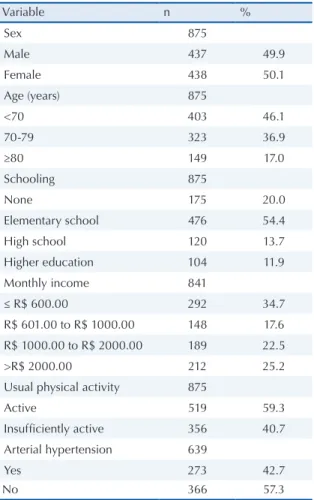
The age of those taking part in the study varied from 60 to 101 years old, with a mean of 71.6 ± 7.9 years. The mean age was 71.4 ± 7.6 years (variance 60 - 94) in men and 71.7 ± 8.2 years in women (p = 0.578). The sample features according to the ad-justment variables are presented in Table 1. There was a similar distribution according to the sex. Most of the individuals studied up to elementary school, were physically active and did not have arterial hypertension. There was a high percentage of older adults aged under 70 years old and with a low monthly income (up to R$ 600.00).
The prevalences of self-reported diabetes mellitus and overweight are presented in Table 2.
A high prevalence of overweight was observed; that of diabetes was within the range expected for older adults. In both the variables no signiicant differences were found between men and women.
Table 1. Features of the sample as per the adjustment variables. Florianópolis, SC, Brazil, 2002.
Variable n %
Sex 875
Male 437 49.9
Female 438 50.1
Age (years) 875
<70 403 46.1
70-79 323 36.9
≥80 149 17.0
Schooling 875
None 175 20.0
Elementary school 476 54.4
High school 120 13.7
Higher education 104 11.9
Monthly income 841
≤ R$ 600.00 292 34.7
R$ 601.00 to R$ 1000.00 148 17.6
R$ 1000.00 to R$ 2000.00 189 22.5
>R$ 2000.00 212 25.2
Usual physical activity 875
Active 519 59.3
Insufficiently active 356 40.7
Arterial hypertension 639
Yes 273 42.7
No 366 57.3
Table 2. Prevalences (%) and confidence intervals (95%) of self-reported diabetes mellitus and being overweight in men, women and the total sample. Florianópolis, SC, Brazil, 2002.
Sample Diabetes Overweight
Men 12.1 (9.3 – 15.5) 58.0 (53.3 – 62.6) Women 14.8 (11.6 – 18.5) 60.7 (56.0 – 65.2) Total 13.5 (11.4 – 15.9) 59.4 (56.1 – 62.6)
The prevalence of self-reported diabetes mellitus, according to the weight status, is presen-ted in Figure 1. A greater prevalence of diabetes mellitus was observed in the older adults who were overweight.
rial hypertension.
Figure 1. Prevalence (%) and 95%CI of self-reported diabetes mellitus, as per the nutritional status in older adults. Florianó-polis, SC, Brazil, 2002.
Figure 2. Association (gross and adjusted prevalence ratio and 95%CI) between self-reported diabetes mellitus and being overweight in the older adults. Florianópolis – SC, Brazil, 2002. * Adjusted by sex, age, schooling, monthly income, usual physical activity and arterial hypertension; p-valuemodel = 0.033.
DISCUSSION
This is the irst population and domiciliary-based study performed with older adults living in Santa Catarina State to investigate the prevalence of diabetes mellitus and is association with being overweight. The data were derived from a represen-tative sample, which suggests that the results can be extrapolated to the general oldr adults population of the municipality of Florianópolis.
The estimate of self-reported diabetes mellitus in older adults was 13.5%. This value is below that observed in countries as the United States (19.7%)15 and Israel (18.9%)21 and above that found
in Canada (9.9%)22. Multicentric studies which
compiled surveys of several countries reported prevalences varying from 6.7% to 24.7% in Asia13
and from 8.5% to 22.4% in Europe14, dependant
upon the sex and age group. Another multicentric study involving samples representing seven large municipalities of Latin America and the Caribbe-an found a prevalence of 15.7%10. Compared with
domestic data, it was found that the prevalence
was below that observed in the older adults in São Paulo (15.4%)23 and 16 Brazilian capitals (17.8%)24.
In spite of the prevalence of diabetes mellitus being on a smaller scale when compared with other morbidities, it is considered to be an extre-mely limiting disease, as it can cause blindness, amputations, nephropathies, cardiovascular and encephalic complications which impair the func-tional capacity, autonomy and quality of life23.
In a study conducted in a municipality inside in São Paulo State, the older dults revealed that not having diabetes mellituswas associated with being satisied with life25.
It was found that six out of each ten older adults in Florianópolis are overweight. These indings corroborate the last study made by VIGITEL in the 26 Brazilian states and in the Federal District, which indicated that 58.4% of the elderly aged 65 years old or above are overweight7. When observing
the nutritional status in some municipalities sepa-rately26,27, the indings indicate a high prevalence
of obesity among the older adults.
Surveys have shown that obesity signiicantly increases morbidity and mortality by other diseases, such as arterial hypertension, dyslipidemias, ische-mic coronary heart disease (IHD), gallbladder dise-ase, osteoarticular diseases, non-insulin-dependent or type 2 diabetes mellitus and certain types of cancer, noting that there is a higher prevalence of obesity in women than men, including among the older adults28. This epidemiological context
indica-tes the urgent need for more eficacious preventive strategies, concerned with changes in the lifestyle of the older adults, by adopting healthy eating habits and regularly practicing a physical activity.
The results of the present study indicate that being overweight was an independent factor and positively associated with diabetes mellitus. The data indicate that the prevalence of diabetes mellitus is 92% (PR = 1.92) higher in older adults who are overweight. Similar results were found in oldr adults in several countries of Latin America and the Caribbean10, suggesting that overweight is
an important risk factor for diabetes mellitus and cardiovascular diseases in the older adults, which was conirmed in analytical studies with a cohort design11. The relevant literature acknowledges that
obesity is a risk factor in the occurrence of the dise-ase and recommends weight reduction and control as being one of the main non-pharmacological strategies for treating diabetes29. Within this
Self-reported diabetes mellitus in the older adults Pelegrini et al.
Brasileira de Diabetes)29 states that reducing body
weight by 5 to 10% could reduce the levels of glycemia, postpone the advance of the disease, decrease requirements for insulin, and even allow the pharmacological treatment to be withdrawn.
Evidence indicates that diabetes mellitus re-mains asymptomatic for a long period of time before being diagnosed. In this respect, early diagnosis and preventive intervention should be made a priority, as this would allow the number of cases of the disease to be reduced. Furthermore, an accessible health system, ensured quality in the treatment, education and the health care adhesion of people with diabetes mellitus would reduce the burden of the disease30.
There are certain limitations regarding the interpretation of the data presented in this study: (i) the prevalence of self-reported diabetes melli-tus doesn’t indicate the proportion of individuals having the disease in a determined population, but only the estimate of known cases. Several studies13,21,22 show that the proportion of diabetes
mellitus not diagnosed in older adults populations is fairly signiicant and can vary with age and sex, besides being affected by the availability of health services; (ii) The cross-sectional design does not allow one to state that the association found indi-cates causation.
CONCLUSIONS
The present study showed that the older adults who are overweight report more diabetes, regardless of sociodemographic factors, practicing a physical activity and having hypertension. In accordance with these results social campaigns and programs are advisable in order to encourage behavioral changes which favor the reduction of the preva-lence or occurrence of diabetes mellitus and its complications in the older adults population.
REFERENCES
1. World Health Organization. Diabetes 2008 (Fact Sheet, 312).
2. Rosa RS, Schmidt MI. Diabetes mellitus: magnitude das hospitalizações na rede pública do Brasil, 1999-2001. Epidemiol Serv Saúde 2008;17(2):131-4.
3. Wild S, Roglic G, Green A, Sicree R, King H. Global Prevalence of Diabetes: Estimates for the year 2000 and projections for 2030. Diabetes Care 2004;27:1047-53. 4. Barros MBA, César CLG, Carandina L, Torre GD.
Desigualdades sociais na prevalência de doenças crônicas no Brasil, PNAD-2003. Ciênc Saúde Colet 2006;11(4):911-26.
5. Brasil. Ministério da Saúde. Secretaria de Vigilância em Saúde. Secretaria de Gestão Estratégica e Participativa. Vigitel Brasil 2009: vigilância de fatores de risco e pro-teção para doenças crônicas por inquérito telefônico / Ministério da Saúde, Secretaria de Vigilância em Saúde, Secretaria de Gestão Estratégica e Participativa. – Brasília : Ministério da Saúde, 2007.
6. Brasil. Ministério da Saúde. Secretaria de Vigilância em Saúde. Secretaria de Gestão Estratégica e Participativa. Vigitel Brasil 2009: vigilância de fatores de risco e pro-teção para doenças crônicas por inquérito telefônico / Ministério da Saúde, Secretaria de Vigilância em Saúde, Secretaria de Gestão Estratégica e Participativa. – Brasília : Ministério da Saúde, 2008.
7. Brasil. Ministério da Saúde. Secretaria de Vigilância em Saúde. Secretaria de Gestão Estratégica e Participa-tiva. Vigitel Brasil 2010: vigilância de fatores de risco e proteção para doenças crônicas por inquérito telefônico / Ministério da Saúde, Secretaria de Vigilância em Saúde, Secretaria de Gestão Estratégica e Participativa. – Brasília: Ministério da Saúde, 2011.
8. Passos VMA, Barreto SM, Diniz LM, Lima-Costa MF. Type 2 diabetes: prevalence and associated factors in a Brazilian community – the Bambuí health. Sao Paulo Med J 2005; 123(2):66-71.
9. Bassler TC, Lei DLM. Diagnóstico e monitoramento da situação nutricional da população idosa em município da região metropolitana de Curitiba (PR). Rev Nutr 2008;21(3):311-21.
10. Barceló A, Peláez M, Rodriguez-Wong L, Pastor-Valero M. The prevalence of diagnosed diabetes among the elderly of seven cities in Latin America and the Carib-bean: the Health Wellbeing and Aging (SABE) Project. J Aging Health 2006;18:224-39.
11. Folsom AR, Kushi LH, Anderson KE, Mink PJ, Olson JE, Hong C-P et al. Associations of general and ab-dominal obesity with multiple health outcomes in older women. Arch Intern Med 2000;160:2117-28.
12. Varner JM. Elders and malnutrition. Ala Nurse 2007;34:22-3.
13. The DECODA Study Group. Age- and sex-speciic prevalence of diabetes and impaired glucose regulation in 11 Asian cohorts. Diabetes Care 2003;26:1770-80. 14. The DECODE Study Group. Age- and sex-speciic
prevalence of diabetes and impaired glucose regulation in 13 European cohorts. Diabetes Care 2003:26:61-9. 15. McBean AM, Gilberson DT, Li S, Collins AJ.
Dif-ference in diabetes prevalence incidence and mor-tality among the elderly of four racial/ethnic groups Whites, Black, Hispanics, and Asians. Diabetes Care 2004;27:2317-24.
16. Instituto Brasileiro de Geograia e Estatística. Sinopse preliminar do censo cemográico 2000. Rio de Janeiro; IBGE; 2001; vol.7.
17. Alvarez BR, Pavan AL. Alturas e comprimentos. In: Petroski EL (ed). Antropometria: técnicas e padroni-zações. Porto alegre: Pallotti; 1999. p.29-51.
Booth ML, Ainsworth BE, et al. International physi-cal pctivity questionnaire: 12-country reliability and validity. Med Sci Sports Exerc. 2003;35(8):1381-95. 20. Benedetti TRB, Borges LJ, Petroski EL, Gonçalves
LHT. Atividade física e estado de saúde mental de idosos. Rev Saúde Publica 2008;42:302-7.
21. Dankner R, Geulayov G, Olmer L, Kaplan G. Un-detected type 2 diabetes in older adults. Age Ageing 2009;38:56-62.
22. Rockwood K, Tan MH, Phillips S, McDowell I. Prevalence of diabetes mellitus in the elderly people in Canada: Report from the Canadian Study of Health and Aging. Age Aging 1998;27:573-7.
23. Francisco PMSB, Belon AP, Barros MBA, Carandina L, Alves MCGP, Goldbaum M et al. Diabetes auto-referido em idosos: prevalência, fatores associados e práticas de controle. Cad Saúde Pública 2010;26:175-84.
24. Pereira JC, Barreto SM, Passos VMA. O peril de saúde cardiovascular dos idosos brasileiros precisa melho-rar: estudo de base populacional. Arq Bras Cardiol 2008;91:1-10.
ao grau de satisfação com a vida entre a população de idosos. Rev Saúde Publica. 2007; 41(1): 131-38. 26. Kain J, Vio F, Albala C. Obesity trends and
determi-nant factors in Latin América. Cad Saúde Pública 2003; 19(suppl 1): S77-S86.
27. Sociedade Brasileira de Diabetes. Atualização brasileira sobre diabetes. Rio de Janeiro: Diagraphic; 2005. 28. Toscano CM. As campanhas nacionais para detecção
das doenças não transmissíveis: diabetes e hipertensão arterial. Ciênc Saúde Colet 2004; 9:885-95.
Endereço para correspondência Andreia Pelegrini