RESUMO: “Substâncias eliminadoras de radicais livres das partes aéreas de Grammosciadium platycarpum Boiss. & Hausskn. (Apiaceae) e análise por CG-MS dos óleos essenciais de seus frutos.” Grammosciadium platycarpum Boiss. & Hausskn (Apiaceae) é uma das três espécies endémicas no Irã do gênero Grammosciadium DC. Consumo da parte aérea da planta afeta a função renal e causa diurese. No ensaio por DPPH o extrato metanólico apresentou o maior nível de atividade de antioxidante por radicais livres (RC50 = 1,196 x 10-2 mg/mL) entre os extratos. Análises por HPLC preparativa de fase reversa do extrato metanólico resultou no isolamento de
nove lavonóides, os quais foram responsáveis pela atividade de antioxidante do extrato metanólico. A análises por CG-EM dos óleos essenciais levou à identiicação de 29 terpenóides, principalmente monoterpenos (não-oxigenados 3,97% e oxigenados, 77,49%), os quais representam mais de 96%
do total de óleos.
Unitermos: Grammosciadium platycarpum, Apiaceae, DPPH, antioxidante, Cg-EM, lavonoide, óleo essencial.
ABSTRACT: Grammosciadium platycarpum Boiss. & Hausskn (Apiaceae) is one of three endemic Iranian species of the genus Grammosciadium DC. Consumption of the aerial parts of this plant affects renal function and causes diuresis. In the DPPH assay the methanol extract showed the highest level of free radical scavenging activity (RC50 = 1.196 x 10⁻² mg/mL) among the extracts.
Reversed-phase preparative HPLC analyses of the methanol extract yielded nine lavonoids, which
were responsible for the free radical scavenging activity of the MeOH extract. The GC-MS analyses
of the essential oils led to the identiication of 29 terpenoids, mainly monoterpenes (non-oxygenated
3.97% and oxygenated 77.49%) accounting for over 96% of the total oils.
Keywords: Grammosciadium platycarpum, Apiaceae, DPPH, antioxidant, GC-MS, lavonoid, essential oils.
in the local markets during the spring. Previous studies on this species, particularly on the essential oils of the aerial parts, revealed the presence of a variety of terpenoidal compounds, and established its close relationships with the taxonomically related species G. scabridum (Sonboli et al., 2005a,b). According to common folk believes, consumption of the aerial parts of G. platycarpum affects renal function and causes diuresis. To the best of our knowledge, there is no report on the isolation of any secondary metabolites from G. platycarpum or studies on
Brazilian Journal of Pharmacognosy 19(4): 914-918, Out./Dez. 2009
Artigo
Received 7 July 2009; Accepted 15 August 2009
Free radical scavengers from the aerial parts of
Grammosciadium
platycarpum
Boiss. & Hausskn. (Apiaceae) and GC-MS
analysis of the essential oils from its fruits
Hossein Nazemiyeh,
1Abbas Delazar,
2Nasrin Movahedin,
1Malake Jodari,
1Yousef Imani,
3Mohammed-Ali Ghahramani,
3Lutfun Nahar,
4Satyajit D. Sarker
*,51Research Center for Pharmaceutical Nanotechnology, Faculty of Pharmacy,
Tabriz University of Medical Sciences, Tabriz, Iran
2School of Pharmacy, Tabriz University of Medical Sciences, Tabriz, Iran 3East Azerbaijan Research Center for Agriculture and Natural Resources, Tabriz, Iran
4Drug Discovery and Design Research Division, Department of Pharmacy, School of Applied Sciences,
University of Wolverhampton, MA Building, Wulfruna Street, Wolverhampton WV 1 1LY, England, UK
5Department of Pharmacy, School of Applied Sciences, University of Wolverhampton,
MM Building, Molineux Street, Wolverhampton WV 1 1SB, England, UK
INTRODUCTION
any pharmacological properties of this plant. As part of our on going phytochemical and pharmacological studies on Iranian medicinal plants (Delazar et al., 2009; Modaressi et al., 2009; Babaei et al., 2008; Nazemieyh et al., 2008a,b; Nazii et al., 2008; Razvi et al., 2008), we now report on the isolation, identiication and free radical scavenging properties of the compounds from the aerial parts, and GC-MS analyses of the essential oils of the fruits.
MATERIAL AND METHODS
General
NMR spectra were obtained using a Bruker Spectrospin 200 and an AMX300 NMR-spectrometers. UV/visible spectra were recorded using a Shimadzu-1600 spectrophotometer. Preparative HPLC was conducted on Shimadzu -10A prep-HPLC coupled with SPDM photo diode array detector (detection at 220 and 280 nm) on a CLC Shim-pack C18 column (22 x 250 mm, 15μ). A Shimadzu GCMS-QP5050A gas chromatograph-mass spectrometer itted with a fused methyl silicon DB-5 column (60 m x 0.25 mm i.d., 0.25 μm ilm thickness) was used for the GC-MS analysis.
Plant material
Aerial parts of Grammosciadium platycarpum Boiss. & Hausskn were collected during the lowering stage from Sahand region (37 30’ 0.2”, 46 17’49.2”; 1870 m, 15 km from Maragheh to Ashan village), Iran in May 2004. The fruits were collected in August 2004 from the same place. A voucher specimen (TUM-FPh-142) for these collections has been deposited at the Herbarium of the Faculty of Pharmacy, Tabriz University of Medical Sciences.
Extraction and isolation
Fresh aerial parts (550 g) of G. platycarpum were extracted with methanol (MeOH; 1.5 L) for 12 h, and the resulting extract was iltered with a Watman No.1 ilter paper. The procedure was repeated three more times, iltered extracts were combined (6 L) and concentrated under reduced pressure. The resulting extract (27.8 g) was suspended in distilled water and re-extracted successively with n-hexane and dichloromethane (DCM). The solvents of all extracts including the aqueous extract were evaporated under reduced pressure at 40 °C till dryness to obtain 10.2 g of n-hexane, 7.32 g of DCM and 9.55 g of water extracts. Portions of the aqueous solution (3x 2 g) were subjected to solid-phase extraction (Sep-Pak, C18 cartridge; 10 g) using a step gradient of MeOH-water mixtures (30:70, 60:40, 80:20 and 100:0). The resulting Sep-Pak fractions were analyzed by preparative-HPLC, eluting with a linear gradient of MeOH-water and monitored by a
photo-diode-array detector at 220 and 280 nm. Prep-HPLC analyses (mobile phase program: linear gradient of MeOH/water 25:65 → 60:40 over 50 min followed by 60% MeOH for 10 min, low rate: 20 mL/min) of the 40% methanolic Sep-Pak fraction (2.15 g) afforded fractions I (collection time: from 8 to 12 min) and II (collection time: from 16 to 50 min), and compound 4 (2 mg, tR =61 min). Fractions I and II were further analyzed by the same system with a minor modiication of the mobile phase (linear gradient of MeOH/water 30:70 → 40:60 over 50 min followed by 40% MeOH for 10 min, low rate: 20 mL/min) to yield compounds 1 (3.5 mg, tR =9.6 min), 2 (19.9 mg, tR =14.5 min), 3 (16.7 mg, tR =15.5 min).
Similar protocol (mobile phase: linear gradient of MeOH/water 50:50 → 75:25 over 50 min followed by 75% MeOH for 10 min, low rate: 20 mL/min) was applied for the 60% methanolic Sep-Pak fraction (750 mg) to afford compounds 5 (14.2 mg; tR = 20.4 min), 6 (12.7 mg; tR = 21.6 min), 7 (27.1 mg; tR = 21.6 min), 8 (3 mg; tR = 47.5 min) and 9 (7.3 mg; tR = 48.0 min). The structures of the isolated compounds (1-9) were elucidated by extensive UV/Vis spectroscopic studies using various shift reagents (Mabry et al., 1970), and by the NMR spectroscopic analyses (Figure 1). All spectroscopic data were compared with the published data.
Oil extraction
Ground dried fruits were subjected to hydro-distillation for 3 h using a Clevenger-type apparatus and the resulting oil was subsequently dried over anhydrous sodium sulphate.
GC-MS analysis
Free radical scavenging activity: the 2,2-diphenyl-1-picrylhydrazyl (DPPH) assay
The free radical scavenging effect of the essential oils, the total extracts and the puriied compounds was assessed using the 2,2-diphenyl-1-picrylhydrazyl (DPPH) assay (Kumarasamy et al., 2002). DPPH was obtained from Fluka Chemie AG, Bucks and a solution of DPPH (0.08 mg/mL) in chloroform (CHCl3) was used. The essential oil was dissolved in CHCl3 to obtain the stock concentration of 1 mg/mL. Dilutions were made to obtain concentrations of 5×10⁻¹, 2.5×10⁻¹, 1.25×10⁻¹, 6.25×10⁻², 3.13×10⁻² and 1.56×10⁻² mg/mL. Diluted solutions (5 mL each) were mixed with DPPH solution (5 mL) and allowed to stand for 30 min for any reaction to occur. The UV absorbance was recorded at 517 nm. The experiment was performed in triplicate and the average absorption was noted for each concentration. The same procedure was followed for the positive control, quercetin.
Table 1. GC-MS analysis of the essential oils of the fruits of Grammosciadium platycarpum.
Compounds Retention time tR in min
Real % area
Mol. mass M o l . formula
Cumene 18.53 0.13 120 C9H12
β-Pinene 19.24 0.48 136 C10H16
β-Myrcene 19.88 0.03 136 C10H16
Hemellitol 20.18 0.42 120 C9H12
Phellandrene 20.96 0.12 136 C10H16
Mesitylene 22.16 0.08 120 C9H12
p-Cymene 22.27 0.14 134 C10H14
Bornylene 22.62 1.81 136 C10H16
β-Ocimene 23.78 0.19 136 C10H16
γ-Terpinene 24.69 0.57 136 C10H16
Linalool oxide A 25.66 0.06 170 C10H18O2
Linalool 27.77 76.43 154 C10H18O
α-Terpineol 34.34 0.4 154 C10H18O
Geraniol 38.69 0.21 154 C10H18O
trans -2-Decanal 39.23 0.09 154 C10H18O
trans -β-Caryophyllene
51.02 1.57 204 C15H24
β-Farnesen 52.80 0.19 204 C15H24
α-Caryophyllen 53.28 0.21 204 C15H24
Decalactone 53.49 0.30 170 C10H18O2
γ –Gurjunene 54.57 0.05 204 C15H24
α-Farnesene 55.27 1.04 204 C15H24
γ-Elemene 56.08 2.83 204 C15H24
Bi-1-cycloocten-1-yl
57.63 0.05 218 C16H26
Spathulenol 61.20 1.61 220 C15H24O
Caryophyllene oxide
61.62 0.55 220 C15H26O
α-Humulene 65.90 6.14 204 C15H24
cis- Lanceol 71.13 0.1 220 C15H24O
Valerenol 71.57 0.29 220 C15H24O
Falcarinol 85.57 1.39 244 C17H24O
Monoterpenes 3.97
O x y g e n a t e d monoterpenes
77.49
Sesquiterpenes 11.08
O x y g e n a t e d
sesquiterpenes 3.94
Total identiied 96.48
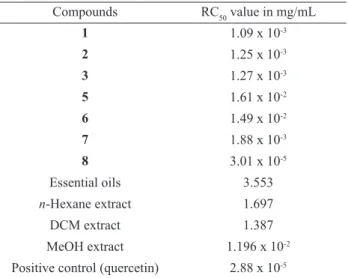
Table 2. Free radical scavenging activity of the essential oils, extracts and the isolated compounds (1-9) determined by the DPPH assay.
Compounds RC50 value in mg/mL
1 1.09 x 10⁻³
2 1.25 x 10⁻³
3 1.27 x 10⁻³
5 1.61 x 10⁻²
6 1.49 x 10⁻²
7 1.88 x 10⁻³
8 3.01 x 10⁻⁵
Essential oils 3.553
n-Hexane extract 1.697
DCM extract 1.387
MeOH extract 1.196 x 10⁻²
Positive control (quercetin) 2.88 x 10⁻⁵
RESULTS AND DISCUSSION
Solid-phase extraction followed by reversed-phase preparative HPLC analyses of the aqueous fraction of the MeOH extract of the aerial parts of G. platycarpum resulted in the isolation of nine lavonoids (1-9). Isolated lavonoid glycosides were identiied as 3,4’,5,6,7-pentahydroxylavone 3-O-β-D-glucopyranoside (1; Mabry
et al., 1970; Wagner et al., 1976; Wenkert & Gottlieb, 1977), 3,3’,4’,5,7-pentahydroxylavone 3-O-β-D-glucopyranoside
(2; Mabry et al., 1970; Wagner et al., 1976; Wenkert &
Gottlieb, 1977), 3,3’,4’,5,7-pentahydroxylavone 3-O-β-D
-galactopyranoside (3; Mabry et al., 1970; Datta et al., 2000), 3,3’,4’,5,6,7-hexahydroxylavone (4; Mabry et al., 1970; Wagner et al., 1976; Wenkert & Gottlieb, 1977), 3,4’,5,7-tetrahydroxylavone 3-O-β-D-glucopyranoside (5; Mabry
et al., 1970; Wagner et al., 1976; Wenkert & Gottlieb, 1977), 3,4’,5,7-tetrahydroxylavone 3-O-α-L-rhamnopyranoside
(6; Mabry et al., 1970; Wagner et al., 1976; Wenkert &
Gottlieb, 1977), 3,4’,5,7-tetrahydroxylavone-3-O-(6-p -coumaroyl)-α-L-rhamnopyranoside (7; Mabry et al., 1970;
1970) by extensive UV spectroscopic analyses using various shift reagents (Mabry et al., 1970), and by 1D and 2D NMR analyses. All spectroscopic data were comparable with respective published data.
O
O OH R
R''
OH
OR' O
H
Compounds R R’ R’’
1 OH Glucosyl H
2 H Glucosyl OH
3 H Galactosyl OH
4 OH H OH
5 H Glucosyl H
6 H Rhamnosyl H
7 H (6-p-coumaroyl)-rhamnosyl H
8 H H OH
9 H H H
The 2,2-diphenyl-1-picryl-hydrazyl (DPPH) free radical scavenging assay is based on the ability of DPPH, a stable free radical, to decolourise in the presence of free radical scavengers (antioxidants). The odd electron in the DPPH radical is responsible for the absorbance at 517 nm, and also for visible deep purple colour (Kumarasamy et al., 2007). When DPPH accepts an electron donated by a free radical scavenger, the DPPH is decolourised, and the extent of decolourisation can be quantitatively measured from the changes in absorbance. The free radical scavenging properties of the isolated compounds (1-9), essential oils and crude extracts are summarized in Table 2. The MeOH extract showed the highest level of activity with a RC50 value of 1.196 x 10⁻² mg/mL among all extracts, and the compounds responsible for this activity were lavonoids. While the free radical scavenging properties of 1-3, 7 and 8 showed similar signiicant activities with the RC50 values ranging from 1.88 x 10⁻³ to 1.09 x 10⁻³ mg/mL, lavonoids 5 and 6 displayed activities approximately ten-fold lower than the lavonoids 1-3, 7 or 8. Owing to the paucity of samples, the free radical scavenging activity assessment of compound 4 and 9 was not performed. The greater activity of 1-3, 7 and 8 than that of 5 and 6 was because of the presence of extra number of phenolics hydroxyl groups in those molecules.
The air-dried fruits of G. platycarpum provided 1.6% pale yellow essential oils. The GC-MS analyses of the essential oils led to the identiication of 29 terpenoidal
compounds accounting for over 96% of the total oils. The majority of components present in the oils were monoterpenes (nonoxygenated 3.97% and oxygenated 77.49%). The amount of sesquiterpenes was about 15%. Among the monoterpenes, linalool was the major component (76.43%). This inding was signiicantly different from the GC-MS analyses reported earlier (Nickavar et al., 2006; 2008) where linalool was found to be the major component of fruit essential oil but the amount was signiicantly lower (53.9%). However, this is not unusual to have such variations in the composition of the essential oils of plants resulting from geographical differences, growing conditions and variations in climate.
It can be concluded that the phytochemical investigation of the aerial parts of Grammosciadium platycarpum has demonstrated that this plant is a good source of lavonoids with signiicant free radical scavenging property, and the essential oils of the fruits predominantly contain oxygenated monoterpenes.
REFERENCES
Adams RP 2004. Identiication of Essential Oil Component by
Gas Chromatography/Quadrupole Mass Spectroscopy, Allured Publishing Corporation, Illinois, USA.
Babaei H, Sadeghpour O, Nahar L, Delazar A, Nazemiyeh H, Mansouri MR, Poursaeid N, Asnaashari S, Moghadam SB, Sarker SD 2008. Antioxidant and vasorelaxant
activities of lavonoids from Amygdalus lycioides. Turkish J Biol 32: 203-208.
Datta BK, Datta SK, Sarker SD 2000. Quercetin 3-O-(6’’-galloyl)-beta-D-galactoside from Polygonum viscosum (Polygonaceae). Biochem Syst Ecol 28: 805-807. Davis PH 1972. Flora of Turkey and East Agean Islands,
Edinburgh University Press, Edinburgh, pp. 318-321.
Delazar A, Nazii E, Movafeghi A, Nahar L, Nazemiyeh H,
Moghadam SB, Asnaashari S, Sarker SD 2009. GC-MS analyses of Ornithogalum procerum. DARU 17: 33-36. Kumarasamy Y, Fergusson M, Nahar L, Sarker SD 2002.
Biological activity of moschamindole from Centaurea moschata. Pharm Biol 40: 307-310.
Kumarasamy Y, Byres M, Cox PJ, Jaspars M, Nahar L, Sarker SD 2007. Screening seeds of some Scottish plants for free-radical scavenging activity. Phytother Res 21: 615-621.
Mabry TJ, Markham KR, Thomas MB 1970. The Systematic
Identiication of Flavonoids, Springer-Verlag, New
York.
Modaressi M, Delazar A, Nazemiyeh H, Fathu-Azad E, Smith E, Rahman MM, Gibbons S, Nahar L, Sarker SD 2009. Antibacterial iridoid glucosides from Eremostachys laciniata. Phytother Res 23: 99-103.
Nazemiyeh H, Delazar A, Ghahramani M-A, Talebpour A-H, Nahar L, Sarker SD 2008a. Phenolic glycosides from Phlomis lanceolata (Lamiaceae). Nat Prod Commun 3: 53-56.
Nazemiyeh H, Bahadori F, Delazar A, Ay M., Topcu G, Kolak U,
Nahar L, Majinda RRT, Sarker SD 2008b. Antioxidant
Nazii E, Delazar A, Movafeghi A, Nazemiyeh H, Nahar L, Sarker
SD 2008. GC-MS analysis of the dichloromethane extract of the bulbs of Ornithogalum cuspidatum Bert. (Family: Liliaceae) from Iran. Records Nat Prod 2: 94-99.
Nickavar B, Kamalinejad M, Mohandesi S 2006. Comparison of
the components of the essential oils from leaves and fruits of Grammosciadium platycarpum. Chem Nat Compd 42: 686-688.
Nickavar B, Mojab F, Kamalinejad M 2008. Chemical composition
of the leaf and fruit oils from Grammosciadium platycarpum. Planta Med 74: 1055.
Razvi SM, Nazemiyeh H, Hajiboland R, Kumarasamy Y,
Delazar A, Nahar L, Sarker SD 2008. Coumarins from the aerial parts of Prangos uloptera (Apiaceae). Rev Bras Farmacogn 18: 1-5.
Sonboli A, Eftekhar F, Yousefzadi M, Kanani MR 2005a. Antibacterial activity and chemical composition of the essential oil of Grammosciadium platycarpum Boiss. from Iran. Z Naturforsch 60c: 30-34.
Sonboli A., Salehi P, Kanani MR, Nejad-Ebrahimi S 2005b.
Antibacterial and antioxidant activity and essential oil composition of Grammosciadium scabridum Boiss. from Iran. Z Naturforsch 60c: 534-38.
Tamamschian SG 1987. Grammosciadium. In: Flora Iranica, No. 162 (Rechinger, K. H., ed.). Akademische Druck- u. Verlagsanstalt, Graz, Austria, pp. 96-100.
Wagner H, Chari VM, Sonnenbichler J 1976. C-13 NMR spectra of natural lavonoids, Tetrahedron Lett 21: 1799-1802.
Wenkert E, Gottlieb HE 1977. C-13 Nuclear Magnetic Resonance
spectroscopy of naturally occurring substances .49. C-13