ABSTRACT
Forensic dentistry, a branch of the forensic sciences, plays an important role within postmortem human identiication, especially in cases of corpses that are charred, skeletonized or in an advanced state of decomposition. Identiication of human remains via dental knowledge is done using a comparative technique, which is simple, inexpensive and reliable, the aim of which is to compare dental records and information recorded by dentists in clinical appointments made before an individual’s death, with postmortem dental records obtained via forensic examination. In this context, the present study aims to demonstrate the importance of dental records and the effectiveness of forensic dentistry in human identiication, illustrated by the report of a case that was conducted at the São Luis Coroner’s Ofice in the Brazilian state of Maranhão. It may be concluded that dental records maintained by a dentist, when complete, properly structured and correctly archived, retain important personal information and are fundamental tools in the process of human identiication.
Indexing terms: Dental records. Forensic dentistry. Forensic anthropology.
RESUMO
A Odontologia Legal, ramo das Ciências Forenses, tem importante atuação nas perícias de identiicação humana post-mortem, sobretudo na ocorrência de cadáveres em avançado estado de putrefação, carbonizados e esqueletizados. O processo odontológico de identiicação humana é realizado por meio de técnica comparativa, o qual é simples, de baixo custo e coniável, que busca relacionar as informações e características odontológicas, registradas em prontuário clínico, antes da morte de um indivíduo, com as particularidades odontológicas encontradas no exame pericial após a morte. Neste contexto, o presente trabalho teve como objetivo demonstrar a importância da documentação odontológica e a efetividade da odontologia legal no processo de identiicação humana, por meio de um relato de caso do Instituto Médico Legal de São Luís, Maranhão, Brasil. Pode-se concluir que o prontuário odontológico, elaborado pelo cirurgião-dentista na clínica diária, quando bem estruturado, completo e arquivado corretamente, armazena informações pessoais importantes, sendo ferramenta fundamental no processo de identiicação humana.
Termos de indexação: Documentação. Identiicação humana. Odontologia legal.
Effectiveness of dental records in human identiication
Efetividade da documentação odontológica na identificação humana
Salen Marchesi de ALMEIDA1
Fábio DELWING1
Juliana Aires Paiva de AZEVEDO1
Renata Kelly Trajano NOGUEIRA1
Flávio Pinheiro FALCÃO1
Suzana Papile Maciel CARVALHO2
1 Instituto Médico Legal de São Luís, Seção de Odontologia Legal. Av. dos Portugueses, 3779, Vila Bacanga, 65085-582, São Luís, MA, Brasil. Corres-pondência para / Correspondence to: SM ALMEIDA. E-mail: <[email protected]>.
2 Universidade de São Paulo, Faculdade de Odontologia, Departamento de Odontologia Legal. Bauru, SP, Brasil.
done by dental surgeons who are forensic experts for the Coroner’s Ofice3.
Identiication is the process by which an individual’s identity is determined, deining individuality and establishing characteristics and peculiarities that differentiate one individual from another3. This endeavor
is indispensable on account of the ethical, legal and civil reasons involved. Every family has the right to bury a deceased family member. At the same time, without identiication of the corpse, many civil proceedings cannot
INTRODUCTION
Forensic dentistry is a challenging branch of forensic science, which combines dentistry and law and is based on the application of dental knowledge in order to provide assistance to the justice system1-3.
satisfactory results is directly linked to the quantity and quality of the information contained in these records. Conversely, laws in these records may lead to the loss of relevant data, making identiication dificult or even impossible17-18.
In cases where dental records are not available, forensic dentistry seeks to create a proile that indicates the individual’s oral habits, diet and probable age. It may even be possible to determine the individual’s socioeconomic status19.
In this context, the present study aims to report on a case of identiication of a body at an advanced stage of decomposition using forensic dentistry and thereby highlight the importance of dental records.
CASE REPORT
In 2014, a corpse was found in the sea off São Luis, in the Brazilian state of Maranhão, and was delivered to the Coroner’s Ofice to undergo forensic tests in order to determine the cause of death, the instrument or means that caused the death and the victim’s identity. Visual recognition was not possible as the corpse was in an advanced stage of decomposition and was partly skeletonized. There was soft tissue in the cranial region, black hair partially dyed red and an absence of upper limbs, which made the use of ingerprint analysis to identify the corpse impossible. Forensic dentistry was the methodology of choice for identiication, as the dental arches were intact.
To examine the corpse’s teeth, a bilateral incision was made from the labial commissure to the zygomatic arch aexposing the dental arches. Forensic dental analysis of the corpse showed several characteristics of forensic importance, such as amalgam illings, extractions and bad tooth position.
Relatives of the missing young woman, who had last been seen at the beach, claimed the body at the Coroner’s Ofice. They were then asked to provide any dental records they had, as well as current photographs of the woman smiling. They provided a photograph of the supposed victim and her dental records from 2006, which revealed that some dental procedures had been performed (Figure 1). The relatives then answered a questionnaire and stated that the supposed victim had black hair, partially dyed red, and had upper anterior crowding.
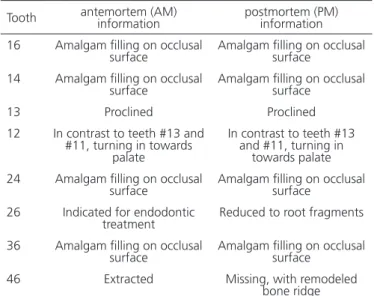
The particularities found in the antemortem (AM) and postmortem (PM) examinations can be seen more clearly in the table below (Table 1).
be concluded, cases regarding inheritance and insurance payments being good examples. Moreover, without being able to identify the victim, a crime may be practically unsolvable4.
The most common means of determining an individual’s identity used by the Coroner’s Ofice are visual recognition (considered to be an empirical identiication, subjective and lacking in scientiic cogency5), ingerprint
analysis, forensic dentistry and DNA analysis (the last three being characterized by the use of scientiic techniques). It is worth noting that there is no hierarchy among these techniques; the methodology of choice in each case depends on the body’s condition6-7.
In situations where visual recognition and other identiication methods, such as ingerprint analysis, tend to be less eficient, safe or even viable (as is the case of bodies that are charred, skeletonized or in and advanced stage of decomposition), forensic dentistry comes to the fore, as the teeth are the most resistant structures of the human body and are frequently found to be well preserved after death, even when caused by ire or water8-9. Furthermore,
studies show that the materials used in dental restorations are highly durable and resistant, remaining in the dental cavity even when subjected to high temperatures10, thereby
aiding the identiication process.
As for DNA testing, although this is possible in many situations and produces highly reliable results, it has some disadvantages, such as high operational costs and the technology necessary for performing the technique11-13.
Human identiication using dental methodology is based on the fact that no two individuals have the same dental composition, not even identical twins, who share the same DNA14. The methodology is simple, inexpensive
and quick, yet accurate and reliable. It is classiied as a comparative methodology, as antemortem and postmortem data are compared, due to the set of dental characteristics being individual and inherent to each person15.
Meanwhile, forensic dental tests for the purposes of identiication are divided into three stages, the irst of which is identifying a corpse’s dental particularities. The second stage is the collection and observation of the information and characteristics contained in a supposed victim’s antemortem dental records. The third stage involves a comparison of the data obtained in order to conduct a thorough veriication of their similarities and differences, both quantitatively and qualitatively16.
DISCUSSION
Forensic dentistry contributes to the process of human identiication via detailed studies of individual dental characteristics. To this end, the availability of a victim’s dental records is necessary. The fundamental aim of these records is primarily clinical, however, in some situations, they have signiicant legal value, contributing to legal issues such as forensic identiication15.
In the present case, teeth #16 (maxillary right irst molar), #14 (maxillary right irst pre-molar), #24 (maxillary left irst pre-molar) and #36 (mandibular left irst molar), which on the dental records were shown to have amalgam illings on their occlusal surfaces, corresponded with the indings of the autopsy (Figure 2). It is important to note that the dental surgeon identiied the material used in the illings and sketched the surface of the affected teeth on the odontogram.
Tooth #26 (maxillary left irst molar) was found to be reduced to root fragments. In the dental records, Figure 1. Dental records of the supposed victim
Table 1. Forensic dental comparison of antemortem (AM) and postmortem (PM) information.
Tooth antemortem (AM) information postmortem (PM) information 16 Amalgam illing on occlusal
surface Amalgam illing on occlusal surface 14 Amalgam illing on occlusal
surface Amalgam illing on occlusal surface 13 Proclined Proclined
12 In contrast to teeth #13 and #11, turning in towards
palate
In contrast to teeth #13 and #11, turning in
towards palate 24 Amalgam illing on occlusal
surface Amalgam illing on occlusal surface 26 Indicated for endodontic
treatment Reduced to root fragments 36 Amalgam illing on occlusal
surface Amalgam illing on occlusal surface 46 Extracted Missing, with remodeled
bone ridge
Figure 2. The corpse’s maxilla
Figure 3. The corpse’s mandible
records as pillars of the process of human identiication should be stressed.
It should be noted that it is not possible to establish a minimum number of consistencies to determine positive forensic dental identiication, as the study deals with both quantitative and qualitative elements7.
CONCLUSION
Forensic dentistry is an eficient and safe method of human identiication. However, the availability of antemortem dental records for comparison is required in order to ensure success. In the case study shown, the clear and correct clinical recording of the dental procedures performed, including information on the material used in illings and the affected dental surfaces as well as records of the extraction performed, among other factors, facilitated and enabled identiication of the victim. In cases where there are incorrect records, which use acronyms or abbreviations that are dificult to understand, do not specify the materials used and dental surfaces affected, omit procedures performed or describe procedures that have not been performed when they have, the identiication process would be impaired or even rendered unviable. Therefore, dental professionals working in clinics have an important role to play in the identiication process, contributing directly via the production of dental records that are in compliance with recommended ethical and legal parameters.
Collaborators
SM ALMEIDA took part in the design, outline, preparation, research and composition of the article. F DELWING, JAP AZEVEDO, RKT NOGUEIRA and FP FALCÃO took part in the revision, research and composition of the article. SPM CARVALHO directed the research and took part in the outline, preparation, research, revision and composition of the article.
this tooth had been indicated for endodontic treatment in 2006. Thus, eight years having passed, it is consistent that the tooth would be reduced to root fragments as a result of not having received the indicated treatment and care. Tooth #46 (mandibular right irst molar) was not present in the corpse’s dental arch, consistent with the antemortem dental records, in which its extraction is shown (igure 3).
Tooth #13 (maxillary right canine) of the corpse exhibited proclination and tooth #12 (maxillary right lateral incisor) was turned in towards the palate, in contrast to tooth #13 (maxillary right canine) and tooth #11 (maxillary right central incisor). These characteristics were also evidenced in the smile in the photograph provided by the family of the supposed victim (igure 4). It was also possible to analyze the anatomical appearance of the crowns of the maxillary central incisors.
The use of smile photographs in the process of human identiication is widely accepted as they can provide accurate, useful information as to the anatomical and positional characteristics of teeth19-20.
As also stated by the relatives, it can be proved, using the photographs provided, that the hair of the supposed victim was partially dyed red, which is consistent with the indings of the autopsy. The compatibility of the hair found on the corpse was not suficient nor exclusive enough to conirm its identity, but was useful as a piece of ancillary data for the examination17.
Some of the postmortem indings, for example the clinical absence of tooth #47 (mandibular right second molar), cannot be challenged given the dental records provided. However, this fact may be explained by the time that elapsed between the date of the dental record and the date the examination was performed and was not, therefore, considered to be incompatible with the identiication in the examination.
The comparison of dental data, besides the several consistencies found, showed several important qualitative characteristics and no discrepancies, resulting in positive identiication of the victim. Thus, the importance of clinical
REFERENCES
1. Silva RF, Pereira SDR, Mendes SDSC, Marinho DEA, Daruge Júnior E. Radiograias odontológicas: fonte de informação para a identiicação humana. Odontol Clín Científ. 2006;5(3):239-42.
2. Wadhwan V, Shetty DC, Jain A, Khanna KS, Gupta A. A call for a new speciality: Forensic odontology as a subject. J Forensic Dent Sci. 2014;6(2):97-100. doi: 10.4103/0975-1475.132535
3. Vanrell JP. Odontologia legal e antropologia forense. 2a ed. Rio de Janeiro: Guanabara Koogan; 2009.
4. Cattaneo C, Porta D, De Angelis D, Gibelli D, Poppa P, Grandi M. Unidentiied bodies and human remains: an Italian glimpse through a European problem. Forensic Sci Int. 2010;195 (1-3):167. doi: 10.1016/j.forsciint.2009.11.008
6. Silva RF, Portilho CDM, Reges RV, Leles CR, Freitas GC, Daruge Júnior E. Importância pericial dos registros odontológicos decorrentes de tratamento restaurador. Rev Dent Press Estét. 2007;4(4):32-8.
7. Silva RF, Prado MM, Oliveira HCM, Daruge Júnior E. Quantos pontos de concordância são necessários para se obter uma identiicação odontolegal positiva? Rev Odontol Univ Cid São Paulo. 2009;21(1):63.
8. Silveira EMSZSF. A importância do odontolegista dentro do Instituto Médico Legal. Rev Bras Med Trab. 2013;11(1):34-9. 9. Menon LML, Prado KFB, Silva RHA. Avaliação histológica da
dentina e do cemento após diferentes tempos de imunação: estudo in vitro. RSBO Rev Sul Bras. 2011;8(2):131-7.
10. Spadácio C, Oliveira OF, Benedicto EN, Daruge Júnior E, Paranhos LR. Análise do comportamento de restaurações estéticas sob a ação de calor e sua importância no processo de identiicação humana. RFO UFP. 2011;16(3):267-72.
11. Silva RF, Pereira SDR, Mendes SDSC, Marinho DEA, Daruge Júnior E. Radiograias Odontológicas: Fonte de informação para a identiicação humana. Odontol Clín Científ. 2006;5(3):239-42.
12. Silva RF, Pereira SDR, Daruge Júnior E, Daruge E, Francesquini Júnior L. A coniabilidade do exame odontolegal na identiicação humana. ROBRAC. 2004;13(35):46-50.
13. Coutinho CGV, Ferreira CA, Queiroz LR, Gomes LO, Silva UA. O papel do odontolegista nas perícias criminais. RFO UFP. 2013;18(2):217-23.
14. Espindula A Geiser GC, Velho JA. Ciências forenses: uma introdução às principais áreas da criminalística moderna. 2a ed. Campinas: Millennium; 2013.
15. Silva RF, Benta NG, Daruge Júnior E, Prado MM, Melo M. Importância pericial dos registros odontológicos decorrentes de tratamento protético. Rev Odonto. 2008 jul-dez;16(32):137-143. doi: 10.15603/2176-1000/
16. Silva RF, Prado MM, Barbieri AA, Daruge Júnior E. Utilização de registros odontológicos para identiicação humana. RSBO. 2009;6(1):95-9.
17. Tsuchiya MJ, Gomes EM, Abe DM, Oliveira FVN, Massaoka C, Oliveira RN. Human identiication through the analysis of dental records registered in the context of a Dental Institution. RGO Rev Gaúch Odontol. 2013 jul-set;61(3):389-93.
18. Paranhos LR, Caldas JCF, Iwashita AR, Scanavini MA, Paschini RC. A importância do prontuário odontológico nas perícias de identiicação humana. RFO UPF. 2009 jan-abr;14(1):14-7. 19. Al-Ahmad SH. Forensic Odontology. Smile Dent J. 2009;4:22-4. 20. Silva RF, Pereira SD, Prado FB, Daruge Júnior E, Daruge E. Forensic
Odontology identiication using smile photograph analysis - case reports. J Forensic Odontostomatol. 2008 Jun;26(1):12-17.
Received on: 24/6/2015 Final version resubmitted on: 3/8/2015