DOI: 10.1590/0004-282X20130169 ARTICLE
Drug utilization profile in adult patients with
refractory epilepsy at a tertiary referral center
Perfil de utilização de fármacos por pacientes adultos com epilepsia refratária
em um centro terciário de referência
Priscila de Freitas-Lima1, André de Oliveira Baldoni2, Veriano Alexandre1, Leonardo Regis Leira Pereira2,
Américo Ceiki Sakamoto1
1Ribeirão Preto School of Medicine, University of São Paulo, São Paulo SP, Brazil;
2Ribeirão Preto Faculty of Pharmaceutical Sciences, University of São Paulo, São Paulo SP, Brazil;
Hospital das Clínicas da Faculdade de Medicina de Ribeirão Preto, Ribeirão Preto SP, Brazil.
Correspondence: Priscila de Freitas-Lima; Hospital das Clínicas da Faculdade de Medicina de Ribeirão Preto; Universidade de São Paulo; Av. dos
Bandeirantes 3900 / CIREP – 4º andar / Bairro Monte Alegre; 14048-900 Ribeirão Preto SP – Brasil; E-mail: [email protected] / [email protected]
Conflict of interest: There is no conflict of interest to declare.
Support: Conselho Nacional de Desenvolvimento Científico e Tecnológico (CNPq) and Coordenação de Aperfeiçoamento de Pessoal de Nível Superior (CAPES). Received 04 June 2013; Accepted 12 June 2013.
ABSTRACT
Objective: To evaluate the utilization profile of antiepileptic drugs in a population of adult patients with refractory epilepsy attending a ter-tiary center. Method: Descriptive analyses of data were obtained from the medical records of 112 patients. Other clinical and demographic characteristics were also registered. Results: Polytherapies with ≥3 antiepileptic drugs were prescribed to 60.7% of patients. Of the old agents, carbamazepine and clobazam were the most commonly prescribed (72.3% and 58.9% of the patients, respectively). Among the new agents, lamotrigine was the most commonly prescribed (36.6% of the patients). At least one old agent was identified in 103 out of the 104 polytherapies, while at least one new agent was prescribed to 70.5% of the population. The most prevalent combination was carbamazepine + clobazam + lamotrigine. The mean AED load found was 3.3 (range 0.4–7.7). Conclusion: The pattern of use of individual drugs, although consistent with current treatment guidelines, is strongly influenced by the public health system.
Keywords: epilepsy, refractory epilepsy, antiepileptic drugs, polytherapy, drug utilization.
RESUMO
Objetivo: Avaliar o perfil de utilização de fármacos antiepilépticos em uma população de pacientes adultos com epilepsia refratária aten-didos em um centro terciário. Método: Análises descritivas dos dados obtidos dos registros médicos de 112 pacientes. Também foram consideradas as características clínicas e demográficas. Resultados: Foram prescritas politerapias com ≥3 antiepilépticos a 60,7% dos pacientes. Em relação aos fármacos de primeira geração, carbamazepina e clobazam foram os mais frequentemente prescritos (a 72,3% e 58,9% dos pacientes, respectivamente). Dentre os novos antiepilépticos, a lamotrigina foi o mais prescrito (36,6% dos pacientes). Ao menos um antiepiléptico de primeira geração foi encontrado em 103 das 104 politerapias; ao menos um novo antiepiléptico foi prescrito a 70,5% da população. A combinação mais prevalente foi carbamazepina+clobazan+lamotrigina. A carga média de antiepilépticos foi 3.3 (0.4 a 7.7). Conclusão: O padrão de utilização de antiepilépticos, embora concordante com guias atuais, é fortemente influenciado pelo sistema público de saúde.
Palavras-chave: epilepsia, epilepsia refratária, fármacos antiepilépticos, politerapia, utilização de fármacos.
Approximately one-third of the patients with epilepsy have recurrent seizures in spite of adequate pharmacologi-cal treatment and good compliance, characterizing what is known as refractory epilepsy1. he lack of control over sei-zure recurrence has a major impact not only on the patients’ clinical and psychosocial status but also on economic conse-quences that could potentially overload the health care sys-tem due to avoidable expenses with regard to medications, hospitalizations, and examinations2.
and the United States4, pharmacoepidemiological studies are valuable tools that contribute to the evaluation of efective-ness and rationality of AED prescriptions and associations5,6, which directly relects on public health policies.
he purpose of the present study was to evaluate the utilization proile of AED in a population of adult patients with refractory epilepsy, attending a tertiary referral center in Brazil. Factors inluencing the prescription proiles as well as clinical and demographic peculiarities are also discussed.
METHOD
Medical records from 112 outpatients in regular treatment at the Hospital das Clínicas da Faculdade de Medicina de Ribeirão Preto (HCFMRP), Brazil, were evaluated and included in a database created using Microsoft Excel for the speciic purpose of this cross-sectional survey. Patient selection was based on convenience sampling, and the inclusion criteria were age ≥8 years and established diagnosis of refractory epi-lepsy, deined as persistence of seizures after ade quately ap-plied treatment(s) with one or more appropriate AED at maxi-mally tolerated doses, excluding treatments whereby titration to usually efective dosages was prevented by the onset of idiosyncratic reactions7. Age, gender, age at onset of seizures, antiepileptic therapy details, pharmacoresistance grading, con comitant non-AED medications, types of seizure, and epi-lepsy according to the International League Against Epiepi-lepsy
(ILAE) classiication8,9, and spontaneous reports of adverse
efects were registered. Evaluation of AED dosages was per-formed by calculating the ratio of the prescribed daily dose
(PDD) over the deined daily dose (DDD) (PDD/DDD)10. DDD
is a unit of measurement commonly applied in drug utilization researches and is deined as the assumed average maintenance dose per day of a drug used on its main indication in adults11.
Data analyses initially consisted of descriptive statistics for demographics, clinical, and drug utilization proiles. In-ferential statistics was used to evaluate potential diferences in AED load based on the occurrence of adverse efects. Two-tailed unpaired Student’s t-test and Chi-square test were used, as pertinent. he correlation between the number of AED and the drug load was assessed by Spearman’s correla-tion test. he software used for statistics was the GraphPad
InStat, and the level of signiicance adopted was p≤0.05.
he present study was approved by the Comitê de Ética em Pesquisa of HCFMRP, Brazil.
RESULTS
Population characteristics
One hundred and twelve patients were enrolled from May 2010 to August 2010 at the refractory epilepsy clinic of
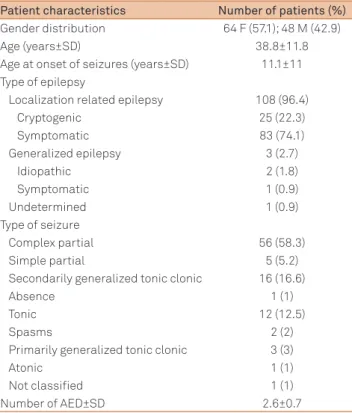
HCFMRP. his sample size represents approximately 13% of all adult patients attending the referred center. Demographic details and epilepsy-related characteristics are expressed in Table 1.
he mean age and standard deviation (SD) for the entire sample (n=112) were 38.8±11.8 years; the mean age was 38.5 years for men (range 19–64 years) and 39.1 years for women (range 18-69 years). he majority of patients were diagnosed with localization-related epilepsy (108/112). Among the symptomatic cases, the most frequent etiology by far was hippocampal sclerosis (57.8% of all the symptomatic cases), followed by malformations of cortical development such as dysplasia, neuronal heterotopia, and polymicrogyria (13.2% of the patients with symptomatic localization-related epilepsy). Excluding the 16 seizure-free patients, complex partial seizure was the most common seizure type reported (56/96), which is in accordance with the high prevalence of hippocampal sclerosis observed, an etiology known to have partial seizures as its main ictal manifestation12. Both, daily and monthly seizures were reported by 25.9% of the patients.
Most patients (52.7%) had failed to respond to maximally tolerated doses of three or more AED used sequentially or, more often, in combination, being eventually classiied within grade 3 of pharmacoresistance7, as seen in Figure 1.
Table 1. Patient demographics and epilepsy-related characteristics (n=112).
Patient characteristics Number of patients (%)
Gender distribution 64 F (57.1); 48 M (42.9)
Age (years±SD) 38.8±11.8
Age at onset of seizures (years±SD) 11.1±11 Type of epilepsy
Localization related epilepsy 108 (96.4)
Cryptogenic 25 (22.3)
Symptomatic 83 (74.1)
Generalized epilepsy 3 (2.7)
Idiopathic 2 (1.8)
Symptomatic 1 (0.9)
Undetermined 1 (0.9)
Type of seizure
Complex partial 56 (58.3)
Simple partial 5 (5.2)
Secondarily generalized tonic clonic 16 (16.6)
Absence 1 (1)
Tonic 12 (12.5)
Spasms 2 (2)
Primarily generalized tonic clonic 3 (3)
Atonic 1 (1)
Not classified 1 (1)
Number of AED±SD 2.6±0.7
frequency of prescription of individual AED in monotherapy or polytherapies, based on patient gender. he most preva-lent combination in use was CBZ + CLB + LTG (18 patients). With respect to the AED prescription patterns regarding speciic epileptic syndromes, we found that CBZ was the drug most frequently prescribed to localization-related epilepsies (used by 73.1% of the patients with this diagnosis), followed by CLB (58.3%) and LTG (37%). Only four patients were diag nosed with generalized or undetermined epilepsy, and, among these, the only monotherapy prescribed was VPA.
he dosages were calculated as described under the me-thods section and the results are displayed in Table 2. Based on mean values, seven out of the 12 AED found in this study were prescribed at dosages within 80%-120% of their respec-tive DDD, namely CBZ, phenytoin (PHT), LTG, levetirace-tam (LEV), TPM, VPA, and VGB. Considering that LEV and VGB were prescribed to less than ive patients each, their data should be analyzed with caution. Clobazam, clonaze-pam (CNZ), phenobarbital (PB), oxcarbazepine (OXC), and GBP were not prescribed within the 80-120% interval of their DDD (84% above, 62.2% below, 60.5% above, 102.5% above, and 33.4% below their corresponding DDD, respec-tively). Furthermore, analysis of the results with OXC and
15.2%
5.3%
26.8%
1.8% 50.9%
1
2A
2B
3A
3B
Figure 1. Pharmacoresistance grading. Grade 1: resistant to maximally tolerated dose of one appropriate antiepileptic drug; grade 2: resistant to two AED administered sequentially (2A) or in combination (2B); grade 3: resistant to three AED administered sequentially (3A) or in combination (3B)7.
Antiepileptic drug therapies
A total of 12 AED were identiied as being currently ad-ministered in our patient population. he mean±SD number of AED used per patient was 2.6±0.7 (Table 1), ranging from one to four AED.
he majority of patients (68 out of 112) were on polythe-rapy with three or more AED (Figure 2). Among these pa-tients, only 6 patients were prescribed a combination of four AED. Carbamazepine (CBZ) was the AED most com-monly found in monotherapy, although not in signiicant number of patients if considering the entire population (6/112); the other two monotherapies used were LTG and valproic acid (VPA).
Both CBZ and clobazam (CLB) were prescribed to more than 50% of the patients (72.3% and 58.9%, respecti-vely). Following these medications, LTG and TPM were also prescribed to a large proportion of patients (36.6% and 29.4%, respectively). Second-generation AED were almost exclusively found in polytherapies (except for one patient using LTG in monotherapy). As expected, at least one irst-generation AED was found in 103 out of the 104 polythera-pies prescribed, while at least one second-generation AED was prescribed to 70.5% of the patients. Figure 3 presents the
60.7% 32.1%
7.1%
Monotherapy
Polytherapy with 2 AED
Polytherapy with >3 AED
Figure 2. Use of antiepileptic drugs as monotherapy or polytherapy (n=112).
80
70
60
50
40
30
20
10
0
CBZ CLB LTG TPM PB VPA PHT CNZ OXC GBP LEV VGB
P
er
centag
e o
f pa
tients
A Monotherapy
Polytherapy with 2 AED
Polytherapy with >3 AED
80
70
60
50
40
30
20
10
0
CBZ CLB TPM LTG PB VPA PHT CNZ OXC GBP LEV VGB
P
er
centag
e o
f pa
tients
B Monotherapy
Polytherapy with 2 AED
Polytherapy with >3 AED
GBP treatment should take into account that both the drugs were prescribed to only a small number of patients. he res-tricted number of patients in monotherapy does not allow us to make robust comparisons between the dosages of the AED when used alone or in combination. he AED load was calculated for each patient as the sum of the PDD/DDD ratios for each AED in the treatment regimen. he mean AED load found in our population was 3.3 (range 0.4-7.7). he higher the number of AED prescribed, the higher the AED load, as
identiied by Spearman’s correlation test (r=0.63; p<0.01).
Approximately 76% of all patients did not spontaneous-ly report the occurrence of any adverse efect, based on an analysis of the medical records. Although the mean AED load in patients with adverse efects did not difer signiican tly between the patients without adverse efects
(p=0.79) and the 27 patients with adverse efects, 17
pa-tients were ta king polytherapies with three AED. Dizziness was the most common complaint (37%), followed by som-nolence (22.2%).
Concomitant use of non-AED medications
Concomitant non-AED were taken by a total of 41 (36.6%) patients. Central nervous system (CNS)-related medications were the most commonly found drugs associated with AED; at least one of these agents was taken by 28 of the 41 patients. he most frequently co-prescribed non-AED were, in decrea-sing order, antidepressants (particularly luoxetine, sertra-line, and amitriptyline), food/mineral supplements (prima-rily folic acid, used by women), and anxiolytics/hypnotics (particularly diazepam) at the same rank position as antipsy-chotics (primarily haloperidol).
DISCUSSION
A tertiary referral center for epilepsy treatment is expected to have a high incidence of cases diagnosed as localization-related epilepsy, primarily due to hippocampal sclerosis, an etiology commonly regarded as a diicult-to-treat
condi-tion12. his clinical characteristic most likely played an
im-portant role on the drug utilization proile observed in our population.
In a decreasing order, CBZ, CLB, LTG, and TPM were the most commonly prescribed AED found in the present study, which reasonably agrees with important interna-tional gui delines that highlight the eicacy and efective-ness of all available13 or only new AED14 for treating partial onset seizures, the most prevalent seizure type in adults15. Carbamazepine and PHT are considered by ILAE to have the highest evidence level for use in treating refractory epilepsy as initial monotherapy. Carbamazepine was in fact the most commonly prescribed AED in our population (72.3%), not only corroborating its therapeutic indication but also in line with the fact that its low cost represents economic advan-tages when compared to other old, and the new AED. Cost consciousness in health care is a relevant aspect, not only for public health interests but also from the patient’s perspec-tive, particularly in developing countries16. Although PHT is established as a low-cost efective drug for partial seizures, it has some peculiarities that limit its broad use in clinical context, as observed in the present population. First, PHT has a diicult-to-manage pharmacokinetic proile characte-rized by variable absorption, high plasma protein binding, and saturable metabolism. Second, this AED exerts impor-tant deleterious efects on cognitive functions such as me-mory, concentration,and mental and motor speed, which, in addition to cosmetic side efects, namely, hirsutism, gengival hyperplasia, and acne, limit its prescription17.
he high frequency of CLB prescriptions in our context (58.9% of all patients), on the other hand, does not follow any international trend. According to Landmark and colleagues18, CLB was prescribed to 14% of their evaluated adult
popula-tion, similarly to an Italian study (18%)19. Clobazam was not
approved as an AED in the United States by the time the present study was conducted20. Nonetheless, for a long time, CLB has been proved to be efective as adjunctive the rapy in refractory epilepsy, particularly with predominant partial sei-zures21. In addition, CLB is generally well tolerated and is not a very expensive medication, which favors its prescription as an add-on treatment.
he two other AED importantly found in our study were LTG and TPM. French and colleagues14 concluded that all new AED are adequate for use as adjunctive therapy in adults with refractory partial epilepsy. Indeed, there is an interna-tional tendency toward increasing prescription of new AED22, sometimes even overcoming the number of prescriptions of Table 2. Defined daily doses for each antiepileptic drug
and respective dosages (PDD/DDD) in monotherapies and polytherapies (total of 112 patients).
Drug DDD mg/day
PDD/DDD monotherapy
mean±SD (n)
PDD/DDD polytherapy mean±SD (n)
CBZ 1000 0.93±0.4 (6) 1.11±0.4 (75)
CLB 20 - 1.8±1.0 (66)
CNZ 8 - 0.3±0.1 (14)
PHT 300 - 1.1±0.3 (10)
PB 100 - 1.6±0.7 (19)
LTG 300 1.2 (1) 1.2±0.5 (40)
LEV 1500 - 1.2±0.7 (2)
OXC 1000 - 2.0±0.6 (8)
TPM 300 - 1.1±0.6 (33)
VPA 1500 1.0 (1) 0.9±0.4 (12)
GBP 1800 - 0.7±0.0 (2)
VGB 2000 - 1.0 (1)
old AED18. In our study, second-generation AED were found at least once in 70.5% of all prescriptions. Topiramate and LTG, similar to most new AED, have a broad eicacy spectrum and favorable pharmacokinetic proile, valuable cha ra c -te ristics particularly when considering co-prescriptions14.
It is noteworthy that beside the vast pharmacological arsenal available to treat epilepsy and the support ofered for the continuous development of additional treatment options
for diicult-to-treat cases23, only a limited number of drugs
are used in our country, particularly when compared with developed countries such as Norway18, Italy19, and Denmark22. he frequent presence of LEV in international studies and the less important but ever present contributions of drugs such as pregabalin (PGB), tiagabine (TGB), zonisamide (ZNS), and OXC raise the issue of limited access to these drugs due
to nation-speciic aspects such as availability and cost24. Of
these four drugs, only OXC was approved for commercial use in the public health care system of Brazil at the time of data collection, although it was not available free of cost.
In general it has been acknowledged that new AED are equivalent to old agents in terms of eicacy; however, their favorable pharmacokinetic proile is an essential characte-ristic if we consider that these drugs are initially approved as polytherapies14. A second-generation AED constituted an important part of the most prevalent polytherapy in the pre sent study (CBZ + CLB + LTG). he rational behind this association may be questioned by some authors because of the similar mechanisms of action of the agents involved; however, the existing national protocol regulating the utiliza-tion of new AED (VGB, TPM, LTG, GBP) in cases of refractory epilepsy treated in the Brazilian public health care system claims that only patients who have not clinically answered to the use of at least two monotherapies and one polytherapy
can beneit from free access to these AED3. he easier access
and the synergism of the combination of CBZ + CLB to treat the prevalent cases of localization-related epilepsy concurred with the protocol requirement for future combinations with a new AED (in case these two agents alone could not achieve seizure control ). hus, only speciic cases will use a combi-nation of one new and one old AED in the context of public health system in Brazil.
he high prevalence of complex polytherapies, though expected, is a recurrent point of concern in the literature.
Contradictory to the indings of Malerba and colleagues19,
not more than four AED were simultaneously prescribed to any of our patients. It should be noted that, as pointed out by Landmark and colleagues18 in their study, the total number of polytherapies may be overestimated due to therapy ad justments; sometime two drugs are simultaneously ad-ministered, while one is being titrated and the other is still in the process of withdrawal. Even on this convergent scenario of high prevalence of polytherapies among diferent studies, it is important to consider that there are no evidences that
polytherapies are better than monotherapies in achieving seizure control, based on randomized controlled trials25.
he occurrence of adverse efects was spontaneously reported only by 24.1% of our cohort, which partially con-licts with the high prevalence of complex polytherapies and their high mean AED load (3.3; range 0.4–7.7). Such situa-tions are frequently associated with the potential occurrence of pharmacological interactions relected as signs of adverse efects and/or therapeutic ineicacy and the possible in-crease in seizure frequency and/or severity as a consequence of overtreatment26,27. he relatively low percentage of patients reporting the occurrence of adverse events may be justiied by the method of evaluation adopted in the present study. his type of search may underestimate the adverse event of AED compared to investigations based on structured ques-tionnaires27. Although not speciic and exclusive to benzodia-zepines, the high prevalence of dizziness and somnolence as adverse efects may be related to the frequent use of these therapeutic agents. Importantly, we found that clobazam was being used in our population at a mean PDD 84% above its DDD.
With respect to the use of non-antiepileptic medications, the high prevalence of the use of CNS-related drugs
corrobo-rates the indings in Norwegian and Italian patients18,19 and
the high incidence of psychiatric comorbidities in patients with epilepsy described elsewhere28. his scenario usually requires special medical care, since most of the AED can in-luence the occurrence/aggravation of psychiatric symptoms; in addition, some psychotropic drugs can potentially deterio-rate seizure control due to interactions with AED and/or due
to their potential epileptogenic efect29.
A relevant consideration refers to the lack of diference in AED utilization proile between men and women. Although
the AED load was signiicantly diferent (p=0.01) between
men (3.8±1.4) and women (3.0±1.6), the total number of AED was virtually the same in both genders, such that the fre-quencies of utilization of speciic medications were indepen-dent of use as monotherapy or polytherapy (data not shown). Considering that 67.2% of our female population was of re-productive age (up to 44 years), the absence of these dife-rences might at irst raise a question if we are treating women the same way we treat men. According to Landmark and col-leagues18 and Malerba and colleagues19, it would be expec-ted that more women than men would use second-genera-tion AED, since these drugs have a low teratogenic potential and risk of interaction with oral contraceptives. To the con-trary, the only diference found in our cohort was a higher trend of use of lamotrigine in men compared to women
(47.9% vs. 28.1%, p=0.03), which highlights that the main
con-cern in our center is the pursuit of seizure control conside-ring our national limitations.
References
1. Regesta G, Tanganelli P. Clinical aspects and biological bases of drug-resistant epilepsies. Epilepsy Res 1999;34:109-122.
2. Tetto A, Manzoni P, Millul A, et al; Osservatorio Regionale per l’Epilessia (OREp). The costs of epilepsy in Italy: a prospective cost-of-illness study in referral patients with disease of different severity. Epilepsy Res 2002;48:207-216.
3. Brasil, Secretaria de Atenção à Saúde. Portaria SAS/MS nº 864, de 05 de novembro de 2002. Protocolo clínico e diretrizes terapêuticas para epilepsia refratária. Diário Oficial da União, Brasília, DF, 05 nov. 2002. 4. Baldoni AO, Guidoni CM, Pereira LRL. A farmacoepidemiologia no
Brasil: estado da arte da produção científica. Rev Univ Vale do Rio Verde 2011;9:78-88.
5. Abasolo-Osinaga E, Abecia-Inchaurregui LC, Etxeandia-Ikobaltzeta I, Burgos-Alonso N, García-del Pozo J. Estudio farmacoepidemiológico del consumo de fármacos antiepilépticos (1992-2004). Rev Neurol 2008;46:449-453.
6. Brodie MJ, Sills GJ. Combining antiepileptic drugs – rational polytherapy? Seizure 2011;20:369-375.
7. Perucca E. Pharmacoresistance in epilepsy: how should it be defined? CNS Drugs 1998;10:171-179.
8. Commission on Classification and Terminology of the International League Against Epilepsy. Proposal for revised clinical and electroencephalographic classification of epileptic seizures. Epilepsia 1981;22:489-501.
9. Commission on Classification and Terminology of the International League Against Epilepsy. Proposal for revised classification of epilepsies and epileptic syndromes. Epilepsia 1989;30:389-399. 10. Lammers MW, Hekster YA, Keyser A, Meinardi H, Renier WO, van Lier
H. Monotherapy or polytherapy for epilepsy revisited: a quantitative assessment. Epilepsia 1995;36:440-446.
11. World Health Organization Collaborating Centre for Drug Statistics Methodology, Guidelines for ATC classification and DDD assignment, 2012. Available at http://www.whocc.no/atc_ddd_publications/guidelines/ 12. Engel Jr J. Introduction to temporal lobe epilepsy. Epilepsy Res
1996;26:141-150.
13. Glauser T, Ben-Menachem E, Bourgeois B, et al. ILAE treatment guidelines: evidence based analysis of antiepileptic drug efficacy and effectiveness as initial monotherapy for epileptic seizures and syndromes. Epilepsia 2006;47:1094-1120.
14. French JA, Kanner AM, Bautista J, et al. Efficacy and tolerability of the new antiepileptic drugs. II. Treatment of refractory epilepsy: report of the TTA and QSS Subcommittees of the American Academy of Neurology and the American Epilepsy Society. Epilepsia 2004;45:410-423. Erratum in: Epilepsia 2004;45:1299.
15. Perucca E, Tomson T. The pharmacological treatment of epilepsy in adults. Lancet Neurol 2011;10:446-456.
16. Betting LE, Kobayashi E, Montenegro MA, et al. Tratamento da epilepsia – Consenso dos especialistas brasileiros. Arq Neuropsiquiatr 2003;61:1045-1070.
17. Thompson P, Huppert FA, Trimble M. Phenytoin and cognitive function: Effects on normal volunteers and implications for epilepsy. Br J Clin Psychol 1981;20: 155–162.
18. Landmark CJ, Rytter E, Johannessen SI. Clinical use of antiepileptic drugs at a referral centre for epilepsy. Seizure 2007;16:356-364. 19. Malerba A, Ciampa C, De Fazio S, et al. Patterns of prescription of
antiepileptic drugs in patients with refractory epilepsy at tertiary referral centres in Italy. Epilepsy Res 2010;91:273-282.
20. Food and Drug Administration 2011 – Available at: http://www. accessdata.fda.gov/drugsatfda_docs/label/2011/202067s000lbl.pdf 21. Allen JW, Oxley J, Robertson MM, Trimble MR, Richens A, Jawad SS.
Clobazam as adjunctive treatment in refractory epilepsy. Br Med J 1983;286:1246-1247.
22. Tsiropoulos B, Gichangi A, Andersen M, Bjerrun L, Gaist D, Hallas J. Trends in utilization of antiepileptic drugs in Denmark. Acta Neurol. Scand 2006;113:405-411.
23. Brodie M. Do we need any more new antiepileptic drugs? Epilepsy Res 2001;45:3-6.
24. Noronha ALA, Borges MA, Marques LHN, et al. Prevalence and Pattern of Epilepsy Treatment in Different Socioeconomic Classes in Brazil. Epilepsia 2007; 48:880-885.
25. Beghi E, Gatti G, Tonini C, et al.; on behalf on the BASE Study Group. Adjunctive therapy versus alternative monotherapy in patients with partial epilepsy failing on a single drug: a multicentre, randomized, pragmatic, controlled trial. Epilepsy Res 2003;57:1-13.
26. Perucca E, Kwan P. Overtreatment in epilepsy: How does it occur and how it can be avoided. CNS Drugs 2005;19: 897-908.
27. Alexandre V Jr, Monteiro EA, Freitas-Lima P, et al. Addressing overtreatment in patients with refractory epilepsy at a tertiary referral centre in Brazil. Epileptic Disord 2011;13:56-60.
28. Kanner AM. The use of psychotropic drugs in epilepsy: what every neurologist should know. Sem Neurol 2008;28:379-388.
29. Ruiz-Giménez J, Sánchez-Álvarez JC, Cañadillas-Hidalgo F, Serrano-Castro PJ. Antiepileptic treatment in patients with epilepsy and other comorbidities. Seizure 2010;19:375–382.
30. Oun A, Haldre S, Magi M. Use of antiepileptic drugs in Estonia: an epidemiologic study of adult epilepsy. Eur J Neurol 2006;13:465-470.
diferent research groups in diferent clinical and sociode-mographic contexts18,19,22,30. To the best of our knowledge, howe ver, there are no Brazilian studies aimed at evaluating the adult population with refractory epilepsy in such a broad clinical approach. It is important to highlight that the cur-rent study, although useful, does not represent the adult po-pulation with epilepsy as a whole, since the selected sample is composed of drug-resistant cases, a portion known to be around one-third of all patients with epilepsy1, and these patients, beside belonging to the wealthiest region of the
country, are considered to be a low-income population by the Brazilian public health care system. hus these patients have restricted access to new AED, driven by political and economic barriers.