IS COLD THE NEW HOT IN SUDDEN
UNEXPECTED DEATH IN EPILEPSY?
Effect of low temperature on heart rate of rats with epilepsy
Eliza Y.F. Sonoda
1,2, Diego B. Colugnati
1, Carla A. Scorza
1, Ricardo M. Arida
3, Aline P. Pansani
1,
Antonio-Carlos G. de Almeida
4, Esper A. Cavalheiro
1, Fulvio A. Scorza
1Abstract – Sudden unexpected death in epilepsy (SUDEP) is the commonest cause of seizure-related mortality in people with refractory epilepsy. Several risk factors for SUDEP are described; however, the importance of including low temperatures as risk factor for SUDEP was never explored. Based on this, the aim of this study was to evaluate the heart rate of rats with epilepsy during low temperature exposure. Our results showed that low temperature clearly increased the heart rate of rats with epilepsy. Taken together, we concluded that exposure to low temperatures could be considered important risk factors from cardiovascular abnormalities and hence sudden cardiac death in epilepsy.
KEy wOrDS: epilepsy, seizure, SUDEP, low temperatures, heart.
É o frio responsável por mortes inesperadas em epilepsia ? Efeito de temperaturas baixas na frequência cardíaca de ratos com epilepsia.
Resumo – A morte súbita e inesperada nas epilepsias (SUDEP) é considerada a maior causa de morte em indivíduos com epilepsia refratária. Vários fatores de risco para SUDEP têm sido descritos, no entanto, a inclusão das baixas temperaturas como um possível fator de risco para SUDEP não foi verificada até o momento. Nesse sentido, o objetivo desse estudo foi verificar a freqüência cardíaca de animais com epilepsia expostos as temperaturas baixas. Nossos resultados demonstraram que as baixas temperaturas são capazes de aumentar significativamente a freqüência cardíaca de animais com epilepsia. Dessa forma, concluímos que as baixas temperaturas podem ser consideradas um importante fator de risco de possíveis alterações cardiovasculares e até mesmo morte súbita cardíaca nas epilepsias.
PAlAVrAS-chAVE: epilepsia, crises epilépticas, SUDEP, baixas temperaturas, coração.
1Disciplina de Neurologia Experimental, Universidade Federal de São Paulo/Escola Paulista de Medicina (UNIFESP/EPM) São Paulo SP, Brasil; 2Núcleo
de Pesquisas Tecnológicas, Universidade de Mogi das cruzes, Mogi das cruzes SP, Brasil; 3Departamento de Fisiologia, UNIFESP/EPM; 4Departamento
de Engenharia Biomédica, Universidade Federal de São João Del rei, São João Del rei MG, Brasil. FAPESP, FAPEMIG, cAPES and cNPq for support the study. DBc and A.P.P. are fellows from cNPq, E.y.F.S is fellow from cAPES and cAS is fellow from FAPESP.
received 15 July 2008. Accepted 20 September 2008.
Dr. Fulvio Alexandre Scorza – Disciplina de Neurologia Experimental - Rua Botucatu 862 - 04023-900 São Paulo SP - Brasil. E-mail: [email protected] The epilepsies are the most common serious
neuro-logical condition. In developed countries, the incidence of epilepsy is around 50 per 100 000 people per year, and is higher in infants and elderly people1,2. The most
com-monly reported etiological factors are tumors, head inju-ries, stroke, genetic inheritance and infections of the cen-tral nervous system1,3. In resource-poor countries,
endem-ic infections, such as neurocystendem-icercosis and malaria seem to be major risk factors1. Moreover, people with epilepsy
are two- to three-fold increase to die prematurely than those without epilepsy and the most common epilepsy-related category of death is sudden unexpected death in epilepsy (SUDEP).
SUDEP is deined as sudden, unexpected, witnessed or unwitnessed, nontraumatic and nondrowning deaths in patients with epilepsy, with or without evidence of a sei-zure and excluding documented status epilepticus (SE), in which post mortem examination does not reveal a toxi-cological or anatomical cause of death4. Information
con-cerning risk factors for SUDEP is conlicting, but poten-tial risk factors include: age, early onset of epilepsy, dura-tion of epilepsy, uncontrolled seizures, seizure frequency, seizure type and antiepileptic drugs number5. The exact
several studies have related an increase in cardiac events during winter temperatures and it has been known that exposure to low temperatures is considered to be one of the main factors inluencing morbidity and mortality from cardiovascular diseases, including sudden death7. At the
moment, there is no information in the literature that de-scribes with precision a possible relationship between cold weather, cardiovascular abnormalities and SUDEP. In this sense, our research group was the irst to hypothesize that low temperatures may lead to cardiovascular abnormali-ties and hence SUDEP and, consequently, to act as poten-tial risk factor for this epilepsy-related category of death8.
In accordance to this hypothesis, the aim of the present study was to evaluate the heart rate (hr) of rats with and without epilepsy during exposition to low temperature.
METHOD
Animals
Adult male wistar rats (n=15, 220–280g) were housed un-der standard controlled conditions (7:00 a.m./7:00 p.m. light/ dark cycle; 20–22ºc; 45–55% humidity) with food and water ad libitum. The SE were induced according to the procedure de-scribes previously9. In brief, 30 minutes after methylscopolamine injection (1 mg/Kg, s.c. – used to reduce the peripheral effects of pilocarpine), pilocarpine injection (350 mg/Kg, i.p.) was ad-ministered to rats. Only rats that displayed continuous, convul-sive seizure activity after pilocarpine treatment were included in these studies. Seizure activity was monitored behaviorally and terminated after 4 h of convulsive SE with an i.p. injection of di-azepam (10 mg/Kg; roche, Brazil). After that, the animals were video-monitored (24 h per day) to detect the irst spontaneous recurrent seizures (SrSs) (chronic phase of the pilocarpine model of epilepsy)9. Following irst SrSs, we performed the hr param-eters of rats with epilepsy (n=05) under the following environ-mental temperature conditions. Firstly, rats with epilepsy were placed in laboratory cages at room temperature (rT) (22±1ºc) for
2 hours. They were then quickly transferred to hr device for 25 minutes and we repeat these same procedures for three consec-utive days. In the next week, the same rats were placed in labo-ratory cages at cold temperature (cT) (14±1ºc) for 2 hours. They were then quickly transferred to hr device for 25 minutes and we repeat these same procedures for three consecutive days as well. It is important to note that the control animals, control rats that received just saline solution (n=5) and control rats that re-ceived just methylscopolamine (1 mg/Kg, s.c.) (n=5) were submit-ted to the same procedures for rT and cT as described above.
Heart rate device
To measure the hr of rats with epilepsy, we used a hr appa-ratus developed in our laboratory (Fig 1). This appaappa-ratus allows to monitor the electric activity of the heart without ix the elec-trodes on animal’s body10. This characteristic is very important because any contact to the body of the animal can stress it and consequently alter the hr. In brief, the animals were placed in-side the box, which was previously cleaned with a solution of 1 mM of acetic acid. The cleaning with acid acetic (followed by drying with paper towel) is fundamental to eliminate coming scents of the previous animal. Following animal’s habituation (approximately 10 minutes) we started the commutation of the plus cables, with the objective to obtain a sign that makes possi-ble the recognition of the r-r interval of each animal (Fig 2). This procedure is simple, taking approximately 15 minutes.
Statistical analysis
To determine if differences between groups were signiicant, we used in this study the two-way ANOVA and the Bonferro-ni post-test. we considered statistical differences among the groups with p<0.05.
RESULTS
Pilocarpine treatment sequentially induced the fol-lowing behavioral changes: akinesia, facial automatisms,
and limbic seizures consisting of forelimb clonus with rearing, salivation, and masticatory jaw movements and falling. This type of behavior built-up progressively into motor limbic seizures that recurred repeatedly and rapid-ly developed into SE. After SE, animals were comatose or unresponsive to their environment and akinetic. Behavior returned to normal over a 3- to 5-day period9,11,12. SrSs in
rats with epilepsy observed during the chronic period of the pilocarpine model of epilepsy were characterized by facial automatisms, forelimb clonus, rearing, loss of pos-tural control and generalized clonic seizures lasting 40– 60s9. In the next step, the behavioral and hr analysis of
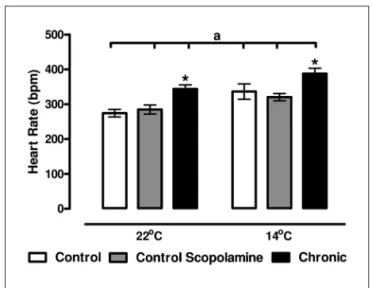
rats with epilepsy exposed to rT and cT conditions were evaluated. At rT condition, rats with epilepsy presented exploratory activity during the irst minutes, followed by a period of habituation, when the animals remained quiet and the hr measurement performed (343±12 bpm) (Fig 3).
In the cT condition, rats exhibited moderate shivering, pi-lomotor responses and vigorous movements in the cage. Following 10 minutes (habituation of the rats in the box) the animals remained still and then the hr was measured (388±15 bpm) (Fig 3). control animals (rats that received just saline solution and rats that received just methylsco-polamine) presented similar behavior of animals with ep-ilepsy to rT and cT conditions. The hr of control rats that received saline solution was 274±10 bpm to rT and 336±22 bpm to cT (Fig 3). The hr of control rats that re-ceived just methylscopolamine was 284±13 bpm to rT and 320±10 bpm to cT (Fig 3).
DISCUSSION
This study evaluated the hr of rats with and without epilepsy during low temperature exposure. Our results showed that low temperature clearly increased the hr of all rats studied. As mentioned before, epilepsy is a chronic disorder that is associated with increased mortality and a common epilepsy-related category of death is sudden unexpected death. The exact pathophysiological causes of SUDEP are unknown, but it is very probable that car-diac abnormalities during and between seizures play a po-tential role6. In accordance to this reasoning, our group
started some studies aimed to explore this question. we evaluated the hr (in vivo and isolated ex vivo) and the ventricular pressure isolated ex vivo of rats with epilep-sy10. The results of our previous study showed a signiicant
increase of heart rate in vivo in the animals with epilepsy when compared with control group. In contrast, we did not ind differences during isolated ex vivo experiments, suggesting a central nervous system modulation on the heart, which could explain the sudden unexpected death in epilepsy. In the present study, we also found an increase of heart rate of rats with epilepsy during in vivo situation that was exacerbated when the animals were exposed to cold temperatures. In these lines, as cardiac abnormalities play an important cause in SUDEP, we postulated that low temperatures may lead some cardiac abnormalities and hence SUDEP. As research in this ield must be guided by the potential for the prevention of SUDEP, a number of arguments might be put forward.
It has been established that exposure to low tem-peratures is considered one of the main risk factors from cardiovascular abnormalities and hence sudden death7. In
this way, it is interesting to review some indings that ex-plain an increase in cardiac events to cold temperatures: 1) There is 53% more cases of acute myocardial infarc-tion reported during the winter compared with the sum-mer13. In these lines, most of reports, but not all, have
demonstrated a signiicant winter increase in cardiovas-cular abnormalities and cardiac death, especially in the Fig 2. Typical signal obtained in adult male Wistar.
northern hemisphere, where there are winter temperature extremes14,15. Quite interesting, sudden cardiac death have
been also reported in regions with most comfortable win-ter16,17, 2) During the winter, increases in
haemoconcentra-tion (erythrocyte count, plasma cholesterol and plasma ibrinogen levels) have been reported, which could con-tribute to arterial thrombosis18. In this way, rapid
coro-nary deaths could result from rupture of atheromatous plaques during hypertension and cold-induced coronary spasm19,20. 3) cold weather can induce a higher systemic
vascular resistance with an increase of the blood pressure (thus increasing oxygen demand). This study was evaluated by Argiles and colleagues21 that determined, during a
four-year period, the inluenceof climate on blood pressure in 53 patients with end-stage renaldisease treated with hae-modialysis. The authors showed that the mean (±SE) sys-tolicand diastolic blood pressure was highest during the winter (153±3/82±2mm hg) and lowest during the sum-mer (141±3/75±2mm hg). 4) The winter temperatures may be associated with lu season and an increase of upper re-spiratory tract infections could place stress on the heart22.
Based on this fact, an interesting explanation developed recently23 should be considered. According to Meyers23,
cardiovascular abnormalities (acute myocardial infarction and atherothrombotic stroke) and hence sudden cardiac death have their peak incidence in winter months. Simi-larly, the incidence of upper respiratory infections (UrIs), 38% of which are due to inluenza, also peaks in winter period (November and December). Based on this, as inlu-enza vaccination is an extremely safe procedure and three epidemiologic and one small clinical trial showed that inluenza vaccination is associated with a 50% reduction in incidence of cardiovascular abnormalities and sudden cardiac death, inluenza vaccination (each year) is able to prevent this cardiac pathogenesis23. Taken these data
to-gether and the results of our present experimental study, we believe that cold weather could be considered a new potential risk factor of sudden cardiac death in patients with epilepsy. Moreover, we are sure that there is an ur-gent need for several studies (large-scale, prospective, community-based and international) of sudden cardiac death in epilepsy to explore deeply the risk factors to plan preventive strategies.
At the moment, some risk factors for sudden unex-pected death in patients with epilepsy have been pro-posed5, but there is very little information in the literature
that describes the relationship between winter tempera-tures and sudden cardiac death in epilepsy8. In accordance
with this reasoning, we believe that as the modiiable risk factors for cardiovascular abnormalities and sudden death are so prevalent within the epileptic population, it is im-portant for clinicians treating patients with epilepsy to
know what these risks are and understand how they can contribute to increased mortality in these patients.
In the mean time, some actions (medical or non-medi-cal therapies) may help to prevent sudden cardiac death in epilepsy. For that, Kloner24 described some very
inter-esting commonsenseand prudent tactics that the physi-cian should consider during the winter time (called “Merry christmas coronary” and “happyNew year heart Attack”), especiallyfor patients with established cardiac disease or for those withknown risk factors for cardiac disease. De-spite considerable suggestions and evidences, Keating and Donaldson have also suggested that reduction of outdoor cold stress has been largely ignored in oficial campaigns to control winter mortality25. In these lines, they purposed
that heating of waiting areas for public transports, and at least windproof shelters on bus routes subject to un-scheduled delays, are obvious measures that would help25.
Finally, the next logical steps to us, epileptologists, are to understand and associate the mechanisms by which cold weather could inluence the cardiovascular system of patients with epilepsy. These mechanisms are likely to be important for developing new strategies in the preven-tion of sudden cardiac death in epilepsy.
Acknowledgments – The authors would like to thank Dr. Torbjörn Tomson for his suggestions and helpful review of this manuscript.
REfERENCES
1. Duncan JS, Sander JW, Sisodiya SM, et al. Adult epilepsy. Lancet 2006; 367:1087-1100.
2. Sander JW. The epidemiology of epilepsy revisited. Curr Opin Neurol 2003;16:165-170.
3. Halatchev VN. Epidemiology of epilepsy--recent achievements and fu-ture. Folia Medica 2000;42:17-22.
4. Nashef L. Sudden unexpected death in epilepsy: terminology and def-initions. Epilepsia 1997;38:S6-S8.
5. Tomson T, Walczak T, Sillanpaa M, et al. Sudden unexpected death in epilepsy: a review of incidence and risk factors. Epilepsia 2005;46:54-61. 6. Stollberger C, Finsterer J. Cardiorespiratory indings in sudden unex -plained/unexpected death in epilepsy (SUDEP). Epilepsy Res 2004; 59:51-60.
7. Arntz HR, Willich SN, Schreiber C, Brãggemann T, Stern R, Schulthe-iss HP. Diurnal, weekly and seasonal variation of sudden death: pop-ulation based analysis of 24,061 consecutive cases. Eur Heart J 2000;21: 315-320.
8. Scorza FA, Albuquerque M, Arida RM, Cavalheiro EA. Sudden unex-pected death in epilepsy: are winter temperatures a new potential risk factor? Epilepsy Behav 2007;10:509-510.
9. Cavalheiro EA. The pilocarpine model of epilepsy. It J Neurol Sci 1995; 16:33-37.
10. Colugnati DB, Gomes PA, Arida RM, et al.. Analysis of cardiac param-eters in animals with epilepsy: possible cause of sudden death? Arq Neuropsiquiatr 2005;63:1035-1041.
11. Turski WA, Cavalheiro EA, Schwarz M, et al. Limbic seizures produced by pilocarpine in rats: behavioural, electroencephalographic and neu-ropathological study. Behav Brain Res 1983;9:315-335.
12. Cavalheiro EA, Leite JP, Bortolotto ZA, Turski WA, Ikonomidou C, Tur-ski L. Long-term effects of pilocarpine in rats: structural damage of the brain triggers kindling and spontaneous recurrent seizures. Epilepsia 1991;32:778-782.
14. Beyerbach DM, Kovacs RJ, Dmitrienko AA, Rebhun DM, Zipes DP. Heart rate-corrected QT interval in men increases during winter months. Heart Rhythm 2007;4:277-281.
15. Beard CM, Fuster V, Elveback LR. Daily and seasonal variation in sud-den cardiac death, Rochester, Minnesota, 1950-1975. Mayo Clin Proc 1982;57:704-706.
16. Kloner RA, Poole WK, Perritt RL. When throughout the year is coro-nary death most likely to occur? Circulation 1999;100:1630-1634. 17. Douglas AS, Al-Sayer H, Rawles JM, Allan TM. Seasonality of disease
in Kuwait. Lancet 1991;337:1393-1397.
18. Neild PJ, Syndercombe-Court D, Keatinge WR, et al. Cold-induced in-creases in erythrocyte count, plasma cholesterol and plasma ibrino -gen of elderly people without a comparable rise in protein C or factor X. Clin Sci 1994;86:43-48.
19. Farb A, Tang AL, Burke AP, Sessums L, Liang Y, Virmani R. Sudden cor-onary death: frequency of active corcor-onary lesions, inactive corcor-onary le-sions, and myocardial infarction. Circulation 1995;92:1701-1709.
20. Collins KJ, Easton JC, Belield-Smith H, Exton-Smith AN, Pluck RA. Ef -fects of age on body temperature and blood pressure in cold environ-ments, Clin Sci 1985;69:465-470.
21. Argiles A, Mourad G, Mion C. Seasonal changes in blood pressure in patients with end-stage renal disease reated with hemodialysis. N Engl J Med 1998;339:1364-1370.
22. Fleming DM, Cross KW, Pannell RS. Inluenza and its relationship to circulatory disorders. Epidemiol Infect 2005;133:255-262.
23. Meyers DG. Myocardial infarction, stroke, and sudden cardiac death may be prevented by influenza vaccination. Curr Atheroscler Rep 2003;5:146-149.
24. Kloner RA. The “Merry Christmas Coronary” and “Happy New Year Heart Attack” phenomenon. Circulation 2004;110:3744-3745. 25. Keatinge WR, Donaldson GC. Winter mortality in elderly people in