Cardiac autonomic modulation adjustments
in isometric exercise
Ana Ma´rcia dos Santos Anto´nio,I,IIMarco Aure´lio Cardoso,I,IIJoice A. T. do Amaral,I,IILuiz Carlos de Abreu,III Vitor E. ValentiI,II
I UNESP Universidade Estadual Paulista, Faculdade de Ciência e Tecnologia, Programa de Pós-Graduação em Fisioterapia, Presidente Prudente, SP, Brazil II UNESP Universidade Estadual Paulista, Faculdade de Ciências, Departamento de Fisioterapia e Terapia Ocupacional, Marilia, SP, Brazil III Faculdade de Medicina do ABC, Departamento de Morfologia e Fisiologia, Santo André, SP, Brazil
OBJECTIVE:Isometric exercise is characterized by promoting an overload on the cardiovascular system due to pulsatile contraction followed by a significant increase in muscle blood flow. The hemodynamic responses during exercise and during recovery from endurance exercise are well documented. However, there are few studies with hard data regarding the influence of isometric exercise on autonomic control, which can be obtained by analysis of heart rate variability. Thus, the object of this study was to analyze reports on cardiac autonomic regulation in isometric exercise.
METHODS:The articles used in this study were selected from Pubmed, PEDro, Medline, Lilacs and SciELO. The search was made by crossing the following keywords: isometric exercise, autonomic nervous system, cardiovascular system, and heart rate variability, which were defined based on descriptors of Health Headings (MeSH).
RESULTS:The search provided 17 articles in isometric exercise autonomic modulation characterized by decreased vagal modulation followed by increased sympathetic modulation and its reversal shortly after the end of the activity. CONCLUSION:During isometric exercise, increased sympathetic modulation and reduced vagal modulation of the sinus node have been reported.
KEYWORDS: Autonomic Nervous System; Exercise; Cardiovascular System.
dos Santos António AM, Cardoso MA, do Amaral JAT, de Abreu LC, Valenti VE. Cardiac autonomic modulation adjustments in isometric exercise. MedicalExpress (São Paulo, online). 2015;2(1):M150102.
Received for publication onAugust 20 2014;First review completed onSeptember 14 2014;Accepted for publication onOctober 22 2014 E-mail: [email protected]
B INTRODUCTION
The magnitude of cardiovascular responses during physical exercise depends on the muscle mass involved, muscle tension, and duration and intensity of exercise.1For these quick adjustments, the cardiovascular system reacts to maintain its homeostasis. Such responses are produced by the action of the autonomic nervous system on the heart.2 Isometric exercise is characterized by promoting a pressure overload on the cardiovascular system due to pulsatile contraction followed by a significant increase in muscle blood flow.3 – 5It is well documented that isometric exercises increase the heart rate and peripheral vascular resistance with a consequent increase in mean arterial pressure.6 During isometric exercise, the mechanical action of muscle increases intramuscular pressure, which compresses the blood vessels, and prevents the output of metabolites produced during exercise. Their accumulation in muscle stimulates the muscle metaboreceptors, leading to increased heart rate. These cardiovascular responses are mediated by neural adjustments.7 – 10There are many studies that directly
evaluate autonomic response during isometric exercise through direct recording of electrical properties of auto-nomic nerves, such as conduction velocity and amplitude of the peaks of neural electrical activity.11,12
In this context, the assessment of autonomic response can be performed indirectly through the analysis of heart rate variability (HRV), which is a simple and non-invasive method that analyzes cardiac autonomic control as well as the heart’s ability to respond to pathological and physio-logical stimuli.13
Considering the importance of identifying autonomic responses induced by isometric exercise, our study describes the effects of isometric exercise on cardiac autonomic modulation.
B BIBLIOGRAPHIC SEARCH
The articles used in this study were selected from Pubmed, Medline, Lilacs and SciELO database. The search was performed by crossing the following keywords: isometric exercise, static exercise, autonomic nervous system, and cardiovascular system. The terms were defined based on descriptors of Health Headings (MeSH). The studies were
DOI:10.5935/MedicalExpress.2015.01.02
selected based on their titles. They were further analyzed and selected according to the inclusion criteria established. The title should express the focus of the study: cardiac autonomic modulation during isometric exercise and isometric training effects on autonomic control. After filtering the results to identify repetitions, all manuscripts chosen had their abstracts studied with the aim of selecting papers discussing the behavior of cardiac autonomic control during or after isometric exercise. Abstracts that approached this theme had their texts read. The selected studies had their references reviewed to identify relevant studies that were not found in the electronic search.
We included studies published between 2003 and 2014, in English and Portuguese, all of which described performed protocols of isometric exercise which analyzed the auto-nomic nervous system through heart rate variability and all types of study design.
To assess the methodological quality of the studies, we used the PEDro scale. The qualitative data were described and tabulated according to the authors and year of the study, population characteristics, purpose of the study, observed indices, and conclusions.
B RESULTS
Search and selection strategy
With the use of above mentioned descriptors in the database searches, 258 manuscripts were found. The first selection resulted in the elimination of 223 manuscripts. We analyzed the content of the remaining 35 studies that passed the next stage of selection. Eighteen studies did not comply with our established criteria and were excluded. The remaining 17 texts were read and analyzed.
Characteristics of the selected studies
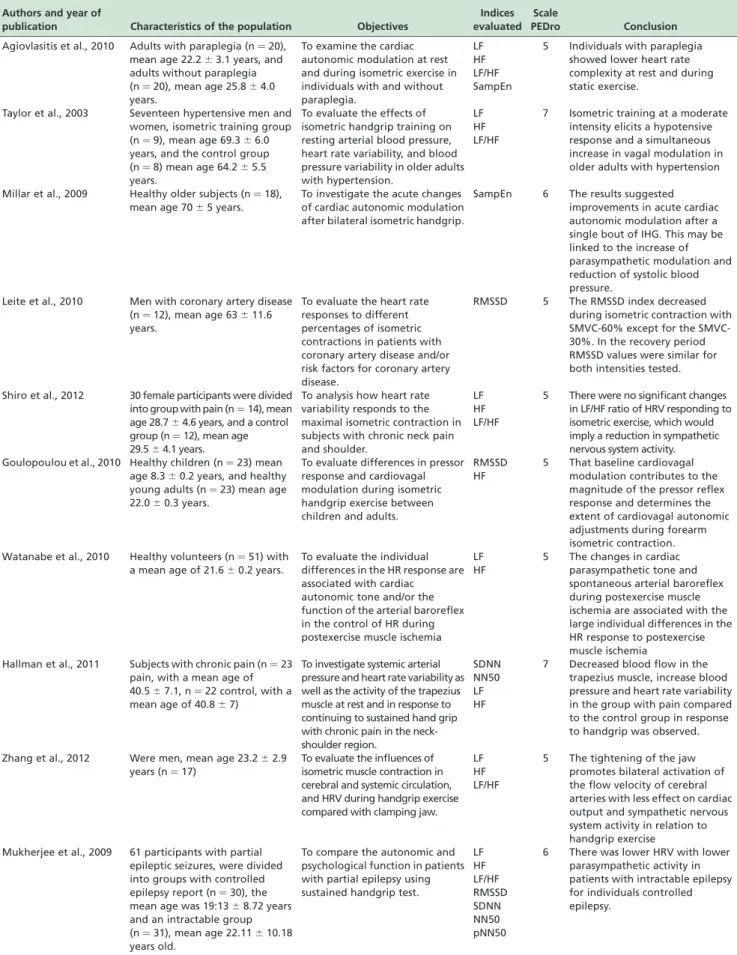
Table 1 presents the studies according to authors and year of publication. It shows the characteristics of the population, objectives, indices evaluated, and the score according to the PEDro scale.
B DISCUSSION
HRV is a reliable technique widely used in the clinical setting for information concerning the integrity of the cardiac autonomic modulation, and it has been investigated in both healthy subjects and in patients with pathological con-ditions.13,14 The objective of this review was to present studies that used isometric exercise protocols and analyzed the cardiac autonomic response through HRV. Heart rate response during isometric exercise has been studied to understand cardiac autonomic control, since there is interaction between the cardiovascular, autonomic and muscular systems while performing exercise. The cardio-vascular system is influenced by the autonomic nervous system through central and peripheral commands. The central mechanism is activated by afferent signals coming from the motor cortex. It is responsible for the activation and recruitment of motor units, and activation of cardiovascular control in the medulla oblongata.15,16 Because peripheral neural receptors are triggered by mechanical activation, nerve endings in contracting muscle send information to the cardiovascular center in the medulla oblongata where activated efferent sympathetic and parasympathetic fibers respond with actions on the heart and blood vessels.17,18
In this sense, the ergoreflex is a mechanism that adjusts hemodynamic responses during exercise to ensure an adequate supply of oxygen and the removal of metabolites produced in muscle. The activation of this reflex occurs in the specific skeletal muscle involved in the exercise. It is mediated by group III afferents that are activated by mechanical stimuli of pressure and stretch, and by the group IV afferent fibers that are activated by metabolic products of muscular contraction and project into the brainstem, increasing sympathetic and decreasing vagal activity.19 – 21 The contribution of each type of fiber to the ergoreflex is still controversial. However, studies have suggested that muscle metaboreceptors are responsible for the reflex increase in sympathetic modulation during static exercise,22 while muscle mechanoreceptors are responsible for increased sympathetic modulation during rhythmic exercises.23
Depending on the intensity of exercise, the mechanical action of the muscles during isometric exercise causes an increase in intramuscular pressure and compresses the blood vessels within the muscles. This prevents muscle blood flow with partial or complete vascular occlusion, preventing the removal of metabolites that accumulate in muscle. This in turn stimulates muscle chemoreceptors and results in increased sympathetic nerve activity.4During the operation of this mechanism, it is possible to evaluate the rate of the low frequency band of HRV, which represents the joint action of the sympathetic and vagal modulation, with sympathetic predominance.13 Agiovlasitis et al.24 found increased low frequency activity during isometric exercise compared with the resting condition in paraplegic patients. Hallman et al.25 investigated the response of cardiac autonomic modulation in isometric contraction in patients with muscle pain, and found a reduction in the overall modulation of HR analyzed through the SDNN index as the intensity of pain increased. Shiro et al.26found no significant changes in the LF/HF ratio in patients with pain in the trapezius muscle, concluding that the decrease in muscle blood flow and oxygen in the trapezius muscles can derive from the sympathetic response during isometric exercise.
Table 1 -Description of studies according to the authors, year of publication, population characteristics, goals, indices evaluated, PEDro scale and conclusions
Authors and year of
publication Characteristics of the population Objectives
Indices evaluated
Scale
PEDro Conclusion
Agiovlasitis et al., 2010 Adults with paraplegia (n¼20), mean age 22.2^3.1 years, and adults without paraplegia (n¼20), mean age 25.8^4.0 years.
To examine the cardiac autonomic modulation at rest and during isometric exercise in individuals with and without paraplegia.
LF HF LF/HF SampEn
5 Individuals with paraplegia showed lower heart rate complexity at rest and during static exercise.
Taylor et al., 2003 Seventeen hypertensive men and women, isometric training group (n¼9), mean age 69.3^6.0 years, and the control group (n¼8) mean age 64.2^5.5 years.
To evaluate the effects of isometric handgrip training on resting arterial blood pressure, heart rate variability, and blood pressure variability in older adults with hypertension.
LF HF LF/HF
7 Isometric training at a moderate intensity elicits a hypotensive response and a simultaneous increase in vagal modulation in older adults with hypertension
Millar et al., 2009 Healthy older subjects (n¼18), mean age 70^5 years.
To investigate the acute changes of cardiac autonomic modulation after bilateral isometric handgrip.
SampEn 6 The results suggested improvements in acute cardiac autonomic modulation after a single bout of IHG. This may be linked to the increase of parasympathetic modulation and reduction of systolic blood pressure.
Leite et al., 2010 Men with coronary artery disease (n¼12), mean age 63^11.6 years.
To evaluate the heart rate responses to different percentages of isometric contractions in patients with coronary artery disease and/or risk factors for coronary artery disease.
RMSSD 5 The RMSSD index decreased during isometric contraction with 60% except for the SMVC-30%. In the recovery period RMSSD values were similar for both intensities tested.
Shiro et al., 2012 30 female participants were divided into group with pain (n¼14), mean age 28.7^4.6 years, and a control group (n¼12), mean age 29.5^4.1 years.
To analysis how heart rate variability responds to the maximal isometric contraction in subjects with chronic neck pain and shoulder.
LF HF LF/HF
5 There were no significant changes in LF/HF ratio of HRV responding to isometric exercise, which would imply a reduction in sympathetic nervous system activity. Goulopoulou et al., 2010 Healthy children (n¼23) mean
age 8.3^0.2 years, and healthy young adults (n¼23) mean age 22.0^0.3 years.
To evaluate differences in pressor response and cardiovagal modulation during isometric handgrip exercise between children and adults.
RMSSD HF
5 That baseline cardiovagal modulation contributes to the magnitude of the pressor reflex response and determines the extent of cardiovagal autonomic adjustments during forearm isometric contraction. Watanabe et al., 2010 Healthy volunteers (n¼51) with
a mean age of 21.6^0.2 years.
To evaluate the individual differences in the HR response are associated with cardiac autonomic tone and/or the function of the arterial baroreflex in the control of HR during postexercise muscle ischemia
LF HF
5 The changes in cardiac parasympathetic tone and spontaneous arterial baroreflex during postexercise muscle ischemia are associated with the large individual differences in the HR response to postexercise muscle ischemia
Hallman et al., 2011 Subjects with chronic pain (n¼23 pain, with a mean age of 40.5^7.1, n¼22 control, with a mean age of 40.8^7)
To investigate systemic arterial pressure and heart rate variability as well as the activity of the trapezius muscle at rest and in response to continuing to sustained hand grip with chronic pain in the neck-shoulder region.
SDNN NN50 LF HF
7 Decreased blood flow in the trapezius muscle, increase blood pressure and heart rate variability in the group with pain compared to the control group in response to handgrip was observed.
Zhang et al., 2012 Were men, mean age 23.2^2.9 years (n¼17)
To evaluate the influences of isometric muscle contraction in cerebral and systemic circulation, and HRV during handgrip exercise compared with clamping jaw.
LF HF LF/HF
5 The tightening of the jaw promotes bilateral activation of the flow velocity of cerebral arteries with less effect on cardiac output and sympathetic nervous system activity in relation to handgrip exercise
Mukherjee et al., 2009 61 participants with partial epileptic seizures, were divided into groups with controlled epilepsy report (n¼30), the mean age was 19:13^8.72 years and an intractable group (n¼31), mean age 22.11^10.18 years old.
To compare the autonomic and psychological function in patients with partial epilepsy using sustained handgrip test.
LF HF LF/HF RMSSD SDNN NN50 pNN50
6 There was lower HRV with lower parasympathetic activity in patients with intractable epilepsy for individuals controlled epilepsy.
the active recovery after isometric exercise depends on the duration and frequency of contraction.
Pivatelli et al.30found decreased levels of HRV in patients with coronary artery disease in the rest condition. Patients with reduced HRV, as assessed by linear methods in the preoperative period of surgical myocardial revasculariza-tion, tend to have higher morbidity and mortality. Laird et al.31 reported increased heart rate and systolic and diastolic blood pressure in 32 healthy subjects during submaximal isometric exercise that returned to baseline after the exercise protocol end.
With respect to the long term aftereffects, studies suggest that progressive resistance exercise results in small reductions in systolic and diastolic resting pressures.32 Taylor et al. concluded that isometric training at moderate intensity causes a hypotensive response and a simultaneous increase in vagal modulation in elderly patients with hypertension, after submitting them to a protocol of isometric handgrip exercise for 10 weeks.33 Raimundo et al.34 evaluated the cardiac autonomic modulation in patients with stroke before, during, and after an acute bout of aerobic exercise. They suggest that stroke patients show a reduced HRV during and at least 30 min after exercise, due to an autonomic imbalance reflected in increased indices that represent the sympathetic nervous system. Watanabe et al.35
evaluated 51 healthy subjects that underwent isometric exercise with 30% of maximum voluntary contraction for 1 minute. They concluded that, in humans, the response of the heart muscle metabolic reflex activation after isometric exercise varies considerably among individuals, and that these differences reflect changes in cardiac parasympathetic tone and baroreflex sensitivity.
Iellamo36 et al. reported that levels of muscle tension caused by isometric contraction resulted in an immediate increase in heart rate in the first seconds (5 to 10 seconds), and this increase is due to reduced vagal modulation of the sinusal nodule. Somers et al.37investigated adjustments in cardiac autonomic modulation in a group of women who performed isometric exercise, and reported reduction of sympathetic modulation and increased vagal modulation minutes after isometric exercise. They conclude that isometric training decreases muscle chemoreflex stimulation during exercise and attenuates the response of the sympathetic nervous system, based on evaluating eight healthy individuals submitted to the protocol of isometric exercise of the upper limbs for six weeks.
A study by Negrao et al.38showed that during isometric exercise, obese subjects have higher muscle sympathetic nerve activity and heart rate, while metaboreflex control of muscle sympathetic nerve activity is decreased in
Table 1 -continued
Authors and year of
publication Characteristics of the population Objectives
Indices evaluated
Scale
PEDro Conclusion
La Fountaine et al., 2009.
Three players (19^2 years of age), and three control subjects (19^2 years).
To compare HRV in athletes who have had concussion at rest and during handgrip test.
LF HF LF/HF
5 There were no significant differences in HRV both at rest and during the handgrip test. Lira et al., 2012. Obese children with a mean age
of 10^0.4 years (n¼11) and placebo group with a mean age of 10^0.7 years (n¼10).
Analyzing the effect of supplementation of vitamin C on cardiac autonomic modulation in obese children, at rest and during isometric exercise.
LF HF LF/HF
8 Vitamin C attenuated the response of cardiac autonomic modulation in obese children provided rest and during isometric exercise compared with the control group.
Silva et al., 2003 2 male volunteers, sedentary patients (26 years old), and an active (22 years old).
Investigate HRV at rest and the magnitude of the HR response to isometric exercise considering the level of physical fitness tests.
RMSM RMSSD
6 The active volunteer had higher HR variation indicates that the dynamics of vagal withdrawal was even greater than that of sedentary, indicating good adaptation to physical training. Zhang et al., 2003. Two women with uncontrolled
hypertension (50 and 55 years of age).
To investigate whether isometric exercise reduces HRV and blood pressure.
LF HF
5 The handgrip exercise is moderately effective in reducing blood pressure, although the effect is more noticeable in the absence of hypertensive medication.
Fisher et al., 2010. Healthy men with an average age of 23^5 years (n¼9).
To verify the cardiac autonomic control during handgrip using beta adrenergic blockers.
RMSSD 5 The value of RMSSD index indicating parasympathetic modulation was greater with the adrenergic beta-blocker compared with control. Gladwell et al., 2005. 5 healthy subjects. To compare the cardiac
autonomic response handgrip and passive stretching.
RMSSD pNN50
5 Vagal modulation decreased significantly during handgrip, whereas passive stretching was not significantly reduced. Hartwich et al., 2013. 23 healthy young women
(20^0.6 years)
To evaluate the influence of muscle metaboreflex in heart rate regulation during handgrip.
RMSSD 5 Muscle metaboreflex increases heart rate due to increase in muscle sympathetic nerve modulation during handgrip.
HRV¼heart rate variability; RMSSD¼square root of the mean square of differences between adjacent normal RR intervals, SDNN¼standard deviation of all normal RR intervals; pNN50¼percentage of adjacent RR intervals differing by duration longer than 50 ms; NN50, number of pairs of adjacent NN intervals differing by more than 50 ms; LF¼low frequency component, HF¼high frequency component, LF/HF¼ratio of components of low and high frequency; un¼normalized unit;2
comparison to normotensive eutrophic subjects. Lira et al.39 noted that oral supplementation with 500 mg of vitamin C for 45 days can restore cardiac autonomic modulation in obese children during isometric exercise, suggesting oxi-dative stress generated changes in cardiac autonomic modulation in this population. Moreno et al.40 found decreased parasympathetic modulation during isometric exercise in both an adult group and in a group of children; however, the children showed greater reduction in HF index in response to isometric exercise compared with the adults. They also demonstrated that a hydration protocol, despite resulting in smaller alterations in the HRV indices, was insufficient to significantly influence these indices during physical exercise. During the recovery period, it induced significant changes in cardiac autonomic modulation, promoting faster recovery of HRV indices.
Our study presents some points that are worth pointing out. As a study review, it does not add new elements in the literature. Nevertheless, it raises important hypotheses for further investigation regarding the involvement of exercise pressor responses, cardiac autonomic regulation, and exercise physiology.
B CONCLUSION
During isometric exercise, cardiac autonomic modulation is characterized by decreased vagal modulation followed by increased sympathetic modulation. The same autonomic components reverse immediately after the end of the contraction.
B AJUSTES DE MODULACA˜ O CARDI´ACA
AUTONOˆ MICA NO EXERCI´CIO ISOME´TRICO
B RESUMO
OBJETIVO: O exercı´cio isome´trico e´ caracterizado por promover uma sobrecarga no sistema cardiovascular devido a` contraca˜o pulsa´til seguida por aumento significativo no fluxo sanguı´neo muscular. As respostas hemodinaˆ-micas durante o exercı´cio e durante a recuperaca˜o do exercı´cio de resisteˆncia esta˜o bem documentados. No entanto, existem poucos estudos com dados concretos sobre a influeˆncia do exercı´cio isome´trico no controle autoˆnomo, a qual pode ser obtida pela ana´lise da variabilidade da frequeˆncia cardı´aca. O objetivo deste estudo foi analisar publicaco˜es sobre a regulaca˜o autonoˆmica cardı´aca durante o exercı´cio isome´trico.
ME´ TODOS: Os artigos utilizados neste estudo foram selecionados do Pubmed, PEDro, Medline, Lilacs e SciELO. A pesquisa foi feita atrave´s do cruzamento das seguintes palavras-chave: exercı´cio isome´trico, sistema nervoso autoˆnomo, sistema cardiovascular, e variabilidade da frequeˆncia cardı´aca, que foram definidas com base nos descritores das rubricas de Sau´de (MeSH).
RESULTADOS:A pesquisa forneceu 17 artigos sobre modulaca˜o autonoˆmica em exercı´cio isome´trico: esta modulaca˜o caracterizou-se pela diminuica˜o da aca˜o vagal, seguida de aumento da modulaca˜o simpa´tica e sua reversa˜o logo apo´s o cessar da contraca˜o.
CONCLUSA˜ O: Durante o exercı´cio isome´trico, ocorre aumento da modulaca˜o simpa´tica e reduca˜o da modulaca˜o vagal sobre o no´dulo sinusal.
UNITERMOS:sistema nervoso autoˆnomo, exercı´cio, sistema cardiovascular.
B REFERENCES
1. Seals DR, Washburn RA, Hanson PG, Painter PL, Nagle FJ. Increased cardiovascular response to static contraction of larger muscle groups. J Appl Physiol. 1983;54(2):434-7.
2. Williamson JW, Fadel PJ, Mitchell JH. New insights into central cardiovascular control during exercise in humans: a central command update. Exp Physiol. 2006;91(1):51-8.
3. Charlton GA, Crawford MH. Consequeˆncias fisiolo´gicas do treinamento. In: Maron BJ, editor. O coraca˜o do Atleta e a doenca cardiovascular. Rio de Janeiro: Interlivros Edico˜es Ltda; 1997; p. 343-53.
4. Friedman DB, Peel C, Mitchell JH. Cardiovascular responses to voluntary and nonvoluntary static exercise in humans. J Appl Physiol. 1992;73(5):1982-5.
5. Seals DR. Influence of active muscle size on sympathetic nerve discharge during isometric contractions in humans. J Appl Physiol. 1993;75(3):1426-31. 6. Forjaz CLM, Tinucci T. A medida da pressa˜o arterial no exercı´cio. Revista
Brasileira de Hipertensa˜o. 2000;7(1):79-87.
7. Asmussen E. Similarities and dissimilarities between static and dynamic exercise. Circ Res. 1981;48(6 Pt 2):I3-10.
8. Edwards RH, Wiles CM. Energy exchange in human skeletal muscle during isometric contraction. Circ Res. 1981;48(6 Pt 2):I11-I17.
9. Gray SD, Carlsson E, Staub NC. Site of increased vascular resistance during isometric muscle contraction. Am J Physiol. 1967;213(3):683-9. 10. Rowell LB, O0Leary DS. Reflex control of the circulation during exercise:
chemoreflexes and mechanoreflexes. J Appl Physiol. 1990;69(2):407-18. 11. Victor RG, Pryor SL, Secher NEI, Mitchell JH. Effects of partial
neuromuscular blockade on sympathetic nerve responses to static exercise in humans. Circ Res. 1989;65(2):468-76.
12. Oren RM, Roach PJ, Schobel HP, Berq WJ, Fergunson DW. Sympathetic responses of patients with congestive heart failure to cold pressor stimulus. Am J Cardiol. 1991;67(11):993-1001.
13. Vanderlei LC. Basic notions of heart rate variability and its clinical applicability. Rev Bras Cir Cardiovasc. 2009;24(2):205-17.
14. Godoy MF, Oliveira CM, Fabri VA, Abreu LC, Valenti VE, Pires AC, Raimundo RD, BertazziI GRL. Long-term cardiac changes in patients with systemic lupus erythematosus. BMC Research Notes. 2013;6:171. 15. Valenti VE, De Abreu LC, Sato MA, Fonseca FL, Riera AR, Ferreira C.
Catalase inhibition into the fourth cerebral ventricle affects bradycardic parasympathetic response to increase in arterial pressure without changing the baroreflex. J Integr Neurosci. 2011;10(1):1-14.
16. Valenti VE, Abreu LC, Sato MA, Ferreira C. ATZ (3-amino-1,2,4-triazole) injected into the fourth cerebral ventricle influences the Bezold-Jarisch reflex in conscious rats. Clinics (Sao Paulo). 2010;65(12):1339-43. 17. Vissing SF, Scherrer U, Victor RG. Stimulation of skin sympathetic nerve
discharge by central command: differential control of sympathetic outflow to skin and skeletal muscle during static exercise. Circ Res. 1991;69(1):228-38.
18. Mitchell JH. Neural control of the circulation during exercise. Med Sci Sports Exerc. 1990;22(2):141-54.
19. Kaufman MP, Longhurst JC, Rybicki KJ, Wallach JH, Mitchell JH. Effects of static muscular contraction on impulse activity of groups III and IV afferents in cats. J Appl Physiol Respir Environ Exerc Physiol. 1983;55(1 Pt 1):105-12.
20. McCloskey DI, Mitchell JH. Reflex cardiovascular and respiratory responses originating in exercising muscle. J Physiol. 1972;224(1):173-86. 21. Rowell LB, O0Leary DS. Reflex control of the circulation during exercise: chemoreflexes and mechanoreflexes. J. Appl Physiol. 1990;69(2):407-18. 22. Kaufman MP, Hayes SG. The exercise pressor reflex. Clin Auton Res.
2002;12(6):429-39.
23. Herr MD, Imadojemu V, Kunselman AR, Sinoway LI. Characteristics of the muscle mechanoreflex during quadriceps contractions in humans. J Appl Physiol. 1999;86(2):767-72.
24. Agiovlasitis S, Heffernan KS, Jae SY. Effects of paraplegia on cardiac autonomic regulation during static exercise. Am J Phys Med Rehabil. 2010;89:817-23.
25. Hallman DM, Lindberg LG, Arnetz BB, Lyskov E. Effects of static contraction and cold stimulation on cardiovascular autonomic indices, trapezius blood flow and muscle activity in chronic neck-shoulder pain. Eur J Appl Physiol. 2011;111(8):1725-35.
26. Shiro Y, Arai YC, Matsubara T, Isogai S, Ushida T. Effect of muscle load tasks with maximal isometric contractions on oxygenation of the trapezius muscle and sympathetic nervous activity in females with chronic neck and shoulder pain. BMC Musculoskelet Disord. 2012;13:146. 27. Fisher JP, Ogoh S, Young CN, Keller DM, Fadel PJ. Exercise intensity influences cardiac baroreflex function at the onset of isometric exercise in humans. J Applied Physiol. 2007;103(3):941-7.
28. Leite PH. Heart rate responses during isometric exercises in patients undergoing a phase III cardiac rehabilitation program. Rev Bras Fisioter. 2010;14:383-9.
29. Millar PJ, MacDonald MJ, McCartney N. Effects of isometric handgrip protocol on blood pressure and neurocardiac modulation. Int J Sports Med. 2011;32(3):174-80.
30. Pivatelli FC, Dos Santos MA, Fernandes GB, Gatti M, de Abreu LC, Valenti VE, et al. Sensitivity, specificity and predictive values of linear and nonlinear indices of heart rate variability in stable angina patients. Int Arch Med. 2012;5(1):31.
31. Laird WP, Fixler DE, Huffines FD. Cardiovascular response to isometric exercise in normal adolescents. Circulation. 1979;59(4):651-4.
33. Taylor AC, McCartney M, Kamath MV, Wiley RL. Isometric training lowers resting blood pressure and modulates autonomic control. Med. Sci. Sports Exerc. 2003;35(2):251-6.
34. Raimundo RD, de Abreu LC, Adami F, Vanderlei FM, de Carvalho TD, Moreno IL, et al. Heart rate variability in stroke patients submitted to an acute bout of aerobic exercise. Transl Stroke Res. 2013;4(5):488-99. 35. Watanabe K, Ichinose M, Fujii N, Matsumoto M, Nishiyasu T. Individual
differences in the heart rate response to activation of the muscle metaboreflex in humans. Am J Physiol Heart Circ Physiol. 2010;299(5): H1708-14.
36. Iellamo F, Pizzinelli P, Massaro M, Raimondi G, Peruzzi G, Legramante JM. Muscle metaboreflex contribution to sinus node regulation during static exercise: insights from spectral analysis of heart rate variability. Circulation. 1999;100(1):27-32.
37. Somers V, Leo R, Shields M, Clary A. Forearm endurance training attenuates sympathetic nerve response to isometric handgrip in normal humans. J. Appl. Physiol. 1992;72(3):1039-43.
38. Negrao CE, Trombetta IC, Batalha LT, Ribeiro MM, Rondon MU, Tinucci T, et al. Muscle metaboreflex control is diminished in normotensive obese women. Am J Physiol Heart Circ Physiol. 2001;281(2):H469-75. 39. Lira FAS. Influeˆncia da vitamina C na modulaca˜o autonoˆmica cardı´aca no
repouso e durante o exercı´cio isome´trico em criancas obesas. Rev Bras Sau´de Matern Infant. 2012;12(3):259-67.