Language and cognition in very Low birth
weight preterm infants with peLcdo appLication
Karina Elena Bernardis Bühler
1, Suelly Cecília Olivan Limongi
2, Edna Maria de Albuquerque Diniz
3abstract – The performance of very low birth weight preterm infants, in terms of cognition and expressive language, was analyzed and compared with that of term infants with the Protocol for Expressive Language and Cognition Development Observation (PELCDO). The study involved 12 very low birth weight preterm infants and 20 term infants, all of whom were evaluated monthly. Sessions were videotaped, and data were analyzed according to this specific protocol. Our results suggest that cognition and expressive language develop significantly later in very low birth weight preterm infants than in the term. We found positive correlations for cognitive and expressive language development, the delay becoming more evident after 6 months of age, persisting through the sensorimotor period, and continuing into the beginning of preoperational period, indicating the importance of follow-up evaluation, defining the true needs of such infants and identifying the ideal moment for speech-language intervention.
KEy WOrDS: infant very low birth weight, language, cognition, infant, premature, protocol.
Linguagem e cognição em bebês pré-termo muito baixo peso por meio da aplicação do podcLe
resumo – O desempenho de bebês pré-termo muito baixo peso em relação ao desenvolvimento cognitivo e de linguagem expressiva foi analisado e comparado com o de bebês de termo com o Protocolo para Observação do Desenvolvimento Cognitivo e de Linguagem Expressiva (PODCLE). O estudo envolveu 12 bebês pré-termo muito baixo peso e 20 bebês de pré-termo acompanhados mensalmente. Todas as sessões foram filmadas em videotape e os dados analisados segundo o protocolo específico. Nossos resultados mostraram que o desenvolvimento cognitivo e da linguagem expressiva ocorreu significativamente mais tarde nos bebês pré-termo muito baixo peso. Nós encontramos correlações positivas entre o desenvolvimento cognitivo e de linguagem expressiva, o atraso foi mais evidente após os seis meses de idade mantendo-se durante todo o período sensório-motor e início do pré-operatório, indicando a importância do seguimento, definindo as necessidades reais destas crianças e indicando o melhor momento para intervenção fonoaudiológica. PALAvrAS-ChAvE: recém-nascido de muito baixo peso, linguagem, cognição, prematuro, protocolos.
hospital Universitário, University of São Paulo, São Paulo SP, Brazil: 1PhD, Speech and Language Therapist, hospital Universitário, University of São Paulo; 2PhD Associate Professor, Department of Speech, Language and hearing Sciences, School of Medicine, University of São Paulo; 3PhD Associate Professor, Department of Pediatrics, School of Medicine, University of São Paulo, Coordinator of researches in Neonatology, hospital Universistário, University of São Paulo. Financing: FAPESP process no 06/55866-9.
received 15 September 2008, received in inal form 11 December 2008. Accepted 4 March 2009.
Dra. Karina Elena Bernardis Bühler – Rua Aliança Liberal 1015 / 101 - 05088-000 São Paulo SP. Brasil. E-mail: [email protected] In children who had been very low birth weight (vLBW)
preterm infants, speech and language disorders have been reported in terms of reception and expression1-3. In
ad-dition, it has been shown that such children are at risk for cognitive and behavioral problems, including lower IQ, learning disabilities, excessive distraction, hyperactiv-ity, and working memory deicits4-9. Although such
ver-bal problems are not evident during the irst years of life, they can have a signiicant negative impact on the social and academic life of the child6.
The focus of the present study was cognitive and
lan-guage development during the sensorimotor period and the beginning of the preoperational period. This is a cru-cial phase in the preparation and acquisition of the irst words and syntactic construction, since sensorimotor in-telligence allows the notions of subject, verb, predicate, and object permanence to be constructed10.
ear-ly language development, a child uses gestures as substi-tutes for, or in conjunction with, the linguistic signals in order to facilitate communication. Once a child has ac-quired a broader linguistic repertoire (through social rela-tionships, as well as through interaction with objects and situations), the use of gestures decreases15-17.
In the genetic epistemology model, observing the be-havior of the child is crucial, and the observer plays an im-portant role, determining how the knowledge is built. It is a descriptive model with qualitative value, but it needs an objective observation18.
Therefore, the use of protocols based on these the-oretical principles is appropriate. The protocol for ex-pressive language and cognition development observa-tion (PELCDO) is one such protocol19,20, which is applied
to the sensorimotor period and the beginning of the pre-operational period.
The aim of the present study was to place and describe the performance of vLBW preterm infants, in terms of cog-nition and expressive language during the sensorimotor and the beginning of the preoperational period, and to com-pare it with that of term infants with PELCDO application.
method
This study was approved by the Ethics Committee of the Uni-versity of São Paulo UniUni-versity hospital (process nº 592/05), as well as by the Ethics Committee for the Analysis of research Projects
of the University of São Paulo School of Medicine Hospital das
Clínicas, (process no. 082/07). Written informed consent was ob-tained from the parents or legal guardians of all study participants.
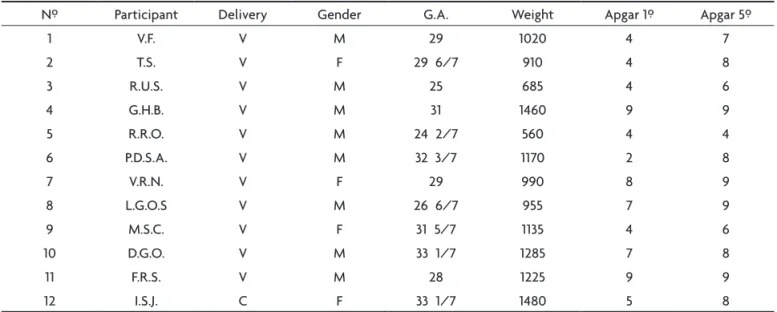
The study was carried out over a period of two years and three months. The study sample was composed of 12 of vLBW preterm infants (vLBW-PI group), the mean gestational age was 29.4 weeks, and the mean birth weight was 1073 g, all infants
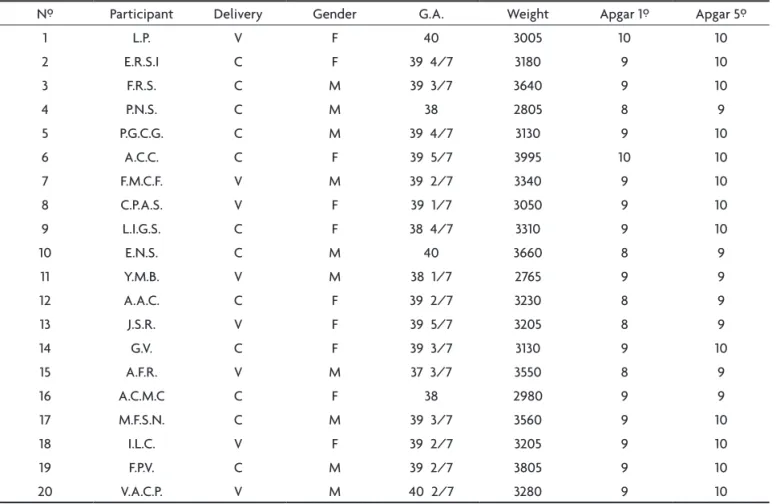
were born at the University of São Paulo University hospital between March of 2005 and February of 2006 and monitored at the University hospital Outpatient Clinic for high-risk New-borns; and a group of 20 term infants (TI group), monitored at the University hospital Pediatric Outpatient Clinic, at the Uni-versity hospital Day Care Center, or both. The mean gestational age was 39.1 weeks, and the mean birth weight was 3291 g.
The criteria for inclusion in the vLBW-PI group were being less than 34 weeks of gestational age (according to the date of last menstrual period) and having a birth weight equal to or low-er than 1500 g, as well as presenting no major malformations, ge-netic syndromes, severe neonatal asphyxia, hearing impairment and visual impairment. The following were the criteria for inclu-sion in the TI group: having presented no prenatal, perinatal, or postnatal complications; being of an appropriate gestational age; presenting a birth weight of between 2500 g and 3999 g. All in-fants should have been exposed only to Brazilian Portuguese.
Tables 1 and 2 presents the distribution of the children ac-cording to delivery, gender, gestational age, birth weight and bul-letin Apgar for vLBW-PI group and TI group respectively.
In conducting the present study, we used the following: the PELCDO19; a tape transcription protocol; a Sony 8 mm video re-corder; and evaluation material according to the protocol.
From inclusion in the study until 18 months of age, infants in both groups underwent monthly, 30-min evaluations in which cognition and expressive language were observed and record-ed according to the PELCDO. There were two observers (raters), both of whom were blinded to the group to which a given in-fant belonged. In accordance with the standards of the institu-tions at which the infants were evaluated, corrected ages were used for the infants in the vLBW-PI group.
All sessions were videotaped and transcribed. The data were analyzed according to the PELCDO. In terms of cognitive devel-opment, the following aspects were evaluated:
Table 1. Distribution and characterization of very low birth weight preterm infants group.
Nº Participant Delivery Gender G.A. Weight Apgar 1º Apgar 5º
1 v.F. v M 29 1020 4 7
2 T.S. v F 29 6/7 910 4 8
3 r.U.S. v M 25 685 4 6
4 G.h.B. v M 31 1460 9 9
5 r.r.O. v M 24 2/7 560 4 4
6 P.D.S.A. v M 32 3/7 1170 2 8
7 v.r.N. v F 29 990 8 9
8 L.G.O.S v M 26 6/7 955 7 9
9 M.S.C. v F 31 5/7 1135 4 6
10 D.G.O. v M 33 1/7 1285 7 8
11 F.r.S. v M 28 1225 9 9
12 I.S.J. C F 33 1/7 1480 5 8
1st and 2nd phases of sensory-motor period – Sensorimotor scheme application (application of isolated schemes); displacement of objects in space (follows incompletely, follows completely).
3rd phase of sensory-motor period – Sensorimotor scheme appli-cation (appliappli-cation of coordinated schemes); object permanence (looks for the object partially hidden), motor scheme imitation (isolated schemes visible in the body).
4th phase of sensory-motor period – Object permanence (looks for the object totally hidden but not considering its displacements), motor scheme imitation (schemes not visible in the body), using objects as tools (support and string conduct).
5th phase of sensory-motor period – Object permanence (looks for the object totally hidden, considering only the visible dis-placements), motor scheme imitation (imitation of coordinat-ed schemes), using objects as tools (the stick conduct), performs experiences with new objects.
6th phase of sensory-motor period – Object permanence (looks for the object totally hidden considering the visible and invis-ible displacements), simple symbolic schemes (applied in the body or in igurative objects).
Beginning of preoperational period – simple symbolic schemes (applied in non-igurative objects), combined symbolic schemes (combines two actions, combines three or more non-ordered ac-tions, combines three or more ordered actions).
In terms of the development of expressive language, the as-pects evaluated were as follows:
Set of productions I – Imitation of deictic or representative ges-tures, accompanied or not by vocalizations
Set of productions II – Differed imitation of deictic or represen-tative gestures, accompanied or not by vocalizations.
Set of productions III – Differed imitation of representative gestures accompanied by vocal onomatopoeia or syllables with meaning. Production of syllables with meaning, monosyllabic words and/or interjections accompanied or not by deictic or representative gestures.
Set of productions IV – Production of onomatopoeic words and words with more than one syllable, accompanied or not by de-ictic or representative gestures.
Set of productions V – Production of combination of two or more words, accompanied or not by deictic or representative gestures.
In order to assure the reproducibility of the analysis, the re-sults were validated by determining inter-rater reliability. The in-ter-rater reliability was 92% for observer 1 and 94% for observer 2. Parametric tests (analysis of variance) and nonparametric tests (Mann-Whitney test, Kruskal-Wallis test, and Spearman’s correlation) were used for the statistical analysis of data. The level of signiicance was set at 5%.
Table 2. Distribution and characterization of term infants group.
Nº Participant Delivery Gender G.A. Weight Apgar 1º Apgar 5º
1 L.P. v F 40 3005 10 10
2 E.r.S.I C F 39 4/7 3180 9 10
3 F.r.S. C M 39 3/7 3640 9 10
4 P.N.S. C M 38 2805 8 9
5 P.G.C.G. C M 39 4/7 3130 9 10
6 A.C.C. C F 39 5/7 3995 10 10
7 F.M.C.F. v M 39 2/7 3340 9 10
8 C.P.A.S. v F 39 1/7 3050 9 10
9 L.I.G.S. C F 38 4/7 3310 9 10
10 E.N.S. C M 40 3660 8 9
11 y.M.B. v M 38 1/7 2765 9 9
12 A.A.C. C F 39 2/7 3230 8 9
13 J.S.r. v F 39 5/7 3205 8 9
14 G.v. C F 39 3/7 3130 9 10
15 A.F.r. v M 37 3/7 3550 8 9
16 A.C.M.C C F 38 2980 9 9
17 M.F.S.N. C M 39 3/7 3560 9 10
18 I.L.C. v F 39 2/7 3205 9 10
19 F.P.v. C M 39 2/7 3805 9 10
20 v.A.C.P. v M 40 2/7 3280 9 10
resuLts
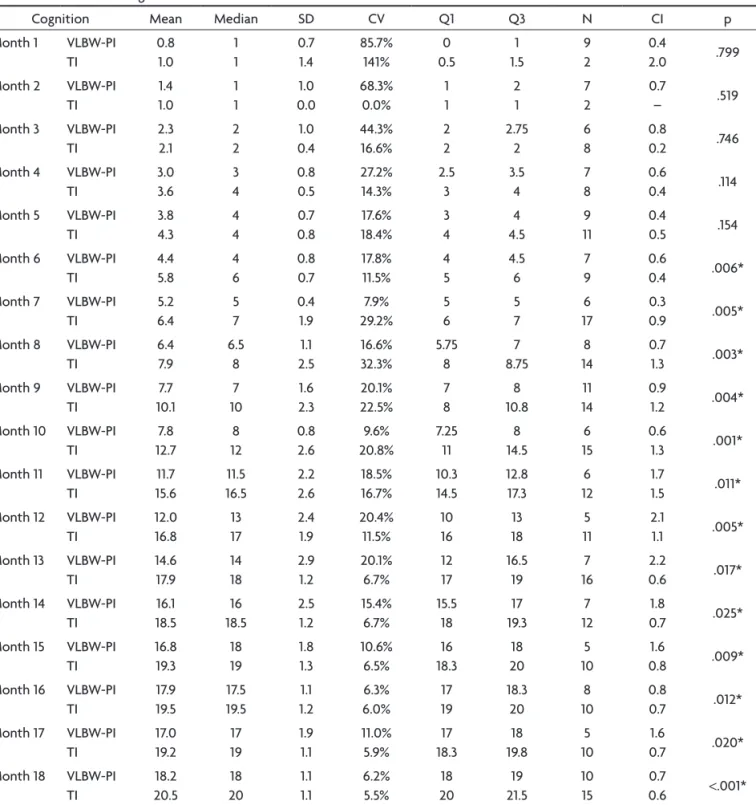
Table 3 presents the results of the monthly cognitive development analyses for both groups. We found statis-tically signiicant differences between the two groups in all months from month 6 onward, cognitive development scores being higher in the TI group.
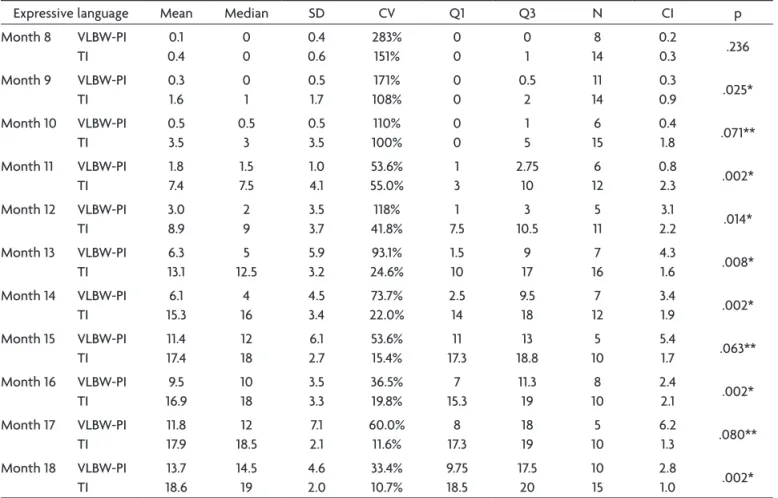
Table 4 presents the results of the monthly evaluations of expressive language development for both groups. We found statistically signiicant differences between the two
groups in months 9, 11, 12, 13, 14, 16, and 18, expressive lan-guage development scores being higher in the TI group. In months 10, 15 and 17, that difference presented only a tendency toward statistical signiicance.
We found statistically signiicant positive correlations between cognition and expressive language in both groups (Table 5), cognitive score increasing in parallel with ex-pressive language score, and vice-versa. The correlations between the two skills were calculated only from month
Table 3. Distribution of cognitive scores over the months evaluated.
Cognition Mean Median SD Cv Q1 Q3 N CI p
Month 1 vLBW-PI
TI 0.8 1.0 1 1 0.7 1.4 85.7% 141% 0 0.5 1 1.5 9 2 0.4 2.0 .799
Month 2 vLBW-PI
TI 1.4 1.0 1 1 1.0 0.0 68.3% 0.0% 1 1 2 1 7 2 0.7 – .519
Month 3 vLBW-PI
TI 2.3 2.1 2 2 1.0 0.4 44.3% 16.6% 2 2 2.75 2 6 8 0.8 0.2 .746
Month 4 vLBW-PI
TI 3.0 3.6 3 4 0.8 0.5 27.2% 14.3% 2.5 3 3.5 4 7 8 0.6 0.4 .114
Month 5 vLBW-PI
TI 3.8 4.3 4 4 0.7 0.8 17.6% 18.4% 3 4 4 4.5 9 11 0.4 0.5 .154
Month 6 vLBW-PI
TI 4.4 5.8 4 6 0.8 0.7 17.8% 11.5% 4 5 4.5 6 7 9 0.6 0.4 .006*
Month 7 vLBW-PI
TI 5.2 6.4 5 7 0.4 1.9 7.9% 29.2% 5 6 5 7 6 17 0.3 0.9 .005*
Month 8 vLBW-PI
TI 6.4 7.9 6.5 8 1.1 2.5 16.6% 32.3% 5.75 8 7 8.75 8 14 0.7 1.3 .003*
Month 9 vLBW-PI
TI 7.7 10.1 7 10 1.6 2.3 20.1% 22.5% 7 8 8 10.8 11 14 0.9 1.2 .004*
Month 10 vLBW-PI
TI 7.8 12.7 8 12 0.8 2.6 9.6% 20.8% 7.25 11 8 14.5 6 15 0.6 1.3 .001*
Month 11 vLBW-PI
TI 11.7 15.6 11.5 16.5 2.2 2.6 18.5% 16.7% 10.3 14.5 12.8 17.3 6 12 1.7 1.5 .011*
Month 12 vLBW-PI
TI 12.0 16.8 13 17 2.4 1.9 20.4% 11.5% 10 16 13 18 5 11 2.1 1.1 .005*
Month 13 vLBW-PI
TI 14.6 17.9 14 18 2.9 1.2 20.1% 6.7% 12 17 16.5 19 7 16 2.2 0.6 .017*
Month 14 vLBW-PI
TI 16.1 18.5 16 18.5 2.5 1.2 15.4% 6.7% 15.5 18 17 19.3 7 12 1.8 0.7 .025*
Month 15 vLBW-PI
TI 16.8 19.3 18 19 1.8 1.3 10.6% 6.5% 16 18.3 18 20 5 10 1.6 0.8 .009*
Month 16 vLBW-PI
TI 17.9 19.5 17.5 19.5 1.1 1.2 6.3% 6.0% 17 19 18.3 20 8 10 0.8 0.7 .012*
Month 17 vLBW-PI
TI 17.0 19.2 17 19 1.9 1.1 11.0% 5.9% 17 18.3 18 19.8 5 10 1.6 0.7 .020*
Month 18 vLBW-PI
TI 18.2 20.5 18 20 1.1 1.1 6.2% 5.5% 18 20 19 21.5 10 15 0.7 0.6 <.001*
8 to month 18, since expressive language scores were un-available prior to month 8.
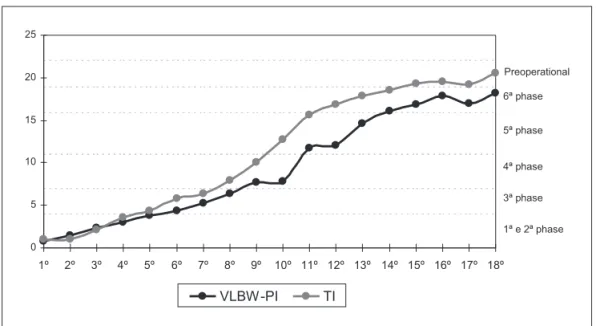
Figures 1 and 2 present the evolution of cognitive scores over the months and its relation with the devel-opment phases and the expressive language scores and its relation with the production assembly respectively for both groups.
discussion
Our results show that cognition and expressive lan-guage both emerge later in children who were vLBW pre-term infants than in those who were pre-term infants. These data corroborate those of other studies indicating that vLBW preterm infants constitute an at-risk population for subsequent disorders or delays in cognitive and language
development1,4,5,7,9. various hypotheses have been
formu-lated to explain these deicits: preterm infants are at high risk for postnatal complications; such infants are submit-ted to a number of painful procedures and can be sepa-rated from their mothers for prolonged periods.
Up to month 4, the cognitive performance of the in-fants in the two groups was similar in terms of the ear-ly sensorimotor acquisition of the use of isolated mo-tor schemes and following object displacement in space, corresponding to phase 1 and phase 2 of the sensorimo-tor period. From month 5 onward, differences between the two groups began to emerge in terms of the phas-es of cognitive development. While the vLBW-PI group infants were still in phase 2 of the sensorimotor period, the TI group had already entered phase 3, which is char-acterized by the use of coordinated motor schemes and searching for a partly-hidden object.
In month 6, the differences between the two groups began to present statistical signiicance, which increased over the subsequent months.
The skills acquired during the various stages of the sensorimotor and preoperational periods are considered essential for the construction of representation and as a condition for oral language expression10,17,21,22. Authors
Table 4. Distribution of expressive language scores over the months in which it was quantiiable.
Expressive language Mean Median SD Cv Q1 Q3 N CI p
Month 8 vLBW-PI
TI 0.1 0.4 0 0 0.4 0.6 283% 151% 0 0 0 1 8 14 0.2 0.3 .236
Month 9 vLBW-PI
TI 0.3 1.6 0 1 0.5 1.7 171% 108% 0 0 0.5 2 11 14 0.3 0.9 .025*
Month 10 vLBW-PI
TI 0.5 3.5 0.5 3 0.5 3.5 110% 100% 0 0 1 5 6 15 0.4 1.8 .071**
Month 11 vLBW-PI
TI 1.8 7.4 1.5 7.5 1.0 4.1 53.6% 55.0% 1 3 2.75 10 6 12 0.8 2.3 .002*
Month 12 vLBW-PI
TI 3.0 8.9 2 9 3.5 3.7 118% 41.8% 1 7.5 3 10.5 5 11 3.1 2.2 .014*
Month 13 vLBW-PI
TI 6.3 13.1 5 12.5 5.9 3.2 93.1% 24.6% 1.5 10 9 17 7 16 4.3 1.6 .008*
Month 14 vLBW-PI
TI 6.1 15.3 4 16 4.5 3.4 73.7% 22.0% 2.5 14 9.5 18 7 12 3.4 1.9 .002*
Month 15 vLBW-PI
TI 11.4 17.4 12 18 6.1 2.7 53.6% 15.4% 11 17.3 13 18.8 5 10 5.4 1.7 .063**
Month 16 vLBW-PI
TI 9.5 16.9 10 18 3.5 3.3 36.5% 19.8% 7 15.3 11.3 19 8 10 2.4 2.1 .002*
Month 17 vLBW-PI
TI 11.8 17.9 12 18.5 7.1 2.1 60.0% 11.6% 8 17.3 18 19 5 10 6.2 1.3 .080**
Month 18 vLBW-PI
TI 13.7 18.6 14.5 19 4.6 2.0 33.4% 10.7% 9.75 18.5 17.5 20 10 15 2.8 1.0 .002*
SD: standard deviation; Cv: coeficient of variance; Q1: irst quartile; Q3: third quartile; CI: conidence interval; vLBW-PI: very low birth weight preterm infants; TI: term infants. *Statistically signiicant. **Trend toward statistical signiicance.
Table 5. Correlations between expressive language and cognition.
Months 8 to 18 Expressive language vs. cognition
Correlation p
TI 88.7% <.001*
vLBW-PI 96.2% <.001*
studying language and its construction based on the prin-ciples of genetic epistemology stress the relationship be-tween the acquisition of such skills and cognitive develop-ment, stating the importance of sensorimotor intelligence in determining the quality of linguistic development10,22.
Considering this relationship, the cognitive delay ob-served in the irst months of life is also thought to have a qualitative and quantitative inluence on the acquisition of linguistic aspects20,23.
The sequence in which children in the TI group present-ed acquisitions (indicators of expressive language develop-ment) was similar to that described in the literature12-16,22.
Our indings corroborate those of studies showing that, in children who were preterm infants, expressive
lan-guage development is delayed during the two irst years of life4,24,25. however, the authors of those studies did not
evaluate vLBW infants. In the present study, we found sta-tistically signiicant differences between the two groups, expressive language development scores being higher in the TI group, in seven of the ten relevant months. The fact that, in the remaining three months evaluated, the differ-ence presented only a tendency toward statistical signif-icance might be attributable to the higher dropout rate in the vLBW-PI group. Other authors have reported difi-culty in maintaining the number of subjects during long-term follow-up studies of prelong-term infants6.
The irst expressive language development acquisi-tions were observed in both groups by month 8. however,
0 5 10 15 20 25
1º 2º 3º 4º 5º 6º 7º 8º 9º 10º 11º 12º 13º 14º 15º 16º 17º 18º
VLBW -PI TI
Preoperational
1ª e 2ª phase 3ª phase 4ª phase 5ª phase 6ª phase
Fig 1. Evolution of cognitive scores over the months evaluated. VLBW-PI: very low birth weight preterm in-fants; TI: term infants.
0 5 10 15 20 25
1º M 2º M 3º M 4º M 5º M 6º M 7º M 8º M 9º M 10º M 11º M 12º M 13º M 14º M 15º M 16º M 17º M 18º M
VLBW-PI TI
I II III IV V
differences between the two groups became pronounced only from month 11 onward. Deferred imitation of repre-sentative gestures together with vocal production of on-omatopoeias or syllables with meaning, as well as isolat-ed production of syllables with meaning, monosyllabic words, or interjections, with or without deictic or repre-sentative gestures, corresponding to set of productions III, were observed by month 12 in the TI group, whereas they did not emerge until at least month 15 in the vLBW-PI group. Furthermore, the production of word combina-tions, with or without deictic or representative gestures, corresponding to set of productions v, was not observed in the vLBW-PI group until the study endpoint (month 18), whereas such production was observed as early as month 15 in the TI group.
Our findings for the TI group corroborate those of studies indicating that the use of deictic and represen-tative gestures is closely related to the use of isolated words and word combinations characterizing the oral ex-pression condition12,15,22.
An increase in the quantity and quality of representa-tive gestures favors a quantitarepresenta-tive and qualitarepresenta-tive increase in oral expression, beginning with vocalizations/production of isolated syllables and evolving to the use of onomato-poeic words, isolated words, and word combinations12-14.
Our results are also in agreement with those of studies demonstrating a relationship between an increase in oral language use and a decrease in the use of gestures, attest-ing to the eficiency of the lattest-inguistic development15,16,22.
The signiicant correlation found between cognitive development and expressive language development in the present study indicates that the delay in cognitive devel-opment observed in the vLBW-PI group inluenced the de-velopment of expressive language in those infants. Those in the vLBW-PI group entered stage 6 of the sensorimo-tor period, characterized by the presence of deferred im-itation, which allows the emergence of the irst words, only in month 14, and only in month 15 did those infants begin to produce vocal onomatopoeia, meaningful sylla-bles, or interjections, as has been previously reported13,14.
In the present study, vLBW infants with a corrected age of 18 months did not reach the preoperational period, nor were they capable of producing combinations of two or more words. The relationships found in the present study among the emergence of representative gestures, symbol-ic play development, the acquisition of the irst words, and the irst use of word combinations corroborate the indings of other authors14,15,22,26.
Another factor that should be considered is the great variability in and heterogeneity among small children with normal language development, which makes it dificult to predict, which any degree of reliability, later language skills from the initial language development27. In order to
reduce this bias, we included the TI group as a suitable ex-ample of how the development of preterm children can be compared to that of healthy term children.
Some studies comparing preterm and term children report that the initial differences, especially certain as-pects, can disappear in the irst years of life, lending cre-dence to the concept of plasticity and recovery of cogni-tion and receptive vocabulary over time in children who were vLBW infants but had no neurologic disorders1.
vari-ous authors indicate the importance of long-term follow-up evaluation, for at least 18 months, in order to identify severe developmental problems28.
The indings of the present study should serve to stim-ulate considerable relection regarding cognitive and the expressive language development in vLBW preterm in-fants: there is a need for systematic follow-up evaluation protocols that provide qualitative and quantitative infor-mation in order to deine the true needs of such infants and identify the ideal moment for speech-language inter-vention, as has been suggested by various authors2,20,29,30.
Our results lead us to conclude that the PELCDO – Protocol for Expressive Language and Cognition Devel-opment Observation used in the present study allows the description, the performance analyses of the children and the placement and follow-up evaluation of the child in terms of knowledge and expressive language develop-ment during the sensorimotor period and the beginning of preoperational period in a objective form. The statistic differences found between the two groups evaluated re-veal not only a delay in the development of cognition and expressive language among vLBW preterm infants but also the relationship existing between the two skills.
references
1. Ment LR, Vohr B, Allan W, et al. Change in cognitive function over time in very low-birth-weight infants. JAMA 2003;289:705-711. 2. Souza R, Andrade CRF. O peril da luência de fala e lingua
-gem de crianças nascidas pré-termo. Pediatria (São Paulo) 2004;26:90-96.
3. Taylor HG, Minich NM, Klein N, et al. Longitudinal outcomes of very low birth weight: neuropsychological indings. J Int Neuropsychol Soc 2004;10:149-163.
4. Cusson RM. Factors inluencing language development in pre -term infants. J Obstet Gynecol Neonatal Nurs 2003;32:402-409. 5. Jansson-Verkasalo E, Korpilahti P, Jäntti V, et al. Neuropsycho-logic correlates of deicient phonoNeuropsycho-logical representations and object naming in prematurely born children. Clin Neurophysiol 2004;115:179-187.
6. Aylward GP. Neurodevelopmental outcome of infants born prematurely. J Dev Behav Pediatr 2005;26:427-440.
8. Hintz SR, Kendrick DE, Vohr B, Poole K, Higgins RD. Chang-es in neurodevelopmental outcomChang-es at 18 to 22 months’ cor-rected age among infants of less than 25 weeks’ gestational age born in 1993-1999. Pediatrics 2005;115:1645-1651.
9. Sansavini A, Guarini A, Alessandroni R, et al. Early relations between lexical and grammatical development in very imma-ture Italian preterms. J Child Lang 2006;33:199-216.
10. Sinclair H, Bertoud I, Gerard J, Veneziano E. Construtivisme et psycholinguistique génétique. Arch Psychol 1985;53:37-60. 11. Bates E, Dick F. Language, gesture and the developing brain.
Dev Psychobiol 2002;40:293-310.
12. Capone NC, McGregor KK. Gesture development: a review for clinical and research practices. J Speech Lang Hear Res 2004;47:173-186.
13. Iverson JM, Golding-Meadow S. Gestures paves the way for language development. Psychol Sci 2005;16:367-371.
14. Ozçaliskan S, Goldin-Meadow S. Gesture is at the cutting edge of early language development. Cognition 2005;96:101-113. 15. Iverson JM, Longobardi E, Caselli MC. Relationship between
gestures and words in children with Down’s syndrome and typically developing children in the early stages of commu-nicative development. Int J Lang Commun Disord 2003;38: 179-197.
16. McEachern D, Haynes WO. Gesture-speech combinations as transition to multiword utterances. Am J Speech Lang Pathol 2004;13:227-235.
17. Andrade RV, Limongi SC. A emergência da expressão co
-municativa na criança com síndrome de Down. Pró-Fono 2007;19:387-392.
18. Adrien JL, Rossignol-Deletang N, Martineau J, Couturier G, Barthelemy C. Regulation of cognitive activity and early com-munication development in young autistic, mentally retarded, and young normal children. Dev Psychobiol 2001;39:124-136.
19. Bühler KEB, Flabiano FC, Limongi SCO, Bei-Lopes DM. Pro
-tocolo para observação do desenvolvimento cognitivo e de linguagem expressiva (PODCLE). Rev Soc Bras Fonoaudiol 2008;13:60-68.
20. Buhler KECB. Desenvolvimento cognitivo e de linguagem
ex-pressiva em bebês pré-termo muito baixo peso em seus está
-gios iniciais. Tese, Faculdade de Medicina, Universidade de São Paulo. São Paulo, 2008.
21. Limongi SCO. A construção da linguagem na criança paralíti-ca cerebral. In: Limongi SCO (Ed). Paralisia cerebral: proces -so terapêutico em linguagem e cognição. Carapicuíba: Pró-Fono;2000.
22. Camaioni L, Aureli T. Trajectoires développementales et indi-viduelles de la transition vers la communication symbolique. Enfance 2002;3:259-275.
23. Tommiska V. Heinonen K, Kero P, et al. A national two year follow up study of extremely low birthweight infants born in 1996-1997. Arch Dis Child Fetal Neonatal 2003;88:29-35. 24. Pereira MR, Funayama CAR. Avaliação de alguns aspectos da
aquisição e desenvolvimento da linguagem de crianças nasci-das pré-termo. Arq Neuropsiquiatr 2004;62:641-648. 25. Oliveira LN, Lima MCMP, Gonçalves VMG.
Acompanhamen-to de lactentes com baixo peso ao nascimenAcompanhamen-to: aquisição de lin-guagem. Arq Neuropsiquiatr 2003;61:802-807.
26. Takiuchi N. Relações entre maturidade simbólica e desenvol-vimento lingüístico em crianças com distúrbios especíicos de desenvolvimento de linguagem. Tese, Faculdade de Filosoia, Letras e Ciências Humanas, Universidade de São Paulo. São Paulo, 2006.
27. Bruce B, Kornfält R, Radeborg K, et al. Identifying children at risk for language impairment: screening of communication at 18 months. Acta Paediatr 2003;92: 1090-1095.
28. Hack M, Klein NK, Taylor HG. Long-term developmental out-comes of low birth weight infants. Future Child 1995;5:176-196. 29. Isotani SM, Pedromônico MRM, Perissinoto J, et al. O desen -volvimento de crianças nascidas pré-termo no terceiro ano de vida. Folha Med 2002;121:85-92.