Effect of Red Wine Associated with Physical Exercise in the
Cardiovascular System of Spontaneously Hipertensive Rats
Paulo Roberto Soares Filho, Iran Castro, Adriene Stahlschmidt
Instituto de Cardiologia do Rio Grande do Sul - Fundação Universitária de Cardiologia, Porto Alegre, RS - Brazil
Mailing address: Iran Castro •
Instituto de Cardiologia do Rio Grande do Sul/Fundação Universitária de Cardiologia - Av. Princesa Isabel 395 - 90620-000 - Porto Alegre, RS - Brazil E-mail: [email protected]
Manuscript received March 25, 2010; revised manuscript received August 09, 2010; accepted on August 18, 2010.
Abstract
Background: Physical exercise (PE) is effective in the treatment and prevention of hypertension associated with improved lipid profile and cardiac contractile function. Regular and moderate consumption of alcoholic beverages such as red wine brings a cardiovascular protective effect. Beverage-derived polyphenols have antioxidant properties benefiting blood vessels. There is little evidence on the consumption of red wine associated with PE and the influences on the cardiovascular system.
Objective: To investigate the effect of physical exercise (PE) and moderate red wine intake interaction on systolic blood pressure (SBP), high density lipoprotein (HDL) levels, physical performance (PP) and left ventricular ejection fraction (LVEF) in spontaneously hypertensive rats (SHR).
Methods: Sample of 32 SHRs divided into four groups: wine and exercise group (WEG), wine group (WG), exercise group (EG) and control group (CG). Red wine doses were given by intra-gastric gavage, during ten weeks, coincident with PE period, performed on treadmills. The SHRs received red wine doses of 3.715 ml/kg/day. Physical performance was analyzed by maximal exercise test (MET) and LVEF by echocardiographic measures. SBP measurement was made before and after the PE protocol.
Results: Demonstrated that the three groups which suffered intervention presented significant SBP reduction compared to CG. At the end of the protocol, WEG showed the largest reduction. Like in SBP results, WEG showed the best outcome on HDL levels at the experiment end. There was no significant difference of physical performance and LVEF between groups.
Conclusion: PE associated with moderate red wine intake has cardioprotective effects on SBP and HDL levels in SHR. Their physical performance and LVEF are not modified. (Arq Bras Cardiol 2011;96(4):277-283)
Keywords: Wine/use, exercise, hypertension/prevention and control, HDL cholesterol, cardiovascular system.
Physical exercise (PE) benefits the cardiovascular system, as used and proven by some experiments4-7 as an efficient
non-pharmachological measure in the treatment and prevention of hypertension. Major causes of this hypotensive effect are cardiac output reduction associated with heart rate7 and
peripheral vascular resistance decrease6. Physical exercise
also improves lipid profile8 and heart contractile function9.
Moderate consumption of some types of alcoholic beverages, including red wine (one to two daily doses), shows an inverse association with the development of coronary artery disease (CAD)10,11. In a meta-analysis12 which involved 13 studies, the
benefits of red wine have incorporated more support because it was shown 32% reduction in the development of atherosclerotic disease in wine consumers. Poliphenols found in red wine may help maintaining the health of blood vessels11.
There is little evidence on the consumption of red wine associated with PE and the influences on the cardiovascular system13. It is established that regular and moderate alcoholic
consumption benefits the cardiovascular system. Polyphenols found in red wine have antioxidant properties that act beneficially in blood vessels14-16. Regular PE is proven to
control and regulate BP17,18. This study sought to investigate
Introduction
High blood pressure (BP) is an independent, linear and continuous risk factor for cardiovascular disease1. A major
limitation in the control of hypertension is based on the concept that this disease is complex and polygenic and is influenced by environmental factors such as diet, salt intake and obesity among others2.
For the ease of obtaining of high blood pressure, spontaneously hypertensive rats are the animal model of hypertension most commonly used3. SHR are pre-hypertensive
the effect of physical exercise (PE) and moderate red wine intake interaction on systolic blood pressure (SBP), high density lipoprotein (HDL) levels, physical performance (PP) and left ventricular ejection fraction (LVEF) in spontaneously hypertensive rats (SHR).
Methods
Sample
This experiment was performed using 3-month-old (338.84 ± 21.25 g) male SHRs (n = 32) obtained from the Federal University of São Paulo (UNIFESP, São Paulo, Brazil). The animals were housed at a controlled air temperature (20° C-25° C) in a 12:12-hr reverse light dark cycle facility. The rats were fed with standard laboratory chow and water (Ad libitum). The rats were distributed into four experimental groups: wine and exercise group (WEG), wine group (WG), exercise group (EG) and control group (CG). Red wine in doses of 3.715 ml/kg/day (commensurate with daily consumption considered moderate for a 70 kg human scaling down to an approximately 0.333 kg rat)19,20. These were given by intra-gastric gavage, for ten weeks,
five times a week, early in the morning.
Experimental protocols
Wine doses of 3.715ml/kg/day were given by gavage, for ten weeks, five times a week, early in the morning. The red wine selected was Dal Pizzol Cabernet Sauvignon (Rio Grande do Sul, Brazil), with 12% of alcohol. Exercise training protocol was performed early in the evening 5 times a week. It was based on the intensity variation method, always respecting limits from 40% to 70% of maximal exercise capacity. All rats were adapted to the treadmill (specific for rats, Inbramed, Brazil) before the first maximal exercise test and before the training protocol, which started with a daily duration of 20 minutes and was gradually increased until it reached 60 minutes. This study follows the standards established in the Guide for the Care and Use of Laboratory Animals (Institute of Laboratory Animal Resources, National Academy of Sciences, Washington, D.C., 1996) and in the Ethical Principles in Animal Experiments of the Brazilian College of Animal Experimentation (COBEA).
Maximal exercise test (MET)
It was performed at three moments during the study (beginning, middle, and final of the training protocol) and consisted of starting at a 0.3 km/h speed and increasing it (0.3 km/h) at each three minutes up to the maximal intensity supported by each rat21. The tests were taken only by the
groups that performed exercise training (WEG and EG).
SBP measurement and plasma analyses
Systolic blood pressure (SBP) was measured using the pneumatic tailcuff method, in two instances: between the tenth and fifth day before the protocol and between the fifth and the tenth day after the end of the protocol (beginning and end of the exercise training protocol). Equipment used was MP100 WSW Biopac Systems (Santa Barbara, CA, USA). By the end of the experiment, the SHRs were anaesthetized with
ketamine (50 mg/kg) and xylazine (20 mg/kg) and killed by cervical dislocation. At this time, a blood sample was collected by means of cardiac puncture. HDL plasmatic levels were measured using homogeneous enzymatic colorimetric method.
Echocardiography
Rats were anaesthetized with ketamine (1 mcl/g) and xylazine (0.5 mcl/g) and had their chest fur shaved in order to perform the exam. Echocardiography was used with Philips echo machine with a 7.5 MHz transducer. Images were recorded and measurements made separately by two independent examiners. Left ventricular ejection fraction (LVEF) was the measure chosen for further analysis. No difference was found in these analyses by different observers.
Statistical analysis
Results are expressed as mean ± standard deviation. Comparisons between initial and final measures were statistically verified using paired Student’s t-tests. One-way ANOVA was used to compare data between groups. The multiple comparisons between groups as for the result of final BP to initial SBP difference were done using Tukey test. The software used was SPSS, Version 13.0.
Results
Systolic blood pressure
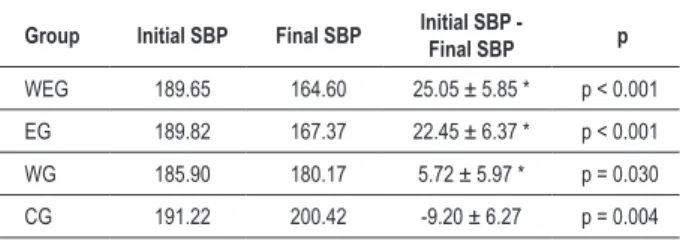
All SBP results are presented in Table 1, where the p value is presented as for the significance level between the initial SBP and final SBP difference within the same group. Comparing this difference between groups, all of the groups presented significance (p<0.001) for CG. WEG showed significant reduction between the first and the second measurement, and this group showed the greatest SBP reduction. When compared to other groups, this difference between the beginning and end of the protocol was significant in relation to the WG and CG (p<0.001). On the other hand, compared to the group that only practiced physical activity (EG), the difference in initial SBP for final SBP, although greater, did not show significance (p=0.83). Physical exercise in isolation has proved effective in controlling hypertension in SHR, because in our experiment, the EG obtained a significant reduction between the first and second measurement. When compared to other groups, this initial difference in SBP for final SBP was significant in the WG and CG (p<0.001). Between our experimental groups, the WG had a small reduction in mean SBP. However, when compared to the CG, the difference between the initial and final SBP was significant (p<0.001).
Physical performance
WEG showed a 62.6% increase in the distance traveled, while EG increased 60.5% the distance on the first MET (Chart 1).
High-density lipoprotein
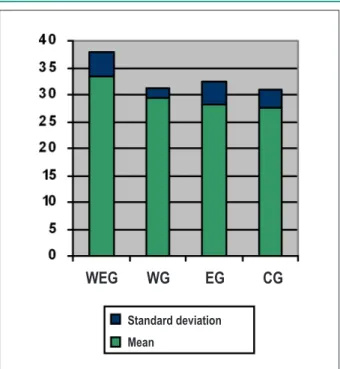
Serum levels of high density lipoprotein (HDL) were analyzed by the end of the training protocol and wine consumption (Chart 2), showing higher levels of HDL in the WEG, with a statistical significance comparing to the CG (p=0.019) and EG (p=0.042). Comparing with the WG, WEG had higher HDL levels, but not significant (p>0.05). In the EG, blood level of HDL did not differ significantly from the CG (p=0.946) - Table 2.
Left ventricular ejection fraction
Echocardiography was performed before and after experimental protocols. Although no significant difference between groups (p=0.579) was found, the results show, in the WEG, a significant increase (p=0.077) between the first and the second measurement of LVEF, and this group presented the highest increase in LVEF. Just like the WEG, the other groups in the study had, to a lesser extent, an increase in LVEF, and
the results are shown in Table 3. Despite the increase in LVEF in all groups, none showed significance for a p value<0.05.
Discussion
Regular exercise seems to be one of the main therapies used to prevent the development of cardiovascular disease because it causes a series of physiological responses resulting from autonomic and hemodynamic changes that will influence the cardiovascular system6,22 and, when associated with changes
in diet, influence positively almost all risk factors6. Regarding
diet, moderate consumption of red wine is associated with a significant reduction of cardiovascular risk12, even for
individuals who consume a diet high in saturated fat, which is a paradoxical situation found in some countries, like France. The outcomes of our study confirm and follow these concepts, because we have found in our data, a significant reduction in cardiac risk markers. Both groups of hypertensive rats that received the interventions in isolation, either exercise or wine, showed reductions in SBP. However, the main outcome of this experiment was to have found in the group that combined physical training program with moderate consumption of red wine, a greater reduction in SBP between the study groups.
Table 1 - Systolic blood pressure (mmHg)
Group Initial SBP Final SBP Initial SBP - Final SBP p
WEG 189.65 164.60 25.05 ± 5.85 * p < 0.001
EG 189.82 167.37 22.45 ± 6.37 * p < 0.001
WG 185.90 180.17 5.72 ± 5.97 * p = 0.030
CG 191.22 200.42 -9.20 ± 6.27 p = 0.004
* p < 0.001, comparing the control group.
Chart 1 - Comparison of travel in meters during the irst MET made in the irst (1), ifth (2) and tenth (3) week. There was no signiicant difference between WEG and EG for a p value<0.05.
Table 2 - HDL, serum level measured at the end of the study (mg/dl)
Group n HDL Standard deviation
WEG 7 33.38 4.438
WG 8 29.25 1.909
EG 8 28.25* 4.234
CG 8 27.43* 3.359
As physical exercise is a known hypotensive agent in both humans and animals4,5,17, understanding the mechanisms of
this effect, which may differ according to the type of exercise employed and the population studied, it is important for its therapeutic use. The effect of an exercise program with an intensity of 60% of VO2 max and duration of four months in controlled hypertensive individuals was examined by Monteiro et al23, showing in the results, a 6% fall in SBP
associated with an improvement in cardiorespiratory fitness and HDL levels increase. The main mechanism attributed to this result is the reduction in cardiac output associated with a drop in heart rate7. The reduction in peripheral vascular
resistance contributes to the hypotensive effect caused by physical training6.
Melo et al21 investigated and compared in SHR and
Wistar-Kyoto, the effects of an exercise program lasting 13 weeks and intensity between 50% and 60% of maximum capacity. Findings showed that only trained SHR rats significantly reduced BP (15 mmHg in average) compared with control rats, confirming a greater hypotensive effect of physical training in hypertensive rats. The growth and proliferation of small venules and regression of arteriole wall hypertrophy
are compensatory adjustments caused by physical training and were indicated as contributors for the hypotensive effect.
Another mechanism caused by physical exercise is decreased sympathetic nervous system activity, which is associated with BP reduction. Bertagnolli et al24 measured BP and norepinephrine
concentration in the heart tissue of SHR rats that participated in a 10-week exercise program. Findings have shown, in the trained group, a reduced norepinephrine concentration in the heart tissue, justifying the animals decreased BP, and this fact is associated with reduced activity of the sympathetic system. Prior to these findings, hemodynamic mechanisms, such as reduced cardiac output associated with rest bradycardia, were described as responsible for attenuating hypertension in SHRs that participated in an exercise program with light to moderate intensity, accounting for 55% of VO2 max25.
Alcohol intake may also influence SBP. Experimental studies with SHR demonstrated that chronic administration of moderate doses of ethanol prevents age-dependant blood pressure increase26. When the effect of consumption of this
substance is analyzed in an acute manner, moderate doses provide BP decrease in SHR27. When red wine is consumed,
regardless of the presence or absence of alcohol, poliphenols play a cardioprotective role, since they have an antioxidant action on LDL-cholesterol11,14,15 and inhibit proinflammatory
proteins16. Studies using alcohol-free red wine compounds
showed that in hypercholesterolemic rabbits28 and rats29, the
phenolic compound had an antithrombotic role as a result of platelet aggregation inhibition.
Polyphenols are generally divided into two groups, flavonoids and non-flavonoids. Those flavonoids most commonly found in red wine are: quercetin, flavonols, tannin, and catechins. This substance if capable of improving endothelial NO synthase expression, releasing more nitric oxide (NO) to endothelial cells31, as well as inhibiting the synthesis of
endothelin-1, the most powerful vasoconstrictor derived from endothelium32. Resveratrol and other polyphenols are absent
in most fruits and vegetables normally used. Hence, red wine intake could be its single nutritional source, mainly because fermentation leads to total polyphenol content enrichment and polyphenol solubilizing results in its larger bioavailability33.
The high-density lipoprotein was another risk marker analyzed in our experiment. Moderate alcohol intake causes an increase in HDL-cholesterol levels, reaching 12% in humans34, and this increase results from the rise in subfractions
HDL2 and HDL3, and apoA-1 and apoA-2, which provides an efficient reverse transport of LDL molecules. Physical fitness also boosts HDL levels. It is a nonpharmacological treatment that reportedly improves the lipid profile8,35.
Table 3 - Left ventricular ejection fraction
Group* Initial LVEF (Mean ± SD) Final LVEF (Mean ± SD) Initial LVEF - Final LVEF p
WEG 87.28 ± 8.47 94.04 ± 4.58 - 6.76 p = 0.077
WG 89.57 ± 6.45 93.52 ± 3.65 - 3.94 p = 0.154
EG 86.87± 5.66 89.52 ± 2.10 - 2.64 p = 0.248
CG 91.28 ± 2.99 93.78 ± 3.20 -2.49 p = 0.135
* The comparison between groups of the difference between the initial LVEF and inal LVEF was not signiicant (p=0.579). Chart 2 - Comparison of HDL levels by the end of the experiment.
Standard deviation
Mean
Just as in the results of SBP, the group that combined physical training with moderate doses of red wine showed the best result in serum levels of HDL. Another interesting finding was that the WG have shown higher levels of HDL than the EG, which, in turn, also showed better results than the CG. The fact that it is not possible to check the initial level of HDL of rats in the study undermined the power of the results concerning the levels of this lipoprotein, despite knowing that SHRs have an isogenic characteristic. In hypertensive rats that practiced physical activity for six weeks, with intensities between 30 and 60%, a significant increase (p < 0.001) in HDL levels compared to sedentary SHR was found28.
An indicator of adaptation to physical training found in our study was the development of rats performance in the MET performed. The fitness program conducted in this experiment resulted in an increase of 60% in the distance traveled by the rats in the last MET. Worthy of note is that the performance of the group that received wine during the exercise protocol did not differ from the group that performed exercise alone.
Pressure overload in hypertension results in pathological cardiac hypertrophy, resulting in the reduction of cardiac function and can lead to heart failure36. The exercise is also related
to cardiac structural changes in SHR, however, hypertrophy triggered by physical training is beneficial to the cardiovascular system and defined as physiological9. Reproducibility of
left ventricular ejection fraction (LVEF) has been universally demonstrated as the preferred measure to express the entirety of cardiac contraction. Thus, LVEF is used as an optimal expression of left ventricular mechanical performance37.
The SHR model is considered to be very similar to the human hypertension model and leads to heart failure3.
Echocardiographic examination was used to demonstrate increased diastolic and systolic volume, as well as reduced LVEF in SHRs after 18 months of life38. Within our sample,
the interventions did not cause any significant difference in LVEF, although the WEG group has presented the best result in the comparison of LVEF between the first and second echocardiography. The effect of PE in the treatment of hypertensive rats with heart failure (SHHF) seems to differ according to the intensity of physical training. Emter et al39
have applied a low intensity protocol in SHHF and obtained as a result a delay on heart failure progress. On the other hand, Schultz et al40 demonstrated that excessive PE triggers
deleterious effects on cardiac remodeling and may accelerate the progression of heart failure in SHHF.
Conclusion
In SHR animal model, the combination of red wine to physical exercise showed beneficial effects, significantly decreasing systolic blood pressure. However, there was no difference in relation to the intervention group with exercise alone, but it was significantly higher than in the group with wine intake alone. This, in turn, decreased blood pressure compared with the control group. This association also showed a significant increase in HDL levels compared to the rats that underwent isolated interventions. It is important to emphasize that in this model, left ventricular ejection fraction was not influenced by the interventions implemented and the physical performance was not impaired by moderate wine intake.
Acknowledgments
This study was supported by Associação Brasileira dos Enólogos (Brazilian Association of Winemakers - ABE). The authors thank the staff of the technical group of the IC//FUC experimental research laboratory (Porto Alegre, RS, Brazil).
Potential Conflict of Interest
No potential conflict of interest relevant to this article was reported.
Sources of Funding
This study was partially funded by the Brazilian Association of Winemakers.
Study Association
This article is part of the thesis of master submitted by Paulo Roberto Soares Filho, from Instituto de Cardiologia de Porto Alegre.
References
1. Lewington S, Clarke R, Qizilbash N, Peto R, Collins R. Age-specific relevance of usual blood pressure to vascular mortality: a meta-analysis of individual data for one million adults in 61 prospective studies. Lancet. 2002;360(9349):1903-13.
2. Krieger JE, Drager LF, Pereira AC, Krieger EM. Genética e hipertensão arterial. Rev Soc Cardiol Estado de São Paulo. 2004;14(3):499-507.
3. Rhoden EL, Rhoden CR. Princípios e técnicas em experimentação animal. Porto Alegre: Editora UFRGS; 2006.
4. Brum PC, Da Silva GJ, Moreira ED, Ida F, Negrao CE, Krieger EM. Exercise training increases baroreceptor gain sensitivity in normal and hypertensive rats. Hypertension. 2000;36(6):1018-22.
5. Kokkinos PF, Narayan P, Papademetriou V. Exercise as hypertension therapy. Cardiol Clin. 2001;19(3):507-16.
6. Monteiro MF, Sobral Filho DC. Exercício físico e controle da pressão arterial. Rev Brasil Med Esporte. 2004;10(6):513-6.
7. Nami R, Mondillo S, Agricola E, Lenti S, Ferro G, Nami N, et al. Aerobic exercise training fails to reduce blood pressure in nondipper-type hypertension. Am J Hypertens. 2000;13(6 Pt 1):593-600.
8. Carroll S, Dudfield M. What is the relationship between exercise and metabolic abnormalities? A review of the metabolic syndrome. Sports Med. 2004;34(6):371-418.
9. Fagard RH. Impact of different sports and training on cardiac structure and function. Cardiol Clin. 1997;15(3):397-412.
nutrition committee, council on cardiovascular nursing of the American Heart Association. Circulation. 2001;103(3):472-5.
11. Szmitko PE, Verma S. Antiatherogenic potential of red wine: clinician update. J Physiol Heart Circ Physiol. 2005;288(5):2023-30.
12. Di Castelnuovo A, Rotondo S, Iacoviello L, Donati MB, Gaetano G. Meta-analysis of wine and beer consumption in relation to vascular risk. Circulation. 2002;105(24):2836-44.
13. Kaplan NM. Alcohol and hypertension. Lancet. 1995;345(8955):1588-9.
14. Kondo K, Matsumoto A, Kurata H, Tanahashi H, Koda H, Amachi T, et al. Inhibition of oxidation of low-density lipoprotein with red wine. Lancet. 1994;344(8930):1152-9.
15. Kerry NL, Abbey M. Red wine and fractionated phenolic compounds prepared from red wine inhibit low density lipoprotein oxidation in vitro. Atherosclerosis. 1997;135(1):93-102.
16. Rosenkranz S, Knirel D, Dietrich H, Flesch M, Erdmann E, Böhm M. Inhibition of the PDGF receptor by red wine flavonoids provides a molecular explanation for the “French paradox” FASEB J. 2002;16(14):1952-60.
17. Mion Jr D, Kohlmann Jr O, Machado CA, Amodeo C, Gomes MAM, Praxedes JN, et al. / Sociedade Brasileira de Cardiologia. V Diretrizes brasileiras de hipertensão arterial. Arq Bras Cardiol. 2007;89(3):e24-e79.
18. Brum PC, Forjaz CLM, Tinucci T, Negrão CE. Adaptações agudas e crônicas do exercício físico no sistema cardiovascular. Rev paul Educ Fis. 2004;18(nº especial):21-3.
19. Celotti E, Ferrarini R, Zironi R, Conte LS. Resveratrol content of some wines obtained from dried Valpolicella grapes: Recioto and Amarone. J Chromatogr A. 1996;730(1-2):47-52.
20. Bertelli A, Bertelli AA, Gozzini A, Giovannini L. Plasma and tissue resveratrol concentrations and pharmacological activity. Drugs Exp Clin Res. 1998;24(3):133-8.
21. Melo RM, Martinho Jr. E, Michelini LC. Training-induced, pressure-lowering effect in SHR: wide effects on circulatory profile of exercised and nonexercised muscles. Hypertension. 2003;42(4):851-7.
22. O’Keefe JH, Nelson J, Harris WB. Lifestyle change for coronary artery disease. Postgrad Med. 1996;99(2):89-106.
23. Monteiro HL, Rolim LMC, Squinca DA, Silva FC, Ticianeli CCC, Amaral SL. Exercise program effectiveness on physical fitness, metabolic profile and blood pressure of hypertensive patients. Rev Bras Med Esporte. 2007;13(2):107-12.
24. Bertagnolli M, Schenkel PC, Campos C, Mostarda CT, Casarini DE, Belló-Klein A, et al. Exercise training reduces sympathetic modulation on cardiovascular system and cardiac oxidative stress in spontaneously hypertensive rats. Am J Hypertens. 2008;21(11):1188-93.
25. Véras-Silva AS, Mattos KC, Gava NS, Brum PC, Negrão CE, Krieger EM. Low-intesity exercise training decreases cardiac output and hypertension in spontaneously hypertensive rats. Am J Physiol. 1997;273(6 Pt 2):2627-31.
26. Guillaume P, Jankowski M, Gianoulakis C, Gutkowska J. Effect of chronic ethanol consumption on the atrial natriuretic system of spontaneously hypertensive rats. Alcohol Clin Exp Res. 1996;20(9):1653-61.
27. El-Mas MM, Abdel-Rahman AA. Acute hemodynamic effects of ethanol in conscious spontaneously hypertensive and normotensive rats. Alcohol Clin Exp Res. 1999;23(2):285-92.
28. Da Luz PL, Serrano Jr CV, Chacra AP, Monteiro HP, Yoshida VM, Furtado M, et al The effect of red wine on experimental atherosclerosis: lipid-independent protection. Exp Mol Pathol. 1999;65(3):150-9.
29. De Curtis A, Murzilli S, Di Castelnuovo A, Rotilio D, Donati MB, De Gaetano G, et al. Alcohol-free red wine prevents arterial thrombosis in dietary-induced hypercholesterolemic rats: experimental support for the ‘French paradox’. J Thromb Haemost. 2005;3(2):346-50.
30. Van de Wiel A, Van Golde PHM, Hart HC. Blessings of the grape. Eur J Intern Med. 2001;12(6):484-9.
31. Wallerath T, Poleo D, Li H, Forstermann U. Red wine increases the expression of human endothelial nitric oxide synthase. J Am Coll Cardiol. 2003;41(3):471-8.
32. Corder R, Douthwaite JA, Lees DM, Khan NQ, Viseu Dos Santos AC, Wood EG, et al. Endothelin-1 synthesis reduced by red wine. Nature. 2001;414(6866):863-4.
33. Soleas GJ, Diamandis EP, Goldberg DM. Resveratrol: a molecule whose time has come? And gone? Clin Biochem. 1997;30(2):91-113.
34. Linn S, Carroll M, Johnson C, Fulwood R, Kalsbeek W, Briefel R. High-density lipoprotein cholesterol and alcohol consumption in US white and black adults: data from NHANES II. Am J Public Health. 1993;83(6):811-6.
35. Toth PP. Cardiology patient page: the “good cholesterol”: high-density lipoprotein. Circulation. 2005;111(5):89-91.
36. Richey PA, Brown SP. Pathological versus physiological left ventricular hypertrophy: a review. J Sports Sci. 1998;16(2):129-41.
37. Gottschall CAM. Dinâmica cardiovascular: do miócito à maratona. São Paulo: Atheneu; 2005.
38. Bing OH, Brooks WW, Robinson KG, Slawsky MT, Hayes JA, Litwin SE, et al. The spontaneously hypertensive rat as a model of the transition from compensated left ventricular hypertrophy to failure. J Mol Cell Cardiol. 1995;27(1):383-96.
39. Emter CA, McCune SA, Sparagna GC, Radin MJ, Moore RL. Low-intensity exercise training delays onset of decompensated heart failure in spontaneously hypertensive heart failure rats. Am J Physiol Heart Circ Physiol. 2005;289(5):2030-8.