DOI: 10.1590/0004-282X20150011
ARTICLE
The effects of bromazepam over the central
and frontal areas during a motor task: an
EEG study
Os efeitos do bromazepam nas áreas corticais central e frontal durante execução de uma
tarefa motora: um estudo de EEG
Suzete Fortunato1, Guaraci Ken Tanaka1,2,3, Fernanda Araújo1, Juliana Bittencourt1,3,4, Danielle Aprigio1, Mariana Gongora2,5, Silmar Teixeira6, Fernando Augusto Monteiro Saboia Pompeu5, Mauricio Cagy7, Luis F. Basile8,9, Pedro Ribeiro2,3,5, Bruna Velasques1,3,5
1Universidade Federal do Rio de Janeiro, Instituto de Psiquiatria, Departamento de Neurofisiologia e Neuropsicologia, Rio de Janeiro RJ, Brazil; 2Universidade Federal do Rio de Janeiro, Departamento de Mapeamento Cerebral e Integração Sensorial, Rio de Janeiro RJ, Brazil;
3Instituto de Neurociência Aplicada (INA), Rio de Janeiro RJ, Brazil;
4Universidade Veiga de Almeida do Rio de Janeiro, Laboratório de Fisioterapia, Rio de Janeiro RJ, Brazil;
5Universidade Federal do Rio de Janeiro, Faculdade de Educação Física, Departamento de Biociências, Rio de Janeiro RJ, Brazil; 6Universidade Federal do Piauí, Laboratório de Mapeamento Cerebral e Funcional, Teresina PI, Brazil;
7Universidade Federal do Rio de Janeiro, Programa de Engenharia Biomédica, Rio de Janeiro RJ, Brazil; 8Universidade Metodista de São Paulo, Faculdade da Saúde, Laboratório de Psicofisiologia, Sao Paulo SP, Brazil; 9Universidade de São Paulo, Faculdade de Medicina, Departamento de Neurocirurgia, Sao Paulo SP, Brazil.
Correspondence: Bruna Velasques; Av. Vesceslau Bras, 71; 22280-060 Rio de Janeiro RJ, Brasil; E-mail: [email protected]
Conflict of interest: There is no conflict of interest to declare.
Received 02 September 2014; Received in final form 26 November 2014; Accepted 15 December 2014.
ABSTRACT
The present study investigates the influence of bromazepam while executing a motor task. Specifically, we intend to analyze the changes in alpha absolute power under two experimental conditions, bromazepam and placebo. We also included analyses of theta and beta frequencies. We collected electroencephalographic data before, during, and after motor task execution. We used a Two Way ANOVA to investigate the condition (PL × Br6 mg) and moment (pre and post) variables for the following electrodes: Fp1, Fp2, F7, F3, Fz, F4, F8, C3, CZ and C4. We found a main effect for condition on the electrodes FP1, F7, F3, Fz, F4, C3 and CZ, for alpha and beta bands. For beta band we also found a main effect for condition on the electrodes Fp2, F8 and C4; for theta band we identified a main effect for condition on C3, Cz and C4 electrodes. This finding suggests that the motor task did not have any influence on the electrocortical activity in alpha, and that the existing modifications were a consequence due merely to the drug use. Despite its anxiolytic and sedative action, bromazepam did not show any significant changes when the individuals executed a finger extension motor task.
Keywords: bromazepam, electroencephalography, sensorimotor integration, absolute alpha power, motor task.
RESUMO
O presente estudo investiga a influência do bromazepam durante a execução de uma tarefa motora. Especificamente, pretende-se analisar as mudanças na potência absoluta de alfa sob duas condições experimentais, bromazepam e placebo. Nós também incluí-mos as analises das frequências teta e beta. Foram coletados dados eletroencefalográficos antes, durante e depois da execução da tarefa motora. Usamos uma Anova de 2 fatores para investigar a condição (PL × Br6 mg) e variáveis no momento (pré e pós) para os seguintes eletrodos: Fp1, Fp2, F7, F3, Fz, F4, F8, C3, C4 e CZ. Encontramos um efeito principal para a condição e eletrodos FP1, F7, F3, Fz, F4, C3 e CZ para alfa e beta. Para beta também foi encontrado um efeito principal para condição nos eletrodos Fp2, F8 e C4; para theta nós identificamos um efeito principal para condition em C3, Cz e C4. Este achado sugere que a tarefa motora não tem qualquer influência sobre a atividade eletrocortical alfa e que as modificações existentes foram uma consequência devido o uso de drogas. Apesar de sua ação ansiolítica e sedativa, o bromazepam não apresentou mudança significativa quando os indivíduos executaram uma tarefa motora.
Motor learning involves a group of processes which pro-voke relatively permanent changes in motor behavior1. From this perspective, learning depends on the integrity of the sen-sorial processing, which is, on the ability of the individual to receive the sensorial information from the environment and from his/her body movements, and to process them and in-tegrate them in the central nervous system (CNS), and uti-lize them to generate adequate adaptive responses2. Previous studies showed that various cortex areas are part of the mo-tor learning process3,4,5. Among these areas, the frontal cor-tex and the somatomotor corcor-tex should be highlighted, since these are the regions that directly participate in motor con-trol. Speciically, the frontal cortex participates in the plan -ning of sequential actions, in the standardization of mo-tor behaviors, and in part of the automated emotional and memory behavior5,6,7. he somatomotor cortex receives so -matic information and controls the limb movements4. Other brain areas also participate in the movement, sending mes-sages, dosing strength and agility, and constantly adjusting the movement through visual, auditory and tactile feedbacks coming from the environment8.
Studies about motor learning have used electroenceph-alographic measures (EEG) in order to analyze motor pro-cesses related to practice, in addition to evaluating electro cortical alterations derived from drug administration with some efect on the CNS4,9,10. Among the investigated drugs, bromazepam can be highlighted. Bromazepam is an anxio-lytic drug from the family of benzodiazepines, capable of pro-ducing important alterations in the CNS; some of the main symptoms caused by the drug are relevant for motor learning and control, such as sleep induction, muscle relaxation and alertness reduction11. he benzodiazepines are psychoactive substances used in the treatment of insomnia, anxiety, agi-tation, muscle spasms and other dysfunctions related to the CNS11. Despite the existence of some results related to the inluence of bromazepam in learning and motor task execu
-tion4,9,10,12, there are still some gaps to be illed within the top
-ic. Several studies report the inluence of bromazepam in the EEG during a motor task, most of these studies investigated beta and theta frequency4,9,10,11,13,14. he papers that we found investigating the inluence of bromazepan in absolute alpha power during a motor task show incongruence in the results. hus, in order to better understand the participation of other frequency band in motor task execution under inluence of bromazepam, we choose to analyses absolute alpha power. With this in mind, the main purpose of the present study is to analyze alpha frequency, however, we included the analy-sis of theta and beta frequencies. herefore, the present study has the objective to investigate the inluence of bromazepam (6 mg) during the practice of a simple motor task, that is, the extension movement of the index inger. Speciically, we an -alyze alpha absolute power under two experimental condi-tions: bromazepam and placebo. he hypothesis is that the subjects under the efect of the drug will tend to be slower
and more relaxed, and will experience lower neural recruit-ment, represented by a greater alpha activity in the frontal and central areas.
METHOD
Sample
Sixteen healthy individuals, (seven men and nine women with average age of 32.5, SD: 9.5) participated of the study. We choose as exclusion criteria: mental or physical illness, and history of psychoactive or psychotropic substances use. For this reason all participants went through anamnesis and a clinical exam. All individuals were right-handed, in agree-ment with the Edinburgh inventory15. In addition to this, they were not allowed to sleep for less than 6-8 hours on the night before the experiment. All subjects signed a consent form and were aware of the experimental protocol. he study is in agreement with the Declaration of Helsinki and was ap-proved by the Ethics Committee of the Federal University of Rio de Janeiro.
Experimental procedure
The subjects performed the task in a sound and light-attenuated room, to minimize sensory interference. Each subject realized two experimental conditions: placebo (Pl) and 6 mg of Bromazepam (Br_6 mg), following a random-ized, double-blind design on different days. Thus, each subject executed one condition on the first day and to the other condition on the second day, one week apart. First, we collected EEG data for each subject during three min-utes. After the capsule ingestion, subjects remained at rest for 2 hour. Then, the subjects sat in front of a computer monitor (Sansung-SyncMaster 550v), they sat on a com-fortable chair with armrest, in order to minimize muscu-lar artifacts, while we recorded the electroencephalogra-phy (EEG) data before, during and after the motor task execution. Under both conditions, the subject performed 6 blocks of 15 trails each (a flexion/extension movement of the index finger in a rhythmic way), with 8-second in-tervals between blocks. The individuals executed the extension of the right index finger after a stimulus ap-peared on the computer monitor many times, as fast as possible. We positioned a sensor called accelerometer (an electro-mechanic device utilized to measure velocity al-terations over time) on the index finger to measure the ac-celeration and, together with the visual feedback, we syn-chronized the accelerometer with the EEG window. We calculated the average of the six blocks together, and we analyzed the initial and final measures, respectively deter-mining the pre and post period.
with the eyes opened. hen, the subjects ingested a capsule containing placebo or bromazepam, and remained at rest for 1 hour. After that, we recorded another 2-minute EEG signal acquisition with the eyes opened. At stage four, si-multaneously with qEEG signal acquisition, the individual started the motor task with lexion and extension of the in -dex inger at the same time that the visual feedback was being generated on the monitor screen. he last stage con -sisted of another signal acquisition through qEEG for 2 min-utes with eyes opened.
Data acquisition
Electroencephalography
he International 10/20 system for electrodes16 was used with a 20-channel Braintech-3000 EEG system (EMSA-Medical Instruments, Brazil). We used 20 elec-trodes arranged on a nylon cap (ElectroCap Inc., Fairfax, VA, USA), yielding mono-pole derivations to linked ear-lobes, set as reference points. In addition, we attached two 9 mm-diameter electrodes above and on the external corner of the right eye, in a bipolar electrode montage, to monitor artifacts on eye-movements (EOG). We kept the impedance of EEG and EOG electrodes between 5 and 10 KΩ. he data acquired had total amplitude of less than 100 µV. We ampliied the EEG signal, with a gain of 22,000, analogically iltered between 0.01 Hz (high-pass) and 100 Hz (low-pass), and sampled at 240 Hz. For the reference data analysis, we applied a visual exam and an indepen-dent component analysis (ICA) to eliminate the possible sources of artifacts produced by the task. We excluded data of individual electrodes which lost contact with the scalp or which showed high impedance (> 10 kΩ), as well as data from blocks with movement artifact excess (± 100 µV). hen, we applied ICA to identify and remove any remaining artifacts after the initial visual inspection. ICA is a group of blind source separation methods, which aim at estimating the maximum independent components from a statistic point of view. he ICA-iltered data were then re-inspected for residual artifacts, using the same rejection criteria de-scribed above. We applied a classic estimator for the power spectral density (PSD), or directly from the square modu-lus of the FT (Fourier Transform), which was performed by MATLAB (Matworks, Inc.).
Statistical analysis
his study analyzed the frontal (Fp1, Fp2, F7, F3, Fz, F4 and F8) and central (C3, CZ and C4) areas. EEG absolute power values underwent a logarithmic transformation through the SPSS software (version 16.0), in order to get closer to a normal distribution. We performed a two way ANOVA test to analyze the results between the conditions (PL × Br 6mg) and between the moments (pre and post) for the following electrodes: Fp1, Fp2, F7, F3, Fz, F4, F8, C3, CZ e C4. We analyzed each electrode
separately. We applied the Schefé test to analyze the signii -cant diferences between the moments (p ≤ 0.05).
RESULTS
Alpha
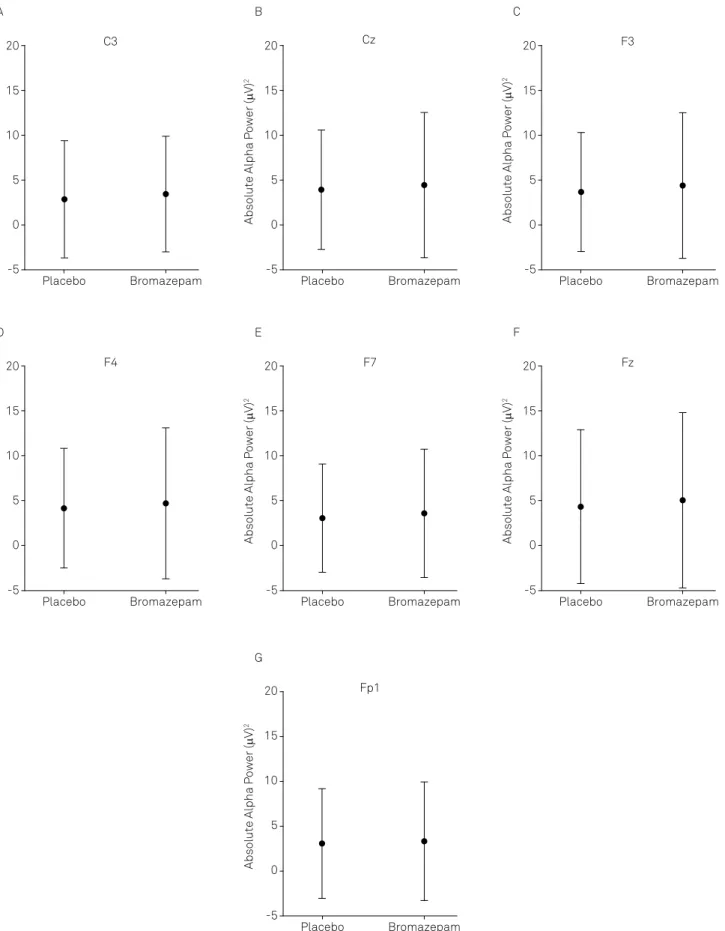
We found a main efect for condition on the elec -trodes Fp1 (p < 0.05; F = 4.67), F7 (p < 0.001; F = 18.96), F3 (p < 0.001), Fz (p < 0.001; F = 18.72), F4 (p < 0.001; F = 10.24), C3 (p < 0.001; F = 26.47) and CZ (p < 0.001; F = 12.79) (Figure 1). For all the electrodes the bromazepam condition showed a greater alpha absolute power when compared to the placebo condition.
Beta
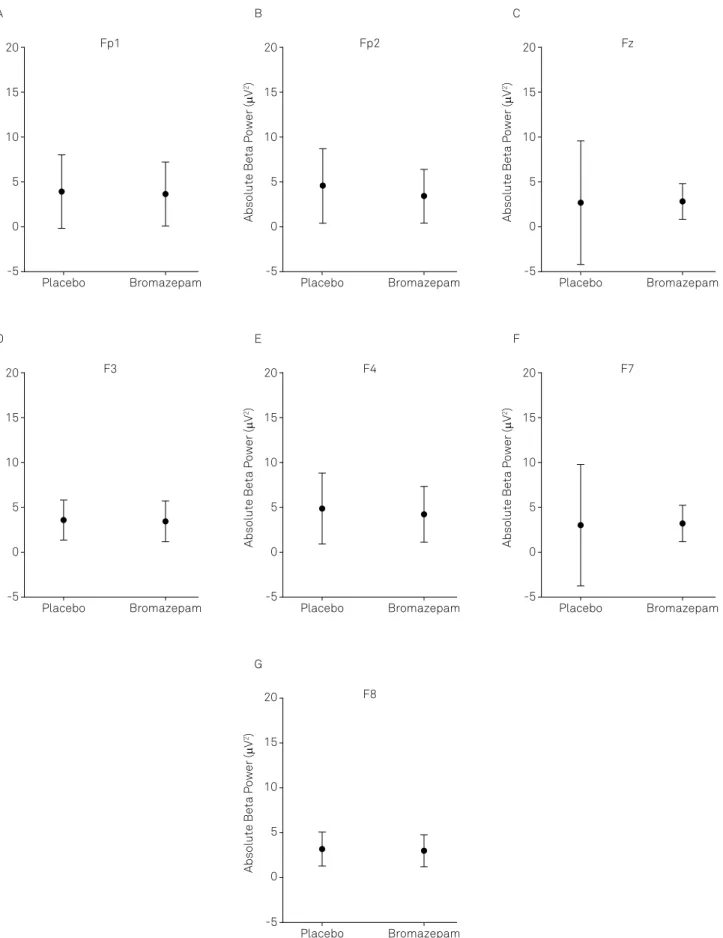
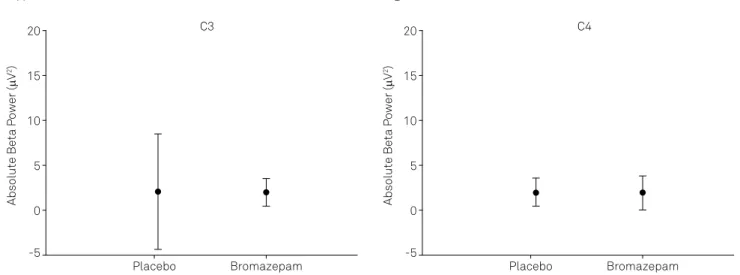
We found a main effect for condition on the electrodes Fp1 (p < 0.005; F = 7.91), Fp2 (p < 0.001; F = 117,43), F7 (p < 0.001), F3 (p < 0.009; F = 6.91), Fz (p < 0.012; F = 6.33), F4 (p < 0.001; F = 54.41), F8 (p < 0.001; F = 19.66) (Figure 2), C4 (p < 0.009; F = 6.82) e C3 (p < 0.047; F = 3.92) (Figure 3). For all the electrodes the bromazepam condition showed a greater alpha absolute power when compared to the placebo condition.
Theta
We found a main efect for conditio non the electrodes C3 (p < 0.001; F = 20.25), Cz (p < 0.001; F = 28.25) e C4 (p < 0.001; F = 32.49) (Figure 4). For all the electrodes the bromazepam condition showed a greater alpha absolute power when com-pared to the placebo condition.
DISCUSSION
Placebo
Absolute Alpha P
ower
(
µ
V)
2
Bromazepam A
C3 Cz F3
Placebo
Absolute Alpha P
ower
(
µ
V)
2
Bromazepam B
Placebo
Absolute Alpha P
ower
(
µ
V)
2
Bromazepam C
Placebo
Absolute Alpha P
ower
(
µ
V)
2
F4 F7 Fz
Bromazepam D
Placebo
Absolute Alpha P
ower
(
µ
V)
2
Bromazepam E
Placebo
Absolute Alpha P
ower
(
µ
V)
2
Bromazepam F
Placebo
Absolute Alpha P
ower
(
µ
V)
2
Fp1
Bromazepam G
-5 0 5 10 15 20
-5 0 5 10 15 20
-5 0 5 10 15 20
-5 0 5 10 15 20
-5 0 5 10 15 20
-5 0 5 10 15 20
-5 0 5 10 15 20
-5
Placebo
Absolute Beta P
ower
(
µ
V
2)
0 5 10 15 20
Bromazepam A
Fp1 Fp2 Fz
-5
Placebo
Absolute Beta P
ower
(
µ
V
2)
0 5 10 15 20
Bromazepam B
-5
Placebo
Absolute Beta P
ower
(
µ
V
2)
0 5 10 15 20
-5 0 5 10 15 20
-5 0 5 10 15 20
-5 0 5 10 15 20
Bromazepam C
Placebo
Absolute Beta P
ower
(
µ
V
2)
F3 F4 F7
Bromazepam D
Placebo
Absolute Beta P
ower
(
µ
V
2)
Bromazepam E
Placebo
Absolute Beta P
ower
(
µ
V
2)
Bromazepam F
-5
Placebo
Absolute Beta P
ower
(
µ
V
2)
0 5 10 15
20 F8
Bromazepam G
It is worth highlighting that the behavioral data, that is, task execution reaction time, was analyzed in a previous study. A statistically signiicant diference was found in the analyzed behavioral parameter (p = 0.001)17. hey observed a greater re -action time for the Br_6 mg condition, when compared to the placebo one; the subjects who used bromazepam showed a slower response to the stimulus. Other researchers analyzed behavioral studies after bromazepam intake, identifying this way some distinct results. In their study, Bourin18 investigated the bromazepam and other benzodiazepines (3 mg) efects in 20 healthy volunteers. he authors observed that the longest motor reaction time was noticed 6 hours after the drug inges-tion. Montenegro19 tried to verify whether there would be re-action time changes after ingestion of 3 mg of bromazepam. he authors believed that a longer reaction time would occur,
but the expected result was not found. his study highlights that the results can be inluenced by the administered dose. Jansen20 also examined the bromazepam (6 mg and 12 mg) ef-fects on the reaction time 65 minutes after the drug adminis-tration, and a lower performance was observed.
However, in the present study, the analysis of the be-havioral data demonstrated a statistically signiicant difer -ence between the Br_6 mg and placebo conditions, proving that the Br_6 mg condition promoted a slower response of the individuals when presented with a stimulus. It is worth pointing out that alpha (8-13 Hz) is a frequency with in-versely proportional amplitude to the quantity of recruited neurons, that is, the alpha rhythm will relect a lowering of cortical action21. Our results will be discussed according to the analyzed areas.
-5
Placebo
Absolute Beta P
ower
(
µ
V
2)
0 5 10 15 20
-5 0 5 10 15 20
Bromazepam A
C3
Placebo
Absolute Beta P
ower
(
µ
V
2)
Bromazepam B
C4
Figure 3. Mean and standard deviation for Absolute Beta Power. (A) The results highlight a significant difference between conditions (p < 0.05) for C3; (B) The results highlight a significant difference between conditions (p < 0.05) for C4.
-5
Placebo
Absolute
Theta P
ower
(
µ
V
2)
0 5 10 15 20
Bromazepam A
C3 C4 Cz
-5
Placebo
Absolute
Theta P
ower
(
µ
V
2)
0 5 10 15 20
Bromazepam B
-5
Placebo
Absolute
Theta P
ower
(
µ
V
2)
0 5 10 15 20
Bromazepam C
Frontal Cortex
he frontal region performs an essential role in the forma -tion of objectives and goals, strategy planning, selecting the cognitive abilities required for the implementation of motor plans and coordinating them to apply them in the correct or-der, in addition to speciic actions related to movement6,7,22. herefore, the execution of a simple motor task allows for a more detailed investigation of the processes associated with planning and motor coordination. We veriied a great -er alpha absolute pow-er for the bromazepam condition for the electrodes Fp1, F7, F3, FZ e F4. his result corroborates with our hypothesis of a lower neural recruitment produced by bromazepam. We also identiied a decrease of absolute beta power for the electrodes Fp1, Fp2, F7, F3, F4 and F8. In a previous study, Portella12 investigated alterations of the at-tention levels in the motor performance using typing, and electroencephalographic parameters because of the admin-istration of 6 mg of bromazepam. Speciically, they analyzed coherence diferences in the alpha, beta, and theta bands in the frontal, central and parietal areas during the execution of four blocks of motor task. According to the same author re-ferred to above, the processes of attention are related to the frontal area and are indicated by beta rhythm increase; how-ever speciically in this band there was decrease between the electrodes F3-Fz in the experimental group, suggesting neu-ronal specialization for such mechanisms. he results dem -onstrated a main efect for the condition factor in the frontal F3-Fz and central C3-Cz. Despite the diference between the task executed in the study by Portella12 and the task execut-ed in the present research, our results in the frontal area are similar to the ones found in his study.
Hubl14 investigated the changes in the brain electrical activity in individuals who ingested olanzapine, using EEG and P300. he study veriied the inluence of the drug in indi -viduals with no addiction, and if there was any alteration in the attention mechanisms during the information process-ing. he author found an increase in the quantity of alpha 2 waves (10-11.5 Hz) in the frontal region, and a decrease in occipital areas. herefore, our results are in agreement with these indings, demonstrating that the benzodiazepines tend to increase the alpha power in these areas. Despite the present study having found an increase in the alpha activ-ity in these areas after the administration of bromazepam, there are contradictions, such as the ones found in the study by Liley23. In this research they veriied the inluence of lo -razepam, a type of benzodiazepine in the alpha band, spe-ciically alpha 1 (8- 9.5 Hz), inding a negative correlation be -tween alpha 1 and the drug use. he literature also points out that there is a decrease in the relative alpha power after the administration of benzodiazepines24.
Somatomotor Cortex
he somatomotor cortex is responsible for sending sig -nals in order to make motor activity control possible; its
function is to coordinate and execute body movements, especially the inest, most complex and varied move -ments25,26,27. When analyzing this region, represented by the electrodes C3 and Cz, we found greater alpha absolute power under the bromazepam condition. Although this re-gion is responsible for motor task control, it was not af-fected by the movement execution. Such result suggests that alpha absolute power cannot be considered as a sen-sible measure to analyze the efects caused by the task. his might have occurred because the alpha band is associated with cognitive aspects28,29.
Studies that investigate motor tasks and electroen-cephalography traditionally investigate the beta frequency band, our study intend to elucidate the alpha power role during motor task execution. Alpha is known for its corre-lation with cognitive and attention aspects, when execut-ing and/or re-learnexecut-ing a motor task, and not with the mo-tor act itself28. It is considered to be sensible to variations in perception, cognition and motor action29. Even though we were not able to observe an efect caused by the task on alpha, i.e., we did not ind a main efect for moment, our data demonstrate that the laterality (i.e., all individuals were right-handed and executed the task with their right hand) interfered in the bromazepam action on the electro cortical activity. his can be explained by the fact that a dif -ference was found between the placebo and bromazepam conditions only on the middle line of the somatomotor cor-tex (Cz) and in the somatomotor corcor-tex contralateral to the movement (C3), with no signiicant result found in the ipsi -lateral motor cortex (C4), speciically, for the C3 electrode, which is located above the area responsible for the corti-cal representation of the right hand12. In a previous study, Silva30 aimed at investigating bromazepam modulating ef-fect on alpha and beta bands in primary motor areas (M1). he subjects were submitted to a motor task, in which they had to rapidly identify a ball thrown horizontally, and they had to catch it with their right hand, while electroencepha-lographic activity was captured. he indings showed that the bromazepam efects caused changes in the information processing within the left M1, represented by the C3 elec-trode. Our study found a result for alpha, which is similar to the one Silva30 observed for beta. herefore, our results con -irm that bromazepam acts diferently in the somatomotor cortex, demonstrating an involvement in the hemisphere directly related to motor action, that is, the left motor cor-tex, which is the area contralateral to the movement.
findings, we can conclude that bromazepam, despite its anxiolytic and sedative action does not cause any signifi-cant changes when performing a finger extension motor task, that is, a not very complex task. Even though our re-sult showed a main affect for condition, agreeing with the fact that bromazepam interferes in alpha absolute pow-er, no difference was found between the pre and post-task moments; this makes us doubt about how exactly bro-mazepam has an influence on motor action. These data
References
1. Schmidt RA. Motor schema theory after 27 years: reflections and implications for a new theory. Res Q Exerc Sport. 2003;74(4):366-75. http://dx.doi.org/10.1080/02701367.2003.10609106
2. Miller LJ, Anzalone ME, Lane SJ, Cermak SA, Osten ET. Concept evolution in sensory integration: a proposed nosology for diagnosis. Am J Occup Ther. 2007;61(2):135-40. http://dx.doi.org/10.5014/ajot.61.2.135
3. Velasques B, Ferreira C, Teixeira SS, Furtado V, Mendes E, Basile L et al. Motor learning processes: an electrophysiologic perspective. Arq Neuropsiquitr. 2007;65(4A):951-4.
http://dx.doi.org/10.1590/S0004-282X2007000600005
4. Cunha M, Portela C, Bastos VH, Machado D, Machado S, Velasques B et al. Responsiveness of sensorimotor cortex during pharmacological intervention with bromazepam, Neurosci Lett. 2008;448(1):33-6. http://dx.doi.org/10.1016/j.neulet.2008.10.024
5. Velasques B, Machado S, Paes F, Bittencourt J, Domingues CA, Basile LF et al. Hemispheric differences over frontal theta-band power discriminate between stimulus- versus memory-driven saccadic eye movement, Neurosci Lett. 2011;504(3):204-8. http://dx.doi.org/10.1016/j.neulet.2011.09.023
6. Alvarez JA, Emory E. Executive function and the frontal lobes: a meta-analytic review, Neuropsychol Rev. 2006;16(1):17-42. http://dx.doi.org/10.1007/s11065-006-9002-x
7. Allman JM, Hakeem A, Erwin JM, Nimchinsky E, Hof P. The anterior cingulate cortex. The evolution of an interface between emotion and cognition. Ann N Y Acad Sci. 2001;935(1):107-17. http://dx.doi.org/10.1111/j.1749-6632.2001.tb03476.x
8. Thoenissen D, Zilles K, Toni I. Differential involvement of parietal and precentral regions in movement preparation and motor intention, J Neurosci. 2002;22(20):9024-34.
9. Cunha M, Machado S, Miana LC, Machado D, Bastos VH, Velasques B et al. Effects of a cognitive modulator in the theta and alpha asymmetry during a typewriting task: a sensorimotor integration perspective. Arq Neuropsiquiatr. 2009;67(2A):214-8. http://dx.doi.org/10.1590/S0004-282X2009000200008
10. Araújo F, Machado S, Paes F, et al., The effects of bromazepam over the temporo-parietal areas during the performance of a visuomotor task: a qEEG study, Neurosci Lett. 2011;496:116-120.
11. Michail E, Chouvarda I, Maglaveras N. Benzodiazepine administration effect on EEG fractal dimension: results and causalities. Conf Proc IEEE Eng Med Biol Soc. 2010;2350-3.
12. Portella C, Silva JG, Bastos VH, Machado D, Cunha M, Cagy M et al. Aprendizagem de procedimento e efeitos ansiolíticos: medidas eletrencefalográficas, motora e atencional. Arq Neuropsiquiatr. 2006;64(2B):478-84. http://dx.doi.org/10.1590/S0004-282X2006000300024
13. Pogosyan A, Gaynor LD, Eusebio A, Brown P. Boosting cortical activity at beta-band frequencies slows movement in humans. Curr Biol. 2009;19(19):1637-41. http://dx.doi.org/10.1016/j.cub.2009.07.074
14. Hubl D, Kleinlogel H, Frölich L, Weinandi T, Maurer K, Holstein W et al. Multilead quantitative electroencephalogram profile and cognitive evoked potentials (P300) in healthy subjects after a single dose of olanzapine. Psychopharmacology (Berl). 2001;158(3):281-8. http://dx.doi.org/10.1007/s002130100861
15. Oldfield RC. The assessment and analysis of handedness: the Edinburgh inventory. Neuropsychologia. 1971;9(1):97-113. http://dx.doi.org/10.1016/0028-3932(71)90067-4
16. Klem GH, Lüders HO, Jasper HH, Elger C. The ten-twenty electrode systems of the International Federation. Electroencephalogr Clin Neurophysiol Suppl. 1999;52:3-6.
17. Gongora M, Peressuti C, Velasques B, Bittencourt J, Teixeira S, Arias-Carrión O et al. Absolute Theta power in the frontal cortex during a visuomotor task: the effect of bromazepam on attention. Clin EEG Neurosci. Forthcoming 2014. http://dx.doi.org/10.1177/1550059414535576
18. Bourin M, Auget JL, Colombel MC, Larousse C. Effects of single oral doses of bromazepam, buspirone and clobazam on performance tasks and memory. Neuropsychobiology. 1989;22(3):141-5. http://dx.doi.org/10.1159/000118609
19. Montenegro M, Veiga H, Deslandes A, Cagy M, McDowell K, Pompeu F et al. Neuromodulatory effects of caffeine and bromazepam on visual event-related potential (P300): a comparative study. Arq Neuropsiquiatr. 2005;63(2B):410-5. http://dx.doi.org/10.1590/S0004-282X2005000300009
20. Jansen AA, Verbaten MN, Slangen JL. Acute effects of bromazepam on signal detection performance, digit symbol substitution test and smooth pursuit eye movements. Neuropsychobiology. 1988;20(2):91-5. http://dx.doi.org/10.1159/000118481
21. Gevins A, Smith ME, McEvoy L, Yu D, High-resolution EEG mapping of cortical activation related to working memory: effects of task difficulty, type of processing, and practice. Cereb Cortex. 1997;7(4):374-85. http://dx.doi.org/10.1093/cercor/7.4.374
22. Rushworth MF, Noonan MP, Boorman ED, Walton ME, Behrens TE. Frontal cortex and reward-guided learning and decision-making. Neuron. 2011;70(6):1054-69. http://dx.doi.org/10.1016/j.neuron.2011.05.014
23. Liley DT, Cadusch PJ, Gray M, Nathan PJ. Drug-induced modification of the system properties associated with spontaneous human electroencephalographic activity, Phys Rev E Stat Nonlin Soft Matter Phys. 2003;68(5):051906. http://dx.doi.org/10.1103/PhysRevE.68.051906
24. Schomer DL, Silva FL. Niedermeyer’s electroencephalography: basic principles, clinical applications, and related fields. 6th ed. Philadelphia: Lippincott Williams & Wilkins; 2010
25. Ganong WF. Reproduction and the renin-angiotensin system. Neurosci Biobehav Rev. 1995;19(2):241-50. http://dx.doi.org/10.1016/0149-7634(94)00056-7
26. Yeo BT, Krienen FM, Sepulcre J, Sabuncu MR, Lashkari D, Hollinshead M et al. The organization of the human cerebral cortex estimated by intrinsic functional connectivity. J Neurophysiol. 2011;106(3):1125-65. http://dx.doi.org/10.1152/jn.00338.2011
27. Carter AR, Patel KR, Astafiev SV, Snyder AZ, Rengachary J, Strube MJ et al. Upstream dysfunction of somatomotor functional connectivity after corticospinal damage in stroke, Neurorehabil Neural Repair. 2012;26(1):7-19. http://dx.doi. org/10.1177/1545968311411054
28. Klimesch W. α-band oscillations, attention, and controlled access to stored information, Trends Cogn Sci. 2012;16(12):606-17. http://dx.doi.org/10.1016/j.tics.2012.10.007
29. Klimesch W, Sauseng P, Hanslmayr S. EEG alpha oscillations: the inhibition-timing hypothesis. Brain Res Rev. 2007;53(1):63-88. http://dx.doi.org/10.1016/j.brainresrev.2006.06.003