Gamma absolute power reveals activation of motor areas
after hand immobilization
Dionis MachadoI, Jadna Helena dos Santos FrançaII, Silmar TeixeiraIII, Victor Hugo do Vale BastosIII, Rayele Pricila Moreira dos SantosIII, Maurício CagyIV, Sergio MachadoV,VI, Bruna VelasquesI,VII, Pedro RibeiroI,VII,VIII
DOI: 10.5935/MedicalExpress.2016.05.04
I Universidade Federal do Rio de Janeiro, Instituto de Psiquiatria (IPUB/UFRJ), Laboratório de Mapeamento Cerebral e Integração Sensório-motor, Rio de Janeiro, RJ, Brazil. II Universidade Federal do Piauí, Departamento de Fisioterapia, Parnaíba, PI, Brazil.
III Universidade Federal do Piauí, Departamento de Fisioterapia, Laboratório de Mapeamento Cerebral Funcional (LAMCEF/UFPI), Parnaíba, PI, Brazil. IV Universidade Federal do Rio de Janeiro, Programa de Bioengenharia, COPPE, Rio de Janeiro, RJ, Brazil.
V Universidade Federal do Rio de Janeiro, Instituto de Psiquiatria Laboratório de Pânico e Respiração, Rio de Janeiro, RJ, Brazil.
VI Universidade Salgado de Oliveira, Laboratório de Neurociência e Atividade Física, Programa de Pós-Graduação em Ciências de Atividade Física, Niterói, RJ, Brazil. VII Instituto de Neurociências Aplicadas (INA), Rio de Janeiro, RJ, Brazil.
VIII Universidade Federal do Rio de Janeiro, Escola de Educação Física e Desportos, Departamento de Biociências (EEFD/UFRJ), Brazil.
OBJECTIVE: To analyze changes in gamma band absolute power in motor cortical areas, before and after a condition of hand immobilization for 48 hours.
METHOD: Fifteen healthy volunteers, aged between 20 and 30, were submitted to EEG assessment before and after 48 hours of immobilization of the dominant hand, while performing a motor task triggered by a visual stimulus. A two-way repeated measures ANOVA with two within-group factors (moment x condition), each one with two levels (before vs. after visual stimuli; before vs. after 48-hour HI, respectively) was used to test for changes in beta band absolute power.
RESULTS: Statistical analysis revealed that hand immobilization caused changes in cortical areas. A signiicant increase in gamma band absolute power was found after hand immobilization at electrodes F3 (p = 0.001) at F4 (p = 0.001) and at Fz (p = 0.001), at C3 (p = 0.001), C4 (p = 0.001) and Cz (p = 0.001).
CONCLUSION: These results reveal that oscillations of the gamma band can be a cortical strategy to solve the efect of less activation due to movement restriction. Knowledge of the functioning of motor cortical areas after a condition of immobilization can lead to more efective strategies in rehabilitation.
KEYWORDS: Gamma band, EEG, Hand, Immobilization, Neural plasticity, Electroencephalography.
Machado D, França JHS, Teixeira S, Bastos VHV, Santos RPM, Cagy M, Machado S, Velasques B, Ribeiro P. Gamma absolute power reveals activation on motor areas after hand immobilization. MedicalExpress (São Paulo, online). 2016;3(5):M160504.
Received for Publication on April 16, 2016; First review on May 11, 2016; Accepted for publication on September 24, 2016; Online on October 13, 2016
E-mail: [email protected]
■
INTRODUCTIONIt is well established that immobilization results in changes of skeletal muscle properties. Reports are to be found about cast immobilization and other forms of disuse, identifying factors that can result in atrophy, increased intramuscular connective tissue, reduction of
muscular strength and impairment to motor function.1,2
These effects have been shown to be preceded by neural
adaptations.3
Other studies involving nerve stimulation, transcranial magnetic stimulation, magnetic resonance
imaging, electromyography (EMG) and electroencephalo-graphy (EEG) reported that changes of cerebral functions can cause impairment in the activation of skeletal muscle
by the nervous system.3-5 Thus, studies about implications
of immobilization on neuroplasticity may be useful for the development of strategies in therapeutic interventions,
guiding best practice in rehabilitation.3
The EEG measures the spontaneous cortical electrical activity and can be helpful in terms of identifying, monitoring and classifying bioelectrical signals into frequency bands, and correlating such signals to wakefulness/not wakefulness. Moreover, EEG registers may be potentially useful in the measurement
accomplished through a research announcement posted in different Universities in the State of Rio de Janeiro. Exclusion criteria were mental or physical illnesses and the use of psychoactive or psychotropic substances during the entire period of the study. Due to hand laterality, the Edinburgh
inventory14 was used to identify the laterality predominance
of the participants (right-handed vs left-handed). Left-handed
individuals were also excluded from the experiment. The
subjects were instructed not to use tobacco, coffee15 or alcoholic
drinks16 10 hours before the test because these substances
may influence cortical activation recorded by QEEG brain
mapping.17,18 The study was approved by the ethics committee
of Veiga de Almeida University and complied with the ethical standards of the Declaration of Helsinki.
Tasks and Procedures
A room with acoustic and electrical isolation was used so that the experimental procedure could be carried out. The lights were dimmed during the electroencephalography (EEG) signal acquisition period; subjects were sitting in a chair with armrest in order to minimize muscle artifact during EEG signal acquisition. In front of the subjects, on a table, there was a 15-inch monitor that was placed facing the subjects and turned on only when the subjects performed the task (i.e., flexion and extension of the index finger). Initially, the EEG signal acquisition lasted for 2 minutes (at rest) with the monitor turned off and facing the subjects. Then, an accelerometer was placed on the right index finger. A visual stimulus appeared on the monitor and the subjects performed the task (i.e., flexion and extension of the index finger). The accelerometer was connected to the EEG though an additional channel (i.e., channel 21) and provided a signal to relate the EEG recording to the movement.
The task required the participants to flex and extend their index finger when visual stimuli were generated as random images (namely a yellow ball) on the monitor. The complete task involved 6 blocks of 15 trials. In order to avoid muscle fatigue, a 3-minute break between each block was given to the subjects. Thus, the task lasted 1 minute for each block with 3-minute intervals between blocks, adding up to 24 minutes for the entire task. After completion of the task, the monitor was turned off and the subjects were submitted again to EEG during 2 minutes, at rest. After this EEG recording, a plaster cast was applied to the subjects’ right hand and kept on for 48 hours; the cast was applied in the hand and fingers in the flexed position in order to prevent any hand or finger movement. After 48 hours, subjects returned to the laboratory to remove the plaster cast. Five minutes after removal, they were submitted to the same task procedures that had been performed before immobilization.
Data acquisition - Electroencephalography
The International 10/20 system for electrodes was used with 20-channel Braintech-3000 EEG system (EMSA-frequency bands are related to motor behavior, to levels
of consciousness and to essential conditions for learning.7
Particularly, the Gamma band (in the frequencies of 30-100Hz) is associated to sensory and motor processes required for motor control. This band is responsible for keeping the selective attention processes necessary for
motor learning;8 there is evidence that the gamma bands
correlate well to changes of blood oxygen level-dependent (BOLD) contrast imaging in functional Magnetic Resonance Imaging (fMRI) during cognitive processing. Furthermore, the gamma band seems to be linked to enhanced neural
communication, reflecting cortical arousal.9,10
The gamma band plays an important role in the binding
between several brain areas in complex motor tasks.11 We may
suppose that after a condition of immobilization this EEG fre-quency would be more pronounced, as a means of supporting communication of neural populations in cortical regions that had been less activated due a condition of immobilization. For
instance, a study using MRI12 examined subjects with injury of
the right upper extremity that were immobilized for at least 14 days. This experiment showed decreased cortical thickness in the sensorimotor regions (left primary motor and somato-sensory area) and a decrease in the fractional anisotropy of the left corticospinal tract after immobilization. This finding reflected plastic changes in gray and white matter, leading to the understanding that immobilization induces rapid reor-ganization of the sensorimotor system. Although there is a cortical involvement in motor restriction, the role of gamma band absolute power in this situation is not well understood; this is especially true within the time period which occurs in the few hours after immobilization.
Our hypothesis was that an increase of gamma absolute power occurs after hand immobilization to allow communication between cortical regions and elicit movement. The absence of movement can affect the activation of sensory motor integration areas and the functions of these areas may perhaps be replaced by the activation of other regions. The EEG may be useful to understand how immobilization changes the activity of cortical areas induced by motor task performance. Thus, the goal of this study was to analyze changes of gamma band absolute power in motor cortical areas (frontal and central regions) before and after a condition of immobilization of the dominant hand for a period of 48 hours. An associated article on beta absolute power in the same procedural setup
is published simultaneously with this report.13
■
METHODSSample
Medical Instruments, Brazil). The 20 electrodes were arranged in a nylon cap (ElectroCap Inc., Fairfax, VA, USA), yielding mono-pole derivations to linked earlobes. Different sizes of the nylon cap were used according to the subject’s cranial perimeter. In addition to those, two 9-mm-diameter electrodes were attached above and on the external corner of the right eye, in a bipolar electrode montage, to monitor eye movement artifacts (EOG). Impedance of EEG and EOG electrodes was kept under 5-10 KΩ. Acquired data had total amplitudes of less than 100 µV. The EEG signal was amplified with a gain of 22.000 times, analogically filtered between 0.3 Hz (high-pass) and 100 Hz (low-pass), and sampled at 240 Hz. A Delphi 5.0 Data Acquisition software was employed to filter the raw data with a 60 Hz notch filter.
Data processing
A visual inspection and independent component analysis (ICA) was applied to identify and remove any remaining artifacts, i.e., eye blinks and ocular
movements.17,18 ICA was applied to the EEG recordings in
order to interpret the source of underlying electrocortical signals in the contaminated artifact of electrical potentials on the scalp. Data from individual electrodes exhibiting loss of contact with the scalp or high impedance levels (>10 kΩ) were discarded, and data from single-trial epochs exhibiting excessive movement artifacts (± 100 µV) were also deleted. ICA is an information maximization algorithm that blinds EEG signals related to the artifacts, it was applied to identify and remove any artifacts after
the initial visual inspection.17,18 Independent components
resembling eye-blinks or muscle artifacts were removed and the remaining components were then projected back onto the electrode data by multiplying it by the inverse matrix of the spatial filter coefficients derived from ICA, using established procedures. The ICA-filtered data were then re-inspected for residual artifacts using the same rejection criteria described above. Then, a classic estimator was applied for the power spectral density, or directly from the square modulus of the Fourier Transform performed by MATLAB (Matworks, Inc.). Quantitative EEG parameters were reduced to 4 sec. periods (the selected epoch started 2 sec. before and ended 2 sec. after visual stimulus).
Selected derivations and frequency band
Because the experiment involved a motor task, derivations F3, F4 and Fz were selected due to frontal region relationships with motivation, planning and motor
programming.19 Derivations C3, Cz and C4, were also
selected because of their relationship with the motor
cortex.20,21 The gamma band was chosen due to its relation
with motor tasks and because it is the most specific EEG band to investigate movements patterns. It may reflect the efficiency of sensory-motor integration and indicates levels
of coupling between cortical areas.22,23
Statistical Analysis
Data were normalized into values of absolute power using natural logarithms in order to approximate values
to a normal distribution;normality and homoscedasticity
were verified through the Levene and Shapiro-Wilk tests. A two-way repeated measures ANOVA with two within-group factors (moment x condition), each one with two levels
(before vs after visual stimuli; before vs after 48-hour HI,
respectively) was used to test for changes in gamma band absolute power. The significance levels were set at p ≤ 0.05. The analyses were conducted using the SPSS for Windows version 18.0 (SPSS Inc., Chicago, Il, USA).
■
RESULTSThe statistical design allowed us to investigate motor cortical function before and after 48 hours of hand immobilization: more precisely, to determine whether gamma band absolute power is affected when a right handed subject performs index finger movements after 48 hours of immobilization of the dominant hand. The two-way
ANOVA indicated a main effect for condition (i.e., before vs
after immobilization), no effect for moment (before vs after
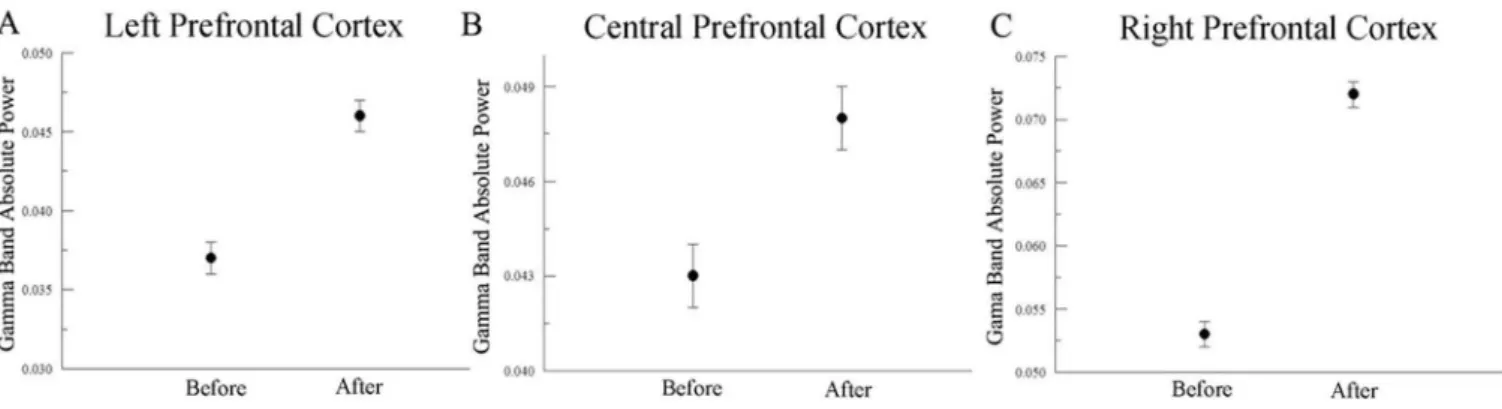
task) and no interaction. We found an increase of the gamma band absolute power at F3, F4, Fz, C3, C4 and Cz derivations. In frontal regions (Figure 1), the two-way ANOVA found a main effect for condition at F3 [F(1,3489)=106.074;
p=0.001; η2
p= 0.030], at F4 [F(1,3588)=170.233; p=0.001;
η2
p=0.045] and at Fz derivations [F(1,3927)=36.800;
p=0.001; η2
p= 0.009]. Similarly, at central regions (Figure 2)
that correspond to the motor cortex, the two-way ANOVA found an increased gamma absolute power after hand
immobilization at C3 [F(1,3705)=209.775; p=0.001; η2
p=
0.054], C4 [F(1,3767)=30.696; p=0.001; η2
p= 0.008] and
Cz [F(1,3900)=60.954; p=0.001; η2
p= 0.000].
Particularly, at C3, the gamma band absolute power before hand immobilization presented a mean value of 0.024±0.01; after hand immobilization this value increased to 0.033±0.01. This was the greatest increase of any of the selected derivations: C3 corresponds to the cortical region responsible for motor control of the right hand. There were no significant moment x condition interactions nor were there any significant main effects for moment in any of the analyzed derivations.
■
DISCUSSIONWe analyzed changes of the gamma band absolute power in motor cortical areas (frontal and central regions) before and after a condition of immobilization of the dominant hand for 48 hours.
The Gamma band is considered to be the most specific
Figure 1 - Mean and SE indicate main efect for condition (before immobilization versus after immobilization) observed in (A) left prefrontal cortex (F3) (p=0.001), (B) central prefrontal cortex (Fz) (p=0.001) and (C) right prefrontal cortex (F4) (p=0.001).
Figure 2 - Mean and SE indicate main efect for condition (before immobilization versus after immobilization) observed in (A) left sensorimotor cortex (C3) (p=0.001), (B) central sensorimotor cortex (Cz) (p=0.001) and (C) right sensorimotor cortex (C4) (p=0.001).
provide a better understanding about how motor cortical areas elicit movement after a condition of immobilization. Our hypothesis was that after immobilization, the gamma band frequency would be more pronounced in order to allow communication between neural populations of motor cortical areas that were less activated during the immobilization condition. The results showed a main effect
of condition (i.e., before vs after immobilization) on gamma
band absolute power. The analyzed derivations located in motor cortical areas (F3, F4, Fz, C3, C4 and Cz) exhibited an increase of gamma band absolute power when the volunteers executed the motor task after immobilization.
Our results point to an increase on gamma band absolute power on F3, F4, and Fz. Frontal cortical areas are associated motivation, planning, reasoning, problem
solving and execution of voluntary movements.25,26
Specifically F3 and F4 derivations (middle frontal gyrus)
correspond to manual planning areas;27,28 F3 is associated
with the cortical area corresponding to right hand (the immobilized hand),while F4 associated with the left hand. Increased gamma band absolute power at F3 after hand immobilization indicates more activation at this cortical region in order to elicit the index finger movement required by the task. We also found an increase of gamma band absolute power at Fz and F4 derivation: at F4 the increase
was greater than at F3 and Fz, indicating larger cortical arousal contralateral to the region corresponding to the immobilized right hand.
The contralateral activation of cerebral cortex after a neural lesion has been used as a therapeutic strategy to
recover motor function in some movement disorders.29,30
The immobilization of a healthy upper limb leads to an increased cortical activation at the contralateral region involved in the movement execution. This therapeutic approach, named constraint-induced movement therapy, is supported by the pattern of cortical activation due
contralateral limb restriction.31,32 This concept is reinforced
by our findings regardingalarger increase of the gamma
band absolute power at the F4 derivation; this shows that the homologous right side cortical region is activated to compensate for the left side region, which is responsible for the immobilized right hand. It thus appears that cortical reorganization did occur in spite of the fact that immobilization only lasted for 48 hours. The motor cortex can be seen here to elicit a compensatory functional
strategy, an example of adaptive neuroplasticity.4,33,34
Sterling et al29 reported results of functional magnetic
comprising areas linked to motor planning and sensory
integrations.11,36 The Cz derivation corresponds to
Brodmann’s area 5, which represents the supplementary motor area, which is a useful support for motor pattern
elaborations to be sent to the primary motor area.21 In our
study, there was greater activation at C3, 2 sec before and 2 sec after the finger movement in the after-immobilization condition; this indicates more neural binding in this area due to movement planning. In a study with a hemiparetic
subject, Machado et al37 found less activation of the C3
derivation in a hemiparetic subject: they reported that this neural lesion was accompanied by lower values in the gamma band absolute power. We found a higher level of activation at the C3 derivation after hand immobilization because this site represents the motor area responsible for right hand movements and because the subjects presented no neural damage. These results pointed to a relevant activation at
central regions due its relation with sensorimotor areas.6,11,38
Each hemisphere has specifics functions and contributes to motor control differently. The right hemisphere is characterized by use attention and sensory feedback to create spatial references, while the left hemisphere plays a role on
movement planning and execution.39
The inter-hemispheric differences in gamma band absolute power after immobilization are justified by the ability of the hemispheres to mutually influence their
functions through the corpus callosum.4,40,41 These findings
may have a bearing on the applicability of therapies such as transcranial magnetic stimulation, constraint-induced movement therapy, which are widely used in the
rehabilitation of stroke42-44 and cerebral palsy.45-47 Some
studies even indicate the possibility of using the EEG as
a central nervous system dysfunctions marker.48-51 As
an example, the specific measurements derived from an electroencephalogram could indicate cortical areas most affected in cases of traumatic brain injury, and may thus
be useful for the development of tools for its diagnosis.48
Furthermore, it would help in the determination of the lesion and the time of return to post-injury sports activities
in athletes.51 Our findings may guide further studies on
the use of EEG as the central nervous system dysfunction marker, considering our finding that cortical changes after a relatively short condition of movement deprivation.
■
CONCLUSIONThe current study showed increased gamma band absolute power in fronto-central areas after hand immobilization. Gamma activity promotes the binding of information through different neural sites in order to supply task demands. We have shown that the 48 hours of immobilization were sufficient to alter neural network, diminishing cortical activation in the investigated regions. After immobilization, the movement performance required in the sensorimotor cortex contralateral to the
more-affected arm; they also showed a trend to an increase of gray matter volume in the ipsilateral motor cortex; these changes were possibly correlated with motor improvement, because the children increased the use of the affected arm in their daily living activities. Based on these findings, Sterling et
al29 also suggested the use of constraint-induced movement
therapy to induce increases in gray matter volume during the development of the nervous system. This reinforces the use of therapies to remodel human brain functioning and to produce motor recovery in patients with motor deficits.
The contralateral cortical activation and ipsilateral cortical deactivation can be explained by transcallosal inhibition; fMRI was used to investigate such inter hemispheric
interactions.35 For this, volunteers performed self-paced
sequential finger/thumb tapping for each hand simultaneously with fMRI data acquisition. This experimental design showed that the hand movements produced activation not only in the contralateral sensorimotor cortex, but also in adjacent subcortical regions and even in the ipsilateral cerebellum. Likewise, less activation in the ipsilateral sensorimotor cortex occurred as a response to unilateral hand movements; this
was accompanied by decreased blood flow.35 In our study
we found increased gamma band absolute power in frontal cortical areas, especially at the motor area ipsilateral to the movement execution. Thus, the hand immobilization condition may have influenced cortical activation, leading to an important activation of the ipsilateral region in order to perform the movement.
The same pattern of increased gamma band absolute power occurred at central cortical areas (C3, C4, Cz), particularly at the C3 derivation, i.e., in the contralateral motor cortex. This same pattern of activation was shown in a study involving fMRI and self-paced sequential finger/
thumb movements;35 the C3, Cz and C4 derivations are
related to somesthetic and motor areas that control limb movements, specifically the hands. The C3 derivation corresponds to the motor area of the right hand and the more pronounced increase of gamma band absolute power at this site denotes a greater involvement of the motor area contralateral to the elicited movement. This finding
is confirmed by Muthukumaraswamy,24 who stated that
gamma oscillations in the motor cortex occur primarily at the contralateral hemisphere to the limb that executes the movement. Moreover, the task of this study involved repetitive movements of the index finger, which can be reported to a set of four experiments which showed that gamma oscillations are most likely triggered by broader movements and by the first movement of a repetitive sequence. This same set of experiments showed that the region anterior to the central sulcus in M1 is the source of gamma oscillations.
a higher communication between these areas to allow appropriated planning and movement execution. The increased gamma oscillations can be a cortical therapeutical strategy to solve the effects of movement restriction.
■
CONFLICT OF INTERESTThe authors declare that the research was conducted in the absence of any commercial or financial relationships that could be construed as a potential conflict of interest.
■
AUTHOR PARTICIPATIONBastos VHV, Cagy M, dos Santos RPM, Velasques B reviewed the literature and the final version of the article. Machado D, Teixeira S, Ribeiro P, Machado S developed the project, contributed in work orientation, discussed the data, and reviewed the final draft of the article.
POTÊNCIA ABSOLUTA DA BANDA GAMA REVELA ATIVAÇÃO EM ÁREAS MOTORAS APÓS IMOBILIZAÇÃO DA MÃO
OBJETIVO: O objetivo deste estudo foi analisar mudanças na potência absoluta da banda gamma em áreas corticais motoras, antes e depois de uma condição de imobilização da mão por 48 horas.
MÉTODO: Quinze voluntários saudáveis, com idades entre 20 e 30 anos, foram submetidos a avaliação eletroencefalográfica antes e depois da imobilização, durante a execução de uma tarefa motora desencadeada por um estímulo visual. Uma análise de variância com dois
fatores (ANOVA two-way) foi empregada para investigar o
fator momento (antes e depois do estímulo visual) e o fator condição (antes e depois da imobilização).
RESULTADOS: Um aumento significativo na potencia absoluta da banda gamma foi encontrado após imobilização da mão nos elétrodos (ou derivações) F3, F4, FZ, C3, C4 e Cz.
CONCLUSÃO: Estes resultados revelam que as oscilações na banda gama podem ser uma estratégia cortical para resolver o efeito de menor ativação devido à restrição de movimento. Um melhor conhecimento do funcionamento de áreas corticais motoras após uma condição de imobilização pode orientar estratégias mais eficazes na reabilitação.
PALAVRAS-CHAVE: mão, imobilização, banda gama, EEG
■
REFERENCES1. Manini TM, Clark BC, Nalls MA, Goodpaster BH, Ploutz-Snyder LL, Harris TB. Reduced physical activity increases intermuscular adipose tissue in healthy young adults. Am J Clin Nutr. 2007;85(2):377-84.
2. Bodine SC. Disuse-induced muscle wasting. Int J Biochem Cell Biol.2013;45(10):2200-8. http://dx.doi.org/10.1016/j. biocel.2013.06.011
3. Clark BC, Taylor JL, Hoffman RL, Dearth DJ, Thomas JS. Cast immobilization increases long-interval intracortical inhibition. MuscleNerve. 2010;42(3):363-72. http://dx.doi.org/10.1002/mus.21694
4. Fortuna M, Teixeira S, Machado S, Velasques B, Bittencourt J, Peressutti C, et al. Cortical Reorganization after Hand Immobilization: The beta qEEG Spectral Coherence Evidences. Plos One. 2013;8(11):e79912. http://dx.doi.org/10.1371/journal.pone.0079912
5. Lundbye-Jensen, Nielsen JB. Central nervous adaptations following 1 wk of wrist and hand immobilization. J Appl Physiol. 2008;105(1):139-51. http://dx.doi.org/10.1152/japplphysiol.00687.2007
6. Kiefer AD, Gualberto Cremades J, Myer GD. Train the brain: novel electroencephalography data indicate links between motor learning and brain adaptations. J Nov Physiother. 2014; 4(2):pii: 198. http:// dx.doi.org/10.4172/2165-7025.1000198
7. Andrew C, Pfurtscheller G. On the existence of different alpha band rhythms in the hand area of man. NeurosciLett. 1997;222(2):103-6. http://dx.doi.org/10.1016/S0304-3940(97)13358-4
8. Rocha ACB, Timm MI, Chiaramonte M, Zaro M, Rasia-Filho AA, Wolf D, et al. Metodologia para observação e quantificação de sinais de EEG relativos a evidências cognitivas de aprendizagem motora. Ciências & Cognição. 2008;13(2):27-50.
9. Maloney KJ, Cape EG, Gotman J, Jones BE. High-frequency gamma electroencephalogram activity in association with sleep-wake states and spontaneous behaviors in the rat. Neuroscience. 1997;76(2):541-55. http://dx.doi.org/10.1016/S0306-4522(96)00298-9
10. Scheeringa R, Fries P, Petersson KM, Oostenveld R, Grothe I, Norris DG, et al. Neuronal dynamics underlying high- and low-frequency EEG oscillations contribute independently to the human BOLD signal. Neuron. 2011;69(3):572–83. http://dx.doi.org/10.1016/j.neuron.2010.11.044 11. Minc D, Machado S, Bastos VH, Machado D, Cunha M, Cagy M, et al.
Gamma band oscillations under influence of bromazepam during a sensorimotor integration task: an EEG coherence study. Neurosci Lett. 2010;469(1):145-9. http://dx.doi.org/10.1016/j.neulet.2009.11.062 12. Langer N, Hänggi J, Müller NA, Simmen HP, Jäncke L. Effects of limb
immobilization on brain plasticity. Neurology. 2012;78(3):182-8. http://dx.doi.org/10.1212/WNL.0b013e31823fcd9c.
13. Machado D, França JHS, Teixeira S, Vale Bastos VHV, Cagy M, Sá-Filho AS, et al. Involvement of beta absolute power in motor areas after hand immobilization: An EEG study. MedicalExpress (São Paulo, online). 2016;3(5) M160503. http://dx.doi.org/10.5935/MedicalExpress.2016.05.03 14. Oldfield RC. The assessment and analysis of handedness: the Edinburgh
inventory. Neuropsychologia. 1971;9(1):97-113. http://dx.doi. org/10.1016/0028-3932(71)90067-4
15. Dixit A, Goyal A, Thawani R, Vaney N. Effect of caffeine on information processing: evidence from stroop task. Indian J Psychol Med. 2012;34(3):218-22. http://dx.doi.org/10.4103/0253-7176.106013. 16. Martinovic J, Jones A, Christiansen P, Rose AK, Hogarth L, Field M.
Electrophysiological responses to alcohol cues are not associated with pavlovian-to-instrumental transfer in social drinkers. PLoS One. 2014;9(4):e94605. http://dx.doi.org/10.1371/journal.pone.0094605. 17. Daly I, Nicolaou N, Nasuto SJ, Warwick K. Automated artifact
removal from the electroencephalogram: a comparative study. Clin EEG Neurosci. 2013;44(4):291-306. http://dx.doi. org/10.1177/1550059413476485.
18. Stewart AX, Nuthmann A, Sanguinetti G. Single-trial classification of EEG in a visual object task using ICA and machine learning. J Neurosci Methods. 2014;228:1-14. http://dx.doi.org/10.1016/j.jneumeth.2014.02.014 19. Fabbri S, Strnad L, Caramazza A, Lingnau A. Overlapping representations
for grip type and reach direction. Neuroimage. 2014;94:138-46. http:// dx.doi.org/10.1016/j.neuroimage.2014.03.017.
21. Teixeira S, Machado S, Velasques B, Sanfim A, Minc D, Peressutti C, et al. Integrative parietal cortex processes: neurological and psychiatric aspects. J Neurol Sci. 2014 Mar 15;338(1-2):12-22. http://dx.doi. org/10.1016/j.jns.2013.12.025.
22. Melgari JM, Zappasodi F, Porcaro C, Tomasevic L, Cassetta E, Rossini PM, et al. Movement-induced uncoupling of primary sensory and motor areas in focal task-specific hand dystonia. Neuroscience. 2013;250:434-45. http://dx.doi.org/10.1016/j.neuroscience.2013.07.027
23. Paek AY, Agashe HA, Contreras-Vidal JL. Decoding repetitive finger movements with brain activity acquired via non-invasive electroencephalography. Front Neuroeng. 2014 Mar 13;7:3. http:// dx.doi.org/10.3389/fneng.2014.00003.
24. Muthukumaraswamy SD. Functional properties of human primary motor cortex gamma oscillations. J Neurophysiol. 2010;104(5):2873-85. http://dx.doi.org/10.1152/jn.00607.2010.
25. Yousry TA, Schmid UD, Alkadhi H, Schmidt D, Peraud A, Buettner A, et al. Localization of the motor hand area to a knob on the precentral gyrus: a new landmark. Brain. 1997;120 (Pt 1):141-57. http://dx.doi. org/10.1093/brain/120.1.141
26. Dreher JC, Koechlin E, Tierney M, Grafman J. Damage to the fronto-polar cortex is associated with impaired multitasking. PLoSOne. 2008; 3(9):e3227. http://dx.doi.org/10.1371/journal.pone.0003227 27. Diniz C, Velasques B, Bittencourt J, Peressutti C, Machado S, Teixeira S,
et al. Cognitive mechanisms and motor control during a saccadic eye movement task: evidence from quantitative electroencephalography. Arq Neuropsiquiatr. 2012;70(7):506-13. http://dx.doi.org/10.1590/ S0004-282X2012000700007.
28. Teixeira S, Velasques B, Machado S, Paes F, Cunha M, Budde H, et al. Gamma band oscillations in parieto-occipital areas during performance of a sensorimotor integration task: a qEEG coherence study. Arq Neuropsiquiatr. 2011;69(2B):304-9. http://dx.doi.org/10.1590/ S0004-282X2011000300007.
29. Sterling C, Taub E, Davis D, Rickards T, Gauthier LV, Griffin A, et al. Structural neuroplastic change after constraint-induce movement therapy in children with cerebral palsy. Pediatrics. 2013;131(5):e1664-9. http://dx.doi.org/10.1542/peds.2012-2051
30. Yoon JA, Koo BI, Shin MJ, Shin YB, Ko HY, Shin YI. Effect of constraint-induced movement therapy and mirrortherapy for patients with subacute stroke. Ann Rehabil Med. 2014;38(4):458-66. http://dx.doi. org/10.5535/arm.2014.38.4.458.
31. Dispa D, Lejeune T, Thonnard JL. The effect of repetitive rhythmic precision grip task-oriented rehabilitation in chronic stroke parents: a pilot study. Int J Rehabil Res. 2013;36(1):81-7. http://dx.doi. org/10.1097/MRR.0b013e32835acfd5.
32. Taub E, Uswatte G, Bowman MH, Mark VW, Delgado A, Bryson C, et al. Constraint-induced movement therapy combined with conventional neurorehabilitation techniques in chronic stroke patients with plegic hands: a case series. Arch Phys Med Rehabil. 2013 Jan;94(1):86-94. http://dx.doi.org/10.1016/j.apmr.2012.07.029.
33. Miltner WH, Bauder H, Sommer M, Dettmers C, Taub E. Effects of constraint-induced movement therapy on patients with chronic motor deficits after stroke: a replication. Stroke. 1999;30(3):586-92. http:// dx.doi.org/10.1161/01.STR.30.3.586
34. Liepert J, Miltner WH, Bauder H, Sommer M, Dettmers C, Taub E, et al. Motor cortex plasticity during constraint-induced movement therapy in stroke patients. Neurosci Lett. 1998;250(1):5-8. http://dx.doi. org/10.1016/S0304-3940(98)00386-3
35. Allison JD, Meador KJ, Loring DW, Figueroa RE, Wright JC. Functional MRI cerebral activation and deactivation during finger movement. Neurology. 2000;54(1):135-42. http://dx.doi.org/10.1212/WNL.54. 1.135
36. Marstaller L, Burianova H, Sowman PF. High gamma oscillations in medial temporal lobe during overt production of speech and gestures. PlosOne. 2014;9(10):e111473. http://dx.doi.org/10.1371/journal. pone.0111473
37. Machado DC, Lima GC, Souza Dos Santos R, Ramos AJ, Menezes de Sousa CC, Moreira Dos Santos RP, et al. Comparative analysis electroencephalographic of alpha, beta and gamma bands of a healthy individual and one with hemiparesis. J Phys Ther Sci. 2014;26(6):801-4. http://dx.doi.org/10.1589/jpts.26.801.
38. Nader S, Machado S, Cunha M, Portella CE, Silva JG, Velasques B, et al. Posterior parietal cortex role in a sensorimotor task performance. Arq Neuropsiquiatr. 2008;66(2B):341-3. http://dx.doi.org/10.1590/ S0004-282X2008000300011.
39. Serrien DJ, Spapé MM. Effects of task complexity and sensory conflict on goal-directed movement, Neurosci Lett. 2009;464(1):10-3. http:// dx.doi.org/10.1016/j.neulet.2009.08.022.
40. Sainburg RL. Evidence for a dynamic-dominance hypothesis of handedness. Exp Brain Res. 2002;142(2):241-58. http://dx.doi. org/10.1007/s00221-001-0913-8
41. Brol AM, Bortoloto F, Magagnin NMS. Tratamento de restrição e indução do Movimento na reabilitação funcional de Pacientes pós acidente vascular encefálico: Uma revisão bibliográfica. Fisioter. Mov. 2009;22(4):497-509.
42. Cassidy JM, Chu H, Chen M, Kimberley TJ, Carey JR. Interhemispheric Inhibition Measurement Reliability in Stroke: A Pilot Study. Neuromodulation. 2016 Jun 22. http://dx.doi.org/10.1111/ner.12459. 43. Peurala SH, Kantanen MP, Sjögren T, Paltamaa J, Karhula M, Heinonen A.Effectiveness of constraint-induced movement therapy on activity and participation after stroke: a systematic review and meta-analysis of randomized controlled trials. Clin Rehabil. 2012 Mar;26(3):209-23. http://dx.doi.org/10.1177/0269215511420306.
44. Goodwill AM, Teo WP, Morgan P, Daly RM, Kidgell DJ. Bihemispheric-tDCS and Upper Limb Rehabilitation Improves Retention of Motor Function in Chronic Stroke: A Pilot Study. Front Hum Neurosci. 2016;10:258. http://dx.doi.org/10.3389/fnhum.2016.00258. 45. Kirton A, Andersen J, Herrero M, Nettel-Aguirre A, Carsolio L, Damji O,
Keess J, Mineyko A, Hodge J, Hill MD. Brain stimulation and constraint for perinatal stroke hemiparesis: The PLASTIC CHAMPS Trial. Neurology. 2016 May 3;86(18):1659-67. http://dx.doi.org/10.1212/ WNL.0000000000002646.
46. Friel KM, Kuo HC, Fuller J, Ferre CL, Brandão M, Carmel JB, Bleyenheuft Y, Gowatsky JL, Stanford AD, Rowny SB, Luber B, Bassi B, Murphy DL, Lisanby SH, Gordon AM. Skilled Bimanual Training Drives Motor Cortex Plasticity in Children With Unilateral Cerebral Palsy. Neurorehabil Neural Repair. 2016. Neurorehabil Neural Repair. 2016;30(9):834-44. http://dx.doi.org/10.1177/1545968315625838.
47. de Brito Brandão M, Mancini MC, Vaz DV, Pereira de Melo AP, Fonseca ST. Adapted version of constraint-induced movement therapy promotes functioning in children with cerebral palsy: a randomized controlled trial. Clin Rehabil. 2010;24(7):639-47. http://dx.doi. org/10.1177/0269215510367974.
48. Rapp PE, Keyser DO, Albano A, Hernandez R, Gibson DB, Zambon RA, et al. Traumatic brain injury detection using electrophysiological methods. Front Hum Neurosci. 2015 Feb 4;9:11. http://dx.doi. org/10.3389/fnhum.2015.00011.
49. Kiefer AW, Barber Foss K, Reches A, Gadd B, Gordon M, Rushford K, et al. Brain Network Activation as a Novel Biomarker for the Return-to-Play Pathway Following Sport-Related Brain Injury. Front Neurol. 2015;6:243. http://dx.doi.org/10.3389/fneur.2015.00243.
50. Eckner JT, Rettmann A, Narisetty N, Greer J, Moore B, Brimacombe S, et al. Stability of an ERP-based measure of brain network activation (BNA) in athletes: A new electrophysiological assessment tool for concussion. Brain Inj. 2016;30(9):1075-81. http://dx.doi.org/10.31 09/02699052.2016.1160152.