Mating system of a population of
Myracrodruon urundeuva
F.F. & M.F.
Allemão using the fAFLP molecular marker
Miguel L.M. Freitas
1, Alexandre M. Sebbenn
2, Mario L.T. Moraes
3and Eliana G.M. Lemos
11
Universidade Estadual Paulista, Faculdade de Ciências Agrárias e Veterinárias,
Departamento de Tecnologia, Jaboticabal, SP, Brazil.
2
Instituto Florestal de São Paulo, Departamento de Conservação e Melhoramento Genético,
São Paulo, SP Brazil.
3
Universidade Estadual Paulista, Faculdade de Engenharia, Departamento de Fitotecnia,
Ilha Solteira, SP, Brazil.
Abstract
The mating system and genetic diversity were studied in a natural population ofMyracrodruon urundeuva originating from 30 open-pollinated trees at the Paulo de Faria Ecological Station, SP, Brazil. The progenies were planted on the Teaching and Research Farm of the Ilha Solteira Engineering School, UNESP. Using the fAFLP molecular marker, eleven loci were selected to study the mating system. The mating system was analyzed using the multilocus mixed-mating model. The estimates of genetic divergence between pollen and ovule allele frequencies were significant for eight loci, suggesting nonrandom outcrossing. The estimates of the multilocus outcrossing rate revealed thatM. urundeuva possesses a mating system with a predominance of outcrossing events (θ$= 0.940 ± 0.086). The estimates of coancestry among plants within progenies (θ$= 0.185) was higher than that expected for half-sib progenies (0.125) and the indirect estimate of the correlation of outcrossed paternity within progeny arrays (r$p)was 0.403, suggesting that progenies have a high proportion of full-sibs. Result analysis suggests the need for the application of biometric models that take into account deviations from random outcrossing in the estimations of genetic parameters for quantitative traits and the need for retaining large sample sizes in order to preserve genetic variability.
Key words: Myracrodruon urundeuva, mating system, fAFLP, molecular marker, correlation of paternity. Received: July 1, 2003; Accepted: April 1, 2004.
Introduction
The understanding of the mating system of a species is of fundamental importance for genetic improvement and conservation programs because it permits the outlining of strategies that optimize the sampling of genetic variability and the adoption of genetic-statistical models appropriate for the estimation of genetic parameters. Information about the mating system, diversity and genetic structure, as well as the spatial distribution of genotypes within populations, is important for the establishment of strategies aimed at the effective conservation of any species.
The mating system and the genetic structure of a spe-cies are directly related to its ecology and genetics (Love-lesset al., 1998). A species can produce its descendants by
different types of mating such as random outcrossing, cor-related outcrossing, biparental inbreeding, self-fertiliza-tion, apomixes and their combinations. The mating system,
together with the mechanism of pollen and seed dispersion, determines part of the genetic structure of populations (Hamrick and Loveless, 1986). Species resulting from out-crossing maintain most of their genetic variability distrib-uted within populations, in contrast to predominantly selfed species in which most of the genetic variability is distrib-uted between populations (Hamrick, 1983; Hamrick and Godt, 1989). Studies on the mating system of tropical tree species using genetic markers have shown that most spe-cies are allogamous or possess a mixed mating system with a predominance of allogamy (Murawskiet al., 1990;
Mu-rawski, 1995).
The fAFLP (fluorescence Amplified Fragment Length Polymorphism) technique, developed by Voset al.
(1995), has been frequently utilized in genetic studies and offers practical advantages for DNA analysis since it gener-ates a large number of polymorphic markers (Gaiottoet al.,
1997), which is mainly due to resolution specificity, diges-tion sampling power with restricdiges-tion enzymes and to the www.sbg.org.br
Send correspondence to Miguel Luiz Menezes Freitas. E-mail: [email protected].
PCR (Ferreira and Grattapaglia, 1998). Further advantages are the use of less DNA, and the possibility of wide genome studies (Scottet al.2000).
The fAFLP marker aimed to utilize a robust mark which would yield a large number of loci. The species was evaluated for isoenzymatic and RAPD-type markers and microsatellite loci that have not been developed for this species. For this reason, the AFLP marker was selected. Al-though this is a dominant inheritance marker, it is more ro-bust than RAPD markers and yields a large number of loci in simple gel (Ferreira and Grattapaglia, 1998).
The constant removal of native forest species and the exploitative cultivation of commercial species in mono-cultures have caused erosion in the forest diversity of dif-ferent Brazilian ecosystems. Studies on native tree species have mainly been carried out since the end of the eighties, when research centers started to draw attention to the con-servation of the genetic resources of these species. Among these species is Myracrodruon urundeuva F.F. & M.F.
Allemão which, due to its high economic value and its oc-currence throughout most of Brazil, has suffered, year after year, a frequent reduction in population number and size as a result of the extinction of its habitat. M. urundeuva
(Anacardiaceae) is found from Ceará to Paraná and throughout the Center-West region in the “Cerrado” areas or surrounding regions (Rizzini, 1971; Lorenzi, 1992). It also occurs in the “Chaco” formations of Paraguay and Ar-gentina. However according to Rizzini (1971), Nogueiraet al.(1982) and Santin and Leitão Filho (1991), Brazil is
cen-ter for the origin of this species . Lorenzi (1992) described the species as a deciduous, heliophytic and selective xero-phytic plant characteristic of dry and rocky soils, which oc-curs in dense groups in both open and very dry (scrubland), very humid and closed formations. It varies in size, with a height of up to 15 m and a diameter ranging from 15 to 30 cm as observed in the “Cerrado” and scrubland, and a height of up to 30 m and a diameter of 1 m for fertile soils in semi deciduous broad-leaf forests (Corrêa, 1926; Record and Hess, 1949; Rizzini, 1971; Santin and Leitão Filho, 1991). Its inflorescences are paniculate, terminal and axillary, and multifloral, measuring about 20 cm in length. Its flowers are attractive to insects and are mainly foraged by hymenopterans. The fruits, containing a single seed, are round drupes always accompanied by a persistent and wide chalice which helps in fruit dispersal (Santin and Leitão Filho, 1991).M. urundeuvais predominately dioecious, but
monoecious trees can also be found (Carvalho, 1994). In dioecious species, all sibs are produced by outcrosses. But it may occur by biparental inbreeding, correlated mating and random mating. The pattern of mating can be measured by the correlated mating model (Ritland, 1989). Thus the objective of the present study was to determine the mating system of anM. urundeuvapopulation, using the fAFLP
molecular markers.
Sampling
The mating system was studied in open-pollinated trees originating from a natural population ofM. urundeuva
at the Paulo de Faria Ecological Station, São Paulo State, Southeast of Brazil. The Ecological Station is located at 19°55’ S, 49°31’ W, at an elevation of 650 m, and with an area of 435.7 ha. This area is savannah woodland whereM. urundeuvais common (> 1 individual per hectare), but the
species appear only in a small section of the area (approxi-mately 50 hectares). In the past, the population underwent some sort of anthropic intervention.
Nine plants per progeny were analyzed from 30 mother trees and the progenies were then planted on the Teaching and Research Farm of the Ilha Solteira Engi-neering School, UNESP, SP.
DNA extraction
fAFLP
The extracted DNA samples were submitted to diges-tion in a reacdiges-tion mixture containing 500 ng DNA, 2.5 U MseI, 3.0 EcoRI and 1.25µL React1 buffer (Invitrogen). The reactions were incubated at 37oC for 24 h, followed by
incubation at 70 °C for 15 min to inactivate the restriction enzymes.
This step was followed by the ligation of adaptors to the digested DNA fragments. The ligation reactions con-sisted of 3.67µL of the digestion reaction, 1.5 U T4 DNA ligase, 1.0µL T4 ligase buffer (1 U/µL) and 0.66µL of each adaptor. The reactions were incubated at 20 °C for 2 h and then 45µL TE was added. The fragments ligated to the adaptors were amplified by a PCR reaction, consisting of 4
µL ligated DNA, 1 µL AFLP EcoRI/MseI primer and 15
µL AFLP Core Mix (Taq DNA polymerase, MgCl2, PCR buffer, dNTP - PE Applied Biosystems - Foster City, CA). The amplification program was: 72 °C for 2 min, followed by 20 cycles at 94 °C for 20 s, 56 °C for 30 s and 72 °C for 2 min. After the pre-selective amplification, 10µL of each sample was loaded on a 1% agarose gel stained with ethidium bromide (0.5µg/mL) to detect amplification. The remaining pre-selective amplification products (10 µL) were diluted in 90µL TE 0.1 and submitted to the selective amplification consisting of 3.0µL of the pre-selective am-plification product, 1.0µL of the MseI primer, 1.0µL of the EcoRI primer, and 15.0µL AFLP Core Mix. The PCR con-sisted of the following steps: 1) one cycle at 94 °C for 2 min; 2) one cycle at 94 °C for 1 min, 66 °C for 1 min and 72 °C for 2 min; 3) one cycle at 94 °C for 20 s, 65 °C for 30 s and 72 °C for 2 min, with the steps running up to the 10th one marked by a 1 °C decrease in the temperature of the in-termediate cycle of the previous step until reaching a tem-perature of 58 °C, with the remaining conditions kept constant. The eleventh step consisted of 20 cycles at 94 °C for 30 s, 56 °C for 30 s and 72 °C for 2 min. The 12th step ended with a cycle at 60 °C for 30 min. A loading buffer (1.5 µL) containing 1.25 µL deionized formamide, 0.625µL loading solution and 0.125µL Rox Size Standard or 0.5µL of the selective amplified DNA, in a total volume of 2.0µL, was then added. The tubes were heated to 95 °C for 5 min and then rapidly placed on ice. A 1.0µL - volume of each sample was loaded on a 5% Long Ranger denaturing gel made with 1X TBE (Tris 0.089M, boric acid -0.089M, EDTA - 0.002M) as running buffer and the gel was run in an ABI PRISMTM377 DNA Sequencer (PE -Applied Biosystems) for 3 h at 2,500 V.
Statistical Analysis
The mating system was analyzed based on the mixed mating model of Ritland and Jain (1981) using the MLDT program of Ritland (1990). The following parameters were
estimated: multilocus outcrossing rate (t$m), single-locus
outcrossing rate (t$
s), outcrossing rate between relatives
(t$m−t$s), ovule and pollen allele frequencies (oandp), and the inbreeding coefficient of maternal parent trees (F$
m).
The standard error of the reported estimates was calculated based on 300 bootstraps, where the sampling units were the plants within progenies for the individual outcrossing rate per maternal tree, and the families for the populational out-crossing rate.
The genetic divergence among families and coeffi-cient of coancestry within families (θ$) were obtained using
the TFPGA program (Miller, 1997), with the allele fre-quencies being estimated by the method of Lynch and Milligan (1994). The estimate ofθ$was used to calculate the
correlations of paternity (r$p). Ritland (1989) showed that
the coefficient of correlation within families can be esti-mated by
[
]
$ . ( $) $ ($ $$$ )( $ )
rxy =025 1+F 4s+ t +tsrs 1+rp
2
whereF$ is the inbreeding coefficient of parental
popula-tion,s$is the self-fertilization rate, andr$sis the correlation of
outcrossing. As the coefficient of coancestry is half of the coefficient of correlation within families (θ =$ r$ /
xy 2), then
[
]
$ . ( $) $ ($ $$$ )( $ )
θ =0125 1+ 4 + 2+ 1+
F s t tsrs rp
Still, since the species is predominantly dioecious, there is probably no variation in the individual outcrossing rater$s, which can be assumed to be zero. Assuming also
$
F= 0, then
[
]
$ . $ $ ( $ )
θ =0125 4 + 2 1+
s t rp
andr$p can be estimated per
$ $ . ( $ $ )
. $
rp =
− +
θ 0125 4 0125
2
2
s t
t
Results
The three primer pairs used in the fAFLP analysis re-vealed a total of 137 polymorphic loci. Eleven loci close to intermediate frequency (0.5) were selected for the mating system investigation. According to Ritland and Jain (1981), alleles with an intermediate or close to intermediate fre-quency are more appropriate for the estimation of multi-locus outcrossing rates because they allow a better distinction between plants generated by outcrossing events and those obtained by self-fertilization.
frequencies of pollen and ovules indicated deviations from random outcrossing, probably correlated outcrossing and/or biparental inbreeding.
The estimate for the multilocus outcrossing rate (t$ m)
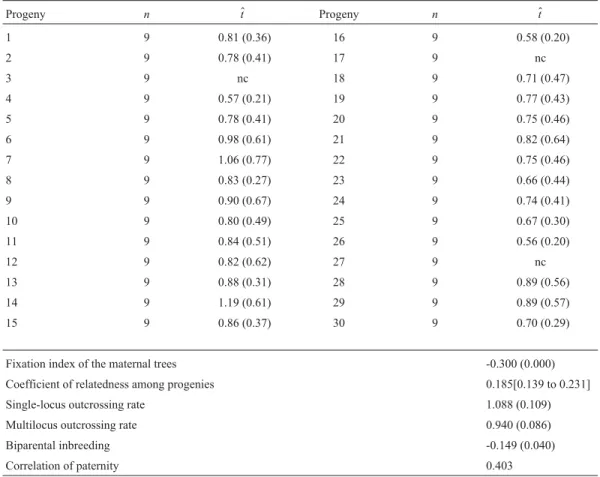
was high (0.940 ± 0.086) and not significantly different from 1.0, as determined by the standard error, indicating thatM. urundeuvais a species of outcrossing (Table 2). The
single-locus outcrossing rate (t$
s = 1.088 ± 0.109) was also
equal to 1.0, reinforcing that it is a species of outcrossing. The difference between the multilocus and single-locus outcrossing rates was negative and significantly different from zero (-0.149 ± 0.040), suggesting an absence of bi-parental inbreeding. Individual outcrossing estimates showed that families 3, 17 and 27 did not converge on any reliable value from the biological stand point (value of 2.0; Ritland, 1990); it was therefore not possible to determine the magnitude of their outcrossing rate. Thus these families were excluded from the analyses of the populational out-crossing rate. For the other families, the individual multilocus outcrossing rate (t$) ranged from 0.56 (family 26) to 1.19 (family 14). But only the individual outcrossing of families 4, 16, 25, 26 and 30 were significantly different fromt$> 1.0. Values of 1.0 are biologically interpreted as being equal to one.
The maternal trees fixation index (F$
m) was negative
(-0.300) and significantly different from zero, indicating excess heterozygotes in the maternal trees. Genetic diver-gence among progenies or coancestry within families (θ$= 0.185) was significantly different from zero and higher
than that expected for half-sib progenies (0.125). The cor-relation of paternity (r$p) was estimated fromθ$. Ther$p value was high for the population (0.403), indicating that proge-nies have a high proportion of full-sibs.
Discussion
M. urundeuvais considered to be a dioecious species by some researchers (Santin and Leitão Filho, 1991) and as monoecious by others (Nogueiraet al., 1982). In progeny tests, both individuals types are found, but the great major-ity of trees found are dioecious (Moraes and Sebbenn, 2003). In accordance with this statement, the estimate of the multilocus outcrossing rate (t$
m) for theM. urundeuva
population was high and not significantly different from 1.0 (0.940 ± 0.086), confirming that this species produces off-spring predominantly by outcrossing. Moraes and Sebbenn (2003), analyzing the mating system in two populations of
M. urundeuva using six polymorphic allozyme loci,
ob-Locus Allele Pollen pool (SE) Ovule pool (SE) n F$ST χ
2 Df
1 1 0.629(0.046) 0.413(0.088)
2 0.371(0.046) 0.587(0.088) 270 0.047 25.24** 1
2 1 0.581(0.042) 0.591(0.048)
2 0.419(0.042) 0.409(0.048) 270 0.000 0.06ns 1
3 1 0.468(0.087) 0.097(0.055)
2 0.532(0.087) 0.903(0.055) 270 0.170 91.67** 1
4 1 0.500(0.007) 0.040(0.007)
2 0.500(0.007) 0.960(0.007) 270 0.268 144.93** 1
5 1 0.597(0.049) 0.511(0.051)
2 0.403(0.049) 0.489(0.051) 270 0.007 4.04* 1
6 1 0.435(0.031) 0.031(0.046)
2 0.565(0.031) 0.969(0.046) 270 0.228 123.29** 1
7 1 0.419(0.065) 0.166(0.031)
2 0.581(0.065) 0.834(0.031) 270 0.077 41.76** 1
8 1 0.694(0.038) 0.655(0.054)
2 0.306(0.038) 0.345(0.054) 270 0.002 0.94ns 1
9 1 0.613(0.047) 0.611(0.068)
2 0.387(0.047) 0.389(0.068) 270 0.000 0.00ns 1
10 1 0.548(0.063) 0.443(0.061)
2 0.452(0.063) 0.557(0.061) 270 0.011 5.95** 1
11 1 0.468(0.029) 0.041(0.030)
2 0.532(0.029) 0.959(0.030) 270 0.024 64.87** 1
**: p≤0.01. *: p≤0.05. Genetic divergence (F$ST) and chi-square statistics (χ
tained a high multilocus outcrossing rate, but with signifi-cant differences among them, with values of 0.899 ± 0.041 and 0.951 ± 0.027, respectively. Some of the trees in the Paulo de Faria population are probably monoecious, which would explain the levels of self-fertilization. The outcross-ing rates obtained in the present study also emphasize that this specie is allogamous.
The single-locus estimate (t$
s) was 1.0 (1.088 ±
0.109), confirming that the species reproduces itself by out-crossing. The difference in the multilocus and single-locus outcrossing rates (t$ t$
m− s) was negative, suggesting an
ab-sence of biparental inbreeding (Ritland and Jain, 1981). Moraes and Sebbenn (2003) studying the same population based on allozyme loci, observed a rate of 4.8% for biparental inbreeding. This difference in the outcrossing rate among related individuals observed in the same popu-lation might be attributed to various factors such as varia-tions in the mating system during the different reproductive events, sampling errors and to the fact that the estimates were calculated based on data obtained by different genetic markers.
The magnitude of the estimated mean of coancestry within families (θ$= 0.185) was higher than that expected
for half-sib progenies (0.125), raising the hypothesis of correlated outcrossing and/or biparental inbreeding in the population (Table 2). Theθ$coefficient assumes values of
0.125 in half-sib progenies, of 0.25 in full-sib progenies and of 0.5 in selfed sibs. The results of the multilocus outcross-ing rate estimate showed that the species is perfectly allogamous and differences between multilocus and sin-gle-locus also suggest the absence of biparental inbreeding. Thus the progenies may be considered a mixture of full-sibs and half-sibs. In mixed half-sibs and full-sibs progenies,θ$
values become intermediate, between 0.125 and 0.25, with the tendency towards one or the other limit being deter-mined by the type of progeny that is present in a higher pro-portion. Thus the cause of the high coancestry is probably due to the correlated mating.
The indirect estimate of correlation of paternity within families was high (r$p = 0.403) showing that about 38% (t r$ $m p) of the progenies are full-sibs and 62% half-sibs
[t$m(1−$rp)]. The possible explanations for the correlated outcrossing in the population include flowering asynchrony, a small number of flowers on the trees, a small number of potentially pollinating trees, and the lack of
Table 2- Estimate of the individual multilocus outcrossing rate (t$) and mating system parameters of anM. urundeuvapopulation.
Progeny n $t Progeny n $t
1 9 0.81 (0.36) 16 9 0.58 (0.20)
2 9 0.78 (0.41) 17 9 nc
3 9 nc 18 9 0.71 (0.47)
4 9 0.57 (0.21) 19 9 0.77 (0.43)
5 9 0.78 (0.41) 20 9 0.75 (0.46)
6 9 0.98 (0.61) 21 9 0.82 (0.64)
7 9 1.06 (0.77) 22 9 0.75 (0.46)
8 9 0.83 (0.27) 23 9 0.66 (0.44)
9 9 0.90 (0.67) 24 9 0.74 (0.41)
10 9 0.80 (0.49) 25 9 0.67 (0.30)
11 9 0.84 (0.51) 26 9 0.56 (0.20)
12 9 0.82 (0.62) 27 9 nc
13 9 0.88 (0.31) 28 9 0.89 (0.56)
14 9 1.19 (0.61) 29 9 0.89 (0.57)
15 9 0.86 (0.37) 30 9 0.70 (0.29)
Fixation index of the maternal trees -0.300 (0.000)
Coefficient of relatedness among progenies 0.185[0.139 to 0.231]
Single-locus outcrossing rate 1.088 (0.109)
Multilocus outcrossing rate 0.940 (0.086)
Biparental inbreeding -0.149 (0.040)
Correlation of paternity 0.403
nc: Estimate of the individual non-converged outcrossing rate. ( ): Standard error.
All these explanations are plausible inM. urundeuva,
how-ever, it is difficult to determine the true causes for corre-lated outcrossing with accuracy. For this determination it would have been necessary to monitor, in detail, the repro-ductive events that originated the seeds herein analyzed. Since we did not perform this analysis, the most likely hy-pothesis that would account for this situations is believed to be associated with the flowering asynchrony, together with the behavior of different pollinators visiting adjacent trees, due to the fact that the species shows a wide and variable flowering period from June to August within the State of São Paulo (Carvalho, 1994). Since the flowering period is often marked by an initial phase during which a few of the trees present flowers, followed by a period of peak flower-ing and a final phase of scarce flowerflower-ing, the initial and fi-nal asynchrony would favor correlated outcrossing. The hypothesis of a small number of pollinating trees can be ruled out because, although having been exploited in the past, the population shows a high density in the studied area (>5 individuals per hectare).
The high proportion of correlated outcrossing implies an increased probability of the establishment of full-sib in-dividuals in the population, a fact that might explain the biparental inbreeding observed by Moraes and Sebbenn (2003). The authors also found a high correlation of pater-nity in the population (r$p = 0.389). Correlation of paternity
also was detected for some other tropical tree species such as Eucalyptus marginata(r$p variation of 0.530 to 0.920;
Millaret al.2000),Enterolobium cyclocarpum(r$p variation
of 0.174 to 0.462; Rocha and Aguilar 2001), Cariniana legalis(r$p variation of 0.219 to 0.324; Sebbennet al.2000)
and Eucalyptus camaldulensis (r$p variation of 0.079 to
0.365; Butcher and Williams 2002).
The mating system plays a fundamental role in the amplification and recombination of the genetic variability of a population of a species. Thus the deviations from ran-dom outcrossing observed inM. urundeuvahave important
implications for genetic conservation and genetic improve-ment. In ex situconservation activities, the deviations from
random outcrossing imply the need for sample size mainte-nance to be larger than those predicted for populations in Hardy-Weinberg equilibrium without inbreeding and relat-edness in the parental generation, due the deviations from random outcrossing that reduce the effective population number. Based on the coancestry within progenies, it was possible to determine the variance effective population size (Ne). Cockerham (1969) defined the variance effective
pop-ulation size of a single family based on coancestry (θ$) and inbreeding in the families (F$), as follows,
$ .
$ $
N n
n
F n
e = −
+
+
05
1 1
2
θ
progeny plants). Substituting parametersθ$(Table 2) and
as-sumingF$ = 0, Cockerham’s (1969) expression provides a
Neof a simple family of 2.671. If the population is larger
and perfectly panmictic, theNeis 4. Thus the variance of
ef-fective size estimated was 33.2% lower than that expected for populations with random outcrossing. This implies that for conservation of genetic variability a larger sample size than required for a panmictic population needs to be main-tained.
For genetic improvement, deviations from random outcropping require the adoption of more elaborate ge-netic-statistical models than those routinely used in quanti-tative genetic studies. Cockerham and Weir (1984) and Ritland (1989) presented a genetic model specific for popu-lations with deviations from random outcrossing.
Acknowledgment
The authors would like to thank FAPESP for support-ing this research (Project No. 99/08426-8).
References
Butcher PA and Williams ER (2002) Variation in outcrossing rates and growth in Eucalyptus camaldulensis from the Petford Region, Queensland; Evidence of outbreeding de-pression. Silvae Genetica 51:65-72.
Carvalho PER (1994) Espécies Florestais Brasileiras: Recomen-dações Silviculturais, Potencialidades e Uso de Madeira. EMBRAPA, Brasília, 640 pp.
Cockerham CC (1969) Variance of gene frequencies. Evolution 23:72-84.
Cockerham CC and Weir BS (1984) Covariances of relatives stemming a population undergoing mixed self and random mating. Biometrics 40:157-164.
Corrêa MP (1926) Dicionário das plantas úteis do Brasil e das exóticas cultivadas. Rio de Janeiro: Imprensa Nacional pp 443-444.
Doyle JJ and Doyle JL (1987) Isolation of plant DNA from fresh tissue. Focus 12:13-15.
Ferreira ME and Grattapaglia D (1998) Introdução ao uso de marcadores moleculares em análise genética. EMBRAPA -CENARGEN, Brasília, 220 pp.
Gaiotto FA, Bramucci M and Grattapaglia D (1997) Estimation of outcrossing rate in a breeding populations of Eucalyptus urophyllawith dominant RAPD and AFLP markers. Anais... IUFRO - Conference on Silviculture and Improvement of Eucalyptus, Salvador, 2:53-57.
Hamrick JL (1983) The distribution of genetic variation within and among natural plant populations. In: Schone-Wald-Cox CM, Chambers SH, MacByde B and Thomas L (eds.) Genet-ics and Conservation. Benjamin Cummings Publishing Company, Menlo Park, pp 335-348.
Hamrick JL and Loveless MD (1986) The influence of seed dis-persal mechanisms on the genetic structure of plant popula-tions. In: Estrada A and Fleming TH (eds) Frugivores and Seed Dispersa. Junk Publishers, 392 pp.
BS (eds) Plant Population Genetics, Breeding and Genetic Resources. Sinauer Associates, Sunderland, MA, pp 43-63. Loveless MD, Hamrick JL and Foster RB (1998) Population structure and mating system inTachigali versicolor, a mo-nocarpic neotropical tree. Heredity 81:134-143.
Lorenzi H (1992) Árvores Brasileiras: Manual de Identificação e Cultivo de Plantas Arbóreas Nativas do Brasil. Ed. Plan-tarun, Nova Odessa, 302 pp.
Lynch M and Milligan BG (1994) Analysis of population genetic structure with RAPD markers. Molecular Ecology 3:91-99. Millar MA, Byrne M, Coates DJ, Stukely MJC and McCom JA (2000) Mating system studies in jarrah, Eucalyptus marginata(Myrtaceae). Aust J Bot 48:475-479.
Miller MP (1997) TFPGA - Analytical Software Page. Available from http://bioweb.usu.edu/mpmbio/tfpga.htm.
Moraes MLT and Sebbenn AM (2003) Mating system in natural populations of tropical tree,Myracrodruon urundeuvaF.F. & M.F. Allemão from Brazil. Forest Genetics, Sloven, 21 pp (submitted).
Murawski DA (1995) Reproductive biology and genetics of tropi-cal trees from canopy perspective. In: Lowman MD and Nadkarni NM (eds) Forest Canopies. Academic Press, pp 457-493.
Murawski DA, Hamrick JL, Hubbell SP and Foster RB (1990) Mating system of two Bombacaceous trees of a neotropical moist forest. Oecologia 82:501-506.
Nogueira JCB, Siqueira ACMF, Moraes E, Coelho LCC, Mariano G, Kageyama PY, Zanatta AC and Figliolia MB (1982) Conservação genética de essências nativas através de en-saios de procedências. Anais... Congresso Nacional Sobre Essências Nativas, Campos do Jordão, Silvicultura em São Paulo 6A, 2, 957-969.
Record SJ and Hess RW (1949) Timbers of New World. 4nded.
Yale University Press, New Haven, 640 pp.
Ritland K (1989) Correlated matings in the partial selferMimulus guttatus. Evolution 43:848-859.
Ritland K (1990) Series of FORTRAN computer programs for es-timating plant-mating systems. Journal of Heredity 81:235-237.
Ritland K and Jain S (1981) A model for the estimation of out-crossing rate and gene frequencies using independent loci. Heredity 47:35-52.
Rizzini CT (1971) Árvores e madeiras úteis do Brasil: Manual de dendrologia brasileira. Edgard Blücher, São Paulo, 294 pp. Rocha OJR and Aguilar G (2001) Variation in the breeding
behav-ior of the dry forest treeEnterolobium cyclocarpum (Gua-nacaste) in Costa Rica. Amer J Bot 89:1600-1606. Sambrook J, Fritsch EF and Maniatis T (1989) Molecular cloning:
A laboratory manual. 2nded. Cold spring Harbor Laboratory,
Cold Spring Harbor, New York.
Santin DA and Leitão Filho HF (1991) Restabelecimento e revi-são taxonômica do gênero Myracrodruon Freire Alemão (Anacardiaceae). Rev Bras de Bot 14:133-145.
Scott KD, Ablett EM, Lee LS and Henry RJ (2000) AFLP markers distinguish an early mutant of flame seedless grape. Euphytica 113:245-249.
Sebbenn AM, Kageyama PY, Siqueira ACMF and Zanatto ACE (2000) Taxa de cruzamento em populações de Cariniana legalis(Mart.) O. Ktze.: Implicações para a conservação e o melhoramento genético. Scientia Forestalis 58:25-40. Vos P, Hogers R, Bleeker M, Reijans M, Van De Lee T, Hornes
M, Frijters A, Pot J, Peleman J, Kuiper M, and Zabeau, M (1995) AFLP: A new technique for DNA fingerprinting. Nu-cleic Acids Res. 23:4407-4414.