Acta Scientiarum
http://www.uem.br/acta ISSN printed: 1679-9275 ISSN on-line: 1807-8621
Doi: 10.4025/actasciagron.v39i3.32520
Genetic diversity between native and improved
Cattleya walkeriana
Gardner famous clones
Evandro Vagner Tambarussi1*, Elizabeth Ann Veasey2, Lou Menezes3, Bruna Ibañes2, Kátia Cylene Lombardi1 and Roland Vencovsky2
1
Universidade Estadual do Centro-Oeste, PR-153, Km 7, 84500-000, Irati, Paraná, Brazil. 2
Escola Superior de Agricultura “Luiz de Queiroz”, Universidade de São Paulo, Piracicaba, São Paulo, Brazil. 3
Orquidário Nacional do Ibama, Brasília, Distrito Federal, Brazil. *Author for correspondence. E-mail: [email protected]
ABSTRACT. The aim of this study was to evaluate the genetic diversity among native plants and some individuals obtained from crosses with unknown genealogy of C. walkeriana as well as C. loddigesii and C. nobilior and to advance towards solving the question of the genetic purity of the “Orchidglade” clone. Eight
microsatellite loci were used to evaluate the genetic diversity between individuals of C. walkeriana.
Microsatellites were not efficient in determining the genetic diversity between C. walkeriana groups (native
and improved). The difficulty in determining the genetic distance between the different genotypes can be attributed to the complex mating system of the species and to a weak genetic barrier that facilitates the development of hybrids. Our analysis revealed smaller genetic distances between the “Orchidglade”, “Equilab”, “Kenny” and “Pedentive” clonesand the species C. loddigesii and C. nobilior. Native C. walkeriana
plants were genetically more distant from the C. loddigesii and C. nobilior species.
Keywords: orchid improvement, genetic variation, genetic differentiation, Cattleya loddigesii, Cattleya nobilior.
Diversidade genética entre clones famosos nativos e melhorados de
Cattleya walkeriana
Gardner
RESUMO. O objetivo desta pesquisa foi o de avaliar a diversidade genética entre plantas nativas e indivíduos de genealogia desconhecida de C. walkeriana, bem como C. loddigesii e C. nobilior, e também
avançar na solução do dilema da origem do clone “Orchidglade” de C. walkeriana. Oito locos microssatélites
foram utilizados para avaliar a diversidade genética entre indivíduos de C. walkeriana. Os marcadores
microssatélites não foram eficientes na determinação da diversidade genética entre os grupos C. walkeriana
(nativas e melhoradas). A dificuldade em determinar a distância genética entre os genótipos diferentes pode ser devida a um sistema complexo de reprodução das espécies e devido a uma fraca barreira reprodutiva facilitando o desenvolvimento de híbridos. Nossa análise revelou menores distâncias genéticas entre os clones Orchidglade, “Equilab”, “Kenny” e “Pedentive” e as espécies C. loddigesii e C. nobilior. As C. walkeriana nativas se mostraram geneticamente mais distantes das espécies de C. loddigesii e C. nobilior.
Palavras-chave: melhoramento de orquídeas, variação genética, diferenciação genética, Cattleya loddigesii, Cattleya nobilior.
Introduction
Cattleya walkeriana Gardner is appreciated by
growers because of its diversity of forms and its beautiful and valuable flowers (Da Silva & Milaneze-Gutierre, 2004). In recent years, collectors have been looking for plants with high levels of genetic improvement (Menezes, 2011), and individuals with improved traits (rare colour and good shape of the flower) are highly valued.
Biotechnology has helped in many different ways to improve the understanding and preservation of orchid species, through in vitro techniques, the
differentiation of natural populations, species delimitations in rare plants (Rodrigues, Borges,
Neto, Boaretto, & Oliveira, 2015), phylogeography (Pinheiro et al., 2012) and hybridization (Azevedo, Borba, & Berg, 2006). Molecular markers have been used for the genetic analysis of many orchids, such as Cypripedium and Calanthe (Qian, Wang, & Tian,
2013), Cattleya (Almeida et al., 2013; Novello et al.,
2013; Tambarussi et al., 2017), and Liparis (Broeck
et al., 2014), among others.
has helped to increase genetic diversity and plant speciation (Arnold, Cornman, & Martin, 2008). Natural hybrids have also been described in several species of orchids, for example, Cattleya (Neto, Motte,
& Dubuisson 2012) and Paphiopedilum (Parveen, Singh,
Raghuvanshi, Pradhan, & Babbar, 2012).
Hundreds of different hybrid combinations were produced by artificial crosses in the genus Cattleya.
Artificial crosses are a standard practice in the multi-million-dollar orchid agribusiness and even among enthusiasts. Orchid growers accept this process when the aim is to produce hybrid individuals; however, it is not very well accepted in intraspecies breeding such as
C. walkeriana when the aim is to produce “pure plants”.
When there is introgression, the second species in these hybridization programs and the newly formed species become indistinguishable based on a "normal" flower shape. This process is not welcome among orchid collectors, and many of them believe that
Cattleya walkeriana alba "Orchidglade" is not natural, as
historically assumed for years. These collectors believe that it is due to a hybridization event, which has never been confirmed.
There has been much discussion among orchid growers about possible contaminants in C. walkeriana
species such as Orchidglade and many other clones. Microsatellites have high power for identifying hybrid plants (Rodrigues, Neto, & Schuster, 2008). Thus, the objective of this research was to estimate the genetic distance/similarity between famous clones of native and improved plants of C. walkeriana and a few
accessions of C. loddigesii and C. nobilior using
microsatellite markers.
Material and methods
Plant materials and microsatellite analysis
A total of 25 individuals of C. walkeriana, four of C. loddigesii and three of C. nobilior were genotyped
for eight microsatellite loci. All C. walkeriana
individuals and two C. loddigesii individuals were
kindly provided by growers from the States of Minas Gerais, São Paulo and Goiás and are at different levels of improvement. These individuals are stored in private collections due to the high value of the plants. One C. loddigesii (34033) and two C. nobilior
(30665 and 5652) were randomly collected from the “Professor Paulo Sodero Martins” Orchids Collection of the Genetics Department (ESALQ/USP), University of São Paulo, Piracicaba, São Paulo State, Brazil (Table 1).
DNA extraction, amplifications and microsatellite loci scoring steps were performed following Tambarussi et al. (2017). Eight microsatellite loci
(Cw01, Cw02, Cw03, Cw04, Cw05, Cw07, Cw08, and Cw09) specific for C. walkeriana were used
(Tambarussi et al., 2017). Allele scoring was performed using a 10 bp DNA Ladder (Invitrogen) as the size standard.
Table 1. List of Cattleya walkeriana genotypes and other Cattleya
species studied, with the respective variety and source/origin.
Name of the clone Variety Origin/provenance Native plants
“Bandida” Albecens Nova Serrana/MG Native concolor Concolor **
“Gravatinha”
rosada-delicata Rio Verde/GO “Marina” alba Abadia dos Dourados/MG
“Matão” albecens Matão/SP “Meire” albecens Arcos/MG “Raquel Nazar” albecens Batatais/SP
“Rosangela” (RO) alba Piumhi/MG “Rainha da Canastra” (RC) alba Delfinópolis/SP “São Francisco” semi-alba Três Marias/MG
“Nomura” albecens **
Crosses from native plants
“Hebe Manarini” semi-alba Poços de Caldas/MG “JK” x “Marina” ? Uberaba/SP “RC” x “Marina” ? Uberaba/SP “RC” x “Rosangela” ? Uberaba/SP Plants with unknown genealogy
“Equilab”* alba Poços de Caldas/MG “Kenny” semi-alba Poços de Caldas/MG “Laina” alba Poços de Caldas/MG
“Orchidglade”* alba Catanduva/SP “Orchidglade”* alba Uberaba/SP “Orchidglade”* alba Poços de Caldas/MG
“Pedentive” alba Belo Horizonte/MG “Tokio”* semi-alba Uberaba/MG “Tokio”* semi-alba Munhuaçu/MG “Puanani”* semi-alba Munhuaçu/MG Other Cattleya spp. (external group)
C. loddigesii alba Poços de Caldas/MG C. loddigesii tipo Cabrália Paulista/SP C. loddigesii tipo Piracicaba/SP-ESALQ 34033 C. loddigesii tipo Poços de Caldas/MG C. nobilior “gracinha” alba Poços de Caldas/MG C. nobilior tipo Piracicaba/SP-ESALQ_30995
33303099530995
C. nobilior tipo Piracicaba/SP-ESALQ 5652
?= there was no bloom;* = contradictory origin.
Statistical analysis
To evaluate the genetic distances between the genotypes of C. walkeriana, C. loddigesii and C. nobilior, we estimated the number of alleles and their
frequencies for eight microsatellite loci. From these frequencies, we estimated all possible pairs of genotypes by Rogers (1972) genetic distances modified by Wright (1978) as follows:
−
=
k ki kj
ij x x
n
d 2
) ( 2
1 ,
where: n = number of loci, χki and χkj = frequency
of k-th allele of individuals i and j, which were used
Population Genetics Analyses (TFPGA) software version 1.3 (Miller, 1997).
To assess the genetic diversity of C. walkeriana
accessions, we separated the individuals into two groups: Group I consisting of native plants and Group II of individuals with some level of improvement and individuals with unknown genealogy. The genetic differentiation between groups was estimated by FSTAT (Goudet, 1995). Genetic differentiation was estimated by Nei’s (1978) statistics, where HT is the total genetic
diversity, Hs is the genetic diversity within groups, DST is the genetic diversity among groups, and GST
is the proportion of genetic differentiation among groups. The GST genetic diversity estimation was
standardized according to Hedrick (2005) and calculated as follows: G’ST = GST(1+HS)/(1-HS). To
measure the genetic differentiation of the two groups, the method developed by Hedrick (2005) was chosen.
Results and discussion
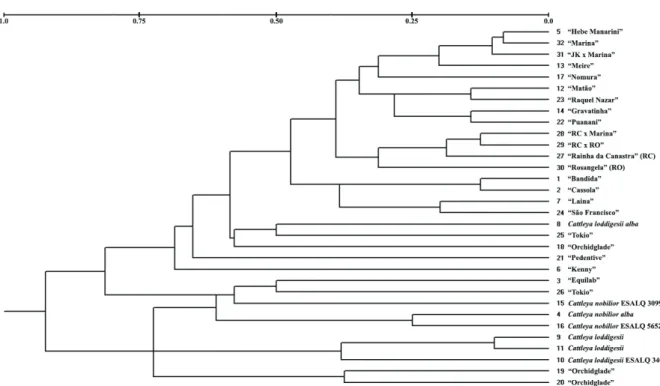
The genetic distances between individuals ranged from 0.0833 to 0.8527 (data not shown). The highest values were observed across species. In the cluster analysis performed on the basis of genetic distances, no well-defined groups were observed (Figure 1). Unlike Jin, Naito, and Matsui (2004), we could not separate the Cattleya loddigesii and C. nobilior species from C. walkeriana individuals. By
separating the accessions into two groups, Group I consisting of 17 native individuals of Cattleya walkeriana (68%) and Group II of the other plants of C. walkeriana (32%) (including individuals with
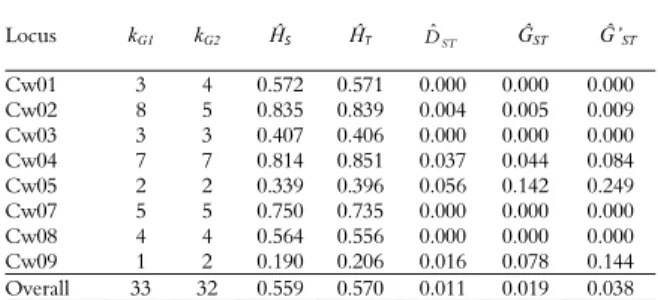
some level of improvement and some from unknown genealogy), we found that the majority (98.1%) of the genetic diversity (ĤT = 0.570) is
distributed within groups (ĤS = 0.559), while only
1.93% is distributed among groups (DˆST = 0.011) (Table 2). Similar results were obtained by Pinheiro et al. (2012) for 130 genotypes of Cattleya labiata.
Low genetic variation was detected among loci, and no genetic diversity was found for loci Cw01, Cw03, Cw07, and Cw08 for ĜST (Table 2). The estimation of G`ST, according to Hedrick (2005), is
considered a more accurate parameter. The advantage of G’ST is that it is suitable as an analogue
of FST for multiple alleles (microsatellite alleles).
This estimation of allelic frequencies also considers the different alleles present in the population. However, some aspects of Nei’s (1978) estimates are
also shown at a comparison level, when using codominant markers. Considering G’ST, the
difference between groups was 0.038. Therefore, the reproductive system has a significant impact on the distribution of genetic variability and consequently on population genetic diversity (Nybom & Bartish, 2000). Brzosko, Wróblewska, Jermakowicz, and Hermaniuk (2013), while studying 11 natural populations of Goodyera repens, detected greater
genetic diversity within populations and low but significant genetic differentiation between them. The genetic variation in neutral loci depends on gene flow patterns; therefore, the dispersion and the founding of new populations are limited. This limitation will contribute to a positive correlation between the geographic and genetic distances between species (Kimura & Weiss, 1964; Slatkin, 1985, Alexandersson & Ågren, 2000).
Table 2. Genetic diversity parameters: number of alleles in
Group 1 (kG1) and Group 2 (kG2), total (ĤT), within (ĤS) and
among group (DˆST) diversity, as well as Nei’s (1978) (ĜST) and
Hedrick’s (2005) (Ĝ’ST) statistics, respectively, between the two
groups in Cattleya walkeriana based on eight microsatellite loci.
Locus kG1 kG2 ĤS ĤT ST
Dˆ ĜST Ĝ’ST
Cw01 3 4 0.572 0.571 0.000 0.000 0.000 Cw02 8 5 0.835 0.839 0.004 0.005 0.009 Cw03 3 3 0.407 0.406 0.000 0.000 0.000 Cw04 7 7 0.814 0.851 0.037 0.044 0.084 Cw05 2 2 0.339 0.396 0.056 0.142 0.249 Cw07 5 5 0.750 0.735 0.000 0.000 0.000 Cw08 4 4 0.564 0.556 0.000 0.000 0.000 Cw09 1 2 0.190 0.206 0.016 0.078 0.144 Overall 33 32 0.559 0.570 0.011 0.019 0.038
Our results showed that the breeding process appears to be little influenced by the loss of alleles, as both groups presented almost the same number of alleles (Table 2). However, for locus Cw2, this allelic loss appears to be more pronounced (Tables 2 and 3). Indeed, 80% of the alleles for this locus are unique in Group 1. This difference in the presence of these alleles in the native plants may reflect higher allelic variability in plants not yet subjected to domestication (Upadhyaya et al., 2008). Genetic diversity variation can be influenced by various factors, with the breeding system having a particularly significant effect (Nybom & Bartish, 2000).
Table 3. Presence (+) or absence (-) of alleles in two groups of
C. walkeriana. Group I consists of native plants, and Group II
consists of individuals with some level of improvement and individuals with unknown genealogy. Only the contrasting alleles are presented from each locus.
Molecular size of the allele Presence (+) or absence (-) of specific alleles Group 1 Group 2 Locus Cw01
146 + -
154 - +
160 - +
Locus Cw02
200 + -
232 + -
234 - +
310 + -
330 + -
Locus Cw04
180 + -
194 - +
Locus Cw09
222 - +
Cattleya is a key genus used in the production of
artificial hybrids. However, in nature, at least 89 natural hybrids have been found with established parents and 36 hybrids of uncertain origin as well as five natural hybrids with other genera (ex. Brassavola, Laelia and Encyclia) (Monteiro,
Selbach-Schnadelbach, Oliveira, & van den Berg, 2010). For plants with unknown genealogy, one from each Orchidglade and Equilab clones were allocated differently from the other two "Orchidglade" clones. Indeed, all of these plants were separated from C. loddigesii alba. This fact may indicate a lower genetic
distance between C. loddigesii alba and these clones.
Among growers, it is widely speculated that the plants called “Orchidglade” were first described in a Rio de Janeiro Botanical Garden, but this fact has never been proven. What we found in this molecular analysis is that these plants are genetically different. This difference may occur because growers change their names (intentional or unintentionally) in their greenhouses. An important fact about C. walkeriana
is that the native clone called "São Francisco" (C. walkeriana var. princeps L.C. Menezes) was grouped
with a clone that escapes the typical standard of the C. walkeriana flower, called “Laina”. Many growers believe
that Laina is a hybrid between C. walkeriana and Cattleya x dolosa (C. walkeriana x C. loddigesii).
As expected, there is lower genetic distance between individuals and their parents. The clones called “Rosangela”, “Marina” and “Rainha da Canastra” (RC) were genetically closer to the seedlings of the crosses “JK” x Marina, RC x “Marina” and RC x “Rosangela”, which may be a proof of the effectiveness of our markers.
With a detailed analysis, we noticed that allele 160 of locus Cw01 found in the clone “Pedentive” from
Group 2 was detected only in Cattleya loddigesii. We also
detected, in Group 2, that allele 232 of locus Cw02 was found in three individuals (“Gravatinha”, “Puanani” and “Rachel Nazar”) and in the C. nobilior group
(Table 3). This result can be explained by the genetic proximity of these two Cattleyas (Braem, 1984). This
similarity may influence the grouping of two “Orchidglade” clones with C. nobilior and C. loddigesii
(Figure 1). However, “Pedentive” presents morphological traits that differ substantially from the
C. walkeriana species. “Pedentive” was once considered
a hybrid by other authors (Jin et al., 2004), which agrees with our analysis (Figure 1).
Traits such as time of flowering, shape, size and lip colour, scent of flowers and shape of the pseudobulbs from individuals stemming from “F1” crosses for the “Pedentive” clone showed strong traces of hybridization (Furusu, 2000). Allele number 222 (loci Cw09), found in Group 2, is exclusive to only one of each of the three clones called “Orchidglade” and “Kenny” and it is not present in any other genotyped individual. “Kenny” and “Pedentive” both have morphological traits that distinguish them from typical
C. walkeriana. In 2009, the American Orchid Society
considered that C. walkeriana Kenny appeared to be Cattleya Snowblind (C. angelwalker1 x C. walkeriana
Pendentive) and recommended changing its name. Another allele present only in Group 2 is allele 194 of locus Cw04. This allele appears at high frequency (0.389, data not shown) in Group 2 but is present only in “Equilab”, Orchidglade and “Pedentive”. In our analysis, “Orchidglade” and “Kenny” are closer than the native plants, which typically may be a signal of the introgression of genes from other species. Gene flow between species by natural introgression is a common event, especially in the genomes of species that are permeable to other closely related species (Russell et al., 2010). The three sources of “Orchidglade” that were analysed appear to be genetically closer to the C. loddigesii
specimens and to individuals with hybrid traits (“Pedentive” and “Kenny”) than to native C. walkeriana plants. For our genotypes, microsatellites
were not efficient for determining the genetic similarity between C. walkeriana groups (native vs
improved). The difficulty in determining the genetic distance between these different genotypes can be attributed to the complex mating system in the orchid species, presenting a weak or non-existent genetic barrier, and facilitating the development of artificial and natural hybrids.
1
Figure 1. Dendrogram of 32 Cattleya genotypes, based on microsatellite data obtained by the UPGMA clustering method, based on the
matrix obtained using the Rogers modified distance.
Conclusion
Our analysis revealed smaller genetic distances between the “Orchidglade”, “Equilab”, “Kenny” and “Pedentive” clones and the species C. loddigesii and C. nobilior. Our results also showed that native plants
of C. walkeriana are genetically more distant from C. loddigesii and C. nobilior.
We still cannot verify that the clone “Orchidglade” underwent hybridization. However, new microsatellite markers and DNA barcodes are being developed to continue these studies.
Acknowledgements
We thank the Laboratório de Reprodução e Genética de Espécies Arbóreas (LARGEA, ESALQ/USP) for providing the physical support necessary to complete this work. Special thanks to Patricia Dias Santos for helping with the laboratory work. RV and EAV were supported by a National Counsel of Technological and Scientific Development (CNPq) research fellowship.
References
Alexandersson, R., & Ågren, J. (2000). Genetic structure in the nonrewarding, bumblebee-pollinated orchid
Calypso bulbosa. Heredity, 85(45),401-409.
Almeida, P. R. M., López-Roberts, M. C., Vigna, B. B. Z., Souza, A. P., Góes-Neto, A., & van den Berg, C.
(2013). Microsatellite markers for the endangered orchids Cattleya labiata Lindl. and C. warneri T. Moore:
Orchidaceae. Conservation Genetics Resources,5(3),
791-794.
Anamthawat-Jónsson, K. (2001). Molecular cytogenetics of introgressive hybridization in plants. Methods in Cell Science : An Official Journal of the Society for In Vitro Biology, 23(1), 139-148.
Arnold, M. L., Cornman, R. S., & Martin, N. H. (2008). Hybridization, hybrid fitness and the evolution of adaptations. Plant Biosystems - An International Journal Dealing with All Aspects of Plant Biology,142(1), 166-171.
Azevedo, C. O., Borba, E. L., & Berg, C. (2006). Evidence of natural hybridization and introgression in
Bulbophyllum involutum Borba, Semir & F. Barros (Ed),
and B. Weddellii (Lindl.) Rchb. f. (Orchidaceae) in the
Chapada Diamantina, Brazil, by using allozyme markers. Revista Brasileira de Botânica,29(3), 415-421.
Braem, G. (1984). Die bifoliaten Cattleyen Brasiliens. Hildesheim, DE: Brücke-Verlag Kurt Schmersow. Broeck, A., Van Landuyt, W., Cox, K., De Bruyn, L.,
Gyselings, R., Oostermeijer, G., & Mergeay, J. (2014). High levels of effective long-distance dispersal may blur ecotypic divergence in a rare terrestrial orchid.
BMC Ecology,14(1), 20.
Brzosko, E., Wróblewska, A., Jermakowicz, E., & Hermaniuk, A. (2013). Plant Systematics and Evolution, 299(8), 1537-1548.
Da Silva, C., & Milaneze-Gutierre, M. (2004). Caracterizaçào morfo-anatômica dos órgãos vegetatives de Cattleya walkeriana Gardner;
Orchidaceae. Acta Scientiarum. Biological Sciences, 26(1),
Furusu, M. (2000). Características da primeira geração de
C. walkeriana cruzada com C. walkeriana alba
“Pedentive.” Informativo ACW, 11(2), 4-5.
Goudet, J. (1995). FSTAT (Version 1.2): A Computer Program to Calculate F-Statistics. Journal of Heredity, 86(6), 485-486.
Hedrick, P. W. (2005). A standardized genetic differentiation measure. Evolution; International Journal of Organic Evolution,59(8),1633-1638.
Jin, G., Naito, T., & Matsui, S. (2004). Randomly amplified polymorphic DNA analysis for establishing phylogenetic relationship among Cattleya walkeriana
Gardn., Cattleya nobilior Rchb. f. and Cattleya loddigesii
Lindl. Japanese Society for Horticultural Science, 73(5),
496-502.
Kaplan, Z., & Fehrer, J. (2007) Molecular evidence for a natural primary triple hybrid in plants revealed from direct sequencing. Annals of Botany, 99(6), 1213-1222.
Kimura, M., & Weiss, G. H. (1964). The Stepping Stone Model of Population Structure and the Decrease of Genetic Correlation with Distance. Genetics, 49(4),
561-576.
Little, D. P. (2014). A DNA mini-barcode for land plants.
Molecular Ecology Resources, 14(3), 437-46.
Menezes, L. (2011). Orchids Cattleya walkeriana. Brasilia, DF: Instituto Brasileiro do Meio Ambiente e dos Recursos Naturais Renováveis.
Miller, M. P. (1997). Tools for Population Genetic Analyses -TFPGA. Reading, 75, 683-684.
Monteiro, S. H. N., Selbach-Schnadelbach, A., Oliveira, R. P., & van den Berg, C. (2010). Molecular phylogenetics of Galeandra: Orchidaceae: Catasetinae based on plastid and nuclear DNA sequences. Systematic Botany, 35(3),
476-486.
Nei, M. (1978). Estimation of average heterozygosity and genetic distance from a small number of individuals.
Genetics, 89(3),583-590.
Neto, V. P. C., Motte, D., & Dubuisson, J. Y. (2012). Cattleya × itabapoanaensis (Orchidaceae), a new natural hybrid
from Rio Janeiro State (Brazil). Phytotaxa, 56(1), 64-68.
Novello, M., Rodrigues, J. F., Pinheiro, F., Oliveira, G. C. X., Veasey, E. A., & Koehler, S. (2013). Simple-sequence repeat markers of Cattleya coccinea: Orchidaceae, an endangered species of the Brazilian Atlantic forest.
Genetics and Molecular Research, 12(3),3274-3278.
Nybom, H., & Bartish, I. V. (2000). Effects of life history traits and sampling strategies on genetic diversity estimates obtained with RAPD markers in plants.
Perspectives in Plant Ecology, Evolution and Systematics, 3(2),
293-114.
Parveen, I., Singh, H. K., Raghuvanshi, S., Pradhan, U. C., & Babbar, S. B. (2012). DNA barcoding of endangered Indian Paphiopedilum species. Molecular Ecology Resources,12(1), 82-90.
Pinheiro, L. R., Rabbani, A. R. C., da Silva, A. V. C., da Silva, L. A., Pereira, K. L. G., & Diniz, L. E. C. (2012). Genetic diversity and population structure in the Brazilian Cattleya labiata (Orchidaceae) using RAPD
and ISSR markers. Plant Systematics and Evolution, 298,
1815-1825.
Qian, X., Wang, C. X., & Tian, M. (2013). Genetic diversity and population differentiation of Calanthe tsoongiana, a rare and endemic orchid in China.
International Journal of Molecular Sciences, 14(10),
20399-20413.
Rodrigues, D. H., Neto, F. D. A., & Schuster, I. (2008). Identification of essentially derived soybean cultivars using microsatellite markers. Crop Breeding and Applied Biotechnology,8(1), 74-78.
Rodrigues, L. A., Borges, V., Neto, D. P., Boaretto, A. G., & Oliveira, J. F. (2015). In vitro propagation of
Cyrtopodium saintlegerianum rchb . f . orchidaceae, a
native orchid of the Brazilian savannah. Crop Breeding and Applied Biotechnology, 15(1), 10-17.
Rogers, J. S. (1972). Measures of genetic similarity and genetic distance (Studies in genetics, VII). Austin, TX:
University of Texas Publication.
Russell, A., Samuel, R., Klejna, V., Barfuss, M. H. J., Rupp, B., & Chase, M. W. (2010). Reticulate evolution in diploid and tetraploid species of Polystachya: Orchidaceae as shown by plastid DNA sequences and low-copy nuclear genes. Annals of Botany,106(1), 37-56.
Slatkin, M. (1985). Gene Flow in Natural Populations.
Annual Review of Ecology and Systematics 16, 393-430.
doi: 10.1146/annurev.es.16.110185.002141
Tambarussi, E. V., Menezes, L. C., Ibañes, B., Antiqueira, L. M. O. R., Dequigiovanni, G., Moreno, M. A., Ferraz, E. M., Zucch, M. I., Veasey, E. A., & Vencovsky, R. (2017). Microsatellite markers for
Cattleya walkeriana Gardner, an endangered tropical
orchid species. Plant Genetic Resources, 15(1), 93-96.
Upadhyaya, H. D., Dwivedi, S. L., Baum, M., Varshney, R. K., Udupa, S. M., Gowda, C. L. L., & Singh, S. (2008). Genetic structure, diversity, and allelic richness in composite collection and reference set in chickpea: Cicer arietinum L. BMC Plant Biology,8(106),
106.
Wright, S. (1978). Evolution and genetics of populations (Vol.
IV). Chicago, IL: University of Chicago Press.
Received on July 2, 2016. Accepted on October 25, 2016