Role of nitric oxide and superoxide
in
Giardia lamblia
killing
Departamento de Farmacologia Básica e Clínica,
Instituto de Ciências Biomédicas, Centro de Ciências da Saúde,
Universidade Federal do Rio de Janeiro, 21944-970 Rio de Janeiro, RJ, Brasil P.D. Fernandes
and J. Assreuy
Abstract
Giardia lamblia trophozoites were incubated for 2 h with activated murine macrophages, nitric oxide (NO) donors or a superoxide anion generator (20 mU/ml xanthine oxidase plus 1 mM xanthine). Acti-vated macrophages were cytotoxic to Giardia trophozoites (~60% dead trophozoites). This effect was inhibited (>90%) by an NO synthase inhibitor (200 µM) and unaffected by superoxide dismutase (SOD, 300 U/ml). Giardia trophozoites were killed by the NO donors, S-nitroso-acetyl-penicillamine (SNAP) and sodium nitroprusside (SNP) in a dose-dependent manner (LD50 300 and 50 µM, respectively). A
dual NO-superoxide anion donor, 3-morpholino-sydnonimine hydro-chloride (SIN-1), did not have a killing effect in concentrations up to 1 mM. However, when SOD (300 U/ml) was added simultaneously with SIN-1 to Giardia, a significant trophozoite-killing effect was observed (~35% dead trophozoites at 1 mM). The mixture of SNAP or SNP with superoxide anion, which yields peroxynitrite, abolished the trophozoite killing induced by NO donors. Authentic peroxynitrite only killed trophozoites at very high concentrations (3 mM). These results indicate that NO accounts for Giardia trophozoite killing and this effect is not mediated by peroxynitrite.
Correspondence
J. Assreuy
Departamento de Farmacologia ICBS/CCS
Universidade Federal do Rio de Janeiro Caixa Postal 68013 21944-970 Rio de Janeiro, RJ Brasil
Fax: 55 (021) 270-8647
E-mail: [email protected]
P.D. Fernandes and J. Assreuy are recipients of CNPq fellowships. Research supported by Fundação Universitária José Bonifácio/UFRJ/ Brasil.
Received April 23, 1996 Accepted October 2, 1996
Key words
•Nitric oxide
•Macrophage
•Peroxynitrite
•Giardia lamblia
•Cytotoxicity
•Superoxide
Introduction
When macrophages are activated, they become competent to kill several pathogens and to lyse tumor cells. During the activation process, macrophages produce an array of biologically active molecules that includes tumor necrosis factor-alpha (TNF-α), inter-leukin-1 (IL-1) and reactive oxygen interme-diates such as superoxide and hydrogen per-oxide (1).
Recent studies have shown that activated macrophages also produce large amounts of an unstable gas, nitric oxide (NO; Ref. 2). Nitric oxide is synthesized from L-arginine
by the enzyme NO synthase (NOS), which occurs in three forms. The endothelial NOS (eNOS) is known to play a role in physiologi-cal vasodilatation whereas neuronal NOS (nNOS) is important for neurotransmission (2). The third NOS (inducible NOS; iNOS) is induced in macrophages and other cells by soluble stimuli such as bacterial lipopolysac-charide (LPS) and by particulate stimuli such as zymosan (3), both in the presence of cyto-kines such as interferon gamma (IFN-γ).
has been shown to kill several pathogenic agents such as fungi (Cryptococcus neofor-mans (4); Candida albicans (6)), mycobac-teria (7) and some intracellular protozoan parasites, such as Toxoplasma gondii (8),
Leishmania major (9) and Trypanosoma
cruzi (10). Cytotoxic effects of NO on an extracellular Platyhelminth parasite, Schis-tosoma mansoni, have also been reported (11). More recently, some reports indicated that peroxynitrite, the product of the reaction between NO and superoxide anion (12), may be the cytotoxic effector responsible for the killing of several targets (13,14).
The most prevalent cause of diarrhea in the world is the infection of the upper gastrointes-tinal tract by the protozoan Giardia lamblia
(15). The infection can be life-threatening in undernourished children of Third World coun-tries and in immunocompromised patients (15). In the present report, we show that NO produced by either activated macrophages or NO donors is cytotoxic to Giardia lamblia
trophozoites. This effect can be attributable to NO alone and does not require the partici-pation of either reactive oxygen intermedi-ates or peroxynitrite.
Material and Methods
Material
Murine recombinant interferon-γ was from Genzyme, (Cambridge, MA). LPS from Sal-monella typhosa (0901) was obtained from Difco (Detroit, MI). S-Nitroso-acetyl-penicil-lamine (SNAP) and N-iminoethyl-L-ornithine (L-NIO) were kindly provided by Dr. S. Moncada, Wellcome Research Laboratories (Beckenham, UK). Zymosan, superoxide dis-mutase (SOD; from bovine erythrocytes), cata-lase and sodium nitroprusside (SNP) were from Sigma (St. Louis, MO). 3-Morpholino-sydnonimine hydrochloride (SIN-1) was kindly provided by Dr. R. Henning, Cassela AG, Frankfurt, Germany. Fetal calf serum (FCS) was from Fazenda Pigue (Rio de Janeiro, RJ,
Brazil). All other tissue culture reagents were purchased from Sigma.
Macrophages
Murine peritoneal macrophages were harvested from C57/Black6 mice which had been injected ip 4 days before with 2 ml of sterile thioglycollate solution (3% w/v in water). Cells were plated onto 48-well plates at 106 cells/well, incubated for 2 h in 5% CO
2
at 37oC and washed with fresh medium to
remove non-adherent cells. Assays were car-ried out in RPMI-1640 supplemented with 10% FCS, 20 mM HEPES, 2 mM L-glutamine, 100 U/ml penicillin and 100 µg/ ml streptomycin.
Giardia lamblia cultures
Trophozoites of the Portland I strain (P1, ATCC-30889) were kept in 15-ml plastic tubes with 14 ml TYI-S-33 medium supple-mented with 0.1% bovine bile and 10% FCS (16). The medium was removed twice a week by aspiration and fresh medium was added to the tubes. For experiments, tubes contain-ing the organisms were kept in ice-cold wa-ter for 20 min and centrifuged (250 g, 10 min) in the cold. With this procedure more than 95% of the parasites detached from the tube and could be recovered in the pellet.
Macrophage activation
Macrophage activation was induced by adding IFN-γ (20 U/ml) plus LPS (100 ng/ ml; referred to as LI) or the same concentra-tion of IFN-γ plus zymosan (80 µg/ml; re-ferred to as ZI) to the macrophages. NO production was assessed by nitrite concen-trations in the medium using the Griess reac-tion (17). Briefly, 100 µl Griess reagent (equal parts of 1% w/v sulfanilamide in 5% H3PO4
plates were read using a Tytertek MKI340P plate reader at 540 nm against a standard curve of sodium nitrite in culture medium.
Giardicidal assay
Peritoneal macrophages were activated as described above and 12 h later, at the peak of NO synthase activity (18), Giardia tro-phozoites were added at a ratio of 4:1 (effector:target). The plate was then further incubated for 2 h at 37oC in 5% CO
2 and
transferred to a refrigerator (4oC) for 30 min
to detach trophozoites. The suspension was centrifuged, supernatants were saved for ni-trite assay and the pellet was resuspended in cold Trypan blue (0.1%) to count viable parasites. As there is a good correlation be-tween dye uptake and parasite motility, we evaluated parasite viability by these two cri-teria, ranking as dead parasites only those that took up the dye and were not moving. When NO donors were used they were incu-bated at different concentrations with 1 x 10⁶ Giardia trophozoites/ml in RPMI medium for 2 h at 37oC. The tubes were chilled and
centrifuged and the pellet was resuspended in cold Trypan blue as described above. The results are reported as percent viable Giar-dia trophozoites in a total count of 200 para-sites. Addition of NO donors did not change the pH of the incubation medium.
Peroxynitrite synthesis
Peroxynitrite was synthesized according to Beckman et al. (19). The concentrations of peroxynitrite used in the killing assays did not modify the pH of the medium. When tested as a bactericidal agent against E. coli, peroxynitrite prepared in our laboratory had an LD50 of about 250 µM, identical to the
value obtained by Zhu et al. (14).
Statistical analysis
Results are reported as mean ± SD.
Dif-ferences were considered to be significant when P<0.05, using analysis of variance fol-lowed by the Bonferroni t-test.
Results
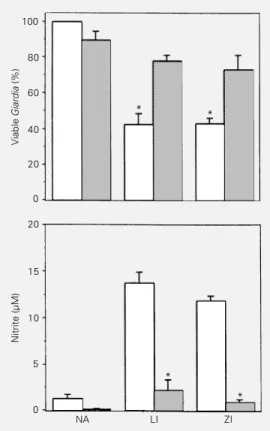
Activation of mouse peritoneal macro-phages with ZI or LI induced NO synthase activity with production of NO as assessed by increased nitrite levels in the supernatants (Figure 1, open bars). It is important to point out that the nitrite concentrations shown in Figure 1 represent the accumulation over a period of 2 h of exposure to Giardia tropho-zoites. When measured 48 h after activation, nitrite concentrations were 3 ± 1 and 80 ± 5 µM (N = 3) in non-activated and activated macrophages, respectively. That NO was responsible for the killing of Giardia tro-phozoites by activated macrophages was con-firmed by showing that the NO synthase inhibitor L-NIO (200 µM) inhibited both killing and nitrite accumulation (Figure 1, shaded bars). We also tested longer times of
Figure 1 - Effect of macrophage activation on Giardia trophozoite killing (upper panel) and nitrite production (lower panel). Murine peritoneal macrophages were activated with IFN-γ (20 U/ml) plus LPS (100 ng/ml; LI) or with IFN-γ plus zymosan (80 µg/ml; ZI). Open and shaded bars are experiments performed in the absence or in the presence of L-NIO (200 µM), respectively. Twelve hours after macrophage activation, cells were washed with fresh medium, Giardia tro-phozoites were added at a ratio of 1:4 (target:effector; see Meth-ods for details) and incubated for 2 h. Supernatants were removed for nitrite determination and the pellet was used for the Giardia -killing assay. Results are re-ported as means ± SD of tripli-cates. *P<0.05 when compared to non-activated cells (upper panel) or when activated cells in the absence of L-NIO were com-pared to cells in the presence of L-NIO (lower panel) (analysis of variance followed by the Bonferroni t-test). NA, Non-acti-vated macrophages. The same results were obtained in two ex-periments.
Viable
Giardia
(%)
100
80
60
40
20
0
* *
Nitrite (µM)
20
15
10
5
0
NA LI ZI
*
of macrophages when kept in a culture medi-um other than TYI-S-33 for more than 3-4 h. Presumably, this is attributable to the high cysteine concentration in Giardia medium which is critical to ensure high trophozoite viability (15).
To confirm that NO was responsible for the killing we tested for the effects of NO generated by NO donors on Giardia tropho-zoites in a macrophage-free system. When added directly to Giardia trophozoites, SNP was the most potent cytotoxic agent (LD50
~50 µM), followed by SNAP (LD50 ~300
µM) whereas SIN-1 was almost ineffective in this regard (Figure 2).
The presence of SOD did not change the killing effect of SNP or SNAP (data not shown). However, SOD greatly enhanced the effect of SIN-1. For instance, 100 µM SIN-1 killed 17.5% and 57% of trophozoites in the absence and in the presence of SOD, respectively (Figure 3). We also performed a set of experiments in which trophozoites were incubated in medium containing SIN-1, SOD and catalase (300 U/ml). The pres-ence of catalase abolished the potentiation of the cytotoxic effect of SIN-1 produced by SOD (SIN-1 alone: 47.3 ± 0.7%; SIN-1 + SOD: 24.5 ± 3.3% and SIN-1 + SOD + catalase: 38.6 ± 0.9% of viable trophozoites, N = 3).
In order to test the possibility that per-oxynitrite is the cytotoxic effector against
Giardia trophozoites, we examined the ef-fects of the simultaneous incubation of the NO donor SNAP and the superoxide-form-ing system (xanthine/xanthine oxidase). This procedure is likely to yield peroxynitrite. The xanthine/xanthine oxidase system killed (although not significantly) a small number of Giardia trophozoites. In contrast, SNAP (200 µM) killed 56.2% of the trophozoites (Figure 4, open bars). In the presence of superoxide, however, the cytotoxic effect of SNAP was completely abolished together with a decrease in nitrite levels (Figure 4, shaded bars). Similar results were obtained
Viable
Giardia
(%)
100
80
60
40
20
0
Figure 2 - Effects of increasing concentrations of NO donors on
Giardia trophozoite killing. Giar-dia killing was measured by incu-bating trophozoites with SNP (C), SNAP (ª) or SIN-1 (£) at the indicated concentrations for 2 h at 37oC. Results are reported as
means ± SD of triplicates. The same results were obtained in three experiments.
1 10 100 1000
Nitric oxide donor (µM)
Figure 3 - Enhancement of the
Giardia trophozoite-killing effects of SIN-1 by superoxide dismu-tase. Trophozoites were incu-bated with increasing concentra-tions of SIN-1 in the absence (open bars) or in the presence (shaded bars) of SOD (300 U/ml) for 2 h at 37oC. Results are
re-ported as means ± SD of tripli-cates. *P<0.05 when compared to groups without SOD (analysis of variance followed by the Bonferroni t-test). The same re-sults were obtained in two ex-periments.
exposure of trophozoites to activated macro-phages. Although it seems that increases in exposure times did not cause higher tropho-zoite killing (data not shown), these experi-ments were biased due to the great increase in trophozoite mortality even in the absence
Viable
Giardia
(%)
100
80
60
40
20
0 10 100 1000
SIN-1 (µM) 0
*
*
when the NO donor was SNP (data not shown). Authentic peroxynitrite was cyto-toxic to Giardia trophozoites but only at very high concentrations (Figure 5) when compared to SNP, SNAP or SIN-1 (the latter in the presence of SOD).
Discussion
The induction of NO production in peri-toneal macrophages by either soluble (LI) or particulate (ZI) stimuli turned these cells into cytotoxic effectors against Giardia tro-phozoites. This effect was highly dependent on NO production as L-NIO, an NOS inhib-itor, blocked both nitrite accumulation and trophozoite killing. Similar results have been reported for Leishmania killing by activated macrophages (20).
NO has been shown to be cytotoxic for a number of parasites (5), but in view of the demonstration that NO can react with super-oxide anion to yield peroxynitrite (12), which is also cytotoxic to some organisms, the identity of the effector species remains con-troversial. As shown by the present results, NO alone accounts for cytotoxicity against
Giardia trophozoites. First, the addition of an NO synthase inhibitor to activated macro-phages completely inhibited trophozoite kill-ing. Second, the NO donors SNAP and SNP reproduced the killing effect observed with activated macrophages, and this effect was not changed in the presence of SOD. Third, incubation of SNAP or SNP together with a superoxide anion producer (xanthine/xan-thine oxidase), a procedure likely to yield peroxynitrite, dramatically reduced the cyto-toxic effect of NO donors. Grisham and Miles (21) have shown that a maximal yield of peroxynitrite is obtained only when NO and superoxide anion react at equimolar con-centrations. If one admits that all NO re-leased by 200 µM of an NO donor reacts with superoxide, this would release 200 µM peroxynitrite. Consistent with the conclu-sion that peroxynitrite is less cytotoxic for
Giardia than NO, we have found that au-thentic peroxynitrite exhibited some cyto-toxic effects only at high concentrations (3 mM). Sensitivity to peroxynitrite seems to vary among microorganisms since peroxyni-trite is an effective cytotoxic agent for Esch-erichia coli (14) and Trypanosoma cruzi
(13), but not for Leishmania (20) or for
Giardia (present study). It may be that in physiological situations, defense cells could use either NO or peroxynitrite as cytotoxic molecules, depending on the kinetics of pro-duction of superoxide anion and NO. For instance, human neutrophils stimulated with
Figure 4 - Effects of SNAP, xan-thine/xanthine oxidase (X/XO) system or both on Giardia tro-phozoite killing (open bars) and nitrite accumulation (shaded bars). Trophozoites were incu-bated either with SNAP (200 µM), xanthine (1mM)/xanthine oxidase (20 mU/ml) or both for 2 h at 37oC. Results are reported
as means ± SD of triplicates. *P<0.05 when compared to the effects of SNAP alone (analysis of variance followed by the Bonferroni t-test). The same re-sults were obtained in two ex-periments. C, Control.
Figure 5 - Effect of increasing concentrations of authentic per-oxynitrite on Giardia trophozoite killing. Peroxynitrite anion was obtained as described in the Methods section and incubated with trophozoites for 2 h at 37oC. Addition of peroxynitrite
did not change medium pH. Re-sults are reported as means ± SD of triplicates. *P<0.05 when compared to the group without peroxynitrite (analysis of vari-ance followed by the Bonferroni
t-test). The same results were obtained in two experiments.
Viable
Giardia
(%)
100
80
60
40
20
0
0 0.1 0.3 1 3
Peroxynitrite (mM)
*
Viable
Giardia
(%) (
)
100
80
60
40
C
*
100
80
60
40
Nitrite (µM) (
)
20
0
20
0
X/XO SNAP SNAP
+ X/ XO
phorbol esters produce NO and superoxide with very similar kinetics, thus favoring per-oxynitrite formation (22). On the other hand, in mouse macrophages activated by zymo-san, superoxide is produced several hours earlier than NO, yet these cells potently killed
Leishmania. In this system, peroxynitrite for-mation is unlikely to occur (20).
SIN-1, which is reported to release both NO and superoxide anion simultaneously (23) and therefore to yield peroxynitrite, exhibited a modest trophozoite-killing ef-fect. However, superoxide removal (achieved by using SOD) greatly enhanced the cyto-toxic effect of SIN-1. This enhancement, however, was blunted by catalase. It was reported that SOD enhancement of the SIN-1 cytotoxic effect on a human liver cell line was dependent on hydrogen peroxide result-ing from dismutation of superoxide and not on increased NO release (24). These investi-gators showed that the cytotoxic species are not NO, peroxynitrite or hydroxyl radical (·OH). Indeed, this seems to be the case in our experiments with SIN-1, since catalase inhibited the SOD-enhancing trophozoite-killing effect of SIN-1. Until this matter is addressed in more detail, one should be care-ful in interpreting the effect of SIN-1 in the presence of SOD. This point, however, seems to be relevant only for SIN-1, as the addition of SOD and/or catalase did not have any effect on the ability of activated macro-phages or SNAP to kill Giardia trophozoites (data not shown).
Reactive oxygen species seem to be im-portant for the killing of some intracellular parasites. Although activated macrophages are able to produce toxic reactive oxygen species (during phagocytosis, for example),
this seems not to be the case for Giardia
killing, as the parasite is too big (15) to be ingested by the macrophage. Therefore, in an in vivo infection, activated macrophages should use an easily diffusible chemical spe-cies to exert their killing action, as the major-ity of the target will be extracellular. The following lines of evidence point to NO as this effector: i) the almost complete inhibi-tion of trophozoite killing by activated mac-rophages when an NO synthase inhibitor was present in the medium (Figure 1); ii) superoxide anion does not easily cross mem-branes (25); iii) hydrogen peroxide does (25), and catalase does not interfere with the kill-ing caused by activated macrophages or SNAP (data not shown); iv) peroxynitrite has a very short half-life and is inactivated by physiological concentrations of bicarbon-ate (>25 mM; Ref. 14). In summary, from the vast array of cytotoxic molecules potentially produced by defense cells, NO seems to account for the majority, if not all, of macro-phage giardicidal effects.
Acknowledgments
References
1. Nathan CF (1980). Secretory products of macrophages. Journal of Clinical Investi-gation, 79: 319-326.
2. Moncada S, Palmer RMJ & Higgs EA (1991). Nitric oxide: physiology, patho-physiology, and pharmacology. Pharma-cological Reviews, 43: 109-142. 3. Cunha FQ, Assreuy J, Liew FY & Moncada
S (1993). Phagocytosis and induction of nitric oxide synthase in murine macro-phages. Immunology, 79: 408-411. 4. Granger DL, Hibbs JB, Perfect JR &
Durack DT (1990). Metabolic fate of L-arginine in relation to microbiostatic capa-bility of macrophages. Journal of Clinical Investigation, 85: 264-273.
5. Liew FY (1993). The role of nitric oxide in parasitic diseases. Annals of Tropical Medicine and Parasitology, 87: 637-642. 6. Cenci E, Romani L, Mencacci A,
Spaccapelo R, Chiraffella E, Puccetti P & Bistoni F (1993). Interleukin-4 and inter-leukin-10 inhibit nitric oxide-dependent macrophage killing of Candida albicans. European Journal of Immunology, 23: 1034-1038.
7. Chan J, Xing Y, Magliozzo RS & Bloom BR (1992). Killing of virulent Mycobacterium tuberculosis by reactive nitrogen interme-diates produced by activated murine mac-rophages. Journal of Experimental Medi-cine, 175: 1111-1122.
8. Adams L, Hibbs JB, Taintor RR & Krahenbuhl JL (1990). Microbiostatic ef-fect of murine-activated macrophages for
Toxoplasma gondii. Role for synthesis of inorganic nitrogen oxides from L-arginine.
Journal of Immunology, 144: 2725-2729. 9. Liew FY, Millot S, Parkinson C, Palmer
RMJ & Moncada S (1990). Macrophage killing of Leishmania parasite in vivo is mediated by nitric oxide from L-arginine.
Journal of Immunology, 144: 4794-4797.
10. Munoz-Fernandez MA, Fernandez M & Fresno M (1992). Synergism between tu-mor necrosis factor-α and interferon-γ on macrophage activation for the killing of intracellular Trypanosoma cruzi through a nitric oxide-dependent mechanism. Euro-pean Journal of Immunology, 22: 301-307. 11. James SL & Glaven J (1989). Macrophage cytotoxicity against schistosomula of
Schistosoma mansoni involves arginine-dependent production of reactive nitro-gen intermediates. Journal of Immunol-ogy, 143: 4208-4212.
12. Beckman JS, Beckman TW, Chen J, Marshall PA & Freeman BA (1990). Appar-ent hydroxyl radical production by peroxy-nitrite: implications for endothelial injury from nitric oxide and superoxide. Proceed-ings of the National Academy of Sciences, USA, 87: 1620-1624.
13. Denicola A, Rubbo H, Rodriguez D & Radi R (1993). Peroxynitrite-mediated cytotox-icity to Trypanosoma cruzi. Archives of Biochemistry and Biophysics, 304: 279-286.
14. Zhu L, Gunn C & Beckman JS (1992). Bactericidal activity of peroxynitrite. Ar-chives of Biochemistry and Biophysics,
298: 452-457.
15. Adam RD (1991). The biology of Giardia
spp. Microbiological Reviews, 55: 706-732.
16. Keister DB (1983). Axenic culture of Giar-dia lamblia in TYI-S-33 medium supple-mented with bile. Transactions of the Royal Society of Tropical Medicine and Hygiene, 77: 487-488.
17. Schmidt HHHW, Wilke P, Evers P & Bohme E (1989). Enzymatic formation of nitrogen oxides from L-arginine in bovine brain cytosol. Biochemical and Biophysi-cal Research Communications, 165: 284-291.
18. Assreuy J, Cunha FQ, Liew FY & Moncada S (1992). Feedback inhibition of nitric ox-ide synthase by nitric oxox-ide. British Jour-nal of Pharmacology, 108: 833-837. 19. Beckman JS, Chen J, Ischiropoulos H &
Crow JP (1994). Oxidative chemistry of peroxynitrite. Methods in Enzymology, 233: 229-240.
20. Assreuy J, Cunha FQ, Epperlein M, Noronha-Dutra A, ODonnell CA, Liew FY & Moncada S (1994). Production of nitric oxide and superoxide by activated macro-phages and killing of Leishmania major.
European Journal of Immunology, 24: 672-676.
21. Grisham MB & Miles AM (1995). Interac-tion between superoxide and nitric oxide under physiological conditions. Endotheli-um, 3 (Suppl): S6 (Abstract).
22. Carreras MC, Pargament GA, Catz SD, Poderoso JJ & Boveris A (1994). Kinetics of nitric oxide and hydrogen peroxide pro-duction and formation of peroxynitrite dur-ing the respiratory burst of human neutro-phils. FEBS Letters, 341: 65-68. 23. Hogg N, Darley-Usmar VM, Wilson MT &
Moncada S (1992). Production of hydroxyl radicals from the simultaneous genera-tion of superoxide and nitric oxide. Bio-chemical Journal, 281: 419-424. 24. Gergel D, Misik V, Ondrias K &
Cederbaum AI (1995). Increased cytotox-icity of 3-morpholinosydnonimine to HepG2 cells in the presence of superox-ide dismutase. Role of hydrogen peroxsuperox-ide and iron. Journal of Biological Chemistry, 270: 20922-20929.