Autonomic nervous system dysfunction
in children with severe tetanus:
dissociation of cardiac and vascular
sympathetic control
Unidad de Cuidados Intensivos Pediátricos, Departamento de Pediatría, Instituto de Investigaciones Cardiovasculares, Universidad de Los Andes, Mérida, Venezuela
C.A. Mazzei de Davila, D.F. Davila, J.H. Donis and X. Gonzalo
Abstract
The medical records of ten pediatric patients with a clinical diagnosis of tetanus were reviewed retrospectively. The heart rate and blood pressure of all tetanus patients were measured noninvasively every hour during the first two weeks of hospitalization. Six of ten tetanus patients presented clinical evidence of sympathetic hyperactivity (group A) and were compared with a control group consisting of four children who required mechanical ventilation for diseases other than tetanus (group B). Heart rate and blood pressure simultaneously and progres-sively increased to a maximum by day 7. The increase over baseline was 43.70 ± 11.77 bpm (mean ± SD) for heart rate (P<0.01) and 38.60 ± 26.40 mmHg for blood pressure (P<0.01). These values were higher and significantly different from those of the control group (group B) at day 6, which had an average heart rate increase over baseline of 19.35 ± 12.26 bpm (P<0.05) and blood pressure of 10.24 ± 13.30 mmHg (P<0.05). By the end of the second week of hospitalization, in group A the increase of systolic blood pressure over baseline had diminished to 9.60 ± 15.37 mmHg (P<0.05), but the heart rate continued to be elevated (27.80 ± 33.92 bpm, P = NS), when compared to day 7 maximal values. The dissociation of these two cardiovascular vari-ables at the end of the second week of hospitalization suggests the presence of asymmetric cardiac and vascular sympathetic control. One possible explanation for these observations is a selective and delayed action of tetanus toxin on the inhibitory neurons which control sympa-thetic outflow to the heart.
Correspondence
C.A. Mazzei de Davila Unidad de Cuidados Intensivos Pediátricos
Apartado Postal 590 Mérida
Venezuela
Fax: +58-27-4240-3203 E-mail: [email protected]
Research supported by CDCH-T and ULA M-596-97-07-D.
Received February 4, 2002 Accepted March 18, 2003
Key words
•Tetanus patients •Sympathetic control •Autonomic dysfunction •Blood pressure •Heart rate
Autonomic nervous system involvement in patients with tetanus was initially reported by Danish investigators in 1954 (1). The first detailed description of the heart rate and blood pressure abnormalities of patients with autonomic dysfunction secondary to tetanus was provided by Kerr et al. in 1968 (2).
ner-vous system (4,5). Nonetheless, how these cardiovascular abnormalities evolve is not well defined (6,7).
In the present retrospective investigation, we reviewed the medical records of ten chil-dren who were admitted to the Intensive Care Unit (ICU) of the University of Los Andes Hospital with a clinical diagnosis of tetanus during the period from January 1982 to December 1995. The diagnosis of severe tetanus with autonomic dysfunction was based on the presence of generalized muscu-lar spasms, sinus tachycardia and systemic hypertension (3). All patients were admitted within 24 h of the beginning of the muscle spasms. Mean age was 8 ± 3.36 years (range 2 to 13 years) and sex was equally distributed. All patients required sedation with
diaze-pam, 2-3 mg kg-1 24 h-1, intubation and
me-chanical ventilation (pancuronium, 100 µg/kg per dose). The autonomic crisis was treated as follows: 1) patients admitted between 1982 and 1985 received morphine, 1 mg/kg per dose (4-6 doses per day), propranolol, 2-7
mg kg-1 24 h-1, and magnesium sulfate,
1 mEq kg-1 24 h-1. 2) Patients admitted after
1987 were given morphine, 0.1 mg/kg per dose (4-6 doses per day), labetalol, 2-8 mg
kg-1 24 h-1, and magnesium sulfate, 1 mEq
kg-1 24 h-1.
In patients admitted before 1985, the heart rate was determined hourly with electrocar-diographic monitors and blood pressure was measured with a mercury sphygmomanom-eter and appropriate pediatric blood sure cuffs. Systolic and diastolic blood pres-sures were estimated according to phases one and four of the Korotkoff method, re-spectively (8). Patients admitted between 1985 and 1995 were monitored by the oscil-lometric technique using a DINAMAP™ adult/pediatric vital signs monitor model 845XT (Tampa, FL, USA).
The control group consisted of four pa-tients with diseases other than tetanus (group B) aged 9 ± 4 years, range 3 to 13 years, who had required mechanical ventilation and
muscle relaxants for causes other than teta-nus. These patients had severe head trauma, required mechanical ventilation, muscle re-laxants (pancuronium, 100 µg/kg per dose), analgesia (meperidine 1 µg/kg per dose, every 6 h), and diuretics (furosemide, 0.5 mg/kg per dose, every 12 h) and remained in the ICU for 5 to 7 days. Simultaneous hospital-ization, medical care provided by the same physician, and heart rate and blood pressure increases above pre-established limits were used as inclusion criteria. This retrospective clinical investigation was approved by the Commission for Scientific Studies of the University of Los Andes. Informed consent was obtained from the children’s parents.
The highest values for blood pressure and heart rate were obtained for all tetanus patients from the hourly measurements made each day. The absolute increase in heart rate and blood pressure was determined from the difference between the latter values and pre-established maximal limits (95th percentile for age and sex) (9,10). The highest blood pressure and heart rate changes observed in patients with diseases other than tetanus were obtained and assessed similarly. Values are reported as means ± SD. Intragroup and intergroup comparisons were performed by the Friedman paired test for series of interde-pendent variables, with the level of signifi-cance set at P<0.05 (11).
Based on heart rate and blood pressure measurements, six patients showed increases above the pre-established limits (95th per-centile for age and sex) and were considered to have clinical evidence of sympathetic hy-peractivity (group A). In group A, one pa-tient had sinus tachycardia but the blood pressure did not increase above the 95th percentile for age and sex (3).
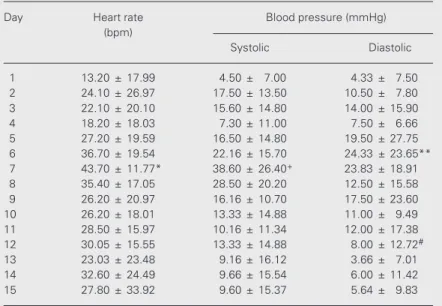
(Table 1 and Figure 1). These values were significantly different from those recorded during the first 4 days. Moreover, when the maximum absolute increases recorded on day 7 were compared to those of the patients with mechanical ventilation for causes other than tetanus at day 6 (group B - systolic pressure: 10.24 ± 13.30 mmHg; heart rate: 19.35 ± 12.26 bpm), patients with tetanus (group A) had significantly larger increases in heart rate (43.70 ± 11.77 bpm, P<0.05) and systolic blood pressure (38.60 ± 26.40 mmHg, P<0.05) (Table 2). During the sec-ond week of hospitalization, the heart rate decreased slightly but not significantly from day 7 to day 9. It then became stationary and continued to be elevated. In contrast, the systolic and diastolic blood pressures de-creased gradually and significantly (Table 1 and Figure 1). In other words, although the heart rate and blood pressure rose simulta-neously at the beginning of the autonomic crisis, these two cardiovascular variables became dissociated by the end of the second week of hospitalization. It should be empha-sized that metabolic and respiratory param-eters were kept at physiological levels throughout the period of hospitalization (3). All patients with severe tetanus and auto-nomic dysfunction survived and were subse-quently discharged from the hospital.
The hyperadrenergic syndrome that oc-curs in tetanus is characterized by hyperten-sion, tachycardia and increased cardiac in-dex. Hemodynamic studies during the man-agement of severe tetanus with autonomic dysfunction have shown that systemic hy-pertension is due to a high output circulatory state with increased cardiac index and nor-mal to low peripheral vascular resistance (12). These cardiovascular abnormalities are paralleled by marked increases in serum cat-echolamine concentration (13). Moreover, spectral analysis of heart rate variability has demonstrated unopposed sympathetic ner-vous system hyperactivity and decreased parasympathetic modulation of cardiac
Heart rate (bpm)
50
Blood pressure (mmHg)
50
40
30
20
10
0
40
30
20
10
0 1 2 3 4 5 6 7 8 9 10 11 12 13 14 15
Day
Figure 1. Heart rate and blood pressure changes in children with severe tetanus and autonomic dysfunction. Heart rate and blood pressure increased simultaneously and pro-gressively to a maximum by day 7. The heart rate (filled squares) decreased slightly but not significantly from day 7 to day 9. It then became stationary and persisted elevated there-after. In contrast, the systolic (open squares) and diastolic pressures (circles) decreased gradually and significantly until day 15. Data are reported as increases above the 95th percentile for age and sex. Standard errors were omitted for purposes of clarity in construct-ing the figure.
Table 1. Heart rate and blood pressure changes in children with severe tetanus and autonomic dysfunction.
Day Heart rate Blood pressure (mmHg) (bpm)
Systolic Diastolic
1 13.20 ± 17.99 4.50 ± 7.00 4.33 ± 7.50 2 24.10 ± 26.97 17.50 ± 13.50 10.50 ± 7.80 3 22.10 ± 20.10 15.60 ± 14.80 14.00 ± 15.90 4 18.20 ± 18.03 7.30 ± 11.00 7.50 ± 6.66 5 27.20 ± 19.59 16.50 ± 14.80 19.50 ± 27.75 6 36.70 ± 19.54 22.16 ± 15.70 24.33 ± 23.65** 7 43.70 ± 11.77* 38.60 ± 26.40+ 23.83 ± 18.91
8 35.40 ± 17.05 28.50 ± 20.20 12.50 ± 15.58 9 26.20 ± 20.97 16.16 ± 10.70 17.50 ± 23.60 10 26.20 ± 18.01 13.33 ± 14.88 11.00 ± 9.49 11 28.50 ± 15.97 10.16 ± 11.34 12.00 ± 17.38 12 30.05 ± 15.55 13.33 ± 14.88 8.00 ± 12.72#
13 23.03 ± 23.48 9.16 ± 16.12 3.66 ± 7.01 14 32.60 ± 24.49 9.66 ± 15.54 6.00 ± 11.42 15 27.80 ± 33.92 9.60 ± 15.37 5.64 ± 9.83
Values are reported as means ± SD of increases for a given day compared to the previous day.
*P<0.01 only compared to days 1-4. +P<0.05 compared to days 1-4 and days 9-15.
**P<0.05 compared to days 1, 2, 3 and 5. #P<0.01 compared to days 13-15 (Friedman
rhythm (14).
In the present retrospective investigation, we found that the changes in heart rate and blood pressure of children with severe teta-nus were dissociated by the end of the sec-ond week of hospitalization. The blood pres-sure gradually returned to normal, while the heart rate persisted accelerated. Since tachy-cardia and hypertension are both secondary to sympathetic hyperactivity, one would ex-pect these two cardiovascular variables to behave similarly at the end of the autonomic crisis. This unexpected finding raises sev-eral pertinent questions: 1) Is this persistent sinus tachycardia the expression of an unde-tected metabolic derangement or sepsis? 2) Could instrumentation, medical care and the use of multiple medications be responsible for the observed phenomena? 3) Could our findings be due to a selective and delayed action of tetanus toxin on the neurons, which use the inhibitory neurotransmitter gamma-aminobutyric acid (GABA) to control sym-pathetic preganglionic outflow to the heart (15)? On the basis of the last hypothesis, the potentiated chronotropic response and nor-mal or blunted vasomotor response would indicate a dissociation of cardiac and vascu-lar sympathetic control (16). Our patients with severe tetanus (group A) received muscle relaxants, morphine and beta-blockers throughout the two-week observation period and their clinical, metabolic and respiratory
parameters were under constant monitoring. The presence of undetected metabolic de-rangement secondary to acute renal failure probably induced by sympathetic overactiv-ity (17) or sepsis is unlikely. Patients with diseases other than tetanus (group B) were similarly instrumented, received the same muscle relaxants and were cared for by the same physician. Moreover, since group A patients were receiving beta-adrenergic blockers and yet, the highest values of heart rate and blood pressure of group B patients were still significantly lower, a state of pri-mary and unusually intense cardiac and pe-ripheral sympathetic activation must have been present in group A.
Tetanus toxin experimentally injected into skeletal muscle is taken up and concentrated by terminal varicosities within pre- and para-vertebral sympathetic ganglia (3). More re-cently, using the novel technique of neuro-anatomic tracing, tetanus toxin was shown to be retrogradely transported to the GABA-ergic terminals, which synapse on the sym-pathetic preganglionic neurons of the last cervical and first three thoracic spinal cord segments (18). Since experimental stimula-tion of these spinal pathways, under specific physiological or pathological conditions (15,19,20), can increase or decrease heart rate, a selective and delayed action of teta-nus toxin on these sympathetic pathways could be responsible for our findings.
Table 2. Heart rate and systolic pressure changes in children with autonomic dysfunction secondary to tetanus and in children with diseases other than tetanus (non-tetanus).
Day Tetanus (N = 6) Non-tetanus (N = 4)
Heart rate Systolic blood pressure Heart rate Systolic blood pressure
(bpm) (mmHg) (bpm) (mmHg)
6 36.70 ± 19.45* 22.16 ± 15.70+ 19.35 ± 12.26 10.24 ± 13.30
7 43.70 ± 11.77* 38.60 ± 26.40+ 9.08 ± 15.54 7.60 ± 12.54
8 35.40 ± 35.17* 28.50 ± 20.20+ 16.87 ± 27.01 3.60 ± 3.60
Data are reported as means ± SD and represent increases over pre-established limits.
*P<0.05 compared to heart rate of the non-tetanus children. +P<0.05 compared to systolic pressure of the
Finally, experimental and clinical prospec-tive studies should be done in order to under-stand the role of tetanus toxin in the
activa-tion of the sympathetic nervous system and in the dissociation of cardiac and vascular control.
References
1. Bjornboe M, Ibsen B & Johnson S (1954). Tetanus. A case treated with artificial respiration during 17 days. Danish Medical Bulletin, 1: 129-131.
2. Kerr JH, Corbett JL, Prys-Roberts C, Smith AC & Spalding JM (1968). Involvement of the sympathetic nervous system in tetanus. Studies on 82 cases. Lancet, 2: 236-241.
3. Cook TM, Protheroe RT & Handel JM (2001). Tetanus: a review of the literature. British Journal of Anaesthesia, 87: 477-487. 4. Kerr JH, Corbett JL & Spalding JMK (1968). Sympathetic overactivity
in tetanus. Proceedings of the Royal Society of Medicine, 62: 659-662.
5. Domenighetti GM, Savary G & Stricker H (1984). Hyperadrenergic syndrome in severe tetanus: extreme rise in catecholamines re-sponsive to labetalol. British Medical Journal, 288: 1483-1484. 6. Peetermans WE & Schepens D (1996). Tetanus - still a topic of
present interest: a report of 27 cases from a Belgian hospital.
Journal of Internal Medicine, 239: 249-252.
7. Bhagwanjee S, Bosenberg AT & Muckart DJJ (1999). Management of sympathetic overactivity in tetanus with epidural bupivacaine and sufentanil: Experience with 11 patients. Critical Care Medicine, 27: 1721-1725.
8. Moss AJ (1978). Indirect methods of blood pressure measurement.
Pediatric Clinics of North America, 25: 3-14.
9. Report of the Second Task Force on Blood Pressure Control in Children (1987). Task Force on Blood Pressure Control in Children. National Heart, Lung, and Blood Institute, Bethesda, Maryland. Pedi-atrics, 79: 1-25.
10. Morgenstern BZ (1994). Hypertension in pediatric patients: Current issues. Mayo Clinic Proceedings, 69: 1089-1097.
11. Glantz SA (1992). Primer of Biostatistics. McGraw Hill Inc., Toronto, Canada, 358-359.
12. Udwadia FE, Sunavala JD, Jain MC, D’Costa JR, Jain PK, Lall A, Sekhar M, Udwadia ZF, Kapadia F & Kapur KC (1992). Hemodynamic studies during the management of severe tetanus. Quarterly
Jour-nal of Medicine, 302: 449-460.
13. Kanerek DJ, Kaufman B & Zwi S (1973). Severe sympathetic hyper-activity associated with tetanus. Archives of Internal Medicine, 276: 447-460.
14. Goto T, Fukushima H, Sasaki G, Matsuo N & Takahashi T (2001). Evaluation of autonomic nervous function with spectral analysis of heart rate variability in a case of tetanus. Brain Development, 23: 791-795.
15. Korner PI (1979). Central nervous system control of autonomic cardiovascular function. In: Berne RM, Sperelakis N & Geiger SR (Editors), Handbook of Physiology, The Cardiovascular System I, The Heart. American Physiological Society, Bethesda, MD, USA, 691-739.
16. Furlan R, Jacob G, Snell M, Robertson D, Posta A, Harris P & Mosqueda-Garcia R (1998). Chronic orthostatic intolerance: a disor-der with discordant cardiac and vascular sympathetic control. Circu-lation, 98: 2154-2159.
17. Daher E, Abdulkhader RCRM, Motti E, Marcondes M, Sabbaga E & Burdmann EA (1997). Prospective study of tetanus-induced acute renal dysfunction: role of adrenergic overactivity. American Journal of Tropical Medicine and Hygiene, 57: 610-614.
18. Logorio MA, Akmentin W, Gallery F & Cabot JB (2000). Ultrastruc-tural localization of the binding fragment of tetanus toxin in putative gamma-aminobutyric acidergic terminals in the intermediolateral cell column: A potential basis for sympathetic dysfunction in gener-alized tetanus. Journal of Comparative Neurology, 419: 471-484. 19. Norris JE, Foreman RD & Wurster RD (1974). Responses of the
canine heart to stimulation of the first five ventral thoracic roots.
American Journal of Physiology, 227: 9-12.