Ferenc Arató
University of Pécs, Hungary
Resumo: Este artigo é uma introdução à teoria do paradigma desconstrutivo de aprendizagem
cooperativa. Centenas de estudos provam com evidências o facto de que as estruturas e os
processos de aprendizagem cooperativa aumentam o desempenho académico, reforçam as competências de aprendizagem ao longo da vida e desenvolvem competências sociais, pessoais de cada aluno de uma forma mais eficaz e usta, comparativamente às estruturas tradicionais de aprendizagem nas escolas. Enfrentando os desafios dos nossos sistemas educativos, seria interessante elaborar o quadro teórico do discurso da aprendizagem cooperativa, dos últimos 40 anos, a partir de um aspeto prático dentro do contexto teórico e metodológico. Nas últimas décadas, o discurso cooperativo elaborou os elementos práticos e teóricos de estruturas e processos de aprendizagem cooperativa. Gostaríamos de fazer um resumo desses elementos com o objetivo de compreender que tipo de mudanças estruturais podem fazer diferenças reais na prática de ensino e aprendizagem. Os princípios básicos de estruturas cooperativas, os papéis de cooperação e as atitudes cooperativas são os principais elementos que podemos brevemente descrever aqui, de modo a criar um quadro para a compreensão teórica e prática de como podemos sugerir os elementos de aprendizagem cooperativa na nossa prática em sala de aula. Na minha perspetiva, esta complexa teoria da aprendizagem cooperativa pode ser entendida como um paradigma desconstrutivo que fornece algumas respostas pragmáticas para as questões da nossa prática educativa quotidiana, a partir do nível da sala de aula para o nível de sistema educativo, com foco na destruição de estruturas hierárquicas e antidemocráticas de aprendizagem e, criando, ao mesmo tempo, as estruturas cooperativas.
Palavras-chave: quadro teórico em contexto prático, estruturas de aprendizagem cooperativa, princípios básicos da aprendizagem cooperativa, papéis cooperativos, atitudes
Abstract: This article is an introduction to the theory of deconstructive paradigm of cooperative
learning. A wealth of research studies have proved that cooperative learning structures and
processes increase academic achievement, enhance lifelong learning competences and develop the personal and social competences of every single learner in a more effective and fairer way when compared to traditional structures of learning in schools. Facing the challenges of our education systems, it would be interesting to outline the theoretical frame-work of the last forty years of cooperative learning discourse from a practical perspective within a theoretical and methodological context. In recent decades, cooperative discourse has drawn up the practical and theoretical elements of cooperative learning structures and processes. We _____________________________________________________________________
Arató, F. (2013). Towards a Complex Model of Cooperative Learning. Da Investigação
às Práticas, 3(1), 57-79.
Contacto: Ferenc Arató, Institute of Educational Sciences, University of Pécs, Hungria / [email protected]
would like to make a summary of these elements for the purpose of understanding what kind of structural changes can make real differences in teaching and learning practice. Basic principles of cooperative structures, cooperative roles and cooperative attitudes are the main elements which we shall describe here shortly to set up a frame-work for understanding theoretically and practically how we can apply the elements of cooperative learning in our classroom practice. In our view, this complex theory of cooperative learning could be understood as a de-constructive paradigm that provides some pragmatic answers to the questions of our everyday educational practice from classroom level to educational system level, focusing on the destruction of hierarchical and anti-democratic structures of learning while setting up cooperative ones.
Keywords: theoretical frame-work in practical context, cooperative learning structures, basic principles of cooperative learning, cooperative roles, attitudes
Résumé: Cet article est une introduction à la théorie du paradigme déconstructif de
l'apprentissage coopératif . Des centaines d'études de recherche avec des évidences prouvent le fait que les structures et les processus d'apprentissage coopératif accroissent la réussite scolaire, améliorent les compétences d'apprentissage continu et développent des compétences sociales personnelles de chaque apprenant unique d'une manière plus efficace et équitable en comparaison avec les structures traditionnelles de l'apprentissage dans les écoles. Face aux défis de nos systèmes d'éducation , il serait intéressant d'élaborer le cadre théorique de ces quarante dernières années du discours sur l'apprentissage coopératif à partir d'un aspect pratique dans le contexte théorique et méthodologique . Dans les dernières décennies, le discours coopératif a élaboré les éléments pratiques et théoriques de structures et de processus d'apprentissage coopératif. Nous tenons à faire une synthèse de ces éléments dans le but de comprendre comment ce genre de changements structurels peut faire de réelles différences dans les pratiques d'enseignement-apprentissage. Les principes fondamentaux de structures coopératives , les rôles coopératifs et les attitudes coopératives sont les principaux éléments que nous pouvons décrire ici brièvement pour mettre en place un cadre pour la compréhension théorique et pratique de la façon dont nous pouvons mettre en place des éléments de l'apprentissage coopératif dans notre pratique de classe. À mon avis, cette théorie complexe de l'apprentissage coopératif pourrait être comprise comme un paradigme dé-constructif qui fournirait des réponses pragmatiques aux questions de notre pratique pédagogique quotidienne allant du niveau de la salle de classe à celui du système éducatif en mettant l'accent sur la destruction des structures hiérarchiques et anti- démocratiques de l'apprentissage pour aller vers des structures coopératives .
Mots-clés: cadre théorique dans un contexte pratique, structures d'apprentissage coopératif, principes fondamentaux de l'apprentissage coopératif, rôles coopératifs, attitudes coopératives
A STRUCTURAL APPROACH: COOPERATIVE LEARNING
At the end of the sixties the challenges that raised the question of how to abolish discriminative structures of learning in everyday educational practice remain almost unchanged today. Segregation, lack of cooperation, lack of interaction among students and little attention to community building issues, as well as negative interdependence were recognized as the roots of violence among and discrimination against students from different backgrounds. The structural approach was identified as an important focus for removing violent and discriminative behaviors among the participants (teachers, learners, parents) of the learning process. Some principles for creating cooperative structures have emerged, like
mutual interdependence (Aronson, 1972) or positive interdependence (Johnsons et al., 1984). The
(Aronson, 1978), and the first signs of the success of these models were proved as well (Aronson, 1978, Slavin, 1980). Cooperative discourse is more than forty years old and literally hundreds of research studies (Johnson & Johnson, 1989, 1994a, 2005, 2009; Johnson et al., 2000, Marzano et al., 2001) have proved how cooperative structures of learning can reduce the academic gap between learners, increase educational equality, boost achievement, improve mixed-race relations, replace racism with understanding and empathy (Kagan & Kagan, 2009). Cooperative learning promotes more constructive management of conflict than competitive or individualistic efforts. It promotes basic self-acceptance as a competent person; it results in higher-level reasoning and critical thinking competences, more frequent generation of new ideas and solutions, and higher rates of student achievement and deeper retention (Johnson & Johnson, 1999). A question has emerged within the Hungarian discourse of cooperative learning: can we describe a general and complex system of cooperative learning, which can incorporate the different elements of the models of the international cooperative discourse?
As a structural approach, cooperative learning has components which can be described easily. These components describe different dimensions of the cooperative learning process. The first dimension is the structural dimension itself: what kind of structures of learning can provide and enhance cooperation within classroom situation? The basic principles of cooperative learning give us practical guidance for structuring the learning process cooperatively. Cooperative roles are the next group of components which can help teacher to enhance cooperation and mutual learning within cooperative structures which were built up by the means of the cooperative principles. Specific attitudes are also necessary to be adapted by the cooperative teachers – these attitudes help teachers to recognize, accept, and utilize the benefits of cooperative learning processes. Teachers have different roles within the cooperative learning processes, these roles help to understand what kind of behavior, what kind of actions are needed from the side of the teachers for the success of learning together. In the following, we discuss these components for the purpose of describing a complex theoretical framework of cooperative learning for the readers. We would like to enhance understanding of this theoretical framework from practical aspects. Therefore, we will use examples from cooperative practice. Our focuses are the following: How can the theoretically described components help to create cooperative structures and processes in practice? Are they important for an understanding of how this theoretical-pragmatic framework can be applied to district schools and educational systems in the same was as we might expect from a complex model of cooperative learning?
THE BASIC PRINCIPLES OF COOPERATIVE LEARNING
The first question which may arise is: what are cooperative structures and how can they be created? The structural approach of cooperative learning was emphasized and related with basic principles by Spencer Kagan (Kagan, 1990). Thus, the concept of basic principles as a main component for understanding the structural feature of cooperative learning comes from Spencer Kagan‟s works (Kagan, 1992; Kagan & Kagan, 2009) and was completed in the Hungarian discourse on cooperative learning (Arató & Varga, 2006; Arató 2012). According to Kagan, we can speak about cooperative structures only if all of the basic principles are built into the steps of the learning structures. These principles are easy to describe and follow, yet it takes hard work on the part of teachers to incorporate them in their practice. In 2009, at a conference in Budapest (Hungary), Elliot Aronson admitted that, from the beginning, one of the most difficult things for teachers was to comprehend that cooperative learning focuses on the structures of learning. When a teacher has already realized that this structural viewpoint is crucial from the aspect of effectiveness, efficiency, and equity, he/she can easily follow the basic principles of cooperative learning, which we will describe shortly.
Constructive and Encouraging Interdependence
If cooperative learning is about cooperation, how can we enhance collaboration among learners who may have no desire to cooperate or to learn in school? One of the most widely shared principles of the cooperative discourse is the principle of positive interdependence. The social theory behind this principle contains an old and clearly stated premise (Lewin, 1935; Deutsch, 1949, 1963, 2006; Aronson et al., 1972, 1978, 2007, Johnson & Johnson, 1999, 2005, Johnson et al., 2009; Kagan & Kagan, 2009). This principle focuses on the importance of the interrelationship of the learners, influenced by the goal structure in classroom situations. It says that the teacher should arrange the learning process so that learners cannot accomplish their learning assignment, their learning goal, without each other. The literature describes
goal, resource, role, identity, environment, task, reward, and outside enemy as positive
interdependence (Johnson & Johnson, 1999). When learners recognize that they can only achieve their individual goals if all the members of their group also attain their goals, – that is goal interdependence. When learners working only with different portions of the learning resources, materials or information necessary for the task, – we can speak about resource interdependence. When every learner is assigned to complementary, interconnected, and partner-based roles which are needed for successful group work and for completing their task, – that is role interdependence. When the group of learners establishes a common identity by creating a group name, by articulating their common goals, demands, – that is identity interdependence. When the members of a group are bonded together by the means of the physical environment (like using a common worktable), – that is environment interdependence. When the tasks of the group members are divided up so that the learning action of one group member has to be completed by another group member‟s action in the next step, – that is task interdependence. In these cases, we can speak about positive interdependence from the aspect of cooperative learning. In the Hungarian discourse we have taken out reward and outside enemy interdependence from the list and suggested that this narrower meaning be referred to as constructive and encouraging interdependence (Arató & Varga, 2006). Positive reward interdependence as a motivation factor in cooperative learning was questioned within the US discourse as well (Kagan & Kagan, 2009).
Personally Inclusive and Parallel Interaction
In a traditional classroom structure there is usually one type of interaction, with the teacher the principal participant. The teacher makes a presentation, asks and answers questions, shows materials from the Internet, checks and discusses individual learning behaviors. These interactions are mainly conducted in the presence of passive listeners. How can a teacher deconstruct these traditional structures of interaction in his/her classroom practice to provide personal and individual access to learning interaction as many participants as possible in the learning process in his/her classroom? For this purpose the principle of simultaneous or
parallel interaction counts the number of interactions during a certain period of time in a
learning process (Kagan 1992; Kagan & Kagan, 2009). It means that the focus is on the number of learners who are involved personally in learning interactions. In a traditional learning process there is a one-way communication (teacher gives a lecture) or a single interaction between the teacher and the learner, who must answer the teacher‟s question. In a traditional group activity there is more than one interaction but there is no guarantee of the involvement of all group members. That is the reason why we completed this principle with „personal involvement‟, which means that a cooperative teacher should provide interactions in which every single class member can participate with his/her full personality. The highest number of interactions can be provided by pair work. That is the reason why Kagan prefers working with groups of four (Kagan, 1992; Kagan & Kagan, 2009) because the variance of pair work is higher in that setting than in groups of three (which is the preference of the Johnson brothers, Johnson et al., 1984). In any case, the design of the interactions is important as well, so it
should be inclusive enough to help learners to articulate their demands, wishes, understanding, and questions. By following this structural principle, teachers can break down the traditional hierarchical structures of learning, and this principle leads to the micro-group structure which is usually identified as group work. An important issue is how to build teams from micro-groups, and group processing or team building are a necessary part of the cooperative learning process; but the emphasis is on the personal involvement in learning and not on community building itself. The Johnson brothers speak about “face to face, knee to knee pro-motive interaction” (Johnson et al., 1984) which means that teachers should work on the quality of the interactions among learners to make interactions pro-motive and supportive. So it is not enough to form micro-groups from a class to start learning cooperatively, and cooperative learning is not only for community building – it is for achieving higher involvement in learning interaction. The first step is to set up a micro-group structure (2-5 members in a micro-group) and create constructive and encouraging interdependence among them. Set up a pair structure within groups of four asking pair members to conduct an interview with their peer about an interesting topic – that could be a clear example of how a teacher can put these two principles into practice with a very simple structure. Pair work structurally provides personal space and time for every single learner in the classroom because everybody has a pair with whom he/she can interact. The task creates encouraging interdependence between the pair members because their task is to write two interviews about each other (task interdependence). Interesting topics could raise the level of curiosity so goal and identity interdependence could emerge when learners want to share their interesting topics and to know what their pair has as an interesting topic. A simple goal interdependence emerges when learners would like to accomplish the task of making two interviews independently of how deeply they are interested in the given topics.
Equal Access and Participation
Micro-group structuring of a class provides the possibility of involvement of the learners and space and time for the spontaneity of the participants but does not in itself guarantee equal participation. That is the reason why equal participation arose as an independent basic principle (Kagan, 1992) – teachers should structurally provide equal participation within and among the micro-groups. By the „Word Rotation‟ structure, for example, when one after the other every group member should share their question, understanding and knowledge about a given issue, teachers structurally provide equal participation. This equal participation does not mean that every group member contributes at the same level because participation depends on the state of the necessary competences of the learners as well. That is the reason why we completed this structural principle with the principle of equal access. Learners from different backgrounds do not have the same access to the language, to the resources or to the activities of learning, so teachers should focus on the accessibility of the suggested assignments, learning tasks or resources from the aspect of every single participant. This focus is necessary for real equal participation. So it is not enough to provide equal participation structurally but there is a deep need for providing equal access as well. How can a teacher contribute to equal access, thus facilitating that pair work which we mentioned in the previous paragraph? Providing enough time for the interviews, applying inclusive rules like they can name fewer than three topics but no more than three, providing written tools for the interview (interview sheets suited to the topic, drawing-based interview sheets were pairs can document their interviews in drawings or symbols etc.), letting them change the theme of the interview if they have a better idea them – these are some ideas as to how a teacher can enhance equal access during an equally structured learning process. Participation and access are two sides of the same coin. The state of different competences (personal and small group competences, learning and thinking competences) can be influenced when a teacher can truly explore the status of the competences of every single learner in his/her class. When he/she is planning a cooperatively structured learning process he/she should design it from group members to
micro-group members from the perspective of the status of the competences and equal access and participation. In cooperative structures where heterogeneous micro-group formation is obviously derived from this principle of equal access it is easy to provide resources for competence development thanks to the intentionally planned diversity of the micro-groups. Continuing to follow my example above, from the aspect of equal access and participation, the teacher should focus on the practice of forming pairs from the class. Could the pairs be selected randomly in order to achieve the expected outcome of this learning activity, or should the teacher conduct a directed pair-forming activity with intentionally chosen pairs? If the expected outcome is a simply teambuilding result – raising group cohesion at whole-group level and providing an opportunity to know each other a little more – teachers can use a semi-random forming activity: choose a pair with whom you have never learned in the same micro-group! If the expected outcome is to understand together a maths task which was comprehended by only 50% of the class – the teacher can form directly selected pairs or groups of four where each pair contains a person who is familiar with the task and where pair members are not too far from each other within the classroom community relationship. Maybe it could be fruitful to think in groups of four where they still work in pair but there are two helping persons at hand. Equal access and participation should be followed according to our expected outcomes. Equal access to the benefits of schooling through learning is the general principle. At classroom level, teachers should consider the access and participation of every single participant in a practical context. In a cooperative learning structure time, space and resources (like the other group members!) are provided yet teachers should check and provide the equal status of accessibility and participative interactivity of their teaching-learning process.
Personal Responsibility and Individual Accountability
The principle of personal responsibility and individual accountability, emphasized by many authors of the cooperative discourse (Aronson, 1978; Johnson & Johnson, 1984; Kagan, 1992; Kagan & Kagan, 2009; Arató & Varga, 2006) is mainly lacking in traditional group work. Teachers usually ask how it is possible to evaluate or assess individuals in a group working process. Although cooperative learning cannot be identified with group work the question is relevant in a cooperative micro-group structure as well. In a cooperative structure individual accountability is one of the principles to follow for enhancing individual efforts and providing individual feedback or assessment for the learners. For example in a „jigsaw‟ structure (Aronson, 1972, 1978, 2007; Slavin, 1984; Johnson, 1995, 1999; Kagan, 1992, Kagan & Kagan, 2009) where every micro-group member is responsible for one portion of the learning material and should learn their portion in order to teach that part to their group members – individual accountably occurs. In cooperative structures individual level is always the starting point, or the first step, as in this example of jigsaw (individual learning of the given portion of the material). At this level there is a need for personal responsibility as well, which means that teachers should offer the kind of activities in which the learners can enter with their whole personality and thus articulate their wishes, demands, doubts, unwillingness, learning goals and learning efforts. If the learner has space and time for self-articulation and reflection on the offered learning activities by means of a micro-structured access to personal participation, then he/she can be spontaneous enough to take personal responsibility for his/her learning or even for his/her non-participative attitude. It means that in a cooperatively structured process the teacher should focus on the individual attitudes, behaviors and actions of every individual learner and respond flexibly by arranging the offered activities, resources, materials, and re-designing the learning assignments or tasks. This principle is a double-sided principle again. Teachers should widen the repertoire of the available activities, resources, materials, assignments in order to create a learning environment in which participants can enter according to their personality, to their status of competences, to their cultural background etc. This focus can lead to the undertaking of personal responsibility. The other side of this
principle is structuring the learning process so that every single participant should be taken into account individually. This accountability refers not only to accountability on the part of teachers (expected outcomes) but mainly on the part of learners. In a „jigsaw‟ structure the different portions of the material could be differentiated by following personal responsibility which means that the „experts‟ on the given portion can work with different resources and with different activities. Individual accountability occurs when they have to teach each other – it will be very obvious who was well-prepared and who was not. Teachers can also measure the level of individual achievement by an individual test on the whole learning „material‟, on the whole issue they had to put together in the jigsaw structure. From the level of achievement in the different parts of the learning material learners and teachers can also evaluate and assess the learning process they have experienced, by following the individual accountability for the given parts of the learned material.
Open and Flexible Structures
There is a need for conscious acceptance of the structural approach to cooperative learning, which means that cooperative teachers realize that they should deal with the structures of learning and should design the learning structures accordingly. There is an effort in the literature of cooperative learning to describe as many cooperative structures as possible (Kagan, 1992; Kagan & Kagan, 2009) but from the perspective of the learners‟ individuality and spontaneity it is suggested that the competence of creating cooperative structures might be more important than knowing a certain amount of ready-made cooperative structures. Described and ready-to-use cooperative structures can help teachers to imagine and design their own cooperative structures of learning; but it is more important that are they capable of re-structuring their pre-planned structures, whether it is needed in a cooperative way, or not. That is the reason why we emphasize this principle of flexible structures. When a teacher realizes that the structure that he/she would like to suggest for the learners is not appropriate to the efforts, demands, and competence of the learners he/she should re-structure the process immediately. For example a maths teacher wants the students to practice a specific maths puzzle (each micro-group working with a different section of the same puzzle) with which he assumes that all the students will cope easily, but then he realizes that there is only one student who can cope with the puzzle from the whole class.He/she should re-structure the process immediately. The teacher should invite the one successful student to teach the other group members, while for the other groups he/she can offer new resources (the maths book or searching on the internet etc.) to find solutions for their section of the given puzzle. When the members of the micro-group which contains the successful student can solve the puzzle individually they can become teachers in the other micro-groups; thus the facilitator re-structures the groups to provide „teachers‟ for other micro-groups. From this example we can understand that flexibility means that teachers should be ready to re-structure the process in a cooperative way. Openness of a learning structure from this viewpoint refers to curricula, and learning resources issues. When a teacher realizes that the pre-planned curricula or learning resources are inappropriate to the recognized competences, demands, needs of the learners he/she should open the learning structures to other resources or curricular issues. For example, when a literature teacher realizes that the learners do not want to learn about poems, novels, or literature at all, he/she should widen his/her horizon of interpretation about literature so that the learners can enter into the discussion about literature and talk about their doubts or unwillingness. It is the teacher who should widen the horizon enough to help learners to move towards that horizon. This principle draws attention to the importance of focusing on the necessity of open and flexible structures of learning.
Critical and Pro-motive Step By Step Publicity
Publicity is a basic issue in the case of open, flexible, and cooperative structures. It is not an additional element or phenomenon. It should be a guiding principle – and a structurally guaranteed one. Within the Hungarian discourse of cooperative paradigm we have inserted
critical and pro-motive publicity into the list of basic cooperative principles. The first dimension
of critical, reflective, and productive publicity is the publicity of the micro-groups. A continuous publicity of a “base group” (Johnson & Johnson, 1999) should be instilled in the minds of the teachers during the designing process so as to ensure the presence of the basic principles of cooperative learning, and to pre-map the specific needs and demands that the offered cooperative structures acquire from the participants. Cooperative structures, roles, and assimilated principles help to coordinate interactions among the group members, and encourage the personal presence of the participants, improving congruency and empathy among the group members through this publicity.
Another dimension of critical and pro-motive publicity is at the whole-group level. For the achievement of all individuals‟ learning goals and needs, documentation plays an important role in a cooperatively structured learning process, as a structural tool for providing publicity for the learning materials, products, performances and resources. Cooperatively structured tools for documentation are much more effective, efficient, and fairer tools for large group documentation because in a certain period of time the highest number of personal articulated needs, demands, solutions, knowledge etc. can be achieved, involving personally each and every participant. With a Placemate/Window structure for example, in 6-8 minutes we can collect ideas, needs, and solutions in a large group of learners by means of the cooperative micro-group structure of group of fours. Step by step documentation should be prepared within cooperative structures (like Placemate/Window structure, where individually collected items of learning are shared in a consistent, cooperatively structured, and documented way) and encourage participants‟ pro-motive interactions for articulating their individual learning products, processes, and items. In a Roundtable structure (where every micro-group member consecutively shares an item of his/her individual work, while the member next to him/her writes it down on a sheet of paper) publicity of the individual work is promoted by the helping hand of the „secretary‟ (and the listeners too) for the purpose of articulating the individual work-item clearly. When conflicts occur within micro-groups, teachers should intervene in the micro-group‟s work to teach conflict resolution competences immediately related to the given conflict situation.
Structurally guaranteed ways of self-actualization, expressing of interest, and sharing emotional impressions can induce conflicts within the publicity of a micro group. These conflicts are an important part of the competence-based learning process because they can explore and cover all aspects of a competence from the personal (self-esteem, motivation, conscientiousness etc) and social competences (empathy, tolerance, small group competences etc) related with the given learning and conflict situation, to all of the related learning (like key competences: literacy, mathematical competences etc.) and cognitive competences (like wide repertoire of thinking skills of the Bloom taxonomy). From this aspect of publicity, facilitators can monitor the learning process, the behavior of the learners immediately; they can execute observations of every single participant within concrete, contextualized learning situations. Structurally guaranteed publicity of a micro-group favours critical and pro-motive attitudes towards cooperation and common learning. In the beginning, facilitators intervene when detours of common learning occur. Facilitators use the publicity of cooperative learning processes for enhancing critical and pro-motive interactions among students by intervening and by developing needed competences immediately. Within a cooperatively structured learning process, ways of documentation can help raise the level of critical and pro-motive interactions. In a Window/Placemate structure, group members want to understand the ideas
and share the learning items of the others to achieve a relevant comparison for the purpose of documentation because they should decide how many times the given item occurs among the micro-group members. This is a structurally guaranteed critical and pro-motive understanding of each other. In a Roundtable structure (described above) the „secretary‟ helps the articulation of the given items of his/her group mate, because he/she has the opportunity to record it as clearly as possible for future utilization of the recorded document.
Cooperatively structured step by step documentation helps to follow the learning activity of the participants, how they can cope with the situation that the given learning activity stimulates. It means that the visual representation of the learning activities (texts, pictures, diagrams, maps, figures, illustrations etc.) can show the progress of the learning process step by step for the facilitators of learning. By means of step by step documentation it is easy to recognize where and when should a teacher re-plan, re-design, re-structure, or halt the learning process, recognizing new needs, demands, and necessary objectives of the learning process and the participants, intervening at relevant moments in the working process. The critical and pro-motive aspect of this publicity can easily be understood if the teacher comprehends the importance of peer-reflection and authentic assessment in competence development. Critical here is used in the same way as in the concept of critical thinking. Critical means that by means of these dimensions of cooperatively structured publicity they will be able to reflect on their own competences, on the ways these competences can be developed, and they can examine their competences form a multi-perspective, although contextual aspect.
Conscious Competence Development
The principle of conscious competence development is not a structural one, yet needs a structural guarantee. Following this principle, teachers should be clear as to their expected outcomes and development goals. In cooperative learning, competence development goals and expected outcomes are shared with the learners, so they can be aware both of their own development plans and those of their peers. Cooperatively structured learning processes have two goal structures. One goal structure is for the academic goals, the other is for the goals of cooperation and personal competences. In our view teachers, together with the learners, should target the objectives of the common learning based on the individual needs of the learners. It is not enough to target academic goals and expected outcomes while ignoring the deep need for targeting the specific personal, social competences (“interpersonal and small group skills” as the Johnson brothers described it, Johnson & Johnson, 1999) as expected outcomes related with the identified needs and demands of the learners. This means that teachers and learners together decide which personal and social competences they will improve consciously in a certain period of the learning process. The same strategy applies to the development of the cognitive and learning competences. When learners can consciously work to improve their own different competences, which are specified, articulated, and supported by the learning process, every participant in the learning process can more easily achieve the level of competence that is required. These processes provide authentic assessment for the learners both from the side of the teachers and that of their pupils. This principle of conscious competence development helps to answer the following questions from learners: Do we want to join this learning process? How can I join? What are the benefits of participating in this? What can I learn here? What kind of competences are required for my autonomous learning in this field? How can I gain an autonomous level in this field? Etc. The expected attitudes, skills, and knowledge of the learners (and teachers) in the context of a given disciplinary matrix should be clearly described for the purpose of understanding the competence elements which are needed. Cooperatively structured learning
processes offer space, time, peer-reflection, step-by-step monitoring and mentoring for every single learner in a structurally guaranteed way. It means that within the cooperative micro-structure of a class, the teacher can easily plan and design step-by-step the learning activities according to the individual needs, demands and goals of the participants. Conscious competence development in cooperative learning structures leads to higher-level personal and social competences, deeper retention, wider range of thinking skills, higher mental balance, decreased academic gap etc. (Aronson, 1972, 2007; Johnson & Johnson, 1989, 1999, 2009; Kagan & Kagan, 2009).
THE PIES ANALYSIS AND THE LIST OF BASIC PRINCIPLES
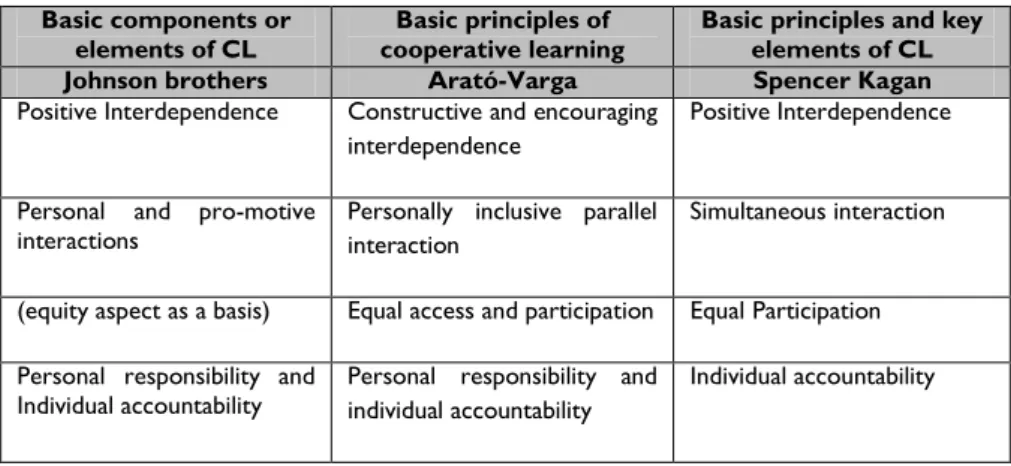
Spencer Kagan offers a structural analysis of the learning process which simply follows the basic principles of cooperative learning as mentioned above. We have completed the list of the basic principles based on both the literature of cooperative discourse and our experiences practising cooperative learning over almost two decades. We have collected this completed list of basic principles of cooperative learning in a comparison of two different models (Johnson & Johnson, 1999; Kagan & Kagan, 2009) for the purpose of clarifying the inter-textuality of our model of principles (table 1). As Kagan suggests, since we can analyze any structure of the learning process from the viewpoint of the basic principles of cooperative learning, so we can apply this approach to our completed list as well. When a learning process contains all the principles of cooperative learning, we can interpret it structurally as a cooperative one. It is interesting to conduct an analysis of a learning process based on traditional group work activities because some of the principles are usually missing, such as constructive and encouraging interdependence, equal access and participation, and individual accountability. By the means of PIES analysis researchers, teachers, and learners can understand that the difference is not between frontal and group work but within the micro-structures of learning in different learning processes. Basic principles of cooperative learning may be seen as „symbolic generalizations‟ (Kuhn, 1970) of a paradigmatically new approach to learning and teaching. Through these, researchers, teachers, and learners can articulate new solutions for the puzzles (Kuhn, 1970) of the effectiveness, efficiency, and equity issues of education and schooling. Furthermore, they may produce new puzzles for the old issues of public education and schooling. These are the puzzles of structures and puzzles of micro-structures of learning processes in our education systems. These micro-structures may be seen as the basis for evaluation from the aspect of cooperation. When a learning process contains all the basic principles, it may be rated as a cooperatively structured one. When some or all of the principles are missing, sub-cooperative or non-cooperative structures have taken their place within the learning process (Arató, 2011a).
Table 1: Basic Cooperative Principles
Basic components or
elements of CL cooperative learning Basic principles of Basic principles and key elements of CL
Johnson brothers Arató-Varga Spencer Kagan
Positive Interdependence Constructive and encouraging interdependence
Positive Interdependence
Personal and pro-motive
interactions Personally inclusive parallel interaction
Simultaneous interaction
(equity aspect as a basis) Equal access and participation Equal Participation Personal responsibility and
(structures of learning in
focus) Open and flexible structures of learning (content-free and repeatable structures) Group processing Critical and pro-motive
publicity provided step by step
Class-building, teambuilding, classroom management
Conscious development of small group and interpersonal skills
Conscious development of competences
Social skills
Application of the basic principles in classroom settings in a school developmental context was one of the first socio-psychological approaches of the cooperative discourse (Aronson, 1972). In the context of de-segregation, from the end of the sixties in the USA, it was evident that simple integration/de-segregation is a key issue from the aspect of personal and social competences but that it still “left children behind”. The importance of structures of learning (Aronson, 1978; Kagan, 1990; Kagan & Kagan, 2009; Arató & Varga, 2006; Arató, 2011a, 2013), or in the social theory discourse (Deautsch, 1962, 2006; Johnson & Johnson, 1999, 2005, 2009): the importance of goal structures was explored and jigsaw structure (Aronson, 1972, 1978, 2007) was invented as a solution, as a „paradigmatic exemplar‟ (Kuhn, 1970) for a cooperatively structured learning process. In the cooperative discourse later described, elements and principles of cooperative learning are all built into the steps of different jigsaw models (Aronson, 1978; Slavin, 1984; Kagan, 1992; Kagan & Kagan, 2009) and jigsaw structures themselves are mentioned by all the authors mentioned both in the US and in the Hungarian cooperative discourse (Aronson, 1972, 1978, 2007; Slavin, 1984; Johnson et al., 1984, 1995; Johnson & Johnson, 1999; Kagan, 1992; Kagan & Kagan, 2009; Arató & Varga, 2006, 2012; Horváth, 1996; Pethőné, 2005; Orbánné 2009). These characteristics of a paradigm – as Kuhn re-described them in his revised texts – may be helpful for understanding how fruitful this structural approach to the cooperative discourse can be for the theory and practice of teaching and learning. The post-structural and de-constructive character of this discourse I have discussed in other articles (Arató, 2011a, 2013). Shortly, we can interpret this approach as a post-structural one when compared to Moreno‟s approach in the US and to Mérei‟s approach following Moreno in the Hungarian discourse. The cooperative approach overcomes and destroys the hierarchical, discriminative and violent structures of education and the schooling heritage, replacing them with cooperative structures and with cooperatively constructed learning processes. From this viewpoint, we call this discourse of cooperative learning a post-structural and de-constructive paradigm (Arató, 2011a, 2013).
The Johnson brothers described how to apply cooperative structures beyond classrooms, at However institutional and district level (Johnson & Johnson, 1994). We applied basic cooperative principles and cooperative structures at educational system level by means of the ISE model (Arató & Varga, 2004, 2005), another paradigmatic character of this principle based model was detected – „fruitfulness‟ (Kuhn, 1970). Namely, the fact that the post-structural approach of following basic principles of cooperative structures could be applied to educational systems proves that this complex theory and practice of the cooperative discourse could be interpreted and useful for different contexts.
AN EXAMPLE OF SYSTEM LEVEL APPLICATION OF COOPERATIVE STRUCTURES – ISE MODEL
The Inclusive System of Education (ISE) model is a system-wide model for creating de-segregative conditions and for enhancing the inclusiveness of educational practice from state
education system level to classroom practice level. This model was established and developed between 2003 and 2013 in Hungary. One of the main concepts of this model is to apply the basic principles and structures of cooperative learning to systematic structures (Arató & Varga, 2004, 2005, 2012; Arató, 2008; Arató et al., 2005). Inclusiveness refers here to the inclusion of each and every participant in the learning processes in the state education system. The selective features and segregation tendency of the Hungarian education system have been studied since the beginning of the seventies focusing on Roma communities (Kemény et al., 2004). From the mid-nineties, this focus was completed by focusing on learners from disadvantaged social backgrounds (Kertesi, 2005; Kézdi & Kertesi, 2008). The evidence shows that selectiveness and segregation within the Hungarian state education system leads to the low schooling achievement in these groups. We had the opportunity to participate both as developers and a researchers in the creation of this ISE model (Arató et al., 2005, 2008; Arató & Varga, 2012) and conducted researches with some colleagues on this development (Arató & Varga, 2004, 2005; Arató et al., 2008). Independent researchers also studied the progress of this model (Kézdi & Surányi, 2008) from the aspect of basic cooperative learning elements (following the Johnson brother‟s five elements, Johnson & Johnson, 1999). Although some of the main elements of the model were ignored after 2005, the evidence of this research showed that the cooperative and horizontal structures of this model were playing a significant role in the internalization of the importance of inclusiveness as a main focus of the educational institution development (Arató & Varga, 2004, 2005). Another important finding was that the elements of the ISE model played an important role in the achievement of expected outcomes of the model, such as reducing dropout, fostering participation in everyday school life and increasing academic achievement (Arató et al., 2008). In 2013, half the institutions of the Hungarian state education system (approximately 1600 institutions) were participating in this developmental programme, from kindergartens to high schools. The new educational policy of the Hungarian government ignored the evidence of this entire process and withdrew its support of these institutions in 2013.
The main elements of this model were the following: Supportive educational policy and legislation – forbidding discrimination, supporting de-segregation, and the development of an inclusive educational environment, providing a competence-based, expected outcomes-oriented and interdisciplinary core curriculum. The ISE model advocates the autonomy of creation of local pedagogical programmes and curricula for each and every institution, provides a guideline for the most relevant aspects and approaches for development; The National Educational Network
for Inclusion (NENI) based its operations on the cooperative structures of the ISE model,
provided individualized support for all educational institutions and organized cooperatively structured network services for enhancing development in practice. There is not enough space to describe the features of the ISE and NENI services here. We have described them in handbooks for trainers (Arató et al., 2005; Arató & Restyánszky, 2008) and for institution developers (Arató & Varga, 2012). The significance of this example here is to clarify that we refer to the basic principles of cooperative learning as the basis of a complex theory and practice framework of cooperative learning.
Although basic principles of cooperative learning help understand the post-structural approach of the cooperative discourse and practice, some of the main components should be described for the purpose of completing the theoretical and practical framework of the complex model.
COOPERATIVE ROLES
Individual Needs and Pro-motive Behavioural Patterns
Cooperative learning builds upon the uniqueness, the non-recurring singularity, in a word the individuality of human beings, structuring its processes according to the competences of the individual. One of the best forms for achieving this aim is to incorporate cooperative roles into the learning process. Individualization is one of the main components of quality education (Wenglinsky, 2000, 2002). The undoubtedly valid question is whether teachers would be able to structure the learning process so that it fulfils the individual development needs, claims and concerns of every single participant.
Delegation of authority, a central concept in complex instruction, helps teacher to manage classroom, by taking students responsible for their own and their group mates learning. The teacher does so by holding students accountable for being on task, for keeping their group mates on task, and for producing individual and group products as a result of their work. (Cohen & Lotan, 1994, p. 20)
It sounds strange to talk about roles in connection with non-recurring and unique individuals. Indeed, teachers provide specific learning structures based on cooperative learning principles and behavioral patterns for enhancing cooperation within the micro-groups of cooperative structures. Cooperative roles can be counted here as pro-motive behavioral patterns. The first basic assumption is that all of the intrapersonal and interpersonal competencies can be developed lifelong. The second is that they can be developed particularly in social relations. If these assumptions are true (Bar-On, 2001; Goleman, 1998) then teachers need tools easy to grab by imagination and practice – these tools are the cooperative roles.
To support teachers as they delegate authority, student assume specific procedural roles. By playing these roles, students manage the groups and themselves; they take over the responsibility for some of the practical yet mundane, functions and duties that traditionally have been the teacher purview. (Cohen & Lotan, 1994, p. 21)
Co-equal and Complementary Patterns
In a cooperative learning process every participant has different but equal roles within the micro-groups. The relation among the roles is not hierarchic but co-equal and cooperative. Equality is on the one hand ensured by the complementary function of the roles. On the other hand, it is ensured by the rotation of roles among the group members, following the basic principle of equal participation.
Roles prescribe what other group members expect from a student (and therefore what the student is obligated to do) and what the person has a right to expect from other group members who have complementary roles. (…) Initially, students may need to be assigned roles that help them form the group. Second, the roles may be assigned that help the group function well in achieving learning goals and maintaining good working relationships among members. Third, roles may be assigned to help students formulate what they are learning and create conceptual frameworks. Finally roles may be assigned that help students ferment each other thinking. It is at this point that cognitive and social roles merge. The social skills represented by the roles should be taught like a spiral curriculum with a more complex version of the skill taught every year. (Johnson & Johnson, 1999, pp. 24˗25)
The roles are created in accordance with the thematic/academic goals and the cognitive, learning, intrapersonal, interpersonal and small group competences. The names of the roles help to identify the function of the given role and the given skills to be developed during the learning process.
John does not really like books, he usually watches TV with his family at home and he does not understand the benefits of the books. Obviously, he will be charged as a Tracer to find nice pictures in books about horses in the school library first and later on he has to write words or short sentences about the selected pictures and he has to self-sufficiently collect materials – pictures, text parts, data – at last. (Arató &Varga, 2006, p. 70)
We can see that the tasks of the given role are in line with the competences to be developed: we may call a “tasting of books” competence. This competence can exist on different levels at the same time.
Similar to John, Eve and Rob are Tracers in different micro-groups. John is just looking for pictures in books about horses – incidentally, his grandfather keeps horses –, Eve is already reading captions while collecting pictures of grey – incidentally, grey is her favourite color – cat species and Rob copies some sentences important for him from a book about dogs. He would like to keep a dog at home. Is it possible that he is looking for an indisputable argument? (Arató & Varga, 2006, p. 71)
The three children are “tasting the books” on different levels. These levels, however build on each other. Actually, we all begin with tasting a book as well…
A cooperative learning role is an assigned action or task for a student to fulfill. Cooperative roles facilitate and enhance teamwork… Roles (…) represent a powerful approach to developing social skills, especially in student interactions that have little structuring. As the students fulfill their roles, they are practicing important social skills. Since roles are rotating, students get the opportunity to play many different cooperative roles, and introduced to a range of important skills. Further the roles that students play enhance and make cooperative learning more productive. (Kagan, 2009, p. 119)
Autonomy in Learning
The Johnson brothers write about autonomous cooperation of learners as a main purpose of the cooperative learning process. Roles help to retain the autonomy of the participants of cooperative learning. Cooperative learning includes and accepts very different individuals participating in learning together. When choosing a role in the group, it is suggested that the pupils consciously collect the tools necessary for the role; and these tools are provided to her or him during the learning process since he/she has just to follow the tasks of his/her role. As every role determines the development framework of its own performance, reflection will be much easier, since the students have to reflect on competences only within the framework of a role and not on the whole personality. Thus, children are not persistently exposed as in the case of an embarrassing repetition at the blackboard. Even if a student feels uncomfortable in a role, then he/she can easily express his/her feelings and concerns in connection with the role. He/she can retain the autonomy of her/his personality better in this way than by answering the teacher‟s question at the blackboard: “How many times did you read the given issue at home?”
Consciously applied, cooperative roles are structural tools at the same time. On the one hand, they differentiate and structure the activities within the micro-groups by developing positive interdependence – everyone has a different but complementary, interconnected role in relation to other group members. On the other hand, learned and experienced cooperative behaviour patterns include the cooperative structures provided for completing the assignment of the given role. The Encourager, for example, collects the cooperative structures ensuring equal participation (leading questions, roundtable, window/placemate structure etc.) Therefore, the use of cooperative roles is a significant aid in the development of cooperative skills in the groups and even in the collection of cooperative structures experienced and practiced by the participants in a competence development-oriented way.
Assigning roles in micro-groups allow all the group members and all the micro-groups to structure their group work autonomously by practicing the cooperative structures of a wide repertoire. Cooperative roles which provide such a structural framework for the development of the personal, social and cognitive competences ensure equal access and participation for every single participant by including his/her personality as a whole.
It is important to note that the cooperative roles allow a great possibility for the conscious application of cooperative structures and for the development of cooperative competences; but we have to provide resources, examples, experiences for the participants, from which they can learn how to play their cooperative roles in an effective and fair way.
We have seen that teachers can develop a role by assigning tasks to its owner – just like the development of a theatrical character with the advance of the story. Nevertheless, teachers – the facilitators of cooperative learning – can use roles as the tools of instruction. Moreover, the use of cooperative roles allows parallel instruction.
Teacher gives parallel instructions for example if he/she asks the Tracers to choose ten pleasing pictures from the books in front of them. At the same time he/she asks the Recorders to write down as many data about the animals of their group as many just come to their minds. Now he/she asks the Encouragers to draw a telling draft of a blazon with the group animal in them and the Interpreters to recall the galloping horses, brave dogs, etc., and to find correspondence between the personalized animals and the characteristics of their own micro-groups. (Arató & Varga, 2006, p. 74)
In this example, the teacher has set four different activities, in four different fields of competence, evoking five different intelligences or fields of competence (naturalist, linguistic, visual, intra- and interpersonal) at the same time. In so doing, he/she has applied the basic principle of positive interdependence with individually differentiated tasks for the whole class. Consequently, every group is working on different issues (horses, dogs, cats, mice) and the group members develop different competences by working on different tasks in the groups (selecting pictures and handling books, knowledge survey, iconic-symbolic-anatomic representation and heraldic knowledge, symbolic text composition and interpretation, development of emotional intelligence). The teacher has achieved all of these with four simple instructions by the use of cooperative roles (and of jigsaw structure). We should emphasize that there could be many cooperative roles according to the way the recognized competences develop. Therefore, teachers can bravely turn their creative energies to the accurate formation and instruction of the cooperative roles.
Although there is a need for roles in every group, it is important to state that there is a need for roles only for the time of the internalization of the given competences (skill, attitudes, knowledge).
If John opens a book borrowed for his own stake from the library at home, then there is no more need for “tasting the books” it seems that he has found them “delicious”. He will be able to develop a closer relationship with the books self-sufficiently at home. (Arató & Varga, 2006, p. 76)
Roles rotate and erode. There is, for example, no need for the role of the Recorder after one-two years of cooperative learning, because everyone annotates according to his/her intentions by thinking of the others‟ needs at the same time. At this point, every participant has become an artist of common and individual annotations. Consequently, the teacher can choose another role instead of the Recorder, according to the next competence to be developed. Teachers can assign any kind of roles when deemed necessary.
After a period of time of cooperative development (approximately after 2 years in the case of primary school pupils), when the basic cooperative learning competences have been developed and mastered, teachers can build on the personally planned and developed projects of the learners, in which the participants themselves discover and assign equally the necessary roles for their learning purposes.
It can be seen very well from the examples above that roles play a significant role in the implementation of the basic cooperative principles and the assurance of individualization and of individual development as well. The cooperative roles play great importance in equal participation (everybody has their individual roles), in parallel interaction (participants can be instructed at the same time in parallel ways), in constructive interdependence (in our example the totality of the domestic animals is pieced together only by cooperation among the micro-groups structured by the roles), and in individual accountability (in our example John sets up an album from the digital copies of the pictures and his notes – another step towards books. Thanks to Eve, we will have knowledge about five beautiful species of grey cats and we will hear all the good and attractive characteristics of dogs from Rob). It seems that we cannot talk about efficient cooperative learning without cooperative roles.
Cooperative teachers are able to adapt the individual development forms of different competences to the cooperative learning processes by means of cooperative roles. The Encourager, for example, supervises the basic principle of equal participation so that he/she encourages everyone to participate and does not let anyone dominate the group. The Encourager receives tools in the course of learning together. He/she receives door openers as communicative tools (like “What is your opinion about this issue?”) The Roundtable, for example, is a deliberately cooperative tool, in which the participants are allowed to speak in turn and with equal opportunity, or the window/placemate is another good example, which contains everyone‟s opinions equally. As time goes by, one can use more and more tools for fulfilling properly the role of the Encourager, until the tools are internalized. It means that the partner-centered cooperation has become the characteristic of the participant playing the role. He/she will regard equal participation in social situations commonplace.
As we have mentioned above, teachers can develop the roles within the competences by supporting learning and cooperation. At the same time, they can get acquainted with the competences by observing the behavior of the learners from the viewpoint of appropriate cooperative characteristics and working social practice. The cooperative roles, the competences and the characteristics mutually determine and develop each other.
Although our examples refer to a classroom practice context, it is easy to apply the cooperative roles to the education system, where micro-groups of staff members from the same school can follow different, interconnected, complementary, partner-oriented, and competence development-based roles. In the ISE model, there are four different functions/roles in the cooperative structure of the educational institution: ISE management, ISE development, community involvement, and ISE services. ISE management is due to complex development strategy, activity plan, resourcing and cooperatively structured management. Different ISE development micro-groups work in tandem, focusing on different aspects: fields of ISE institution development like implementation of drama pedagogy, follow- up programmes in high schools, common transition programmes with kindergartens etc. The Institution Environmental Group focuses on community involvement – learners, parents, maintainers, community organizations and local neighbourhoods being the targeted groups. ISE service management is about the participation in the services of NENI. Different forms of services are available like teacher training, staff training, coaching, visiting each other, workshops, community building, publishing and involvement in the services. This last opportunity shows that NENI services are structured cooperatively, which means that they are open for recruiting, training professionals from the schools for enhancing participation in horizontal learning. To assure to each and every individual the appropriate framework of development is what creativity is all about. Creating roles which refer to the given status of competences of learners, micro-groups, classes and institutions, according to the context and structural level (from micro-group to institutional level), may be challenging for teachers. Basic cooperative principles provide the framework for teacher creativity in the course of forming the cooperative roles. If the basic cooperative principles prevail in the function of a role, then teachers cannot really go wrong.
ATTITUDES SUPPORTING LEARNING TOGETHER
The following attitudes can help teachers to comprehend and accept the phenomena which occur within a cooperative context (Arató, 2011b). By accepting these attitudes, they can utilize the benefits of cooperative learning and they can plan and design more consciously their cooperative learning structures and processes. They can understand how their role as a facilitator could be played and why the classic roles of teachers should inevitably be replaced or complemented with new ones.
Knowledge is a social construction
.
This approach considers human knowledge as a jointly constructed tradition of human society. It does not concern the nature of knowledge – whether it is secret or public, religious or scientific, etc. It rather strives for remaining persistently open to accessible and emerging knowledge, and to ensuring individual access to this knowledge for the sake of the development of a learning community.Access to knowledge is a personal basic human right for everyone. The principle of popular
sovereignty states that the legitimacy of the state is created and sustained by the will or consent of its people. If we take for granted that people are able to guarantee the principle of popular sovereignty through their autonomous and conscious decisions, then we have to guarantee equal participation in the process of knowledge acquirement and equal access to knowledge for everyone. If one is able to access for example the common knowledge taught in school, then he/she will make his/her conscious individual or social decisions on much more consistent and firmer grounds. Accordingly, it is necessary that the accessibility to common knowledge become a basic personal right.
The learning processes must be structured so that they ensure the equal accessibility to knowledge for everyone. If we vindicate the definite practical cooperative basic principles, then we can achieve