1 INTRODUCTION
Rehabilitation and strengthening of existing columns of reinforced concrete with FRP wraps has been growing rapidly, requiring further studies on the re-liability of their use, both in terms of mechanical properties and in durability. Design expressions that fully explore the properties of the composites have to be based on experimental work and on modelling that respects failure modes, ductility gains, interfa-cial pressure and other important aspects. The pre-sent study adds some information on those topics and examines test data against recently proposed empirical formulations.
Concrete is a brittle material that deforms in-elastically under compression, due to progressive loss of stiffness caused by voids and micro cracking. Under axisymetric stresses (σx=σy),micro cracking
is related to confinement and the following phases can be identified:
(i) Stiffening, when dσ/dε>0;
(ii) Peak stressing, when dσ/dε reaches zero and damage accumulation leads to σmax;
(iii) Softening associated with dσ/dε<0 and the formation of cracks and/or shear bands. Restraining lateral deformation, a higher strength capacity is ob-tained as well as higher ductility. Confinement may be provided by transversal reinforcement (stirrups)
or external wraps of FRP or steel and the behaviour of the specimen differs for each case. In the latter so-lution, the elastic behaviour of FRP’s contrasts with yielding of steel and has to be reflected on the mod-elling and on the estimate of interfacial pressure.
Many available data have been obtained for low values of the aspect ratio, λ=height/diameter, typi-cally λ=2, raising some doubts on generalisation of those results. Besides well-known shortcomings of such scaling for compressive tests based on which failure modes are to be analysed, the relative stiff-ness of the outer composite shell vs. concrete ap-pears over estimated. The aspect ratio for the tests reported in this note is λ=5, avoiding the above ob-jection to frequently cited results (Harmon & Slaterry 1992, Mirmiran & Shahawy 1997, Samaan et al. 1998).
Earlier results on lateral confinement and on re-sponse to cyclic loading are briefly outlined below to frame adequately the results obtained at UNL. Models for confinement of RC columns by FRP shells still need improvement. In fact, core confine-ment provided by transverse reinforceconfine-ment in RC columns has been extensively studied and quantified in Codes, although some procedures are still de-bated. It has been referred, for instance, that the re-sponse of cylinders subjected to equivalent levels of pressure depends on how that lateral pressure is transmitted and not on its magnitude alone (Samaan
The behaviour of GFRP reinforced concrete columns under monotonic
and cyclic axial compression
Carlos Chastre Rodrigues
PhD Student, Universidade Nova de Lisboa, Portugal, [email protected]
Manuel Gonçalves da Silva
Full Professor, Universidade Nova de Lisboa, Portugal, [email protected]
ABSTRACT: Retrofitting reinforced concrete columns with FRP materials is a recent but established tech-nique based on their high strength/weight ratio and on other relative advantages, including the fact that FRP external shells prevent or mitigate environmental degradation of the concrete and consequent corrosion of the steel reinforcement. These techniques require, nevertheless, further studies and this paper presents and dis-cusses experimental results obtained in tests of RC columns jacketed with GFRP under monotonic and cyclic axial compression, topic especially relevant when interventions on seismic zones are required. In order to evaluate the effect of the loading type on strength and ductility, 27 circular columns with 750mm height and 150 mm diameter, either of plain concrete or of RC, were tested. Among these circular columns, 11 were con-fined with two plies of CFRP whereas six were concon-fined with three plies of GFRP. Comparison of results with proposed empirical models is shown.
et al. 1998). Consequently, the stiffness of the FRP jackets is of great importance and has to be ac-counted for in the modelling (Sarkani et al. 1999), contrary to common practice. It also raises questions on applicability of Mander et al. (1988) model ex-tension to FRP confinement. The balance of axial strain energy of confined concrete with hoop strain energy plus axial strain energy of the unconfined column, fails in the case of FRP wrapping, when lat-eral strain energy in concrete cannot be neglected.
This paper presents and discusses several experi-mental results of GFRP reinforced concrete columns under monotonic or cyclic axial compression in or-der to evaluate the effect of the monotonic and cy-clic loading on strength and ductility.
2 TESTING SET-UP
Tests on 27 circular columns with 750mm height and 150 mm diameter either of plain concrete or of RC with 6φ6mm – S400 longitudinal steel, and φ3mm stirrups at spacing equal to 5, 10 or 15 cm were carried out. Among these circular columns, 11 were confined with 2 plies of CFRP (Rodrigues & Silva 2001) whereas 6 were confined with 3 plies of GFRP.
Concrete, tested in standard cubes, led to cylindri-cal strength f’c0=37.7MPa. Glass fibers were ac-quired from TYFO and, from the manufacturer, the mechanical characteristics were Ej=27.6 GPa,
fj=552MPa, tply=1.27mm and ultimate strain of
2.0%.
Axial tests were conducted with a 5000kN press belonging to the National Laboratory of Civil Engi-neering, partner in the project. Three vertical dis-placement transducers were placed at mid-height and two pairs of two strain gauges were placed so as to measure vertical and circumferential deformation. In three of the specimen, additional twelve strain gauges were placed to evaluate eventual vertical variation of vertical strain. Monotonic and last cycle tests were displacement controlled at a velocity of 10 μm/s and continued beyond failure to record the stress-strain (fc-ε) curves until a force of solely 50kN
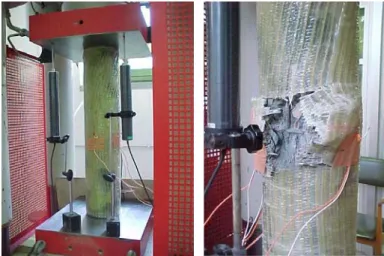
was attained. Cyclic tests were run at a rate of 0.2N/mm2/s until beginning of last cycle when changed to displacement control. Figure 1 shows a column prior to test and after failure.
3 RESULTS
Table 1 presents discrete values of strength (fc) from
results of the experimental investigation of GFRP
re-inforced concrete columns under uniaxial cyclic compression. The value of axial strain in rupture (εcc) is also indicated.
Figure 1 – Instrumented column of GFRP prior to test and after failure.
Table 1. Results of Uniaxial Compression Tests
Specimen Stirrups GFRP Load f’c0 f’cc
ε
ccnumber Type (MPa) (MPa) (%)
C1 - - Monotonic 23.1 - 0.20 C2 - - Monotonic 24.4 -C3 - - Monotonic 32.2 - 0.20 C21 - 3 layers Monotonic - 77.6 1.28 C22 - 3 layers Monotonic - 114.2 2.46 C23 - 3 layers Cyclic - 115.7 3.13 C27 - 3 layers Cyclic - 112.4 2.21 C7 φ3 // 0.10 - Monotonic - 26.4 0.20 C8 φ3 // 0.10 - Monotonic - 30.4 0.20 C9 φ3 // 0.10 - Monotonic - 24.9 0.20 C24 φ3 // 0.10 3 layers Monotonic - 116.3 2.23 C25 φ3 // 0.10 3 layers Cyclic - 91.3 1.66
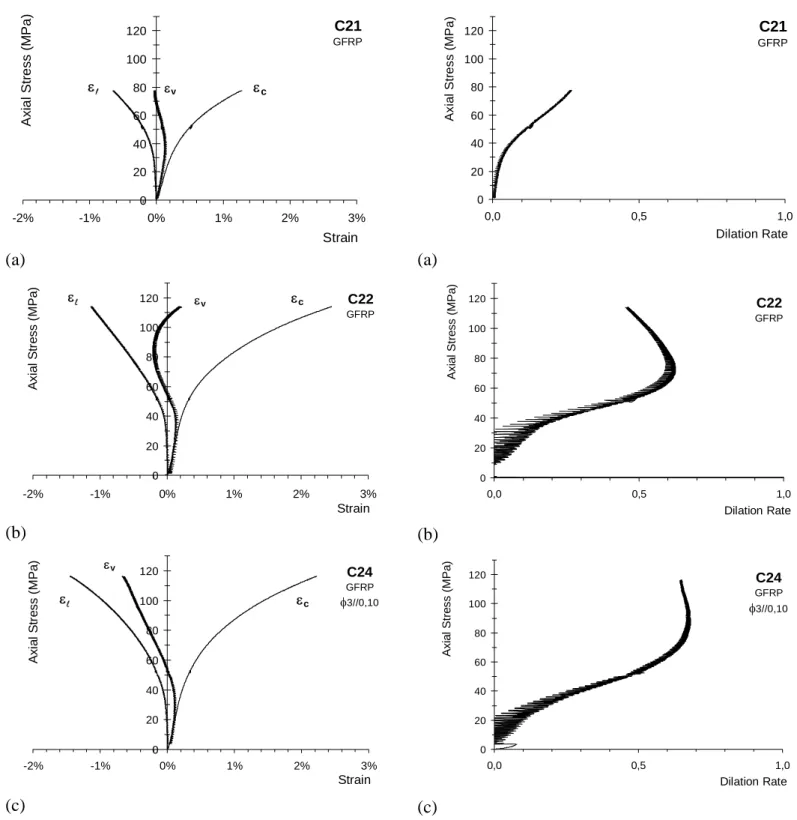
Figure 2 trough 5 display results of stress (fc),
ax-ial strain (εc), lateral strain (εl), volumetric strain
(εV) and dilation rate (μ) obtained on tests. Figure 2
shows fc − , εc fc −εl and fc −εV curves for con-fined concrete with GFRP (C21; C22). Column C24 has 6φ6 for longitudinal reinforcement and φ3//0,10 for stirrups.
As described for CFRP (Rodrigues & Silva 2001), following concrete failure, the GFRP jacket holds the column and provides stiffness that allows an in-crease of the strength and still higher inin-crease of ul-timate strain. The monotonic curve can be approxi-mated by a bilinear curve, as seen. The volumetric strain, εv = 2εl+εc, can be correlated to the failure
and post-failure of the concrete, with volume de-creasing for fc near f’c0 in the present case.
C24 GFRP φ3//0,10 0 20 40 60 80 100 120 0,0 0,5 1,0 Dilation Rate Axi a l St re s s (MPa ) C21 GFRP 0 20 40 60 80 100 120 0,0 0,5 1,0 Dilation Rate Ax ia l St re s s ( M Pa) C22 GFRP 0 20 40 60 80 100 120 -2% -1% 0% 1% 2% 3% Strain A x ia l S tr e s s ( M P a ) εc εv εl C24 GFRP φ3//0,10 0 20 40 60 80 100 120 -2% -1% 0% 1% 2% 3% Strain Axi a l S tr e s s ( M Pa ) εc εv εl C21 GFRP 0 20 40 60 80 100 120 -2% -1% 0% 1% 2% 3% Strain Ax ia l Str e s s ( M Pa ) εc εv εl (a) (b) (c)
Figure 2 – Stress-Strain response (fc vs. εc, εl, εV) for plain
(C21,C22) & RC (C24) jacketed columns. Monotonic loading.
Observed Behaviour of columns of plain concrete can be divided in phases. Firstly, increasing axial strain causes decrease of volume and lateral expan-sion at low rate. Then concrete fails, volume re-verses change and the jacket enters its main function of confinement, with dilation rate increasing almost linearly with stress. Finally, total load capacity is exhausted and the column fails through rupture of the jacket.
Reinforced concrete shows a different behaviour near failure with εv decreasing continuously,
whereas⏐εv⏐reaches a maximum at failure for plain
concrete. (a) C22 GFRP 0 20 40 60 80 100 120 0,0 0,5 1,0 Dilation Rate Axi a l St re ss (MPa ) (b) (c)
Figure 3 – Dilation (εl/εc) curves for plain (C21, C22) and
RC (C24) jacketedcolumns. Monotonic loading.
Figure 4 shows curves fc − , εc fc −εl and V
c
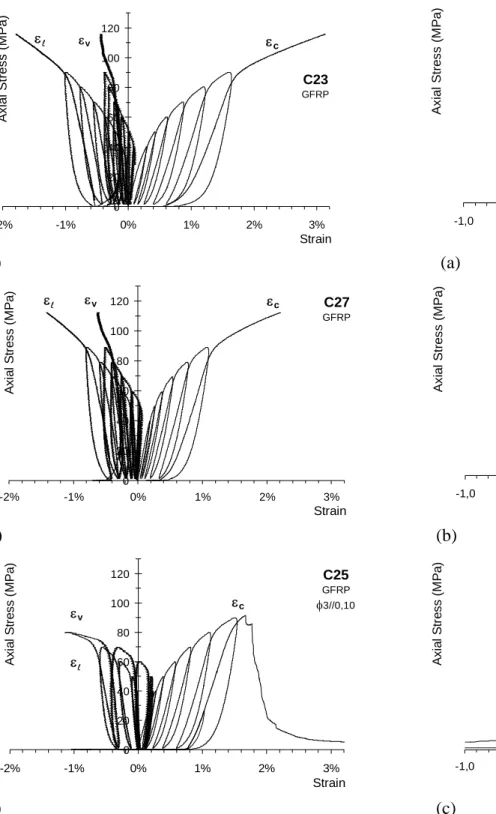
f −ε for confined plain concrete columns with GFRP (C23; C27) or RC (Strφ3//0.10) under cyclic loads.
Specimen C25 experienced strain gauges failure and εl not recorded in the upper range. Comparison of figures 2 and 4 indicates that the envelopes for cyclic loads follow trends approaching the mono-tonic curves.
Dilation curves shown in figures 3 and 5 require further study and more data for interpretation.
C23 GFRP 0 20 40 60 80 100 120 -2% -1% 0% 1% 2% 3% Strain Ax ia l St re s s (M Pa ) εc εv εl C27 GFRP 0 20 40 60 80 100 120 -2% -1% 0% 1% 2% 3% Strain Ax ia l St re s s ( M Pa) εl εv εc C25 GFRP φ3//0,10 0 20 40 60 80 100 120 -2% -1% 0% 1% 2% 3% Strain Ax ia l Str e s s ( M Pa) εc εv εl C25 GFRP φ3//0,10 0 20 40 60 80 100 120 -1,0 -0,5 0,0 0,5 1,0 1,5 Dilation Rate A x ia l S tr e s s (MP a ) C23 GFRP 0 20 40 60 80 100 120 -1,0 -0,5 0,0 0,5 1,0 1,5 Dilation Rate Ax ia l St res s (M Pa ) C27 GFRP 0 20 40 60 80 100 120 -1,0 -0,5 0,0 0,5 1,0 1,5 Dilation Rate A x ia l St re s s (M P a ) (a) (b) (c)
Figure 4 – Stress-Strain response (fc vs. εc, εl, εV) for plain
(C23, C27) and RC (C25) jacketedcolumns. Cyclic loading.
4 COMPARISON WITH EMPIRICAL MODELS Several procedures have been proposed to estimate the strength and the ultimate strain of concrete con-fined with FRP, under axial loading (Karbhari et al. 1997, Mirmiran & Shahawy 1997, Samaan et al. 1998, Spoelstra & Monti 1999).
Expressions submitted by Samaan et al. (1998) and Spoelstra & Monti (1999) provide also the stress-strain curves and are selected for application hereafter.
(a)
(b)
(c)
Figure 5 – Dilation (εl/εc) curves for plain (C23, C27) and
RC (C25) jacketedcolumns. Cyclic loading.
a) Samaan et al. (1998)
The bilinear relationship advanced by Samaan et al. (1998) is displayed in figure 6 based on (1):
(
)
(
)
c c c c E f E E E E f ε ε ε 2 5 . 1 1 5 . 1 0 2 1 2 1 1 + ⎥ ⎥ ⎦ ⎤ ⎢ ⎢ ⎣ ⎡ ⎟⎟ ⎠ ⎞ ⎜⎜ ⎝ ⎛ − + − = (1)Initially, the jacket acts passively and the slope (∂fc/∂ε) corresponds solely to the vertical response
of concrete and is given by:
3950 0
1 fc
E = [MPa] (2)
For fc near the maximum stress of unconfined
concrete, f’c0, the effective modulus (Ej) and the
thickness (tj) of the FRP also play a role, as
indi-cated by:
[
MPa]
3456 . 1 61 . 245 00.2 2 D t E f E = c + j× j (3)The strenght of the confined concrete relates to
f’c0 through the equation:
7 . 0 0 ' 0 . 6 l c cc f f f = + (4)
that derives from s modification of the linear expres-sion proposed by Richart et al. (1929).
Analogously, an estimate of the ultimate strain can also be found:
2 0 E f fcc cc − ′ = ε (5) where:
[
MPa]
258 . 6 371 . 0 872 . 0 0 0 = fc + fl+ f (6)b) Spoelstra & Monti (1999)
The model suggested by Spoelstra & Monti (1999) is based on Popovics (1973) formula:
x r r x f f cc c = −+ 1 ' (7) where: cc c x ε ε = ; ) (E Esec E r c c − = ; cc cc f E ε ' sec = (8-a,b,c) ⎜ ⎜ ⎝ ⎛ ⎟ ⎟ ⎠ ⎞ ⎟⎟ ⎠ ⎞ ⎜⎜ ⎝ ⎛ − ′ ′ + = 1 5 1 0 0 c cc c cc f f ε ε (9)
Strain εc0, corresponding to the maximum
com-pressive stress of unconfined concrete fc0, is taken as
2‰. The elasticity modulus at the origin is: '
0
5000 c
c f
E = [MPa]. (10)
Maximum stress f’cc for confined concrete, based
on Mander et al. (1988) modified by Karbhari et al. (1997) is given by: ⎟ ⎟ ⎠ ⎞ ⎜ ⎜ ⎝ ⎛ ′ − ′ + + − ′ = ′ 0 0 0 2 94 . 7 1 254 . 2 254 . 1 c l c l c cc f f f f f f (11)
where f is the confinement pressure due to the FRP l
jacket and given by static equilibrium:
D t f fl FRP ⋅ = 2 (12)
Mander et al. (1988) model [4] is applicable to concrete confined by steel, except in the early stages when steel is still in the elastic range. Spoelstra & Monti (1999) adapted formula due to Pantazopoulou & Mills (1995) to take into consideration the elastic behaviour of FRP through the entire range of strain:
(
)
(
(
)
)
l l l l f f f f E f c c c c c c c , 2 , , ε β ε ε ε ε = − (13)the relationship of fc and ε with the current strain l
c
ε and confining pressure f is given by the au-l
thors. The constant β is a property of concrete:
co co c f E ε β = − 1 (14)
Once ε is computed from Equation (11), the l strain ε in the confining jacket can be found, as j well as stress fj =Ejεj. The updated value of fl
can be used for a new estimate of ε through Equa-l tion (13), the iterations continuous until fl con-verges. The procedure is repeated for each ε , until c the complete stress-strain curve is covered (Spoelstra & Monti 1999).
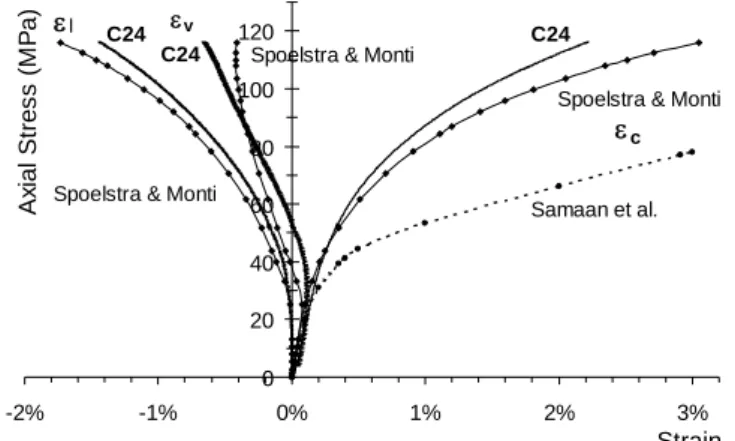
The response of an FRP-wrapped RC specimen obtained with Spoelstra & Monti (1999) model can be seen in Figure 6, along with a comparison with Samaan et al. (1998) model. Figure 7 shows curves
c c
f − , ε fc −εl and fc −εV for Spoelstra & Monti (1999) model compared with experimental results (C24) and compared with fc − curve of Samaan εc
et al. (1998) model. Figure 8 shows dilation curves of GFRP confined concrete obtained with Spoelstra & Monti (1999) model compared with experimental results (C24). 0 20 40 60 80 100 120 -2% -1% 0% 1% 2% 3% Strain A x ia l S tres s (M P a ) εc εv
εl Spoelstra & Monti
Spoelstra & Monti Spoelstra & Monti
Samaan et al.
Figure 6 – Empirical Stress-Strain responses of GFRP confined concrete (Spoelstra & Monti 1999, Samaan et al. 1998) models.
0 20 40 60 80 100 120 -2% -1% 0% 1% 2% 3% Strain Ax ia l St re s s (M P a ) εc εv εl C24 C24 C24
Spoelstra & Monti
Spoelstra & Monti
Spoelstra & Monti
Samaan et al.
Figure 7 – Empirical Stress-Strain models compared with ex-perimental results (C24). C24 0 20 40 60 80 100 120 0,0 0,5 1,0 Dilation Rate A xi a l S tr e ss (M P a )
Spoelstra & Monti
Figure 8 – Dilation curves of GFRP confined concrete obtained with Spoelstra & Monti (1999) model compared with experi-mental results (C24).
The Spoelstra & Monti (1999) curves show a fairly good agreement with experimental results.
5 FINAL REMARKS
The study provides interesting results on GFRP rein-forced cylindrical columns, obtained for specimen with adequate aspect ratio (height/diameter). Both columns of plain concrete and of RC, wrapped with GFRP jackets, were tested under axial load until complete failure. Load was applied both monotoni-cally and in cycles and the changes of volumetric expansions, lateral and axial strain with axial stress were recorded. Results show:
a) Relatively good agreement of results with empirical formulas proposed by Spoelstra & Monti (1999). Results are less accurate for model proposed by Samaan et al. (1998). b) Behaviour of columns of plain concrete can
be divided in phases. Firstly, increasing axial strain causes decrease of volume and lateral expansion at low rate. Then concrete fails, volume reverses change and the jacket enters its main function of confinement, with dila-tion rate increasing almost linearly with
stress. Finally, total load capacity is ex-hausted and the column fails through rupture of the jacket.
c) Reinforced concrete shows a different behav-iour near failure with εv decreasing
continu-ously, whereas⏐εv⏐reaches a maximum at
failure for plain concrete.
Studies continue seeking the improvement of modelling and the generation of results applicable to design.
6 ACKNOWLEDGMENTS
Support for this study was provided by the Portu-guese Foundation for Science and Technology under PRAXIS XXI Project nº CEG 3/3.1/2572-95. The writers are grateful to Mr. Rui Neves and Mr. Bernardino from LNEC and Mr. Gaspar from UNL for their help with the experiments.
REFERENCES
Harmon, T.G. and Slaterry, K.T. (1992); “Advanced composite confinement of concrete”, Proc. Advanced Composite Mat. In Bridges & Struct., CSCE, pp292-302.
Karbhari, Vistasp, M., Gao, Yanqiang (1997); “Composite Jacketed Concrete Under Uniaxial Compression – Verifica-tion of Simple Design EquaVerifica-tions”. Journal of Materials in Civil Engineering, Vol. 9, nº 4, Nov., Paper nº 13873. Mander, J.B., Priestley, M.J.N. and Park R. (1988);
“Theoreti-cal stress-strain model for confined concrete”, Journal of Structural Engineering, ASCE, 114 (8), pp.1804-1826. Mirmiran, A. and Shahawy, M.(1997); “Behaviour of Concrete
Columns Confined by Fiber Composites”, Journal of Struc-tural Engineering, vol.123, No. 5, May, pp. 583-590. Pantazopoulou, S. J. and Mills, R. H. (1995), “Microstructural
aspects of the mechanical response of plain concrete”, ACI Materials Journal, 92-M62, November-December, 605-616.
Popovics, S. (1973), “Numerical approach to the complete stress-strain relation for concrete”, Cement and Concrete Research, 3(5), 583-599.
Richart, F. E., Brandtzaeg, A. and Brown, R. L. (1929), “The failure of plain and spirally reinforced concrete in com-pression”, Engineering Experiment Station Bulletin, 190, University of Illinois, Urbana, USA, April.
Rodrigues, C. C.; Silva, M. G. (2001); “Experimental investi-gation of CFRP reinforced concrete columns under uniaxial cyclic compression”; In Proceedings of the 5th Interna-tional Conference on FRP for Reinforced Concrete Struc-tures; Cambridge, UK.
Samaan, M., Mirmiran, A. and Shahawy, M.(1998); “Model of Concrete Confined by Fiber Composites”, Journal of Struc-tural Engineering, vol.124, No. 9, September, pp. 1025-1031.
Sarkani, S. et al., (1999); “Strengthening RC Structures Using FRP”, Proc. Structural Faults + Repair, 8th. Intl. Conf., London, 13 -15 July, UK.
Spoelstra, M. R. and Monti, G., (1999), “FRP-confined con-crete model”. Journal of Composite for Construction, ASCE, 3(3), 143-150.