Improvement of technological quality of eucalypt wood by heat
treatment in air at 170-200ºC
BRUNOESTEVES1,IDALINADOMINGOS1ANDHELENAPEREIRA2
1
Dep. Wood Engineering, Superior School of Technology of Viseu, Polytechnical Institute of Viseu
Polythecnic Campus 3504-010 Viseu, Portugal
Phone: +351-232480645 Fax: +351232424651 Email: [email protected]
2
Professor
Center of Forest Studies, Superior Institute of Agronomy,
Tapada da ajuda 1349-017 Lisbon, Portugal
Phone : +351.21.3634662 Fax : +351.21.3645000 Email: [email protected]
Acknowledgement
The authors would like to thank Forest Products Journal for this publication.
The original publication is available at
http://www.freepatentsonline.com/article/Forest-Products-Journal/160106273.html
Reference
Esteves, B., Domingos, I., Pereira, H 2007 Improvement of technological
quality of eucalypt wood by heat treatment in air at 170-200ºC. Forest
Products Journal, 57 (1/2), 47-52
Abstract
Eucalypt wood is a low value wood considered a non durable species with low dimensional stability, used almost exclusively for pulp and paper or as firewood.
The heat treatment was made in an oven in the presence of oxygen during 2 to 24 h and temperatures of 170-200ºC. Mass loss with treatment, equilibrium moisture content, dimensional stability measured as ASE in radial and tangential directions and at 35%, 65% and 85% relative humidity, MOE, bending strength and wettability were determined.
Mass loss increased with treatment time and temperature reaching 9.5% for wood treated at 190ºC for 24h. Equilibrium moisture content decreased more than 50% (at 35% relative humidity) reaching a maximum of 61% reduction. At higher air relative humidity the reduction was smaller, 49% and 38% at the most for 65% and 85% relative humidity. Dimensional stability (ASE) increased with maximum values of 88% and 96% in radial and tangential direction, respectively. The improvement was higher for lower relative humidity. There was a reduction on mechanical resistance with heat treatment especially for bending strength that decreased about 20% for 3% mass loss, reaching 60% for mass losses higher than 10%. MOE decreased with heat treatment the reduction was under 10% until 8% mass loss. The contact angle increased until 5% mass loss, decreasing slightly afterwards.
Heat treatment was shown to be a useful method to improve the technological quality of eucalypt wood as regards dimensional stability allowing it to compete with higher cost woods for some applications.
1 INTRODUCTION
In the last years several heat treatments of wood appeared in Europe with the publication of quite a few patents.
The Thermowood process developed in Finland (Viitanen et al. 1994) is probably the most evolved with more than a dozen factories producing heat treated wood. The treatment is made with vapour, with less than 3-5% of oxygen, at ambient pressure and with an air speed of at least 10 m/s (Syrjänen and Kangas 2001). The process starts with a fast increase in the oven temperature with heat and vapour until 100ºC, followed by a gradual increase up to 130 ºC until wood moisture is almost zero; after that, the thermal treatment is done between 185ºC-230ºC during 2-3 hours (Militz 2002) and at the end the temperature decreases to about 80-90 ºC. The species used are mainly pine (Pinus
sylvestris), spruce (Picea abies), aspen (Populus tremula) and birch (Betula pendula) and
the treated wood is applied for exterior uses like decks, fences, garden furniture, doors and windows and for interior uses like kitchen furniture, parquet and panels.
Plato Wood, in Holland, is a four step process that uses green or air dried wood (Tjeerdsma et al. 1998). The first step named hydrothermolysis is carried out between 160-190 ºC in wet conditions and above atmospheric pressure during about 4-5 hours (Boonstra et al. 1998); in the second step, wood dries until about 10% moisture by conventional processes during 3 to 5 days, and in the third step, wood is heated up until 170-190 ºC during 14 -16 hours in dry conditions (Militz 2002); the last step is used to raise the wood equilibrium moisture to normal functioning conditions. Wood treated by this method is already commercialised with a plant in Arnhem (Holland) with a capacity of 35000 m3/year.
In France two processes were developed: the Rectification process (Dirol and Guyonnet 1993) treats wood with 12% moisture in an oven with nitrogen in one step at 200-240ºC; the process Boisperdure uses green wood, and consists of a fast drying with vapour at 200-240 ºC.
The process used in Germany, OHT, is quite different because it uses oil at high temperatures (Rapp and Sailer 2001). The wood is enclosed in a container where hot oil is introduced at high temperatures and remains for 18-24 hours. The oil promotes a good heating and limits the oxygen but wood absorbs a great amount of oil corresponding to a mass increase of 50-70% which can be a disadvantage (Sailer et al. 2000).
The heat treatment of wood reduces its equilibrium moisture (Jämsä and Viitaniemi 2001) and increases the dimensional stability (Kollmann and Schneider 1963; Viitaniemi et al. 1997; Bekhta and Niemz 2003) and rot resistance (Kim et al. 1998; Kamdem et al. 2002). Moreover the treatment darkens the wood (Mitsui et al. 2001; Bekhta and Niemz 2003) which might be an advantage for less attractive woods. The largest disadvantage of heat treated wood is the decrease in some mechanical properties, namely in bending strength (Kim et al. 1998, Kubojima et al 2000; Bengtsson et al. 2002). Surface wettability decreases (Pétrissans et al. 2003; Hakkou et al. 2005) but gluing can be easily adapted for treated wood (Militz 2002).
Eucalypt wood (Eucalyptus globulus) is one of the cheapest woods on the market. The possibility to transform this wood into a durable material capable of competing for some applications with tropical woods of much higher cost opens a window of new opportunities. The low dimensional stability and durability are the main reasons for the low value of eucalypt wood, together with the difficulty to use preservative treatments. Impregnation is almost impossible, and only feasible for sapwood and small diameters. Even when treated, eucalypt wood is still vulnerable to soft-rot fungus (Reimão and Nunes 1989) and there is a substantial preservative leaching due to the large diameter of vessels. Nowadays
eucalypts are cut down with about 10-14 years of age for pulp and paper, but older eucalypts with larger dimensions and very high extractives content are not adequate for pulping and are sold as firewood.
In this paper we report the results on the technological improvement of eucalypt wood by using a heat treatment in air in the range 170-200ºC regarding dimensional stability, equilibrium moisture and wettability, and on its effects on the mechanical resistance of treated wood. It is the objective to contribute to increase the timber value of mature eucalypt (Eucalyptus globulus) trees and to reduce the use of tropical woods in some applications.
2. MATERIAL AND METHODS 2.1 Material
Eucalypt wood (Eucalyptus globulus Labill.) was tested for heat treatment in the presence of air using a radial board from a tree with a 100 cm diameter. The samples were cut with clear radial, tangential and transversal faces from the heartwood region in the board (sapwood width was less than 10 cm). The samples for determination of equilibrium moisture and dimensional stability were cubic with 40 mm of edge. The samples for measurement of mechanical properties had 360x20x20, in mm, respectively in transverse, radial and tangential directions, 4 replicates of each kind were used for each time/temperature of treatment. All the samples were kept for three weeks in a room with 50% relative humidity and 20 ºC. After this period samples were weighed and the wood equilibrium moisture content was determined.
2.2 Heat treatment
The heat treatment was made in an oven during 2 to 24 hours and temperatures from 170ºC to 200ºC. The oven heating was made by electric coils located in the walls without forced convection, but with exhaustion of the heated gases by natural convection through an opening on the oven wall. The period to reach the treatment temperature was about one hour, which was kept approximately constant at ±5ºC. The samples were put in the oven in the beginning of the heating process at ambient temperature. At the end of the treatment the samples were cooled down in a desiccator and weighed.
2.3 Equilibrium moisture content, dimensional stability and wettability
The heat treated and untreated samples were kept in an oven at 20ºC and 35% relative humidity until stabilization. Afterwards samples were weighed and measured with a digital gauge with an error of ±0.01 mm in radial, tangential and transversal directions. The same procedure was done on separate samples kept at 65% and 85% relative humidity.
Dimensional stability in radial and tangential directions was determined at 35%, 65% and 85% air relative humidity by the ASE (Anti Shrinking Efficiency) method. ASE gives the difference between the swelling coefficient of treated and untreated samples, from oven dry to 35% (ASE35), 65% (ASE65) and 85% (ASE85) relative humidity. Total ASE
corresponding to volume difference was also determined. A higher ASE value means that the effect of the treatment on wood dimensional stabilization was higher.
Wettability of wood was determined in tangential and radial sections, by the contact angle method, measured 10 seconds after the contact of the water drop with the wood surface. A high contact angle means that the surface wettability is low.
2.4 Mechanical properties
Bending strength and apparent modulus of elasticity were determined by a three point bending device. Measurements for MOE were made using a constant velocity of 0.3 mm/min. For bending strength the velocity was set to cause rupture in 3 min. MOE and bending strength were determined according to (NP-619):
MOE(N/mm2) = 3 3 * * 4 * * b h x L F *9.8
Bending strength (MPa) =
6 10 * * 2 * * 3 h b L F *9.8
where F is the load on rupture measured in kgf/mm,
x F
is the slope of the elastic zone in kgf/mm, L is the arm length, h the height and b the width, all expressed in mm.
3 RESULTS
3.1 Mass loss with treatment
The mass loss of eucalypt wood with heating in air at 170ºC, 180ºC, 190ºC and 200ºC during 2 to 24 h is shown in Figure 1.
190 ºC 180ºC 170ºC 200ºC 0 2 4 6 8 10 12 0 5 10 15 20 25 30 Treatment time (h) M as s los s (%)
Figure 1. Mass loss of wood with heat treatment time at temperatures from 170ºC to 200ºC.
Mass loss increased with treatment time and temperature. At 170ºC mass loss was very small in the first two hours, and increased with time until reaching 4% for a 24 h treatment. Mass loss also increased with temperature of treatment. For instance, a 3% mass loss was obtained between 6 and 8 hours of treatment at 180ºC and between 4 and 6 hours at
190 ºC. The maximum mass loss was 4%, 7% and 9.5% for a 24 h treatment at 170ºC, 180ºC and 190ºC, respectively. For 200ºC mass loss was 1.8% with 2 hours of treatment and reached 10.3% with 12 hours.
The rate of mass loss was higher in the beginning of the treatment and decreased for longer exposure times. The rate of mass loss increased with temperature.
3.2 Equilibrium moisture
The equilibrium moisture content of the heat treated samples decreased in relation to the untreated wood. Even for the less severe 2-hour treatment at 170ºC, the wood equilibrium moisture content at 35% relative humidity was reduced by more than 50%, from 8.4% to 4.1%.
The decrease of the wood equilibrium moisture content depended to some extent on treatment temperature and duration. It decreased with temperature (3.3% for 170ºC and 3.0% for 200ºC) and at the same temperature, with treatment time, i.e. at 170ºC it varied between 4.1% (2 h) and 3.3% (24 h). However, the difference in the wood equilibrium moisture between the treatments was irrelevant when compared with the difference between treated and untreated wood.
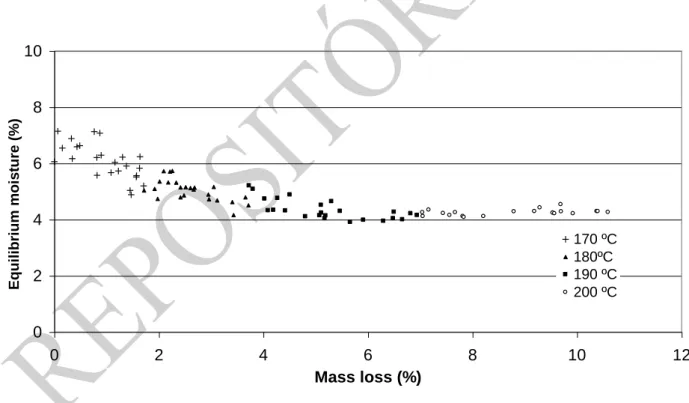
Figure 2 presents the equilibrium moisture content, for 35% air relative humidity, of heat treated wood versus the corresponding mass loss with the treatment. The wood equilibrium moisture content decreased steadily until a mass loss of 4-6%, and remained approximately constant for higher mass losses at a value of approximately 3%.
0 2 4 6 8 10 0 2 4 6 8 10 12 Mass loss (%) Equi li br ium moi s tur e ( %) 170 ºC 180ºC 190 ºC 200 ºC
Figure 2. Equilibrium moisture content of eucalypt wood at 35% relative humidity versusmass loss with treatment
The treatment was less effective at higher air relative humidities. For example, the decrease of the equilibrium moisture for wood samples treated at 170ºC in relation to the untreated samples was 61%, 49% and 38% respectively for 35%, 65% and 85% air relative humidity. Higher treatment temperatures narrowed the differences, i.e. 64%, 57% and 48%, respectively, for 200ºC treated samples.
3.3 Dimensional stability
The dimensional variations of eucalypt wood between oven-dry and 35%, 65% and 85% air humidity are presented in Table 1.The dimensional changes in tangential direction (from 3.3 to 5.6%) were higher than in radial direction, (from 1.8 to 3.5%). The volume variation was between 5.1-9.2%. The tangential/radial ratio was between 1.8-1.6 for untreated wood.
Table 1.
Dimensional variations between oven dry and the corresponding air humidity.
The dimensional stability improvement given by the heat treatment was evaluated by the ASE (Anti Shrinking Efficiency) in 35%, 65% and 85% air relative humidity.
Dimensional stability improved with heat treatment even for short durations. For example a treatment of 2 hours at 170ºC lead to a 60% ASE in radial direction. There was an increase in ASE with treatment time until the maximum value was achieved. For 170 ºC the maximum ASE35 in radial direction of 76% was obtained with a 12-hour treatment, and
a further increase in treatment time did not lead to an increase in dimensional stability. Dimensional stability increased with treatment temperature, with ASE reaching 76% for 170ºC and 88% for 200ºC.
The dimensional stability improvements were generally higher in the tangential direction than in the radial direction, i.e. ASE35 of wood treated at 180ºC ranged 63-85% for radial
and 69-95% for tangential directions. The maximum value obtained at each temperature was also higher in the tangential direction, ranging from 84-96% against 76-88% in the radial direction at 170 to 200ºC. Despite the higher reduction of tangential swelling with heat treatment, the absolute swelling value is still higher than in radial direction but the anisotropy is smaller than in untreated wood.
The air relative humidity influenced the dimensional stability improvement. Although the general trends for ASE65 and ASE85 were similar to ASE35, the values were smaller. For
example, in the radial direction of wood treated at 170ºC, ASE65 ranged 45-59% and
ASE85 17-45%, while maximum ASE values were between 59-71% and 45-57% for 65%
and 85% air relative humidity respectively.
Figure 3 presents the radial ASE in function of mass loss with heat treatment in 35%, 65% and 85% air relative humidity. The rate of dimensional stability increase was higher until 4% mass loss but for higher mass losses ASE increased only slightly, having reached maximum values between 4-6% mass loss. These values of mass loss correspond to the mass loss at which the minimum equilibrium moisture was obtained.
Relative Dimensional variation (%)
humidity Radial Tangential Tangential/Radial Volume
35% 1.8 3.3 1.8 5.1
65% 2.5 3.9 1.6 6.4
0 10 20 30 40 50 60 70 80 90 100 0 2 4 6 8 10 12 Mass loss (%) R ad ia l AS E (%) 35% 65% 85%
Figure 3. Radial ASE versus mass loss with heat treatment at 35%, 65% and 85% air relative humidity.
3.4 Wettability
Figure 4 presents the contact angle of eucalypt wood measured in radial and tangential sections as a function of mass loss with heat treatment. The contact angle increased until about 5% mass loss, reaching approximately 70º in radial section and 75º in tangential section, corresponding to a decrease of surface wettability. The increase was very high even for small mass losses of about 1%, i.e. contact angle changed from 25º to about 55º in radial section and from 52º to about 72º in tangential section. For mass losses higher than 6% the contact angle seemed to decrease.
0 10 20 30 40 50 60 70 80 0 2 4 6 8 10 12 14 16 Mass loss (%) C ont a c t a ngle 1 0 s ( D e g) Tangential Radial
Figure 4. Contact angle in tangential and radial directions as a function of mass loss with heat treatment.
Figure 5 presents a stress-strain curve for eucalypt wood untreated and treated at 200ºC for 2h, 6h and 12h. The initial zone where deformation is elastic is similar for treated and untreated wood, while the plastic deformation zone where deformation is definitive was shortened in the heat treated samples and almost did not exit for wood treated for 12 hours. With the increase of treatment severity the stress-strain curve changed, and rupture occurred for smaller tensions. In some samples, the rupture was preceded by some failure as, for example, the sample treated at 200ºC during 6 hours (Figure 5).
2 h 6 h 12 h Initial 0 1 2 3 4 5 6 0 1 2 3 4 5 6 7 8 9 10 Strain (mm) Str es s (M Pa)
Figure 5. Stress-strain curve for the bending of untreated and heat treated eucalypt wood with samples of 360*20*20 in mm.
The apparent modulus of elasticity (MOE) of eucalypt wood without treatment was on average 14197 MPa, varying between 9289-17782 MPa. MOE decreased with heat treatment temperature and time but for the less severe heat treatments the difference was very small. For example with 2 hours, the reduction of MOE was 0% (180ºC), 3% (190ºC) and -1% (200ºC) and with 12 hours 6% (180ºC), 6% (190ºC) and 25% (200ºC).
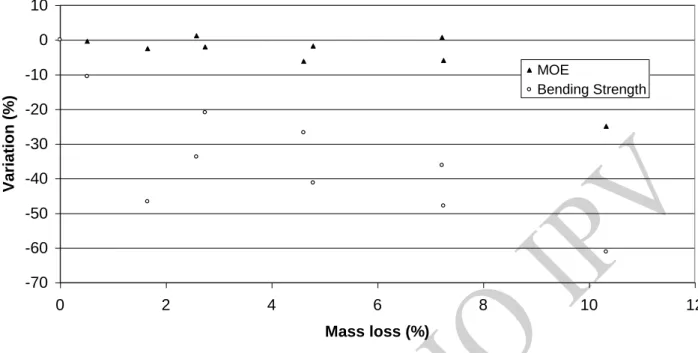
Figure 6 shows the variation of MOE and bending strength of eucalypt wood with mass loss by heat treatment. The decrease in MOE was of small magnitude (under 10%) until 8% mass loss but reached 25% for about 10% mass loss. The treatment effect on MOE was much smaller than in bending strength. The reduction of bending strength was considerable even for short treatments and increased with temperature: with 2 hours 11% (180ºC), 47% (190ºC) and 34% (200ºC) and with 12 hours 27% (180ºC), 48% (190ºC) and 61% (200ºC).
The mechanical resistance of heat treated eucalypt wood decreased with mass loss (Figure 6) and bending strength decreased about 20% at 3% mass loss and reached 60% for mass losses higher than 10%.
-70 -60 -50 -40 -30 -20 -10 0 10 0 2 4 6 8 10 12 Mass loss (%) Variatio n (%) MOE Bending Strength
Figure 6. MOE and bending strength variation of heat treated wood in relation to untreated wood versus mass loss with heat treatment.
4 DISCUSSION
The mass loss with heat treatment increased with treatment time and temperature (Figure 1), which is in agreement with earlier studies reported for species like beech, spruce or birch (Viitaniemi et al. 1997; Alén et al. 2002). The kinetic behaviour of mass loss showed a higher rate in the beginning of the treatment for all the temperatures studied. Similar results were reported by González-Peña et al. (2004) with Western red cedar treated at temperatures 190-230ºC. This higher rate of mass loss in the first phase of the heating process and at higher temperatures should be due to the rapid removal of more volatile extractives from wood. In eucalypt wood extractives amount to 4.9% for 11-14 year old eucalypts (Pereira 1988). The disappearance of some extractives from wood with the increase in treatment temperature was also reported (Nuopponen et al. 2003).
The equilibrium moisture content of eucalypt wood decreased significantly with the heat treatment (Figure 2). Identical results were reported by Jämsa and Viitaniemi (2001) using a steam heat treatment, by Rapp and Sailer (2001) using hot oil, and by Militz and Tjeerdsma (2001) for the Plato treatment with steam and pressure.
The differences in equilibrium moisture between heat treated and untreated wood decreased for higher air relative humidities. This is in accordance with Kamdem et al. (2002) with beech wood treated by the Boisperdure method at temperatures between 200-260ºC and conditioned at 66% and 86% air relative humidity, but Militz and Tjeerdsma (2001) reported that the effect of the heat treatment was more pronounced at relative humidities higher than 70%.
The reduction in the wood equilibrium moisture content was improved only until 4-6% mass loss and remained approximately constant for higher mass losses (Figure 2).
Wood dimensions vary with air relative humidity, mainly in tangential and radial directions, resulting into wood shrinking and swelling. The volumetric variation is mainly due to the dimensional changes that occur in tangential and radial directions since the axial variation
is very small. Wood swelling is anisotropic with the tangential swelling of untreated wood higher than radial swelling (Table 1). Despite the more substantial dimensional stability improvement in the tangential direction, the anisotropy of swelling still remains for the heat treated wood.
The heat treatment was more efficient at lower air relative humidities (Figure 3). For example at 35% air relative humidity ASE was always higher than 60%, while it was 40% and 20% for 65% and 85% air relative humidity (Figure 3). The dimensional stability increased even for small mass losses with heat treatment and until 4-6% mass loss (Figure 3). These values correspond to the mass loss at which the minimum equilibrium moisture was obtained (Figure 2), showing the close relation between equilibrium moisture and dimensional stability.
Surface wettability decreased sharply even for small mass losses until 3-4% (Figure 4). These results are in accordance with earlier studies (Pecina and Paprzycki 1988; Pétrissans et al. 2003; Hakkou et al. 2005). At higher mass losses (above 6%) there was an increase in wettability, which should be due to the occurrence of thermal degradation compounds (Pecina and Paprzycki 1988).
The mechanical resistance of eucalypt wood decreased with the heat treatment. The reduction on MOE was of small magnitude until 8% mass loss and at the mass losses necessary to attain maximum stability (4-6%) it was only about 5%. The MOE reduction reached 25% for a 10% mass loss (Figure 6). Yildiz et al. (2002) reported for beech wood treated at temperatures 130-200ºC for 2-10 hours a higher decrease in MOE, exceeding 45%, although the corresponding mass loss was not mentioned. Santos (2000) referred a surprising increase in MOE of eucalypt wood with heat treatment but no information was given on treatment conditions.
The decrease in bending strength was higher, attaining 20% and 60% respectively for 3% and 10% mass loss. At 4-6% mass loss, corresponding to the highest improvement on dimensional stability, the reduction on bending strength was between 25-40%. A similar decrease was reported by Bengtsson et al. (2002) with spruce wood and Scots pine. In conclusion, it was shown that the heat treatment of eucalypt wood decreased its hygroscopicity and improved substantially its associated properties: the wood equilibrium moisture content decreased, the dimensional stability improved and the tangential/radial anisotropy decreased. Maximum gains in these properties could be attained with relatively mild treatment conditions, i.e 5 h at 190ºC, corresponding to a mass loss of about 4%. In these conditions the effect on MOE was negligible and the bending strength was reduced by only about 20%. Stronger treatment conditions leading to higher mass losses will reduce significantly the bending strength and this effect must be considered when envisaging the heat treated wood applications.
5 LITERATURE CITED
Alén, R., R. Kotilainen, and A. Zaman 2002. Thermochemical behavior of Norway spruce (Picea abies) at 180-225 ºC. Wood Science and Technology. 36:163-171.
Bekhta, P. and P. Niemz. 2003. Effect of high temperature on the change in colour, dimensional Stability and mechanical properties of spruce wood. Holzforschung. 57: 539-546.
Bengtsson, C., J. Jermer, and F. Brem. 2002. Bending strength of heat-treated spruce and pine timber. International Research Group on Wood Preservation, Section 4-Processes, Nº IRG/WP 02-40242.
Boonstra, M., B. Tjeerdsma, and H. Groeneveld. 1998. Thermal Modification of Non-Durable Wood Species. 1. The Plato technology: thermal modification of wood. The International Research Group On Wood Preservation, Section 4 - Processes. 29 Annual Meeting, Maastricht, June 14 - 19: 13 p.
Dirol, D. and R. Guyonnet. 1993. Durability by rectification process, International Research Group on Wood Preservation, Section 4-Processes, Nº IRG/WP 93-40015.
González-Peña, M., M. Breese, and C. Hill. 2004. Hygroscopicity in Heat-Treated Wood: Effect of extractives, ICECFOP - International Conference on Environmentally Compatible Forest Products. 22-24 September 2004. pp. 105-119.
Hakkou, M., M. Pétrissans, A. Zoulalian, and P. Gérardin. 2005. Investigation of wood wettability changes during heat treatment on the basis of chemical analysis. Polymer Degradation and Stability. 89: 1-5.
Jämsä, S. and P. Viitaniemi. 2001. Heat treatment of wood – Better durability without chemicals. COST ACTION E22-Environmental optimisation of wood protection. Proceedings of special seminar held in Antibes, France.
Kamdem, D., A. Pizzi, and A. Jermannaud. 2002. Durability of heat treated wood. Holz als Roh und Werkstoff. 60: 1-6.
Kim, G., K. Yun, and J. Kim .1998. Effect of heat treatment on the decay resistance and the bending properties of radiata pine sapwood. Material und Organismen. 32 (2): 101-108 Kollmann, F. and A. Schneider. 1963. On the sorption behaviour of heat stabilized wood. Holz als Roh und Werkstoff. 21 (3): 77-85.
Kubojima, Y., T. Okano, and M. Ohta 2000. Bending strength of heat-treated wood. Journal of Wood Science. 46: 8-15.
Militz, H. 2002. Thermal treatment of wood: European Processes and their background, International Research Group on Wood Preservation, Section 4-Processes, Nº IRG/WP 02-40241.
Militz, H. and B. Tjeerdsma. 2001. Heat treatment of wood by the PLATO-process, COST ACTION E22-Environmental optimisation of wood protection. Proceedings of Special Seminar in Antibes, France.
Mitsui, K., H. Takada, M. Sugiyama, and R. Hasegawa. 2001. Changes in the properties of light-irradiated wood with heat treatment: Part 1 Effect of treatment conditions on the change in colour. Holzforschung. 55, 601-605.
Nuopponen, M., T. Vuorinen, S. Jamsä, and P. Viitaniemi. 2003. The effects of heat treatment on the behaviour of extractives in softwood studied by FTIR spectroscopic methods, Wood Science and Technology. 37: 109-115.
Pecina H. and O. Paprzycki. 1988. Interrelations between the treatment temperature of wood and its wettability. Holzforschung und Holzverwertung. 40(1): 5-8.
Pereira H. 1988. Variability in the chemical composition of plantation eucalypts (Eucalyptus globulus Labill). Wood and Fiber Science. 20 (1): 82-90
Pétrissans, M., G. Philippe, I. El Bakali, and M. Serraj. 2003 . Wettability of heat-treated Wood. Holzforschung. 57: 301-307.
NP 619 Portuguese Standard,. 1973. Static bending test of wood. Portuguese Institute of Quality.
Rapp A. and M. Sailer. 2001. Heat treatment of wood in Germany-state of the art, COST ACTION E22-Environmental optimisation of wood protection. Proceedings of Special Seminar in Antibes, France.
Reimão, D. and L. Nunes. 1989. A study about impregnability of round eucalypt wood. National Laboratory of Civil Engineering. Lisbon.
Sailer, M., A. Rapp, and H. Leithoff. 2000. Improved resistance of Scots pine and spruce by application of an oil-heat treatment. International Research Group on Wood Preservation, Section 4-Processes, Nº IRG/WP 00-40162.
Santos, J. 2000. Mechanical behaviour of Eucalyptus wood modified by heat. Wood Science and Technology 34: 39-43.
Syrjänen, T. and E. Kangas. 2000. Heat treated timber in Finland. International Research Group on Wood Preservation, Section 4-Processes, Nº IRG/WP 00-40158.
Tjeerdsma, B., M. Boonstra, and H. Militz. 1998. Thermal modification of nondurable wood species: improved properties of thermally treated wood. International Research Group on Wood Preservation, document Nº IRG/WP 98-40124.
Viitanen H., S. Jämsä, L. Paajanen, A. Nurmi, and P. Viitaniemi. 1994. The effect of heat treatment on the properties of spruce IRG/WP 94-40032
Viitaniemi, P., S. Jämsa, and H. Viitanen. 1997. Method for improving biodegradation resistance and dimensional stability of cellulosic products. United States Patent Nº 5678324 (US005678324).
Yildiz, S., G. Çolakoglu, Ü. Yildiz, E. Gezer, and A. Temiz. 2002. Effects of heat treatment on modulus of elasticity of beech wood. International Research Group on Wood Preservation, Section 4-Processes, Nº IRG/WP 02-40222.