1
The di-iron RIC protein (YtfE) of Escherichia coli interacts with the DNA-binding 1
protein from starved cells (Dps) to diminish RIC-protein-mediated redox stress 2
3
Liliana S.O. Silva1, Joana M. Baptista1, Charlotte Bately2, Simon C. Andrews2, and Lígia 4
M Saraiva1,* 5
1
Instituto de Tecnologia Química e Biológica NOVA, Av. da República, 2780-157 Oeiras, 6
Portugal 7
2
School of Biological Sciences, Knight Building, University of Reading, Reading RG6 8 6AJ, UK 9 10 *Corresponding author: 11 Lígia M. Saraiva 12
Av. da República, 2780-157 Oeiras, Portugal 13 Phone: +351-214469328; Fax: +351-214411277 14 E-mail: [email protected] 15 16 17 18
2 Abstract
19 20
The RIC (Repair of Iron Clusters) protein of E. coli is a di-iron hemerythrin-like protein 21
that has a proposed function in repairing stress-damaged iron-sulphur clusters. To further 22
understand the mechanism of action of RIC, we performed a Bacterial Two Hybrid screen 23
of RIC-protein interaction partners in E. coli. As a result, the E. coli Dps was identified and 24
its potential interaction was confirmed by further BACTH assays and by Bimolecular-25
Fluorescence-Complementation assay. The ric and dps single mutants displayed sensitivity 26
to NO and H2O2 induced stress, respectively, whereas the ric dps double mutant displayed 27
sensitivity to both stresses at similar levels to those seen for the corresponding single 28
mutants. The activity of the Fe-S-containing aconitase enzyme was assayed as an indicator 29
of cellular Fe-S cluster damage. Results showed significant loss of activity under non-stress 30
conditions for the two single mutants, however, the double mutant displayed no loss of 31
aconitase activity with respect to the wild type. Furthermore, complementation of the ric 32
dps double mutant with multicopy ric led to a severe loss of aconitase activity, but this
33
effect was not observed when a gene encoding a di-iron site variant of the RIC protein was 34
employed. In addition, the dps mutant exhibited a large increase in ROS levels, but this 35
increase was eliminated when ric was also inactivated. Absence of other iron-storage 36
proteins, or of peroxidase and catalases had no impact of RIC-mediated redox stress 37
induction. In summary, the results indicate that Dps and RIC proteins interact to counter 38
RIC-protein-induced ROS. 39
40
3 Importance
42
The mammalian immune system produces reactive oxygen and nitrogen species that kill 43
bacterial pathogens by damaging key cellular components such as lipids, DNA and 44
proteins. However, bacteria possess detoxifying and repair systems that mitigate such 45
deleterious effects. The E. coli RIC (Repair of Iron Clusters) protein is a di-iron 46
hemerythrin-like protein that repairs stress-damaged iron-sulphur clusters. E. coli Dps is an 47
iron-storage protein of the ferritin superfamily with DNA-binding that protects cells from 48
oxidative stress. We show that the RIC and Dps proteins interact in a fashion that counters 49
RIC-protein-induced ROS. Altogether, the results unveil the formation of a new bacterial 50
protein complex and reveal a novel contribution for Dps in bacterial redox-stress 51 protection. 52 53 54 Keywords 55
E. coli, di-iron RIC protein, YtfE, Dps, oxidative stress, nitrosative stress
56
57 58
Running Title 59
Di-iron RIC protein interacts with Dps 60
61 62
4 Introduction
63
During the infection process, bacterial pathogens are able to survive aggressive 64
environments through the activation of specific stress-resistance genes. One such example 65
of a stress-induced gene is ric. This gene encodes the ‘Repair of Iron Centre’ (RIC) protein 66
that contains a di-iron centre and contributes to the protection of bacterial pathogens such 67
as Escherichia coli, Haemophilus influenzae, Salmonella spp., Yersinia spp. and 68
Clostridium spp. during exposure to nitrosative and/or oxidative stress (1). ric is induced
69
upon exposure to either oxidative or nitrosative stress and in E. coli, Staphylococcus 70
aureus, Neisseria gonorrhoeae, H. influenza and Cryptococcus neoformans the RIC protein
71
is thought to confer stress resistance through maintenance of the activity of various Fe-S 72
containing enzymes (1–3). Such an effect is well demonstrated for E. coli and S. aureus 73
where RIC proteins restore the activity of oxidatively and nitrosatively-damaged Fe-S 74
clusters in the TCA cycle enzymes, fumarase and aconitase (1, 4). In E. coli, the RIC 75
protein also acts under non-stress conditions to maintain aconitase and fumarase activities 76
(5). Further, the E. coli RIC protein delivers iron (most likely in the ferrous state) for the 77
assembly of Fe-S clusters in spinach apo-ferredoxin and in the E. coli Fe-S cluster-78
assembly scaffold protein, IscU (6). The RIC protein also contributes to the survival of S. 79
aureus and H. influenzae in activated macrophages, and is required for full virulence in S.
80
aureus when infecting the wax moth larva infection-model, Galleria mellonella (3, 7).
81
Thus, the RIC protein has an apparent role in bacterial pathogenicity through mediation of 82
Fe-S cluster stability during exposure to redox- and/or nitrosative-stress. 83
The RIC proteins of E. coli and S. aureus contain di-iron centres of the 84
histidine/carboxylate type within a four-helix-bundle fold (8). The UV-visible spectrum of 85
5
oxidized RIC protein exhibits a broad band at ca. 350 nm and Electron Paramagnetic 86
Resonance (EPR) spectroscopy indicates that the principal g-values are below 2 (g=1.96, 87
1.92 and 1.88), which is indicative of a S=½ spin state in a mixed valence and anti-88
ferromagnetically coupled Fe(III)-Fe(II) binuclear iron centre. Mössbauer spectroscopy 89
showed that the mixed-valence Fe(III)–Fe(II) di-iron centre of the RIC protein is more 90
labile than that of the (oxo)-diferric form (6). 91
RIC proteins possess several highly-conserved amino acid residues of which some have 92
been shown to influence the properties of the di-iron centre and/or function of the protein. 93
In particular, substitution of residues His129, Glu133 or Glu208 of the E. coli RIC protein 94
abrogated its ability to protect the Fe-S cluster of aconitase. Moreover, two µ-carboxylate 95
bridges contributed by Glu133 and Glu208, linking the two di-iron site atoms, were shown 96
to be required for the assembly of a stable di-iron centre (9). These studies also 97
demonstrated the important contribution of the conserved His84, His129, His160, His204, 98
Glu133 and Glu208 residues in ligating the di-iron centre within the four-helix bundle fold, 99
and these di-iron coordination roles were recently confirmed by X-ray crystallographic 100
structural studies (10). 101
In the work reported here, we sought to identify proteins that interact with, and support the 102
function of, the RIC protein of E. coli. For this purpose, an E. coli library was screened for 103
RIC protein interaction partners using the Bacterial Adenylate Cyclase Two Hybrid system 104
(BACTH). Potential interacting gene products were further tested by BACTH and 105
Bimolecular Fluorescence Complementation (BiFC) assays. Our protein-protein interaction 106
studies revealed that the RIC protein interacts with the DNA-binding protein from starved 107
6
cells (Dps). Dps is a symmetrical dodecameric iron-storage protein of the ferritin 108
superfamily that contains a di-iron ferroxidation centre located at the interface between 109
subunits (11–13). Dps sequesters ferrous iron, which is oxidized preferentially by hydrogen 110
peroxide at its di-iron centre and then deposited for storage as Fe(III) oxyhydroxide in the 111
central cavity as an iron core; the sequestered iron can subsequently be released by 112
reduction (13, 14). The ferroxidase activity, DNA-binding and iron-sequestration properties 113
of Dps confer cells with protection from oxidative stress and nutrient deprivation, as judged 114
by the reduced survival of dps mutants under stress conditions including starvation, 115
oxidative stress, metal toxicity, and thermal stress (15). The physiological relevance of the 116
interaction between the RIC protein and Dps was examined and the results revealed that 117
Dps modulates the function of RIC. 118 119 120 121 122 123 124 125 126 127
7 Results
128
129
Identification of novel potential RIC-protein-interaction partners by screening a 130
bacterial two-hybrid E. coli library 131
132
We used a genetic approach to further assess the physiological role of RIC in E. coli, in 133
which a bacterial two-hybrid (BACTH) system (16) was employed to screen the E. coli 134
genome for gene products that could interact with RIC. For this purpose, RIC was fused to 135
C-terminal of B. pertussis adenylate cyclase T25 fragment and used as ‘bait’ to screen 136
previously constructed partial-Sau3A-digested E. coli DNA random libraries that express 137
fusions to the N-terminal of B. pertussis adenylate cyclase T18 fragment (17). We isolated 138
22 positive recombinant Lac+ colonies, from which plasmids were purified and then 139
transformed into E. coli DHM1 harbouring either pKT25-RIC or the empty vector pKT25 140
(control), and the β-galactosidase specific activities were determined (Figure 1). Seven 141
pKT25-RIC transformants, harbouring plasmids A to G, exhibited significant β-142
galactosidase activity indicative of a specific interaction (Figure 1). Nucleotide sequencing 143
followed by BLAST analysis was used to identify the genes within the inserts of these 144
plasmids. Sequencing data revealed that plasmids A to C contain an ~2 kb E. coli DNA 145
fragment upstream of the T18 Cya domain, and all contained the complete efp and ecnA 146
genes, and part of the ecnB gene. The efp gene encodes the elongation factor EF-P, a 147
translation factor that facilitates the in vitro the formation of the first peptide bond during 148
translation (18, 19). The gene cluster ecnAB expresses two small cell-membrane associated 149
entericidin lipoproteins, forming EcnAB a toxin-antitoxin module that regulates a 150
8
programmed bacterial cell death under high osmolarity conditions, with EcnA acting as the 151
antidote for the bacteriolytic entericidin, EcnB (20). 152
The other four plasmids D to G also contained a ~2 kb insert located upstream of the T18 153
Cya domain, but in these cases the inserts carried the entire rhtA gene), encoding an inner-154
membrane transporter involved in resistance to homoserine/threonine (21), and the dps 155
gene, encoding the DNA-binding and iron-storage protein from starved cells (11). Like 156
RIC, E. coli Dps has been implicated in oxidative-stress protection, which raises the 157
possibility of a functional association between these two proteins which might be 158
dependent on their direct interaction. For this reason, the potential interaction between the 159
two proteins was investigated further in order to establish its validity and determine its 160
physiological purpose. 161
162
The E. coli RIC protein interacts with Dps 163
164
To determine whether the interaction between the RIC protein and Dps, as identified 165
through the screening of the pUT18 library, is indeed genuine, further BACTH experiments 166
were performed. To enable such experiments, the gene encoding the RIC protein was 167
cloned into pUT18C and pUT18 vectors (to create T18-RIC and RIC-T18 fusions), and the 168
dps-coding region was introduced into the pKNT25 vector (to give Dps-T25 fusions),
169
following which the β-galactosidase activities of the corresponding co-transformants were 170
measured. High β-galactosidase activities were recorded for both sets of the RIC-Dps 171
BATCH combinations tested, with activities 4-6 times greater than those of the controls 172
(Figure 2), indicative of interaction between the RIC protein and Dps within the cytosol of 173
E. coli.
9
A second approach was also used to test the proposed RIC-Dps interaction, which involved 175
using the Bimolecular Fluorescence Complementation (BiFC) assay. In this method, one 176
of the two proteins of interest is fused to the N-terminal half of the green fluorescent 177
protein (GFP), and the other protein of interest is fused to the C-terminal half; the assay 178
depends upon an interaction between the two proteins that promotes the reassembly of the 179
two halves of GFP such that emission of fluorescence is restored (22). Thus, GFP fusions 180
(both the N- and C-terminal domains) were generated for both the RIC protein and Dps, 181
and the fluorescence intensity of the corresponding E. coli cells containing plasmids co-182
expressing the RIC and Dps fusions was measured (Figure 3). The data show that cells 183
expressing RICC-GFP and DpsN-GFP exhibited an approximately six-fold higher fluorescence 184
relative to the control, although transformants expressing RICN-GFP and DpsC-GFP presented 185
fluorescence levels similar to that of the control samples. 186
The RIC protein consists of two domains: a short N-terminal ‘ScdA_N’ domain of ~60 187
residues of unclear function with a highly-conserved pair of Cys residues (10); and a larger 188
C-terminal ‘hemerythrin’ domain of ~140 residues that forms a di-iron centre. Therefore, 189
we tested the BiFC interaction between Dps and a truncated form of RIC that lacks the so-190
called first Scd_N domain to determine which of the two RIC protein domains is 191
responsible for the observed interaction with Dps. The results showed that the degree of 192
interaction between the truncated RIC protein and Dps is similar to that observed when 193
using the full-length protein (Figure 3). Thus, the interaction observed here between the 194
RIC protein and Dps appears to be mediated through the C-terminal hemerythrin domain of 195
the RIC protein. 196
10
Dps modulates the function of the RIC protein in maintaining Fe-S cluster status 198
The RIC protein has been linked to the resistance of E. coli to nitrosative and oxidative 199
stresses as its inactivation decreases the survival of E. coli upon exposure to hydrogen 200
peroxide or nitric oxide donors (4). Due to the interaction of the RIC and Dps proteins 201
shown above, we questioned whether Dps could contribute to the stress protection afforded 202
by the RIC protein. To test this possibility, a Δdps Δric double mutant was constructed and 203
the growth of E. coli wild type, Δric, Δdps, Δdps Δric mutants under oxidative and 204
nitrosative stress conditions was tested (Figure 4). The growth experiments showed that 205
inactivation of ric resulted in impaired growth under stress conditions imposed by 4 mM 206
H2O2 or 250 µM spermine NONOate (Figure 4), which is consistent with previous reports 207
(4). However, the dps mutation had little impact on growth under these conditions. 208
Combining the Δdps mutation with the Δric mutation did not result in any further growth 209
reduction under the same stress conditions, i.e. the Δdps Δric strain grew similarly to the 210
Δric strain under the oxidative and nitrosative stress conditions employed (Figure 4). Thus, 211
Dps does not notably compensate for the lack of the RIC protein under peroxide or NO-212
induced stress. 213
Another characteristic of the E. coli ric mutant is a reduced endogenous activity of Fe-S 214
cluster-containing proteins, such as aconitase, that possess exposed Fe-S clusters exhibiting 215
a marked sensitivity to redox and nitrosative stress (4). Therefore, the possible contribution 216
of Dps to this phenotype was explored by comparing the aconitase activity of the Δdps and 217
Δdps Δric strains to that of the wild type and Δric mutant. The results showed that the Δdps 218
mutation caused a 50% reduction in aconitase activity in log phase (Figure 5A), consistent 219
with a role for Dps in maintaining Fe-S cluster status. As expected, a similar effect was 220
11
seen for the Δric mutant, although the activity reduction (30%) was only approximately 221
half as great as that observed for the Δdps mutant (Figure 5A). Surprisingly, the Δdps Δric 222
mutant exhibited aconitase activity that was higher than that of the corresponding single 223
mutants and similar to that of the wild type (Figure 5A). These observed aconitase-activity 224
effects were apparent in both the early-log and the post-exponential phase (OD600 0.6 and 2, 225
respectively; Figure 5A and B), suggesting that the phenotype is independent of growth 226
stage (note that dps is stationary-phase induced). The observed restoration of aconitase 227
activity resulting from the combination of the dps and ric mutations suggests that the 228
negative impact of lack of the RIC protein on such activity is dependent on the presence of 229
Dps (and vice-versa), and this in turn indicates a hitherto unrecognised functional 230
interdependence for these two proteins. 231
The association of the above aconitase-activity effects with the RIC protein was confirmed 232
by complementation using a multicopy plasmid bearing the wild type ric gene under 233
control of its natural promoter. Complementation of the single Δric mutant led to the 234
recovery of aconitase activity to levels similar to those of the wild type (Figure 5C). More 235
importantly, provision of a wild type version of ric (in multicopy) caused a large (60%) and 236
significant reduction in the aconitase activity of the Δdps Δric double mutant (Figure 5C). 237
Thus, as anticipated, the ric-complemented double mutant exhibited the same phenotype as 238
the dps mutant. This confirms that the RIC protein is responsible for decreasing aconitase 239
activity in a dps- background. 240
To confirm that the role of the RIC protein in lowering aconitase activity in the dps mutant 241
is dependent on a biochemically-functional version of the RIC protein, the ability of a RIC 242
protein variant (lacking a complete di-iron site due to an E133L substitution; (9)), was used 243
12
in the complementation experiments (Figure 5C). The resulting activity data clearly show 244
that the non-functional Glu133Leu-RIC variant does not lead to a notable decrease in 245
aconitase activity when expressed in the Δdps Δric strain (Figure 5C). 246
In summary, the above data suggest that in the absence of Dps, the RIC protein has a 247
deleterious effect on aconitase activity, but that such an effect is not exhibited when Dps is 248
present. This would imply that the interaction between Dps and the RIC protein, as 249
revealed here, acts to ensure that neither of these two proteins can participate in processes 250
that negatively impact the activity of aconitase. 251
252
253
RIC does not interact with other E. coli iron-storage proteins 254
E. coli Dps is an iron-sequestering protein composed of 12 identical subunits forming a
255
shell surrounding a central cavity where up to ~500 ferric iron atoms can be sequestered. 256
As E. coli encodes two other iron-storage proteins, namely bacterioferritin (Bfr) and ferritin 257
(FtnA), the possibility that the RIC protein might also interact with these other iron-storage 258
proteins was also investigated. Thus, corresponding BiFC experiments were performed in 259
cells carrying recombinant plasmids that express the RIC protein with either Bfr or FtnA, as 260
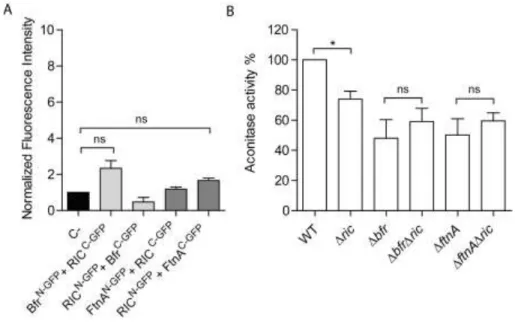
N- or C-terminal fusions to GFP domains. The resulting fluorescence intensity data failed 261
to support any protein-protein interaction between the RIC protein and Bfr or FtnA (Figure 262
6A). 263
13
In a second set of experiments, the aconitase activity of wild type, Δric, Δbfr, ΔftnA, 264
Δbfr Δric and ΔftnA Δric strains, grown to the exponential phase (OD600 of 0.6), was 265
determined. Similarly to the Δdps strain, the Δbfr and ΔftnA strains both displayed ~50% 266
lower aconitase activity levels (Figure 6B). But contrary to the effect of combining the 267
Δdps and Δric mutations, the combined absence of the RIC protein and the Bfr or FtnA 268
proteins resulted in aconitase activities similar to those present in the correspondent single 269
mutant strains (Figure 6B). Thus, the lower aconitase activity caused by the Δric mutation 270
is not additive with respect to lower activity of resulting from the Δbfr or ΔftnA mutations. 271
Further, it can be concluded that (unlike Dps) Bfr and FtnA do not tightly interact with the 272
RIC protein, and that their absence does not result in a RIC-protein dependent decrease in 273
aconitase activity. 274
275
The RIC protein increases intracellular ROS levels when Dps is absent 276
Dps protects cells from oxidative stress due to its ability to couple the reduction of 277
hydrogen peroxide to water with the oxidation of free-ferrous iron to sequestered-ferric 278
iron. In addition, its association with DNA helps to prevent ROS-induced DNA damage 279
(23). This suggests that the role of Dps in preventing RIC-protein induced inhibition of 280
aconitase activity may arise from the ability of Dps to detoxify ROS that might be produced 281
by the di-iron centre of the RIC protein (e.g. through binding and reduction of oxygen). 282
Therefore, the ROS content of Δric, Δdps and Δdps Δric strains were compared with those 283
found in the wild type to determine whether the presence of the RIC protein, in the absence 284
of Dps, results in raised levels of ROS (Figure 7). The results show that the wild type and 285
14
Δric mutant contain similar amounts of ROS while the Δdps strain had significantly higher 286
(~2-fold) levels (Figure 7). This is as expected given the known role of Dps in redox-stress 287
resistance (23). However, introduction of the ric mutation into the dps mutant eliminated 288
the increased intracellular ROS levels of the single Δdps mutant (Figure 7). This suggests 289
that the raised ROS levels of the dps single mutant are a consequence of an increase in 290
RIC-protein-dependent ROS production which thus supports a role for Dps in interacting 291
with the RIC protein to restrict its release of ROS species. 292
To discover whether other elements of the redox-stress resistance response might also act to 293
lessen RIC-protein induced ROS production, the Δric mutation was introduced into a strain 294
(Δhpx) lacking capacity to degrade hydrogen peroxide due to inactivation of both catalase 295
genes as well as the alkyl-hydroperoxide reductase genes (Table 1; (24, 25) . Assay of the 296
resulting aconitase activity levels showed that the Δhpx Δric quadruple mutant has activity 297
levels similar to those determined for the Δric and Δhpx mutants (Figure 8), which shows 298
that the three major peroxidases (KatE, KatG, AhpCF) of E. coli are not involved in 299
countering any RIC-protein mediated ROS production, at least under conditions where Dps 300 is active. 301 302 303 304 305 306
15 Discussion
307
Aconitase and fumarase are enzymes of the TCA cycle that are prone to oxidative stress 308
damage. We previously showed that the di-iron RIC protein repairs these enzymes and is 309
able to transfer iron to Fe-S containing proteins (4–6). In the work described here, we 310
screened an E. coli BACTH library in order to identify proteins that interact with the RIC 311
protein and thus might be required to assist its function. As a consequence of our 312
screening, Dps emerged as a RIC protein interaction candidate. This suggested interaction 313
was supported by generation and analysis of additional Dps and RIC protein BACTH 314
constructs and by a GFP complementation assay. Dps belongs to the ferritin superfamily 315
which led us to investigate the possible interaction of RIC with the two other ferritins 316
present in E. coli, namely ferritin and bacterioferritin. However, neither of these proteins 317
were found to interact with the RIC protein or to influence its activity in vivo. 318
We also observed that inactivation of the RIC protein resulted in lower aconitase activity, 319
which is consistent with previous findings indicating that this protein contributes to the 320
protection of solvent accessible Fe-S clusters from ROS damage under aerobic growth 321
conditions (5). Similar results were herein obtained for the single mutant strains of dps, 322
ftnA and bfr, indicating that lack of any of these gene products results in lower endogenous
323
aconitase activity. The role of FtnA and Bfr in aconitase protection was previously 324
demonstrated as the two ferritins promote the reactivation of aconitase activity following 325
stress damage in Salmonella enterica serovar Typhimurium (26). In contrast with our 326
findings with E. coli, no loss of aconitase activity was observed for S. enterica ftnA or bfr 327
single mutants in the absence of stress; this discrepancy may be related to the different 328
function and regulation of ferritins in Salmonella and E. coli species (26, 27). 329
16
A surprising result was the finding that the defective aconitase activity of the Δdps and Δric 330
single-mutant strains was reversed when these two mutations were combined in the Δdps 331
Δric double mutant, such that activity was restored to that seen in the wild type. This result, 332
together with the lower amounts of ROS observed in the Δdps Δric mutant compared to the 333
Δdps mutant, suggests that the RIC protein is responsible for the generation of ROS, but 334
only in the absence of Dps and, thus, that the interaction of Dps and the RIC protein serves 335
to enable Dps to restrict ROS release (which is presumed to damage the Fe-S cluster of 336
aconitase and hence lower the observed activity of this enzyme in a dps mutant) by the RIC 337
protein. Interestingly, other redox-stress resistance components (KatE, KatG and AhpCF) 338
failed to impact the RIC-protein-mediated inhibition of aconitase activity (at least in the 339
presence of Dps). These results suggest that the effect of Dps on the ROS-generation 340
activity of the RIC protein is one that is highly specific and not replicated by the other 341
peroxide-consuming cytosolic factors examined. Indeed, the findings relayed here indicate 342
that a direct interaction is required to enable Dps to quench the ROS-generating activity of 343
the RIC protein. The exact mechanism involved in the apparent quenching of RIC-protein-344
mediated ROS production by Dps is unclear; such understanding will require in vitro 345
reaction studies combining the Dps and RIC proteins. However, two possible processes by 346
which Dps could exert a ROS-quenching action upon the RIC protein can be considered: 347
Dps might sequester iron released from the di-iron site of the RIC protein and thus restrict 348
Fe-driven Fenton chemistry; or Dps could consume hydrogen peroxide (or hydroxyl 349
radicals; (14, 28)) generated by the RIC protein through reaction at its di-iron site with 350
molecular oxygen. 351
17
The absence of the RIC protein also reduced aconitase activity, but only in the presence of 352
Dps. However, lack of RIC protein had no impact on ROS levels when Dps was present. 353
The reason for this effect is unclear but may indicate a role for the RIC protein in supply of 354
iron from Dps for Fe-S cluster repair and/or synthesis. 355
The proposed role of the RIC protein (4) is to repair damaged Fe-S clusters of [Fe-S]- 356
proteins, such as aconitase and fumarase, by donating iron from its di-iron centre leading to 357
the formation of an intermediate mononuclear iron centre that is prone to react with oxygen 358
to generate ROS such as hydrogen peroxide. In this process, the interaction with Dps would 359
fulfil two roles, namely by trapping ROS released by the RIC protein and providing a sink 360
for iron liberated from the di-iron centre of RIC. 361
In conclusion, we report an interaction between the Dps and RIC proteins of E. coli which 362
represents the first example of a protein that interacts with the ferritin-like Dps protein. In 363
addition, our results indicate that the Dps-RIC protein interaction contributes to the 364
function of RIC, which is one of the few known bacterial repairing proteins. 365 366 367 368 369 370 371
18 Materials and Methods
372
Bacterial strains and growth conditions
373
Escherichia coli strains used in this work are listed in Table 1, and all were grown at 37 ᵒC.
374
E. coli reporter strain DHM1 non-reverting adenylate cyclase deficient (cya) was used for
375
detection of protein-protein interactions and E. coli XL2Blue was used as host strain. 376
Construction of the E. coli double mutant strains was performed by bacteriophage P1-377
mediated transduction (29), and the corrected mutations were confirmed by PCR using 378
primers listed in Table 2. 379
E. coli cells were grown in LB medium under aerobic conditions in flasks containing a 1/5
380
volume of culture or under anaerobic conditions in rubber seal-capped flasks filled with 381
medium and extensively bubbled with nitrogen prior to growth. For the stress assays, cells 382
were grown, at 37 °C and 150 rpm, in M9B minimal medium (60 mM K2HPO4, 33 mM 383
KH2PO4, 7.6 mM (NH4)2SO4, 1.7 mM sodium citrate, 1 mM MgSO4 and 10 µM MnCl2, pH 384
7) supplemented with 10 µg/mL thiamine and 40 µg/mL L-arginine, L-leucine, L-proline, 385
L-threonine and 40 mM glucose. Once cultures reached an OD600=0.3, they were either left 386
untreated or exposed to 4 mM H2O2 for 6 h or to 250 µM spermine-NONOate for 9 h. 387
388
BACTH experiments
389
The Bacterial Adenylate Cyclase-based Two-Hybrid (BACTH) system assay (16) was used 390
to identify RIC -interacting proteins. E. coliRIC protein was fused to the C-terminal of 391
19
Bordetella pertussis Cya (adenylate cyclase) T25 domain (pKT25-RIC) and used to screen
392
an E. coli MC4100 gene library containing chromosomal fragments fused to the N-terminal 393
of B. pertussis Cya T18 domain. The DNA fragments were obtained by partial digestion 394
with Sau3AI and cloning into the BamHI site of pUT18 plasmids (17). About 1 µg of 395
pUT18BamHI DNA library was transformed together with pKT25-RIC into E. coli DHM1 396
cells by electroporation. Blue colonies present in AmpR CmR selective plates (L-agar with 397
5-bromo-4-chloro-3-indolyl β-D-galactopyranoside (X-Gal)) were identified after 398
incubation at 30 ᵒC for 36 h, and cells with the highest β-galactosidade were considered to 399
contain recombinant plasmids harbouring genes encoding polypeptides that interact with 400
the E. coli RIC protein. Twenty two colonies were obtained and the corresponding plasmids 401
were isolated, co-transformed with pKT25-RIC plasmid in E. coli DHM1 and the strength 402
of the protein-protein interactions observed was again estimated by quantification of β-403
galactosidase activity. Seven isolates considered positive were named ‘A’ to ‘G’ (Figure 1) 404
and subject to nucleotide sequencing using primer T18Fw (Table 2). The sequences 405
obtained were screened against the E. coli K-12MG1655 genome using BLAST to identify 406
the encoded genes. 407
Genes coding for the RIC protein and Dps were PCR amplified from E. coli K-12 genomic 408
DNA using the oligonucleotides described in Table 2, and cloned into pKT25 (fused to Cya 409
C-terminal T25 domain), pKNT25 (fused to Cya N-terminal T25 domain), pUT18 (fused to 410
Cya N-terminal T18 domain) and pUT18C (fused to Cya C-terminal T18 domain) 411
plasmids, and the enzyme Pfu DNA polymerase (Thermo Scientific). The resulting 412
recombinant plasmids encoded either Dps or the RIC protein with either a C- or N-413
terminally linked T25 or T18 domain from the B. pertussis Cya) protein. Two 414
complementary plasmids, one carrying a T25 fragment and the other a T18 fragment, were 415
20
co-transformed into the E. coli DHM1 strain (cya-). E. coli DHM1 cells containing the ric-416
encoding pUT18 or pUT18C plasmids were co-transformed with complementary pKTN25 417
empty plasmid to provide negative controls. 418
In all cases, false positives were tested by co-transformation of E. coli DHM1 with 419
plasmids containing each gene and pKT25-TorD, which expresses E. coli TorD that binds 420
non-specifically to a wide variety of polypeptides (30). 421
For β-galactosidase activity determination (31), at least 3 representative colonies of each 422
transformation plate were inoculated, in duplicate, in LB medium, and following an 423
overnight growth at 37 ᵒC, transformant cultures were re-inoculated (at a 0.01 dilution) into 424
LB with ampicillin (100 μg/mL), kanamycin (50 μg/mL) and IPTG (0.5 mM). When 425
cultures reached an OD600=0.5 (approximately after 16 h of growth, at 30 ᵒC), 1 mL of each 426
culture was collected by centrifugation (5 min, 5000 g, 4 ᵒC). The pellets were lysed by 427
incubation with 100 µL BugBuster HT 1x (Novagen) at 37 ᵒC, for 30 min. Cellular debris 428
was then removed by centrifugation and β-galactosidase activity was assayed in 20 µL 429
suspensions in a microplate reader. The assays were initiated by addition of a reaction 430
mixture comprising: 0.27% β-mercaptoethanol (v/v) and 0.9 mg/mL ONPG (o-nitrophenyl-431
β-D-galactopyranoside) in buffer A (60 mM Na2HPO4.7H2O, 40 mM NaH2PO4.H2O, 1 mM 432
MgSO4.7H2O, 10 mM KCl). Reactions were incubated at 28 ᵒC, and absorbance was 433
recorded at 420 nm at 2 min intervals, for 90 min. The β-galactosidase specific activity was 434
defined in ONP/min/milligram of protein. Interactions were considered positive for those 435
reactions where β-galactosidase activity was at least four times higher than the negative 436
control. 437
21
Bimolecular fluorescence complementation (BiFC) assays
438
BIFC assay was performed essentially as described previously (32). For this purpose, the 439
genes encoding RIC protein, a truncated version of the RIC protein (lacking the first 57 440
amino acid residues in N-terminal (9)) Dps, Bfr and FtnA were PCR amplified from 441
genomic DNA of E. coli K-12 using the primers described in Table S2, and the DNA 442
fragments were cloned into vectors (pET11a-link-N-GFP and pMRBAD-link-C-GFP; (32) 443
that express the green fluorescence protein, GFP, to allow formation of corresponding N- or 444
C-terminal GFP fusions. Cloning was achieved using XhoI and BamHI sites (for cloning 445
into pET11a-link-N-GFP) or NcoI and AatII (for cloning into pMRBAD-link-C-GFP) sites, 446
except for Dps for which SphI replaced NcoI. All recombinant plasmids were sequenced 447
confirming the integrity of the genes and the absence of undesired mismatches. Cells 448
harboring pET11a-link-N-GFP and pMRBAD-link-C-GFP served as negative control. 449
E. coli BL21(DE3)Gold (Stratagene) was co-transformed with the resulting recombinant
450
pET11a-link-N-GFP and pMRBAD-link-C-GFP vectors, in various combinations 451
(RIC/Dps, truncated-RIC/Dps, RIC/Bfr and RIC/FtnA), and plated on selective LB-agar. 452
Colonies were inoculated in LB medium, grown overnight, at 37 ᵒC and 150 rpm, and 453
plated in inducing medium containing 20 µM IPTG and 0.2 % of arabinose. After an 454
overnight incubation at 30 ᵒC followed by two days incubation at room temperature, 455
colonies were suspended in PBS and spread on 1.7% agarose slides. Cells were examined 456
for green fluorescence in a Leica DM6000 B upright microscope coupled to an Andor 457
iXon+ camera, using 1000x amplification and a FITC filter. The images were analysed 458
using the MetaMorph Microscopy Automation and Image Analysis Software. 459
22
Aconitase activity assays and determination of endogenous ROS
460
All E. coli strains were grown, from an overnight inoculum, in LB medium under aerobic 461
conditions and 37 ᵒC, until reaching an OD600 of either 0.6 or 2, as indicated. Cells were 462
collected, washed in reaction buffer (50 mM Tris-HCl, 0.6 mM MnCl2, pH 8) and frozen in 463
liquid nitrogen. Cell extracts were prepared under anaerobic conditions, by suspending the 464
cell pellets in reaction buffer containing 0.5 mg/mL lysozyme and 0.2 mg/mL DNAse, and 465
then incubating on ice for 10 min. Supernatants were obtained by centrifugation at 9600 g 466
for 10 min at 4 ᵒC, and aconitase activity was then determined in by reaction with 200 µM 467
NADP+, 1 U isocitrate dehydrogenase and 30 mM sodium citrate (9) by following the 468
formation of NADPH at 340 nm. Wild type and Δric, Δdps and Δdps Δric strains of E. coli 469
were transformed with either pUC18, pUC18-RIC or pUC18-RIC-E133L (described in (9)) 470
and were similarly tested for endogenous aconitase activity. 471
Endogenous reactive oxygen species content was determined in wild type, Δric, Δdps, Δdps 472
Δric, Δbfr, Δbfr Δric, ΔftnA, ΔftnA Δric strains E. coli (Table 1). Cells were grown 473
aerobically to an OD600=0.6, collected by centrifugation, resuspended in PBS, and 474
distributed in 96-well microtitre plates. Following the addition of dichloro-dihydro-475
fluorescein diacetate (10 µM DCFH-DA,), fluorescence was evaluated (λex = 485 nm and 476
λem = 538 nm) for 2 h in a spectrofluorimeter Varian Cary (Agilent). The Fluorescence 477
Intensity (FI) was normalized in relation to the optical density of each culture at 600 nm. 478
479 480 481
23 Acknowledgments
482 483
We thank Professor Hirotada Mori (Graduate School of Biological Sciences, Nara Institute 484
of Science and Technology, Ikoma, Nara, Japan) for provision of the Keio mutant 485
collection, and Professor James Imlay (Department of Microbiology, B103 CLSL, 601 S 486
Goodwin Ave, Urbana, IL 61801, USA) for the Hpx mutant. 487
The work was funded by Fundação para a Ciência e a Tecnologia (FCT) project 488
PTDC/BBBBQB/5069/2014 and by the FCT fellowship SFRH/BD/118545/2016 (L. Silva). 489
The funders had no role in study design, data collection and interpretation, or the decision 490
to submit the work for publication. 491 492 493 494 495 References 496 497
1. Overton TW, Justino MC, Li Y, Baptista JM, Melo AMP, Cole JAa, Saraiva LM. 498
2008. Widespread distribution in pathogenic bacteria of di-iron proteins that repair 499
oxidative and nitrosative damage to iron-sulfur centers. J Bacteriol 190:2004–13. 500
2. Chow ED, Liu OW, O’Brien S, Madhani HD. 2007. Exploration of whole-genome 501
responses of the human AIDS-associated yeast pathogen Cryptococcus neoformans 502
var grubii: nitric oxide stress and body temperature. Curr Genet 52:137–148. 503
3. Harrington JC, Wong SMS, Rosadini C V, Garifulin O, Boyartchuk V, Akerley BJ. 504
24
2009. Resistance of Haemophilus influenzae to reactive nitrogen donors and gamma 505
interferon-stimulated macrophages requires the formate-dependent nitrite reductase 506
regulator-activated ytfE gene. Infect Immun 77:1945–1958. 507
4. Justino MC, Almeida CC, Teixeira M, Saraiva LM. 2007. Escherichia coli di-iron 508
YtfE protein is necessary for the repair of stress-damaged iron-sulfur clusters. J Biol 509
Chem 282:10352–9. 510
5. Justino MC, Almeida CC, Gonçalves VL, Teixeira M, Saraiva LM. 2006. 511
Escherichia coli YtfE is a di-iron protein with an important function in assembly of
512
iron-sulphur clusters. FEMS Microbiol Lett 257:278–84. 513
6. Nobre LS, Garcia-Serres R, Todorovic S, Hildebrandt P, Teixeira M, Latour J-M, 514
Saraiva LM. 2014. Escherichia coli RIC is able to donate iron to iron-sulfur clusters. 515
PLoS One 9:e95222. 516
7. Silva LO, Nobre LS, Mil-Homens D, Fialho A, Saraiva LM. 2018. Repair of Iron 517
Centers RIC protein contributes to the virulence of Staphylococcus aureus. 518
Virulence 9:312–317. 519
8. Todorovic S, Justino MC, Wellenreuther G, Hildebrandt P, Murgida DH, Meyer-520
Klaucke W, Saraiva LM. 2008. Iron-sulfur repair YtfE protein from Escherichia 521
coli: Structural characterization of the di-iron center. J Biol Inorg Chem 13:765–770.
522
9. Nobre LS, Lousa D, Pacheco I, Soares CM, Teixeira M, Saraiva LM. 2015. Insights 523
into the structure of the diiron site of RIC from Escherichia coli. FEBS Lett 524
589:426–431. 525
10. Lo F-C, Hsieh C-C, Maestre-Reyna M, Chen C-Y, Ko T-P, Horng Y-C, Lai Y-C, 526
25
Chiang Y-W, Chou C-M, Chiang C-H, Huang W-N, Lin Y-H, Bohle DS, Liaw W-F. 527
2016. Crystal structure analysis of the Repair of Iron Centers Protein YtfE and its 528
interaction with NO. Chem - A Eur J 1–10. 529
11. Almiron M, Link J, Furlong D, Kolter R. 1992. A novel DNA-binding protein with 530
regulatory and protective roles in starved Escherichia coli. Genes Dev 6:2646–2654. 531
12. Grant R , Filman DJ, Finkel SE, Kolter R, Hogle JM. 1998. The crystal structure of 532
Dps, a ferritin homolog that binds and protects DNA. Nat Struct Biol 5:294–303. 533
13. Calhoun LN, Kwon YM. 2011. Structure, function and regulation of the DNA-534
binding protein Dps and its role in acid and oxidative stress resistance in Escherichia 535
coli: a review. J Appl Microbiol 110:375–86.
536
14. Zhao G, Ceci P, Ilari A, Giangiacomo L, Laue TM, Chiancone E, Chasteen ND. 537
2002. Iron and hydrogen peroxide detoxification properties of DNA-binding protein 538
from starved cells. A ferritin-like DNA-binding protein of Escherichia coli. J Biol 539
Chem 277:27689–96. 540
15. Karas VO, Westerlaken I, Meyer AS. 2015. The DNA-Binding Protein from Starved 541
Cells (Dps) utilizes dual functions to defend cells against multiple stresses. J 542
Bacteriol 197:3206–15. 543
16. Karimova G, Pidoux J, Ullmann A, Ladant D. 1998. A bacterial two-hybrid system 544
based on a reconstituted signal transduction pathway. Proc Natl Acad Sci U S A 545
95:5752–5756. 546
17. Jack RL, Buchanan G, Dubini A, Hatzixanthis K, Palmer T, Sargent F. 2004. 547
Coordinating assembly and export of complex bacterial proteins. EMBO J 23:3962– 548
26 72.
549
18. Blaha G, Stanley RE, Steitz TA. 2009. Formation of the first peptide bond: The 550
structure of EF-P bound to the 70S ribosome. Science 80 325:966–970. 551
19. Ganoza MC, Aoki H. 2000. Peptide bond synthesis: function of the efp gene product. 552
Biol Chem 381:553–559. 553
20. Bishop RE, Leskiw BK, Hodges RS, Kay CM, Weiner JH. 1998. The entericidin 554
locus of Escherichia coli and its implications for programmed bacterial cell death. J 555
Mol Biol 280:583–596. 556
21. Livshits VA, Zakataeva NP, Aleshin V V., Vitushkina M V. 2003. Identification and 557
characterization of the new gene rhtA involved in threonine and homoserine efflux in 558
Escherichia coli. Res Microbiol 154:123–135.
559
22. Magliery TJ, Wilson CGM, Pan W, Mishler D, Ghosh I, Hamilton AD, Regan L. 560
2005. Detecting protein-protein interactions with a green fluorescent protein 561
fragment reassembly trap: Scope and mechanism. J Am Chem Soc 127:146–157. 562
23. Chiancone E, Ceci P. 2010. The multifaceted capacity of Dps proteins to combat 563
bacterial stress conditions: Detoxification of iron and hydrogen peroxide and DNA 564
binding. Biochim Biophys Acta 1800:798–805. 565
24. Park S, You X, Imlay JA. 2005. Substantial DNA damage from submicromolar 566
intracellular hydrogen peroxide detected in Hpx- mutants of Escherichia coli. Proc 567
Natl Acad Sci U S A 102:9317–9322. 568
25. Seaver LC, Imlay JA. 2004. Are respiratory enzymes the primary sources of 569
intracellular hydrogen peroxide? J Biol Chem 279:48742–50. 570
27
26. Velayudhan J, Castor M, Richardson A, Main-Hester KL, Fang FC. 2007. The role 571
of ferritins in the physiology of Salmonella enterica sv. Typhimurium: A unique role 572
for ferritin B in iron-sulphur cluster repair and virulence. Mol Microbiol 63:1495– 573
1507. 574
27. Abdul-Tehrani H, Hudson AJ, Chang YS, Timms AR, Hawkins C, Williams JM, 575
Harrison PM, Guest JR, Andrews SC. 1999. Ferritin mutants of Escherichia coli are 576
iron deficient and growth impaired, and fur mutants are iron deficient. J Bacteriol 577
181:1415–1428. 578
28. Bellapadrona G, Ardini M, Ceci P, Stefanini S, Chiancone E. 2010. Dps proteins 579
prevent Fenton-mediated oxidative damage by trapping hydroxyl radicals within the 580
protein shell. Free Radic Biol Med 48:292–297. 581
29. Lennox ES. 1955. Transduction of linked genetic characters of the host by 582
bacteriophage P1. Virology 1:190–206. 583
30. Pommier J, Mejean V, Giordano G, Iobbi-Nivol C. 1998. TorD, a cytoplasmic 584
chaperone that interats with the unfolded trimethylamine N-oxide reductase enzyme 585
(TorA) in Escherichia coli. J Biol Chem 273:16615–16620. 586
31. Thibodeau SA, Fang R, Joung JK. 2004. High-throughput β-galactosidase assay for 587
bacterial cell-based reporter systems. Biotechniques 36:410–415. 588
32. Wilson CGM, Magliery TJ, Regan L. 2004. Detecting protein-protein interactions 589
with GFP-fragment reassembly. Nat Methods 1:255–262. 590
33. Justino MC, Vicente JB, Teixeira M, Saraiva LM. 2005. New genes implicated in 591
the protection of anaerobically grown Escherichia coli against nitric oxide. J Biol 592
28 Chem 280:2636–43.
593
34. Baba T, Ara T, Hasegawa M, Takai Y, Okumura Y, Baba M, Datsenko KA, Tomita 594
M, Wanner BL, Mori H. 2006. Construction of Escherichia coli K-12 in-frame, 595
single-gene knockout mutants: the Keio collection. Mol Syst Biol 2. 596
35. Seaver LC, Imlay JA. 2001. Alkyl hydroperoxide reductase is the primary scavenger 597
of endogenous hydrogen peroxide in Escherichia coli. J Bacteriol 183:7173–81. 598
36. Jang S, Imlay JA. 2010. Hydrogen peroxide inactivates the Escherichia coli Isc iron-599
sulphur assembly system, and OxyR induces the Suf system to compensate. Mol 600
Microbiol 78:1448–1467. 601
602 603
29 Table 1 –Strains and plasmids used in this study 604
605
E.coli Description Source
Strains
DHM1 F′, cya-854, recA1, endA1, gyrA96 (NalR), thi1,
hsdR17, spoT1, rfbD1, glnV44(AS)
Euromedex
Wild type K-12 ATCC 23716 ATCC
Δric K-12 Δric::cat (33)
Δdps JS091 Δdps::kan (34)
Δbfr JW3298 Δbfr::kan (34)
ΔftnA MC4100 ΔftnA::spc (27)
ΔdpsΔric K-12 Δdps::kan, Δric::cat This study
ΔbfrΔric K-12 Δbfr::kan, Δric::cat This study
ΔftnAΔric K-12 ΔftnA::spc, Δric::cat This study
MG1655 F- WT (35)
SJ90 BW25113 Δric::cat (36)
LC106 (hpx) ΔahpCF′kan::′ahpḞ, Δ(katG17::Tn10)1, Δ(katE12::Tn10)1
(25)
ΔhpxΔric LC106 Δric1::cat This study
XL2 Blue recA1, endA1, gyrA96, thi-1, hsdR17, supE44, relA1, lac [F’ proAB+, lacIqZΔM15 Tn10 (Tetr)]
Stratagene
30
gal, λ(DE3), endA, Hte
Plasmids
pUT18/pUT18C Vector that allows construction of in-frame fusions at the N-terminus/C-terminus of T18 fragment (amino acids 225-399 of CyaA)
(16)
pKT25/pKNT25 Vector that allows construction of in-frame fusions at the N-terminus/C-terminus of T25 fragment (amino acids 1-224 of CyaA)
(16)
pUT18/pUT18C-ric RIC fused to T18 fragment in N/C-terminal This study pKT25/pKNT25-ric RIC fused to T25 fragment in N/C-terminal This study pUT18/pUT18C-dps Dps fused to T18 fragment in N/C-terminal This study pKT25/pKNT25-dps Dps fused to T25 fragment in N/C-terminal This study pUT18-Zip Leucine zipper fused to T18 fragment in the
N-terminal
(16)
pKT25-Zip Leucine zipper fused to T25 fragment in the C-terminal
(16)
pUT18-TorD TorD fused to T18 fragment in N-terminal (17) pKT25-TorD TorD fused to T25 fragment in C-terminal (17)
BamHI pUT18 plasmid that contains chromosomal
fragments obtained by partial digest of the MC4100 chromosomal DNA with Sau3A1 and cloned into de BamHI site
31
pUC18 Expression vector ATCC
pUC18-ric Vector for expression of RIC (4)
pUC18-RIC-Glu133Leu Vector for expression of RIC-Glu133Leu (9) pET11a-link-GFP Vector for expression of fusions with N-
terminal fragment of GFP
(32)
pMRBAD-link-GFP Vector for expression of fusions with C- terminal fragment of GFP
(32)
pET11a-ric-GFP RIC fused to N-terminal GFP fragment This study pMRBAD-ric-GFP RIC fused to C-terminal GFP fragment This study pET11a-dps-GFP Dps fused to N-terminal GFP fragment This study pMRBAD-dps-GFP Dps fused to C-terminal GFP fragment This study pET11a-bfr-GFP Bfr fused to N-terminal GFP fragment This study pMRBAD-bfr-GFP Bfr fused to C-terminal GFP fragment This study pET11a-ftnA-GFP FtnA fused to N-terminal GFP fragment This study pMRBAD-ftnA-GFP FtnA fused to C-terminal GFP fragment This study pET11a-ricTrunc-GFP Truncated RIC fused to N-terminal GFP
fragment
This study
pMRBAD-ricTrunc-GFP Truncated RIC fused to C-terminal GFP fragment
This study
606
32 Table 2 – Oligonucleotides used in this study 608
Primer Name Sequence
Construction of plasmids used in BACTH
ric_Fw GAGGTGTCGACTATGGCTTATC ric_Rv CTTTTAGGATCCTCACCCGCC dps_Fw GTTAATTACTGGGATCCAACATCAAGAGG dps_Rv TCCTGTCAGGTACCCGCTTTTATC T18_Fw CATTAGGCACCCCAGGCTTTAC T18_Rv GAGCGATTTTCCACAACAAGTC T18C_Fw CATACGGCGTGGCGGGGAAAAG T18C_Rv AGCGGGTGTTGGCGGGTGTCG T25_Fw ATGCCGCCGGTATTCCACTG T25_Rv CGGGCCTCTTCGCTATTACG NT25_Fw CACCCCAGGCTTTACACTTTATGC NT25_Rv CAATGTGGCGTTTTTTTCCTTCG
Construction of plasmids used in BiFC
ric_xhoFw GAATGAGGTCTCGAGTATGGCTTATC ric_bamRv GCGCAATGGGATCCAGCTTTTAGA ric_ncoFw GAGGTATCAGCCATGGCTTATCG ric_aatRv CCAGCTTTTAGACGTCTCACCC dps_xhoFw CGTTAATTACTCGAGCATAACATCAAG dps_bamRv GTACTAAGGATCCGCACCATCAGC
33 dps_sphFw CAAGAGGATATGCATGCATGAGTACCGCTA dps_aatRv CATCAGCGATGGGACGTCTCGATGTTAG bfr_xhoFw GAGTGGAAGCGCTCGAGTCAAAAAATG bfr_bamRv GGAGGGTTCTGGATCCCGACACG bfr_ncoFw GAAGGAGTCAAACCATGGAAGGTGATAC bfr_aatRv CGGACGTCCCTTCTTCGCGGATC truncric_xhoFw CTTTAAGAAGGCTCGAGACATATGGCTG truncric_ncoFw GGAGATATACCCATGGCTGAACAAC ftna_xhoFw CAAATATAACCTTTCTCGAGCACTATC ftna_bamRv TGAAACGGATCCAGTAAACCTGC ftna_ncoFw GAGCACTACCATGGTGAAACCAGAAAT ftna_aatRv CGGAGAGGACGTCTTTTGTGTGTC
Double mutant construction confirmation
Conf_dps_Fw CAGAATAGCGGAACACATAGC Conf_dps_Rv GATGCACTAAATAAGTGCGTTG Conf_bfr_Fw CTCTTCAAAGAGTGGAAGCG Cof_bfr_Rv GATCTCTTATTAACCGGGAGG Conf_ftnA_Fw CAAATTATAGTGACGCCACAG Conf_ftnA_Rv ACCGATCAGAGTAAGATTTGC Conf_ric_Fw AAGAATGAGGTATCACATATGGCTTATCGC Conf_ric_Rv GGCTGTTTATTGGTAAGAATTCGGCTGCTG 609
34 610
Figure 1: E. coli RIC interactions analysed by BACTH. β-Galactosidase activities of E. 611
coli DHM1 cell lysates expressing, separately, plasmids A to G, which were extracted
612
from two different BamHI libraries, and co-transformed with the pKTN25-RIC (grey bars), 613
pKTN25 empty plasmid (white bars), and pKTN25 fused to TorD (black bars). Each bar 614
represents the mean value ± standard error from results of at least three independent 615
cultures. 616
35 618
Figure 2: Assessment of the interaction of the E. coli RIC and Dps proteins using the 619
bacterial two-hybrid assay. The interaction of the RIC protein, fused to the C- (white bar) 620
or N-terminus (grey bar) of the T18-Cya domain and expressed from pUT18 or pUT18C, 621
respectively, was evaluated in E. coli DHM1 co-transformed with pKTN25 containing a 622
Dps fused to the N-terminus of the T25-Cya domain. E. coli cells harbouring 623
simultaneously empty pKTN25 and pUT18/pUT18C vectors expressing ric fusions served 624
as negative controls (black bars). Values are means (± standard error) of at least three 625
independent cultures analysed in duplicate. *p<0.05; **p<0.005 (One-way ANOVA 626
multiple comparison test). 627
628
629
36 631
Figure 3: Analysis of the interaction the E. coli RIC and Dps proteins by BiFC. Cells 632
were co-transformed with vectors expressing either RICC-GFP (pMRBAD-link-C-GFP-RIC) 633
or RIC-TruncatedC-GFP (pMRBAD-link-C-GFP-RICTrunc) with DpsN-GFP (pET11a-link-N-634
GFP-Dps). Dps-RIC protein interactions were assessed by BiFC assay. The inverse 635
configurations were also included. A) Cells expressing RICC-GFP and DpsN-GFP analysed by 636
light microscopy (bright field, left upper panel) and fluorescence microscopy (right upper 637
panel). Lower panels depict images of cells co-transformed cells with empty vectors. 638
Images were acquired using a 100x objective and a FITC filter was used for the acquisition 639
of the fluorescence images. B) Fluorescence quantification was achieved using MetaMorph 640
Microscopy Automation and Image Analysis Software. Fluorescence values for negative 641
control (empty plasmid vectors) were normalized to 1. Values are means ± standard error of 642
at least three independent cultures analysed in duplicate ***p<0.0005 (One-way ANOVA 643
multiple comparison test). 644
37 645
646
Figure 4: Growth impairment caused by nitrosative and oxidative stress is related to 647
ric absence. E. coli wild type, Δric, Δdps and ΔdpsΔric strain were grown under anaerobic 648
(A) and aerobic (B) conditions. At an OD600=0.3, cells were left untreated (white bars), 649
treated (grey bars) with 250 µM spermine NONOate for 7 h (A), or treated with 4 mM 650
H2O2 for 5 h (B). Error bars are ± SD for experiments carried out at least three times. 651
652
653
654
38 656
657
Figure 5: Effect of Δdps and Δric mutations on aconitase activity. Aconitase activity of 658
E. coli wild type, Δric, Δdps and Δdps Δric strains grown aerobically to OD600 0.6 (A, C) 659
or 2.0 (B). Complementation experiments (C) were performed for the Δric and Δdps Δric 660
strains by transformation with pUC18 or with pUC18 encoding the RIC protein or 661
Glu133Leu-RIC (a RIC protein where glutamate 133 was site-directed mutated by leucine 662
(9)). Values are represented as normalized to the aconitase activity of wild type cells. 663
Values are means (± standard error) of at least two independent cultures analysed in 664
duplicate. *p<0.05; **p<0.005; ns: not significant (unpaired Student’s t-test). 665
39 666
Figure 6: Analysis of interaction between the iron-storage proteins, Bfr and FtnA, and 667
the RIC protein, and impact of iron-storage proteins on the RIC-protein dependence 668
of aconitase activity. (A) Possible protein interaction between RIC and Bfr ant FtnA was 669
analysed by fluorescence microscopy and quantified by MetaMorph Microscopy 670
Automation and Image Analysis Software. Cells were co-transformed with vectors 671
expressing RICC-GFP (pMRBAD-C-GFP-RIC) and BfrN-GFP (pET11a- N-GFP-Bfr) or FtnA N-672
GFP
(pET11a-N-GFP-FtnA). The inverse conformations were also tried. Fluorescence values 673
for negative control (empty plasmid vectors) were normalized to 1. Values are means ± 674
standard error of at least three independent cultures analysed in duplicate. ns: not 675
significant (One-way ANOVA multiple comparison test). (B) E. coli cells of single (Δric, 676
Δbfr, ΔftnA) and double mutant strains (Δbfr Δric, ΔftnA Δric) were grown aerobically, 677
collected at OD=0.6 and its aconitase activity determined. Values are represented as 678
normalized to the aconitase activity of wild type cells. Values are means ± standard error of 679
at least two independent cultures analysed in duplicate. *p<0.05; ns: not significant 680
(unpaired Student’s t-test 681
40 682
683
684
Figure 7: Impact of Δdps and Δric mutations on intracellular ROS levels. The E. coli 685
wild type and isogenic Δric, Δdps and Δdps Δric mutant strains were grown to OD 0.6 and 686
the intracellular ROS levels were measured by incubation of cell suspensions with 10 µM 687
DCFH-DA for 2 h. Fluorescence intensity was normalized according to the final OD 688
(FI/OD). Values are means (± standard error) of at least three independent cultures analysed 689
in duplicate. ***p<0.0005 (unpaired Student’s t-test). 690
41 692
Figure 8: Effect of combining the Δhpx and Δric mutations on aconitase activity. 693
Aconitase activity of the E. coli wild type, Δric, Δhpx (ΔahpCF ΔkatE ΔkatG), and Δhpx 694
Δric strains cultured aerobically to log phase (OD600=0.6). Values are represented as 695
normalized to the aconitase activity of wild type cells. Values are means (± standard error) 696
of at least two independent cultures analysed in duplicate. ***p<0.0005; ns: not significant 697
(unpaired Student’s t-test). 698