eISSN: 2171-9845 http://dx.doi.org/10.5424/fs/2016251-08122 Instituto Nacional de Investigación y Tecnología Agraria y Alimentaria (INIA)
RESEARCH ARTICLE OPEN ACCESS
Stakeholders’ perception of forest management: a Portuguese
mountain case study
Alexandra Marta-Costa1,2,3*, Filipa Torres-Manso1,3,4, Rui Pinto1, Luís Tibério1,2,3, Inês Carneiro3
1 University of Trás-os-Montes e Alto Douro. Quinta de Prados. Vila Real, Portugal. 2 Department of Economy, Sociology and Management. University of Trás-os-Montes e Alto Douro. Vila Real, Portugal. 3 Centre for Transdisciplinary Development Studies. University of
Trás-os-Montes e Alto Douro. Vila Real, Portugal. 4 Department of Forest and Landscape. University of Trás-os-Montes e Alto Douro. Vila Real, Portugal.
Abstract
Aim of study: This paper aims to test a participatory methodology to draw parallels and paradoxes as to how some forest
sector-related entities and local communities view the Montemuro Mountain forest, namely in terms of its characteristics, the offered opportunities, its problems and the likely solutions for its management as well as the role played by stakeholders, which can be replicated in other case studies and can also facilitate the forest policy making process.
Area of study: The Natura 2000 Network “Montemuro Mountain” Site in Portugal.
Material and methods: This study combined several consultation and citizen participation techniques.
Main results: The perceptions shared by the stakeholders are some similar, others not similar and others still quite paradoxical
regarding forest characteristics and the opportunities they offer. The study has shown that it is possible to implement and improve citizen participation methodologies. This can be a viable way towards more effective forest management and fire prevention as this may help blunt conflicts of interest in forest space management. However, for participation to be truly effective and representative, a policy regarding training and awareness of the importance of information is necessary.
Research highlights: The stakeholder perceptions on forests and forest management are assessed; forest fires and agrarian
aban-donment are central for territory’s development; depopulation, old age and absenteeism emphasize degradation of forest areas; Conscious citizen participation benefit policymaking and forest management.
Keywords: Citizen participation; stakeholders; forest management; forest fires; territory; rural development.
Abbreviations used: ZIF: Forest Intervention Zones; GAL: Local Follow-up Group; GTFs: Technical Bureaus of Forestry. Citation: Marta-Costa, A., Torres-Manso, F., Pinto, R., Tibério, L.; Carneiro, I. (2016). Stakeholders’ perception of forest
manage-ment: a Portuguese mountain case study. Forest Systems, Volume 25, Issue 1, e052, 13 pages. http://dx.doi.org/10.5424/fs/2016251-08122.
Received: 03 Jun 2015. Accepted: 21 Dec 2015
Copyright © 2016 INIA. This is an open access article distributed under the terms of the Creative Commons Attribution-Non
Commercial (by-nc) Spain 3.0 Licence, which permits unrestricted use, distribution, and reproduction in any medium, provided the original work is properly cited.
Funding: This paper is part of the research project “ForeStake: the role of local stakeholders in the success of forest policy in
areas affected by fire in Portugal” (PTDC/AGRCFL/099970/2008) supported by the European Regional Development Fund (ERDF) through the Competitiveness Operational Programme (COMPETE) and by national funds through the Foundation for Science and Technology (FCT).
Competing interests: The authors have declared that no competing interests exist. Correspondence should be addressed to Alexandra Marta-Costa: [email protected]
of forest records, rural fires and a lack of forest manage-ment, which hinder sustainable development (Azevedo et al., 2009). The increase of burnt areas and the growing number of forest fires are partly due to socio-economic factors related to rural areas (Vélez, 2002). This is also mentioned in the Portuguese Plan for Prevention and Protection against Fires (Presidência do Conselho de Ministros, 2006) which also singles out rural exodus, the abandonment of traditional land use practices, extensive grazing and traditional fires for the disposal of agricul-tural residues and pasture renewal as causes of biomass fuel accumulation and the spread of forest fires.
Introduction
From the viewpoint of nature conservation, in forest ecosystems there are many of the priority habitats mentioned in the Natura 2000 Network Sector Plans (e.g. PT CON0025, ICN, 2006). Preserving these habitats is crucial for climate regulation, retaining a carbon sink and helping soil protection and water re-sources as well as for preserving endangered fauna and flora species (ICN, 2006).
However, forest ecosystems have a series of con-straints according a country’s context, such as the absence
The depopulation of rural areas, forest owners’ ab-senteeism and population aging are the main upstream reasons that exacerbate the continuous decline and degradation of forest areas (FAO, 2006; Aguiar & Pinto, 2007; Uriarte et al., 2012). Several attempts have been made to cope with these constraints to clearly and inclusively meet needs, inhabitants’ expectations, the environment and the forest landscape.
The use of participatory methodologies at an early stage of a planning process to promote dialogue and open communication between the various stakeholders, while integrating the latter’s views in the policies and measures for the landscape, is extremely important and is one of the more obvious tools used to design and carry out public policies that bring about the suitable management of forestland (Arnestein, 1969; Sannoff, 1999). Although the issue is not a new one, it has been increasingly contested by technicians and politicians who, once on the field, have been confronted with the need to conciliate and converge different interests shared by local populations. However, if on the one hand, significant steps regarding passive citizen par-ticipation (e.g. consultations and public hearings, Santos et al., 2004) have been taken, especially as re-gards the forest, on the other hand, there is still much to be done in the field of active citizen participation, which must enlist different the participation of stake-holders in various actions on behalf of the landscape.
As active citizen participation was, until now, poor or non-existent, this paper aims to test a participatory meth-odology to draw parallels and paradoxes as to how some forest sector-related entities and local communities view the Montemuro Mountain forest, namely in terms of its characteristics, the offered opportunities, its problems and the likely solutions for its management as well as the role played by stakeholders, which can be replicated in other case studies and can also facilitate the forest policy making process. Other similar studies regarding partici-patory methodologies had been carried out, namely in central Portugal (Valente et al., 2015), which are used for the results discussion of the present work.
Theoretical assumptions
Forest management conducted in a sustainable way requires a multiple vision regarding stakeholder inter-ests and needs (Fabra-Crespo et al., 2012). Stake-holder roles and interactions, using top-down to bot-tom-up strategies through participatory methodologies, is a new paradigm to pursue, being a challenge for the governance theory.
Many authors advocate how participatory arrange-ments can improve the effectiveness and legitimacy of
policies, planning and decision-making (e.g. Ramet-steiner & Kraxner, 2003; Howlett et al., 2009; Newig & Fritsch, 2009; Wolf, 2011; Fabra-Crespo et al., 2012; Klenk et al., 2013). Also, Bryden & Mittenzwei (2013) argue that we should focus on working with citizens and their civil society movements because they are well informed on policy-relevant tendencies and conse-quences. Their role complements the political and economic approaches towards certain problems (Dubuisson-Quellier et al., 2011) because they have different perceptions.
For forest management, Klenk et al. (2013) add other reasons for the importance of the involvement of local people as their proximity to forest resources, reliance on non-timber forest resources and recognized right to take part in natural resource planning and decision-making can impact their ancestral lands. The advan-tages of such options are also recognised, namely a stronger cooperation among policy makers, scientists, stakeholders and civil society on the one hand and a greater interaction among researchers from various fields on the other. Wallace (2012) goes further and advocates alliances between industry, government, forest-dependent communities and the forests them-selves that must be actively negotiated to solidify a production-oriented land policy.
However, a correct local planning can be achieved in the future if social and emotional factors are inte-grated with environmental issues, whereby all indi-viduals should adequately be granted information as to the subject in question and have the opportunity to be part of the decision making process (Nohl, 1997). Policies need to be sensitised not only to the local ecol-ogy and economy but also to invisible work and to the knowledge of the stakeholders, as Siebert et al.’s (2006) findings emphasise.
André et al. (2006) have summed up citizen partici-pation in three levels: passive participartici-pation or receiving of information (a unidirectional form of participation), participation through consultation (e.g. public audi-ences and open meetings) and interactive participation (e.g. workshops, negotiation, mediation and even co management). The first two models have been used in the forest sector (e.g. national strategy for forests, Presidência do Conselho de Ministros, 2015), but the last is required as a process closest to a preventive prac-tice, and it has been initiated only in some projects (e.g. ForeStake project, Marta-Costa et al., 2013).
With the ‘Reduced Emissions from Deforestation and Forest Degradation’ project implemented in Tan-zania, through community-based forest management, Robinson et al. (2013) demonstrated that, when exter-nal forces drive forest change, forest management becomes an enforcement programme with local
com-graphic area with 3,154,800 ha of forest stands and about 1,500,157 ha of shrublands in 2010. Privately owned land predominates here, occupying 85% of the country’s territory. However, common land (commons) is especially important in the mountain regions and occupies 12% of the territory (DGRF, 2006).
Between 1985 and 2005, Portuguese forest suffered the highest average increase of burnt area in Mediter-ranean Europe (Catry et al., 2006). According to Pinho (2008), mountain areas were the most affected, cor-responding to the poorest and socially and economi-cally most vulnerable areas in Portugal. Similar situa-tions are revealed by many authors for other countries (e.g. Osti, 2010).
The Montemuro Mountain Site is an example suf-fering from many of the above mentioned constraints. It is one of the 60 sites, which compose the Natura 2000 Network National Site List (PT CON0025), cov-ering an area of approximately 39,000 ha of Portugal (ICN, 2006).
This territory is used mainly for forest landscape purposes (73% of its area is occupied by Pinus pi-naster, Eucalyptus globulus, and some Quercus spp), and it includes a substantial shrubland area (around 50%) (DGRF, 2006). Being a Site of Community Im-portance, it is house for priority habitats (ICN, 2006). In demographic terms, it is characterized by a strong decline and aging of the population, which, along with little investment initiatives and weak investment capac-ity, has contributed to the appearance of large forest areas that are poorly managed and fire prone.
Methodology
From a methodological view point, this study com-bined several consultation and citizen participation techniques, which resulted in the four stages that are presented next. The details and preliminary tests can be found in Marta-Costa et al. (2013).
Stage I – Creation of the project’s Local
Follow-up Group (GAL)
The Local Follow-up Group, later called GAL Mon-temuro, was created during the Local Seminar of the Project that took place in 2010. The goal was to as-semble a group of individuals and entities representa-tive of the forest sector in that territory that could ac-tively involve themselves in the project. In its final composition, GAL Montemuro gathered 24 institutions, including Municipalities and Technical Bureaus of Forestry (GTFs) (4), Juntas de Freguesia (Portuguese munities rather than government agencies being
respon-sible for the enforcement. This initiative provided an opportunity to allow local communities to reap benefits from the forests to offset the costs associated with re-ducing their use of the forests.
As highlighted by Klenk et al. (2013), based on two forests models in Canada and Sweden, there may be cultural bias, resulting in dilemmas of governance for actors. So, the legitimacy and effectiveness of govern-ance networks are affected by structuring, participation and deliberation rules, which are substantiated in social practices of representation in these networks (Klenk et al., 2013). The extent to which this procedure may be considered useful depends to a large degree on par-ticipants and practitioners and on a more critical un-derstanding of the problematic nature of the problem by researchers of participatory philosophy and practice (Hayward et al., 2004).
In the case of forest management issues, local com-munities’ lack of decision-making power regarding the best strategies to implement seems to limit the plan’s efficacy and success. Many rules and obligations are developed without interacting with them, resulting in a lack of perception and realization of those practices. In the South of Europe, stakeholders’ participation in de-signing and carrying out forest programmes and policies capable of developing the sector is still a recent practice or even non-existent. Its former conception clearly shows a top-down instead off a bottom-up process in which the various stakeholders have a word to say. Yet, as regards forest management and prevention against fires, the legislation that has been passed more often than not goes against the local communities’ interests, needs and ex-pectations. It happened with the sites included in the Natura 2000 network, the Natural Parks Management Plans and the creation and functioning of Forest Inter-vention Zones (ZIF). In this regard, it is essential that social representations on forest and forest policy be evaluated as well as stakeholders’ role in reinforcing political measures for the sector, namely the prevention and mitigation of fires and the recovery of burnt areas, thus allowing a better understanding of the citizen’s role in designing and implementing successful public policies for forest areas. The aim of this project was to employ this approach in the Montemuro Mountain Site, an en-vironmentally protected mountain area of Portugal.
Material and methods
Case study
According to the 6th National Forest Inventory (ICNF, 2013), forests cover about 67% of the
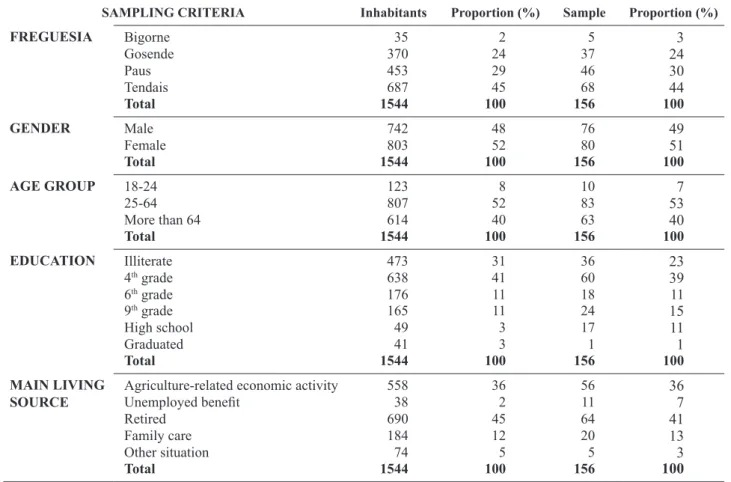
geo-The sample size was 10% of the population over 18 years old (156 questionnaires), residing in the four freguesias (one for each municipality of the Site) that lie completely in the perimeter of the Site and have the largest forestland area (settlements and shrublands) (Table 1). The criteria that have been used were dic-tated by the need to integrate the territory’s diversity (one freguesia per municipality) and the notion that measures leading to sustainable forest management should be implemented and evaluated exactly where forestland occupies the largest area. The target popula-tion represented the 42% of the populapopula-tion residing in the Montemuro Mountain Site (INE, 2011).
In order to select the sample, quota sampling tech-niques were used, and the criteria chosen as most reli-able were the geographic location (freguesia) and the residing population distribution for gender, age and education level. Employment status and the activity sector were also included as indicative parameters for sample selection.
The majority of the respondents (51%) were females. In terms of age, the class between 25 and 64 years (53%) and more than 64 years (40%) dominate, being 56 years old the average age of the sample. Most re-spondents’ qualifications were at elementary education level (until 9th grade, 65%) or corresponded to no lit-eracy at all (23%). Around 41% of the sample was retired people, and 36% had some kind of agriculture-related economic activity (e.g. fresh products and groceries trade).
It was also verified that 35% of the respondents claimed to be forest owners, of which 61% owned less than 5 plots; in 63% of the cases, each plot was less than 0.5 hectares.
Data collected through the survey were analysed with recourse to SPSS (version 21, IBM Corp, 2012), complemented with qualitative information gathered during the application of the questionnaire.
Stage IV – Workshops with stakeholders
After the previous stages had been concluded and the information thus obtained had been treated, a work-shop with the GAL Montemuro members took place in a freguesia of the Site (Cabril in the municipality of Castro Daire) in May of 2013. The purposes were to debate and to validate the main problems that hinder or limit forest management that had been identified in the study on social perceptions and to build strategies to solve them. This workshop began with two interac-tive activities (expectation cards and pictures) to obtain an informal ambient. After that, three exercises in plenary and group sessions were realized. The final territorial-administrative units) (5), Forest Producer
Organizations (3), a Livestock Association (1), an Hunting and Fishing Association (1), a Common Land Managing Entity (1), the Secretariat for Common Land (1), the National Forestry Authority (2), the National Authority for Civil Protection (1), the Institute for Nature and Biodiversity Conservation (1), the Na-tional Republican Guard (1), Fire fighters (1) and an Environmental consultancy firm (1).
Stage II – Application of survey
questionnaires to stakeholders
In this stage, the methodology was based on inter-views of GAL Montemuro members that took place between October 2011 and January 2012 in the office of each entity. They were conducted face to face and obeyed a questionnaire script with forty-two questions structured into six sections. The first and second sec-tions of the questionnaire were designed to characterise both the respondent and the forest, respectively; section three included questions about forest management prac-tices and the recovery of burnt areas; section four re-ferred the stakeholders’ participation and cooperation relationships; section five was dedicated to future forest perspectives; and finally, section six mentioned the measures and techniques most used in the forest defence against fires in Montemuro Mountain Site.
Respondents were mostly male (68%); their average age was 43 (ranging from a minimum age of 28 to a maximum of 66), and they had higher levels of quali-fication (72% of the respondents).
The collected data were treated with recourse to the Software Statistical Package for Social Sciences (SPSS version 19, IBM Corp, 2010) and subject to a fre-quency analysis. Results are presented in the next sec-tion, complemented with qualitative information gath-ered by the interviewer during the application of the questionnaire.
Stage III – Application of survey
questionnaires to the local community
In 2013, a meeting was organized in the Montemuro Mountain Site during which face-to-face survey ques-tionnaires were applied to the local community. It had the same structure as the one applied to the GAL Mon-temuro members, but included nine main closed ques-tions and five sub-quesques-tions mainly related to a gen-eral characterization of the forest owner profile and the type of management used by forest owners living in the Montemuro mountain.
only related to the territorial unit of the freguesia of residence. This was confirmed by the Chi-square cor-relation test, considering as a hypothesis Montemuro Mountain Site’s dependence on forest occupation (listed by each respondent of the sample as his/her freguesia), which resulted in a statistically significant value (p > 0,001). In fact, it became clear that the population does not recognize the Site’s territorial boundaries (geographically and legally established), which indicates citizens were absent from the process that led to the creation of this protected area and the definition of its boundaries. The absence of an informed population aware of what is happening within their territory undermines the basic principle of public par-ticipation defined in the Convention on access to in-formation, public participation in decision-making and access to justice in environmental matters (EC, 2005). However, this group represents local knowledge and technical-scientific information is integrated in this work by the GAL Montemuro. The last group of stake-holders has to know the policies and tools they use to perform their duties, so they are obviously aware of the Site’s geographical boundaries. This procedure fol-lows Bryden & Mittenzwei (2013) and Dubuisson-Quellier et al.’s (2011) perspectives. Different local actors can be well informed or have points of view that part consisted of summing up the main ideas to be
imparted to policy makers about local needs and how to include stakeholders in the decision making process and enlist their participation in designing management policies and tools.
Results and discussion
The forest: its characterization, opportunities
and bottlenecks
According to the local population, this territory is dominated by forest areas, consisting mainly of Pine (Pinus pinaster), (24%), oak (Quercus robur and Q. pyrenaica, 23%) and chestnut (Castanea sativa) and other hardwood forest stands (23%). Shrublands are referred to by only 11% of the respondents. According to the 2005 Land Use and Land Cover Map (IGP, 2006), it is possible to understand how respondents fail to have an accurate perception of the situation, in that there are, actually, approximately 18,000 hectares of shrublands, 5,000 hectares of wooded land and 9,000 hectares of farmland.
In some cases, the local community’s perception of forest occupation in Montemuro Mountain Site was
Table 1. Inhabitants above 18 years old and sample distribution by selected criteria.
SAMPLING CRITERIA Inhabitants Proportion (%) Sample Proportion (%)
FREGUESIA Bigorne 35 2 5 3 Gosende 370 24 37 24 Paus 453 29 46 30 Tendais 687 45 68 44 Total 1544 100 156 100 GENDER Male 742 48 76 49 Female 803 52 80 51 Total 1544 100 156 100 AGE GROUP 18-24 123 8 10 7 25-64 807 52 83 53 More than 64 614 40 63 40 Total 1544 100 156 100 EDUCATION Illiterate 473 31 36 23 4th grade 638 41 60 39 6th grade 176 11 18 11 9th grade 165 11 24 15 High school 49 3 17 11 Graduated 41 3 1 1 Total 1544 100 156 100 MAIN LIVING
SOURCE Agriculture-related economic activityUnemployed benefit 55838 362 5611 367
Retired 690 45 64 41
Family care 184 12 20 13
Other situation 74 5 5 3
stakeholders’, for what they actually do on the moun-tain”. This aspect is also stated by several authors (Castro, 2008; Manso, 2008; Moreira, 2008; Rodriguez et al., 2008; Santos, 2008; Vélez, 2009).
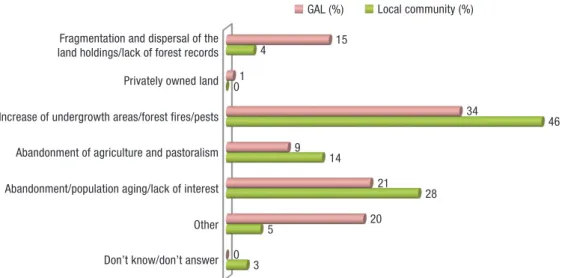
However, 85% of the respondents expressed their satisfaction with the type of forest they have in the Montemuro Mountain Site. “It is very good the way it is” – some make a point of saying – although others think “it would be better if it weren’t for the fires”. Fires are no doubt one of the main problems affecting the Montemuro Mountain Site listed by both groups of respondents (Figure 1) as well by the respondents (both technicians and citizens) of the Valente et al. (2015) study. They are connected with the increase of shrub-lands, followed by the abandonment of forest manage-ment, population aging, depopulation and the abandon-ment of agricultural and pastoralism practices. This type of situation is widely referred to by authors who explain the short, medium and long term consequences of these phenomena (e.g. Vélez, 2002; FAO, 2006; Aguiar & Pinto, 2007; Uriarte et al., 2012; Valente et al., 2015).
According to GAL Montemuro’s perspective, the situation is becoming worse with “the landscape being full of wind turbines”, “there being few financial re-sources to invest in the forest”, “common land manage-ment being incipient”, “there being a surplus of caprine animals”, “shepherds’ work not being duly appreciated” and “there being too many eucalyptus and pines”.
Within the framework of the Project’s workshop, the GAL members had the opportunity of reflecting on the main problems related to forest fires that prevent or impair the forest management of the territory. They identified the following situations:
1. The low value of raw materials, services and goods, which does not compensate for the costs of forest management;
complement their vision regarding issues of forest management.
The GAL Montemuro members proved to have a clear view of reality (68%) for they pointed out the “shrub-lands” mostly used for extensive grazing as being dominant in Montemuro Mountain Site. The fact that, in the actual conditions, this kind of landscape has been deteriorating may results in the populations’ lack of par-ticipation in creating protected areas, a situation already addressed by Wells et al. (1992) regarding Natural Parks. The forest tree species favoured by the respondents as being the most suitable for the Montemuro Mountain Site is the Pinus pinaster or Maritime Pine (more than 24% of both respondents). Other opinions favour either hardwood tree production, leisure areas, aesthetics and landscape (21% of the local community) or agrofor-estry, hunting and fishing (24% of GAL Montemuro members). The areas occupied with eucalyptus produc-tion or used for biodiversity conservaproduc-tion were the situations less cited.
These responses are basically related to the main functions that forest areas should have according to the respondents. Timber production as well as other forest product activities stand out due to their relevant con-tribution to the Site’s economy. Other aspects, like environmental protection or the preservation of natural resources (water, air, soil) (36%), are also pointed out by either the local population or by GAL members. In particular the later focused on pastoralism, hunting and serving as home for wind power plants for aeolian energy production (23%), which are frequently seen on the Montemuro Mountain. This economic vision of forests, followed by the vital role of the forest in the environment agrees with the founding of Valente et al. (2015), in the central Portugal. In the words of an as-sociation leader of Montemuro, “(...) it is important to value people’s work, namely shepherd’s and other
Fragmentation and dispersal of the
land holdings/lack of forest records 15
1 0 34 9 21 20 4 0 3 46 14 28 5
Privately owned land Increase of undergrowth areas/forest fires/pests Abandonment of agriculture and pastoralism Abandonment/population aging/lack of interest
Don’t know/don’t answer
GAL (%) Local community (%)
Other
ter surveillance (10%), arresting and punishing arson-ists (8%) and job creation in the area (7%) were also measures suggested to solve the problem.
The mainly solutions pointed out by forest owners and other citizens in the Valente et al. (2015) study involve incentives or penalties to compel and promote active forest management, followed by a definition and implementation of a rural development strategy, in ac-cordance with the national technicians.
Despite national policies and guidelines for forest management, the truth is that the public has little or no knowledge about this, especially at the level of local communities. This was especially true for the ZIFs1 unknown to the great majority of respondents (98%), who had never heard of them.
Forest fires
The reality of forest fires is transversal to the whole Mediterranean territory. It is no surprise then that al-most all of the respondents stated that “the mountain burns every year” and that 2009 and 2012 were the worst years in this respect.
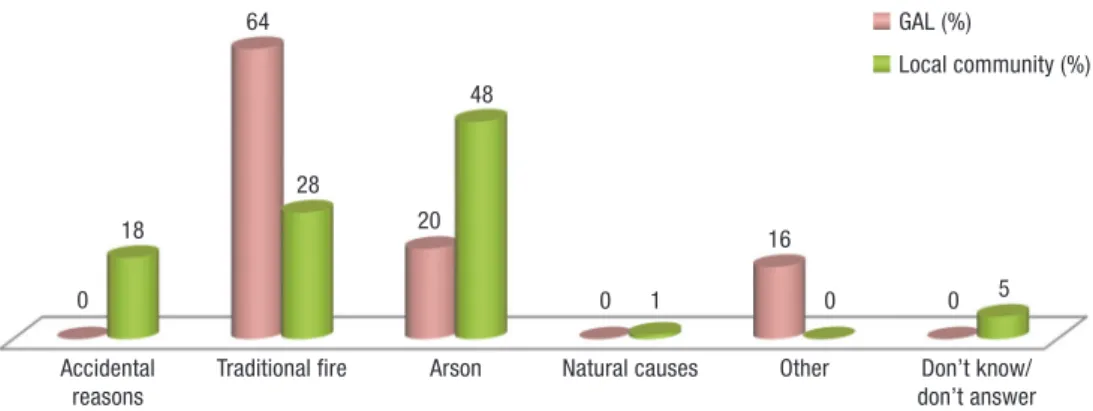
According to the two groups, traditional fires and arson are the main causes of fire, as can be seen in Figure 2. This was also identified by Valente et al. (2015). As it happens, when respondents point out arson, they are in fact referring to traditional fires that are not prescribed and are done on nearby land. This seems to be a common practice and, in a way, it em-phasises the idea of some absenteeism on the part of landowners in the region. Another study about Portu-guese forest also revealed the increasing disinterest and absenteeism of the forest owners as an important social concern and a major cause of forest fires (Va-lente et al., 2015).
2. A lack of forest records preventing more effective forms of organization and conflicts of interest amongst involved parties;
3. The abandonment of agricultural and pastoralism practices and difficulties in implementing tradi-tional fire techniques;
4. Fragmentation and dispersal of land holdings, population aging, depopulation, abandonment of traditional forest management.
The small-scale forest holdings was also identified by the forest national and local technicians, in Valente et al. (2015), as one of major problem of the forest, and constitutes the major difference between technical and social perspectives. However, it was not considered as a problem for forest owners or for other citizens inter-viewed in that study, because they had inherited the land. As a way to solve or somehow mitigate these prob-lems, respondents made several suggestions. They think that it is necessary to “invest more in the region”, “find solutions to fight depopulation”, “cultivate abandoned land”, “increase accessibility in the mountain”, “con-trol pests and diseases, especially of chestnut and oak trees”, “create better accesses to the land”, “carry out projects that contribute to reordering the forest and promoting the economy of the region”, among others (37% of local population respondents).
To a certain extent, this set of suggestions concurs with GAL Montemuro’s, especially in regards to the need to invest in the Site. It seems as if the local popu-lation is asking the government for a trade-off, saying, “You do the investment and we will work to develop the region!”.
Land clearing is pointed out by 27% of the local population as a solution to reduce forest fires and as one that should be mandatory for landowners or be delegated to central or local authorities. More and
bet-1 The ZIF is a continuous and demarcated territorial area, consisting mostly of forestland under a Forest Management Plan and a Specific Forest Intervention Plan and run by an entity called the Managing Body (Decree-Law nº 127/2005, 5 August, altered by Decree-Law nº 15/2009, 14 January, MADRP, 2009).
Other Don’t know/
don’t answer
Traditional fire Arson Natural causes
Accidental reasons 18 28 48 1 0 5 0 64 20 0 16 0
Figure 2. Main causes of fire in the Montemuro Mountain Site.
GAL (%)
of investment so that fire prevention can be really effec-tive. “Forest management” is at the top of a list of “great investments”, for it covers many areas and involves many resources. Next comes “enlisting citizen participa-tion in the decision making process” regarding the forest. Contrarily, respondents are of the opinion that it is “by no means necessary” to invest in “fire fighting resourc-es”. The number of those who think that “supervising and punishing those who fail to comply” is not the solu-tion to rural fire prevensolu-tion was also significant. Con-sidering what has been done about this problem over the years, respondents think “awareness raising and infor-mation campaigns” need “some investment”.
Although there are no ZIFs in the Montemuro Moun-tain Site, they are viewed by GAL Montemuro mem-bers as likely solutions to overcome most of the prob-lems listed. They also think extraordinary measures should be taken to “force” landowners to “do some-thing” about their land: “The government should make people who own land cultivate it, and, if they did not want to do it, they should lease it or sell it to those who want it” (the President of a Junta de Freguesia). ZIFs’ main advantage listed by 35% of the respondents is the increase of “forest areas’ economic return”, followed by the “decrease of forest risk” (18%) and “diversifica-tion of forest areas’ use and func“diversifica-tions” (15%). For the 22% of the respondents, ZIFs have numerous disad-vantages: as a management model, they are not adapt-ed to the reality of the country and are a source of conflict; they are difficult to set up and imply too much bureaucracy; forest owners who do not agree to be part of the ZIF are still obliged to design a forest manage-ment plan; ZIFs must have at least 1,000 ha.
Within the framework of the project’s workshop, some solutions emerged, outlined according to “What depends on us”, in order to enlist stakeholder’s par-ticipation and make them accept their responsibilities. It was clear to all that it is necessary to raise public At the same time, there is no mention of shepherds
as regards this matter, contrary to what was stated by GAL Montemuro members. Some locals accused the timber industry of using fires as a way of buying wood at lower prices.
When asked about the greatest impacts of fires (Figure 3), respondents chose environmental issues like the increase of air pollution associated with carbon diox-ide emissions resulting from fires; ecological issues like the loss of biodiversity; economic issues like the loss of wood and the decrease of its commercial value and so-cioeconomic issues resulting in the destruction of the local economic fabric, perhaps the worst of consequences.
In a study developed by Torres Manso et al. (2010), in 2007, regarding 78 burnt areas covering 484 hectares of the Montemuro Site circumscribed area, it was verified that most of the areas that were studied (91%) had no serious problems of erosion; in fact, evidence of critical erosion was only observed in one place. The respondents did not mention the erosion among the greatest impacts and this result agrees with Torres Manso et al. (2010).
During the interviews, the locals were extremely pragmatic in what concerns priority investment for Montemuro forest. Since fires, particularly arson, are the main problem listed and since neglect to clear the land is responsible for fires spreading, respondents indicated that the bulk of investment goes to preven-tion, namely undergrowth clearing (27%), supervision and punishment of those who fail to comply with the rules (20%) and awareness raising and information campaigns (13%).
GAL Montemuro members’ responses show an alto-gether different local perception from the one shared at other decision-making and acting levels. The measures that have been taken to implement rural fire prevention may not have been the most suitable according to the respondents and, therefore, they call for a restructuring
69 0 0 0 1 9 21 39 2 8 4 4 1 42 Impact on natural resources (air, soil, water, biodiversity)
Direct impact on people (health and death) Destruction of assets and infrastructures (houses,
goods, wood, animals)
Other Stronger awareness of the importance of the forest Destruction of the local economic fabric
Don’t know/don’t answer
GAL (%) Local community (%)
landowners – “One has to look after what one owns”. Local government, along with Juntas de Freguesia (22%) and Municipalities (17%), are also assigned that responsibility. GAL Montemuro shares this view but only to some extent, insofar as this group of respond-ents includes Forest Producer Organizations in the list of stakeholders with managerial responsibility as con-cerns the forest. Nonetheless, the situation is para-doxical, given the forest associativism that exists in the zone. Valente et al. (2015) also concluded that the differences in the perceptions about the responsibility for forest management were mainly related to the or-ganization of the sector in the area of residence of each respondent.
Results reflect what was said above. When the pro-cess is one-sided, since not all stakeholders have been involved in the decision-making process itself, they cannot be assumed as responsible (Renn, 2006).
After looking into scenarios suggested by respond-ents regarding the different realities of the Montemuro Mountain Site, it was possible to establish that, on average, 39% of the local population think there will be no changes, 36% expressed the idea that the chanc-es of the proposed scenarios actually occurring will eventually decrease and 15% think they will increase. Particularly relevant is the number of respondents who believe that agricultural lands and shrublands will in-crease (31% and 35% respectively) and that stakehold-ers and people in general will have more concern for the forest (30%). Also, opinions concur in that neither agroforestry areas nor forest fires will be the subject of much change (58% and 56% of the respondents respectively). Finally, economic investment in the for-est is seen with some pessimism since 54% of the re-spondents believe it trends to decrease and the same will happen to producers associations (51%).
In terms of the future perspectives referred by GAL Montemuro, collected information showed that there is room for optimism but also for some pessimism. As regards the evolution of agroforestry activities for the next ten years, the “search for nature as the stage for recreational and leisure activities” is expected to in-crease, but “shrublands” show the same tendency. At the same time, the entities that constitute this group of respondents foresee that “agricultural” and “pine” areas will decrease unlike “game and fish reserves” and “agroforestry areas”, which will be maintained. There seems to be a generalized notion amongst re-spondents that agroforestry may be one of the activities, if not the activity with the most potential in this terri-tory, provided it is considered in the light of a system of multiple use forest management in which wood material production must be looked at as a generator of wealth and as ecologically and socially value added. awareness about the problems that had been listed as
well as to join efforts to preserve and promote tradi-tional know-how that is so important for the develop-ment of the territory. Respondents also stressed the need to foster communication amongst the various stakeholders with managerial responsibility in that area. Another important issue addressed during the workshop was the need to adapt legislation to the real needs and features of the territory and to make an effort to start a forest record as soon as possible. There should also be external mediators/moderators to help negotiate compromise solutions among the various players with forest management responsibility. In this context, “Par-ticipation” was listed as being essential to mediate, raise awareness and set the foundations for communi-cation among the various stakeholders, besides provid-ing concerted solutions that avoid conflicts of interest. Previous experience has shown that learning among participants is one of the most recognized benefits of citizen participation (Martineau-Delisle & Nadeau, 2010; Young et al., 2013). A higher knowledge is rel-evant for a participatory consciousness, an essential basis of democracy (EC, 2005). This may be another reason why public participation is mostly materialized in public discussions and not always indicative of the public authorities’ reluctance in sharing decision-making power, as indicated by other studies (e.g. Pretty, 1995).
Stakeholders and forest management:
roles and perspectives about the
forest’s future
Locals showed some difficulty in figuring out who is responsible for managing the territory (51% of the responses), portraying Montemuro as “nobody’s and yet everybody’s land”. This is especially true of the local population and the forest owners who have no knowledge of the guidelines and tools available for forest management. The GAL is obviously more aware of these guidelines and tools; half of its members claim they know national guidelines well enough.
Of those who actually know who is responsible for managing forest areas, 14% think the responsibility lies with individual landowners and 13% stated that it lies with the Juntas de Freguesia. This is an important issue, especially since GAL members identify Common Land Governing Boards as responsible for managing the territory, followed by individual landowners and finally the Juntas de Freguesia.
When we compare the answers given by both groups, we can verify that the local population (27%) delegates the responsibility for forest management to individual
local population was represented following a diversity of criteria imposed on sampling by quotas. This meth-odological concern about actor selection was an attempt to have a balanced involvement of different individuals and groups of agents, interests, powers and needs in the forest sector. All dimensions are crucial for an ad-equate representation of visions and perspectives, as pointed Pretty (1995), and to make possible finding parallels and paradoxes in stakeholders’ perception of forest management and its problems and solutions.
However, the stakeholder heterogeneity also had disadvantages when they were together (e.g. in the workshop), regarding the asymmetry of information and knowledge and the leadership of certain agents in comparison to the others, with implications for equi-table participation. With more specific and homogenous groups, the conversation would be more intense and profitable.
To avoid these problems also identified by Buchy & Hoverman (2000) and to ensure that citizen participa-tion has a greater probability, the language was adapt-ed to reality and the specific circumstances of both key agents. The sample of the local resident population and the implemented survey was similar for each target group.
The facilitator had a peremptory function in terms of successful citizen participation. Besides the knowl-edge of correct management of the dialogues, he had to show a neutral position and be able to mediate con-flicts. Her identification with the socioeconomic and cultural realities of the participants was also very im-portant in order to get the feedback of all recipients. The adoption of interactive exercises on the workshop with a logical sequence of questions or exercises in regarding its objectives avoided possible misunder-standings and allowed defining common goals. This situation promoted a meaningful dialogue among the participants, allowing them to promote change and to gain a shared understanding of forest management and its policies, and corroborated research on other differ-ent issues (Vallely et al., 2007; Rydzik et al., 2013).
The study has shown that it is possible to implement and improve citizen participation methodologies. How-ever, for participation to be truly effective and repre-sentative, a policy regarding training and awareness of the importance of information is necessary. The govern-ment must inform citizens and promote education so citizens do not become passive. This situation was found by Renn (2006), who says that only in this way can a participatory procedure be ensured and contribute to a correct forest management.
Also, it is the government’s responsibility to create the conditions for an effective exchange of expertise and know-how to take place, one that will lead stake-Twenty per cent of GAL members considered
“for-est management” as one of the main challenges to the Montemuro Mountain Site forest, along with the need to make it more functional (14%) and to increase forest exploitation and productivity (14%). “Involving the various stakeholders” was also considered extremely important (11%); “other” challenges, according to 20% of the respondents, were forest certification, the recov-ery of burnt areas, the decrease of fires and the attempt to create ZIFs in the territory being studied.
During the project workshop, a memorandum was developed consisting of all the subjects that should integrate the political agenda of sustainable forest management in the Montemuro Mountain Site. Among those subjects are the need for suitable legislation for the territorial context, harmonized into a forest practice code, the demand for more citizen participation and greater proximity between policy makers and policy enforcers and raising of the citizens’ awareness of for-est matters.
This disjuncture between ideas and interests in the forest sector has characterized forest policy develop-ment for many years (Howlett & Rayner, 1995). After Fabra-Crespo et al. (2012), Krom et al. (2014) identi-fied a large divergence between the desires, prefer-ences and priorities of society and the government.
Citizen participation methodology:
lessons and contributions
The cultural and political framework of Portugal has not allowed finding solutions that redefine the course of forest management. The lack of initiatives to enlist citizen and stakeholder participation in designing and carrying out public policies is still an impediment to correct forest management. The Montemuro Mountain Site is paradigmatic and justifies the research that has been conducted within the “ForeStake” project. Simi-lar situations can be seen in other contexts, namely in Europe, and confirmed by recent studies (e.g. Valente et al., 2015).
On this point, the learned lessons from the prepara-tion and the development of the citizen participaprepara-tion procedure are synthesized, mostly confirmed according the literature on the theme (e.g. Pretty, 1995; Buchy & Hoverman, 2000; Vallely et al., 2007; Reed et al., 2009; Rydzik et al., 2013).
The procedure of this work began by including all individual and stakeholders groups related to the forest and evolved into a process of analysis and selection based on the roles of each group regarding forest man-agement in terms of their categorization and relation-ship, as recommended by Reed et al. (2009). Also, the
EC, 2005. Council Decision 2005/370/EC on the conclusion, on behalf of the European Community, of the Convention on access to information, public participation in decision-making and access to justice in environmental matters. Official J European Union L 124, 17/02/2005. pp. 1-3. Fabra-Crespo M, Mola-Yudego B, Gritten D, Rojas-Briales
E, 2012. Public perception on forestry issues in the Region
of Valencia. Forest Systems 21(1): 99-110. http://dx.doi.
org/10.5424/fs/2112211-11309
FAO, 2006. The Role of Agriculture and Rural Development in Revitalizing Abandoned/Depopulated Areas. Document prepared under the supervision of the Policy Assistance Branch Regional Office for Europe. 24 pp.
Hayward C, Simpson L, Wood L, 2004. Still left out in the cold: problematising participatory research and
develop-ment. Sociologia Ruralis 44(1): 95-108. http://dx.doi.
org/10.1111/j.1467-9523.2004.00264.x
Howlett M, Rayner J, 1995. Do ideas matter? Policy network configurations and resistance to policy change in the Cana-dian forest sector. CanaCana-dian Public Administration 38:
382-410. http://dx.doi.org/10.1111/j.1754-7121.1995.tb01055.x
Howlett M, Rayner J, Tollefson C, 2009. From government to governance in forest planning? Lessons from the case of the British Columbia great bear rainforest initiative.
Forest Policy Econ 11: 383-391. http://dx.doi.
org/10.1016/j.forpol.2009.01.003
IBM Corp, Released 2010. IBM SPSS Statistics for Win-dows, Version 19.0. IBM Corp, Armonk, NY.
IBM Corp, Released 2012. IBM SPSS Statistics for Win-dows, Version 21.0. IBM Corp, Armonk, NY.
ICN, 2006. Plano sectorial Rede Natura 2000, sítio serra de Montemuro. Instituto da Conservação da Natureza, Lis-bon, Portugal.
ICNF, 2013. 6º Inventário Florestal Nacional (IFN6) – áreas dos usos do solo e das espécies florestais de Portugal continental, resultados preliminares. Instituto da Con-servação da Natureza e Florestas, Lisbon, Portugal. INE, 2011. Recenseamento da população. Dados provisórios.
Available in http://www.ine.pt/xportal/xmain?xpid=
INE&xpgid=ine_main. [15 march 2012].
IGP, 2006. Carta de uso e ocupação de solo de Portugal Continental (COS90 2005).
Klenk NL, Reed MG, Lidestav G, Carlsson J, 2013. Models of representation and participation in model forests: dilem-mas and implications for networked forms of environ-mental governance involving indigenous people. Env Pol
Gov 23: 161-176. http://dx.doi.org/10.1002/eet.1611
Krom MPMM, Dessein J, Erbout N, 2014. Understanding relations between science, politics, and the public: the case of a GM field trial controversy in Belgium.
Sociolo-gia Ruralis 54(1): 21-39. http://dx.doi.org/10.1111/
soru.12031
Manso FT, 2008. A problemática das relações entre a flo-resta, o fogo e o pastoreio: resultados indicadores no norte de Portugal. In A silvopastorícia na prevenção dos fogos rurais (Moreira MB, Coelho IS, coord). ISA Press, Lisbon, Portugal. pp: 141-157.
Marta-Costa AA, Pinto R, Torres Manso F, Tibério ML, Carneiro I, Fernandes P, Botelho H, 2013. Participação
holders and people in general to participate in the de-cision-making and, thus, increase the social acceptance and implementation of decisions. Above all, participa-tory approaches enable researchers to become socially involved through research and action (Rydzik et al., 2013).
This is a slow and long-term process in which the results, in terms of the participatory involvement of stakeholders and the operational effects of an active public participation policy, are not immediate. How-ever, this can be a viable way towards more effective forest management and fire prevention as this may help blunt conflicts of interest in forest space management.
References
Aguiar C, Pinto B, 2007. Paleo-história e história antiga das florestas de Portugal continental: até à Idade Média. In Árvores e florestas de Portugal: floresta e sociedade, uma história comum (Silva JS, eds). Jornal Público, Fundação Luso-Americana para o Desenvolvimento, Liga para a Protecção da Natureza, Lisbon, Portugal. pp: 15-53. André P, Enserink B, Connor D, Croal P, 2006. Public
par-ticipation international, best practice principles. Special publication series Nr. 4, Int Ass Impact Assessment, Fargo, USA. 3 pp.
Arnstein SR, 1969. A ladder of citizen participation. J Am
Inst Planners 35(4): 216-224. http://dx.doi.
org/10.1080/01944366908977225
Azevedo J, Tibério L, Torres F, Fonseca C, Almeida L, Ca-papé A, Marta A, Mascarenhas A, Mesquita M, Magalhães M, et al., 2009. Plano de gestão integrada do sítio PTCON0025 Montemuro. Relatório final – plano de acção. University of Trás-os-Montes e Alto Douro, Vila Real, Portugal, 89 pp.
Bryden J, Mittenzwei, K, 2013. Academic freedom, democ-racy and the public policy process. Sociologia Ruralis
53(3): 311-330. http://dx.doi.org/10.1111/soru.12012
Buchy M, Hoerman S, 2000. Understanding public participation in forest planning: a review. Forest Policy and Economics
1: 15-25. http://dx.doi.org/10.1016/S1389-9341(00)00006-X
Castro M, 2008. A utilização dos pequenos ruminantes na prevenção dos incêndios rurais: estratégia pró-activa de promoção silvopastoril. In A silvopastorícia na prevenção dos fogos rurais (Moreira MB, Coelho IS, coord). ISA Press, Lisbon, Portugal. pp: 159-175.
Catry F, Rego FC, Bugalho MN, Lopes T, Silva JS, Moreira F, 2006. Effects of fire on tree survival and regeneration in a Mediterranean ecosystem. Forest Ecol Manag 234:
S180-S207. http://dx.doi.org/10.1016/j.foreco.2006.08.316
DGRF, 2006. Estratégia nacional para as florestas. Direção Geral dos Recursos Florestais, Lisbon, Portugal. 189 pp. Dubuisson-Quellier S, Lamine C, Le Velly R, 2011. Citizen-ship and consumption: mobilisation in alternative food systems in France. Sociologia Ruralis 51(3): 304-323. http://dx.doi.org/10.1111/j.1467-9523.2011.00540.x
Rodriguez R, Losada M, Franco R, Hernández M, Urtiaga J, 2008. Prevención de incendios mediante sistemas sil-vopastorales. In A silvopastorícia na prevenção dos fogos rurais (Moreira MB, Coelho IS, coord). ISA Press, Lisbon, Portugal. pp: 77-98.
Rydzik A, Pritchard A, Morgan N, Sedgley D, 2013. The potential of arts-based transformative research. Annals
Tourism Research 40: 283-305. http://dx.doi.
org/10.1016/j.annals.2012.09.006
Sannof H, 1999. Community participation methods in design and planning. Jonh Wiley &Sons, Inc., New York, USA. 320 pp.
Santos H, 2008. Novos rumos, caminhos velhos. In A silvo-pastorícia na prevenção dos fogos rurais (Moreira MB, Coelho IS, coord). ISA Press, Lisbon, Portugal. pp: 23-47. Santos F, Martins H, Borges J, 2004. Desenvolvimento de
abordagens participativas no planeamento florestal por-tuguês. Silva Lusitana 12: 67-76.
Siebert R, Toogood M, Knierim A, 2006. Factors affecting European farmers’ participation in biodiversity policies.
Sociologia Ruralis 46(4): 318-340. http://dx.doi.
org/10.1111/j.1467-9523.2006.00420.x
Torres Manso F, Bento J, Botelho H, Pinto R, Ferreira P, Magalhães M, Gomes M, 2010. Avaliação de caracterís-ticas regionais e sazonais inerentes ao regime de fogo e ao pastoreio. Silva Lusitana 18(1): 27-45.
Uriarte M, Pinedo-Vasquez M, DeFries R, Fernandes K, Gutierrez-Velez V, Baethgen W, Padoch C, 2012. De-population of rural landscapes exacerbates fire activity in
the western Amazon. PNAS 109(52): 21546-21550. http://
dx.doi.org/10.1073/pnas.1215567110
Valente S, Coelho C, Ribeiro C, Liniger H, Schwilch G, Figueiredo E, Bachmann F, 2015. How much ment is enough? Stakeholder views on forest manage-ment in fire-prone areas in central Portugal. Forest
Policy Econ 53: 1-11.
http://dx.doi.org/10.1016/j.for-pol.2015.01.003
Vallely A, Shagi C, Kasindi S, Desmond N, Lees S, Chiduo B, Hayes R, Allen C, Ross D, 2007. The benefits of par-ticipatory methodologies to develop effective community dialogue in the context of a microbicide trial feasibility study in Mwanza, Tanzania. BMC Public Health 7(133):
1-12. http://dx.doi.org/10.1186/1471-2458-7-133
Vélez R, 2002. The causes of forest fires in the Mediterra-nean basin. In Risk management and sustainable forestry (Arbez M, Birot Y, Carnus JM, eds). European Forest Institute, Finland. pp. 35-42.
Vélez R, 2009. The causing fires: a focus on economic and social driving forces. In Living in wildfires: what science can tell us. Discussion paper 15. (Birot, ed). EFFI, Euro-pean Forest Institute, Joensuu. pp: 21-25.
Young JC, Jordan A, Searle KR, Butler A, Chapman DS, Simmons P, Watt AD, 2013. Does stakeholder involvement really benefit biodiversity conservation? Biol Conserv
158: 359-370.
http://dx.doi.org/10.1016/j.bio-con.2012.08.018
Wallace LJ, 2012. An actor-network approach to Canadian forest research: The case of a New Brunswick policy debate. The Canadian Geographer / Le Géographe cana-pública e gestão florestal na serra de Montemuro: entre a
perceção e a realidade. Sodivir – Edições do Norte Lda., Vila Real, Portugal. 166 pp.
Martineau-Delisle C, Nadeau S, 2010. Assessing the effects of public participation processes from the point of view of participants: significance, achievements, and
chal-lenges. The forestry chronicle 86(6): 753-765. http://
dx.doi.org/10.5558/tfc86753-6
Moreira M, 2008. A Pastorícia como prevenção dos fogos rurais: A necessidade de um novo empreendedorismo. In A silvopastorícia na prevenção dos fogos rurais (Moreira MB, Coelho IS, coord). ISA Press, Lisbon, Portugal. pp: 99-122.
Newig J, Fritsch O, 2009. Environmental governance: participatory, multi-level – and effective? Environ
Pol-icy Governance 19: 197-214. http://dx.doi.org/10.1002/
eet.509
Nohl W, 1997. Halbierter Naturschutz. Nature conservation only half the job! Natur und Landschaft 4: 221-232. Osti G, 2010. Mobility demands and participation in remote
rural areas. Sociologia Ruralis 50(3): 296-310. http://
dx.doi.org/10.1111/j.1467-9523.2010.00517.x
Pinho J, 2008. Organização do território e defesa da flo-resta contra incêndios. In A silvopastorícia na prevenção dos fogos rurais (Moreira MB, Coelho IS, coord). ISA Press, Lisbon, Portugal. pp: 31-47.
Presidência do Conselho de Ministros, 2006. Resolução do Conselho de Ministros n.º 65/2006 of 26 May, relativa ao Plano Nacional de Defesa da Floresta Contra Incêndios. Diário da República de Portugal No. 102, I-B Série, 26/05/2006. pp. 3511-3559.
Presidência do Conselho de Ministros, 2015. Resolução do Conselho de Ministros n.º 6-B/2015 of 4 February, rela-tiva à Estratégia Nacional para as Florestas. Diário da República de Portugal No. 24, I Série, 04/02/2015. pp. 692(2)-692(92).
Pretty J, 1995. Participatory learning for sustainable
agri-culture. World Development 23(8): 1247-1263. http://
dx.doi.org/10.1016/0305-750X(95)00046-F
Rametsteiner E, Kraxner F, 2003. Europeans and their for-ests. What do europeans think about forests and sustain-able forest management? A review of representative public opinion surveys in Europe. Ministerial Conference on the Protection of Forests in Europe (MCPFE), Liaison Unit Vienna, Vienna, Austria. 56 pp.
Reed MS, Graves A, Dandy N, Posthumus H, Hubacek K, Morris J, Prell C, Quinn CH, Stringer LC, 2009. Who’s in and why? A typology of stakeholder analysis methods for natural resource management. J Environ Manage 90:
1933-1949.
http://dx.doi.org/10.1016/j.jenv-man.2009.01.001
Renn O, 2006. Participatory processes for designing
envi-ronmental policies. Land Use Policy 23(1): 34-43. http://
dx.doi.org/10.1016/j.landusepol.2004.08.005
Robinson EJZ, Albers HJ, Meshack C, Lokina RB, 2013. Implementing REDD through community-based forest management: lessons from Tanzania. Natural Resources
Forum 37: 141-152.
Wolf SA, 2011. Network governance as adaptive institu-tional response: the case of multifuncinstitu-tional forested landscapes. J Nat Resources Policy Research 3(3):
223-235. http://dx.doi.org/10.1080/19390459.2011.591760
dien 56: 362-380. http://dx.doi.org/10.1111/
j.1541-0064.2012.00436.x
Wells M, Brandon K, Hannah L, 1992. People and parks: Linking protected areas management with local commu-nities. World Bank, World Wildlife Fund, Washington DC.