Genome-wide identification and phylogenetic analysis of the ERF gene family
in cucumbers
Lifang Hu
2and Shiqiang Liu
11
School of Sciences, Jiangxi Agricultural University, Nanchang, China.
2School of Agriculture, Jiangxi Agricultural University, Nanchang, China.
Abstract
Members of the ERF transcription-factor family participate in a number of biological processes, viz., responses to hormones, adaptation to biotic and abiotic stress, metabolism regulation, beneficial symbiotic interactions, cell differ-entiation and developmental processes. So far, no tissue-expression profile of any cucumber ERF protein has been reported in detail. Recent completion of the cucumber full-genome sequence has come to facilitate, not only ge-nome-wide analysis of ERF family members in cucumbers themselves, but also a comparative analysis with those in Arabidopsis and rice. In this study, 103 hypothetical ERF family genes in the cucumber genome were identified, phylogenetic analysis indicating their classification into 10 groups, designated I to X. Motif analysis further indicated that most of the conserved motifs outside the AP2/ERF domain, are selectively distributed among the specific clades in the phylogenetic tree. From chromosomal localization and genome distribution analysis, it appears that tan-dem-duplication may have contributed toCsERF gene expansion. Intron/exon structure analysis indicated that a few CsERFs still conserved the former intron-position patterns existent in the common ancestor of monocots and eudicots. Expression analysis revealed the widespread distribution of the cucumberERF gene family within plant tis-sues, thereby implying the probability of their performing various roles therein. Furthermore, members of some groups presented mutually similar expression patterns that might be related to their phylogenetic groups.
Key words: Cucumis sativusL., ERF, phylogenetic analysis, transcription factor, genome sequence.
Received: January 21, 2011; Accepted: August 18, 2011.
Introduction
The AP2/ERF superfamily, one of the largest groups of transcription factors in plants, is characterized by the presence of the AP2/ERF-type DNA-binding domain con-sisting of from 60 to 70 highly conserved amino acids (Wessler, 2005). Based on sequence similarities and the number of AP2/ERF domains, this superfamily can be clas-sified into three families, viz.,AP2, ERF and RAV (Sakuma et al., 2002; Nakanoet al., 2006). AP2 family proteins con-tain two repeated AP2/ERF domains, the ERF, a single AP2/ERF domain, and the RAV one AP2/ERF domain, as well as a B3 domain conserved in other plant-specific tran-scription factors. The ERF family is usually classified into two major subfamilies, CBF/DREB, and ERF, the latter based on the amino acid sequence of the DNA-binding do-main. Both are divisible into I to X groups (Nakanoet al., 2006).
ERF family proteins are involved in a series of bio-logical events, such as hormonal signal transduction
medi-ated by ethylene, cytokinin and brassinosteroid (Huet al., 2004; Rashotteet al., 2006), response to biotic and abiotic stress (Stockingeret al., 1997; Liuet al., 1998), metabolism regulation (van der Fits and Memelink, 2000; Aharoniet al., 2004; Zhanget al., 2005), beneficial symbiotic interac-tion (Vernieet al., 2008), and cell differentiation (Iwaseet al, 2011), as well as developmental processes, such as leaf epidermal cell density (Moose and Sisco, 1996), flower de-velopment (Elliottet al., 1996), and embryo development (Boutilieret al., 2002) in various plant species. To date, some ERF family proteins have been identified in various plant species, viz., Arabidopsis (Arabidopsis thaliana) (Sakumaet al., 2002), soybeans (Liet al., 2005), rice (Cao et al., 2006; Sharoni et al., 2011), cotton (Jin and Liu, 2008),Populus trichocarpa(Zhuanget al., 2008), tomato (Sharma et al., 2010) and Vitis vinifera (Licausi et al., 2010). The sequenced Arabidopsis genome contains 147 postulated genes encoding AP2/ERF-type proteins, 122 of which belonging to the ERF family(Nakanoet al., 2006). In Arabidopsis, expression of both theDREB1Agene and its two homologs in group III is induced by low-temperature stress, but not by drought or high-salt stress, whereas, ex-pression of both theDREB2Agene and its single homolog in another group, group IV, is induced by dehydration, but www.sbg.org.br
Send correspondence to Shiqiang Liu. School of Science, Jiangxi Agricultural University, Nanchang Economic and Technological De-velopment District, Nanchang, Jiangxi 330045 China. E-mail: [email protected].
not by low-temperature stress (Liuet al., 1998; Gilmouret al., 2000), which suggests the functions of members within the same group in the ERF family are likely related to each other, similar to reported MADS-box and bHLH families (Parenicovaet al., 2003; Toledo-Ortizet al., 2003). Thus, the assessment of structural relationships between all the ERF family proteins in plants, as part of each transcription factor function analysis, would provide a guide for predict-ing the functions of these genes.
Cucumber (Cucumis sativus L.), belonging to the Cucurbitaceaefamily, is an economically and nutritionally important vegetable crop cultivated world-wide. Huanget al.(2009) proposed the existence of 110 AP2/ERF family genes in the cucumber genome. However, they did not present any specific information regarding individual genes, and no member of the cucumber ERF family has been characterized so far. Furthermore, the expression pat-terns of this family, as well as details on phylogenetic rela-tionships with ERF members of other plants, remain poorly understood. Thus, the genome-wide identification, and phylogenetic and expression analysis of the family in cu-cumbers, as well as the comparative analyses with Arabidopsis and rice ERF members, all undertaken here, could be extremely useful in studies on the biological func-tions of each gene in the cucumber ERF family.
Material and Methods
Database search for cucumberERFgenes
The AP2/ERF domain of a cucumber ethylene re-sponse factor sequence (GenBank number AY792593) was used as a query sequence for TBLASTN (Altschulet al., 1997) searches of AP2/ERF superfamily genes encoded in the cucumber genome. The cucumber genome sequence from Cucumber Genome Initiative (CuGI), obtained and released by The Institute of Vegetables and Flowers, of the Chinese Academy of Agricultural Sciences (IVF-CAAS) was used. Default parameters with the TBLASTN program were wordsize 2 and extension 11. Redundant sequences with the same scaffold or chromosome location were re-moved from the data set. In addition, we have also obtained the same sequences from the CuGI database using Hidden Markov Model (HMM) analysis with the Pfam number PF00847 cotaining typical AP2/ERF domain.
To further confirm hypothetical AP2/ERF superfamily genes, the cDNA sequences, first translated into amino-acid sequences, were then searched for the AP2/ERF domain using the Simple Modular Architecture Research Tool (SMART)(Letunicet al., 2004).
Multiple sequence alignment, tree building and conserved motif prediction
Multiple sequence alignment, using Clustal X (Lar-kin et al., 2007) with default parameters, was with pre-dicted cucumberCsERFprotein sequences, with sequential
manual adjustment. Similar amino acids were highlighted using the GeneDoc tool (Nicholaset al., 1997). Multalin software (Corpet, 1988) was also used as a secondary method for aligning sequences and rechecking results. To compare the evolutionary relationships of cucumber, Arabidopsis, and rice ERF family members, multiple se-quence alignment was applied, by way of Clustal X, on al-ready obtained CsERF protein sequences, and 122 Arabidopsis AtERF and 139 rice OsERF members pre-dicted by Nakanoet al.(2006), also with posterior manual adjustment of alignments.
A phylogenetic tree was constructed with aligned CsERFprotein sequences using MEGA4 (Tamura et al., 2007), and the Neighbor Joining (NJ) method, with Pois-sion correction, pairwise deletion and bootstrap (1,000 rep-licates; random seeds), as parameters. Simultaneously, the Maximum Parsimony (MP) method of PHYLIP 3.69 soft-ware (Felsenstein., 1989) was employed to create a second phylogenetic tree with a bootstrap of 1,000 replicates, to so validate the results from the NJ method. A combined CsERF,AtERFandOsERFphylogenetic tree was then con-structed, also with MEGA4, the NJ method and a bootstrap of 1,000 replicates. The subsequent tree file was visualized by the TreeView1.6.6 tool (Page, 1996).
The MEME tool (Baileyet al., 2003) was used in the search for conserved motifs shared byCsERFmembers, to so identify similar sequences.
Intron/exon structure, genome distribution, and segmental duplication
For intron/exon structure analysis, the DNA and cDNA sequences corresponding to each predicted gene from BLASTN research and CuGI database annotation, were unloaded, and their intron distribution patterns and splicing phases analyzed, using the GSDS web-based bioinformatics tool.
In order to obtain information onCsERFgene loca-tion, a map with the distribution ofCsERFfamily members throughout the cucumber genome, was drawn with the MapInspect tool. The 100 kb DNA segments flanking each CsERF gene were analyzed to detect large segment-duplicated events. Regions on the different linkage groups containing six or more homologous pairs, each with less than 25 nonhomologous intervening genes, were defined as duplicated segments. A gene-pair, separated by less than five intervening genes and sharing³40% sequence similar-ity at the amino acid level, was considered as tandem-duplicated. BioEdit5.0.6 software (Hall., 1999) was used for analyzing homologs for similarity on the NJ phylogen-etic tree of theseCsERFgenes.
Expression analysis of CucumberERFgenes
sequences (Guoet al., 2010), as well as the ~8,210 cucum-ber EST sequences available in GenBank. An EST was considered as corresponding to its gene on sharing³95% sequence similarity, E values £ 10-10, and the length of matching sequences ³100 bp. Semi-quantitative RT-PCR was also used to detect the expression patterns of two CsERFgenes from each group. PCR primers were designed to avoid the conserved region. Information on primer se-quences appears in detail in Table S4. Seeds of the `Chinese long’ 9930 inbred line, commonly used in modern cucum-ber breeding (Huang et al., 2009), were germinated and grown in trays containing a soil mixture (peat: sand: pum-ice, 1:1:1, v/v/v). Plants were adequately watered and grown at day/night temperatures of 24/18 °C with a 16 h photoperiod. Total RNA of root, stem, leaf, and flower of cucumber at the stage of the 20 main-stem nodes was iso-lated using the TRIzol Reagent (Invitrogen, USA). RT-PCR was carried out according to manufacturer’s rec-ommendations (Tiangen Biotech Co. Ltd, Beijing China). The cucumberactinDNA fragment (161 bp) was employed as inner standard for each gene.
Results and Discussion
Identification of 103CsERFgenes
In order to identify theCsERF genes in cucumber genomes, the AP2/ERF domain of a cucumber ethylene re-sponse factor sequence (GenBank number AY792593) was used as BLAST query sequence. 131 genes were identified as possibly encoding proteins containing the AP2/ERF do-main (Table 1). The same 131 sequences were also ob-tained from the Cucumber Genome Initiative (CuGI) database, using HMM analysis with PF00847containing a typical AP2/ERF domain. The individual genes are listed in Table S1. Among these, the 18 predicted to encode proteins containing two AP2/ERF domains, and the 4 to encode one AP2/ERF domain together with one B3 domain, were thus assigned to the AP2 and RAV families, respectively. The remaining 109 genes were all predicted to encode proteins containing a single AP/ERF domain. Among these, 103 were assigned to the ERF family. Of the remaining 6, two, Csa002695 and Csa012456, although also containing a sin-gle AP/ERF domain, were distinct from the ERF type and more closely related to the AP2. Hence, they were assigned to the AP2 family. As homology appeared to be quite low in comparison with the others, the remaining 4, viz., Csa020380, Csa005269, Csa013415 and Csa012810, were designated as soloists (Figure S1). Based on the amino acid similarity of AP2/ERF domains, the 103 ERF family mem-bers were further classified into two subfamilies, 42 genes encoding CBF/DREB-like proteins were assigned to the CBF/DREB subfamily, and the other 61, encoding ERF-like proteins, to the ERF subfamily. As number designation of the ERF family genes was based on the order of multiple sequence alignments, for study purposes, each was
provi-sionally distinguished by a generic name, viz.,CsERF001 --CsERF103(Table S1).
SMART analysis indicated that the AP2/ERF domain of each of the 103CsERFgenes was typical, thereby certi-fying to their reliability.
Multiple sequence alignments and tree building
To examine sequence features of 103 CsERF pro-teins, we performed a multiple sequence alignment using amino acid sequences of the AP2/ERF domain (Figure S2). The alignment indicated that the residues Gly-4, Arg-6, Arg-8, Trp-38, Gly-40, and Ala-48 were completely con-served (Figure S2). Furthermore, more than 95% of CsERF-family members contain Gly-12, Glu-17, Ile-18, Arg-36, Leu-39, Ala-49, Ala-51, and Asp-53 residues (Fig-ure S2).
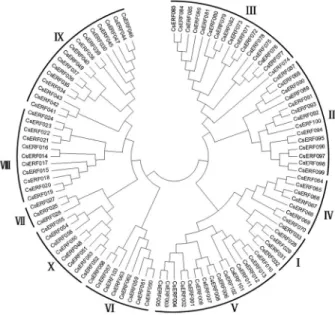
To determine the evolutionary relationship among CsERF proteins, an unrooted NJ phylogenetic tree was con-structed, with bootstrap analysis (1000 replicates) based on the multiple sequence alignments of the 103CsERF pro-teins (Figure 1). The analysis result showed that the 103 CsERF members were divided into 10 groups, designated I to X, in accordance with the Arabidopsis ERF gene family classification (Nakanoet al., 2006). Detailed information appears in Figure 1 and Table S1. The bootstrapping values for the nodes in this phylogenetic tree were not high in ev-ery case, similar to the results of the phylogenetic analysis done on Arabidopsis ERF proteins (Nakanoet al., 2006).
Table 1- Summary of the structure and size of each group of the AP2/ERF superfamily in cucumber, compared with those in Arabidopsis and rice, as classified by Nakanoet al.(2006). Totals for each family are in bold-type.
Family Subfamily Group Cucumber Arabidopsis Rice
AP2 20 18 29
ERF 103 122 139
DREB 42 57 56
I 5 10 9
II 10 16 15
III 20 22 26
IV 7 9 6
ERF 61 65 76
V 15 12 11
VI 8 8 6
VII 3 5 15
VIII 11 15 13
IX 16 18 18
X 8 7 13
a single group 7
RAV 4 6 5
Soloist 4 1 1
This is most likely due to the AP2/ERF domain being rela-tively short, and members within the subfamily highly con-served, with relatively few informative-character positions. NJ-tree reliability was certified by generating another phylogenetic tree by MP analysis (Figure S3), whereupon it was found that nearly all theCsERFmembers were placed within the same groups.
Conserved motifs outside the AP2/ERF domain
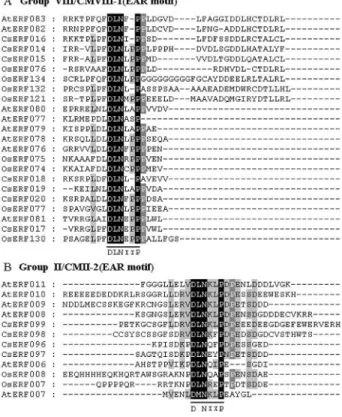
Regions outside the DNA-binding domain in tran-scription factors generally contain either functionally im-portant domains, or motifs associated with transcription-regulation and nuclear localization (Liuet al., 1999). Pro-teins within a group that share these domains or motifs in a phylogenetic tree are likely to share similar functions. It has been reported that an ERF-associated amphiphilic repres-sion (EAR) motif (DLNxxP) is a represrepres-sion domain in the C-terminal regions of the repressor-type ERF proteins playing key roles in several biological functions by nega-tively regulating genes involved in developmental, hor-monal and stress signaling pathways (Fujimotoet al., 2000; Ohtaet al., 2001). Motif analysis in this study revealed that the EAR motif was only found among proteins within groups II and VIII, as CMII-2 and CMVIII-1 motifs, re-spectively (Figure 2, Figure 3, Table S2), thus leading us to suspect their involvement in negative-regulation functions. Previous research showed that the Cys repeat sequence-CX2CX4CX2~4C, possibly a zinc-finger motif, plays a part either in DNA binding, or in protein-protein interactions (Nakanoet al., 2006). such a consensus sequence was only found within the CMX-2 motif in the N-terminal region of
group X proteins. Liuet al.(1999) believed that regions of acidic amino acid-rich, Gln-rich, Pro-rich, and/or Ser/Thr-rich amino acid sequences, can usually be designated as transcriptional-activation domains (Liuet al., 1999). The conserved motifs identified in this study have similar fea-tures, such as Gln-rich in group III as the CMIII-7 motif, Pro-rich in group III as the CMIII-2 motif, and/or Ser/Thr-rich in group VIII as the CMVIII-4 motif (Figure 2; Table S2).
In addition, we also found that most of the motifs were selectively distributed among the specific clades in the phylogenetic tree, thereby demonstrating structural si-milarities among members within the same group (Figu-re 2, Table S2).
Figure 1- Phylogenetic analysis of 103 cucumber ERF proteins. An unrooted neighbor-joining phylogenetic tree was constructed using MEGA4 for the multiple sequence alignment of 103 cucumber ERF pro-tein sequences. 10 groups are marked I to X, as described by Nakanoet al., (2006).
Structure and evolution ofCsERFgenes
Apparently, most ArabidopsisERFgenes do not pos-sess introns (Sakumaet al., 2002). A similar situation also appeared in this study, among the 103CsERF genes, 83 (81%) having no intron, the remaining 20, unevenly distrib-uted in groups I, IV, V, VII and X, having only one or two introns (Figure 2). As shown in Figure 2, 17 of the 20 pos-sess only a single intron, and the other three genes CsERF002, CsERF009andCsERF050 possess two. The presence and position of the introns was highly conserved in each group, thus further validating the reliability of the cucumber ERF-family gene classification in this study.
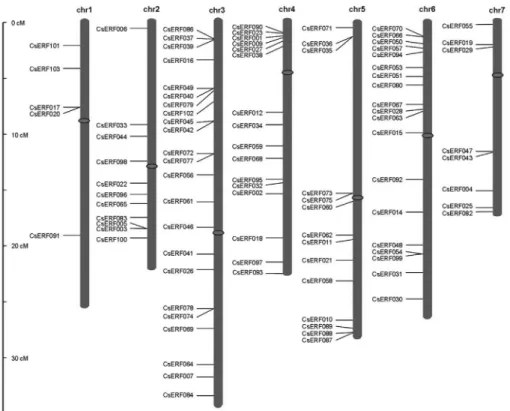
The genomic distribution of the 103 CsERF genes was analyzed, in order to acquire an insight into their evolu-tion. With the exception of the seven genes CsERF008, CsERF013, CsERF024, CsERF052, CsERF076, CsERF081 and CsERF085 lying within unassembled scaffold000393, scaffold000131, scaffold000677, scaffold000111, scaffold000379, scaffold000576 and scaffold000118, respectively, the remainder were found to be unevenly distributed among seven chromosomes (Fig-ure 4, Table S1). As indicated in Fig(Fig-ure 4, some, clustered
in a large group, within the same small chromosomal re-gion, as, for example, group III members CsERF087, CsERF088andCsERF089, located in a region close to a telomere on chromosome 5, whereas other members of this group were distributed among different chromosomes,i.e., CsERF083in chromosome 2 andCsERF090in chromo-some 4. A similar situation also occurred amongOsERF andAtERFmembers (Nakanoet al., 2006), thereby indicat-ing thatERF genes are distributed widely within the ge-nome of the common ancestor of monocots and eudicots.
Although previous research has shown that whole-genome duplication, as a recent event, is not the case with cucumbers, several tandem duplications have in fact actu-ally occurred (Huanget al., 2009), with considerable im-pact on the increase in the number of family genes in the genome. As the analysis of 100 kb DNA segments flanking eachCsERFgene indicated that none could have derived from segment duplication, it is most likely that tandem du-plication played a crucial role in gene multidu-plication. Ac-cording to previously reported results with Arabidopsis, members of groups III and IX play crucial roles in biotic and/or abiotic stress response. Our analyses indicated both to be the two largest groups, gene multiplication in the two possibly having arisen from the higher frequency of tandem duplication, as a means of adapting to various environment changes.
In silicoidentification ofERFgenes in Arabidopsis and rice, and a comparative analysis of cucumbers
As a previous report indicated there to be 122 and 139 ERF family members distributed within Arabidopsis and rice genomes, respectively (Nakano et al., 2006), Arabidopsis and rice genomes were re-screened for ERF sequences, with the subsequent discovery of a further four AtERF and six OsERF genes, designated as AtERF123~AtERF126andOsERF140~OsERF145(Table S3), respectively, based on the names of the previous 122 AtERFs and 139OsERFs. This discrepancy is probably ow-ing to fresh information on Arabidopsis and rice genome sequences.
To define the evolutionary relationship of cucumber ERF family proteins with those of Arabidopsis and rice, an unrooted neighbor-joining (NJ) phylogenetic tree was gen-erated, based on bootstrap analysis (1000 replicates) of multiple sequence alignment of their respective ERF mem-bers. In addition to the ten groups I to X inArabidopisisand rice, described by Nakanoet al.(2006), another group was found, containing four new AtERF members clustering with three new OsERF members, viz., OsERF140, OsERF142 and OsERF144 (Figure S4). A further three new OsERF members, viz., OsERF141, OsERF143 and OsERF145, were placed in groups I, II and VIII, respec-tively.
Phylogenetic analysis revealed that most CsERF members were closer to eudicot AtERF members than
monocotOsERFs in this classification. For example, based on bootstrap values, three group III CsERF members (CsERF071~CsERF073) clustered with six AtERF (AtERF028~AtERF033), whereas another nine OsERFs (OsERF024~OsERF031,OsERF133) were branched into a single clade (Figure S4). On closely examining group IV, it was found that only one member, CsERF070, was clustered withOsERF117andAtERF052. As previous studies have shown thatAtERF052mainly mediates the effects of exog-enous trehalose on Arabidopsis growth and starch break-down, and vegetative development by sugar, besides re-pressing endosperm induced seed germination,CsERF070 may also participates in these plant-development pro-cesses, the detailed function needs further researched and confirmation. At the same time,CsERF078 was close to AtERF024 in group III and CsERF017 to AtERF081 in group VIII, although the functions of these genes have not, as yet, been rigorously demonstrated.
Usually, the intron/exon position pattern provides clues on evolutionary relationships. Research by Nakanoet al.(2006) indicated that the position of the intron was con-served in ArabidopsisERF groups V, VII, X, with Xb-L containing only one intron. As with Arabidopsis and rice ERF, in the present study, it was revealed that both the pres-ence and position ofCsERFintrons in groups IV, V, VII and X were highly conserved, with only one or two excep-tions (Figure 2). Thus, besides further validating the
classi-fication ofCsERFfamily genes, this was an indication of the conservation of intron position patterns that existed in the common ancestor of monocots and eudicots. On the other hand, and in the same group, introns were observed in only one species, but not in others. For example, two CsERF members in group I, namely CsERF028 and CsERF031, possessed one intron at the N-terminal region, althoughAtERFandOsERFmembers in the same group possessed none. A similar situation also occured in group II, twoOsERFmembers,OsERF015andOsERF016, hav-ing one intron, andCsERFandAtERFmembers none, thus possibly indicating intron insertion after the divergence of monocots and eudicots.
As described above, proteins within a group that share conserved domains or motifs outside the DNA-binding domain in transcription factors in a phylogenetic tree, are likely to share similar functions. Cheong et al. (2003) believed that the CMVII-4 motif, as a putative MAP kinase phosphorylation site inOsEREBP1, and the phos-phorylation ofOsEREBP1, resulted in the enhancement of its binding to the GCC box and GCC box-mediated trans-criptional activation. Conserved motif analysis showed that the very CMVII-4 motif (CMVII-3 in this study) has been observed in CsERF025 and CsERF026 in group VII, OsERF070~OsERF072 in rice, and AtERF074 and AtERF075 in Arabidopsis. Whether CsERF025 and
CsERF026share similar functions in transcriptional activa-tion regulaactiva-tion, needs to be confirmed.
Expression analysis of 103 cucumberERFgenes
As gene expression patterns are often correlated with their functions, the ESTs, created by partially sequencing randomly isolated gene transcripts, have proved to be in-valuable in discovery through expression pattern analysis.
By using data originating from both 353,941 previ-ously reported high quality ESTs (Guo et al. 2010) and ~8,210 cucumber ESTs available in GenBank, 41CsERF genes were discovered in at least one tissue among the four investigated,i.e., root, shoot, leaf and flower, the remaining 62 having presented no expression signal. Whereas among the 41 expressed genes, 35, with a high 85% ratio, were found in flowers, two,CsERF067andCsERF072, of the re-maining six were expressed in roots, one,CsERF067, in shoots, and,three,CsERF026,CsERF036, andCsERF045, in leaves. The fact that most sequence tag expression corre-sponded toCsERFgenes in flowers and little in the other tissues, might be due to the 353,941 EST sequences (98%) having all originated from one flower tissue (Guoet al. 2010).
For further study ofCsERFgene expression patterns, two members of each group were selected for RT-PCR analysis with RNA from roots, stems, leaves and flowers. In general, patterns were conserved within subfamilies, al-though expression levels of specific members could change in different organs. Similar expression patterns were ob-served among members belonging to 6 groups ofCsERF genes (I, III, IV, VII, VIII, X). Among these, the members of 4 groups (I, VII, VIII, X) were expressed wherever in-vestigated, thereby implying that these genes could play regulatory roles in various cucumber tissues. As regards the other two groups,CsERF067andCsERF068from group IV presented transcript signals in three plant tissues, whereas in group III,CsERF072andCsERF073transcript signals were detected only in the root and stem, a possible indication of their taking part in specific biological pro-cesses in cucumber vegetative development. Given that similar expression patterns were observed in two members in each group, it is speculated that this similarity might also extend to other group-members, pending corroboration by further experiments.
On the other hand, expression patterns in members of the other 4 groups (II, V, VI and IX) were varied. As indi-cated in Figure 5, inCsERF02andCsERF03in group V, the high transcript signals detected in three of the four vege-tative tissues were different from those expressed in flow-ers. A similar situation was also found in two members, CsERF057 and CsERF058, in group VI. More obvious variation in gene expression among group members could be observed in the remaining groups, II and IX. Group II memberCsERF087presented transcripts in the stem, leaf and flower, whereas for the other member,CsERF089, no
detectable signal was observed anywhere. In group IX, CsERF051was highly expressed in all the tissues, whereas the other member,CsERF048, was expressed only in the root and stem. The different expression patterns among these 4 groups could imply the existence of a probable intragroup functional divergence.
In summary, after extensive analysis,103 CsERF genes were compared with 126 Arabidopsis and 145 rice ERF genes. The 103CsERF genes were divided into 10 groups, I to X, thus in general accordance with previous studies (Nakanoet al., 2006). This classification was based on the presence and position of the introns and the con-served amino acid sequence motifs outside the AP2/ERF domain. Chromosomal localization and genome distribu-tion revealed that tandem duplicadistribu-tion may have contributed toCsERF-gene expansion. Expression data revealed the widespread distribution of this gene family within cucum-ber plant tissues. Furthermore, in most of the groups, two different members presented similar expression patterns, whereby a possible basis for functional analysis to discover the role ofCsERFgenes in cucumber development.
Acknowledgments
The authors wish to thank Zhonghua Zhang for help with statistical analysis. This work was supported by the National Natural Science Foundation of China (31060262), the Natural Science Foundation of Jiangxi, China (2009GQN0034) and the Foundation of Jiangxi Agricul-tural University, Jiangxi, China (2009).
References
Aharoni A, Dixit S, Jetter R, Thoenes E, van Arkel G and Pereira A (2004) The SHINE clade of AP2 domain transcription factors activates wax biosynthesis, alters cuticle properties,
and confers drought tolerance when overexpressed in Arabidopsis. Plant Cell 16:2463-2480.
Altschul SF, Madden TL, Schaffer AA, Zhang J, Zhang Z, Miller W and Lipman DJ (1997) Gapped BLAST and PSI-BLAST: A new generation of protein database search programs. Nu-cleic Acids Res 25:3389-3402.
Aukerman MJ and Sakai H (2003) Regulation of flowering time and floral organ identity by a MicroRNA and its APE-TALA2-like target genes. Plant Cell 15:2730-2741. Bailey PC, Martin C, Toledo-Ortiz G, Quail PH, Huq E, Heim
MA, Jakoby M, Werber M and Weisshaar B (2003) Update on the basic helix-loop-helix transcription factor gene fam-ily inArabidopsis thaliana. Plant Cell 15:2497-2502. Boutilier K, Offringa R, Sharma VK, Kieft H, Ouellet T, Zhang L,
Hattori J, Liu CM, van Lammeren AA, Miki BL, et al.
(2002) Ectopic expression of BABY BOOM triggers a con-version from vegetative to embryonic growth. Plant Cell 14:1737-1749.
Broun P, Poindexter P, Osborne E, Jiang CZ and Riechmann JL (2004) WIN1, a transcriptional activator of epidermal wax accumulation in Arabidopsis. Proc Natl Acad Sci USA 101:4706-4711.
Brown RL, Kazan K, McGrath KC, Maclean DJ and Manners JM (2003) A role for the GCC-box in jasmonate-mediated acti-vation of the PDF1.2 gene of Arabidopsis. Plant Physiol 132:1020-1032.
Cao Y, Song F, Goodman RM and Zheng Z (2006) Molecular characterization of four rice genes encoding ethylene-responsive transcriptional factors and their expressions in response to biotic and abiotic stress. J Plant Physiol 163:1167-1178.
Che P, Lall S, Nettleton D and Howell SH (2006) Gene expression programs during shoot, root, and callus development in Arabidopsis tissue culture. Plant Physiol 141:620-637. Cheong YH, Moon BC, Kim JK, Kim CY, Kim MC, Kim IH, Park
CY, Kim JC, Park BO, Koo SC,et al.(2003) BWMK1, a rice mitogen-activated protein kinase, locates in the nucleus and mediates pathogenesis-related gene expression by acti-vation of a transcription factor. Plant Physiol 132:1961-1972.
Corpet F (1988) Multiple sequence alignment with hierarchical clustering. Nucleic Acids Res 16:10881-10890.
Dong CJ and Liu JY (2010) The Arabidopsis EAR-motif-con-taining protein RAP2.1 functions as an active transcriptional repressor to keep stress responses under tight control. BMC Plant Biol 10:e47.
Elliott RC, Betzner AS, Huttner E, Oakes MP, Tucker WQ, Gerentes D, Perez P and Smyth DR (1996) AINTEGU-MENTA, an APETALA2-like gene of Arabidopsis with pleiotropic roles in ovule development and floral organ growth. Plant Cell 8:155-168.
Felsenstein J (1989) PHYLIP: Phylogeny Inference Package. Cla-distics 5:164-166.
Fujimoto SY, Ohta M, Usui A, Shinshi H and Ohme-Takagi M (2000) Arabidopsis ethylene-responsive element binding factors act as transcriptional activators or repressors of GCC box-mediated gene expression. Plant Cell 12:393-404. Gilmour SJ, Sebolt AM, Salazar MP, Everard JD and Thomashow
MF (2000) Overexpression of the Arabidopsis CBF3 trans-criptional activator mimics multiple biochemical changes
associated with cold acclimation. Plant Physiol 124:1854-1865.
Guo S, Zheng Y, Joung JG, Liu S, Zhang Z, Crasta OR, Sobral BW, Xu Y, Huang S and Fei Z (2010) Transcriptome se-quencing and comparative analysis of cucumber flowers with different sex types. BMC Genomics 11:e384. Hall TA (1999) BioEdit: A user-friendly biological sequence
alignment editor and analysis program for Windows 95/98/NT. Nucleic Acids Symp Ser 41:95-98.
Hinz M, Wilson IW, Yang J, Buerstenbinder K, Llewellyn D, Dennis ES, Sauter M and Dolferus R (2010) Arabidopsis RAP2.2: An ethylene response transcription factor that is important for hypoxia survival. Plant Physiol 153:757-772. Hu YX, Wang YX, Liu XF and Li JY (2004)ArabidopsisRAV1 is down-regulated by brassinosteroid and may act as a nega-tive regulator during plant development. Cell Res 14:8-15. Huang S, Li R, Zhang Z, Li L, Gu X, Fan W, Lucas WJ, Wang X,
Xie B, Ni P,et al.(2009) The genome of the cucumber,
Cucumis sativusL. Nat Genet 41:1275-1281.
Ikeda Y, Banno H, Niu QW, Howell SH and Chua NH (2006) The ENHANCER OF SHOOT REGENERATION 2 gene in Arabidopsis regulates CUP-SHAPED COTYLEDON 1 at the transcriptional level and controls cotyledon develop-ment. Plant Cell Physiol 47:1443-1456.
Iwase A, Mitsuda N, Koyama T, Hiratsu K, Kojima M, Arai T, Inoue Y, Seki M, Sakakibara H, Sugimoto K,et al.(2011) The AP2/ERF transcription factor WIND1 controls cell dedifferentiation in Arabidopsis. Curr Biol 21:508-514. Jin LG and Liu JY (2008) Molecular cloning, expression profile
and promoter analysis of a novel ethylene responsive tran-scription factor gene GhERF4 from cotton (Gossypium hirstum). Plant Physiol Biochem 46:46-53.
Larkin MA, Blackshields G, Brown NP, Chenna R, McGettigan PA, McWilliam H, Valentin F, Wallace IM, Wilm A, Lopez R,et al.(2007) Clustal W and Clustal X v. 2.0. Bioinfor-matics 23:2947-2948.
Letunic I, Copley RR, Schmidt S, Ciccarelli FD, Doerks T, Schultz J, Ponting CP and Bork P (2004) SMART 4.0: To-wards genomic data integration. Nucleic Acids Res 32:D142-D144.
Li XP, Tian AG, Luo GZ, Gong ZZ, Zhang JS and Chen SY (2005) Soybean DRE-binding transcription factors that are responsive to abiotic stresses. Theor Appl Genet 110:1355-1362.
Licausi F, Giorgi FM, Zenoni S, Osti F, Pezzotti M and Perata P (2010) Genomic and transcriptomic analysis of the AP2/ERF superfamily in Vitis vinifera. BMC Genomics 11:e719.
Lim CJ, Hwang JE, Chen H, Hong JK, Yang KA, Choi MS, Lee KO, Chung WS, Lee SY and Lim CO (2007) Over-expression of the Arabidopsis DRE/CRT-binding transcrip-tion factor DREB2C enhances thermotolerance. Biochem Biophys Res Commun 362:431-436.
Lin RC, Park HJ and Wang HY (2008) Role of Arabidopsis RAP2.4 in regulating light- and ethylene-mediated develop-mental processes and drought stress tolerance. Mol Plant 1:42-57.
Liu Q, Kasuga M, Sakuma Y, Abe H, Miura S, Yamaguchi-Shinozaki K and Yamaguchi-Shinozaki K (1998) Two transcription fac-tors, DREB1 and DREB2, with an EREBP/AP2 DNA bind-ing domain separate two cellular signal transduction path-ways in drought- and low-temperature-responsive gene expression, respectively, in Arabidopsis. Plant Cell 10:1391-1406.
Moose SP and Sisco PH (1996) Glossy15, an APETALA2-like gene from maize that regulates leaf epidermal cell identity. Genes Dev 10:3018-3027.
Nag A and Yang Y and Jack T (2007) DORNROSCHEN-LIKE, an AP2 gene, is necessary for stamen emergence in Arabidopsis. Plant Mol Biol 65:219-232.
Nakano T, Suzuki K, Fujimura T and Shinshi H (2006) Ge-nome-wide analysis of the ERF gene family in Arabidopsis and rice. Plant Physiol 140:411-432.
Nakashima K, Shinwari ZK, Sakuma Y, Seki M, Miura S, Shino-zaki K and Yamaguchi-ShinoShino-zaki K (2000) Organization and expression of two Arabidopsis DREB2 genes encoding DRE-binding proteins involved in dehydration- and high-salinity-responsive gene expression. Plant Mol Biol 42:657-665.
Nicholas KB, Nicholas Jr HB and Deerfield II DW (1997) GeneDoc: Analysis and visualization of genetic variation. Embnew News 4:14.
Ogawa T, Pan L, Kawai-Yamada M, Yu LH, Yamamura S, Koyama T, Kitajima S, Ohme-Takagi M, Sato F and Uchi-miya H (2005) Functional analysis of Arabidopsis ethyl-ene-responsive element binding protein conferring resis-tance to Bax and abiotic stress-induced plant cell death. Plant Physiol 138:1436-1445.
Ohta M, Matsui K, Hiratsu K, Shinshi H and Ohme-Takagi M (2001) Repression domains of class II ERF transcriptional repressors share an essential motif for active repression. Plant Cell 13:1959-1968.
Page RD (1996) TreeView: An application to display phylogen-etic trees on personal computers. Comput Appl Biosci 12:357-358.
Parenicova L, de Folter S, Kieffer M, Horner DS, Favalli C, Busscher J, Cook HE, Ingram RM, Kater MM, Davies B,et al.(2003) Molecular and phylogenetic analyses of the com-plete MADS-box transcription factor family in Arabidopsis: New openings to the MADS world. Plant Cell 15:1538-1551.
Pre M, Atallah M, Champion A, De Vos M, Pieterse CM and Memelink J (2008) The AP2/ERF domain transcription fac-tor ORA59 integrates jasmonic acid and ethylene signals in plant defense. Plant Physiol 147:1347-1357.
Qin F, Sakuma Y, Tran LS, Maruyama K, Kidokoro S, Fujita Y, Fujita M, Umezawa T, Sawano Y, Miyazono K,et al.(2008) Arabidopsis DREB2A-interacting proteins function as RING E3 ligases and negatively regulate plant drought stress-responsive gene expression. Plant Cell 20:1693-1707. Rashotte AM, Mason MG, Hutchison CE, Ferreira FJ, Schaller GE and Kieber JJ (2006) A subset of Arabidopsis AP2 tran-scription factors mediates cytokinin responses in concert with a two-component pathway. Proc Natl Acad Sci USA 103:11081-11085.
Riechmann JL, Heard J, Martin G, Reuber L, Jiang C, Keddie J, Adam L, Pineda O, Ratcliffe OJ, Samaha RR,et al.(2000)
Arabidopsis transcription factors: Genome-wide compara-tive analysis among eukaryotes. Science 290:2105-2110. Sakuma Y, Liu Q, Dubouzet JG, Abe H, Shinozaki K and
Yama-guchi-Shinozaki K (2002) DNA-binding specificity of the ERF/AP2 domain of Arabidopsis DREBs, transcription fac-tors involved in dehydration- and cold-inducible gene ex-pression. Biochem Biophys Res Commun 290:998-1009. Schmid M, Uhlenhaut NH, Godard F, Demar M, Bressan R,
Weigel D and Lohmann JU (2003) Dissection of floral in-duction pathways using global expression analysis. Devel-opment 130:6001-6012.
Shaikhali J, Heiber I, Seidel T, Stroher E, Hiltscher H, Birkmann S, Dietz KJ and Baier M (2008) The redox-sensitive tran-scription factor Rap2.4a controls nuclear expression of 2-Cys peroxiredoxin A and other chloroplast antioxidant en-zymes. BMC Plant Biol 8:e48.
Sharma MK, Kumar R, Solanke AU, Sharma R, Tyagi AK and Sharma AK (2010) Identification, phylogeny, and transcript profiling of ERF family genes during development and abiotic stress treatments in tomato. Mol Genet Genomics 284:455-475.
Sharoni AM, Nuruzzaman M, Satoh K, Shimizu T, Kondoh H, Sasaya T, Choi IR, Omura T and Kikuchi S (2011) Gene structures, classification and expression models of the AP2/EREBP transcription factor family in rice. Plant Cell Physiol 52:344-360.
Solano R, Stepanova A, Chao Q and Ecker JR (1998) Nuclear events in ethylene signaling: A transcriptional cascade me-diated by INSENSITIVE3 and ETHYLENE-RESPONSE-FACTOR1. Genes Dev 12:3703-3714. Stockinger EJ, Gilmour SJ and Thomashow MF (1997)
Arabidopsis thalianaCBF1 encodes an AP2 domain-con-taining transcriptional activator that binds to the C-repeat/DRE, a cis-acting DNA regulatory element that stim-ulates transcription in response to low temperature and wa-ter deficit. Proc Natl Acad Sci USA 94:1035-1040. Tamura K, Dudley J, Nei M and Kumar S (2007) MEGA4:
Molec-ular Evolutionary Genetics Analysis (MEGA) software v. 4.0. Mol Biol Evol 24:1596-1599.
Toledo-Ortiz G, Huq E and Quail PH (2003) The Arabidopsis ba-sic/helix-loop-helix transcription factor family. Plant Cell 15:1749-1770.
van der Fits L and Memelink J (2000) ORCA3, a jasmonate-responsive transcriptional regulator of plant primary and secondary metabolism. Science 289:295-297.
Vernie T, Moreau S, de Billy F, Plet J, Combier JP, Rogers C, Oldroyd G, Frugier F, Niebel A and Gamas P (2008) EFD Is an ERF transcription factor involved in the control of nodule number and differentiation in Medicago truncatula. Plant Cell 20:2696-2713.
Welsch R, Maass D, Voegel T, Dellapenna D and Beyer P (2007) Transcription factor RAP2.2 and its interacting partner SINAT2: Stable elements in the carotenogenesis of Arabidopsis leaves. Plant Physiol 145:1073-1085.
Wessler SR (2005) Homing into the origin of the AP2 DNA bind-ing domain. Trends Plant Sci 10:54-56.
Xu H, Wang X and Chen J (2010) Overexpression of the Rap2.4f transcriptional factor in Arabidopsis promotes leaf senes-cence. Sci China Life Sci 53:1221-1226.
puta-tiveMedicago truncatulaAP2 domain-containing transcrip-tion factor gene, increases cuticular wax accumulatranscrip-tion and enhances drought tolerance in transgenic alfalfa (Medicago sativa). Plant J 42:689-707.
Zhuang J, Cai B, Peng RH, Zhu B, Jin XF, Xue Y, Gao F, Fu XY, Tian YS, Zhao W,et al.(2008) Genome-wide analysis of the AP2/ERF gene family in Populus trichocarpa. Biochem Biophys Res Commun 371:468-474.
Zhu Q, Zhang J, Gao X, Tong J, Xiao L, Li W and Zhang H (2010) The Arabidopsis AP2/ERF transcription factor RAP2.6 par-ticipates in ABA, salt and osmotic stress responses. Gene 457:1-12.
Internet Resources
Cucumber Genome Initiative (CuGI), http://cucum-ber.genomics.org.cn (October 15, 2010). Clustal X, http://www.clustal.org (October 20, 2010).
GeneDoc tool, http://www.nrbsc.org/gfx/genedoc/ (October 20, 2010).
Multalin software,
http://multalin.toulouse.inra.fr/multalin/multalin.html (Oc-tober 20, 2010).
MEGA4, http://www.megasoftware.net/index.html (October 20, 2010).
PHYLIP 3.69, http://evolution.genetics.washing-ton.edu/phylip.html (October 20, 2010). TreeView1.6.6,
http://taxonomy.zool-ogy.gla.ac.uk/rod/treeview.html (October 20, 2010). MEME, http://meme.sdsc.edu/meme4_4_0/cgi-bin/meme.cgi
(October 20, 2010).
GSDS, http://gsds.cbi.pku.edu.cn/ (October 20, 2010). MapInspect,
http://www.plantbreeding.wur.nl/UK/soft-ware_mapinspect.html (October 20, 2010).
BioEdit5.0.6, http://www.mbio.ncsu.edu/BioEdit/bioedit.html (October 20, 2010).
TIGR Arabidopsis annotation deduced protein database, http://www.tigr.org/tdb/e2k1/ath1/ (October 15, 2010). Rice genome, release version 5 of TIGR pseudomolecules,
http://rice.plantbiology.msu.edu/ (October 15, 2010).
Supplementary Material
The following material is available for this article: Figure S1 - Multiple sequence alignment of the AP2/ERF domain.
Figure S2 - Multiple sequence alignment of the AP2/ERF domains.
Figure S3 - Phylogenetic analysis of 103 cucumber ERF proteins.
Figure S4 - Comparative phylogenetic analysis of cu-cumber ERFs with those of Arabidopsis and rice.
Table S1 - TheCsERFgenes identified in this study. Table S2 - Summary of conserved motifs (CMs) within the CsERF family.
Table S3 - NewAtERFandOsERFgenes identified in this study.
Table S4 - Information on the primers used in RT-PCR reactions.
This material is available as part of the online article from http://www.scielo.br/gmb.
Associate Editor: Adriana Silva Hemerly
33 defined by multiple sequence alignment (Figure S2).
Serial No.
Gene
Name Gene ID CuGI(5'-3')
Length of chr (bp)
Chromosomal location
Length (a.a.)
No. of Introns
Group name
1 CsERF001 Csa002836 1350153-1349175 22434855 4 180 1 V
2 CsERF002 Csa014841 15208734-15209357 22434855 4 138 2 V
3 CsERF003 Csa005862 18494975-18495575 22000590 2 164 1 V
4 CsERF004 Csa001957 15271088-15271957 17370973 7 196 1 V
5 CsERF005 Csa005861 18488382-18489011 22000590 2 175 1 V
6 CsERF006 Csa006854 631812-630472 22000590 2 246 1 V
7 CsERF007 Csa002035 31922812-31923895 34445220 3 194 1 V
8 CsERF008 Csa022657 8462-9248 13703 Scaffold000393 223 1 V
9 CsERF009 Csa003049 1527385-1528304 22434855 4 190 2 V
10 CsERF010 Csa009694 26544766-26545851 28091742 5 361 0 V
11 CsERF011 Csa015404 19399419-19400496 28091742 5 212 0 V
12 CsERF012 Csa020206 8143974-8143339 22434855 4 211 0 V
13 CsERF013 Csa019531 316141-316866 319939 Scaffold000131 241 0 V
14 CsERF014 Csa007982 17124858-17125502 26547709 6 214 0 VIII
15 CsERF015 Csa011614 9915259-9915918 26547709 6 219 0 VIII
16 CsERF016 Csa019805 3390113-3389469 34445220 3 214 0 VIII
17 CsERF017 Csa016336 7651209-7651703 25430643 1 164 0 VIII
18 CsERF018 Csa015626 19286010-19286591 22434855 4 193 0 VIII
19 CsERF019 Csa003390 2180880-2180251 17370973 7 209 0 VIII
20 CsERF020 Csa016229 7666682-7666047 25430643 1 211 0 VIII
21 CsERF021 Csa000861 21263555-21264580 28091742 5 341 0 VIII
22 CsERF022 Csa011398 14429466-14430542 22000590 2 358 0 VIII
23 CsERF023 Csa003016 1119240-1119923 22434855 4 227 0 VIII
24 CsERF024 Csa023463 3481-4167 6853 Scaffold000677 228 0 VIII
25 CsERF025 Csa009872 16743027-16740950 17370973 7 389 1 VII
26 CsERF026 Csa013360 22272823-22271143 34445220 3 370 1 VII
27 CsERF027 Csa002799 1832463-1831545 22434855 4 272 1 VII
28 CsERF028 Csa007704 7871002-7869906 26547709 6 337 1 I
29 CsERF029 Csa003368 2420250-2419057 17370973 7 397 0 I
30 CsERF030 Csa000642 24948986-24949513 26547709 6 175 0 IX
31 CsERF031 Csa012067 22481978-22481499 26547709 6 250 1 I
32 CsERF032 Csa011099 14386960-14385884 22434855 4 358 0 I
33 CsERF033 Csa006177 9209327-9208125 22000590 2 400 0 I
34 CsERF034 Csa016672 9166496-9167080 22434855 4 194 0 IX
35 CsERF035 Csa012537 1252601-1253083 28091742 5 160 0 IX
36 CsERF036 Csa012536 1247100-1247813 28091742 5 237 0 IX
37 CsERF037 Csa017104 1586163-1585129 34445220 3 344 0 IX
38 CsERF038 Csa002749 2287694-2286942 22434855 4 250 0 IX
34
42 CsERF042 Csa000150 8965136-8964735 34445220 3 133 0 IX
43 CsERF043 Csa019346 11809343-11809789 17370973 7 148 0 IX
44 CsERF044 Csa022480 10161945-10162631 22000590 2 228 0 IX
45 CsERF045 Csa000151 8945006-8944320 34445220 3 228 0 IX
46 CsERF046 Csa001354 18506357-18505683 34445220 3 224 0 IX
47 CsERF047 Csa019306 11796883-11796188 17370973 7 231 0 IX
48 CsERF048 Csa010078 20115512-20116789 26547709 6 338 1 X
49 CsERF049 Csa000408 6003134-6002700 34445220 3 144 0 IX
50 CsERF050 Csa005593 1951916-1955219 26547709 6 364 2 X
51 CsERF051 Csa008584 4931216-4930683 26547709 6 177 0 X
52 CsERF052 Csa018661 326047-327680 411159 Scaffold000111 285 1 X
53 CsERF053 Csa008878 4066091-4064303 26547709 6 404 1 X
54 CsERF054 Csa010237 20921657-20921076 26547709 6 193 0 VII
55 CsERF055 Csa003542 358765-357989 17370973 7 258 0 VII
56 CsERF056 Csa008749 13733610-13732786 34445220 3 274 0 VII
57 CsERF057 Csa008966 2537686-2538642 26547709 6 318 0 VI
58 CsERF058 Csa001015 23085965-23086894 28091742 5 309 0 VI
59 CsERF059 Csa020336 11118158-11119108 22434855 4 316 0 VI
60 CsERF060 Csa012752 15983553-15984509 28091742 5 318 0 VI
61 CsERF061 Csa019969 16219410-16220390 34445220 3 326 0 VI
62 CsERF062 Csa015455 19016343-19015537 28091742 5 268 0 VI
63 CsERF063 Csa007656 8048779-8049393 26547709 6 204 0 VI
64 CsERF064 Csa017883 30847250-30846696 34445220 3 184 0 IV
65 CsERF065 Csa003622 16252055-16252693 22000590 2 212 0 IV
66 CsERF066 Csa005696 1334610-1333345 26547709 6 421 0 IV
67 CsERF067 Csa007621 7427734-7428273 26547709 6 179 0 IV
68 CsERF068 Csa018854 12152362-12151250 22434855 4 370 0 IV
69 CsERF069 Csa002451 27503953-27503030 34445220 3 230 1 IV
70 CsERF070 Csa005700 1276290-1275373 26547709 6 305 0 IV
71 CsERF071 Csa012414 522938-522336 28091742 5 200 0 III
72 CsERF072 Csa008861 11874380-11873739 34445220 3 213 0 III
73 CsERF073 Csa012870 15262990-15262313 28091742 5 225 0 III
74 CsERF074 Csa004675 25841918-25841304 34445220 3 204 0 III
75 CsERF075 Csa012869 15277531-15276773 28091742 5 252 0 III
76 CsERF076 Csa022610 8225-7716 15472 Scaffold000379 169 0 III
77 CsERF077 Csa008860 11887175-11886597 34445220 3 192 0 III
78 CsERF078 Csa005091 25834056-25834607 34445220 3 183 0 III
79 CsERF079 Csa000388 6224581-6224039 34445220 3 180 0 III
80 CsERF080 Csa008546 5675974-5675333 26547709 6 213 0 III
81 CsERF081 Csa023237 1739-1134 8810 Scaffold000576 201 0 III
82 CsERF082 Csa009843 17099285-17098680 17370973 7 201 0 III
35
86 CsERF086 Csa017112 1509830-1509186 34445220 3 214 0 III
87 CsERF087 Csa009589 27747151-27746573 28091742 5 192 0 II
88 CsERF088 Csa009590 27726472-27725981 28091742 5 163 0 II
89 CsERF089 Csa009622 27355787-27355296 28091742 5 163 0 II
90 CsERF090 Csa003012 1044217-1044711 22434855 4 164 0 II
91 CsERF091 Csa012919 19140452-19139841 25430643 1 203 0 II
92 CsERF092 Csa013079 14191691-14192332 26547709 6 213 0 II
93 CsERF093 Csa009304 22349007-22348447 22434855 4 186 0 II
94 CsERF094 Csa008952 2719822-2719217 26547709 6 201 0 II
95 CsERF095 Csa011091 14097006-14097704 22434855 4 232 0 II
96 CsERF096 Csa011471 15315130-15315558 22000590 2 142 0 II
97 CsERF097 Csa009478 21425457-21425906 22434855 4 149 0 II
98 CsERF098 Csa020278 12479634-12480113 22000590 2 159 0 II
99 CsERF099 Csa010224 21063174-21062653 26547709 6 173 0 II
100 CsERF100 Csa005900 19222095-19222541 22000590 2 148 0 II
101 CsERF101 Csa005450 2122879-2123478 25430643 1 199 0 V
102 CsERF102 Csa000299 7196619-7195888 34445220 3 243 0 V
36
Summary of conserved motifs (CMs) within the CsERF family
Serial
No. Gene Name Gene ID CuGI(5'-3')
Length of chr (bp)
Chromosomal
location Length(a.a.)
No. of Introns
1 AtERF123 At2g39250 16398009-16396740 19705359 2 222 4
2 AtERF124 At2g41710 17409981-17407352 19705359 2 423 7
3 AtERF125 At3g54990 20387499-20386013 23470805 3 247 4
37 numbers.
Serial
No. Gene Name Gene ID CuGI(5'-3')
Length of chr (bp)
Chromosomal
location Length(a.a.)
No. of Introns
1 OsERF140 LOC_Os02g29550 17571123-17576025 35930381 2 222 5
2 OsERF141 LOC_Os02g42585 25591508-25590087 35930381 2 473 0
3 OsERF142 LOC_Os05g32270 18749964-18754112 29894789 5 348 7
4 OsERF143 LOC_Os06g09717 4959148-4959771 31246789 6 207 0
5 OsERF144 LOC_Os10g26590 13791722-13792405 23134759 10 227 0
38
Primer name Sequence (5' to 3') Size (bp)
CsERF002_1F GGGTTTCCGAAATTCGTCAT 215
CsERF002_1R CACCGCCGGTATAATCTCCT
CsERF003_1F GAGGCGTTCGTCAAAGACAT 239
CsERF003_1R ACGGTGGAGTTTAGCAGTCA
CsERF014_1F ATTCCATTCTCGCAGCAGTT 361
CsERF014_1R ACAGAGCAGTGGCATGAAGA
CsERF015_1F TGAGTGCGTTCAGGCTAATA 256
CsERF015_1R GTCCATCGGAGGTGGTAAGT
CsERF025_1F TTCAAGGATGATTCCGATTT 216
CsERF025_1R GATTTCTGCTGCCCATTTAC
CsERF027_1F TCCGACATTTGGCCTAACTC 240
CsERF027_1R TTCCTCAGCCGTATTGAAAG
CsERF028_1F GAAGAAGAAGCCTCACAAGC 270
CsERF028_1R TGGGCAAGATGAAGAAGAAG
CsERF030_1F GGGGTAAATACGCTGCCGAGAT 216
CsERF030_1R GCTTCCTCTTCGACGGTGGG
CsERF031_1F AGACTCTGGCTTGGGACCTT 223
CsERF031_1R ACTCCTTCACCCCATTGAGA
CsERF034_1F GAAAGTCGCCGTGGTAGAGG 183
CsERF034_1R AACGCCGCACAGTCATAAGC
CsERF048_1F TCTTCCTCTGTTTCTGCTCCCG 182
CsERF048_1R ACCGTTGCCGACCCTGTTTG
CsERF051_1F CCTGCCAGTATTGCTGCTCC 254
CsERF051_1R TCACCGTAACGATCCTGATCTTCT
CsERF057_1F ATCAATGGATGTAACTACCAGCAC 247
CsERF057_1R GTAGGCTTGGGAGGCTTCTT
CsERF058_1F GAAGAAGGCAAAGGGAGTGG 337
CsERF058_1R TGGGTTCATCATCAGCGAGT
CsERF067_1F AAATTCGAGCACCGAATAGA 287
CsERF067_1R AACTGCACAATCCTCAGACAG
CsERF068_1F AGAAAGGCACTCGTTTATGG 200
CsERF068_1R CGAAGAAGAAGAGGAGGAAG
CsERF072_1F TGTCTCAATTTCGCCGATTC 242
CsERF072_1R GCCATATCCTCCAACAATCC
CsERF073_1F GAGCCGAATAAGAAGACGAG 352
CsERF073_1R AAGATGGAGGAGATAGCAGTAG
CsERF087_1F GAACCAGGAAAGAAGACGAGG 120
CsERF087_1R TGGGAAGTTGAGGCGAGCAT
CsERF089_1F ATTCTCAACTTCCCTGACTCTGT 225
CsERF089_1R GCCAAGTAGACCCAACCTCA
CsACTIN_F GACATTCAATGTGCCTGCTATG 161