Microsatellite variability analysis in farmed catfish (
Ictalurus punctatus
)
from Tamaulipas, Mexico
Laura E. Perales-Flores
1, Ana María Sifuentes-Rincón
1and Francisco J. García de León
2 1Centro de Biotecnología Genómica, Instituto Politécnico Nacional, Tamaulipas, México.
2Programa de Planeación Ambiental y Conservación, Centro de Investigaciones del Noroeste,
La Paz Baja, BCS, México.
Abstract
Analysis of cultured catfish from six farms in Tamaulipas, Mexico was achieved using a combination of microsatellite PCR analysis and semiautomatic fluoresce-based detection, in order to provide a first assessment of the genetic variability on cultured catfish in Mexico. Five microsatellites showed extensive polymorphism with allele numbers ranging from 10 and 20. Overall observed heterozygosity at each locus ranged between 0.76 and 0.91 and the aver-age polymorphic information content (PIC) for the five loci was 0.811, indicating that these loci can be used for stud-ies of paternity identification, linkage and population genetics. On the basis of the FST values (FST= 0.03829; p = 0.00000) it appears that there was a small amount of genetic differentiation between the channel catfish stocks. The high intrapopulation allelic diversity was the most remarkable parameter.
Key words: Ictaluridae, molecular characterization, genetic variability. Received: February 3, 2006; Accepted: November 23, 2006.
Genetic markers development have been impacting research in almost every biological area, including aqua-culture where they have become an important tool for pro-viding information regarding genetic variability, parentage relationships and the performance of lines in breeding
pro-grams (García de Leónet al., 1998; Spidle et al., 2004;
Vandeputte et al., 2004; Rowena et al., 2004; Liu and
Cordes, 2004). Currently a wide variety of markers have been developed for different aquaculture species, such mar-kers include allozymes, amplified fragment length poly-morphisms (AFLPs), expressed sequence tags (ESTs), microsatellites, mtDNA, random amplified polymorphic DNAs (RAPDs), restriction fragment length polymor-phisms (RFLPs) and single nucleotide polymorpolymor-phisms (SNPs) (Liu and Cordes, 2004). Microsatellites are repeti-tive elements characterized by mono, di, tri and tetra nucle-otide arrays and have become one of the most important tools in genetic studies due to their high degree of polymor-phism and conservation between species and families
(FitzSimmonset al., 1995; Pépin et al., 1995; Goldstein
and Schlotterer, 1999; Liuet al., 1999d; Waldbieseret al.,
2001; Cunningham and Meghen, 2001).
The channel catfish (Ictalurus punctatus) is one of the
world-wide highlight species in aquaculture and has been subject of several genomic studies which have led to the
de-velopment of different molecular markers (Carmichaelet
al, 1992; Waldbieser and Bosworth, 1997; Liu et al.,
1998a; 1998b; 1999a; 1999b; 1999c, 1999d); Tan et al.,
1999; Waldbieseret al., 2001). Mickettet al.(2003),
pro-posed that understanding the genetic variation within do-mestic catfish populations is a main requirement for maximizing the selective breeding of this species. More-over, analysis of catfish genetic resources is also important for establish a baseline date for both genetic enhancement programs and genetic conservation programs.
In the Mexican state of Tamaulipas the most
impor-tant aquaculture species apart from shrimp isI. punctatus,
with the production from this state accounting 53% of the
national catfish crop, some blue catfish (Ictalurus furcatus)
are also produced (Tamaulipas-Sedem-Agropesca, 2000).
Although several genetic aspects of I. punctatus and I.
furcatus are well know from gene mapping,
marker-assisted selection, gene cloning, engineering and integrated genetic improvement studies (Liu, 2001), in Mexico the ge-netic variation, breeder fitness and gege-netic structure of both domestic and native populations of this specie is practically unknown. In fact there is no firm data even on the origin of
current cultured I. punctatus, although it is thought they
probably originated in the USA (Rosas, 1981).
Send correspondence to AM Sifuentes. Laboratorio de Biotec-nología Animal I, Centro de BiotecBiotec-nología Genómica, Instituto Politécnico Nacional, Boulevard del Maestro esq. Elías Piña, Col. Narciso Mendoza, Cd. Reynosa, 88710 Tam, México. E-mail: [email protected].
Tanet al.(1999) reported a group of microsatellites
markers, which were described as effective in analysis of the Ictaluridae genome, especially in studies of genetic re-source analysis, stocking success evaluation, population structure, paternity identification and molecular systemat-ics.
The study described in this paper used microsatellite markers to evaluate the genetic variability of cultured-catfish from Tamaulipas Mexico. Since the Mexican cat-fish industry has been developed with little knowledge on the genetic background of breeder-fish the data produced in this study could help to define more focused management strategies to improve the Mexican catfish industry.
Tissue samples were obtained from six of the most productive catfish farms located in the center of the Mexi-can state of Tamaulipas, the farms being: Las Delicias (LA), Acuamex (A), Prodatec (P), El Paraìso (EP), El Tomaseño (ET) and La Lajilla (LL). Sample size varied from 23 to 30 fish per farm and DNA was extracted from
muscle tissue by a standard method (Sambrook et al.,
1989). The total sample number was n = 158.
Genetic diversity at five microsatellite loci was deter-minate using primers Ip077, Ip591, Ip265, Ip427 and Ip607 reported as useful for amplification studies in several
ictalurid catfish (Tanet al., 1999). The PCR conditions for
each loci were individually optimized. Each PCR reaction
was used 50 ng of total DNA, 1.25 U ofTaqDNA
polymer-ase (Promega Co, Madison, Wi. USA), 0.2 M of unla-beled primer and 0.5 mM dNTP’s per 10 L-reaction
volume. The concentrations of MgCl2 were 2 mM for
Ip265, Ip427 and Ip607 loci and 1.75 mM for Ip077 and Ip591. The PCR products were analyzed in a LI-COR se-quencer (LI-COR, Inc. Lincoln, Nebraska USA), 5’-primers being labeled with IRD800 and used at a final concentration of 0.025 M for the Ip265, Ip427 and Ip607 loci and 0.025 M for the Ip077 and Ip591 loci. Amplifica-tion temperature profiles were 94 °C for 30 s, 60 °C for 1 min and 72 °C for 2 min, for 30 cycles. The PCR products were denatured at 95 °C for 5 min and separated by electro-phoresis on 6.5% (w/v) denaturing polyacrylamide-bisacrylamide gel for 2 h.
Allele size data for each locus were obtained using the SAGA GT software (LI-COR,Lincoln, NE). Numbers of alleles (k), observed (Ho) and expected (He) hetero-zygosity, allelic frequencies, and the polymorphic
informa-tion content (PIC, Boststeinet al., 1980) for each locus and
combinations of loci were estimated using the CERVUS
2.0 software (Marshallet al., 1998). The effective number
of alleles was estimated based on the formula: ae= 1/Sxi2,
wherexiis the frequency of theith allele for each locus (Li
et al., 2004). Heterogeneity in allele frequencies among
pair-wise comparisons and exact tests for conformance to Hardy-Weinberg equilibrium (HW) at each locus within samples were performed using the GENEPOP 3.1b
pro-gram (Markov chain method; Raymond and Rousset, 1995).
The genetic structure of the populations was deter-mined by analysis of molecular variance (AMOVA) using
the Arlequin software (Schneideret al., 2000), under a
hier-archical design that considered variations among popula-tions and within individuals.
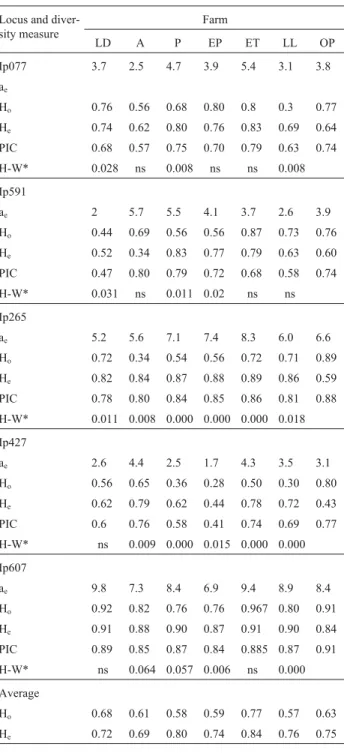
The panel of five microsatellites used in this study ex-hibited high polymorphism in the total studied population (n = 158), with the total number of alleles per locus varying between 10 and 20. The highest number of effective alleles was 8.4 for locus Ip607 and the lowest was 3.1 for locus Ip427 (Table 1). Although the number of detected alleles ranged from 4 for the Ip591 locus in the LD population to 15 for the Ip607 locus in the ET population there were con-siderable differences in the number of alleles per loci be-tween the farms. Private alleles were also present in the six farms (data not shown).
Average observed heterozygosity by loci for the six cultivated catfish populations ranged between 0.57 for the LL population and 0.77 for the ET population, with an aver-age of 0.63 (Table 1). These values are similar to those
de-scribed for a research catfish line (I. punctatus) line in
Auburn USA using a microsatellite panel which including
the five used in our study (Tanet al., 1999) and for selected
strains and farmed wild catfish (I. punctatus) populations
(Waldbieseret al., 2001). The Prodatec farm (P) showed
the highest difference between observed and expected heterozygosity.
Genotype frequencies at all five loci revealed an over-all departure from Hardy-Weinberg expectations in three or more loci per farm, this departure being due to a heterozygote deficit strongly influenced by loci Ip265 and Ip427, which, with the exception of locus Ip427 in the LD population, showed significant HW values in all the popu-lations. The Prodatec farm was the only farm that showed a departure from H-W disequilibrium for all loci, suggesting a high rate of inbreeding in this farm (Table 1). Although the small sample-size could be the main explanation for the HW deviation observed in most of the markers and the six farms, other causes have to be considered in to determined the influence of this deviation, these include null alleles (mainly for loci Ip265 and Ip427) and management prac-tices such as the use of a small number of effective breeders which could lead to endogamy.
The loci used in this study are known to be independ-ent (Liu ZJ, Personal Communication). The polymorphism information content (PIC) is an indicator of how many al-leles a marker has, and how evenly the frequencies of these
alleles are distributed (Boststein et al., 1980) and if a
marker has few alleles, or many alleles but with only one being frequent, the PIC will be low. In our study, locus Ip607 had a PIC value of 0.91 and a high effective number
of alleles ae= 8.4 while the Ip077 locus had a moderate PIC
(ae= 3.8). The fact that all the loci in our study had PIC
val-ues higher than 70% (Table 1) could be considered as good for the selection of polymorphic markers in the study of pa-rental relationships, paternity, and genetic mapping (Blouin
et al.1996; Borrellet al.2002; Chistiacovet al., 2005) but further studies should be conducted to establish the real
dis-crimination power of these markers and to assess their use in identification and pedigree analysis during selection and
management of farmedI. punctatusin Tamaulipas.
Based on the analysis of molecular variance summa-rized in Table 2, global comparisons show that there was
little genetic differentiation among farms (FST= 0.03829;
p = 0.00000). Genetic variation in the studied populations was mainly attributable to individual-level variation, with a percentage of variance of 79.6%. Variation between fish within populations represented 16.56% of the variation while between populations variation was 3.83%. The cat-fish origins and also the cultivation practices could have been responsible for the low level of genetic differentiation
observed between the farms in the FSTanalysis. According
to the catfish producers, the first and unique introduction of a commercial catfish strain into Tamaulipas occurred 25 years ago. There are no reports suggesting recent catfish in-troductions into the Tamaulipas area so it is probable that the stocks studied have the same origin. In addition a com-mon practice acom-mong farmers is to share stock between
neighboring-farms (i.e.between P, A and EP), the
individ-ual catfish being selected on the basis of their observed
phenotypic performance and not their location (i.e. other
locations even within the same state).
Even though we do not know the exact number of breeder-fish in different farms in Tamaulipas the high within individual genetic variance (79.61%) and between individual within populations (16.56%) and the high hete-rozygosity deficit in all the farms could suggest the exis-tence of high temporal variance in allele frequencies due to variation in reproductive success caused by a small number
of effective breeders (Hedgecocket al., 1992). There are
numerous studies that clearly demonstrate a loss of genetic diversity following hatchery culture in aquatic organisms (Beaumont, 1994) and an important conclusion drawn in
several studies (Sbordoniet al., 1986; Gile and Ferguson,
1990) is that the effective population size (Ne) involved in
hatchery “mass spawnings” can be much smaller than the apparent number of progenitors used. Moreover, effective population size is strongly affected by the sex ratio of the progenitors (Allendorf and Ryman 1987) and according to the catfish producers this is indeed the case for the Tamau-lipas farms.
Micketet al., (2003) carried out a genetic diversity
study using AFLP markers and found that there are
differ-ences betweenI. punctatusfarms in Alabama USA, these
authors emphasizing the importance of this information for the management, conservation and selection of catfish brood-stocks. In Tamaulipas, apparently, the management practices for cultivated catfish are a principal cause of heterozygosity deficit because rather than carrying out a single spawning involving many ripe adults from neighbor-ing farms multiple small spawnneighbor-ing with the subsequent pooling of larvae should be attempted. Unfortunately we were unable to obtain any records about the real
manage-Table 1- Effective number of alleles (ae), expected and observed hetero-zygosity (He and Ho respectively), polymorphic information content (PIC) and Hardy-Weinberg values (HW) of five microsatellite markers used in six catfish farms in the Mexican state of Tamaulipas, the farms be-ing: Las Delicias (LA), Acuamex (A), Prodatec (P), El Paraìso (EP), El Tomaseño (ET) and La Lajilla (LL).
Locus and diver-sity measure
Farm
LD A P EP ET LL OP
Ip077 3.7 2.5 4.7 3.9 5.4 3.1 3.8
ae
Ho 0.76 0.56 0.68 0.80 0.8 0.3 0.77
He 0.74 0.62 0.80 0.76 0.83 0.69 0.64
PIC 0.68 0.57 0.75 0.70 0.79 0.63 0.74
H-W* 0.028 ns 0.008 ns ns 0.008
Ip591
ae 2 5.7 5.5 4.1 3.7 2.6 3.9
Ho 0.44 0.69 0.56 0.56 0.87 0.73 0.76
He 0.52 0.34 0.83 0.77 0.79 0.63 0.60
PIC 0.47 0.80 0.79 0.72 0.68 0.58 0.74
H-W* 0.031 ns 0.011 0.02 ns ns
Ip265
ae 5.2 5.6 7.1 7.4 8.3 6.0 6.6
Ho 0.72 0.34 0.54 0.56 0.72 0.71 0.89
He 0.82 0.84 0.87 0.88 0.89 0.86 0.59
PIC 0.78 0.80 0.84 0.85 0.86 0.81 0.88
H-W* 0.011 0.008 0.000 0.000 0.000 0.018
Ip427
ae 2.6 4.4 2.5 1.7 4.3 3.5 3.1
Ho 0.56 0.65 0.36 0.28 0.50 0.30 0.80
He 0.62 0.79 0.62 0.44 0.78 0.72 0.43
PIC 0.6 0.76 0.58 0.41 0.74 0.69 0.77
H-W* ns 0.009 0.000 0.015 0.000 0.000
Ip607
ae 9.8 7.3 8.4 6.9 9.4 8.9 8.4
Ho 0.92 0.82 0.76 0.76 0.967 0.80 0.91
He 0.91 0.88 0.90 0.87 0.91 0.90 0.84
PIC 0.89 0.85 0.87 0.84 0.885 0.87 0.91
H-W* ns 0.064 0.057 0.006 ns 0.000
Average
Ho 0.68 0.61 0.58 0.59 0.77 0.57 0.63
He 0.72 0.69 0.80 0.74 0.84 0.76 0.75
ment practices in the farms studied and therefore we cannot determine with certainty the causes of the low genetic di-versity observed in farmed fish. However, channel catfish producers are now very interested in the design of genetic improvement regimes and our study represents the first step in defining the genetic variation in the actual commercial catfish stocks of this region.
From a conservation point of view, the native cat-fishes of Northeastern México (Tamaulipas included) are
generally poorly known and although severalIctalurus
spe-cies (furcatus, lupusandpunctatus) are recognized various
species have not yet been described (Miller, 2005). There has not been an initial baseline evaluation of the native
pop-ulations ofI. furcatusandI. punctatusor any other catfish
wild populations in order to start the aquaculture practices in the region, but it has been presumed that domestic and
native populations have hybridized (García de Leónet al.,
2005). The consequence of this hybridization is that co-adapted gene complexes may have broken down and uni-que alleles could have been lost in wild fish populations fol-lowing extensive hybridization and introgression of genes from cultivated fish (Beaumont, 1994). The genetic impact of such hybridization and introgression of genes on native populations requires further attention and the genetic mark-ers tested in our study will find immediate application not only in tracking pedigrees and establishing breeding pro-grams but also in the analyses of local wild-type catfish populations.
Acknowledgments
The authors are grateful to Acuamex personal for technical assistance and support in obtaining the samples. Financial support was provided by Direccion General de Pesca in Tamulipas and CGPI-IPN 20011090 Research Grants. FJGdL thanks the Instituto Tecnológico de Ciudad Victoria for their support.
References
Allendorf FW and Tyman N (1987) Genetic management of hatchery stock. In: Ryman N and Utter F (eds) Populations Genetics and Fisheries Management. 1st edition. University of Washington Press, Seattle, pp 141-59.
Beaumont AR (1994) Genetics and aquaculture. In: Beaumont AR (ed) Genetics and Evolution of Aquatic Organisms. 1st edition. Chapman & Hall, London, pp 447-486.
Blouin MS, Parsons MS, Lacaille V and Lotz S (1996) Use of microsatellite loci to classify individuals by relatedness. Molecular Ecology 5:393-401.
Borrell Y, Álverez J, Vázquez E, Sánchez Prado JA, Fernández-Pato C, Martínez-Tapia C and Blanco C (2002) Aplicación de marcadores microsatélites a los programas de cultivo del rodaballoScophthalmus maximus(L., 1758). Bol Inst Esp
Oceanog 18:203-209.
Boststein D, White RL, Skolnick M and David R (1980) Con-struction of genetic linkage map in man using restriction fragment length polymorphism. Am J Hum Genet 32:314-331.
Carmichael GJ, Schmidt ME and Morizot DC (1992) Electropho-retic identification of genetic markers in Channel Catfish and Blue Catfish by use of low-risk tissues. Transactions of the American Fisheries Society 121:1:26-35.
Chistiakov DA, Hellemans B, Haley ChS, Law AS, Tsigeno-poulos, Kotulas G, Bertotto D, Libertini A and Volckaert FAM (2005) A microsatellite linkage map of the European Sea BassDicentrarchus labraxL. Genetics 170:1821-1826. Cunningham EP and Meghen CM (2001) Biological
identifica-tion systems: Genetic markers. Rev Sci Tech Off Int Epiz 20:2:491-499.
FitzSimmons NN, Moritz C and Moore SS (1995) Conservation and dynamics of microsatellite loci over 300 million years of marine turtle evolution. Molecular Biology and Evolution 12:432-440.
Hedgecock D, Chow V and Waples RS (1992) Effective popula-tion numbers of shellfish brood-stock estimated from tem-poral variance in allele frequencies. Aquaculture 108:215-32.
Gile SR and Ferguson MM (1990) Crossing methodology and ge-netic diversity in a hatchery strain of rainbow trout (Onchorynchus mykiss). Can J Fush Aquat Sci 47:719-24.
Goldstein DB and Schlotterer C (1999) Microsatellites. Evolution and Applications. Oxford University Press, New York, 352 pp.
García de León FJ, Canonne M, Quillet E, Bonhomme F and Chatain B (1998) The application of microsatellite markers to breeding programes in the sea bass, Dicentrarchus labrax. Aquaculture 159:303:316.
García de León FJ, Gutiérrez-Tirado D, Hendrickson DA and Espinosa-Pérez H (2005) Fishes of the continental waters of Tamaulipas: Diversity and conservation status. In: Cartron JLE, Ceballos G and Felger RF (eds) Biodiversity, Ecosys-tems and Conservation in Northern Mexico. Oxford Univer-sity Press, New York, pp 138-166.
Li SJ, Yang SH, Zhao SH, Fan B, Yu M, Wang HS, Li MH, Liu B, Xiong TA and Li, K (2004) Genetic diversity analyses of 10 indigenous Chinese pig populations based on 20 micro-satellites J Anim Sci 82:368:374.
Table 2- Hierarchical analysis of molecular variance (AMOVA) within and among catfish populations.
Source of variation Variance component Percentage of variation Fixation indices Probability (p)
Among populations 0.07002 3.83 FST= 0.03829 0.000 ± 0.000
Among individuals within populations
0.30278 16.56 FIS= 0.17218 0.000 ± 0.000
Liu ZJ and Cordes JF (2004) DNA marker technologies and their applications in aquaculture genetics Aquaculture 238:1-37. Liu ZJ, Li P, Argue BJ and Dunham, RA (1998a) Inheritance of
RAPD markers in channel catfish (Ictalurus punctatus), blue catfish (I. furcatus) and their F1, F2 and backcross
hy-brids. Anim Genet 29:1-5.
Liu ZJ, Nichols A, Liand P and Dunham RA (1998b) Inheritance and usefulness of AFLP markers in channel catfish (Ictalurus punctatus), blue catfish (I. furcatus) and their F1, F2 and backcross hybrids. Mol Gen Genet 258:260-268. Liu ZJ, Karsi A and Dunham RA (1999a) Development of
poly-morphic EST markers suitable for genetic linkage mapping of catfish. Mar Biotechnol 5:437-447.
Liu ZJ, Li P, Argue BJ and Dunham RA (1999b) Random ampli-fied polymorphic DNA markers: Usefulness for gene mapping and analysis of genetic variation of catfish. Aqua-culture 174:56-65.
Liu ZJ, Li P, Kucuktas H, Nichols A, Tan G, Zheng X, Argue BJ, Yant R and Dunham RA (1999c) Development of AFLP markers for genetic linkage mapping analysis using channel catfish and blue catfish interspecific hybrids. Trans Am Fish Soc 128:2:317-327.
Liu ZJ, Tan G, Kucuktas H, Li P, Karsi A, Yant DR and Dunham RA (1999d) High levels of conservation at microsatellite loci among Ictalurid Catfishes. J of Here 902:307-312. Marshall TC, Slate J, Krukk LEB and Pemberton JM (1998)
Sta-tistical confidence for likelihood-based paternity inference in natural populations. Mol Ecol 7:639-655.
Mickett K, Morton C, Feng J, Li P, Simmons M, Cao D, Dunham RA and Liu Z (2003) Assesing genetic diversity of domestic populations of channel catfish (Ictalurus punctatus) in
Ala-bama using AFLP markers. Aquaculture 228:91-105. Miller RR (2005). Freshwater Fishes of México. The University
of Chicago Press, Chicago, 490 pp.
Pépin L, Amigues Y, Lépingle A, Berthier JL, Bensaid A and Vaiman D (1995) Sequence conservation of microsatellite between cattle (Bos taurus) goat (Carpa hircus) and related species. Exemples of use in parentage testing and phylogeny analysis. Heredity 74:56-61.
Rosas M (1981) Biología Acuática y Piscicultura en México. Serie de Materiales Didácticos de Ciencias y Tecnología del Mar, Secretaría de Educación Pública, México, 254-257 pp.
Rowena M, Romana-Equia R, Ikeda M, Basiao ZU and Taniguchi N (2004) Genetic diversity in farmed Asian Nile and red hy-brid tilapia stock evaluated from microsatellite and mito-chondrial DNA analysis. Aquaculture 236:31-150. Sambrook J, Fritsch EF and Maniatis T (1989) Molecular
Clon-ing. A Laboratory Manual. 2ndedition. Cold Spring Harbor Laboratory Press, USA 3:18.8 pp.
Sbordoni V, De Matthaeis E, Cobolli-Sbordoni M, La Rosa G and Matoccia M (1986) Bottleneck effects and the depression of genetic variability in hatchery stock ofPenaeus japonicus
(Crustacea, Decapada). Aquaculture 57:239-51.
Spidle AP, King TL and Letcher BH (2004) Comparison of ge-netic diversity in the recently founded Connecticut River At-lantic Salmon population to that of its primary donor stock Maine’s Penobscot River. Aquaculture 236:253-265. Raymond M and Rousset F (1995) GENEPOP versión 1.2:
Popu-lations Sofware of Exact Test and Ecumenicism. J Heredity 86:248-249.
Tan G, Karsi A, Li P, Zheng X, Kucuktas H, Argue BJ, Dunham RA and Liu ZJ (1999) Polymorphic microsatellite markers inIctalurus punctatusand related catfish species. Mol Ecol
8:1753-1768.
Vandeputte M, Kocour M, Mauger S, Dupont-Nivet M, De Guer-ry D, Rodina M, Gela D, Vallod D, Chevassus B and Linhart O (2004) Heritability estimates for growth-related traits us-ing microsatellite parentage assignment in juvenile common carp (Cyprinus carpioL.). Aquaculture 235:223-236. Waldbieser GC and Bosworth BG (1997) Cloning and
character-ization of microsatellite loci in channel catfish, Ictalurus punctatusAnim Genet 28:295-298.
Waldbieser GC, Bosworth BG, Nonneman DJ and Wolters WR (2001) A microsatellite-based genetic linkage map for chan-nel catfishIctalurus punctatus. Genetics 158:727-734.
Internet Resource
Arlequin software version 2000, http://anthro.unige.ch/arlequin. Subsecretaría de Pesca Dirección General de Acuacultura. Norma
Oficial Mexicana NOM-010-PESC-1993, http://www. semarnap.gob.mx/gestion/legislación/federal/norma010. htm (October 1, 2005).