Universidade de Lisboa
EVALUATION OF THE MECHANICAL PROPERTIES OF
POWDER PARTICLES INTENDED FOR INHALATION
Dissertation supervised by Professor Doctor
F. Pinto
and co-supervised by Master of Science Joana T. Pinto
Master Degree in Pharmaceutical Engineering
Universidade de Lisboa
EVALUATION OF THE MECHANICAL PROPERTIES OF
POWDER PARTICLES INTENDED FOR INHALATION
Dissertation supervised by Professor Doctor
F. Pinto
and co-supervised by Master of Science Joana T. Pinto
Master Degree in Pharmaceutical Engineering
A
BSTRACT
Pulmonary drug administration has been the subject of investigation due to its advantages such as the avoidance of the first pass effect, rapid onset of action and small drug doses. Carrier-based dry powder inhalers (DPI) are, as the name indicates, dry powder formulations of inhaled medications. In these, the micronized active pharmaceutical ingredient (API) is blended with coarser excipient particles, the carrier, to provide better bulk properties, flowability and achieve reproducible dosing. However, the production of DPI products is quite complex and to obtain stable formulations, particle properties of the API, excipients and their respective mixtures are important factors to consider. The aim of this work was to understand how the mechanical properties of distinct powder particles intended for inhalation, influence the powder bulk properties and, consequently, their influence in the in vitro aerodynamic performance of DPIs. For this, jet-milled Salbutamol Sulphate (SS) was selected as a model API and four different grades of lactose (Duralac H, Flowlac 90, Respitose SV003 and Lactohale 100) were chosen as potential carriers. Adhesive blends of API (2%) and excipients were produced. Particle size distribution (PSD), hardness, porosity and flowability of the powders and blends were studied. It was found that the API increased the values of tensile strength of pure lactoses due to a decrease in porosity. Also, it was demonstrated that cohesivity and compressibility of the powder bed of the raw materials and blends increased with the presence of a higher percentage of fine particles. However, the latter turned the powders less permeable to air. Finally, the aerodynamic performance of the adhesive blends was tested using a Next Generation Impactor (NGI), at two different flow-rates: 60 and 100 L/min. It turned out that a higher flow-rate resulted in a higher fine particle fraction (FPF) values for all the blends. The best performance was achieved with SS+Duralac H, being unresponsive to different flow-rates and having the highest and constant values of FPF.
Keywords: Adhesive mixtures; carrier; dry powder inhalers (DPIs); lactose; salbutamol sulphate
R
ESUMO
vantagens, nomeadamente evitar
2 -0.2 m) e um fluxo
elevado de sangue (5 L/min). C bastante comple
lo o tipo de inalador, a sua
como por
exemplo a OC) e fibrose .
aspetos importantes, como o tipo de SA a ser usada, as suas pr
-design do inalador que
transportar e o seu smo independentemente das diferentes fisionomias dos pacientes. Existem diversos tipos de dispositivos para este tipo de (DPIs), correspondendo, tal como o nome indica, a fo de medicamentos de
SA excipientes
denominados de transportadores, de modo a proporcionar maior fluidez e conseguir uma
- da SA, excipientes e respetivas , uma vez que
significativo em todo o processo e no propriedades incluem
micromer A
estabelecidas entre SA e as de excipientes
O objetivo desta tese passou por perceber como las
afetam as propriedades do bulk e, consequentemente, a sua
nomeadamente, Duralac H, Flowlac 90, Respitose SV003 e Lactohale 100, foram escolhidos como potenciais transportadores a serem utilizados.
Numa fase inicial procedeu-se a um estudo detalhado do SS e das quatro lactoses anteriormente citadas, verificando-se que a SA
apesar de pequenas e de se encontrem
-5 m), bastante adesivas, o que as leva a aderirem fortemente umas outras, formando grandes aglomerados . Ainda, o valor de Span obtido para as
Span finas pre
positivo para
ia
prima menos porosa. Q Flowlac 90
relacionada a uma menor De entre as lactoses com uma forma menos regular, o Duralac
Finalmente, a compressibilidade, permeabilidade e coesividade foram examinadas
uma maior compressibilidade e coesividade e, em contraste, uma menor permeabilidade,
maior as finas.
Para melhorar al da SA, foram produzidas misturas
adesivas contendo 2% de SS e lactose como excipiente.
stada de forma a ntravam bem dispersas. Foi conclusivo que a mistura com maior percentagem de finos era a SS+Duralac H o que levou a que esta ibilidade, apesar de tornar
anteriormente. No entanto, seria de esperar que esta apresentasse um valor de porosidade u
.
Finalmente,
in vitro, de modo a
determinar- in vivo aerossol no
Existem diferentes procedimentos a ser aplicados num teste in vitro se depositam: os
impingers usam um m impactors recorrem ao
testado recorrendo a um Next
Generation Impactor (NGI), usando duas taxas de fluxo diferentes: 60 e 100 L/min. As
foram, en
determinar o mesmas
c
velocidades associadas. Assim,
, as mais pesadas, impactaram ao longo da rapidamente
impactaram mais tarde.
- ivo de
resul
i ainda
par H e SS+Respitose SV003
com o SS+Duralac H, visto que apresentou valores constantes de FPF, dose emiti
diferentes taxas de fluxo. l concluir que existe
Palavras-chave: seco; misturas adesivas; sulfato de salbutamol;
A
CKNOWLEDGEMENTS
Firstly, I would like to thank to my supervisors Prof. Dr. F. Pinto and MPharm. Joana Pinto, for the guidance, support and patience throughout these months really thankful to Dr. Sarah Zellnitz and Dr. Amrit Paudel, for the help and given advices.
Furthermore, thank you to all the chroma and lab team, in special to Paul, for all the funny moments, chocolates and, above all, for being helpful and supportive. Thank you to Feroz and Mike as well, for all the trainings, support and help during my stay in RCPE.
uvirem os meus desabafos e por
Aos grandes amigos que a faculdade me deu
momentos que passamos juntos, bem como pelo apoio neste
processo. r-me durante a
escrita desta tese e pelos teus conselhos; foram essenciais!
a T. e B. Maria e Carlos! Thank you, Laura and Joe! Gracias Alvaro! , Tijana! Ederim, Atay! All the moments we shared were really important for me and you made my stay in Graz unforgettable.
Rita, devo-te um agradecimento espe pelos passeios, pelas francesinhas,
tudo, obrigada Vemo-nos em Aveiro (ou em Serpa)!!
Outro gigante agradecimento tem de ir ,
bem como a tua companhia durante os longos dias de trabalho foram essenciais para que eu no que estava a fazer. Foste
mais velha para mim. Finalmen
constante e pelos conselhos que me deste e por ouvires
os meus desabafos, choros e gargalhadas.
ca constantemente sempre.
e por corretas. Obrigada por me motivarem todos os dias!
pelas conversas,
, por me motivares e me animares durante estes meses, especialmente nas , quando o calor i
T
ABLE OF
C
ONTENTS
Abstract... i
Resumo ...ii
Acknowledgements ...v
Table of Contents ...vii
List of Tables ...ix
List of Figures...x
List of Abbreviations ...xii
1. Introduction ...1
1.1. Respiratory Tract ...1
1.2. Deposition of Inhaled Particles ...2
1.3. Inhalation Devices ...3
1.3.1. Dry Powder Inhalers ...3
1.4. DPI Formulation ...6
1.4.1. Particle Engineering ...6
1.4.2. Particle Properties ...8
1.4.2.1. Solid-State ...8
1.4.2.2. Micromeritics ...8
1.4.3. Bulk Formulation Properties (Adhesive Mixtures) ...12
1.4.3.1. Flowability ...13
1.4.3.2. Aerodynamic Performance ...14
2. Aim of the thesis (Hypothesis) ...17
3. Materials and Methods ...18
3.1. Materials ...18
3.1.1. Solvents ...18
3.1.2. Raw materials: Carriers and API ...18
3.2. Preparation and Characterization of the Blends ...19
3.2.1. Preparation of adhesive mixtures ...19
3.2.2. Mixing Homogeneity ...19
3.3. Powder Characterization ...20
3.3.1. Particle Size Distribution ...20
3.3.2. Hardness and Tensile Strength ...20
3.3.3. Density and Porosity ...21
3.3.4. Dynamic Powder Flow Analysis ...21
4. Results and Discussion ...23
4.1. Particle Characterization of the Raw Materials and Blends ...23
4.1.1. Blend Homogeneity ...23
4.1.2. Particle Size Distribution...23
4.1.3. Hardness and Tensile Strength ...34
4.1.4. Density and Porosity ...36
4.1.5. Compressibility, Permeability and Cohesivity ...38
4.1.6. Aerosolization Performance ...44
5. Conclusion ...49
6. Future Perspectives ...51
L
IST OF
T
ABLES
Table 1 -sph, -
-tom_lar), namely solid-state properties, SSA (m2/g) and their morphology ...18 Table 2 API content present in the blends and mixing homogeneity, in percentage, for
- - -tom_lar ...23 Table 3 Particle size volume distribution and respective Span of the jet-milled S
- - -tom_lar at primary dispersion pressure of 0.1, 1.5 and 2.0 bar ...24
Table 4 -sph,
SS - -tom_lar at primary dispersion pressure of 0.1, 1.5 and 2.0 bar ...25 Table 5 Hardness, thickness and diameter of the produced plugs using the raw materials
and blends. ...34 Table 6 Cut-off diameters of the individual stages at 60 and 100 L/min ...44 Table 7 Aerodynamic performance results (ED, EDD, FPD, FPF and MMAD values) of
L
IST OF
F
IGURES
Figure 1 Schematic representation of the respiratory tract ...2 Figure 2 Types of DPIs and illustrations of four dosing design options available. ...5 Figure 3 Capsule-based DPI: one single dose DPI ...5 Figure 4 Schematics of an air-jet mill: (a) front view, showing the opposite high velocity
gas stream inside the mill and (b) side view, showing the filter and the collection vessel separated by the cyclone behind the mill ...7 Figure 5 Schematic representation of a laser-light scattering method, showing how the
laser beam passes through the powder and the laser diffract in different directions according to different particle sizes ...10 Figure 6 Schematic representation of the working principle of a scanning electron
microscope ...12 Figure 7 Representation of the NGI when (a) open, showing the nozzles and collection
cups with the indication of the zig zag airstream from stage 1 to 8 and (b) closed, with -separator ...15
Figure 8 - - -tom_lar ...19
Figure 9 Schematic representation of the equatorial tablet tensile strength test ...21 Figure 10 Particle size density volume distribution at different pressure titrations from 0.1
- - -tom_lar and (e) SS ...26
Figure 11 Particle size density volume distribution at different pressure titrations from 0.1
-sph, (c) - -tom_lar ..27
Figure 12
different pressure titrations from 0.1 to 2.0 bar for (a) carriers, (b) API and (c) blends ...29 Figure 13 Mean particle size values obtained via dry dispersion at primary titration of 0.1,
1.5 and 2.0 bar and mean particle size obtained via wet dispersion for (a) L , (b) LH -sph, (c) LH -tom_sm, (d) LH -tom_lar and (e) SS ...32 Figure 14 - Mean particle size values obtained via dry dispersion at primary titration of 0.1,
1.5 and 2.0 bar and mean particle size obtained via wet dispersion for (a) SS+L , (b) SS+LH -sph, (c) SS+LH -tom_sm and (d) SS+LH -tom_lar ...33 Figure 15 Tensile strength (N/m2) of (a) carriers, API and (b) Blends ...35 Figure 16 Porosity, in percentage, of the (a) carriers, API and (b) produced blends ...37 Figure 17 Percentage change in volume after compression for (a) carriers, API and (b)
blends at different pressures applied from 1 to 15 kPa ...39 Figure 18 Pressure drop variation for (a) carriers, API and (b) blends at different pressures
Figure 19 Supersonic shear imaging for (a) carriers, API and (b) blends at different pressures applied from 5 to 15 kPa ...43 Figure 20 - Amount of SS (w%) deposited on the inhaler device + capsules shells,
mouthpiece+throat, pre-separator and different stages after aerosolization of the DPI blends, operating at a flow-rate of (a) 60 L/min and (b) 100L/min ...47
L
IST OF
A
BBREVIATIONS
API: Active pharmaceutical ingredient APSD: Aerodynamic particle size
distribution
CLF: Coarse lactose fines
COPD: Chronic obstructive pulmonary disease
Copt: Optical concentration
CPS: Percentage by which the bulk density has increased with an applied normal stress (kPa)
DSC: Differential scanning calorimetry DPI: Dry powder inhaler
DTA: Differential thermal analysis Dv0.5: Mean particle size
ED: Emitted dose
EDD: Emitted dose of the dose FPD: Fine particle dose
FPF: Fine particle fraction FTIR: Fourier transform infrared
spectroscopy
GSD: Geometric standard distribution L : Duralac H
-sph: Flowlac 90
LH -tom_lar: Lactohale 100 LH -tom_sm: Respitose SV003 MMAD: Mass median aerodynamic
diameter
MOC: Micro-orifice Collector NGI: Next generation impactor OIPs: Orally inhaled products PD: Pressure drop
PDI: Polydispersability
pMDI: Pressurized metered-dose inhaler PSD: Particle size distribution
RSD: Relative Standard Deviation SEM: Scanning electron microscopy SSA: Specific surface area
SSi: Supersonic shear imaging SWAXS: Small and wide-angle X-ray
scattering
SS: Salbutamol Sulphate TS: Tensile strength
1.
I
NTRODUCTION
Pulmonary route can be used to deliver drug substances in form of aerosols or vapours into the lungs, for a systemic or local therapeutic effect1,2. Through this method of delivery, it is possible to treat respiratory diseases such as asthma, chronic obstructive pulmonary disease (COPD) and cystic fibrosis1. When compared with other routes of administration, delivery to the lungs has some significant advantages, such as the reduced risk of systemic adverse side effects, a rapid onset activity, the ability of administering smaller doses locally (compared to the oral or parenteral delivery) and finally the circumvention of the first pass effect, bypassing the metabolism in the liver1 4. In fact, due to its large surface area available for absorption (~100 m2), with a thin absorption membrane (0.1-0.2 L/min), the lungs can also be used to distribute the active pharmaceutical ingredient (API) through the whole body4. Notwithstanding, pulmonary administration can be very complex and several aspects should be taken into account when developing new orally inhaled products (OIPs), i.e. the type of inhaler, the dry powder inhaler (DPI) formulation and the
condition5. As a result, understanding the structure and function of the human respiratory tract and its relationship with the product characteristics are key aspects in the development of new inhalation therapies.
1.1. Respiratory Tract
The respiratory tract is divided in two parts, the upper and the lower part. The upper part is formed by the mouth, oropharynx, larynx and glottis and the lower part consists in the trachea, primary bronchi, bronchioles and alveolar ducts ending up in the alveolar sacs (Figure 1). These alveolar sacs contain bundles of alveoli surrounded by blood vessels, between which the unrestricted gas exchange occurs, guaranteeing blood oxygenation5. The respiratory system is divided 23 times, forming a branched system and after each bifurcation, two new airways arise, duplicating the airways after each branching. For this reason, after each bifurcation, the sectional area of each subsequent airway decreases and the cross-sectional area of all airways increases, decelerating the airflow and changing the pattern flow from turbulent in the trachea to laminar in the alveoli, reducing the airflow resistance inside the airways6.
Figure 1 Schematic representation of the respiratory tract (from 5)
1.2. Deposition of Inhaled Particles
Particles are considered deposited in the respiratory tract when they are definitely removed from the flow streamline. For this reason, it is very important to understand the process and the factors that influence particles settlement in the surface of certain regions of the airway tree. Thus, the deposition of inhaled particles can be determined by the airway geometry, airflow velocity and particle shape. API particle size and its respective distribution are the parameters that are considered more often when engineering particles for pulmonary drug delivery7. In order to achieve its therapeutic targets within the lung, it is generally agreed that
particles have to be in an aerodynamic size range of 1-5 will
impact in the throat and do not go into the lungs8 10.
The aerodynamic diameter of a particle is defined as the diameter of a sphere with a density that settles in a motionless air with constant velocity as the considered particle (Equation 1):
(1)
where d is the diameter of the sphere, is the spherical particle density and 0 is unit density. For non-spherical particles, the particle shape also influences the aerodynamic diameter and, for that reason, a shape factor may also be applied to the equation ( )7. Considering that particles designed for inhalation have often different sizes, the mass median aerodynamic diameter (MMAD) and its geometric standard deviation (GSD) can be used to describe the particle size distribution (PSD). MMAD corresponds to the diameter of a particle where 50% of the total aerosol mass has a smaller particle diameter and the other 50% has a larger particle diameter. The GSD indicates the magnitude of dispersity from the MMAD value7.
Particle deposition can occur via three different mechanisms: inertial impaction, sedimentation due to gravity and diffusion (Brownian motion)5,7,8. When the particles diameter
is larger than 5 as small as 2 , inertial impaction is the most relevant mechanism. Particles that deposit through this mechanism are not able to follow the trajectory of the surrounding fluid (air), depositing usually in the upper airways down to the primary bronchi7,11,12. Sedimentation is the settling of a particle caused by the force of gravity and its density difference in relation to the surrounding fluid, affect aerosols in the size range of 0.5-5 ; these particles settle and deposit on the lower surface of an airway11,12. At last, particles smaller than 0.5 ainly deposited due to diffusion. In this case, particles are strongly exposed to collisions with the surrounding gas molecules and exhibit a random movement (Brownian motion). These particles mostly deposit in the alveoli where the velocity of the air is very small7,11,12.
1.3. Inhalation Devices
The efficiency of pulmonary drug delivery is highly dependent on the device chosen. For the development of an inhaler it is important to take into account several factors, such as the type of drugs used, the physicochemical properties of the drug substance (solubility profile, particle size, morphology and density), the type of formulation (dry powder, propellant driven liquid or aqueous inhalation formulation) and the design of the device for both compatibility with the formulation and suitability for the targeted patient population13. A good inhaler, among some other characteristics, should be easy to use, easy to carry and of equal ease of usage in patients with different physical performances9,14,15.
There are three main types of devices for pulmonary drug delivery: pressurized metered-dose inhalers (pMDIs), nebulizers and DPIs1,13. These devices use different approaches to deliver the drug to the lung and they vary in both dosing principle and type of formulation. pMDIs are composed of formulations where the APIs are either dissolved or dispersed in a propellant and, through the actuation by the patient, the liquid phase is nebulized into inhalable particles16. In nebulizers, a suspension or an aqueous solution containing API is nebulized, too. However, they are used as stationary devices and hardly ever as portable ones13. Finally, as the name indicates, DPIs allow the delivery of a dry powder of the active drug to the lung9,10.
1.3.1. Dry Powder Inhalers
DPIs are devices made up of three different parts. Each part contributes to the aerodynamic performance and hence to the efficiency of pulmonary drug delivery; namely, these are: the formulation, the dosing/container system and the device with the powder de-agglomeration unit and mouthpiece8.
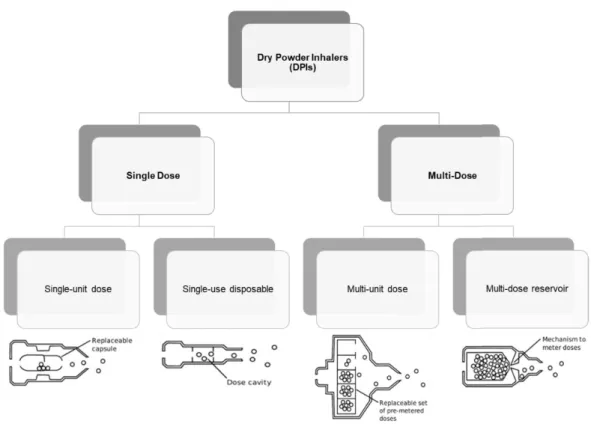
There are different categories of DPIs, based in their dose type (Figure 2), i.e.: Single dose, where a capsule or a blister is filled with a metered powder that contains the API and multi
dose, where a formulation is stored in a reservoir container and metered upon activation. In a single-unit dose device, the drug is formulated as a micronized drug powder and carrier system, being inside an individual gelatine capsule, which are is inserted into the inhaler and discarded after use. Concerning the two different multi-dose devices, the multi-dose reservoir stores the formulation in bulk and has a mechanism which allows the inhaler to meter individual doses from the bulk upon inhalation; the multi-unit dose device uses factory metered and sealed doses packaged in a manner that the device can hold multiple doses without having to reload, which is an advantage since the formulation is protected from the environment until use, ensuring adequate control of dose uniformity17.
These types can be summarized as passive devices or breath-actuated devices, which trigger powder release by the inhalation of the patient. The pulmonary drug delivery with these devices depends on the respirable flow-rate achieved by the patient9,14,15,18. On the other hand, there are active DPIs which use integrated facilities such as electrically operated impellors to prompt powder dispersion16.
The first DPIs on the market were the single dose ones (Figure 3) and these are still in use nowadays. In these, the capsule or blister, which is used just for one application, is pierced by the inhaler device and then, via a deep breath of the patient, the powder is released and delivered into the lungs16. An example of a single dose DPI is Pharmachemie Cyclohaler .To overcome the need of refilling the DPI after each use, multi dose DPIs were developed. In these, the powder is filled into an attached reservoir or be contained in multi-unit doses from which metered single doses are administered to the patient19. It is important to note that the dose metering system must deliver a consistent amount of the formulation into the airstream. The former depends on the weighing of the container and/or the effective discharge of the compartment during inhalation20.
The several DPIs can lead to clinically relevant variations in the performance between the different existing devices. Therefore, these must be considered when prescribing a specific device to a certain patient. For example, the inconvenient and complex procedure of loading single-unit dose devices has been associated with a high age related error rate17.
Recently, Hovione launched a single used disposable inhaler which has been accepted worldwide, called TwinCaps . This inhaler can deliver lactose-based or particle-engineered powders and has the capacity to deliver large drug doses. It has been approved in Japan for the delivery of Inavir , a long-acting neuraminidase inhibitor for the treatment of influenza.
TwinCaps has high efficiency, it is a market-leader in Japan and it is entering in USA. Also, it
has the lowest number of parts on the market (2 parts) for highest manufacturability in the industry, no metal parts, blades or springs and it is under patent until 202721.
Figure 2 Types of DPIs and illustrations of four dosing design options available. single-unit dose, single-use disposable, multi-unit dose, multi-dose reservoir
(adapted from 17,22)
Figure 3 Capsule-based DPI: one single dose DPI (from 23)
The main difficulty associated with inhalation drug powders and their efficient delivery is the strong interparticle forces which turns the cohesive bulk powder agglomerate. There are three different types of interparticle forces, namely Van der Waals force, which becomes noticeable when particles are close to each other
(0.2-less), capillary force and electrostatic force. The addition of external energy or reduction of surface force of particles may lower those interparticle forces, since they may alter surface e morphology or surface chemistry. Being that, there are different formulation strategies in DPIs, for example, carrier free, spherical pellets and adhesive mixtures8,20. There are some considerable differences between those formulation principles, such as:
Carrier free systems:
API particles are engineered in a way that allows drug aerosolization without the aid of large excipient particulates;
Some properties of API particles must be altered and controlled, such as surface roughness (corrugation), particle size, density and shape;
API particles must be produced using spay drying, super-critical fluid processing and sonocrystallization.
Spherical pellets:
Spheronized agglomerates of small drug particles which are sieved to obtain easy dispersible pellets with 200-2000 ;
More appropriate for high dose drugs (mg range).
Adhesive mixtures:
Carrier-based formulations, where the fine API particles are mixed with a coarser carrier -lactose monohydrate crystals, since these are approved and generally accepted as safe by most regulatory agencies8,17,22.
Carrier-based formulations present advantages, such as increasing the bulk of formulation and improving flowability of the small cohesive drug particles. The former allows easier metering of small quantities (usually < 100 improving dosing consistency. The latter improves processing of the formulation (e.g. flow characteristics, avoidance of segregation) during manufacturing and aerosolization during DPI22.
1.4. DPI Formulation
1.4.1. Particle EngineeringThere are several methods to engineer particles. These include spherical crystallization, mechanical milling (jet-milling), spray drying, precipitation and other several techniques24. Each of them produces particles with unique physicochemical characteristics that can further affect processing and inhalation performance8.
The major aim of particle engineering is to improve some characteristics of the powders, taking into account the specifications of the inhaler device that will be used, as well as the intended type of drug delivery25. Particles engineered by different methods have different
characteristics. For that reason, solid particles for pulmonary delivery will exhibit different aerosolization behaviours depending on the nature of the interparticulate interactions, type of formulation, inhalation device, flow-rate and breathing pattern25.
Several techniques have been described in carrier engineering, for example spray-drying, which has been used to produce spherical particles with different surface topographies depending on the process parameters. Moreover, lactose has been extensively engineered using techniques such as mechanofusion, that results in particles with very smooth surface or spherical crystallization, leading to spherical aggregates of lactose particles25.
Nowadays, milling is the most common technique to obtain particles between 1-5
range (respirable sizes) and there are several milling methods well established and validated available26, namely vibration milling, ball milling and jet-milling (fluid energy)25. Pressure, friction, attrition, impact or shear lead to the particle size reduction25. This process can disrupt the crystalline phase leading to the production of random domains of various molecular disorders, specially amorphous ones27,28.
Air-jet milling (Figure 4) is the technique used to manufacture inhalation products, which causes particle acceleration, impact, self-attrition, fracture and consequent size reduction27. In this technique, particles are carried on a high velocity gas stream (usually with air or nitrogen) into an opposing high velocity gas stream such that particles impinge on each other and the walls of the mill shattering ultimately into respirable sizes. These particles are, then, collected by elutriation29.
Figure 4 Schematics of an air-jet mill: (a) front view, showing the opposite high velocity gas stream inside the mill and (b) side view, showing the filter and the collection vessel separated
by the cyclone behind the mill (from 29)
1.4.2. Particle Properties
The physicochemical properties of the carrier and drug may have a strong impact on further processing and on the aerodynamic performance of the formulation. To be able to produce potent adhesive mixtures, it is necessary to analyse and understand the influence of particle properties, since they affect cohesive and adhesive interactions. It is important to say that adhesive forces act between particles with different properties and cohesive forces among particles with similar properties30. These properties include solid-state of the material, particle micromeritics and surface morphology31.
1.4.2.1. Solid-State
To obtain outstanding efficiency of aerosols, it is necessary to develop an optimized formulation and, for that, the solid-state of the powders (chemical and physical stability) must be well known. Usually, the particles can be either crystalline or amorphous25.
The crystalline form is typically described by polymorphs and pseudopolymorphs. Polymorphism is a phenomenon in which crystals display different lattice structures or molecular conformations without changing its chemical composition. Pseudopolymorphs are crystalline solvates and hydrates, which bound organic solvents or water molecules, respectively, to the crystal structure itself32. Amorphous solids usually have a higher dissolution rate and solubility; nevertheless, they present a higher Gibbs free energy, which means they are less stable chemically and physically. For that reason, they can recrystallize, changing the surface characteristics of the powder33.
During secondary processing (particle engineering), amorphous regions can appear in crystalline materials and this phenomenon called mechanical activation can be beneficial in specific cases and it is usually dominant on the surface34,35. Also, reactivity, conductivity, surface free energy and true density are influenced by mechanical activation and these variations might influence the performance of inhalation products34.
There are several methods to characterize solid-state, such as small and wide-angle X-ray scattering (SWAXS), Fourier transform infrared spectroscopy (FTIR) and differential scanning calorimetry (DSC). In most techniques, the detection limit for quantification of amorphous content is between 5 to 10%, which sometimes can be a problem especially when small amorphous content are on the surface of the powder36.
1.4.2.2. Micromeritics
Particle Size
Concerning DPI formulations, drug particle size is of extreme importance to assure that drug particles can penetrate the small airways.
According to Kulvanich et.al.37, adhesion forces increase with the decreasing of the particle size. When the size range is below 10 , adhesion forces exceed gravitational forces and particles become able to adhere to larger ones. These fine particles are highly sticky, cohesive and have poor flowability because of the dominant attraction force38. Thus, it is expected that the API particle detachment during inhalation improves with the decrease of mean drug particle diameter. However, this detachment does not exclusively depends on the attraction forces, but on the magnitude of the removal forces as well and it was observed that increasing the drug particle size enhance particle aerosolization39. For this reason, and because the particles of a powder are heterodisperse (different particle sizes are present), it is very important to determine the powder PSD.
The PSD of a powder can be represented by a cumulative or density curve based on number (q0, Q0), length (q1, Q1), area (q2, Q2) or mass/volume (q3, Q3), which can be used to determine a mean particle size (Dv0.5) and MMAD38. In terms of aerosol quality and efficiency, PSD is a key parameter and is commonly evaluated by the determination of the polydispersibility (PDI), which is usually known as Span value (Equation 2). A higher value of PDI of the carrier indicates a wider PSD, leading to a more heterogeneous blend and can lead to a higher variability in lung deposition of drug upon inhalation40.
(2)
Several techniques can be used to measure the PSD, such as sieve analysis, light scattering and laser diffraction, image analysis, etc., the most common one being laser diffraction.
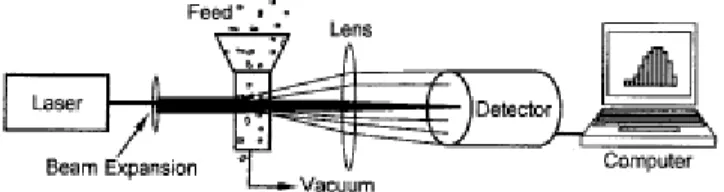
Light-scattering methods (Figure 5) are a commonplace in formulation development26. Laser diffraction involves the measurement of a representative sample, dispersed at an adequate concentration in a suitable liquid or gas. For the measurement, the powder should pass through an expanded laser beam. The light of the laser beam is diffracted in different directions, according to the different particle sizes, and the scatter pattern is recorded by detectors. The scatter pattern is related to the particle size and its distribution. The laser diffraction results are often expressed as a volume distribution. The full profile is evaluated, and particle size is generally specified as a three-point specification containing Dv0.1, Dv0.5 and Dv0.9 value. The percentage of fine particles below 5, 10 or 15 can also be determined. These parameters can potentially be linked to the product performance26,41.
The distribution of scattered light is a
of the particle and the dimensionless particle diameter42, as represented in Equations 3 and 4. (3) (4)
The algorithms are based on Fraunhofer or Mie theories, from which the particle sizes are determined. Since the algorithms differ among the different instruments, comparison is difficult,
particularly for the majority of pharmaceutical particles, which deviate from sphericity26. The > 10) and the theory of Mie can be used for relatively small particles (0,1 < < 10)42.
The scattering pattern of small particles is extremely complex, such that the direct calculation of a particle diameter is impossible. For that reason, calibration with defined particles is used. For a reliable calculation of the particle diameter, multiple detectors are used.
Two examples of laser equipment are Sympatec and Malvern.
Figure 5 Schematic representation of a laser-light scattering method, showing how the laser beam passes through the powder and the laser diffract in different directions according
to different particle sizes (from 26)
Also, fine particles have an important role in the aerodynamic performance of DPIs. The
particle size compared to coarse ones. In this thesis, particles smaller than 10
Although the numerous studies developed in how fines may affect the performance of DPI formulations, the results are contradictory. Some studies showed that small quantities of fines could increase the deaggregation efficiency and lead to a therapeutical efficacy of the DPI. However, some other studies proved that fines would decrease the deposition of the powder in the lung, decreasing the fine particle fraction (FPF) value40. Several theories exist about the role of the fine particles in DPI performance40,43:
(a) Active-sites theory: active-sites are defined as areas on the carrier surface that are more adhesive than others, which are preferentially occupied by fines. However, there were some criticisms to this idea, since it cannot explain how active sites affect the performance of a powder for inhalation;
(b) Fluidization theory: fluidization of a DPI occurs when the pressure drop across the powder bed (PD) is equivalent to the weight of the powder. So, the addition of fines improves DPI performance by increasing the tensile strength (TS) of the formulations, which is related to the interparticulate forces and the free volume of the carrier;
(c) Agglomeration theory: the presence of fines results from the formation of drug-fine agglomerates and these are easier to remove from the carrier surface than API particles due to the greater aerodynamic drag force that exists on agglomerates;
(d) Buffer hypothesis: usually, commer -lactose monohydrate has a rough surface and carries natural fines and impurities on its surface, which may influence their interaction with the drug. Dickhoff et. al.44 developed a study where lactose was submerged in ethanol-water mixtures and it was found that submersion removed the adhering lactose fines, leading to a decrease in drug particle detachment without affecting shape or size of the carrier. Adhering lactose fines act as a buffer between colliding carrier particles and protect smaller drug particles attached to the same crystal planes from the press-on forces that cause increased drug particle detachment during inhalatipress-on;
(e) Case-dependent theory: Fines do not always improve the aerosol performance of a DPI, which is determined by the formulation and dispersion conditions. According to the study developed by Grasmeijer et. al.45, the presence of coarse lactose fines (CLF) led to a higher detachment of the drug at all flow-rates. To explain these results, two mechanisms are involved: first, fines below a certain size reduce the dispersion performance, increasing the effectiveness of press-on forces; second, lowering TS, CLF may weaken or prevent the formulation of fine particles network.
Particle Shape
The shape of the particle must be considered when developing a DPI formulation. Particle shape is one of the most intractable and uncontrollable factors in powder technology, being important to analyse the influence of this property, since different shapes, such as spherical, tomahawk or irregular, lead to different results. It is known that higher contact areas and shorter interparticulate distances, lead to stronger adhesion forces38. Irregular shaped drug particles are usually more cohesive/adhesive than spherical particles46. Furthermore, particle shape also has a great impact on the flow behaviour of dispersed particles: elongated particles are very aerodynamic, resulting in a smaller aerodynamic diameter compared to spherical ones, but they tend to have a poorer flowability. Therefore, elongated particles disperse better in a gas stream and penetrate further in a branching system, as is the case of the lungs38. On the other hand, spherical particles with low density tend to bind the API for a longer period, reducing the drug loss at different flow-rates and thus enhance the drug delivery40.
Scanning electron microscopy (SEM) is an example of a method that allows the determination of the shape and morphology of a particle. Also, contact angle measurements and optical microscopy are used to determine the particle shape of the powder.
Surface Morphology
Surface area is not exclusively determined by particle size and shape, but also by the morphology of the particle. The morphology of the particle surface determines the contact area
between drug and carrier particles and the magnitude of adhesion forces38. Rough particles have more surface area than smooth ones. Thus, particle morphology can also be engineered for DPI formulation design26,47. Carrier surface is formed by active sites in which fine drug particles primarily and strongly adhere to. These active sites can have several sources, such as impurities, surface asperities and crystal lattice defects48. There is the possibility to create drug particles with specific morphology or select particles to obtain specific surface morphologies and the interparticulate forces can be modulated to enhance lung deposition. Ideally, the contact area and, consequently, the forces should be adjusted to a level that offers enough adhesion between drug and carrier to provide a stable formulation yet allowing easy separation upon inhalation26.
As mentioned previously, SEM can be used to determine the surface morphology. SEM scans a sample with a focused electron beam over a surface and deliver images with (Figure 6)49. The electrons interact with atoms present in the sample, which produces signals containing information about the surface topology and composition of the sample. The electron beam is scanned in a raster scan pattern and the position of the beam is combined with the detected signal to produce an image. It is used to study the morphology of the particle, giving information about the roughness or smoothness of the particle itself50.
Figure 6 Schematic representation of the working principle of a scanning electron microscope
(from 51)
1.4.3. Bulk Formulation Properties (Adhesive Mixtures)
It is known that different engineering techniques lead to different solid structures and, consequently, different solid-state behaviours, micromeritics and surface morphologies, influencing particle interaction. The surface energy of a material is the necessary energy to increase the surface area of a solid particle. Therefore, particles with different solid-state
properties, micromeritics and surface morphologies will exhibit different surface energies38. For instance, it is known that molecular disordered spots that exhibit higher surface energies can be induced on the surface of the milled particles, resulting in an increased particle cohesiveness and adhesiveness52. Drug particles with higher surface energies adhere better to the carrier surfaces53. Also, the water uptake of the particles depends on the differences in solid surface structures. When the surface structure is amorphous, the absorption of water is
higher, leading , potentially impacting on product
performance.
Two different forces act during a mixing process, which are the cohesive forces between the drug particles and adhesive forces between the API and the carrier particles. To complete the mixing process and avoid the agglomeration of the particles, the adhesion force must be high enough. However, the redispersion of the drug affects the performance of the DPI, which is influenced by three factors: the inhaler device, the inhaler manoeuvre of the patient and the formulation. These factors determine the FPF which is the part of the API supposed to reach the deeper part of the lungs54. Usually redispersion is easier for smaller carrier particles and the particle surface roughness is a main factor when considering adhesion and friction. In the resuspension process, the particle shape is important for the adhered drug particles, but the shape of the carrier particles might influence the mixing force. During mixing, occurs the friction between the particles of the powder. Friction is smaller for spherical and smooth particles and increases with the increase of the irregularities in the particle shape, increasing interparticle forces. The latter will cause a change in the resuspension properties of the interactive powder mixture55.
Carrier rugosity and active carrier sites are two important factors for the performance of a DPI. Those can be manipulated by adding fines to the carrier material or other materials56,57. Manipulation of the carrier material causes changes in the adhesion forces between carrier and API. The adhesion force should not be too high so that the detachment of the drug particles during inhalation is possible and to avoid the impaction of the API together with the carrier in the upper airways. Thus, the adhesion force is a key parameter for the behaviour of the interactive mixture54.
1.4.3.1. Flowability
The behaviour of the powder bulk depends on several factors, including the particle properties already mentioned before (particle size, PSD, shape and surface roughness). Besides those factors, flowability, compressibility, dispersibility and fluidization are important to have into account, as well. For example, spherical particles have a higher flowability when compared with irregular particles, due to less interparticle contact points31,58. Powder mixtures can be more or less cohesive and this promotes or reduces the aerodynamic performance,
respectively31. For this reason, it is important to investigate the behaviour of a powder to draw a conclusion regarding the powder performance during mixing, dosing and aerosolization31,58. To analyse the powder bulk, usually a powder rheometer is used, for example, the FT4 equipment (freeman Technology, Tewkesbury, UK).
The powder bulk properties of an adhesive mixture for DPIs depend on the carrier. Poor carrier flowability and low carrier bulk density affects negatively the mixing homogeneity and facilitates segregation31. The concentration of the drug at which the powder starts forming particle layers will depend on the interactive capability between the drug particles and carrier and it will influence the bulk of an adhesive mixture. So, if the ratio drug-carrier is high enough, it may result in a multilayer formation of adherent drug particles, even before the carrier surface is covered with a complete monolayer37. Also, it is possible that a complete saturation of the carrier surface occurs, resulting in free drug particles (not coupled to the carrier) that agglomerate59. Thus, it is advisable that the concentration of drug is adjusted to the physicochemical properties of the carrier, guaranteeing that all drug particles adhere to the carrier surface.
As said before, fine particles are cohesive and have less flowability in contrast to coarse ones. However, it is important that the final formulation has enough flowability to obtain a reproducible dosing during the dispersion from the DPI device. This can be achieved by one of two ways: by controlling the aggregation of particles, forming loosely adherent floccules that improve dispersion or by using carrier-based formulations60. The last one has turned out as a challenge, since interactions between the drug and the carrier have an important influence on DPIs performance. Forces acting between carrier and API must be well balanced to guarantee detachment during inhalation.
1.4.3.2. Aerodynamic Performance
After developing a new DPI formulation, in vitro aerosolization performance should be tested. These in vitro tests allow to determine the possible in vivo action of the formulation, simulating the aerosol deposition inside the human lung. Impingers and impactors are two procedures used for testing the in vitro performance. The difference between an impinger and an impactor is the medium in which particles deposit: the impingers use liquid impaction plates and impactors use dry ones. However, it is possible to find a similar set-up in both devices; the , then succeeded by impactor plates (usually four to eight plates) with a filter at the end, where non-deposited particles are collected. There is a vacuum pump that creates an airflow through the plates, as well61.
There are several types of impactors, but the most used one is the Next Generation Impactor (NGI) (Figure 7). The NGI has a horizontal setup with three main parts: the cut tray, the frame that holds the cup tray and the cover with the fixed nozzles and the inter-stage
pathways. It contains seven impaction stages and a micro-orifice collector that acts as a filter and is responsible for collecting the finest fraction. The air enters the impactor through a bent inlet tube adapted into a pre-separator, where the carrier particles are collected. The air streams zig zags from stage to stage, through nozzle diameters that decrease stepwise and the air velocity increases, leading to a decreasing particle cut-off diameter as impactor stages progress. Each of the stages has a specific cut-off size that can be calibrated62. When testing a DPI, the airflow-rate varies between 28 and 100 L/min. Although, it is possible to calculate the cut-off diameters for a specific flow-rate61 (Equation 5):
(5)
where D50Qn is the cut-off diameter of the standardized flow-rate Qn (often 60L/min) and D50Q is the cut-off of the applied flow-rate Q. The variable n depends on the individual stage and varies from 0.54 at stage 1 to 0.67 at stage 7. For this reason, the higher the flow-rate, the smaller the cut-off diameters for the individual stages61. To have an adequate correlation between in vitro assessment and in vivo action of the DPI, the airflow-rate should correspond to a pressure drop of a 4kPa over the device, and a duration consistent with the withdrawal of 4 L of air should be employed61.
Figure 7 Representation of the NGI when (a) open, showing the nozzles and collection cups with the indication of the zig zag airstream from stage 1 to 8 and (b) closed,
bended inlet tube and the pre-separator (from 62)
DPI formulation in vitro assessment is based on inertial impaction of aerosols. Particles get fractionated according to their sizes and from this it is possible to determine the particle aerodynamic diameters. Aerosols are constituted by particles of different sizes that exhibit different energies, particle mass and velocity. Particles with large aerodynamic diameters and heavier ones have a high momentum, so they are not able to adjust fast enough when the air stream changes direction, impacting earlier than small particles that are transported further. (b) (a) 1 2 3 4 5 6 7 8
Consequently, the probable impaction of aerosols can be calculated using the particle Stokes number, which is a dimensionless parameter which governs the efficiency of particle impact on a collection plate (Equation 6):
(6)
where U0 is the average fluid velocity to the nozzle, is the particle density, d is the particle diameter, Cc is the Cunningham slip correction factor, is the dynamic viscosity of air and Dn is the nozzle diameter.
particles with a diameter of less than 1
spherical, that their Re is less than 0.1 and that their density is greater than air density. The particle will impact on to a plate if its Stokes number is larger than 161.
2. A
IM OF THE THESIS
(H
YPOTHESIS
)
Particle properties such as PSD, shape and solid-state can influence interparticle interactions that in turn will influence powder bulk properties, i.e. flowability and in vitro aerodynamic performance.
Therefore, the aims of this thesis were to understand how the particle properties affect the powder bulk and, consequently, how all these properties influence the aerodynamic performance of carrier-based DPIs and which particle property most influences the aerodynamic performance of carrier-based DPIs. Four different lactoses with distinct solid-state, micromeritics and surface morphologies were chosen to be tested. Jet-milled Salbutamol Sulphate (SS) was used as model API and mixed with the carrier at a load of 2% (wt%). All the raw materials and resulting blends were analysed via PSD by pressure titration, breaking force and powder rheometry. Finally, the aerodynamic performance of the adhesive blends was determined by NGI, obtaining the aerodynamic particle size distribution (APSD) and the FPF.
3.
M
ATERIALS AND
M
ETHODS
3.1. Materials
3.1.1. SolventsPurified water (TKA Wasseraufbereitunssystem GmbH, Germany), acetic acid (Emprove, Merck Millipore, USA) and isopropanol (VWR Chemicals, Germany).
3.1.2. Raw materials: Carriers and API
Micronized SS (Fagron GmbH & Co., Germany) with a particle size of Dv0.1
0.5 0.9 Duralac H
(16% anomer and 83.5% anomer, Meggle, G -lactose monohydrate Flowlac 90 3%, Meggle, Germany), Respitose
Germany) and Lactohale
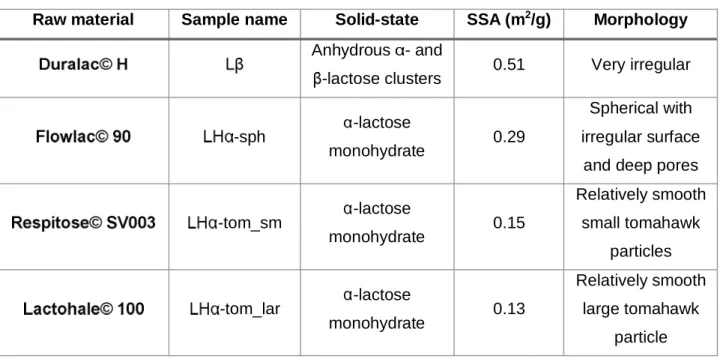
carriers. These powders were chosen as potential carriers due to their distinct solid-states, particle shapes, as well as different values of specific surface area (SSA) (Table 1 and Figure 8).
Table 1 Characteristics of the potential carriers ( -sph, -tom_sm and -tom_lar), namely solid-state properties, SSA (m2/g) and their morphology
Raw material Sample name Solid-state SSA (m2/g) Morphology
Anhydrous - and
-lactose clusters 0.51 Very irregular
-sph -lactose
monohydrate 0.29
Spherical with irregular surface
and deep pores
-tom_sm -lactose monohydrate 0.15 Relatively smooth small tomahawk particles -tom_lar -lactose monohydrate 0.13 Relatively smooth large tomahawk particle
Figure 8 SEM images of the (a) ; (b) -sph; (c) -tom_sm; (d) -tom_lar (at 228.7 m width and 500x magnification)
3.2. Preparation and Characterization of the Blends
3.2.1. Preparation of adhesive mixturesLactose was dry sieved through sieves (Retsch GmbH, Germany) using a vibratory sieve shaker (Retsch AS200, Germany) to obtain a 20-9 particle size fraction.
Adhesive mixtures of 2% jet-milled SS were prepared. 49 g of lactose and 1 g of API were weighed into a vessel using the sandwich method : the first 24 g of the carrier was weighed in the vessel followed by a layer of 1 g of the API and then the rest of the carrier was added. The vessels were blended in a Turbula blender TC2 (Willy A. Bachofen Maschinenfabrik, Muttenz, Switzerland) for 90 min at 62 rpm (criteria stablished based on 27,63). 4 blends were prepared, one for each lactose studied.
3.2.2. Mixing Homogeneity
Homogeneity of each mixture was determined by taking 10 samples of approximately 25 mg and dissolved in 10 ml of purified water. Samples were taken from the top, centre, bottom and close to the walls of the vessel, ensuring the uniform sampling. For the analysis of the
dissolved samples, the absorbance -VIS
(a) (b)
spectrophotometer UV-2700 (Shimadzu, Kyoto, Japan). The measurements were made in triplicate (n=3).
3.3. Powder Characterization
3.3.1. Particle Size DistributionPSD was evaluated using laser diffraction (HELOS/KR, Sympatec GmbH, Germany). The powder was placed on a vibrating chute (Vibri, Sympatec GmbH, Germany) and dispersed using a dry dispersing system (RODOS, Sympatec GmbH, Germany). A sampling time of 10 s (12 s real time) was applied and measurement with an R2 (0.45-87.5 -875 , triggered once an optical concentration (Copt) of 0.5% was reached. To evaluate the pressure at which the particles de-agglomerate, a pressure titration was applied. For this, the primary dispersion pressure was manually adjusted in 0.2 bar step in the range of 0.1-2.0 bar. Measurements were done in triplicate (n=3) at 0.1, 1.5 and 2.0 bar. Before each measurement, the dispersing system was cleaned using sand and a reference measurement was taken.
Moreover, and in order to evaluate the un-agglomerate state of the samples, the powders were evaluated using wet-dispersion (CUVETTE, Sympatec GmbH, Germany). Isopropanol was chosen as the dispersant medium. 50 ml of the alcohol were added into a stationary cuvette and very small amounts of powder were added, step-wise to the solvent. The system was magnetic stirred (1000 rpm) in order to disperse the samples. Measurements were carried during 120 s, once a Copt above 0.5% was reached.
Particle size cumulative volume and number distribution (cumulative (Q3) and density (q3) distribution and Q0/q0, respectively) were calculated and analysed using Windox 5 software (Sympatec GmbH, Germany).
3.3.2. Hardness and Tensile Strength
The hardness of the plugs of lactose, SS and blends were evaluated using a 3-in-1 hardness, diameter and thickness testing instrument (PTB 311E, PharmaTest GmbH, Germany). For that, it was necessary to compress the powders with a hydraulic press, using a 500 kg load. Measurements were done in quintupled (n=5) and the thickness of the plugs were . The plug is put on the surface of the testing instrument and the pressure is applied in the lateral area of the plug itself, as represented in Figure 9.
Figure 9 Schematic representation of the equatorial tablet tensile strength test (From 64)
The TS was calculated using the Equation 764:
(7) where D is the diameter of the plug and T is the thickness of the plug.
3.3.3. Density and Porosity
The density of the materials was tested using a gas pycnometer (AccuPyc II 1340 TEC, Micromeritrics). For this, it was necessary to compress the powders using a hydraulic press. In order to be used, the pycnometer had to be calibrated using three metal spheres and, for the actual measurement, five plugs were placed inside of its chamber. The equipment gives five values of volume that are used to calculate the density of the materials. Knowing the grain density of the plug and the bulk density, it was possible to calculate the porosity using the following formula (Equation 8)65:
(8)
The values of the bulk density, which corresponds to the calculated density, were obtained dividing their mass (g) for the respective volume (cm3). The grain density of the plugs was directly obtained through the pycnometer.
3.3.4. Dynamic Powder Flow Analysis
To measure the flow properties of the samples, a FT4 Powder Rheometer (Freeman Technology, Welland, UK) was used.
To measure the compressibility, a sample of powder was analysed using a 25 mm bore borosilicate glass cylinder. The samples were conditioned using a 23.5 mm blade which was moved down a helical path, allowing the displacement of the powder, which removes the packing history of the powder and any operator influence and, therefore, generates a homogenized uniform low packing stress in the powder. The cell was then split to remove any
surplus powder. Formerly, the blade was replaced by a piston and a varying normal stress between 1 and 15 kPa was applied on the sample, obtaining eight values of compressibility at different pressures. Measurements were performed in triplicate (n=3).
Powder permeability was measured using a 25 mm bore borosilicate glass cylinder. The samples were conditioned using a 23.5 mm blade which was moved down a helical path, displacing the powder. After conditioning the powder, the cell is split to remove any excess of powder. Permeability studies were conducted at a constant airflow velocity of 2mm.s-1, which was passed through the powder bed, with varying normal stress between 1 to 15 kPa being applied on to the sample, using a piston. Measurements were performed in triplicate (n=3).
Powder cohesivity was analysed using a 25 mm bore borosilicate glass cylinder. Once again, the samples were conditioned using a 23.5 mm blade which was moved down a helical path, allowing the displacement of the powder. Then, the blade was replaced by a piston which compacted the sample. The cell was split to remove any surplus powder. At that point, the piston was substituted by a 24 mm sear cell and the test was carried out varying normal stress between 5 to 15 kPa being applied on the sample. Measurements were performed in triplicate (n=3).
3.4. Aerosolization Assessment
The aerosolization performance of the blends at both capsule fill settings was determined with a NGI (Copley Scientific, Nottingham, United Kingdom) and according to the procedure described in the US pharmacopoeia (Preparations for inhalation: aerodynamic assessment of fine particles, Ph. Eur., 7.0) and taken from the literature61. For the experiments, capsules were filled with, approximately, 40 mg of sample. At first, the vacuum pump (SCP5, Copley Scientific) was switched on and the small trays and the large cups were coated with a coating agent (2% solution of Tween 20 in absolute ethanol). The small impaction trays were coated with 2 ml and the two larger ones with 4 ml of the coating agent and 30 min were waited to guarantee that the coating agent was able to cure completely. The pre-separator was filled with 10 ml of acetic acid buffer (pH=3) and the flow-rate through the device was set to 60 and 100 L/min using a critical flow controller (TPK, Copley Scientific), which was checked with a flow meter (DFM3, Copley Scientific). As an inhalation device, a unit dose DPI was selected: Cyclohaler .
4.
R
ESULTS AND
D
ISCUSSION
4.1. Particle Characterization of the Raw Materials and Blends
To understand how the particle properties affect the powder bulk and, consequently, how all these properties influence the aerodynamic performance of carrier-based DPIs, some studies were conducted, such as PSD, hardness and porosity, compressibility, permeability and cohesivity. It is known that these parameters have a relationship between them and it was desirable to confirm these relations. However, the main goal of these analysis was to find out how they influence the aerodynamic performance of DPIs and, for that, an NGI analysis was made, which allowed to find which property most contribute to a better performance and, afterward, which lactose had the best characteristics to be an ideal carrier to be used in a DPI formulation.
4.1.1. Blend Homogeneity
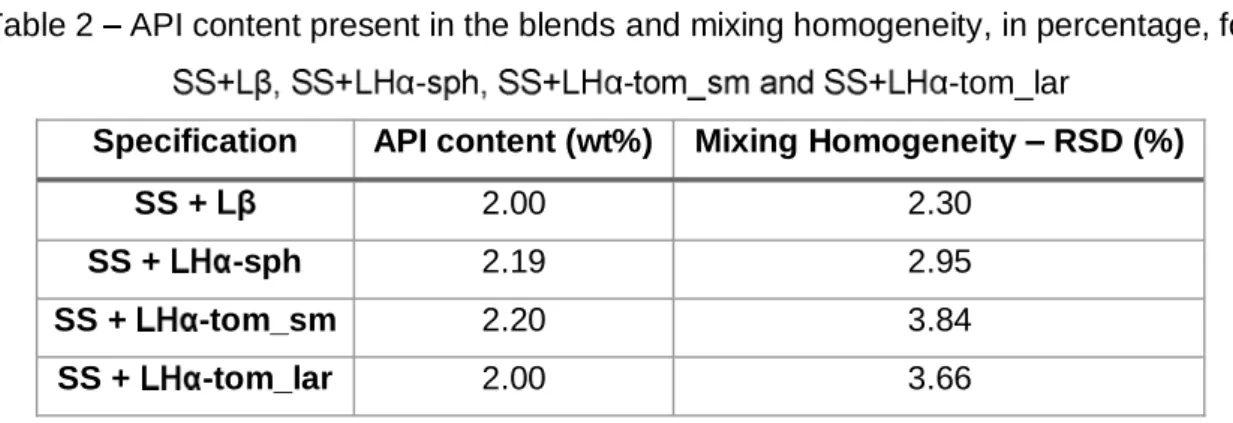
To proceed with the study, it was necessary to analyse the mixing homogeneity, as described in section 3.2.2. According to US Pharmacopeia, blends are considered homogeneous when the relative standard deviation (RSD) is less than 5%.
As represented in Table 2, all mixtures are considered homogeneous and, for that reason, the powder properties of the blends could be analysed. Since RSD are below 5%, it was possible to proceed with the research.
Table 2 API content present in the blends and mixing homogeneity, in percentage, for
- - -tom_lar
Specification API content (wt%) Mixing Homogeneity RSD (%)
SS + 2.00 2.30
SS + -sph 2.19 2.95
SS + -tom_sm 2.20 3.84
SS + -tom_lar 2.00 3.66
4.1.2. Particle Size Distribution
The laser diffraction system using wet and dry pressure titration was used to identify the presence or not of agglomerates and the respective force necessary to break them. Moreover, the PSD of the different materials was analysed and compared among each other using the volume distribution percentiles, i.e. Dv0.1, Dv0.5 and Dv0.9. Furthermore, the percentage of particles below 10 , considering the content of fine particles, was also evaluated.
First, a dry dispersion measurement was performed. This type of measurement permits to overcome the binding forces between agglomerated particles, resulting in the optical dilution of the particle agglomerates, making them measurable by the sensor as individual specimens.
The PSD values obtained at the primary pressures in the range from 0.1 bar to 2.0 bar are presented in Figure 10 and 11 for raw materials and blends, respectively. The particle diameters and Span values are in Table 3 and 4, which allows to understand if the raw material powders and respective blends were mono- or heterodisperse66.
Table 3 Particle size volume distribution and respective Span of the jet-milled SS, --tom_sm and -tom_lar at primary dispersion pressure of 0.1, 1.5 and 2.0 bar
Raw Material Dv0.1 Dv0.5 Dv0.9 Span*
0.1 bar -sph LH -tom_sm -tom_lar SS 1.5 bar -sph -tom_sm -tom_lar SS 2.0 bar -sph -tom_sm -tom_lar SS * (9) Triplicates were c
Table 4 Particle size volume distribution and respective Span of the SS+ SS+ -sph, SS+ -tom_sm and SS+ -tom_lar at primary dispersion pressure of 0.1, 1.5 and 2.0 bar
Raw Material Dv0.1 Dv0.5 Dv0.9 Span
0.1 bar -sph -tom_sm -tom_lar 2 1.5 bar -sph -tom_sm -tom_lar 2.0 bar 2.84 -sph -tom_sm -tom_lar
By comparison of the mean particle size and its Span
lactose with larger distribution of particles, since it has the highest value of Span among the lactoses (Table 3). It is also visible that -sph has the lowest value of Span, which means it has a smaller distribution of particles. Moreover, in every primary pressure used, SS particles
exhibit a Dv0.5 Span, which means that SS had the largest
distribution of particles.
Concerning the blends (Table 4)
distribution of particles, since it had the highest value of Span, which was concordant with the -sph had the lowest value of Span, having the smaller distribution of particles. Also, in general, it was possible to see that there was a decrease of the values of Dv0.1, Dv0.5 and Dv0.9 when compared with the raw material results, leading to higher values of Span, which is a natural consequence of adding 2% of fine SS particles to the raw coarser carriers.
Figure 10 Particle size density volume distribution at different pressure titrations from 0.1 to 2.0 bar for (a) , (b) -sph, (c) -tom_sm, (d) -tom_lar and (e) SS
Triplicates were carried out at 0.1, 1.5 and 2.0 bar (Mean
(a) (b)
(d) (c)
Figure 11 Particle size density volume distribution at different pressure titrations from 0.1 to 2.0 bar for (a) SS+ SS+ -sph, (c) SS+ -tom_sm, (d) SS+ -tom_lar
Triplicates were carried out at 0.1, 1.5 and 2.0 bar (Mean
According to the density distribution represented in Figure 10 - -tom_sm have a mean particle size in the range
smaller mean particle size of all the analysed carriers (Dv0.5 = , on average). -tom_lar presenting the largest particles, have a higher value of Dv0.5 (Dv0.5 =
, on average). -lactose monohydrate has been
employed as a carrier in adhesive blends and depending on the design of the DPI device, a 67 is deemed as adequate, being also described that lactose carriers should be one order of magnitude greater than the drug particles (> 50 68. Analysing the results in Figure 10 and Table 3, it is seen - -tom_sm are within the mentioned range. Moreover, there are studies using capsule based DPIs that indicate that decreasing carrier particle size can lead to a better aerodynamic performance: studies that used polystyrene spheres wit
(a) (b)