(Annals of the Brazilian Academy of Sciences)
Printed version ISSN 0001-3765 / Online version ISSN 1678-2690 www.scielo.br/aabc
http://dx.doi.org/10.1590/0001-3765201520140376
Correspondence to: Tatiane Maria Rodrigues E-mail: [email protected]
Glandular trichome density and essential oil composition
in leaves and inflorescences of
Lippia origanoides
Kunth (Verbenaceae) in the Brazilian Cerrado
LUIZ R.S. TOZIN1, MARCIA O.M. MARQUES2 and TATIANE M. RODRIGUES1
1Universidade Estadual Paulista/UNESP, Instituto de Biociências de Botucatu, IBB, Departamento de Botânica, Distrito de Rubião Júnior, s/n, 18618-970 Botucatu, SP, Brasil
2
Instituto Agronômico de Campinas/IAC, Laboratório de Produtos Naturais, Av. Barão de Itapura, 1481, 13020-902 Campinas, SP, Brasil
Manuscript received on August 5, 2014; accepted for publication on November 25, 2014
ABSTRACT
The essential oils from leaves and inflorescences of Lippia origanoides Kunth present aromatic and medicinal potential and have been used to treat several diseases, including melanoma. In Brazil, L. origanoides is commonly found in campo cerrado and cerrado stricto sensu, physiognomies featured mainly by the differential light conditions to which short and medium-sized plants are subjected. Our aim was to investigate the glandular trichome density and the yield and chemical composition of the essential oils in leaves and inflorescences of L. origanoides from campo cerrado and cerrado stricto sensu. For glandular density analysis, leaves and inflorescences were processed according to conventional techniques for scanning electron microscopy. The essential oils of leaves and inflorescences were obtained by hydrodistillation and identified with gas chromatography. Bracts and sepals showed the highest glandular density, followed by petals and leaves. The glandular density in the abaxial leaf surface was higher in individuals from the campo cerrado. In both populations the essential oil yield was higher in inflorescences than in leaves. The chemical composition of the essential oils varied among individuals from different areas and inside a same population. Our results demonstrated the chemical plasticity of L. origanoides
suggesting the importance of monitoring its popular use.
Key words: campo cerrado, cerrado stricto sensu, external glands, terpenes.
INTRODUCTION
Species of Verbenaceae are known for the presence
of glandular trichomes that secrete essential oils.
Many of these species are widely exploited by drug
manufacturers and used in popular medicine (Judd
et al. 2009, Pascual et al. 2001, Souza and Lorenzi
2008).
Lippia origanoides
Kunth, a native shrub
of the Brazilian Cerrado, is widely distributed in
South America from Guiana to northern Argentina,
and also occurs in Central America (O’Leary et
al. 2012). The essential oil extracted from leaves
of
L
.
origanoides
shows antimicrobial, antiviral,
acaricidal, antioxidant, antibacterial and
Gomes et al. 2012, Oliveira et al. 2007,
Rocha-Guzmán et al. 2007, Stashenko et al. 2010, 2013,
Veras et al. 2013). Different chemotypes of
L.
origanoides
were reported in literature and p-cimene,
thymol and carvacrol are the major components most
commonly found (Cavalcanti et al. 2010, Oliveira et
al. 2007, Stashenko et al. 2010, 2013).
In the Brazilian Cerrado,
L. origanoides
is
commonly found in areas of campo cerrado and
cerrado
stricto sensu
. These Cerrado physiognomies
are featured mainly by the differential light intensity
that reaches the short and medium-sized plants.
The cerrado
stricto sensu
is characterized by the
occurrence of medium-sized trees, scattered shrubs
and some grasses. In this area the individuals of
L. origanoides
are shaded by nearby trees in the
early hours of the morning and in late afternoon.
In the campo cerrado, grasses and small shrubs
are predominant, with some sparse trees (Maroni
et al. 2006), and individuals of
L
.
origanoides
are
exposed to full sunlight throughout the day.
Studies indicate that both yield and chemical
composition of the essential oils and the
glan-dular trichome density, can be influenced by
environmental factors, including herbivory,
temperature, water availability, altitude, circadian
cycle, seasonality, and light intensity, among
others (Argyropoulou et al. 2007, Gianfagna et
al. 1992, Gobbo-Neto and Lopes 2007, Gonzáles
et al. 2008, Juliani Jr et al. 2002,
Martínez-Natarén et al. 2011, Pérez-Estrada et al. 2000,
Viljoen et al
.
2005, Werker 2000). Whether the
different organs in a same plant respond similarly
to the environmental fluctuations concerning the
essential oil composition is still unknown.
Since leaves and inflorescences of
L.
origanoides
are exhaustively exploited by people
living in Cerrado areas in Brazil for medicinal
purposes, knowledge on the occurrence of variation
in the essential oil composition in plants living in
different environmental conditions can be important
in order to avoid it being misused.
We investigated the density of the glandular
trichomes and the yield and chemical composition
of essential oils in leaves and inflorescences of
L
.
origanoides
from campo cerrado and cerrado
stricto sensu
.
MATERIALS AND METHODS
STUDY AREA AND PLANT MATERIAL
Two wild populations of
L. origanoides
were
located in two different Cerrado physiognomies,
cerrado
stricto sensu
(S 22°49’11.39” and W
48°44’51.18”) and campo cerrado (S 22°53’29.82”
and W 48°29’25.81”), both in midwestern state
of São Paulo, Brazil. The climate of both areas is
Cwa, according to Köppen.
Data on the temperature and relative humidity
from November 2012 through March 2013 were
obtained from meteorological stations in the
cerrado
stricto sensu
and campo cerrado areas. The
photosynthetic photon flux density (PPFD) was
measured with a PAM fluorometer on successive
days. The altitude data were recorded with a GPS.
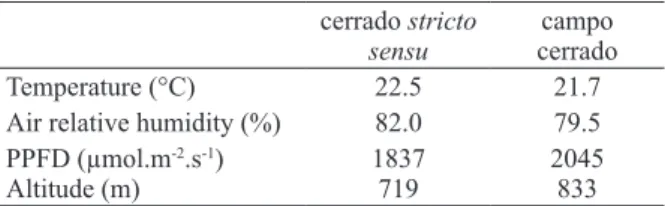
Table I shows the data for temperature, relative
humidity, PPFD and altitude in both areas.
cerrado stricto sensu
campo cerrado
Temperature (°C) 22.5 21.7
Air relative humidity (%) 82.0 79.5 PPFD (µmol.m-2.s-1)
Altitude (m)
1837 719
2045 833
TABLE I
Environmental data from areas of cerrado sensu stricto and campo cerrado in São Paulo State, Brazil.
Twelve adult plants of
L. origanoides
were sampled in each population. Leaves and
inflorescences were collected during the summer,
in February 2013. All individuals were in the same
phenological stage.
DENSITY OF GLANDULAR TRICHOMES
To evaluate the density of glandular trichomes, two
fully expanded leaves were collected from each
plant in both populations. To estimate the density
of glandular trichomes in reproductive organs, two
inflorescences were collected from each individual
in the campo cerrado.
Samples of flowers and the middle part of leaf
blades were fixed in glutaraldehyde (2.5% with 0.1
M phosphate buffer, pH 7.3, overnight at 4
°C),
dehydrated in a graduated acetone series,
critical-point dried, mounted on aluminum stubs,
gold-coated (Robards 1978), and examined with a Fei
Quanta scanning electron microscope.
The glandular density in leaves and flowers
was calculated in 1 mm
2using the Scandium
software with an image-capture system coupled to
the scanning electron microscope. We compared
the glandular density between a) the adaxial and
abaxial leaf surfaces in individuals from the same
population; b) leaves from different populations;
and c) leaves and floral parts (bracts, sepals,
petals) from the same population. The data were
submitted to ANOVA followed by Tukey test, at a
5% probability level.
YIELD AND CHEMICAL COMPOSITION OF THE ESSENTIAL OILS
For the essential oil analyses, leaves and
in-florescences were collected from four individuals
growing in the cerrado
stricto sensu
(numbered 1 to
4) and from three individuals growing in the campo
cerrado (numbered 1 to 3). Individual number 3 in
the campo cerrado was located on an ant colony.
The samples were dried at 40 °C and were
subjected to hydrodistillation in a Clevenger-type
apparatus (Craveiro et al. 1981) for 2 h.
The qualitative analysis of the essential oil
was performed on a gas chromatograph coupled
to a mass spectrometer (CG-MS, Shimadzu,
QP-5000), with an OV-5 fused silica capillary column
(30 m x 0.25 mm x 0.25 μm, Ohio Valley Specialty
Chemical, Inc.), operating at an MS ionization
voltage of 70 eV, with helium as the carrier gas
(1.0 mL/min.). The following chromatography
conditions were used: injector at 240 °C, detector at
230 °C, injection volume: 1 µL of solution (1 mg
of essential oil/1 mL of ethyl acetate), split 1/20,
and the temperature program: 60 °C – 240 °C, 3 °C/
min. The compounds were identified by comparison
of the acquired mass spectra with those stored in
the GC/MS database of the system (NIST 62 lib.)
and retention indices (Adams 2007). The retention
indices (RI) were obtained from the injection of
a mixture of
n
-alcanes (Sigma-Aldrich, C
9-C
24),
employing the same temperature program conditions
described above for GC/MS, applying the equation
of Van den Dool and Kratz (1963).
The separation and quantification (area norma
lization method) of the substances were carried out
by gas chromatography (FID, Shimadzu,
GC-2010/AOC20i), equipped with a flame ionizer,
using a DB5 capillary column (J and W Scientific;
30 m x 0.25 mm x 0.25 μm), with helium as the
carrier gas (1.0 mL/min), temperature injector at 240
°C, detector at 230 °C, split 1/20, injection volume
1 µL of solution (1 mg essential oil/1 mL ethyl
acetate). The following chromatography conditions
were used: 60 °C – 160 °C, 5 °C/min; 160 °C – 230
°C, 3 °C/min; 230 °C – 280 °C, 10 °C/min.
The yield of essential oil was analyzed using
factorial analysis, and compared among the plant
organs and populations by ANOVA, followed by
Tukey test at a 5% probability level.
RESULTS
DISTRIBUTION AND DENSITY OF GLANDULAR TRICHOME
Glandular trichomes were observed in both leaf
(Fig. 1A, B) and bract (Fig. 1C) surfaces, as well as
the abaxial side of sepals (Fig. 1D) and petals (Fig.
1E) of
L. origanoides
. In the petals, these glands
occurred exclusively in the distal region.
In the individuals from the campo cerrado, the
glandular density was higher in the inflorescences
(Table II). Bracts and sepals were the organs with
the highest glandular density (Table II). The density
of glandular trichomes was three to four times
higher on the abaxial surface of the leaf (Fig. 1A)
than on the adaxial (Fig. 1B) for individuals from
both the campo cerrado and the cerrado
stricto
sensu
(Table II).
The abaxial leaf surface of individuals from
the campo cerrado showed a higher density of
glandular trichomes in comparison to individuals
from the cerrado
stricto sensu
(F
(1,22)=15.6354;
P=0.0009). Differences in the glandular density
were not observed for the adaxial leaf surfaces
of individuals from the different populations
(F
(1,22)=1.1297; P=0.2998) (Table II).
YIELD AND CHEMICAL COMPOSITION OF THE ESSENTIAL OIL
The yield of the essential oil of
L. origanoides
was
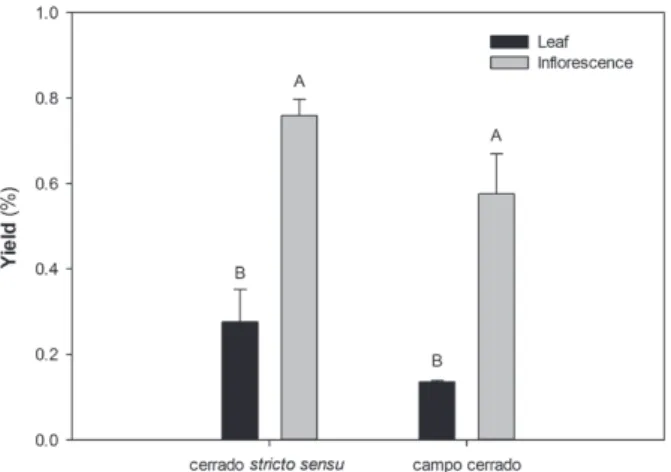
higher in inflorescences than in the leaves (Fig. 2)
in individuals from both cerrado physiognomies
(F
(3,8)=22.7906; P<0.0001) (Fig. 2). No significant
differences were observed in the oil yield between
individuals from the cerrado
stricto sensu
and the
campo cerrado, for both leaves (P=0.390) and
inflorescences (P=0.233).
During the analysis of the essential oil yield, the
samples from individual 3 (the one that was located
on an ant colony in the field) from the campo cerrado
were not used, due to the discrepant values obtained
for its inflorescences (1.98) and leaves (3.97).
Figure 1 - Scanning electron micrographs of leaves and floral parts of Lippia origanoides Kunth showing glandular and non-glandular trichomes. A. Abaxial leaf surface. B. Adaxial leaf surface. C. Abaxial bract surface. D. Abaxial sepal surface. E. AbaxialOrgan Glandular density
campo cerrado cerrado stricto sensu
Bract (abaxial surface) 624.00 A
-Sepal (abaxial surface) 544.42 A
-Petal (abaxial surface) 271.85 B
-Leaf (abaxial surface) 97.62 Ca 69.52 Ab
Leaf (adaxial surface) 21.43 Da 19.16 Ba
TABLE II
Glandular density (mm2) in leaf blades and inflorescences of
Lippia origanoides Kunth from two physiognomies of the Brazilian Cerrado.
Means followed by different capital letters indicate statistical differences in the glandular density among organs and different lowercase letters indicate statistical differences in the glandular density between populations (Tukey test p < 0.05).
Figure 2 Yield of essential oil of leaves and inflorescences
of Lippia origanoides Kunth from two populations in the Cerrado (Means followed by different letters indicate statistical differences in the essential oil yield between organs inside a same population and between different populations by Tukey
test at 5% significance level).
We identified 49 substances in the essential
oil extracted from leaves and inflorescences of
L.
origanoides
. The amount of substances found in
the inflorescences was higher than in the leaves,
in both populations. The major compounds varied
between the populations, among the individuals
from the same population, and between the organs
of the same individual (Table III).
In the cerrado
stricto sensu, trans
-caryo phyllene
was the major compound in the inflorescences of
individual 1 (63.4%), 2 (34.2%) and 4 (39.3%),
whereas αhumulene was the major compound in
individual 3 (58.7%). Concerning the leaves,
trans
-caryophyllene (33.7%) and δcadinene (10.3%) were
the major compounds in individual 2; individuals
3 and 4 showed αhumulene (66.3% and 40.0%,
respectively) and
trans
-caryophyllene (9.5% and
24.9%, respectively) as their major compounds.
In the campo cerrado, αpinene (27.2%) and
trans
-caryophyllene (38.6%) were the major
compounds in the inflorescences, and
trans
-caryophyllene (60.6%) in the leaves of individual
1. βelemene was the major compound in the
inflorescences (10.2%), and αhumulene in the
leaves (10.3%) of individual 2;
trans
-caryophyllene,
γselinene and 7
epi
αselinene were the majority
compounds in both the inflorescences (11.2%,
14.9% and 10.5%) and the leaves (9.5%, 16.7% and
13.5%) in this individual. 1,8 cineole was the major
compound in both the inflorescences (52.2%) and
the leaves (58.2%) of individual 3; differently from
the other individuals, oxygenated monoterpenes
were predominant in the inflorescences (61.8%)
and leaves (71.3%) of this individual (Table III).
DISCUSSION
Compound
Inflorescences Leaves
RI* RI** cerrado stricto sensu campo cerrado cerrado stricto
sensu campo cerrado
1.0 2.0 3.0 4.0 1.0 2.0 3.0 2.0 3.0 4.0 1.0 2.0 3.0 Hydrocarbon Monoterpenes
αthujenew nd nd nd nd nd nd 0.6 nd nd nd nd nd 0.8 927 930
αpinene 3.7 0.8 8.4 nd 27.2 nd 4.6 0.5 0.7 nd 2.4 nd 4.2 934 939
camphene 1.2 3.0 1.3 0.4 2.4 0.2 0.2 1.5 0.1 0.1 0.2 nd tr 948 954
sabinene nd nd nd nd nd nd 5.8 nd nd nd nd 0.7 4.2 975 975
βpinene nd nd nd nd 1.3 nd 2.3 nd nd nd nd nd 2.3 977 979
myrcene nd 0.6 0.5 nd 0.7 tr 1.5 tr tr nd nd nd 1.5 991 990
αphellandrene nd nd 0.4 nd tr nd 0.3 nd nd nd nd nd 0.4 1006 1002
αterpinene nd 0.6 tr nd nd nd nd nd nd nd nd nd 0.6 1017 1017
p-cymene 1.0 1.9 0.3 tr 2.1 0.2 1.6 0.9 nd nd nd nd 1.0 1024 1024
limonene 0.4 1.9 3.0 nd nd nd nd nd nd nd 0.4 0.2 1.8 1029 1029
Zβocymene nd nd nd nd nd nd nd 1.4 nd 0.3 nd nd nd 1037 1037
Eβocymene nd 7.9 1.8 nd nd 1.7 tr 4.5 0.2 tr nd 0.8 tr 1047 1050
γterpinene tr 5.1 1.2 nd nd nd 1.9 0.3 nd nd nd nd 1.3 1058 1059
terpinolene nd 0.2 tr nd tr nd 0.3 tr nd nd nd nd 0.2 1089 1088
Oxygenated Monoterpenes
1-octen-3-ol 0.2 0.3 0.5 nd nd nd nd 0.9 tr 0.4 nd nd nd 977 979
1,8 cineole 0.4 8.7 0.4 0.3 0.2 0.3 52.2 4.3 1.3 nd nd nd 58.2 1031 1031
linalool 1.2 5.2 0.8 3.7 1.9 5.7 0.6 1.1 tr 2.8 0.7 4.1 1.6 1100 1096
borneol nd 1.2 tr nd tr nd 0.5 0.3 tr nd nd nd 0.6 1165 1169
terpinen-4-ol nd 0.6 nd nd nd nd 1.8 tr nd nd nd nd 2.4 1177 1177
αterpineol nd 1.0 nd nd nd nd 6.7 tr nd nd nd nd 8.6 1190 1188
Hydrogenated Sesquiterpenes
αcopaene 5.3 5.1 3.4 5.4 3.7 1.0 tr 8.5 4.2 4.6 8.5 1.4 nd 1378 1376
βelemene 4.2 1.6 1.4 1.7 3.3 10.2 0.5 nd nd nd tr 0.5 nd 1394 1390
αgurjunene nd 0.3 tr 0.2 nd nd nd 0.6 nd 0.2 nd nd nd 1411 1409
trans-caryophyllene 63.4 34.2 12.7 39.3 38.6 11.2 3.9 33.7 9.5 24.9 60.6 9.5 2.5 1422 1419
αguaiene nd 0.9 nd nd nd nd 0.3 1.8 nd nd nd tr 0.2 1440 1439
aromadendrene nd nd nd nd nd 0.6 nd nd nd nd nd 0.6 nd 1446 1441
αhumulene 3.7 2.3 58.7 35.0 2.2 8.3 0.3 2.7 66.3 40.0 3.7 10.3 tr 1455 1554
allo-aromadendrene 0.6 nd tr 0.8 0.2 tr tr 0.3 0.3 0.7 0.5 tr tr 1462 1460
γmuurolene 1.0 0.4 0.5 1.0 nd 1.3 nd 0.9 nd nd nd 1.2 nd 1475 1479
germacrene D 1.6 0.6 0.3 0.9 0.7 0.7 0.6 1.0 0.6 0.9 1.2 nd nd 1478 1485
γselinene nd nd nd nd nd 14.9 nd tr nd nd nd 16.7 nd 1481 1498
βselinene 0.9 0.7 1.3 0.5 1.1 3.7 nd tr nd nd tr 3.1 nd 1487 1492
valencene nd nd nd nd nd 3.0 nd nd nd nd nd 3.6 nd 1490 1496
αselinene nd nd nd nd nd 6.6 nd 0.9 0.3 nd tr 6.0 nd 1496 1498
bicyclogermacrene 0.2 0.5 tr tr 4.1 nd 5.3 nd nd nd nd nd 2.2 1497 1500
αmuurolene nd nd nd 1.7 nd nd nd 1.6 0.7 0.9 1.4 nd nd 1501 1500
germacrene A 1.8 2.4 tr nd nd 1.0 nd 0.4 nd nd nd nd nd 1506 1509
7-epiαselinene nd nd nd nd nd 10.5 nd nd nd nd nd 13.5 nd 1514 1522
δcadinene 2.2 5.4 1.0 2.2 0.8 0.2 tr 10.3 1.5 2.5 2.9 0.4 nd 1525 1513
trans-cadina-1,4-diene nd tr nd nd nd nd nd 0.3 nd nd nd nd nd 1534 1534
germacrene B tr nd tr nd nd 0.5 nd nd nd nd nd 0.5 nd 1553 1561
TABLE III
Oxygenated Sesquiterpenes
spathulenol nd tr nd 0.3 1.0 nd 3.4 nd nd 0.3 nd nd 2.0 1578 1578
caryophyllene oxide 2.1 3.6 0.5 2.3 5.8 1.4 2.3 6.0 0.7 3.9 6.2 1.0 2.5 1583 1583 humulene epoxide II tr nd nd nd tr 1.1 nd tr 5.0 4.6 2.8 1.2 nd 1610 1608
1-epi-cubenol 0.3 nd 1.2 1.5 nd 0.8 nd 4.5 1.7 2.2 nd 1.7 nd 1629 1628
cubenol 0.6 1.4 tr 0.5 0.6 nd 0.7 0.3 0.3 2.4 1.1 2.0 tr 1643 1646
αmuurolol tr 0.8 tr 0.5 nd 0.7 nd 5.5 0.2 1.0 0.7 0.6 nd 1646 1646
selin11en4αol nd nd nd nd nd 5.8 nd tr nd nd nd 8.1 nd 1654 1652***
αcadinol 2.6 0.5 0.6 1.6 2.0 5.9 nd 1.1 1.3 2.8 nd 8.6 tr 1655 1654
Hydrocarbon
Monoterpenes 6.3 21.9 16.9 0.4 33.7 2.0 18.9 9.1 1.0 0.4 3.0 1.8 18.2 Oxygenated
Monoterpenes 1.8 16.9 1.7 4.1 2.1 6.0 61.8 6.6 1.3 3.2 0.7 4.1 71.3 Hydrogenated
Sesquiterpenes 84.8 54.2 79.1 88.5 54.6 73.6 10.9 62.9 83.3 74.7 78.8 67.1 4.9
Oxygenated
Sesquiterpenes 5.5 6.2 2.3 6.5 9.4 15.6 6.3 17.4 9.2 16.9 10.7 23.2 4.5
Total identified 98.4 99.2 100.0 99.5 99.7 97.2 97.9 95.9 94.9 95.2 93.3 96.0 98.9
RI*= Retention index calculated; IR**= Retention index (Adams 2007); nd = not detected; tr = trace (tr ≤0.13). *** Retention
index obtained on the website: www.pherobase.com
about the influence of exogenous factors on the
origin of secretory structures in plants. Studies
have reported on the effects of light, temperature,
altitude, and availability of nutrients, among others,
on the glandular density in different plant species
(Gianfagna et al. 1992, Horgan et al. 2009,
Pérez-Estrada et al. 2000). In drier environments, the
density of trichomes on leaves can be higher than
in plants of the same species growing in wetter
situations (Pérez-Estrada et al. 2000). Similarly,
light intensity can positively influence the glandular
trichomes (Pérez-Estrada et al. 2000, Yamaura et
al. 1989). According to Pérez-Estrada et al. (2000),
in addition to playing a defensive role against biotic
agents, glandular trichomes can help to reflect
sunlight and minimize water loss.
Although the PPFD was similar between the
areas, plant density in the cerrado
stricto sensu
is higher, and at certain periods of the day the
individuals can be shaded. This does not occur in the
campo cerrado, where shorter herbaceous species
predominate. The shading of
L
.
origanoides
plants in
the cerrado
stricto sensu
may be related to the lower
glandular density of their leaves, since plants under
more intense radiation tend to have higher glandular
density as a protective mechanism (Gianfagna et al.
1992, Pérez-Estrada et al. 2000). In addition, the
higher density of glandular trichomes on leaves of
L. origanoides
plants in the campo cerrado may be
related to the higher altitude of this area.
The influence of altitude on the abundance
of glandular structures was evaluated by Sheue et
al. (2003), who found a higher density of internal
glands in individuals of
Pinus taiwanensis
in
middle altitudes (1000 to 2500 m), in comparison
with plants at lower (700 m) or higher (3000 m)
altitudes. According to the authors, variation in
the number of glands can result from genetic and
environmental interactions. This suggests that
variations in the glandular density in individuals
of
L. origanoides
growing in the campo cerrado
and the cerrado
stricto
sensu
may result from
interactions between environmental or
micro-environmental factors and genetic factors.
secretion produced by the glandular trichomes of
L.
origanoides.
Besides lipid substances, Tozin et al.
(2015), using histochemical methods, detected the
presence of polysaccharides, phenolic compounds,
proteins, and alkaloids, among others, in the glandular
trichomes of this species. The mixed nature of the
secretion produced by the trichomes is an aspect
common to other
Lippia
species (Argyropoulou et
al. 2010, Combrinck et al. 2007). Tozin et al. (2015)
demonstrated that not all morphotypes of glandular
trichomes of
L
.
origanoides
produce essential oils.
Therefore, the more-abundant glandular trichomes
in leaves in individuals from the campo cerrado are
probably not secretors of essential oils. We can still
suggest that under the environmental conditions
of the campo cerrado there is a higher investment
in the production of other types of substances by
the glandular trichomes, and this provides greater
protection against high light intensity and lower
relative humidity. Hydrophilic substances can act
as a lubricant in dry environments and facilitate leaf
expansion (Ascensão et al. 1999). In
Lippia
species,
phenolic compounds are abundant and variable in
constitution (Pascual et al. 2001), and may help to
protect against intense UV-B radiation resulting from
greater exposure to sunlight (Liakoura et al. 1997).
Our results also showed that
L. origanoides
inflorescences had a higher density of glandular
trichomes and produced a higher yield of essential
oils in comparison to the leaf blades of individuals
in the same environment. These data contrast
with studies on other species, which reported
a low yield of essential oils in flowers and
inflorescences in comparison to leaves (Bassole
et al. 2005, Parra-Gárces et al. 2010), and can
be related to the different roles of these glands
in reproductive organs (Ascensão et al. 1999,
Paiva and Martins 2011). We suggest that in
L.
origanoides,
the trichomes in the inflorescences
are mainly involved in the production of large
amounts of essential oils that play an important
role in protecting the reproductive organs against
herbivores and pathogens (Stökl et al. 2010). In
addition, several terpenes can be reused in the
plant metabolism (Harborne 1988), acting as
precursors in the synthesis of hormones such as
flowering hormones (Danilova and Kashina 1987,
Roshchina and Roshchina 1993).
Chemical analysis of the essential oils in leaves
and inflorescences of
L. origanoides
revealed a
wide variation in the chemical composition of
the essential oil among the individuals in each
area. This may be related to genetic variability
among individuals from these populations. Catalan
and Lampasona (2002) found that intraspecific
variations in the chemical composition of essential
oils are common in species of
Lippia
.
Studies with
L. origanoides
(
sensu
lato
)
individuals have presented widely divergent
chemical profiles. Thymol, carvacrol and pcymene
have been reported as the majority compounds
(Cavalcanti et al. 2010, Oliveira et al. 2007,
Stashenko et al. 2010, 2013). However, in this
study, thymol and carvacrol were not found, while
pcymene was detected in small quantities. These
findings are in accordance with the information
reported by Rodrigues et al. (2011) and Stashenko
et al. (2010), who demonstrated very divergent
chemical profiles in this species. The wide variety of
chemotypes found in
L. origanoides
may be a factor
of the synonymization proposed by O’Leary et al.
(2012); in a revision of the
Goniostachyum
section
of
Lippia
, the authors synonymized 41 species into
only four. The taxon that is presently known as
L
.
origanoides
results from the synonymization of 28
taxa that were formerly considered to be separate
species (O’Leary et al. 2012).
In some individuals of
L. origanoides,
αpinene
was found in large quantities in the inflorescences.
This may be associated with the known role of
this substance in attracting pollinators (Stökl et
al. 2010). However, the inflorescences of some
L. origanoides
individuals did not contain this
phenological differences among the individuals.
Studies indicate that some compounds, such as
carvone, limonene and ß-pinene (Bicas et al. 2008)
can volatilize or be utilized as precursors in the
formation of other substances after the anthesis
(Parra-Garcés et al. 2010, Stökl et al. 2010).
Trans
caryophyllene and αhumulene were
among the major compounds in leaves and
inflorescences from several individuals. These
substances show several important biological
activities, including antiinflammatory, analgesic,
and others (Fernandes et al. 2007, Sabulal et al.
2006), and they are used to manufacture soaps,
detergents and food products (Standen et al. 2006).
Individual number 3 from the campo cerrado,
situated on an ant colony, diverged most widely from
the others in oil yield and chemical composition;
only this individual contained 1,8-cineole as the
major compound, in both the inflorescences (52.2%)
and the leaves (58.2%). The abundant production of
this substance can be related to ant attacks on this
individual, since 1,8-cineole is toxic to herbivorous
insects (Prates et al. 1998, Sukontason et al. 2004).
This toxic substance penetrates the insect body via
the respiratory or digestive system, and is lethal to
several animal species (Sukontason et al. 2004).
These findings evidenced the occurrence of
variability in the glandular density in leaves of
L.
origanoides
plants living in different areas. Our data
demonstrated the chemical plasticity of this species,
which can
produce essential oils with differential
chemical composition in distinct environments and
evidenced the differential answers between leaves
and inflorescences in a same individual. In view
of this plasticity, the use of this species should be
better monitored, particularly in popular medicine.
ACKNOWLEDGMENTS
We thank Fundação de Amparo à Pesquisa do
Estado de São Paulo (FAPESP) (TEM/BIOTA
Proc. 2008/554347) for financial support; PROPE/
FUNDUNESP (Proc. 0504/011/14) for supporting
the review service of the manuscript; the technical
team of the Centro de Microscopia Eletrônica (CME),
IBB, UNESP, for helping in the sample preparation;
and Dr. Luiz Fernando Rolim de Almeida, IBB,
UNESP, for assistance with statistical analyses.
RESUMO
Os óleos essenciais de folhas e inflorescências de Lippia origanoides Kunth apresentam potencial aromático e medicinal e têm sido utilizados no tratamento de diversas doenças, incluindo melanoma. No Brasil, L. origanoides
é comumente encontrada no campo cerrado e no cerrado
stricto sensu, fisionomias caracterizadas principalmente
pelas diferentes condições de luminosidade às quais as plantas de médio e pequeno porte estão sujeitas. Nosso objetivo foi investigar a densidade de tricomas glandulares e o rendimento e a composição química do óleo essencial em folhas e inflorescências de L.
origanoides do campo cerrado e do cerrado stricto sensu. Para análise de densidade glandular, folhas e inflorescências foram processadas segundo técnicas convencionais em microscopia eletrônica de varredura. Os óleos essenciais de folhas e inflorescências foram obtidos por hidrodestilação e identificados com cromatografia gasosa. Brácteas e sépalas mostraram a maior densidade glandular, seguidas por pétalas e folhas. A densidade glandular na face abaxial do limbo foliar foi maior em indivíduos do campo cerrado. Em ambas as fisionomias, o rendimento de óleos essenciais foi maior nas inflorescências em comparação com folhas. A composição química dos óleos essenciais variou entre os indivíduos de diferentes áreas e entre indivíduos da mesma população. Nossos resultados demonstraram a plasticidade química de L. origanoides sugerindo a importância do monitoramento de seu uso popular.
Palavras-chave: campo cerrado, cerrado stricto sensu, glândulas externas, terpenos.
REFERENCES
ARGYROPOULOU C, AKOUMIANAKI-LOANNIDOU A, C HRIS-TODOULAKIS SN AND FASSEAS C. 2010. Leaf anatomy and histochemistry of Lippia citriodora (Verbenaceae). Aust J Bot 58: 398-409.
ARGYROPOULOU C, DAFERERA D, TARANTILIS PA, FASSEAS C AND POLISSIOU M. 2007. Chemical composition of the essential oil from leaves of Lippia citriodora H.B.K. (Verbenaceae) at two developmental stages. Biochem Syst Ecol 35: 831-837.
ASCENSÃO L, MOTA L AND CASTRO MM. 1999. Glandular
trichomes on the leaves and flowers of Plectranthus ornatus: morphology, distribution and histochemistry. Ann Bot 84: 437-447.
BASSOLE IHN, NEBIE R, SAVADOGO A, OUATTARA CT, BARRO N AND TRAORE NA. 2005. Composition and antimicrobial
activities of the leaf and flower essential oils of Lippia chevalieri and Ocimum canum from Burkina Faso. Afr J Biotechnol 4: 1156-1160.
BICAS JL, FONTANILLE P, PASTORE GM AND LARROCHE C. 2008. Characterization of monoterpene biotrans-formation in two pseudomonads. J Appl Microbiol 105: 1991-2001.
CATALAN CAN AND LAMPASONA PDE. 2002. The chemistry of the genus Lippia (Verbenaceae). In: KINTZIOS SE (Eds), Oregano: The Genera Origanum and Lippia, Taylor and Francis; London, p. 127-149.
CAVALCANTI SCH, NICULAU ES, BLANK AF, CÂMARA CAG, ARAÚJO IN AND ALVES PB. 2010. Composition and acaricidal activity of Lippia sidoides essential oil against two-spotted spider mite (Tetranychusurticae Koch). Bioresour Technol 101: 829-832.
COMBRINCK S, DU PLOOY GW, MCCRINDLE RI AND BOTHA BM. 2007. Morphology and histochemistry of glandular trichomes of Lippia scaberrima (Verbenaceae). Ann Bot 99: 1111-1119.
CRAVEIRO AA, FERNANDES AG, ANDRADE CHS, MATOS FJA, ALENCAR JW AND MACHADO MIL. 1981. Óleos Essenciais de Plantas do Nordeste. UFC, Fortaleza, 209 p.
DANILOVA MF AND KASHINA TK. 1987. Ultrastructure of
glandular squamule of Perilla ocymoides (Lamiaceae)
in connection with their participance in the synthesis of steroid hormones and gibberellins. Phytomorphol 72: 427-435.
FERNANDES ES, PASSOS GF, MEDEIROS R, CUNHA FM, FERREIRA J, CAMPOS MM, PIANOWSKI LF AND CALIXTO JB. 2007. Antiinflammatory effects of compounds alpha humulene and (-)-trans-caryophyllene isolated from the essential oil of Cordia verbenacea. Eur J Pharmacol 569: 228-236.
GIANFAGNA TJ, CARTER CD AND SACALIS JN. 1992.
Temperature and photoperiod influence trichome density and sesquiterpene content of Lycopersicon hirsutum f.
hirsutum. Plant Physiol 100: 1403-1405.
GOBBO-NETO L AND LOPES NP. 2007. Plantas medicinais:
Fatores de influência no conteúdo de metabólitos
secundários. Quím Nova 30: 374-381.
GOMES GA, MONTEIRO CMO, SENRA TOS, ZERINGOTA V, CALMON F, MATOS RS, DAEMON E, GOIS RWS, SANTIAGO GMP AND CARVALHO MG. 2012. Chemical composition and acaricidal activity of essential oil from Lippia sidoides on larvae of Dermacentor nitens
(Acari: Ixodidae) and larvae and engorged females of
Rhipicephalus microplus (Acari: Ixodidae). Parasitol Res 111: 2423-2430.
GONZÁLES WL, NEGRITTO MA, SUÁREZ LH AND GIANOLI E. 2008. Induction of glandular and non-glandular trichomes by damage in leaves of Madia sativa under contrasting water regimes. Acta Oecol 33: 128-132.
HARBORNE JB. 1988. The Flavonoids: Advances in Research since 1980. Chapman and Hall, New York.
HORGAN FG, QUIRING DT, LAGNAOUI A AND PELLETIER Y. 2009. Effects of altitude of origin on trichome-mediated anti-herbivore resistance in wild Andean potatoes. Flora 204: 49-62.
JUDD WS, CAMPBELL CS, KELLOGG EA, STEVENS PF AND DONOGHUE MJ. 2009. Sistemática Vegetal: Um Enfoque Filogenético. 3a ed., Artmed, Porto Alegre.
JULIANI JrHR, KOROCH AR, JULIANI HR, TRIPPI VS AND ZYGADLO JA. 2002. Intraspecific variation in leaf oils of
Lippia junelliana (Mold.) Tronc. Biochem Syst Ecol 30: 163-170.
LIAKOURA V, STEPFANOU M, MANETAS Y, CHOLEVAS C AND KARABOURNIOTIS G. 1997. Trichome density and its UV-B protective potential are affected by shading and leaf position on the canopy. Environ Exp Bot 38: 223-229. MARONI BC, DI STASI LC AND MACHADO SR. 2006. Plantas
Medicinais do Cerrado de Botucatu – Guia Ilustrado. Editora UNESP, São Paulo.
MARTÍNEZ-NATARÉN DA, PARRA-TABLA V, DZIB G AND CALVO-IRABIÉN LM. 2011. Morphology and density of glandular trichomes in populations of Mexican oregano (Lippia graveolens H.B.K., Verbenaceae), and the relationship between trichome density and climate. J Torrey Bot Soc 138: 134-144.
O’LEARY N, DENHAM SS, SALIMENA F AND MÚLGURA ME. 2012. Species delimitation in Lippia section
Goniostachyum (Verbaneceae) using the phylogenetic species concept. Bot J Linn Soc 170: 197-219.
OLIVEIRA DR, LEITÃO GG, BIZZO HR, LOPES D, ALVIANO DS, ALVIANO CS AND LEITÃO SG. 2007. Chemical and antimicrobial analyses of essential oil of Lippia origanoides H.B.K. Food Chem 101: 236-240.
PAIVA EAS AND MARTINS LC. 2011. Calycinal trichomes in
Ipomoea cairica (Convolvulaceae): ontogenesis, structure and functional aspects. Aust J Bot 59: 91-98.
PARRA-GARCÉS MI, CAROPRESE-ARAQUE JF, ARRIETA-PRIETO D AND STASHENKO E. 2010. Morfología, anatomia,
ontogenia y composición química de metabolitos
secundários em inflorescencias de Lippia alba
(Verbenaceae). Rev Biol Trop 58: 1533-1548.
PÉREZ-ESTRADA LB, CANO-SANTANA Z AND OYAMA K. 2000. Variation in leaf trichomes of Wigandia urens:
environmental factors and physiological consequences.
Tree Physiol 20: 629-632.
PRATES HT, SANTOS JP, WAQUIL JM, FABRIS JD, OLIVEIRA AB AND FOSTER JE. 1998. Insecticidal activity of monoterpenes against Rhyzopertha dominica (F.) and
Tribolium castaneum (Herbst). J Stored Prod Res 34: 243-249.
ROBARDS AW. 1978. An introduction to techniques for scanning electron microscopy of plant cells. In: Electron Microscopy and Cytochemistry of Plant Cells. HALL JL (Ed), Elsevier, New York.
ROCHA-GUZMÁN NE, GALLEGOS-INFANTE JA, G ONZÁLEZ-LAREDO RF, RAMOS-GÓMEZ M, RODRÍGUES-MUÑOZ ME, REYNOSO-CAMACHO R, ROCHA-URIBE A AND R OQUE-ROSALES MR. 2007. Antioxidant effect of oregano (Lippia berlandieri v. Shauer) essential oil and mother liquors.
Food Chem 102: 330-335.
RODRIGUES FFG, COUTINHO HDM, CAMPOS AR, LIMA SG AND COSTA JGM. 2011. Antibacterial activity and chemical composition of essential oil of Lippia microphylla Cham. Acta Scient Biol Sci 33: 141-144.
ROSHCHINA VV AND ROSHCHINA VD. 1993. The Excretory Function of Higher Plants. Springer, Berlin.
SABULAL B, DAN M, JOHN AJ, KURUP R, PRADEEP NS, VALSAMMA RK AND GEORGE V. 2006. Caryophyllene-rich rhizome oil of Zingiber nimmonii from South India: Chemical characterization and antimicrobial activity. Phytochem 67: 2469-2473.
SHEUE CR, YANG YP AND KUO-HUANG LL. 2003. Altitudinal variation of resin ducts in Pinus taiwanesis Hayata (Pinaceae) needles. Bot Bull Acad Sin 44: 305-313. SOUZA VC AND LORENZI H. 2008. Botânica sistemática: guia
ilustrado para identificação das famílias de Angiospermas da flora brasileira, baseado em APG II. 2ª Ed., Instituto
Plantarum, Nova Odessa.
STANDEN MD, CONNELLAN PA AND LEACH DN. 2006. Natural killer cell activity and lymphocyte activation: Investigating the effects of a selection of essential oils and components in vitro. Int J Aromather 16: 133-139. STASHENKO EE, MARTÍNEZ JR, CALA MP, DURÁN DC
AND CABALLERO D. 2013. Chromatographic and mass spectrometric characterization of essential oils and extracts from Lippia (Verbenaceae) aromatic plants. J Sep Sci 36: 192-202.
STASHENKO EE, MARTINÉZ JR, RUÍZ CA, ARIAS G, DURÁN C, SALGAR W AND CALA M. 2010. Lippia origanoides
chemotype differentiation based on essential oil GC-MS and principal component analysis. J Sep Sci 33: 93-103. STÖKL J, BRODMANN J, DAFNI A, AYASSE M AND HANSSON
BS. 2010. Smells like aphids: orchid flowers mimic aphid
alarm pheromones to attract hoverflies for pollination.
Proc Royal Soc B Biol Sci: doi:10.1098/rspb.2010.1770. SUKONTASON KL, BOONCHU N, SUKONTASON K AND
CHOOCHOTE W. 2004. Effects of eucalyptol on house fly
(Diptera: Muscidae) and blow fly (Diptera: Calliphoridae).
Rev Inst Med Trop S Paulo 46: 97-101.
TOZIN LRS, CARVALHO SF, MACHADO SR AND RODRIGUES TM. 2015. Glandular trichome diversity on leaves of Lippia origanoides and Lippia stachyoides (Verbenaceae): morphology, histochemistry, and ultrastructure. Botany 93: 297-306.
VAN DEN DOOL H AND KRATZ DJ. 1963. A generalization of the retention index system including liner temperature
programmed gasliquid partition chromatography. J
Chromatogr 11: 463-467.
VERAS HNH, ARARUNA MKA, COSTA JGM, COUTINHO HDM, KERNTOPF MR, BOTELHO MA AND MENEZES IRA. 2013.
Topical antiinflammatory activity of essential oil of Lippia sidoides Cham: Possible mechanism of action. Phytother Res 27: 179-185.
VILJOEN AM, SUBRAMONEY S, VAN VUUREN SF, BASER KHC AND DERMIRCI B. 2005. The composition, geographical variation and antimicrobial activity of Lippia javanica
(Verbenaceae) leaf essential oils. J Ethnopharmacol 96: 271-277.
WERKER E. 2000. Trichome diversity and development. Pages 1-35. in Hallahan DL, JC Gray, eds. Plant Trichomes. Advances in Botanical Research 31, Academic Press, New York.
YAMAURA T, TANAKA S AND TABATA M. 1989. Light-dependent formation of glandular trichomes and monoterpenes in