Vol.53, n. 6: pp.1487-1496, November-December 2010
ISSN 1516-8913 Printed in Brazil BRAZILIAN ARCHIVES OF
BIOLOGY AND TECHNOLOGY A N I N T E R N A T I O N A L J O U R N A L
Recovery of Phytase Produced by Solid-state Fermentation
on Citrus Peel
Daniel Ernesto Rodríguez-Fernández
1, José Angel Rodríguez-León
1, Júlio Cesar de
Carvalho
1, Vanete Thomaz-Soccol
1,2, José Luis Parada
2and Carlos Ricardo Soccol
1*1Divisão de Engenharia de Bioprocessos e Biotecnologia; Universidade Federal do Paraná Federal 81531-970;
Curitiba - PR – Brasil. 2Divisão de Biotecnologia Industrial; Universidade Positivo; 81280-330; Curitiba - PR - Brasil
ABSTRACT
The extraction of phytase produced by solid-state fermentation of citrus peel was studied employing a multistage leaching process. It was observed that the extracts containing EDTA retained over 90% of phytase activity at room temperature after 24 h after the leaching. A fractional design 22 (with 4 replicates at the central point) was carried out for testing the pH and agitation as process independent factors. Only the interaction between the pH and agitation showedasignificant influence. These factors were optimizedwith a central composite design. Agitation at 300 rpm and pH at 5.0 were the best conditions to extract the enzyme from solid matrix. The modeling ofthe process indicated that diffusivity of the enzyme in the solvent was the controlling mechanism. The corresponding kinetic constant and saturation concentration in this process were 0.89 min-1 and 4.0 IU/mL, respectively. The multistage process indicated that after two steps, it was possible to recover 85% of total enzyme produced.
Key words: leaching, recovery multistage, phytase, solid state fermentation, kinetic models
*Author for correspondence: [email protected]
INTRODUCTION
The inclusion of enzymes in the formulation of feeding diets for mono-gastric animals have increased in recent times (Cowieson et al., 2006; Bedford and Schultze, 1998). The purpose of these additives deals with the aim to make the diets more efficient in terms of animal weight gain against the amount of diets consumed, and also, to reduce the negative impact of large-scale animal production over the environment. In this regard, the employment of phytase in the diary food of mono-gastric animals is especially important (Vohra et al., 2003; Wodzinski et al., 1996).
Rodríguez-Fernández, D. E. et al. 1488
the animal feed; second advantage is on the environment, avoiding eutrophication of freshwater or seawater (Durmand and Jondreville 2007; Bogar et al., 2003). However, the high price of commercial phytase, which adds up US$2–3 per metric ton of the feed, is the main problem to the widespread application of phytase as feed supplement. Also, majority of the commercial phytase is produced by submerged fermentation, which is an expensive process (Bogar et al., 2003). There have been reports on the use of filamentous fungi for the production of phytase in solid-state fermentation (SSF) (Spier et. al. 2008, Bogar et. al, 2003). One of the main advantages of SSF lies in the fact that agro and food industrial residues can be employed as substrates directly or with only a mild pretreatment (Pandey et al., 2001). When enzymes are produced by SSF, the first step for the recovery or purification process is the leaching or liquid/solid extraction (Rodríguez-Fernandez, 2004). However, there are just a few papers dealing with the leaching of metabolites from a solid-state fermented matrix (Ikari and Mitchell, 1996; Castilho et. al., 1999; 2000; Palit and Banerjee, 2001; 2010; Heck et. al., 2005; Díaz et. al. 2007) and none considering the leaching of phytase form a solid-state fermented matrix. Thus, the aim of the present work was to study the extraction of phytase produced in SSF on a citrus peel medium.
MATERIALS AND METHODS
Microorganism and strain conservation
A strain of Aspergillus niger F3 was used in this work. The culture was grown in Czapeck medium (agar slants) by incubating at 30°C for seven days. The slants were preserved at 4 - 8°C.
Inoculum preparation
Ten grams ground dried citrus peel was mixed with 100 mL of hot distilled water for 15 minutes and after cooling to room temperature, the solution was filtered. The filtrate was diluted at 1:10 with distilled water, followed by the addition of 0.3g NH4NO3, pH adjustment at 5.0 and was autoclaved
at 121°C for 15 minutes. After cooling, this was inoculated with the spores of fungal culture and incubated in a shaker at 30oC and 120 rpm for 96 h.
Solid-state fermentation
The dried citrus peel (75% of peel had a particle size ranging from 0.8mm to 2mm, and the other 25% had a particle size between 2-3 mm) was supplemented with (% dry wt basis) NH4NO3 0.43;
NaSO4 0.021; MgSO4 .7H2O 0.077; ZnSO4 .7H2O
0.042; KCl 0.162; Ca(OH)2 0.011. Water was
added to the medium to obtain 60% initial humidity. Inoculation was made in 1:10 (v/w) of mycelia grown as above with biomass concentration 15 g/L. Fermentations were carried out in a static drum bioreactor with 2 Kg substrate and aeration of 1 VKgM (defined as 1 liter of air per kilogram of moist medium per minute; L kg-1 min-1) (Rodríguez-Fernández, 2009).
Phytase activity
Phytase activity was determined using a modified method as described by Greiner and Farou (2007). Enzyme assay was carried out at 50°C in 350 µL
of 100 mM sodium citrate buffer (pH 3.0) containing 875 nmol sodium phytate. The enzymatic reaction was started by adding 50 µL of enzyme solution to the assay mixture. After incubating at 50°C for 15 min, the liberated phosphate was measured according to the ammonium molybdate method (Heinonen and Lahti, 1981). Then, 1.5 mL of freshly prepared solution of acetone/5 N H2SO4/10 mM ammonium molybdate (2:1:1 v/v) and 100 µL 1.0 M citric acid were added to the assay mixture. Any cloudiness that might have appeared was removed by centrifugation prior to the measurement of absorbance at 355 nm. One international unit (IU) of phytase activity is expressed as 1 µmol phosphate liberated per mL per min (µmol mL-1 min-1). Blanks were run by the addition the of ammonium molybdate solution prior to adding the enzyme to the assay mixture.
Leaching of enzymes
Extracts were prepared by employing a mechanical agitator FISATOM Model 713D in a beaker (1000 ml of working volume) using a solid/liquid ratio of 1/25 g/mL, considering dry wt basis of fermented matter.
Influence of anions on the extraction
The effect of anions (Cl
-, SO
4-2, NO
3-1, citrate
activity was investigated by the addition of
acid solutions containing these anions to the
solvent for 30 min at room temperature
(approximately 25°C). The EDTA was added
at a concentration of 50
µµµµ
L. Distilled water
was considered as the control. The solid-liquid
relation was fixed at 25 g/ml on dry wt basis.
Experimental designs
An initial 22 factorial plan with four repetitions of the central point was employed to determine the influence of pH (4.5 and 6.5) and agitation (450 and 150) on phytase extraction with the central point being pH 5.0 and 300 rpm, respectively (Montgomery, 2005).
Table 1- Experimental range and levels of independent variables studied using a two level fractionated factorial design (22) with replicates at central point in terms of actual and coded factors.
Coded level of variable Factors Corresponding Variable
- 1 0 1
A pH 3.5 5.0 6.5
B Agtation (rpm) 150 300 450
After establishing the influence of the above variables, the factorial design was extended to a Central Composite Design considering the results obtained, plus four axial points with values of pH of 2.9 and 7.1 and agitation of 90 and 510 rpm.
This kind of design allows the optimization of the dependent variable if there is a non-lineal zone in the range analyzed (Montgomery, 2005). All runs lasted 30 minutes.
Table 2- Experimental range and levels of independent variables studied using a CCD in terms of actual and coded factors.
Coded level of variable Factor Units
- α - 1 0 1 α
pH 2.9 3.5 5.0 6.5 7.1
Agitation (rpm) 89 150 300 450 520
RESULTS AND DISCUSSION
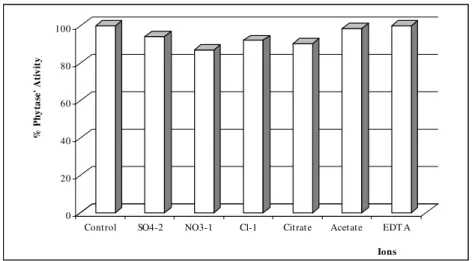
Effect of anions on the recovery of phytase The influence of anions on the phytase activity was carried out taking water as control at room temperature during 30 minute. The control sample had an activity of 3.57 IU/ml. Figure 1 showed that none of the anions used in the study had an activating effect when used at a concentration of 30 mM; NO3- showed significant inhibitory effect
on phytase activity. Only EDTA (3.69 IU/ml) had better results when compared with the control because EDTA tended to chelate metal ions, which
Rodríguez-Fernández, D. E. et al. 1490
0 20 40 60 80 100
%
P
h
y
ta
se
'
A
ti
v
it
y
Control SO4-2 NO3-1 Cl-1 Citrate Acetate EDT A
Ions
Figure 1 - Effect of several anions on phytase activity during the extraction from solid matrix fermented.
Statistical analysis for factorial design 22
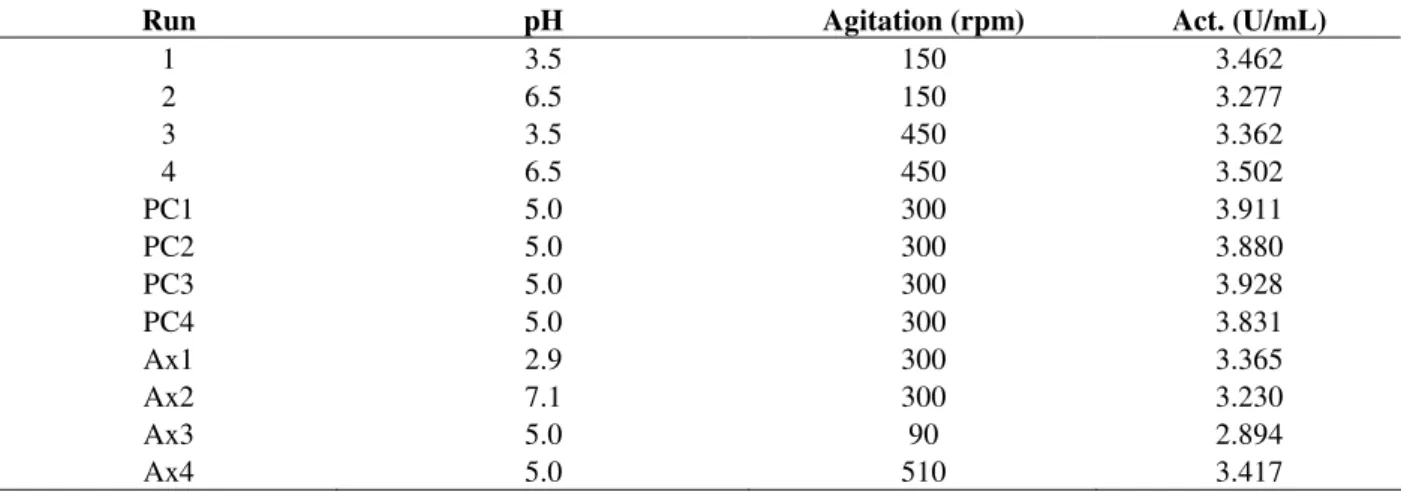
After establishing the composition of the solvent to leach the phytase from solid matrix, different levels of pH and agitation were tested through a 22 factorial design. The response matrix (Y) obtained from the experiments developed in the fractionated factorial plan 22 is shown in Table 3. The highest activities obtained in the corresponded to runs made at central point. ANOVA was performed to obtain the significant coefficients corresponding in terms of coded factors and to validate the regression model. In Table 4, the results for the values and discrimination of coefficients (βo, β1, β2 and β12) consequent to the independent factors are
shown. The ANOVA analysis showed that the interaction between pH and agitation was significant at a 95% confidence level; moreover, independent factor had no significant influence on the phytase recovery. The statistical model obtained in Table 3, indicated a significant lack of fit of the model obtained. The coefficient regression was 0.6017. This significant lack of fit suggested that a non-linear model could adjust better in the range analysed and that there might be a zone of optimal conditions. This optimal point would be better represented by a second order model fixed in the range studied; it could be a point of maximum.
Table 3 - Response matrix (Y) of the factorial plan 22 developed for the phytase lixiviation.
Run pH Agitation (rpm) Act. (U/mL)
1 3.5 150 3.462
2 6.5 150 3.277
3 3.5 450 3.362
4 6.5 450 3.502
PC1 5.0 300 3.911
PC2 5.0 300 3.880
PC3 5.0 300 3.928
PC4 5.0 300 3.831
Table 4- Factor coefficients discrimination corresponding to the fractionated factorial design 22.
Fator Coeficiente de Regressão p
Independent term (β0) 3.644 0.0000001*
pH (L) (β1) -0.01122 0.635184
Agitation (L) (β2) -0.03118 0.240004
Interation (β12) 0.08106 0.032001*
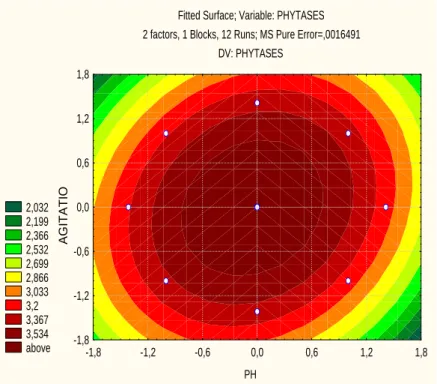
A central composite design based on the results of the factorial design was carried out to optimise the conditions for lixiviation. For this reason, four axial points were added as complementation and design a surface design to optimize the phytase activity in fresh extracts. The design and results are shown in Table 5. The analysis of variance was performed to validate the regression model. The regression coefficients and p-values are presented in Table 6. The statistical model accounted for 97.72% of the response. Figure 2 shows the surface response and the optimum (maximum) point of phytase activity.The coordinates of the
maximal point were at pH 5.0 and 300 rpm. At this point, 3.91 IU/mL enzyme was obtained.
The matrix response corresponding to the considered Central Composite Design is reported in Table 6. The ANOVA allowed to establish the following statistical model with a 95% confident level:
2 2 2
1 2
1
0
,
26
0
,
2
03
,
0
X
X
X
X
Y
=
−
−
Where :
X1: codified values of pH
X2: codified values of agitation respectively.
Y: Phyatse activity (U/mL)
Table 5 - Experimental design and response matrix (Y) corresponding to the CCD employed for the optimization of phytase recovery.
Run pH Agitation (rpm) Act. (U/mL)
1 3.5 150 3.462
2 6.5 150 3.277
3 3.5 450 3.362
4 6.5 450 3.502
PC1 5.0 300 3.911
PC2 5.0 300 3.880
PC3 5.0 300 3.928
PC4 5.0 300 3.831
Ax1 2.9 300 3.365
Ax2 7.1 300 3.230
Ax3 5.0 90 2.894
Ax4 5.0 510 3.417
Table 6- Discrimination of the factor coefficients corresponding to the CCD.
Fator Coeficiente de Regressão p
Independent term
(
β0)
3.864134 0.0000001*pH (L)
(
β1)
-0.028114 0.133186pH (Q)
(β11)
-0.220867 0.000429*Agitation (L)
(
β2)
0.002276 0.878957Agitationo (Q)
(β22)
-0.162987 0.001057*Interation
(β
12)
0.081057 0.032001*Lack of fit - 0.051091
Kinetic pattern of the PG leaching process After the initial conditions for the leaching of phytase were established, the kinetics of the process was studied. Figure 3 shows the leaching kinetic of phytase, which showed that the saturated
Rodríguez-Fernández, D. E. et al. 1492
2,032 2,199 2,366 2,532 2,699 2,866 3,033 3,2 3,367 3,534 above
Fitted Surface; Variable: PHYTASES
2 factors, 1 Blocks, 12 Runs; MS Pure Error=,0016491
DV: PHYTASES
PH
A
G
IT
A
T
IO
-1,8 -1,2 -0,6 0,0 0,6 1,2 1,8
-1,8 -1,2 -0,6 0,0 0,6 1,2 1,8
Figure 2 - Surface response corresponding to the CCD considering enzyme extraction as depending variable of pH and agitation.
0 1 2 3 4 5
0 20 40 60 80 100
Time (min)
P
h
y
ta
se
c
o
n
c.
(
IU
/m
L
)
Figure 3 - Kinetics of phytase leaching from a solid fermented dried citrus pulp by an A. niger F3 matrix.
It was assumed that the leaching mechanism depends on factors such as the migration of the solute extracted from the surface of the solid
and/or degradation of the solutes. However, most of these transformations take part in the beginning of the extraction, when the solid matrix is added to the solvent, and then the diffusion of solute takes over. The basic equation for lixiviation processes is represented by a first order kinetic equation (Coulson and Richardson, 1981):
)
1
(
ktS
e
C
C
=
−
− (2)where:
k: Leaching specific rate constant of (min -1) C: Enzyme concentration (IU/ml)
Cs: Saturated enzyme concentration (IU/ml)
t: Time (min)
Equation (1) can be represented in a linear form as:
kt
C
C
C
s
s
=
−
−
ln
(3)R2 = 0,9379
-3 -2 -1 0
0 20 40 60 80
Tmie (min)
ln
((
C
s-C
)/
C
s)
)
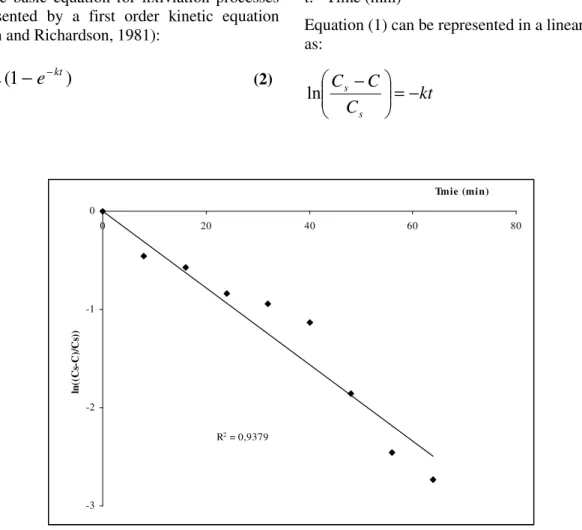
Figure 4 - Linear form of Equation (1) and estimated values for the parameters.
The kinetic constant of the process (k) could be deduced from expression (2) by linear correlation of the data. Figure 4 expresses graphically the leaching data suitably plotted in logarithmic scale according Equation 3. A fair correlation of 0.9456 confirmed the validity of assumption that this process was controlled only by the migration of the extracted solute from the particle surface into the bulk solution without further interference, including that of the possible entry of the solvent into the particles. The model obtained to phytase leaching is given by:
(
t)
e
C=4,011− −0,039 (4)
Study of the PG leaching process by a multistage process
Rodríguez-Fernández, D. E. et al. 1494
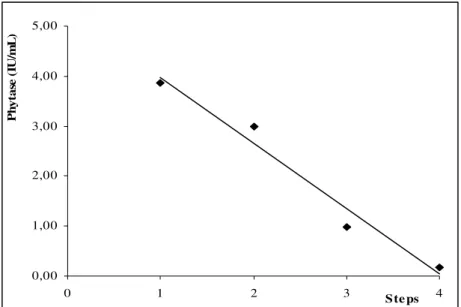
concentration. The phytase concentrations obtained in the earlier steps were higher than 2.0 IU/mL, comparing feasibly with concentrations reported for those obtained by submerged fermentations, which reached 2.0 IU/mL as highest concentration for strain modified genetically to produce phytase (Rodríguez-Fernández, 2009). This results indicated that one step leaching process for phytase at a solid-liquid ratio of 1:25 in dry basis resulted in an extraction
of 44.79 IU/g on dry wt basis, with residual activity as high as 48.29 IU/g (Table 8). This value was more than the value obtained in a one step extraction. The concentration in each step diminished with successive steps, which indicated that the former kinetic patterns established were no longer valid and that the transport of the solute to the exterior of the particles or internal diffusion started to control the process.
0,00 1,00 2,00 3,00 4,00 5,00
0 1 2 3 Ste ps 4
P
h
y
ta
se
(
IU
/m
L
)
Figure 5 - Phyatse concentration obtained for each successive steps of recovery.
Table 8 - Results of PG leaching from a fermented dried citrus pulp by A.. niger F3 at six steps with a solid-liquid ratio of 1:25 for a dry basis.
Step Phyatse in solvent. (IU/ml)
Phytase extracted from solid matrix. (IU/g) (d.b.)
Yield Phytase extracted %
1 3.86 44.79 48.12
2 3.00 34.79 37.37
3 0.99 11.44 12.29
4 0.18 2.06 2.21
As shown in Table 8, it was possible to recover approximately 85% of the phytase produced after two steps of extraction, indicating that two liquid extractions from a solid-state fermented substrate were better than equivalent to two submerged fermentations, emphasising one of the advantages of this type of fermentation. Furthermore, the entire phytase content in the solid fermented substrate after four steps was calculated to be 93.03 IU/g (dry wt basis), which was overlooked if
CONCLUSIONS
more that 50% of the enzyme produced. The process could be improved by one or two more extraction stages, with the concentration obtained in the second step being as high as 75% of the value obtained in the first one. After two steps of extractions, it was possible to recover 85% of enzymes produced with higher concentration in the solution.
RESUMO
A extração de fitases produzidas por fermentação em estado sólido de polpa cítrica foi estudada utilizando um processo de extração sólido-líquido em varias etapas. A adição de EDTA permite manter durante 24 horas a temperatura ambiente 90% da atividade inicial do caldo com a enzima extraída. Um planejamento fatorial 22, com 4 replicas no ponto central, foi desenvolvido para testar os valores de ph e agitação convenientes para a extração das enzimas. A interação entre ambos os fatores foi estadisticamente significativa. A atividade da enzima foi otimizada nos valores onde o pH (5.0) e a agitação (350 rpm) resultaram ser as melhores condições para extrair a enzima da matriz sólida. O ajuste do modelo matemático obtido mostra que é possível considerar a difusividade como o mecanismo que controla o processo de transferência de massa. A constante cinética que descreve este processo e a concentração de saturação foram 0.039 min-1 e 4.01 IU/mL respectivamente. A extração em varias etapas mostrou que nas duas primeiras etapas é possível recuperar 85% da fitase produzida.
REFERENCES
Bedford, M.R.; Schulze, H. (1998), Exogenous enzymes for pigs and poultry. Nutr Res Rev, 11, 91-114
Bogar, B.; Szakacs, G.; Linden, J. C.; Pandey, A.; Tengerdy, R. P. (2003), Optimization of phytase production by solid substrate fermentation. J Ind Microbiol Biotechnol,30, 183–189
Castilho, L.R.; Medronho, R. A.; Alves, T.L.M. (1999), Recovery of pectolytic enzymes produced by solid state culture of Aspergillus niger. Process Biochem, 34, 181–186
Castilho, L.R.; Alves, T.L.M.; Medronho, R. A. (2000), Production and extraction of pectinases obtained by solid state fermentation of agroindustrial residues with Aspergillus niger. Bioresour Technol, 71, 45-50 Coulson, J. M.; Richardson; J. F. (1981), Ingeniería
Química. Tomo II, Capítulo 10. Lixiviación. Ed: Editorial Reverté S. A. España
Cowieson, A.J.; Hruby, M.; Pierson E.E.M. (2006), Evolving enzyme technology: impact on commercial poultry nutrition. Nutr Res Rev, 19, 90-103
Díaz, A.B.; Caro, I.; de Ory, I.; Blandino, A. (2007), Evaluation of the conditions for the extraction of hydrolitic enzymes obtained by solid state fermentation from grape pomace. Enzyme Microb Technol, 41, 302–306
Dourmad, J.I.; Jondreville, C. (2007), Impact of nutrition on nitrogen, phosphorus, Cu and Zn in pigmanure, and on emissions of ammonia and odours. Livest Sci, 112; 192–198
Fadel, M. (2001), High-level xylanase production from sorghum flour by a newly isolate of Trichoderma harzianum cultivated under solid state fermentation. Ann Microbiol,51, 61-78
Greiner, R.; Farouk A.E. (2007), Purification and characterization of a bacterial phytase whose properties make it exceptionally useful as a feed supplement. The Protein Journal,26, 467-474 Heck, J.X., Hertz, P.F.; Ayub, M.A.Z. (2005),
Extraction optimization of xylanases obtained by solid-state cultivation of Bacillus circulans BL53. Process Biochem, 40, 2891–2895
Heinonen, J.K.; Lahti, R. J. (1981), A new and convenient calorimetric determination of inorganic orthophosphate and its application to the assay of inorganic pyrophosphatase. Anal Biochem, 113, 313-317
Ikasari, L.; Mitchell, D.A. (1996), Leaching and characterization of Rhizopus oligosporus acid protease from solid-state fermentation. Enzyme Microb Technol, 19, 171-175
Montgomery, D.C. (2005), Design and Analysis of Experiments (2005), Ed. John Wiley & Sons. New York.
Mullaney, E.J.; Ullah, A.H.J. (2003), The term phytase comprises several different classes of enzymes. Biochem Biophys ResCommun, 312, 179–184
Pandey A, Soccol, C. R., Rodriguez-Leon, J. A. & Nigam, P. (2001), Solid state fermentation in biotechnology: fundamentals and applications. Ed. Asiatech Publishers Inc. New Delhi
Rodríguez-Fernández, D. E. et al. 1496
Rodríguez-Fernández, D.E. (2004), Estudio de la lixiviación de la enzima polimetilgalacturonasa (PMG) obtenida en un proceso de fermentación en estado sólido. Ms. Sci Thesis., Instituto Superior Poliyécnico José Antonio Echevarría (ISPJAE), La Habana, Cuba.
Rodríguez-Fernández, D. E. (2009), Desenvolvimento de um bioprocesso por fermentação em estado sólido para produzir e recuperar enzimas de interesse comercial. PhD Thesis, Universidade Federal do Paraná, Brasil
Spier, M.R.; Greiner, R.; Rodriguez-León, J.A.; Woiciechowski, A.L.; Pandey, A.; Soccol, V.T.; Soccol, C.R. (2008), Phytase Production Using Citric Pulp and Other Residues of the Agro-Industry in SSF by Fungal Isolates. Food Technol Biotechnol, 46, 176–180
Vohra, A.; Satyanarayana, T. (2003), Phytases: microbial sources, production, purification, and potential biotechnological applications. Crit Ver Biotechnol, 23, 29–60.
Wodzinski, R.J.; Ullah, A.H.J. (1996), Phytase. Adv Appl Microbiol,42, 263–302