Novembro, 2014
Ruben Duarte Dias da Costa
Mestre em Engenharia Informática
Semantic Enrichment of Knowledge Sources Supported by
Domain Ontologies
Dissertação para obtenção do Grau de Doutor em
Engenharia Electrotécnica e de Computadores
Orientador: Professor Doutor Celson Pantoja Lima,
Professor Visitante, Massachusetts Institute of Technology Professor Adjunto II, Universidade Federal do Oeste do Pará
Co-orientadores: Professor Doutor Adolfo Sanchez Steiger Garção Professor Catedrático Jubilado,
Faculdade Ciências e Tecnologia,Universidade Nova de Lisboa
Júri:
Presidente: Professor Doutor Joaquim Pamiés Teixeira Arguentes: Doutor Alain Zarli
Professor Doutor Paulo José Osório Rupino da Cunha Vogais: Professor Doutor Manuel Martins Barata
Professor Doutor Ricardo Jorge Silvério de Magalhães Machado Professor Doutor Ricardo Luís Rosa Jardim Gonçalves
Semantic Enrichment of Knowledge Sources Supported by Domain Ontologies
Copyright © Ruben Duarte Dias da Costa, Faculdade de Ciências e Tecnologia, Universidade Nova de Lisboa.
v | P a g e
To Ana,
My soulmate. My light.
To my Parents,
iii | P a g e
Acknowledgements
Some people might argue about “why bother in doing a PhD?”. Looking back now, I can think of a million of reasons for not doing it, and very few reasons for doing it. It will not double your monthly salary when you finish it. You will have to stay working overtime, giving up moments where you could be with your family and friends, meaning less and less weekends, less and less holidays. You might even to end up in a situation where you go to bed thinking in your PhD and wake up thinking in your PhD. You have to be well prepared to deal with frustrations – oh yes, they happen! So, it is very plausible to ask: “So why did you bother?”. It is all about challenge yourself, push yourself to new heights, achieve a difficult goal. It is all about, improve yourself and your life, improve your abilities to understand and solve problems, increase your confidence. Like someone said, it is just another challenge in life. But, like any other challenge in life, this one in particular would not be possible with the people that always stood there for me in this journey.
For all the reasons I’ve stated previously, I would like to give a big thank you to my supervisor and friend Professor Celson Lima. Despite the fact that we were not working co-located, Professor Celson support during the development of this thesis, was unconditional. Besides his technical and scientific skills, Professor Celson was much more than a supervisor; he was a mentor to me, which made me a more mature person. He showed me that life as a researcher goes beyond a PhD thesis; it is not only about how you solve problems, but your ability to seek for answers that matters. “Valeu”!
iv | P a g e
I wish to thank the members of the thesis accompanying committee, represented by Professor José Barata and Professor Paulo Rupino Cunha, for all the useful comments and suggestions that were provided during the development of this thesis.
I owe a special note of gratitude to my colleague Professor Pedro Maló, who was the responsible for encouraging me to work as a researcher at UNINOVA and start with my MSc and PhD theses. Thank you Pedro for believing in me.
I’m also very grateful to Professor Ricardo Gonçalves, who I worked with for more than 10 years. Professor Ricardo, provided me with valuable advices not only with respect to this thesis, but also at a professional level as a researcher at UNINOVA.
My thanks to Eng. Graham Storer, not only for helping me with English proofreading which I’m very grateful, but much more than that, to our long discussions through skype about this work and your insights about the building & construction sector, which were vital for the accomplishment of this thesis.
I would like to extend my gratitude to all my colleagues at UNINOVA who have worked with me over the years, which I’m very proud of, and especially to Eng. Paulo Figueiras who I had the pleasure to support him during his MSc dissertation and currently working him at UNINOVA. Paulo is the proof that learning can also be derived from young people, and I have learnt a lot by working with Paulo – Keep up the good work!
I would like to thank to the participants of the European research projects in which I was involved in, namely CoSpaces (IST-5-034245), CRESCENDO 234344) and MobiS (FP7-318452), and specially to Scott Hansen, Terrence Fernando, Mitja Jermol and Luka Bradesko. My acknowledgement to all my friends, who I had the pleasure to spend wonderful times during the years of a PhD student. They have tried to keep me as sane as possible, even when things were not progressing the way I would like them to be.
I wish to thank my parents for all their unconditional support along my life and always present in providing me so much motivation during this work.
iii | P a g e
Resumo
iv | P a g e
trabalhos já existentes, desenvolvidos no âmbito de projetos Europeus de investigação, a fim de se evitar percorrer caminhos já percorridos.
iii | P a g e
Abstract
iv | P a g e
v | P a g e
Table of Contents
1
INTRODUCTION ... 1
1.1
P
ROBLEMS
TATEMENT... 5
1.1.1
Research question ... 6
1.1.2
Hypothesis ... 6
1.1.3
Expected Outcomes ... 6
1.2
M
ETHODOLOGICALA
PPROACH... 8
1.3
C
ONTEXT OF THE WORK... 10
1.4
T
HESISO
UTLINE... 12
2
KNOWLEDGE IN CONTEXT ... 17
2.1
C
ONCEPTS ANDD
EFINITIONS... 19
2.2
C
ONTROLLEDV
OCABULARIES(O
NTOLOGIES&
T
AXONOMIES) ... 24
2.2.1
Definitions ... 24
2.2.2
Ontological Structures ... 25
2.2.3
Language & Representations ... 27
2.3
K
NOWLEDGE INB
UILDING&
C
ONSTRUCTION... 30
2.3.1
Major reasons behind the development of Controlled Vocabularies in
Construction ... 30
2.3.2
Tools ... 32
2.3.3
Relevant initiatives on Controlled Vocabularies in B&C ... 34
vi | P a g e
3
OVERVIEW OF INFORMATION RETRIEVAL ... 49
3.1
M
ODELS FORD
OCUMENTS’
S
EMANTICSC
HARACTERIZATION... 53
3.1.1
Boolean Model ... 54
3.1.2
Vector Model ... 54
3.1.3
Probabilistic Model ... 54
3.1.4
Alternative Set Theoretic Models ... 54
3.1.5
Alternative Algebraic Models ... 55
3.1.6
Alternative Probabilistic Models ... 56
3.2
D
OCUMENTC
LASSIFICATION... 57
3.2.1
Web classification ... 59
3.2.2
Text Categorization ... 60
3.3
T
EXTC
LEANSINGO
PERATIONS... 64
3.3.1
Tokenization ... 64
3.3.2
n-Grams ... 64
3.3.3
Stop Words ... 64
3.3.4
Capitalization ... 65
3.3.5
Stemming and lemmatization ... 66
3.4
T
HEV
ECTORS
PACEM
ODEL... 68
3.4.1
Inverse document frequency ... 70
3.4.2
The vector space model for scoring ... 72
3.5
E
VALUATION IN INFORMATION RETRIEVAL... 76
3.6
C
LUSTERING... 80
3.6.1
Problem statement ... 82
3.6.2
K-Means ... 83
4
THE SEMANTIC ENRICHMENT MODEL ... 89
4.1
K
NOWLEDGES
OURCES... 94
4.2
A
CTORS... 97
4.3
T
HEO
NTOLOGICALM
ODEL ANDM
ETHODOLOGY DEVELOPMENT... 100
4.3.1
The Model ... 100
4.3.2
The Methodology ... 103
4.4
K
NOWLEDGER
EPRESENTATIONE
NRICHMENTP
ROCESS... 106
4.4.1
Document Analysis phase ... 109
4.4.2
Semantic Enrichment Phase ... 111
vii | P a g e
5
PROOF OF CONCEPT
–
DESIGN AND IMPLEMENTATION ... 123
5.1
N
OTATION... 125
5.2
P
ROJECTD
ESIGN... 126
5.2.1
Functional View ... 126
5.2.2
Architectural View ... 130
5.2.3
Behavioural View ... 132
5.2.4
Data Model (ERD) ... 136
5.3
I
MPLEMENTATION... 137
5.3.1
Technologies... 139
5.3.2
Database Stored Procedures ... 141
5.3.3
RapidMiner Workflows ... 141
6
EVALUATION AND ANALYSIS ... 143
6.1
D
ATAS
AMPLES... 144
6.2
T
HE EVALUATION PROCESS... 153
6.3
C
HALLENGES AND CORRECTIVE MEASURES... 160
6.4
R
ESULTS... 163
6.5
A
NALYSIS... 168
7
CONCLUSIONS ... 175
7.1
R
ESULTS... 178
7.2
O
VERVIEW OF THE WORK... 182
7.3
F
UTUREW
ORK–
C
HALLENGES IN THE SEMANTIC ENRICHMENT QUEST... 185
8
BIBLIOGRAPHY ... 187
9
ANNEXES ... 197
9.1
A
NNEXA
–
D
ATAM
ODELS(E
NTITY-R
ELATIOND
IAGRAMS) ... 198
9.2
A
NNEXB
–
S
TOREDP
ROCEDURES... 199
9.3
A
NNEXC
–
C
LASSESI
NTERFACES... 202
9.3.1
Basic Services ... 202
9.3.2
Advanced Services ... 205
9.3.3
Interfaces ... 207
9.3.4
Web Services Interface ... 207
9.3.5
User Interface ... 208
9.4
A
NNEXD
–
R
APIDM
INERW
ORKFLOWS... 210
ix | P a g e
List of Figures
FIGURE 2.1.THE DIKW HIERARCHY, ALSO KNOWN AS THE KNOWLEDGE PYRAMID ... 19
FIGURE 2.2.THE SECI MODEL, DEPICTING MODES OF KNOWLEDGE CREATION AND CONVERSION (NONAKA E TAKEUCHI 1995) ... 23
FIGURE 2.3.ONTOLOGY MODELLING CONCEPT (BARRESI, ET AL.2005) ... 26
FIGURE 2.4.SOME EXAMPLES OF CV-FOCUSED INITIATIVES IN EUROPE AND WORLDWIDE (LIMA,ZARLI AND STORER 2007) ... 34
FIGURE 2.5. THE E-COGNOSTAXONOMY OF CONCEPTS ... 39
FIGURE 2.6.TAXONOMY OF RELATIONS ... 39
FIGURE 2.7.CREATING THE E-COGNOS ONTOLOGY ... 40
FIGURE 2.8.NAMING CONCEPTS ... 42
FIGURE 2.9. BSDD MULTIPLE NAMES IN THE SAME LANGUAGE ... 43
FIGURE 2.10.CONCEPTS AND RELATIONSHIPS ... 43
FIGURE 2.11. BSDD AS A MAPPING MECHANISM ... 44
FIGURE 3.1.INFORMATION RETRIEVAL MODELS (BAEZA-YATES E RIBEIRO-NETO 1999) ... 53
FIGURE 3.2.BINARY CLASSIFICATION ... 58
FIGURE 3.3.MULTICLASS, SINGLE-LABEL, HARD CLASSIFICATION ... 58
FIGURE 3.4.MULTICLASS, MULTI-LABEL, HARD CLASSIFICATION ... 58
FIGURE 3.5.MULTICLASS, SOFT CLASSIFICATION... 58
FIGURE 3.6.FLAT CLASSIFICATION ... 59
FIGURE 3.7.HIERARCHICAL CLASSIFICATION ... 59
FIGURE 3.8.COSINE SIMILARITY ILLUSTRATED. SIM(D1, D2)=COS Θ ... 73
FIGURE 3.9.TERM-DOCUMENT MATRIX ... 73
FIGURE 3.10.HYPER-PLAN VECTOR REPRESENTATION ... 73
FIGURE 3.11.THE BASIC ALGORITHM FOR COMPUTING VECTOR SPACE SCORES ... 75
x | P a g e
FIGURE 3.13.THE K-MEANS ALGORITHM ... 84
FIGURE 4.1.CONCEPTUAL FOUNDATIONS OF THE WORK ... 90
FIGURE 4.2.INSTANTIATION OF THE CONCEPTUAL MODEL IN THE B&C SECTOR ... 93
FIGURE 4.3.KNOWLEDGE EVOLUTION MODEL BASED ON DECISIONAL GATES... 95
FIGURE 4.4.SOME KNOWLEDGE SOURCES ... 96
FIGURE 4.5.ACTORS'ROLES ... 99
FIGURE 4.6.HIGH-LEVEL ONTOLOGY CONCEPTS AND THEIR RELATIONS ... 101
FIGURE 4.7.PRODUCT CONCEPT HIERARCHY ... 102
FIGURE 4.8.ONTOLOGICAL ELEMENTS ... 103
FIGURE 4.9.ONTOLOGY DEFINITION PROCESS ... 104
FIGURE 4.10.UPPER-LEVEL ONTOLOGICAL CONCEPTS ... 105
FIGURE 4.11.KNOWLEDGE REPRESENTATION ENRICHMENT PROCESS ... 107
FIGURE 4.12.TECHNOLOGIES INSIDE THE PROCESS ... 108
FIGURE 4.13.THE SEMANTIC VECTOR CREATION PROCESS ... 109
FIGURE 4.14.VECTOR TERMS MAPPING AGAINST THE ONTOLOGY CONCEPTS ... 112
FIGURE 4.15.HOMOLOGOUS AND NON-HOMOLOGOUS CONCEPTS (SHENG 2009) ... 113
FIGURE 4.16.ONTOLOGICAL RELATIONS CREATION PROCESS ... 117
FIGURE 4.17.ASSOCIATION RULES RESULTS ... 120
FIGURE 4.18.LIST OF CANDIDATE ONTOLOGY CONCEPTS ... 120
FIGURE 4.19.ASSOCIATION RULE EXAMPLE ... 121
FIGURE 5.1.PRE-PROCESSING DIAGRAM ... 127
FIGURE 5.2.ONTOLOGY EVOLUTION DIAGRAM ... 128
FIGURE 5.3.SEMANTIC VECTOR CREATION USE CASE ... 129
FIGURE 5.4.CLASSIFICATION DIAGRAM ... 129
FIGURE 5.5.EVALUATION DIAGRAM ... 130
FIGURE 5.6.SEARCH KSDIAGRAM ... 130
FIGURE 5.7.SENSECOMPONENTS DIAGRAM... 132
FIGURE 5.8.PRE-PROCESSING DIAGRAM ... 133
FIGURE 5.9.ONTOLOGY EVOLUTION DIAGRAM ... 134
FIGURE 5.10.SEMANTIC VECTOR CREATION DIAGRAM ... 135
FIGURE 5.11.CLASSIFICATION DIAGRAM... 135
FIGURE 5.12.SEARCH KSDIAGRAM ... 136
FIGURE 5.13.TECHNICAL ARCHITECTURE ... 137
FIGURE 6.1.TERM DISPERSION THROUGH DATA SAMPLES ... 147
FIGURE 6.2.TOP BEST TERM DISCRIMINATORS ... 148
FIGURE 6.3.STATISTIC VECTORS DIMENSIONALITY ... 148
FIGURE 6.4.KEYWORD-BASED VECTORS DIMENSIONALITY ... 149
xi | P a g e
FIGURE 6.6.CATEGORIES USED FOR EVALUATION ... 150
FIGURE 6.7.ICONDA SEARCH ENGINE ... 150
FIGURE 6.8.PRE-LABELLING MISMATCH ... 151
FIGURE 6.9.EVALUATION PROCESS ... 153
FIGURE 6.10:"READ DATABASE" EXAMPLE ... 154
FIGURE 6.11.EXAMPLESET TRANSFORMATION ... 155
FIGURE 6.12.REMOVE DUPLICATES FROM EXAMPLE SET ... 156
FIGURE 6.13.JOIN EXAMPLE ... 156
FIGURE 6.14.REPLACE MISSING VALUES EXAMPLE ... 157
FIGURE 6.15.CENTROID CLUSTERS ... 157
FIGURE 6.16.MAP CLUSTERING ON LABELS EXAMPLE ... 158
FIGURE 6.17.ELBOW CRITERION FOR DETERMINING K... 159
FIGURE 6.18.ONTOLOGY EVOLUTION EXAMPLE ... 160
FIGURE 6.19. PRE-LABELLING USING ICONDA SEARCH ENGINE ... 161
FIGURE 6.20."BULB" STATISTIC SEARCH ... 169
FIGURE 6.21."BULB" KEYWORD-BASED SEARCH ... 170
FIGURE 6.22."BULB" TAXONOMY-BASED SEARCH ... 171
FIGURE 6.23."CLEANING PRODUCT" STATISTIC SEARCH ... 171
FIGURE 6.24."CLEANING PRODUCT" KEYWORD-BASED SEARCH ... 172
FIGURE 6.25."CLEANING PRODUCT" TAXONOMY-BASED SEARCH ... 173
FIGURE 6.26."CLEANING PRODUCT" ONTOLOGY-BASED SEARCH ... 174
FIGURE 9.1.KRREPOSITORY ... 198
FIGURE 9.2.ONTOLOGY REPOSITORY ... 198
FIGURE 9.3.SENSE SYSTEM CLASS STRUCTURE... 202
FIGURE 9.4.PLAIN OLD JAVA OBJECTS (POJOS) CLASSES ... 203
FIGURE 9.5.CALCULUS SERVICES CLASSES AND INTERFACES ... 203
FIGURE 9.6.DATABASE SERVICES CLASSES AND INTERFACES ... 203
FIGURE 9.7.ONTOLOGY SERVICES CLASSES AND INTERFACES ... 204
FIGURE 9.8.SERIALIZATION SERVICES CLASSES AND INTERFACES ... 204
FIGURE 9.9.SEMANTIC VECTOR SERVICES AND DOCUMENT COMPARISON SERVICES CLASSES AND INTERFACES... 206
FIGURE 9.10.QUERY TREATMENT SERVICES CLASSES AND INTERFACES ... 207
FIGURE 9.11.WEB SERVICES INTERFACE CLASSES ... 208
FIGURE 9.12.USER INTERFACE CLASSES ... 209
FIGURE 9.13.PROCESS DOCUMENTS ... 210
FIGURE 9.14.ASSOCIATION RULE MINING ... 210
xiii | P a g e
List of Tables
TABLE 1.1.LIST OF SCIENTIFIC PUBLICATIONS ... 13
TABLE 2.1.ONTOLOGIES LANGUAGES (LIMA 2004) ... 27
TABLE 2.2.ONTOLOGY SUPPORTING TOOLS ... 32
TABLE 2.3.CONTRIBUTIONS TO E-COGNOSONTOLOGY ... 38
TABLE 3.1.DOCUMENT CLASSIFIERS ... 62
TABLE 3.2.A STOP LIST OF 24 SEMANTICALLY NON-SELECTIVE WORDS ... 65
TABLE 3.3.STEMMED WORDS EXAMPLE ... 66
TABLE 3.4.EXAMPLE OF STEMMING ALGORITHM ... 66
TABLE 3.5.TYPICAL EVALUATION MEASURES FOR IR ... 77
TABLE 4.1.SIGNATURES EXAMPLES... 101
TABLE 4.2.ONTOLOGY METRICS ... 102
TABLE 4.3.KEYWORD-BASED SEMANTIC VECTOR ... 112
TABLE 4.4.ONTOLOGICAL RELATIONS ... 115
TABLE 4.5.PART OF A SEMANTIC VECTOR ONTOLOGY-BASED ... 115
TABLE 4.6.EXAMPLES OF SIMILARITIES BETWEEN FI AND OET ... 119
TABLE 4.7.REPRESENTATION OF ASSOCIATION RULES ... 119
TABLE 5.1.MAPPING BETWEEN SENSE COMPONENTS AND SERVICES ... 138
TABLE 5.2.TECHNOLOGIES USED ... 140
TABLE 6.1.DATA SAMPLES USED FOR EVALUATION ... 144
TABLE 6.2.REPRESENTATION OF “COVER CLADDING AND FINISH” RELATED KS(SAMPLE) ... 151
TABLE 6.3.PERFORMANCE USING STATISTICAL-BASED VECTOR ... 164
TABLE 6.4.STATISTICAL CLUSTER CENTROIDS ... 164
TABLE 6.5.PERFORMANCE USING KEYWORD-BASED VECTOR ... 165
TABLE 6.6. KEYWORD-BASED CLUSTER CENTROIDS ... 165
TABLE 6.7.PERFORMANCE USING TAXONOMY-BASED VECTOR ... 166
TABLE 6.8. TAXONOMY-BASED CLUSTER CENTROIDS ... 166
TABLE 6.9.PERFORMANCE USING ONTOLOGY-BASED VECTOR ... 167
xiv | P a g e
TABLE 7.1.SCIENTIFIC AND TECHNOLOGICAL ACHIEVEMENTS ... 178 TABLE 7.2.CONCLUDED MSC DISSERTATIONS ... 179 TABLE 7.3.ONGOING PHD THESIS ... 180 TABLE 9.1.STORED PROCEDURES DESCRIPTION ... 199
List of Acronyms
AI Artificial Intelligence ANN Artificial Neural Networks B&C Building and Construction
bsDD buildingSMART Data Dictionaries
CoP Communities of Practice
CSCW Computer Supported Cooperative Work CWE Collaborative Working Environments
DG Decisional Gate
FI Frequent Itemset
GUI Graphical User Interface
HTML HyperText Markup Language
ICT Information and Communication Technologies IFC Industry Foundation Classes
IP Integrated Project
xv | P a g e
IT Information Technology
KB Knowledge Base
KDD Knowledge Discovery in Databases
kNN k-nearest neighbours
KM Knowledge Management
KR Knowledge Representation
KS Knowledge Source
NB Naives Bayes
NLP Natural Language Processing
NN Neural Network
OET Ontology Equivalent Term
OWL Ontology Web Language
OWL Ontology Web Language – Description Logic
PoC Proof of Concept
POS Part of Speech
RDF Resource Description Framework
RSS Residual Sum of Squares
SD Sequence Diagram
SECI Socialization, Externalization, Combination, Internalization SENSE Semantic Enrichment of Knowledge Sources
SOA Service Oriented Architectures
SV Semantic Vector
SVKB Semantic Vector Keyword-based
SVM Support Vector Machine
SVOB Semantic Vector Taxonomy-based SVTB Semantic Vector Ontology-based
TC Text Categorization
xvi | P a g e
TREC Text REtreival Conference
UC Use Case
UML Unified Modelling Language
VSM Vector Space Model
XML Extensible Markup Language
W3C World Wide Web Consortium
1 | P a g e
1 Introduction
“Anybody who has been seriously engaged in scientific work of any kind realizes that over the entrance to the gates of the temple of science are written the words: Ye must have faith. It is a quality which the scientist cannot dispense with.”
- Max Karl Ernst Ludwig Planck (1858 – 1947), Nobel Prize in Physics
2 | P a g e
source to recipient in common data formats, and to aid humans to find the information they want in an easily understandable manner. With the evolution of the Semantic Web, knowledge representation techniques moved into the spotlight, aiming at bringing human understanding of the meaning of data to the world of machines. Such techniques create knowledge representations of Knowledge Sources (KSs), whether they are web pages or documents. The field of Information Retrieval (IR) is concerned with the retrieval of information content that is relevant to a user’s information needs. Information retrieval techniques were primarily designed for the access and retrieval of library documents, and more recently web pages. IR is often regarded as synonymous with document retrieval and text retrieval, though many IR systems also retrieve pictures, audio, and other types of non-textual information. The word “document” is used herein to include not just textdocuments, but any “clump” of information.
People have the ability to understand abstract meanings that are conveyed by natural language. This is why intermediary reference librarians are useful; they can talk to a librarian about his/her information needs and then find the documents that are relevant. The challenge of information retrieval is to mimic this interaction, replacing the librarian with an automated system. This task is difficult because machine comprehension of natural language is generally still an open research problem.
Ontologies are the foundation of both content-based information access and semantic interoperability over the web. With respect to the work reported in this thesis, it is proposed to use knowledge available in domain Ontologies in order to support the process of representing knowledge sources (e.g. project reports, meeting minutes, descriptions of problems/solutions) thus improving the classification of such knowledge sources. A case study focused on the Building & Construction sector is used. Fundamentally, Ontologies are used to improve communication between people and/or computers. By describing the intended meaning of “things” in a formal and unambiguous way, Ontologies enhance the ability of both humans and computers to interoperate seamlessly and consequently facilitate the development of semantic (and more intelligent) software applications.
3 | P a g e term vectors for all documents to be represented, with the help of already available domain Ontology to generate new “enriched” semantic vectors.
This thesis describes the representation of KSs through the use of Semantic Vectors (SVs) based on the combination of the Vector Space Model (VSM) approach and a domain-specific Ontology. Thus, KSs are represented by SVs which contain concepts and their equivalent terms, weights (statistical, keyword, taxonomical, and ontological), relations and other elements that semantically enrich each SV. The proposed approach takes into account three different but complementary procedures for building up the semantic vector, each of which is considered a more realistic iteration of a given knowledge representation, namely keyword-based, taxonomy-based and ontology-taxonomy-based semantic vectors.
The idea behind a term vector is to represent each document in a collection of documents as a point in a multi-dimensional space (a vector in a vector space). Points that are close together in this space are semantically similar and points that are far apart are semantically distant. The intuition behind this work is to alter term vectors by strengthening the discriminative terms in a document in proportion to how much they are related to other terms in the document (where relatedness includes all possible relationships modelled in an Ontology). A side effect of this process is the weeding out (weakening/removal) of less important terms. Since Ontologies model domain knowledge independently of any particular document corpus, there is also the possibility of introducing new terms to the term vector that are highly related to the document but are not explicitly present in it. The approach adopted for enriching term vectors is therefore based on a combination of statistical information and semantic domain knowledge.
The performance of the proposed “enriched” approach needed evaluation which was done by comparison with an unsupervised document classification algorithm. Document clustering has become one of the main techniques for organizing large volumes of documents into a small number of meaningful clusters. However, there still exist several challenges for document clustering, such as high dimensionality, scalability, accuracy, meaningful cluster labels, overlapping clusters, and extracting the semantics from the texts. Also, performance is directly related to the quantity and quality of information within the Knowledge Base (KB) it runs upon. Until, maybe, Ontologies and metadata (and the Semantic Web itself) become a global commodity, the lack, or incompleteness, of available Ontologies and KBs is a limitation that has to be lived with.
4 | P a g e
knowledge of the actual contents of the document corpus used was provided (it was largely “blind”).
In summary, the reasons why unsupervised classification was chosen over supervised classification were:
Supervised classification is inherently limited by the information that can be inferred from the training data. Meaning that, the accuracy and the representativeness of the training data, and also the distinctiveness of the classes must be taken into account. This tends to be a problem when dealing with large document corpora, when no previous in-depth (discriminatory) knowledge about the contents of documents is assumed.
Some documents tend to overlap, even when belonging to different categories. Such situations are quite common when working with documents with an average of 3.500 words each. In general, text classification is a multi-class problem (more than 2 categories). Training supervised text classifiers requires large amounts of labelled data, which annotation can be time consuming and expensive. A common drawback of supervised learning algorithms is that they assume binary classification tasks and thus require the use of sub-optimal (and often computationally expensive) approaches such as “one vs. rest” to solve multi-class problems, let alone structured domains such as strings and trees.
Manually labelling documents beforehand is not a trivial task and the quality of the task influences the training set of the classification algorithm. The intention of this work is to reduce as far as possible human intervention in the classification task and also to scale up our approach to sets of hundreds of scientific publications.
5 | P a g e
1.1 Problem Statement
One of the scientific themes focused on is the information retrieval and especially the evaluation of the quality of the information retrieval process. In order words, how to evaluate the beneficial effect of semantic enrichment from using background knowledge in existing domain Ontologies? The practice of information retrieval evaluation has, however, run well ahead of the theory. It was only at the end of the 1990s that the reliability, efficiency, and interpretability of evaluation results began to be formally investigated. In part the delay was because the datasets needed for a critical investigation of evaluation only became available when large-scale collaborative experiments had been running for several years.
But the same scale of data that makes information retrieval technology necessary, also makes manual assessment costly. Document classification refers to the process of organizing a set of documents, typically a large set, into a set of predefined classes or categories. To perform this function automatically, a document classifier typically relies on some training data, which is often a small but significant fraction of the documents and their correct categories as specified by a human (or some other external and similarly expensive accurate means of classification). Search technology basically connects simple queries with documents, relieving both the provider and the consumer of knowledge from the complexity of matching knowledge sources to knowledge needs. The result is a panoply of tools that allow “novice” users (and experts) to find relevant information, across billions of documents, in a fraction of a second. But in doing away with precise, formal knowledge representations in favour of approximations, information retrieval faced an important problem. It is simply not possible to conclusively state that a knowledge source matches a knowledge request, even in the terms in which the request is formulated. One can say that a document has been manually assigned a certain classification under a hierarchical taxonomy. However one cannot guarantee that in absence of an effective knowledge representation, a particular knowledge source meets a user’s knowledge need expressed by a set of keywords.
6 | P a g e
large amounts of text, despite the high computational power and cost required to update and maintain the indexes.
The semantic referential (particularly Ontologies) which been used in information system development as one of the main knowledge representation tools, consists of concepts, a hierarchy, arbitrary relations between concepts, and possibly other axioms. However, Ontology building is a time-consuming process, involving manual work in conceptualizing, formalizing and maintaining it, which sometimes leads to a rather incomplete on inconsistent model. This is why Ontology learning is still one of the topics which deserves the special attention of the scientific community. Although several research streams have been proposed within this area, there are still no automatic mechanisms for creating and maintaining Ontologies from unstructured sources of information efficiently and without human intervention.
1.1.1 Research question
Such challenges provoke the following question:
How to formally alter and add contents to a document's statistical term vector (a basic
knowledge representation) and thereby provide classifiers with a semantically enriched
vector as opposed to a pure statistical representation?
1.1.2 Hypothesis
The hypothesis which guides this work is that:
Semantic background knowledge from Ontologies can be used for the enrichment of
traditional statistical term vectors, by consequently to affect the document term vectors
in a way that it is possible to measure the effect of semantic enrichment on existing
classifiers.
Thus, one of the main contributions of this work is to affect the document term vectors in a way that is possible to use and measure the effect of semantic enrichment on existing classifiers.
1.1.3 Expected Outcomes
The expected outcomes to be delivered by this thesis are the following:
A step-wise approach for semantic enrichment of knowledge representations.
Advancement of domain Ontology as a way to externally enrich knowledge sources.
Developing a semi-automatic method for keeping semantic integrity of domain Ontology harmonized with a knowledge repository.
7 | P a g e
A proof-of-concept applicable to the Building & Construction sector which implements the semantic enrichment process.
A set of relevant scientific publications with peer review accepted.
8 | P a g e
1.2 Methodological Approach
The methodological approach followed by this thesis has its roots in the scientific method. Aristotle is recognized as the “inventor” of the scientific method, which can be defined as a process by which scientists, collectively and over time, endeavour to construct an accurate (i.e. valid, reasoned, reliable, consistent and non-arbitrary) representation of the world.
When conducting research, scientists observe the scientific method to collect measurable, empirical evidence in an experimental process related to a hypothesis (often in the form of an if/then statement), the results aiming to support or contradict a theory. The scientific method is decomposed into 7 main steps: (i) Research Question / Problem; (ii) Background / Observation; (iii) Formulate Hypothesis; (iv) Design Experiment; (v) Test Hypothesis / Collect Data; (vi) Interpret / Analyse Results; and (vii) Publish Findings.
For illustrative purposes, a description of the instantiation of the scientific method (including steps iv, v and vi) addressing the objectives of this thesis are detailed as follows:
Design Experiment: The design of the experiment is conducted in order to test a hypothesis, about how a particular process or phenomenon works. The experiment conducted in this body of research and reported in this thesis relies solely on observations of the variables of the system under study, rather than manipulation of just one or a few variables as occurs in other types of experiments such as controlled experiments. The design experiment step incorporates the development of a conceptual framework and system architecture. Herein is developed a proof of concept and a validation scenario illustrated under chapter 4 and chapter 5 “The Semantic Enrichment Conceptual Model” and “Proof of Concept –Design and Implementation”.
Test Hypothesis / Collect Data: Setting up and testing hypotheses is an essential part of the scientific method. Using the experimental design, data can be obtained that will enable conclusions to be drawn. In this step, the proof of concept is implemented and applied into a validation scenario in order to collect data. The testing of the hypothesis is presented in chapter 6 “Evaluation and Analysis”.
10 | P a g e
1.3 Context of the work
The domain context of the work reported in this thesis takes into account a collection of relevant knowledge sources for the Building & Construction sector which are selected and stored in a knowledge base repository. For this case study, they were selected from the ICONDA database, provided by Fraunhofer IRB, which is a large database of technical documents (e.g. reports and papers) related to B&C matters. Such knowledge sources comprise a knowledge repository which the semantic enrichment process works upon.
From an application scenario point of view, it could be stated that the approach proposed here can be applied into an engineering project environment, where collaboration between different disciplines and project teams is the norm. Knowledge creation in engineering projects cannot be analysed in isolation, but rather from a joint perspective between teams of professionals working together to reach the same goal – Project Success. This means that, the success of collaboration in an engineering project, relies on capitalising on existing knowledge across the project team in order to find solutions to problems that are faced. Some examples of closely related research streams in recent years are: the extensive work on knowledge models and knowledge management tools, the rise of so-called knowledge engineering, the myriad of projects around ‘controlled vocabularies’ (such as ontologies, taxonomies, dictionaries, and thesauri), and the academic knowledge-centred courses (graduation, master, and doctoral). From an European research perspective, this thesis has re-used as base material some of the scientific results achieved by research projects. The EU CoSpaces project provided contributions to the application scenario (the proof-of-concept) explored by this thesis, specifying a collaborative workspace as a composition of a set of checkpoint decisional gates where issues related to design optimization and risk analysis are taken into account. Each decisional gate is a point where all relevant parties and interests in the collaboration process agree on an approach to problem solving, supported as necessary by inputs from discipline experts. The approach acts as an application scenario to build upon by adding the semantic enrichment dimension to the knowledge collaboration process. The ideas pursued by CoSpaces project establish the practical context of this work.
12 | P a g e
1.4 Thesis Outline
This thesis is organized in the following chapters:
Chapter 1: gives an introduction about the relevance of having knowledge representations as a way to facilitate knowledge creation and sharing among users within collaborative engineering environments. It presents the problem statement to be addressed by the thesis. It presents the research method used and the research question and hypothesis which will conduct the scientific work.
Chapter 2: describes the philosophical underpinnings of knowledge evolution and how controlled vocabularies within contribute to such knowledge evolution. Several initiatives regarding the adoption of controlled vocabularies are presented. This chapter concludes with some trends and future directions for research on controlled vocabularies.
Chapter 3: gives an historical overview of information retrieval. It describes several techniques for document classification and text cleansing operations. The vector space model method is described in detail. The most relevant classical measures for evaluating information retrieval are also presented. This chapter concludes by presenting a clustering algorithm used for hypothesis evaluation.
Chapter 4: aims at describing a conceptual approach for semantic enrichment of knowledge sources. An overview of the knowledge sources is presented also with the main actors involved in the process of semantic enrichment. The method for formalizing the semantic referential is detailed. The step-wise approach for enrichment is presented with some examples of each enrichment step.
Chapter 5: brings in the description of the proof of concept design and its implementation. The proof of concept is instantiated in a software platform named SENSE (Semantic Enrichment kNowledge SourcEs). SENSE was conceived using UML notation, where several views are used (functional, architectural and behavioural). A data model is described using an entity-relation diagram. An implementation section is included, presenting an architectural view of SENSE and the technologies used for implementing it are detailed.
13 | P a g e
Chapter 7: summarises the contributions of this PhD research on the field of semantic enrichment of unstructured information, with the support of external knowledge available in domain Ontologies. It gives an overview of the proposed work, presents the thesis outcomes and discusses important future work.
An important remark concerning the assessment of this thesis, relates to the scientific published papers arising from the work, which is per se an essential mechanism for evaluating the work carried out here.
Table 1.1. List of scientific publications
1
Ruben Costa, Celson Lima, Intelligent Systems in Accounting, Finance and Management, Wiley
Paper Journal
Submitted, waiting for decision
2
Ruben Costa, Celson Lima, Ricardo Gonçalves, “Classification of Knowledge Sources Using Vector Space
Model Supported by Domain Ontologies –AEC Case
Study”, Automation in Construction, Elsevier
Paper Journal
Submitted, waiting for decision
3
Ruben Costa, Celson Lima, “Knowledge Representations With Ontology Support for Collaborative Engineering in
AEC”, Journal of Information Technology in Construction: ITcon
Paper Journal
Published
4
Ruben Costa, Celson Lima, João Sarraipa, Ricardo Jardim-Gonçalves. “Semantic enrichment of building and construction knowledge sources using a domain ontology
for classification”, in 11th international conference of numerical analysis and applied mathematics 2013: icnaam 2013, pp 1381-1384, 20013
Conference Proceedings
Published
5
Ruben Costa ,Paulo Figueiras,Pedro Maló, Celson Lima. “Classification of Knowledge Representations using an Ontology-based Approach”, International Conference on Knowledge Engineering and Ontology Development: KEOD2013, pp184-191, 2013
Conference Proceedings
Published
6
Ruben Costa, Celson Lima, João Sarraipa, Ricardo Jardim-Gonçalves. “Facilitating knowledge sharing and reuse in building and construction domain: an ontology-based
approach”, Journal of Intelligent Manufacturing, pp 1-20, Springer, 2013
Paper Journal
14 | P a g e 7
Luis Paiva, Ruben Costa, Paulo Figueiras, Celson Lima, “Discovering Semantic Relations from Unstructured Data for
Ontology Enrichment - Association rules based approach”, 8ª Conferência Ibérica de Sistemas e Tecnologias de Informação: CISTI'2013, pp 579-584, 2013
Conference Proceedings
Published
8
Ruben Costa, Celson Lima, “An Architecture to Support Semantic Enrichment of Knowledge Sources in
Collaborative Engineering Projects”, Knowledge Discovery, Knowledge Engineering and Knowledge Management, pp 276-289, Springer, 2013
Book Chapter
Published
9
Ruben Costa, Paulo Figueiras, Pedro Maló, Celson Lima, “Representação Semântica de conhecimento no setor da construção”, Simpósio de Informática e Geotecnologia de Santarém, 2012 Conference Proceedings Published (best paper award) 10
Ruben Costa, Paulo Figueiras, Luis Paiva, Ricardo Jardim-Gonçalves, Celson Lima, “Capturing Knowledge Representations Using Semantic Relationships An
Ontology-based Approach”, Sixth International Conference on Advances in Semantic Processing: SEMAPRO 2012, pp 75-81, 2012
Conference Proceedings
Published
11
Paulo Figueiras, Ruben Costa, Luis Paiva, Ricardo Jardim-Gonçalves, Celson Lima, “Information Retrieval in Collaborative Engineering Projects-A Vector Space Model
Approach”, International Conference on Knowledge Engineering and Ontology Development: KEOD2012, pp 233-238, 2012
Conference Proceedings
Published
12
Ruben Costa, Celson Lima, “An Approach for Indexation, Classification and Retrieval of Knowledge Sources in
Collaborative Environments”, Fifth International Conference on Advances in Semantic Processing: SEMAPRO 2011, pp 14-20, 2011
Conference Proceedings
Published
13
Celson Lima, Ruben Costa, Pedro Maló, João Antunes, “A knowledge-based approach to support decision making
process in project-oriented collaboration”, 11th European Conference on Knowledge Management: ECKM 2010, pp
Conference Proceedings
15 | P a g e 614-622, 2010
14
Celson Lima, Paulo Figueiras, Ruben Costa, “A Knowledge Engineering Approach Supporting Collaborative Working
Environments Based on Semantic Services”, International Conference on Knowledge Engineering and Ontology Development: KEOD2010, pp 123-132, 2010
Conference Proceedings
Published
15
Ruben Costa, Celson Lima, João Antunes, Paulo Figueiras, Vitor Parada, “Knowledge Management Capabilities Supporting Collaborative Working Environments in a Project
Oriented Context”, European Conference on Intellectual Capital: ECIC 2010, pp 208-216, 2010
Conference Proceedings
Published
16
Celson Lima, Pedro Maló, Ruben Costa, “Knowledge support for collaborative workspaces: the cospaces
approach”, 5th Conference on Information and Knowledge Management in Building: CIB-w102, pp 59-71, 2009
Conference Proceedings
Published
17
Ruben Costa, Pedro Maló, Colin Piddington, Gilles Gautier, “Knowledge Enabled Collaborative Engineering in AEC”, European Conference on Product and Process Modelling: ECPPM 2008, 2008
Conference Proceedings
17 | P a g e
2 Knowledge in Context
“Knowledge has to be improved, challenged, and increased constantly, or it vanishes.”
- Peter F. Drucker (1909 – 2005), Management consultant, educator and author
Knowledge resides inside people’s heads, surely, but also in books, electronic media, regulatory documents and many other distributable, human-readable resources. One of today’s problems is that we have too many knowledge sources and too little time to browse them! Assistance is needed.
Researchers working with practitioners believe that knowledge can be externalised, captured, formalised, represented and mined to provide targeted, tailored information. This thesis strongly supports this viewpoint and seeks to extend and refine techniques drawing on semantic methods.
18 | P a g e
19 | P a g e
2.1 Concepts and Definitions
Knowledge is a broad and abstract notion that has generated epistemological debates in Western philosophy since the classical Greek era. In a broad sense, knowledge is information possessed in the mind of an individual; it is personalized or subjective information related to facts, procedures, concepts, interpretations, ideas, observations and judgments (which may or may not be unique, useful, accurate, or structured). Knowledge can refer to physical skills and competencies (e.g., playing tennis or doing carpentry), cognitive/intellectual activity (e.g., problem solving), or both (e.g., surgery which involves both manual skills as well as cognitive elements of human anatomy and medicine) (Holsapple 2003).
From a more engineering-oriented perspective, a comprehensive definition has been given by Alavi and Leidner (Alavi e Leidner 1999), which defined knowledge as: “A fluid mix of framed experience, values, contextual information and expert insight, which provides a framework for evaluating and incorporating new experiences and information”. Knowledge originates only in the mind of knowledge holders, and may be embodied in documents, repositories, organisational routines, processes, practices and norms.
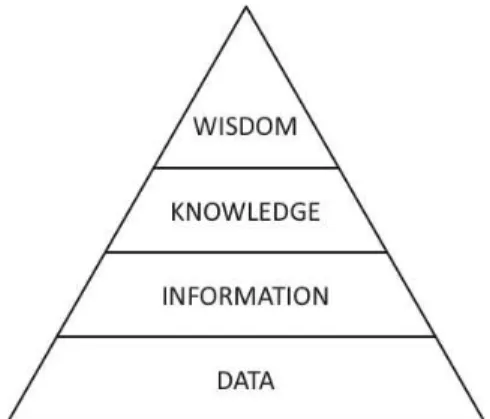
One way to better understand the concept of knowledge is to make the distinction between Data, Information, Knowledge, and Wisdom, which are often confused and overlapping terms, although they embed different meanings. This distinction is referred to as the DIKW (Data, Information, Knowledge, and Wisdom) hierarchy, knowledge hierarchy or the knowledge pyramid (Figure 2.1). The implicit assumption is that data can be used to create information, information can be used to create knowledge, and finally that wisdom is built on knowledge (Rowley 2007). The visual metaphor of the pyramid depicts the fact that, usually, large amounts of data are distilled to a smaller quantity of information. Then, a still rather large amount of information is further distilled to a more limited knowledge (Hey 2004).
20 | P a g e
In the knowledge management domain, something along the lines of a DIKW hierarchy was alluded to by Zeleny (Zeleny 1987). Also, Ackoff (Ackoff 1989) proposed a similar categorization, where the concepts are defined as follows:
Data represents raw facts and symbols that have no significance or meaning by themselves. Data is unorganised and unprocessed, and has no relation to anything else (Ackoff, 1989; Bellinger, Castro and Mills, 2004). Data deals with the past (Ackoff, 1989) and comes through research, creation, gathering, and discovery. Data is also sometimes defined as unprocessed information (Hey, 2004). When encountering a piece of data, the first action is usually to attempt to find a way to attribute meaning to it.
Information is data that has been processed and given meaning, by relating it and organising it, so that it is useful (Ackoff, 1989; Bellinger, Castro and Mills, 2004; Hey, 2004). Information can be considered as an aggregation of processed data which relates to the What, Who, When, and Where dimensions (Ackoff 1989). Information has context. When information is created from data, sense is made out of the data (Hey 2004). Information has a tendency to be relatively static in time and linear in nature and, while it entails an understanding of the relations between data, it generally does not explain the reason why the data is what it is, nor it gives an indication on how the data is likely to change over time. Analogously to, information is about the past, about what has been (Ackoff 1989).
Knowledge is created when data and information are organised (Hey 2004), accumulated (Nonaka e Takeuchi 1995), and integrated, so that a pattern appears, which describes both a reoccurring problem and the core of solution to such problem. Knowledge is also constructed from achieving an added context and understanding. Knowledge is understood to be personal (Hey 2004), residing in the heads of the people, and is built up from scratch by the learner through utilising his/her experience. The personal aspect also makes it hard to transfer from one person to another. Knowledge comprises strategies, practices, methods and approaches relating to the issue of ‘how’, knowing how to do something. Data and information are about looking at the past, but with knowledge representing a pattern in the data and information, it is possible to interpolate in this pattern and to deal with the present. Knowledge is basically the first step in the ladder of decisions can be taken with some predictability and accuracy.
21 | P a g e levels of the pyramid. With wisdom, you can create a vision of the future and make “educated” forecasts of impacts of future decisions and actions (Ahsan e Shah 2006). A person who exhibits wisdom is knowledgeable, has a longer perspective, is aware of context, is flexible and can change perspective, recognises uncertainty and the limits to the knowledge, and is prepared to be tentative and flexible about solutions (Rowley 2007). This level of the pyramid is purely a human quality and cannot be represented in a computer. Ahsan and Shah (Ahsan e Shah 2006) stress the interrelations between the different levels in the following way: ‘Data’ is the basic unit of ‘information’, which in turn is the basic unit of ‘knowledge’, which itself is the basic unit of ‘wisdom’. The whole purpose in collecting data, information and knowledge is to be able to make wise decisions. If the data sources are flawed then in most cases the decisions will be flawed. However, good data sources do not provide any guarantee that decisions will be good!
2.1 Knowledge Cycle
Since the main focus of this thesis relates to aspects regarding knowledge creation and sharing, it is important to mention what kind of methodologies and framework have been proposed by the wider scientific community.
There are several different typologies and classifications that aim to clarify what knowledge ‘is’ and how it can be created and shared. Ryle (Ryle 1984) observes a distinction between know-what (i.e. facts) and know-how (i.e. skills), where the latter concept can be seen as “…the particular ability to put know-what into practice”. Brown and Duguid (Brown and Duguid 2000) and Quinn, Anderson and Finkelstein (Quinn, Anderson and Finkelstein 1996) note that cognitive knowledge (i.e. know-what) is the basic mastery of a discipline that can be achieved through extensive training and certification, that advanced skills (i.e. know-how) is the ability to apply the rules of a discipline to complex real-world problems, and that systems understanding (i.e. know-why) is the deep knowledge of the web of cause-and effect relationships underlying a discipline. Similarly, (Polanyi 1966) uses the concepts of explicit and tacit knowledge to make a distinction between knowledge that can easily be described in documents and knowledge that humans normally have difficulties articulating and codifying but still are able to express in action.
22 | P a g e
ambiguous in nature, which makes duplication difficult. There is therefore also a risk of losing the knowledge due to loss of employees (Jasimuddin, Klein and Connell 2005). Transfer of tacit knowledge is best achieved by using shared experiences, such as spending time together in the same environment (Nonaka, Toyama and Konno 2000), for instance apprenticeships, since it relates to personal skills (Nonaka, Toyama and Konno, 2000; Wyatt, 2001). In these apprenticeships, apprentices learn the tacit knowledge needed for their craft through hands on experience (Snowden 2003), under guidance by experts. Tacit knowledge forms the basis of explicit knowledge (Jasimuddin, Klein and Connell 2005), but is often understood to compromise the main body of knowledge. Polanyi proposes that “we know more than we can tell” (Polanyi 1966).
Explicit knowledge, or codified knowledge, is the knowledge that is transmittable in formal, systematic language (Polanyi, 1966; Nonaka, 1994; Hey, 2004). This knowledge includes facts, rules, relationships, and policies that can be codified and shared without need for discussion (Wyatt 2001). Since explicit knowledge is codified it is easy to communicate and store. The risk of losing explicit knowledge due to employee turnover is quite small (Jasimuddin, Klein and Connell 2005). Hey (Hey 2004) relate to tacit and explicit knowledge with the metaphor of viscosity, depicting that explicit knowledge is “sticky” and that tacit knowledge is “leaky” and hard to retain.
Tacit and explicit knowledge are closely related, where one of the main targets of knowledge management is to formalise and codify tacit knowledge, so that it becomes explicit and can be stored in knowledge repositories or other types of databases. Drivers for this process is the knowledge’s accessibility (Jasimuddin, Klein and Connell 2005), where explicit knowledge is accessible by everyone as opposed to just available to the owners, and in the fact that explicit knowledge stays in the company even though there is employee turnover.
Further, Jasimuddin, Klein and Connell propose that the tacit and explicit parts are inseparable, and complimentary to each other, where all knowledge has both tacit and explicit parts. Their relationship can be likened to an iceberg, where the visible, explicit part is supported and given meaning by the hidden tacit part. Nonaka, Toyama, and Konno state that “to understand the true nature of knowledge and knowledge creation, we need to recognise that tacit and explicit knowledge are complimentary”, where new knowledge is created through interactions between tacit and explicit knowledge.
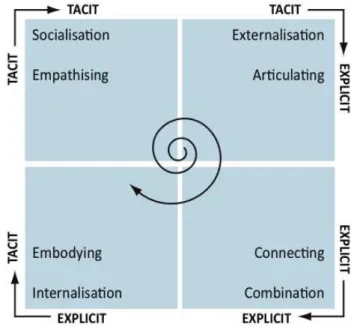
23 | P a g e knowledge. The SECI model is depicted in the form of a spiral (Figure 2.2), since the interaction between explicit and tacit knowledge amplifies knowledge creation, i.e., the SECI model tries to illustrate that knowledge held by individuals is shared with other individuals so it interconnects to a new knowledge. The spiral of knowledge, or the amount of knowledge so to say, grows all the time when more rounds are done in the model. Socialisation is creating new tacit knowledge from existing tacit knowledge through shared experiences. Externalisation is about articulating tacit knowledge into explicit. Combination depicts converting explicit knowledge into more complex and systematic sets of knowledge. Internalisation is “learning by doing” by embodying the explicit into tacit.
Figure 2.2. The SECI model, depicting modes of knowledge creation and conversion (Nonaka e Takeuchi 1995)
The knowledge creation process proposed by Nonaka and Takeuchi (Nonaka e Takeuchi 1995) seems adequate to adopt into a collaborative engineering environment, where knowledge is: (i) transformed in an evolving way along the time; (ii) managed around problems and solutions in order to be proper capitalised; (iii) better capitalised with the appropriate support of reasoning mechanisms; and (iv) supported by a set of ontology-enabled services to increase the semantic level of knowledge sources.
24 | P a g e
2.2 Controlled Vocabularies (Ontologies & Taxonomies)
2.2.1 Definitions
Various definitions of what constitutes an ontology have been formulated and have evolved over time. A good description of these can be found in (Corcho, Fernandez-Lopez and Gomez-Perez 2003). From the authors’ perspective, the best definition that captures the essence of an ontology is the one given by Gruber (Gruber 1993): “an ontology is a formal, explicit specification of a shared conceptualization”. As elaborated in (Studer, Benjamins and Fensel 1998):
Conceptualization refers to an abstract model of some phenomenon in the world which identifies the relevant concepts of that phenomenon. Explicit means that the types of concepts used and the constraints on their use are explicitly defined. Formal refers to the fact that the ontology should be machine processable.
People often find it difficult to see clearly how an ‘‘ontology’’ differs from what they already recognize as a ‘‘data model’’, focusing on the formal nature and structuring mechanisms that seem to be characteristic of both. Certainly, data modelling languages provide the ability to define taxonomies through notations that support classification, generalization and specialization, they support the definition of relationships or associations between concepts, and ideas of aggregation and composition, and in terms of these primitives appear to offer the same support for representing concepts and the relationships between them. However, it should be stated that trying to understand the distinctions in terms of the modelling primitives that are used is a mistake; it is the nature of the models themselves, the way in which they are derived, and the tools that support their use that provides the differentiation. In order to understand this, it is necessary to return to the underlying problems that make it difficult to achieve a single agreed data model for an industry.
25 | P a g e In order to understand and formalize the shared worldviews of such communities in the form of ontologies to support the integration of diverse human activities, it is important to consider approaches that derive from an interpretive philosophical standpoint rather than from a positivist, scientific/engineering one (Fitzgerald and Howcroft 1998). In such an approach, it is important to interpret, accommodate, and model what is, rather than trying to change reality to fit a single model. This inevitably results in different ontologies for different communities, but the challenge then is to find ways to allow those communities to collaborate effectively with one another whilst maintaining their existing, efficient, effective separate worldviews. The implication is that the emphasis must be shifted from developing a standard representation of a single ‘‘reality’’, towards providing mechanisms for supporting communication between differing perceptions of reality, focusing our attention on the overlaps at the boundaries and the specific conceptualizations that are required for such communication to happen.
2.2.2 Ontological Structures
Ontologies, having transcended the domain of philosophy, are currently referred as part of many activities from different domains, such as Artificial Intelligence, Knowledge Management solutions or e-commerce/e-business-related processes. Ontologies are very often considered key elements integrated into catalogues, semantic-oriented databases, web-based documents, and so on.
From a general point of view, it could be stated that an ontology is required and (likely) used when talking about precise meaning of things (such as terms, expressions, or products). For instance, when indexing/retrieving documents, ontologies can provide richer indexes linking different documents through terms that are not found within these documents; rather they are "mapped" through the ontology. In other words, the ontology gives access to the knowledge that is implicitly found within the documents. A keyword-based mechanism would never be able to do that. An ontology-based query is not ambiguous as the queries in natural language can be. It is also needed a semantic resource (ontology/taxonomy) when doing e-procurement and searching for products using a very precise technical specification. Unless the technical attributes are available to the search mechanism, this is not possible.
26 | P a g e
According to McGuiness, one of the simplest notions of a possible ontology is a vocabulary with a finite list of terms. Another potential ontology specification for modelling an ontology starts with the enumeration of relevant concepts that are useful to describe it. Each concept will be labelled with a unique identifier. In order to facilitate the comprehension of the meaning of each concept by human beings, this identifier can be based on a combination of everyday words. This set of identifiers represents a Vocabulary. A definition (for instance, in natural language) is attached to each identifier and this produces a dictionary or a glossary.
Identifying and naming the relevant concepts in a given domain is a complex exercise. A good way to proceed is to classify these concepts into a hierarchical structure, creating a Classification. This hierarchy, which is actually a tree structure, must enable a multi-inheritance mechanism in order to allow the expression of a multi-dimension space in a 2D diagram.
If the way to classify is based on the use of the relation "is a" (for instance the concept "person" "is a" "human being"), the tree produced as the result of such a classification is called a Taxonomy which is than a special way of classifying things.
Figure 2.3. Ontology modelling concept (Barresi, et al. 2005)
The use of the unique relation "is a" is not enough to model a complex system. Extra relations exist "de facto" between concepts even if these concepts are not closely defined in the taxonomy tree. This leads to the definition of a different structure (more complex than a tree) to express these semantic relations. One can consider that the "is a" relation is a semantic relation but to keep things simple, this particular relation will only be called a hierarchical relation. These semantic relations enable the expression / representation of a domain specific knowledge. A relation, called a Signature, may bind only two concepts. The notion of signature is very important. It allows the liaison of each concept with any other existing concept within the ontology. The liaison of concepts can be done freely in order to really stick with the domain being represented by the ontology.
27 | P a g e A Thesaurus can be viewed as a subset of an ontology, where the whole structure (hierarchical and semantic relations) is rigidly defined. The first consequence is that the semantic content in the thesaurus is not so rich because of this rigid structure of relations applicable to the concepts. Only high level relations such as the notions of close or far neighbourhood can be represented. The addition of a specific relation to link two given concepts is not allowed.
The word Ontology has been used to refer to all of the above things. When used in the Knowledge Representation community, it tends to refer to things that have a rich and formal logic-based language for specifying meaning of the terms. Both a thesaurus and a taxonomy can be seen as having a simple language that could be given a grammar, although this is not normally done. Usually they are not formal, in the sense that there is no formal semantics given for the language. However, one can create a model in UML and a model in some formal ontology language and they can have identical meaning. It is thus not useful to say one is an ontology and the other is not because one lacks formal semantics. The truth is there is a fuzzy line connecting these things.
The bottom line is, taxonomies and thesauri may relate terms in a controlled vocabulary via parent-child and associative relationships, but do not contain explicit grammar rules to constrain how to use controlled vocabulary terms to express (model) something meaningful within a domain of interest.
2.2.3 Language & Representations
Despite the fact that there is a long list of languages used to create and represent ontologies, this section provides a summarised list of the languages/representation formats that are considered more standard-oriented (Table 2.1), by their very nature (i.e. promoted by an standardisation body) or by their acceptance and usage by the research community.
Table 2.1. Ontologies Languages (Lima 2004)
Language Description URL
DAML+OIL
DAML+OIL is a semantic markup language for Web resources. It builds on earlier W3C standards such as RDF and RDF Schema, and extends these languages with richer modelling primitives. DAML+OIL provides modelling primitives commonly found in frame-based languages. It is important to emphasise that this language was the basis of OWL.
http://www.w3.org/T
R/daml+oil-reference
EXPRESS / EXPRESS-G
EXPRESS-G is a standard graphical notation for information models. It is a useful companion to the