JOÃO ALMEIDA DAS ROSAS
ASSESSING ORGANIZATIONS COLLABORATION READINESS
A BEHAVIORAL APPROACH
Dissertation presented at the Faculty of
Sciences and Technology of the New
University of Lisbon to obtain the degree of
Doctor in Electrical Engineering, specialty of
Robotics and Integrated Manufacturing, held
under the guidance of Professor Luís Manuel
Camarinha de Matos.
III ACKENOWLEDGEMENTS
It is generally accepted that making a PhD is a very hard work, and that some of its phases require an effort, of almost superhuman nature, determination, will and faith. The quest for the satisfactory answers to the research questions and facing sudden adversities, manifested collaterally in the form of severe effects in the physical and mental health of the researcher, including a proudly bald head. As the supervisor many times told us, ―a PhD is also a psychological resistance test‖.
The successful achievement of this thesis‘ goals would not be possible without the
help of several people that very kindly supported me during the walk through this frantic time. Without more delays, I want to thank the very much appreciated help received from the following people and entities:
To Professor Luis Camarinha-Matos, supervisor of this thesis, who provided me a continuous and intense support and help during the work, namely at the scientific guidance, logistic, material, intellectual and mental levels. His continuous psychological pressure exerted over me was a determining factor for finishing the work.
To Faculty of Sciences and Technology which provided me the resources that were necessary for undertaking the thesis, and on which I am proud to work as a staff.
To Uninova, which provided me valuable resources for the research work.
To Fundação da Ciencia e Tecnologia for the financial support provided during these three years.
To the ECOLEAD and ePAL European projects, which allowed quite beneficial interactions with international experts from the field of collaborative networks and other related areas.
To my family Rosa, Pedro and Beatriz for their support and tenderness. Even at an early age, Beatriz understood it was necessary to abdicate of her father during countless weekends.
To Patricia Macedo, for the fruitful discussions, the joint work, the friendship, and the wonderful teas with honey taken there in Mr. Carlos‘.
To Tiago Cardoso, for the logistical support, friendship, and for sometimes running away to the nearest bar for a couple of beers (and you must stop smoking!).
To all other people that somehow contributed to my effort during this work.
V SUMMARY
This thesis presents an approach for assessing organizations‘ readiness to collaborate.
This assessment is based in three fundamental aspects, namely (1) on collaboration preparedness, which aims at assessing whether a partner has adequate collaboration-related character traits; (2) on competencies fitness which is predominantly aimed at assessing how well an organization is able to use its competencies in a collaboration context; and (3) on willingness to collaborate, which is a concept applied to assess whether an organization is, or is not, really interested to engage in concrete collaboration opportunities.
The proposed approach contributes to the formation of improved collaborative networks, increasing their likelihood of success. The principal characteristic of the model lies in the fact that it follows a behavioral perspective. As such, collaboration
preparedness is based on the idea of the organizations‘ character, traits and behavioral
patterns. Competencies fitness is in turn based on the so-called soft competencies, exploring the performance influences/effects of the soft competencies on the hard ones in a collaboration context. Finally, willingness to collaborate is based on the
organization‘s planned behavior, attitudes and intentions that are perceived in/from a partner.
The work involved in the conceptualization of readiness to collaborate includes the utilization of text data mining to discover the behavioral aspects, namely the collaboration-related organization‘s traits which are relevant for assessing collaboration readiness. Bayesian belief networks are proposed as a way to deal with the underlying uncertainty in assessing collaboration readiness.
A soft versus hard competencies dichotomy is used to develop the concept of competencies fitness, proposing the adjusted competencies profile and the fitness level,
as the way to assess whether a partner‘s competencies fit in a collaboration opportunity.
VII SUMÁRIO
Esta tese propõe uma abordagem para avaliar o nível de prontidão das organizações para colaborarem. Esta abordagem baseia-se em três aspectos fundamentais, que são o nível de preparação para colaborar, que visa aferir se uma organização possui traços ou características adequadas para um ambiente de colaboração; o alinhamento de competências, que visa aferir até que ponto uma organização consegue utilizar as suas competências num ambiente de colaboração; e na vontade de colaborar, que visa aferir se uma organização está manifestamente interessada em participar em oportunidades de negócio concretas.
A abordagem proposta tem como objectivo contribuir para a formação de melhores redes colaborativas, correspondendo a uma maior probabilidade de sucesso. A principal característica do modelo desenvolvido reside no facto deste seguir uma abordagem comportamental. Como tal, a preparação para colaborar baseia-se em ideias assentes no carácter das organizações, em traços e padrões de comportamento. Por sua vez, o
alinhamento de competências baseia-se na ideia das competências ―soft‖, explorando os
efeitos que essas exercem sobre as competências de carácter mais ―hard‖, num ambiente
de colaboração. Finalmente, a vontade para colaborar baseia-se no conceito de comportamento planeado, atitudes e intenções que podem ser percepcionadas num parceiro.
O trabalho envolvido na conceptualização do nível de aptidão para colaborar incluiu a utilização de mineração de dados sobre fontes bibliográficas, de forma a descobrir quais os aspectos ao nível comportamental, nomeadamente quais os traços mais relevantes em termos de colaboração e importantes para medir esse nível. Propõe-se também a utilização de redes Bayesianas como uma forma de lidar com a incerteza inerente ao processo de avaliação da capacidade para colaborar.
A utilização de uma dicotomia entre as competências ―soft‖ e as de carácter mais
―hard‖, dá origem à ideia de perfil ajustado de competências e de alinhamento de competências, tendo em vista aferir se as competências de um determinado parceiro estão bem ajustadas em oportunidades de negócios específicas.
IX SYMBOL LIST
Symbol Description
ATB Attitude Towards Behavior CN Collaborative Network
CNO Collaborative-Networked Organization CO Collaboration opportunity
DVO Dynamic Virtual Organizations
hc hard competency
IQM Intentions Query Mechanism MBTI Myers Briggs Type Indicator MC Motivation to comply NB Normative beliefs
o organization
OCI Organization Character index org organization
P Preparedness (to collaborate) PBC Perceived Behavioral Control PC Preparedness condition PP Preparedness pattern
PVC Professional Virtual Community R Readiness (to collaborate)
SC Soft competency
SI TPB
Social Influence
Theory of the Planned Behavior
VBE Virtual Organization Breeding Environment VE Virtual Enterprise
VO Virtual Organization W Willingness (to collaborate)
XI TABLE OF CONTENTS
1 INTRODUCTION ... 1
1.1 STATING THE RESEARCH QUESTION ... 1
1.2 MOTIVATION WHY THIS IS A WORTHWHILE QUESTION ... 3
1.3 RESEARCH HYPOTHESIS AND GOALS ... 4
1.4 THE RESEARCH METHOD ... 7
1.5 THE ECOLEAD PROJECT CONTEXT ... 8
1.5.1 The vision and goals of ECOLEAD project ... 8
1.5.2 Relating ECOLEAD and this work ... 11
1.6 STRUCTURE OF THE THESIS ... 11
2 LITERATURE REVIEW ... 13
2.1 COLLABORATION AND RELATED CONCEPTS ... 14
2.1.1 Establishing a meaning for collaboration ... 15
2.1.2 When to collaborate ... 17
2.1.3 Collaboration in an inter-organizational context ... 18
2.2 COLLABORATIVE-NETWORKED ORGANIZATIONS ... 21
2.2.1 What are collaborative networks ... 21
2.2.2 Existing types of collaborative networks ... 22
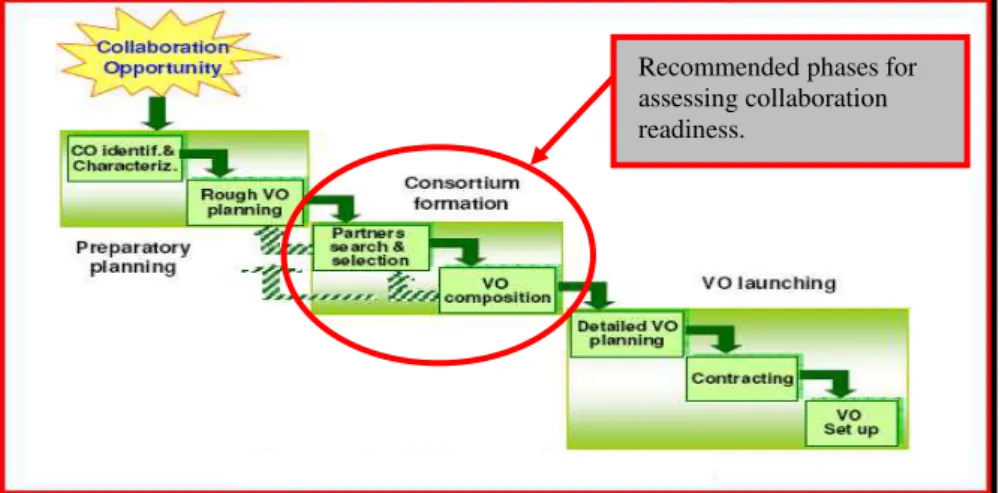
2.2.3 The role of collaboration readiness in „consortia formation‟ ... 24
2.3 OVERVIEW OF BEHAVIORAL CONCEPTS ... 25
2.3.1 Intuitive notion of behavior ... 26
2.3.2 Behavioral patterns ... 28
2.3.3 The concept of character/personality ... 32
2.3.4 Existing personality models ... 33
2.3.5 Relation to behavior prediction ... 34
2.3.6 Traits-situation behavioral prediction ... 36
2.3.7 Personality model versus personality profile ... 37
2.4 TOWARDS A COLLABORATION READINESS BEHAVIORAL PERSPECTIVE ... 38
2.4.1 The several perspectives of an organization ... 38
2.4.2 Visiting some metaphors ... 39
2.4.3 Taking the organization‟s character concept ... 42
2.4.4 The character for good collaboration preparedness ... 44
2.5 THE COLLABORATION READINESS CONCEPT ... 47
2.5.1 What is collaboration readiness and preparedness ... 48
2.5.2 Competencies assessment ... 53
2.5.3 The willingness concept ... 55
2.6 REFLECTIONS AND IDENTIFIED OPEN ISSUES ... 57
3 THE COLLABORATION READINESS MODEL ... 59
3.1 THE MEANING OF READINESS ... 60
3.1.1 The theoretical inputs for collaboration readiness modeling ... 63
3.1.2 How to model behavior ... 64
3.2 MODELING PREPAREDNESS TO COLLABORATE ... 65
3.2.1 Readiness versus preparedness ... 66
3.2.2 The collaboration preparedness hypothesis ... 66
3.2.3 The concept of organization‟s character ... 67
3.2.4 Assessment of collaboration preparedness ... 76
3.3 COMPETENCIES FITNESS ASSESSMENT ... 78
3.3.1 Establishing the framework ... 79
3.3.2 Competencies assessment model specification ... 80
3.3.3 Competencies assessment ... 85
3.3.4 Hard competencies assessment ... 86
3.3.5 Soft competencies assessment ... 88
3.3.6 Hard competencies levels adjustment ... 89
3.3.7 The concept of fitness level ... 92
3.4 WILLINGNESS TO COLLABORATE ... 97
3.4.1 Willingness versus preparedness ... 98
3.4.3 Modeling willingness to collaborate... 99
3.4.4 The willingness to collaborate assessment schema ... 109
3.5 PUTTING ALL TOGETHER ... 111
3.5.1 Issues on using the model ... 112
3.5.2 The canonical form of the readiness model ... 113
3.5.3 Adding more levels of detail ... 115
4 MODELING EXPERIMENTS ... 117
4.1 ASPECTS STILL TO ADDRESS ... 117
4.2 STRATEGY TO FOLLOW ... 119
4.3 THE EXAMPLE SCENARIO ... 119
4.4 THE ORGANIZATION‘S CHARACTER MODEL ... 121
4.4.1 Adopting a character model ... 121
4.4.2 Determining which traits to assess ... 123
4.5 ASSESSMENT OF COLLABORATION PREPAREDNESS ... 133
4.5.1 Assessment based on organization‟s character profile... 134
4.5.2 The impact of imperfect information in preparedness assessment ... 137
4.5.3 Belief networks basics ... 137
4.5.4 Performing decision making ... 139
4.5.5 Modeling collaboration preparedness predictor ... 141
4.5.6 Performing uncertain assessments ... 147
4.5.7 Deciding on who to invite for a partnership ... 149
4.6 USE OF PREPAREDNESS IN A PARTNER‘S SUGGESTION MECHANISM ... 153
4.6.1 The partners‟ suggestion model ... 154
4.6.2 The simulation component ... 156
4.6.3 Implementation details ... 156
4.6.4 Running an example ... 158
4.7 USING THE COMPETENCIES FITNESS CONCEPT ... 162
4.7.1 A Prolog-like competencies fitness assessment mechanism ... 162
4.7.2 Performing assessment of competencies ... 163
4.8 ASSESSMENT OF THE WILLINGNESS TO COLLABORATE ... 166
4.8.1 The intentions query mechanism specification ... 166
4.8.2 Testing with an example ... 168
4.9 REFLECTIONS ABOUT THE EXPERIMENTS ... 171
4.9.1 The work done ... 171
4.9.2 A collaboration readiness filter ... 172
5 MODEL VALIDATION ... 175
5.1 ASPECTS OF VALIDATION ... 175
5.2 ISSUES ON VALIDATING THE COLLABORATION READINESS MODEL ... 178
5.2.1 Experimentation is not possible ... 178
5.2.2 Considering past partnerships ... 178
5.2.3 Where are partnerships which failed? ... 179
5.2.4 The “halo effect” ... 179
5.2.5 Using simulation ... 179
5.2.6 Which way to go? ... 180
5.3 VALIDATION OF THE RESEARCH WORK ... 180
5.3.1 Findings on the research question and hypothesis ... 181
5.3.2 Validation of the research by the peers ... 184
5.4 APPLYING THE MODEL IN ILLUSTRATIVE ―REAL‖ CASES ... 186
5.4.1 Rio Tinto: tackling the cross sector partnership challenge ... 187
5.4.2 The UNCPP/MAXLT partnership ... 190
5.4.3 The Microsoft/Yahoo collaboration agreement ... 193
5.4.4 The HP/Canon collaboration agreement ... 195
5.5 THE ECOLEAD/WP5 CASE ... 197
5.5.1 The case and context ... 197
5.5.2 Information for the assessment ... 199
5.5.3 Assessment of collaboration preparedness ... 201
5.5.4 Assessing competencies fitness ... 202
5.5.5 Assessing willingness to collaborate ... 204
5.6 REFLECTING ON THE VALIDATION PROCESS... 208
XIII
6.1 SYNTHESIS OF THE WORK ... 209
6.2 CONTRIBUTIONS FROM THIS RESEARCH ... 210
6.2.1 Collaboration readiness ... 211
6.2.2 Collaboration preparedness ... 211
6.2.3 Competencies fitness ... 212
6.2.4 Willingness to collaborate ... 213
6.3 FUTURE WORK ... 214
REFERENCES ... 217
ANNEX 1- THE BIG FIVE PERSONALITY SCALE ... 223
ANNEX 2- METAPHOR WHICH SEES AN ORGANIZATION AS A LIVING ENTITY ... 225
XV TABLE OF FIGURES
Fig. 1.1 – Factors of success and failure of partnerships ... 4
Fig. 1.2 – The adopted approach ... 6
Fig. 1.3 – The ECOLEAD focus areas ... 9
Fig. 2.1 – Structure of this chapter ... 13
Fig. 2.2 – Establishing the concept of collaboration. ... 15
Fig. 2.3 – Companies work together without losing their autonomy ... 21
Fig. 2.4 – Important aspects associated to collaborative networks ... 21
Fig. 2.5 – Examples of collaborative networks ... 22
Fig. 2.6 –The several ―degrees‖ of collaboration ... 24
Fig. 2.7 – Importance of readiness in the VO creation process in a VBE ... 25
Fig. 2.8 – Fundamental behavior-related concepts ... 26
Fig. 2.9 – Involved aspects in the notion of behavior ... 27
Fig. 2.10 – Some ways in which a behavior is started. ... 27
Fig. 2.11 – Collaboration patterns ... 30
Fig. 2.12 – Example of a tree-like fractal. ... 31
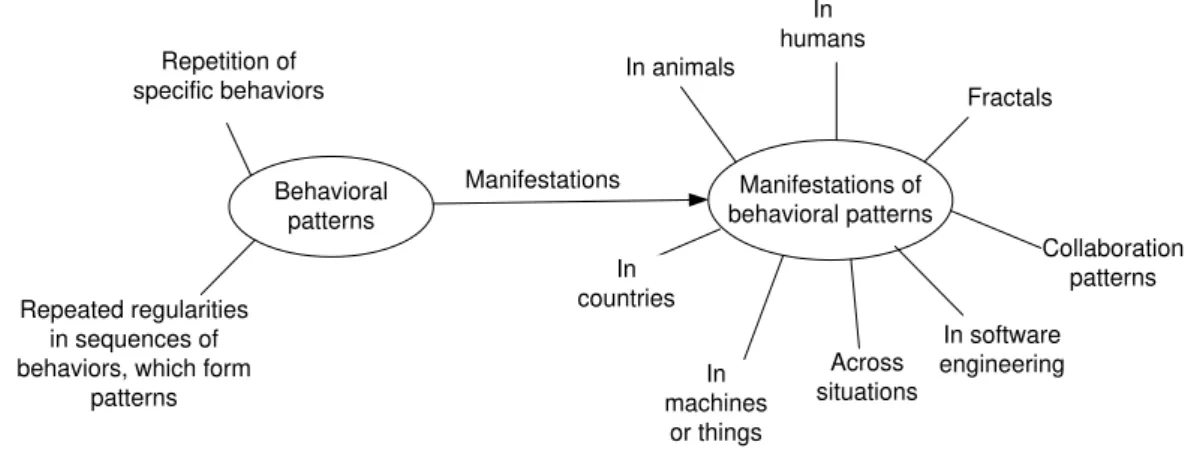
Fig. 2.13 – Notion of behavior patterns and where they can be manifested ... 31
Fig. 2.14 – Examples of personality models found in related research ... 33
Fig. 2.15 – Involved aspects in behavioral prediction ... 35
Fig. 2.16 – A hierarchical, nested, model of personality organization ... 35
Fig. 2.17 – Relation between traits theory and social learning theory ... 36
Fig. 2.18 – Degeneration of a network into a disrupted environment ... 37
Fig. 2.19 – An organization seen as a living entity ... 41
Fig. 2.20 – Taking organization as a living entity ... 41
Fig. 2.21 –Aspects contributing to the formation of organization‘s character ... 43
Fig. 2.22 –Examples of organizations‘ character profiles using the OCI scale... 47
Fig. 2.23 – Proposed way to study the related research of collaboration readiness ... 48
Fig. 2.24 – Reasons to join a VBE ... 50
Fig. 3.1 – Structure of this chapter ... 60
Fig. 3.2 – Establishing the need of using several dimensions in readiness to collaborate ... 61
Fig. 3.3 – The collaboration readiness concept ... 62
Fig. 3.4 – The theoretical inputs for the collaboration readiness model ... 63
Fig. 3.5 – Readiness versus preparedness ... 66
Fig. 3.6 – A behavior performed by entity(ies) and corresponding situation states ... 68
Fig. 3.7 – Behavioral patterns as latent characteristics in the concrete behaviors ... 70
Fig. 3.8 – Relationship between traits, behavioral patterns and behaviors. ... 71
Fig. 3.9 –The organization‘s character concept ... 73
Fig. 3.10 –An example of organizations‘ character model ... 73
Fig. 3.12 – Distinction between character model and character profile ... 75
Fig. 3.13 – Organization‘s character profile versus required preparedness pattern ... 77
Fig. 3.14 – Assessing collaboration preparedness ... 77
Fig. 3.15 – Behavioral space containing the key concepts involved in organization‘s competencies assessment ... 81
Fig. 3.16 –Soft-Competencies assessment and hard competencies levels adjustment. ... 86
Fig. 3.17 – Why establishing a consortium ... 87
Fig. 3.18 – Matching between the required competencies in a CO with the competencies provided by organizations ... 87
Fig. 3.19 – Soft Competencies importance according to network type. ... 92
Fig. 3.20 – Fitness of partner o2‘s competencies according to co1. ... 96
Fig. 3.21 – Motivation versus willingness ... 99
Fig. 3.22 – The characteristics of collaboration ... 102
Fig. 3.23 – Willingness to collaborate model ... 103
Fig. 3.24 –The ―collaboration readiness‖ model ... 111
Fig. 4.1 – Structure of this chapter ... 119
Fig. 4.2 – The example scenario ... 120
Fig. 4.3 – Phases of a survey for character modeling. ... 121
Fig. 4.4 –An organizations‘ character model. ... 122
Fig. 4.5 –Character and corresponding organization‘s aptitudes ... 123
Fig. 4.6 – Experts‘ documents concerning partnership success/failure factors ... 124
Fig. 4.7 – Semantic relationships between success/failure factors and character traits ... 125
Fig. 4.8 – Example of hyponym relationships... 125
Fig. 4.9 – WordNet relations ... 126
Fig. 4.10 –Semantic path between ―collaborate‖ and ―trust‖ ... 126
Fig. 4.11 – Identification of the relevant traits for assessing collaboration preparedness ... 127
Fig. 4.12 – Sample list of used web documentation ... 127
Fig. 4.13 –Predicate that searches relations between traits and the experts‘ documents ... 128
Fig. 4.14 – Some outputs of the Prolog program ... 128
Fig. 4.15 – Highlighting more important traits. ... 129
Fig. 4.16 – Two-step text data mining approach to collect experts‘ knowledge ... 130
Fig. 4.17 – The obtained clusters. ... 131
Fig. 4.18 – Found associations between clusters and traits ... 131
Fig. 4.19 – Trait importance levels, obtained from clusters/traits association ... 133
Fig. 4.20 –Ways to assess a partners‘ information concerning character profile ... 135
Fig. 4.21 – Calculation of the dimensions from character traits ... 135
Fig. 4.22 – Profile for a given organization. ... 136
Fig. 4.23 – An example of a Bayesian belief network ... 138
Fig. 4.24 – Example of a decision network ... 141
Fig. 4.25 – Belief Network modeling and utilization ... 143
Fig. 4.26 – Assigning values to conditional probability tables ... 144
XVII
Fig. 4.28 –A decision network for VO partners‘ suggestion ... 151
Fig. 4.29 – The decision network with additional evidences ... 153
Fig. 4.30 – The partners suggestion mechanism ... 157
Fig. 4.31 –Prolog predicates for the partners‘ suggestion axioms. ... 157
Fig. 4.32 – Business process plan for the given collaboration opportunity... 158
Fig. 4.33 –The Partners‘ suggestion process without preparedness conditions ... 159
Fig. 4.34 – Applying preparedness conditions ... 160
Fig. 4.35 – Gantt chart with the suggested VO ... 161
Fig. 4.36 – Signature for the competencies fitness model ... 162
Fig. 4.37 – Diagram for the Prolog version of the competencies model ... 163
Fig. 4.38 –Original versus adjusted competency levels ... 165
Fig. 4.39 – Extension of TPB with an intentions query mechanism ... 166
Fig. 4.40 – Describing the collaboration opportunity ... 169
Fig. 4.41 – Selected questions for the willingness assessment... 170
Fig. 4.42 – Estimation of willingness to collaborate. ... 171
Fig. 4.43 – Projecting readiness in a Euclidian-space ... 172
Fig. 4.44 – The readiness filter ... 173
Fig. 4.45 – Assigning correlation weights to the readiness concept ... 174
Fig. 5.1 – Structure of this chapter ... 175
Fig. 5.2 – Approaches for model validation ... 177
Fig. 5.3 –Work validation and dissemination... 186
Fig. 5.4 – Benefits achieved by shifting to more collaborative approaches ... 188
Fig. 5.5 –Focused aspects in the assessment of Rio Tinto‘s partnerships ... 189
Fig. 5.6 – Incentives for each partner to work together ... 191
Fig. 5.7 – Collaboration readiness assessment for the UNCPP/MAXLT ... 192
Fig. 5.8 – Collaboration readiness assessment for Microsoft/Yahoo case ... 195
Fig. 5.9 – HP/Cannon example ... 197
Fig. 5.10 –Partner o4‘ competencies fitness... 203
Fig. 5.11 –Partner 06‘ competencies fit better in WP5 ... 204
Fig. 5.12 – Description of the WP5 collaboration opportunity ... 205
Fig. 5.13 – Question for computing willingness to collaborate ... 206
Fig. 5.14 – The willingness to collaborate assessment ... 207
Fig. 6.1 – Relevant contributions for the readiness to collaborate concept ... 211
Fig. 6.2 – Relevant contributions for the preparedness to collaborate concept ... 212
Fig. 6.3 – Relevant contributions for the competencies fitness concept ... 213
XIX TABLE INDEX
Table 2.1 – Situations better addressed by a collaboration strategy... 18
Table 2.2 – Reasons to form a joint venture... 20
Table 2.3 – Definitions of behavior ... 26
Table 2.4 – Behavioral patterns in a collaboration context ... 29
Table 2.5 – Some definitions for Personality/Character ... 32
Table 2.6 – Existing personality models ... 34
Table 2.7 – Examples of behavior, behavioral patterns and traits correspondences. ... 36
Table 2.8 – Available metaphors for organizations ... 40
Table 2.9 – Typical Behaviors of an Extraverted versus Introverted organization ... 44
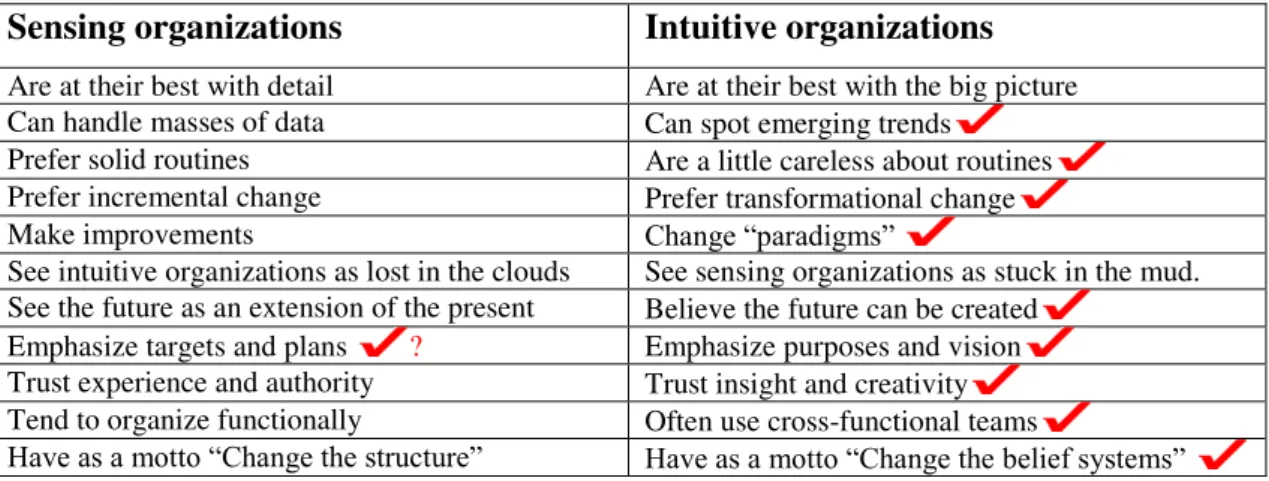
Table 2.10 – Typical Behaviors of a Sensing versus Intuitive organization ... 45
Table 2.11 – Typical Behaviors of a Thinking versus Feeling organization ... 45
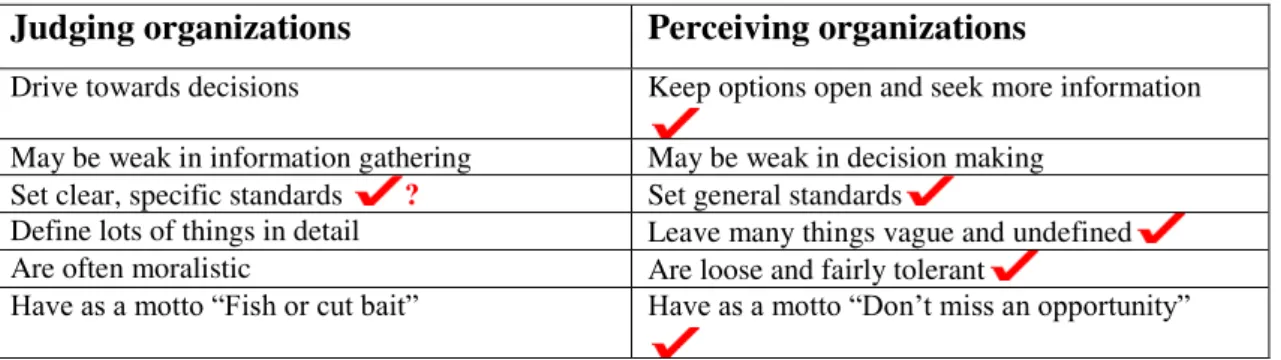
Table 2.12 – Typical Behaviors of a Judging versus Perceiving organization ... 46
Table 3.1– How to model behavior ... 65
Table 3.2 – Non-beneficial inter-organizational behaviors ... 69
Table 3.3 – The willingness to collaborate schema ... 110
Table 3.4 – Schema instantiation ... 111
Table 3.5 – Classifying organization by their readiness level. ... 113
Table 3.6 – Readiness assessment with the canonical the model for a single organization ... 114
Table 3.7 – Adding more detailed levels the collaboration readiness assessment ... 115
Table 4.1 – Results of the text mining process... 129
Table 4.2 – Results from clustering the words/traits associations... 132
Table 4.3 – Example of information involved in a decision-making problem ... 140
Table 4.4 – Competencies and traits of the VBE‘s members ... 147
Table 4.5 –Values of desirability for character traits and decision‘s choice ... 150
Table 4.6 – A snapshot for the decision instance ... 151
Table 4.7 –Competencies and traits of the VBE‘s members ... 158
Table 4.8 – Detailed plan for the given collaboration opportunity ... 159
Table 4.9 – Example of VO suggestions ... 160
Table 4.10 – Another example of VO suggestions ... 160
Table 4.11 – Another example of VO suggestions ... 161
Table 4.12 – Requirements for the context of the given collaboration opportunity ... 163
Table 4.13 – Extended Competency Profile for a set of organizations ... 164
Table 4.14 – Components from the readiness concept addressed during the experiments ... 172
Table 5.1 – Soft competencies requirements... 183
Table 5.2 – Differences recognized by both parties ... 192
Table 5.3 – Visited pages for the Microsoft/Yahoo case ... 193
Table 5.4 – Positions assumed by both parties ... 194
Table 5.5 – Visited pages for the HP/Cannon agreement ... 196
Table 5.7 –Partners‘ scientific domains and interests ... 199
Table 5.8 – Identification of hard competencies or scientific domains ... 200
Table 5.9 – Important soft competencies ... 200
Table 5.10 – The WP5 phases ... 200
Table 5.11 – Necessary soft competencies ... 201
Table 5.12 – Organizations hard and soft competencies levels... 201
Table 5.13 –Partners‘ previous and current collaborations ... 202
Table 5.14 – Adjusted levels of hard competencies ... 202
1
1
Introduction
―If I had one hour to save the world I would spend 59 minutes defining the problem and one minute finding solutions‖
Albert Einstein
1.1
Stating the research question
Typically, organizations engage in partnerships as a way to together grasp new opportunities and accomplish goals which would not be achieved if working alone. In such partnerships, the involved entities work together and combine their assets in order to fulfill a number of common or compatible goals. Since the advent of ICT, and specially the growth of computer networks, the traditional ways of partnering evolved into new forms, known as collaborative networked organizations. Organizations engage in these networks as a strategy to together compete in, and protect from a market environment of growing complexity, characterized by a fierce competition and high globalization in a context of large uncertainty. In such an environment, these partnerships are seen as both providing a competitive advantage and as a survival factor. Therefore, it is of great importance that partnerships are planned in a way that increases their likelihood of success. This success depends, among other factors, on the
organizations‘ readiness to collaborate.
characterize an organization in a collaboration context, mainly in what concerns its readiness to collaborate.
Although such concepts start to be considered in more recent research, the topic of collaboration readiness has probably not been addressed from a proper perspective. This
is due to the fact that most research does not put the focus on organizations‘ behavior.
To illustrate the idea, when an organization considers a new partner, it has already got a general idea of some of its competencies, being its main concerns focused on whether its new partner is likely to be a good one or not, which depends to a great extent on how it will behave. Putting the focus on a more behavioral perspective breaks up from
existing research, mainly focused on assessing ―functional‖ competencies and
technological performance. This new perspective raises new difficulties and opens difficult challenges, which previous approaches could not adequately handle. One of
such challenges is to find an adequate way to model organization‘s behavior which, as
this work shows, is a fundamental concept in assessing collaboration readiness. This shift towards a behavioral perspective raises the necessity for new models and assessment methods, which are able to comply with these soft aspects of organizations. As a consequence, the main research question pursued during this work is:
How to effectively model collaboration readiness?
Obtaining a satisfactory answer to this question will lead to a model for representing
organizations‘ collaboration readiness with a corresponding assessment approach. By assuming a behavioral perspective of collaboration readiness, the proposed approach aims to bring new insights on how to increase the chances of partnership success.
3
1.2
Motivation why this is a worthwhile question
In order to understand why a model of collaboration readiness is so important, and why the approach should be focused on a behavioral perspective, it is necessary to address the very factors underlying partnerships success/failure.
First of all, it is important to notice that the overall success rate of alliances hovers near 50% (Ernst and Bamford, 2005). The reasons for such a high number of failures are varied, including competition, market turbulence, and the endogenous factors related to the partnerships and their members. Just to bring some light in order to establish a framework, a small research was performed, aimed at enquiring about which causes are referred by researchers and entrepreneurs, which led to the success or the failure of partnerships. The work involved analyzing web documents concerned with partnerships and the factors of success or failure mentioned in those documents. The obtained results are a list of factors, which are summarized in Fig. 1.1. The method to obtain this list consisted of the following steps:
Search the WEB for documents referring partnerships‘ success/failure factors.
Collect these factors and split them in two groups, one for the success and the other for the failure factors.
Observe each factor trying to perceive a possible behavioral connotation.
Factors from both groups with such connotation are underlined (Fig. 1.1).
A factor has a behavioral connotation whether it is more related to behavioral aspects,
and less to technical, financial or managerial ones. For instance, the ―establishing of attainable goals‖ can be considered as having a behavioral connotation, because the word ―attainable‖ is related to the words ―reasonable‖ and ―realistic‖, meaning that the
partnership should together be able to establish achievable goals. Other factors, such as
―decision by consensus‖, ―fairness‖ and ―trust‖ on the positive side, and ―differences in partners‘ values‖, ―criticism‖, ―weak partner commitment‖, ―worry about lost of independence‖ and ―blaming and feeling blamed‖ on the negative side can also be
considered behavioral factors. Lastly, ―resources sharing‖ or ―knowledge sharing‖ can
be considered behavioral, because such acts depend on a partner‘s ability and
Factors of success
Establishing of attainable goals, unrelenting focus on the client, common purposes, common values or norms, good communication, decision by consensus, creativity, fairness, flexibility (flexible set up of VO), existence/use of adequate ICT , best use of interests, knowledge sharing, joy in working together, visible leadership, mutual needs and opportunities, organizational readiness, open and honest participation, partnershiping skills, existence of performance measurement and reporting mechanisms, resource sharing, roles fitness, skills fitness, trust among partners, willingness to commit resources and capabilities, development of social skills, trying to like your partner, compatible culture, share knowledge motivation, and trust.
Factors of failure
The absence of trust, cultural incompatibility, differences in partners‘ values, forgotten agreements, inefficient alliance leadership, low levels of commitment or interest, partners who don‘t agree on realistic roles, personality conflicts, poor communication, power struggles, relationship breakdowns, unrealistic or unclear expectations, weak partner commitment, worry about lost of independence, blaming partners and feeling blamed, criticism, feuds and competition between partners, floundering, individualism, lack of flexibility, loss of autonomy, overbearing or dominating partners, reluctant partners, rush for accomplishment, unquestioned acceptance of opinions as facts, changing priorities, drastic market changes, external forces, poorly negotiated terms, product failure, underestimating the risks and difficulties in partnering, conflicting goals, conflicting mission, and (unsuccessful) past collaboration history.
Fig. 1.1 – Factors of success and failure of partnerships obtained in partnership-related web documents
Although this list may not be exhaustive, it can be considered enough to get the idea. Due to the impressive number of behavioral factors found in the analyzed reports, an assumption can be made that probably most partnership failures are caused by behavioral factors. For instance, about 47 out of 64 of the above factors (accounting for 73%) are of behavioral nature. No existing models in the literature seem to be able to address these factors in their behavioral true nature, nor even relate them to partners‘ readiness to collaborate. It is for this reason that the established research question should be pursued. Although reduced in number, the remaining factors which correspond to a more ―technological‖/management nature are the ones that have had more attention in other research works.
1.3
Research hypothesis and goals
From the above section, a first research hypothesis for this work should be that collaboration readiness is a behavioral subject, and that an adequate modeling approach should assume a behavioral perspective. This hypothesis will be based on the concepts
5
behave according to what it is usually expected in a good partnership, then this organization can be considered well prepared to collaborate.
The rationality for this hypothesis is based on the assumption that an organization involved in a partnership works and interacts with its peers towards the achievement of common or compatible goals, during which they manifest a variety of behaviors, according to the situations they are involved in. These behaviors tend typically to show some repetition through time. This repetition in turns leads to the formation of behavioral patterns, which can be associated to a set of identifiable traits. In this sense, traits are used to characterize the behavior of organizations. A trait represents a relatively stable predisposition to act in a certain way or, in other words, the preponderance for the occurrence of a certain behavioral pattern (Webber, 2006). Examples of behavioral patterns are perceived when a partner performs a reliable or friendly behavior. These traits, together, form what is referred to as character. An
organization‘s character can therefore be seen as a composition of a set of traits that determine the behavior or nature of the organization.
This suggested mapping between character traits and behavior can be used to perform behavior prediction. It is here that the hypothesis being addressed in this work can be established. Given the mapping between traits and behavioral patterns, and given that using these mappings one can perform behavior prediction, it is possible to assert collaboration readiness. Basically if the predictable behavior is considered positive towards collaboration, then the readiness level increases, otherwise it decreases. This means, that collaboration readiness assessment can be performed using the concept of
organization‘s character. It shall be noted that the intrinsic connection between character
traits and behavior has traditionally been an extensive research topic in Psychology, as expressed in (Goldie, 2004) and (Webber, 2006).
A remark must be made to this readiness hypothesis. It adequately establishes a behavioral perspective for collaboration readiness. However, as explained in subsequent chapters of this work, the readiness concept must be of a composite nature. This requirement lies in the fact that, beyond behavioral preparedness, readiness to
collaborate also depends on the organization‘s competencies, which are the
competencies required in a collaboration opportunity. Without these competencies, an organization cannot be considered ready to collaborate. Readiness also depends on the
to partnership demands is diminished, which poses a negative effect in its readiness. This composite structure of readiness is explored in the remaining chapters, together with additional research hypothesis related to each of the readiness‘ constituents, namely collaboration preparedness, competencies fitness, and willingness to collaborate. In this work, incidentally, even competencies fitness and willingness to collaborate are also seen from a behavioral perspective.
The mentioned issues cannot be addressed by existing models, as they require a behavioral approach, which none have yet proposed. Therefore, this work is fully committed to explore a behavioral perspective for developing a collaboration readiness assessment model (Fig. 1.2).
Collaboration readiness and preparedness
model
Behavioral perspective
based_on
Fig. 1.2 – The adopted approach
In order to achieve the established commitment it is necessary, during this work, to perform the following steps:
Clarify the concepts of collaboration readiness and preparedness.
Clarify the concepts of organization‘s behaviors, traits, and behavioral patterns.
Clarify the importance of a behavioral approach to collaboration readiness, and
show that without considering the behavioral factors, readiness assessment is an incomplete process.
Build a model to perform collaboration readiness, encompassing preparedness,
competencies fitness, and willingness to collaborate.
Propose a validation strategy.
7
1.4
The research method
The research method for this work, which is based on the traditional scientific method, includes:
1) Establish the motivation for a collaboration readiness assessment approach In this phase the aim is to depict the importance of collaboration readiness in the creation and success of collaborative networks. Considering the behavioral perspective mentioned before, the problem in question consists on identifying how to adequately model the concepts involved in collaboration readiness assessment.
2) Background information for collaboration readiness
During this phase, the aim is to collect enough information and evidences, which provide clues for the modeling approach pursued during this work. The analysis of relevant literature is thus conducted at this stage.
3) Formulation of collaboration readiness hypothesis
The strategy for establishing the collaboration readiness hypothesis consists of trying to establish a relation between organizations‘ behavioral determinants, e.g. their behavioral traits, and collaboration readiness. As mentioned before, this hypothesis is based on the assumptions that the expected behaviors can be used to assess collaboration readiness.
4) Design of the collaboration readiness assessment approach
This part involves the development of the collaboration readiness model. It starts by the
clarification of fundamental concepts, e.g. the notion of organizations‘ behavior,
behavioral patterns and traits. The research continues with the specification of each
readiness‘s components, namely collaboration preparedness, competencies fitness, and
willingness to collaborate. In specific terms, the work involved in the development of each of these components is:
Preparedness – Determination of the more important organization‘s traits in terms of
Competencies fitness – Clarification of the hard versus soft competencies dichotomy, and why it is important for partnerships. Then the development of the competencies fitness concept, and a corresponding assessment approach, are performed.
Willingness to collaborate – Clarification of this concept and its importance in partnerships. Then the corresponding assessment part is developed.
After developing each of the mentioned parts, the obtained components are combined in order to form the collaboration readiness assessment approach.
5) Model validation
The validation process involves two parts, which are the validation of the research work, and thereafter, the validation of the readiness model. Due to the difficulty in obtaining enough and more detailed information for a sufficient number of cases, some validation approaches, such as statistical ones, cannot be applied. As such, the readiness model will be applied on a few cases of partnerships using corresponding information from web documents. Rather than trying to perform full assessments, it will be shown that using the readiness model would provide a better perspective about the factors that affected the partnership in each of the considered cases.
1.5
The ECOLEAD project context
This work started within the ECOLEAD project. One of the aspects from this project more related to this work was the realization of the importance of the soft aspects in collaborative networks. During this section, an overview of this project is provided, aiming at introducing the context of this work.
1.5.1
The vision and goals of ECOLEAD project
9
formation of dynamic virtual organizations in response to fast changing market conditions (Camarinha-Matos, Afsarmanesh et al., 2005).
The underlying rational of ECOLEAD was that the efficient launching and operation of virtual organizations require organizational preparedness, both in terms of VO environment and involved entities. The core research of ECOLEAD addressed three main areas (as seen in Fig. 1.3), namely VO Breeding Environments (VBE), Virtual Organizations (VO) and Professional Virtual Communities (PVC). These areas were complemented by research on horizontal ICT support infrastructures and theoretical foundation.
Fig. 1.3 – The ECOLEAD focus areas (Camarinha-Matos, Afsarmanesh et al., 2008)
Each of these three main areas was focused on the following aspects:
VO Breeding Environments
The aim of this focus area was to provide a substantial contribution for the VBE concept in terms of understanding and formalizing the operating principles, the infrastructures and services to support the VBE life cycle. The included actions were:
Development of generic models and mechanisms for VBE operation - Some of
the aspects addressed were the definition of working and sharing principles, the
elaboration of common ontologies, partners‘ competencies, and value systems.
Development of a VBE management system - to support mechanisms for the
daily operation and evolution of VBEs. Some of the aspects addressed in this area are the mechanisms for: competencies management, trust management, assets management, and performance catalog management.
Development of a VO creation framework – To support the creation of VOs
launching, collaboration opportunity identification, mechanisms for partners search and suggestion, negotiation and contracts establishment.
Dynamic VOs management
The challenges of VO management come from the temporary nature of VOs and the need of fast reaction to changes, usually inside turbulent markets. These challenges are also related to the entities involved in the VOs, such as their strategic objectives, commitments, and business cultures. The concrete actions developed for Dynamic VOs management are:
The definition of VO performance measurement approach and assessment
mechanisms.
The VO management, coordination and supervision.
The VO inheritance management.
The development of generic business support e-services.
Professional Virtual Communities (PVC)
This focus area aims at leveraging the human centered management and exploitation of knowledge and value creation in a PVC, and to ensure the members‘ motivation, commitment and welfare. The actions for this area were the following:
Elaboration of collaboration models and social forms.
Development of advanced collaboration space platforms.
Business models for PVC exploitation.
Complementarily to the above ―vertical‖ areas, the following ―horizontal‖ areas were
also considered:
Theoretical foundation
This area is focused on the contribution to the establishment of collaborative networks as a recognized scientific discipline. The corresponding actions were:
Establishing a formal modeling foundation for collaborative networks.
Elaborate reference models for collaborative networks.
Develop soft models for collaborative organizations.
11
ICT horizontal infrastructure
This area is aimed at contributing to the development of technological enablers of collaborative behaviors in collaborative networks. The actions for achieving this objective were:
Elaboration of infrastructure reference architecture principles for Collaborative
Networked Organizations (CNO).
Devise new business models for the horizontal infrastructure.
Develop generic security framework for distributed collaborative environments.
An extensive account of the achieved results can be found in (Camarinha-Matos and Afsarmanesh, 2008) and (Camarinha-Matos, Afsarmanesh et al., 2008).
1.5.2
Relating ECOLEAD and this work
This research work started to be forged during the ECOLEAD project. Since the very beginning an effort was made to establish compatibility between the thesis and ECOLEAD in terms of objectives to be achieved, namely to benefit from a synergistic effect in terms of efforts deployed and resources used.
In concrete terms, this thesis meets an action area of ECOLEAD related to the development of soft models for collaborative networks. This area was concerned both with the behavioral aspects underlying collaborative networks, and the decision making in face of incomplete and imprecise information. The work performed in this area consisted of knowledge modeling for assessing collaboration preparedness using Bayesian belief networks and Rough Sets. This research on collaboration preparedness was in fact the starting point for the collaboration readiness assessment modeling approach pursued in this thesis. The author of the thesis had a relevant contribution to this part of ECOLEAD (Camarinha-Matos and Afsarmanesh, 2008).
1.6
Structure of the thesis
The structure of this thesis is composed of the following chapters:
Chapter 2 (Literature review) – Review of existing research, theory and concepts which can be related, contribute to, or even help establish the context for this research. A special effort is devoted to clarify why behavioral aspects of a human realm can be applied to organizations in a collaboration context.
Chapter 3 (The collaboration readiness model) – The collaboration readiness model
is introduced. It starts by clarifying the relevant concepts related to collaboration preparedness, namely the mentioned behaviors, behavioral patterns and traits. The model description proceeds with the remaining components of readiness to collaborate, namely competencies fitness, and willingness to collaborate.
Chapter 4 (Modeling experiments) – Includes an explanation of the modeling
experiments performed during the development of the collaboration readiness assessment model. For instance, one such experiment consists of determining which organizations' character traits should be observed in order to assess collaboration preparedness. Furthermore, an approach to improve such experiments into components able to be integrated into decision support systems is suggested. This is illustrated by a
partners‘ suggestion mechanism developed during this phase. There is also a modeling
experiment for competencies fitness, aimed at showing the effects of the soft competencies in the performance of hard ones in a context of a given collaboration opportunity. Finally, an experiment is performed in order to show how to assess willingness to collaborate.
Chapter 5 (Model validation) – This chapter is devoted to the description of the validation for this thesis. It starts by clarifying the difficulties of performing a validation in a work involving organizations in a collaboration context, followed by proposing an approach more adequate for this work. The validation process is twofold, firstly aiming at assessing the work performed during the research, and afterwards focalizing in validating the readiness model itself.
13
2
Literature review
―The more we share, the more we have‖. Leonard Nimoy
The aim of this chapter is to synthesize current research related to collaboration readiness, from which open issues and useful ideas are identified and considered in the posterior phases of this research work. The chapter starts by addressing the concept of collaboration. Afterwards, the discussion proceeds to an overview of collaborative networks and the consortia formation process.
Considering that this work follows a behavioral perspective for assessing collaboration readiness, it is worth to mention relevant theories and models provided by research works from social sciences, which are aimed at characterizing
people/organizations‘ behavior, including a synthesis of existing personality and character models.
As a way to better understand organizations, in order to assess their collaboration
readiness, a few organizations‘ metaphors are introduced. The utilization of an adequate metaphor, which allows looking at organizations from a certain perspective, and suggests corresponding modeling approaches, is a determinant aspect for modeling collaboration readiness assessment.
Finally, a review of the state-of-the-art concerning collaboration readiness is provided. As mentioned before, while the concepts are introduced, an effort is made to identify useful ideas, as well as identifying open issues, which may be useful for the development of the collaboration readiness assessment model. The structure for this chapter is illustrated in Fig. 2.1.
The collaboration
concept
Behavioral concepts
Assuming a behavioral perspective of
collaboration readiness
Overview of collaborative networks
Reflections and identified
issues Willingness to
collaborate Preparedness to
collaborate Competencies
fitness State-of-the-art
Fig. 2.1 – Structure of this chapter
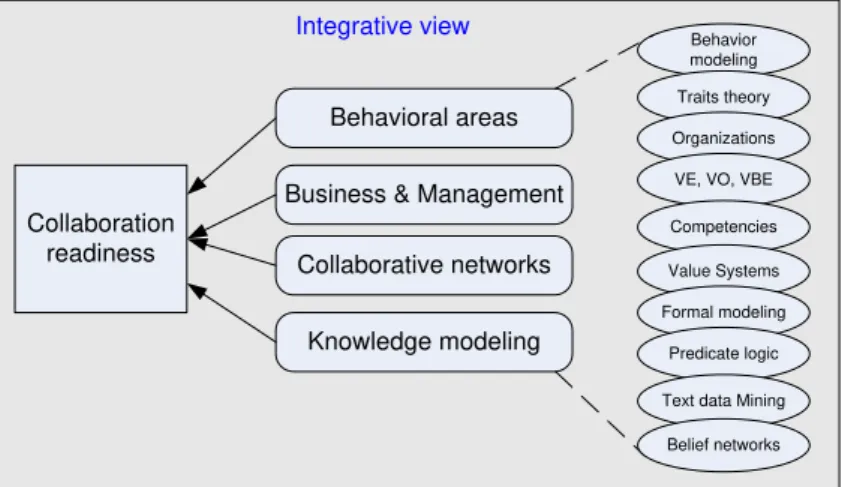
the utilization of models and theories originated from diverse areas, such as Collaborative Networks, Behavioral Sciences, Management, and Knowledge Modeling areas, as later discussed in section 3.1.1. On the other hand, some concepts are used in distinct ways in different, but related, areas. For instance, the notion of organization can be observed from a point of view of distinct theories, perspectives, schools, models and metaphors. In a similar way, involved in the problem of behavior prediction are Traits Theory, Personality Psychology, and Social Learning Theories, just to name a few.
As a result, each theory or model found useful and considered as a potential contribution to model collaboration readiness may bring useful concepts, but it also brings additional layers of complexity. On top of it, is the fact that most models and theories from a social realm are presented in an informal and textual manner, making it even harder to visualize and understand the concepts. The best way to overcome these difficulties is to rely on a formalism, which can be used to represent ideas and concepts in an intuitive, straightforward way. The proposed approach is based on the utilization of semantic maps.
A semantic map can be seen as a loosely coupled web of concepts, in which links are used to connect concepts or ideas, which are related in a structural or semantic way (Van Der Auwera, 2008). Semantic maps can help to highlight relevant aspects from a textual representation into a visual, clearer, and more intuitive way. The obtained semantic map representations can then be used in the posterior phases of modeling collaboration readiness.
2.1
Collaboration and related concepts
Considering the objective of this work, specifically collaboration readiness assessment, this section is aimed at providing an overview about the notion of collaboration and some of its related concepts. Collaboration is a complex and multifaceted concept, for which a detailed description requires an extensive analysis that is out of the scope of this work. Therefore, the overview is constrained to a few fundamental aspects of
collaboration, addressing collaboration both from a social and from an ―industrial‖ (e.g.
15
2.1.1
Establishing a meaning for collaboration
The idea of people and groups working together to achieve shared objectives is not new. But according to (IBHE, 2007), collaboration still remains a concept that is difficult to define and even more difficult to implement. The precise meaning of collaboration can be elusive, in part because it may be interchangeably used with many other terms, namely as partnerships, alliances, joint ventures, and research consortia, any of which may be different in nature.
According to Gray (Gray, 1989), collaboration is a process through which parties who see different aspects of a problem can constructively explore their differences and search for solutions that go beyond their own limited resources and vision of what is possible. Collaboration is based on the simple adage that ―two heads are better than
one‖ and that one by itself is simply not good enough. Those parties with an interest in a
given problem or opportunity to collaborate are termed stakeholders. They include all the individuals, groups, or organizations that are directly influenced by the actions others take to solve the problem. Each stakeholder has a unique appreciation of the problem, and the objective of collaboration is to create a richer, more comprehensive, appreciation of the problem among the stakeholders, than any one of them could construct alone.
The research in (IBHE, 2007), allowed to identify ten distinguishing characteristics of collaboration, which are synthesized in Fig. 2.2.
Collaboration
(1) Is intentional, planned and structured
(2) Has specific purposes
(3) Involves strategic activities
(4) Involves multiple participating organizations and entities
(5) Involves shared responsability
(10) Is unique to the context
(9) It develops in stages
(8) Involves knowledge and resources sharing
(7) Involves
interpersonal interaction
(6) Is based on parity among participants
Fig. 2.2 – Establishing the concept of collaboration.
The meaning of each aspect in this figure is the following
1. Collaboration does not happen accidentally or without a specific commitment to
precedes the actual engagement in any collaborative activities, which are planned and structured in advance.
2. Organizations decide to collaborate with others to achieve objectives that are important to them and that they could not achieve by acting independently. These goals are to be clearly defined so that everyone involved will have a common understanding and shared acceptance of the aims that lead to collaboration.
3. Collaboration is not intrinsically successful as a way to achieve identified goals and objects. The success of collaboration largely depends on the appropriateness of the strategies or activities specifically designed, or chosen, by the collaborating partners to achieve these goals.
4. By definition, collaboration involves more than one organization or entity, and
the challenge is to engage the ―right‖ participants.
5. The decision to collaborate with others to achieve common or compatible goals
is also a decision to share responsibility for the work, outcomes and potential risks, including the risk of failure.
6. All participants should be equals in the consortium, but this is not obligatory. In fact, there should be differentiation of roles to take advantage of different talents and perspectives. Nevertheless, the consortium should be structured and operated in ways that acknowledge and support the parity among the participants, each of whom has a stake in the outcomes.
7. Although collaboration occurs between and among organizations, its
implementation involves interaction among individuals who represent those organizations. Many research works in collaboration suggest that the nature of this personal dimension is the most important factor in determining the success of the initiative.
8. Sharing of resources is a fundamental principle of collaboration and one of its primary benefits. In a time of limited resources, pooling money, time and talent can extend their impact and avoid duplication of effort.
9. Existing literature indicates that the work of collaboration or strategic alliance passes through four or five predictable stages: Creation, Operation, Evolution, and Metamorphosis/Dissolution (Camarinha-Matos and Afsarmanesh, 2006).
10.Although collaboration may be developed or replicated around successful
17
aspects are taken into consideration in the readiness model, by assessing willingness to collaborate.
The characteristics mentioned above are later recalled to justify the adopted approach for assessing willingness to collaborate in chapter 3. The characteristic at point 7 deserves some attention, because it is related with the issue of whether it is an organization‘s collaboration readiness that is being assessed, not of the individual representing it. However this aspect can only be addressed after necessary concepts are introduced later on.
2.1.2
When to collaborate
Collaboration is seen in (Gray, 1989) as a constructive approach for confronting difficult social problems, in front of the organizations‘ inability to provide effective and timely responses to the increasing pace at which new problems are generated. While new problems are cropping up daily, yesterday problems often go unsolved. This pileup of problems and the inability of organizations to contend with them reflect the turbulence of the environment. Under turbulent conditions, organizations become highly interdependent with others in indirect but consequential ways, and that under these circumstances, it is difficult for organizations to act unilaterally to solve problems without creating unwanted consequences for other parties and without encountering constraints imposed by others.
Table 2.1 – Situations better addressed by a collaboration strategy
Problem-related characteristics Stakeholders-related characteristics
Problems are ill defined, or there is disagreement about how they should be defined.
These problems are often characterized by technical complexity and scientific uncertainty.
Differing perspectives on the problems often lead to adversarial relationships among the stakeholders.
Several stakeholders have a strong interest in the problem and are interdependent on each other.
The stakeholders are not necessarily identified a priori or organized in any systematic way.
There may be a disparity of power and/or resources for dealing with the problems among the stakeholders.
The stakeholders may have different levels of expertise and different access to information about the problems.
Incremental or unilateral efforts to deal with the problems typically produce less than satisfactory solutions.
Existing processes for addressing the problems have proved insufficient and may even exacerbate them.
2.1.3
Collaboration in an inter-organizational context
Given that this work is about assessing organizations‘ collaboration readiness, it is
worth to address collaboration in an inter-organizational context. Some forms of collaboration between organizations are summarized below.
Cooperation
According to Penã and Arroyabe (Penã and Arroyabe, 2002), cooperation can be defined as a formal agreement between companies, or between companies and organizations, for a stable long-term bond to exploit a specific market opportunity. Each company is responsible for its individual duties and all of them also responsible for reaching a joint objective. It involves a reciprocal, limited and progressive commitment to improve their respective performance and to acquire competitive advantages in the market. The principal characteristics of a cooperation agreement are:
Reciprocal commitment: The partners consider real interests, either qualitative
or quantitative, in the cooperation.
Limited: The partners develop common objectives through cooperation, but
they preserve their independence in their own activities.
Reversible: partners can dissolve the cooperation agreement if obtained results
are not considered satisfactory.
19
The reasons for company cooperation can be summarized as follows:
Reduction of the transaction costs that arise when uncertainty in the markets is
high.
Obtaining a greater volume and presence in the market by reaching agreements
with competitors, suppliers and customers.
Seeking efficiency in certain activities carried out by a company.
Strategic alliances
A strategic alliance can be seen as links formed between two or more independent companies, which choose to carry out a project or specific activity jointly by coordinating the necessary skills and resources (Penã and Arroyabe, 2002). The key parameters surrounding alliances are opportunism, necessity and speed (Dussauge and Garrette, 1995), (Išoraité, 2009).
Under the context of a strategic alliance, the reasons for engaging in collaboration can be summarized as follows:
Reduce the uncertainty of businesses in an age when the great growth of competition levels and economic globalization pose increasing business risks.
The need to reduce transaction costs that have risen due to the volatility of the
environments.
The search for synergies linked to combining complementary operations (for instance, through the joint use of common sales networks, joint development of technological projects, and so on).
Consortium
A consortium is an association of two or more individuals, companies, organizations or governments (or any combination of these entities) with the objective of participating in a common activity or pooling their resources for achieving a common goal (Wiki, 2009), (Lang, 2002). Consortia are common in large construction and infrastructure projects for bridges, airports, railways. Their lowest common denominator is that they are normally formed on a project-by-project basis (Halaris, Bafoutsou et al., 2009).
Joint ventures
Nowadays an increasing number of firms are utilizing joint ventures for the first time to increase their strategic capabilities and global competitiveness (Lyles, 2002). A joint venture (often abbreviated JV) is an entity formed between two or more parties to undertake economic activity together. The parties agree to create a new entity by contributing with equity and sharing the revenues, expenses, and control of the enterprise. The venture can be made either for one specific project only or for a continuing business relationship.
The reasons to form a joint venture can be split by internal, competitive and strategic goals, which are shown in Table 2.2.
Table 2.2 – Reasons to form a joint venture (Lyles, 2002)
Internal reasons Competitive goals Strategic goals
Build on company's strengths
Spreading costs and risks
Improving access to financial resources
Economies of scale and advantages of size
Access to new technologies and customers
Access to innovative managerial practices
Influencing structural evolution of the industry
Pre-empting competition
Defensive response to blurring industry boundaries
Creation of stronger competitive units
Speed to market
Improved agility
Synergies
Transfer of technology/skills
Diversification
An aspect that persists in each of the above collaboration forms is that the involved companies remain independent. In this sense, they join forces in the pursuit of common goals without losing their autonomy and without abandoning their own specific interests, as illustrated in Fig. 2.3.
Lately, the increase in both market turbulence and complexity led to the appearance of emergent collaboration paradigms. These paradigms were further leveraged by newer and sophisticated ICT, opening the path for richer and inter-organizational contexts and
interactions. Such richness allowed a further ―virtualization‖ of organizations, allowing
21
Company A Company B
Strategic alliance Goals and interests
specific to A
Goals and interests specific to B
Limited common or compatible goals
Fig. 2.3 – Companies work together without losing their autonomy. Inspired in (Child and Faulkner, 1999)
2.2
Collaborative-networked organizations
This section is devoted to provide an overview of relevant concepts concerning collaborative-networked organizations. The aim is to briefly establish the application context of this work, without being too much exhaustive. CNOs belong to another type of organizational structure, known as collaborative networks, which comprises networks involving organizations and individuals, as discussed below. Some important aspects regarding collaborative networks are shown in Fig. 2.4.
Collaborative networks
What they are Types of
networks
Consortia formation
Partners selection
Collaboration readiness
Values and benefits sharing Assets sharing
Fig. 2.4 – Important aspects associated to collaborative networks