, ., FGV EBAPE
FUNDAÇÃO GETULIO VARGAS
ESCOLA BRASILEIRA DE ADMINISTRAÇÃO PÚBLICA E DE EMPRESAS MESTRADO EXECUTIVO EM GESTÃO EMPRESARIAL
ASSESSING THE MATURITY LEVEL OF AN
ORGANIZATION IN ITS ADOPTION OF
COLLABORA TION TECHNOLOGIES
-'AS LEIRA
~- .STRAÇAO PUBL CA E DE EMrQ•SAS
DISSERTAÇÃO APRESENTADA
À
ESCOLA BRASILEIRA DE ADMINISTRAÇÃO PÚBLICA E DE EMPRESAS PARA OBTENÇÃO DO GRAU DE MESTRERunning head: ASSESSING THE MATURITY LEVEL OF AN ORGANIZATION IN ITS ADOPTION OF C!Ts 2
MARIA DEL PILAR MUNOZ RINCON
ASSESSING THE MATURITY
LEVEL OF AN ORGANIZATION IN
ITS ADOPTION OF
COLLABORA TION
TECHNOLOGIES
Master's thesis presented to Corporate Intemational Master's program, Escola Brasileira de Administração Publica, Fundação Getúlio Vargas, as a requirement for obtaining lhe title of Master in Business Management.
RONALDO COUTO PARENTE
Ficha catalográfica elaborada pela Biblioteca Mario Henrique Simonsen/FGV
Mufíoz Rincon, Maria del Pilar
Assessing the maturity levei of an organization in its adoption of collaboration technologies
I
Maria del Pilar Mufíoz Rincon. - 2015.75 f.
Dissertação (mestrado) - Escola Brasileira de Administração Pública e de Empresas, Centro de Formação Acadêmica e Pesquisa.
Orientador: Ronaldo Couto Parente. Inclui bibliografia.
1. Sistemas de informação gerencial. 2. Desenvolvimento organizacional. 3. Tecnologia da informação. 4. Modelos de capacitação e maturidade (Software). I.
Parente, Ronaldo Couto. 11. Escola Brasileira de Administração Pública e de Empresas. Centro de Formação Acadêmica e Pesquisa. III. Título.
, ~ FGV
MARIA DEL PILAR MUNÕZ RINCON
ASSESSING THE MATURITY LEVEL OF AN ORGANIZATION IN ITS ADOPTION OF COLLABORATION TECHNOLOGIES.
Dissertação apresentada ao Curso de Mestrado Profissional Executivo em Gestão Empresarial da Escola Brasileira de Administração Pública e de Empresas para obtenção do grau de Mestre em Administração.
Data da defesa: 28/1 0/2015
ASSINATURA DOS MEMBROS DA BANCA EXAMINADORA
,\SSI'.SING Til E ivli\TURITY LEYTL OF ;\N ORCii\NIZATION IN ITS ADOPTION OF C'!Ts 3
Abstract
Nowadays there are many infonnation technologies that can make a significant difference to support collaborative efforts in the workspace. The role of IT is to support group collaboration by empowering team members with the right capabilities. One way to assess capabilities is through a maturity model. This paper proposes a first version of the Collaboration-Technology Maturity model (CTMM), aiming to serve as a strategic instrument for IT managers to contra! and manage the adoption of Collaboration Teclmologies (CITs) among their organizations. Our contribution is both theoretical and practical as we propose a descriptive maturity model. Nevertheless, it is also an application method and assessment instruments. We also completed an empirical evaluation by conducting 89 assessments at Latin American companies of all sizes and industries. This extensive field exercise allowed us to not only evaluate the usefulness of the model and instruments but also investigate CIT adoption pattems in Latin America in an attempt to collect historical data to further evolve CTMM into a comparative model. Responses were used to provide conclusions on CIT adoption in Latin America with respect to three specific backgrounds: the country of origin (region), size (in number of employees) and industry type. The implications of our findings are discussed for practitioners and researchers.
;\SSI:SINU Til E fvi,\TURITY IYVEL OF /IN ORGANIZATIOi' IN ITS ADOPTION OF C'lT' 4
TABLE OF CONTENTS
ABSTRACT ... 3
1. INTRODUCTION ... 6
2. LITERATURE REVIEW (BACKGROUND) ... 9
2.1 MATURITY MODELS ... 9
2.2 COLLABORA TION TECHNOLOGIES ... 11
2.3 COLLABORATION MATURITY MODELS ... 14
2.4. 1NTRODUCING COLLABORATION-TECHNOLOGY MATURITY MODEL (CTMM) ... 16
2.4.1 Procedure modelfor CTMM development ... ... 17
2.4.1.1 Problem Definition ... . . .. 17
2.4.1.2 Comparison o f existing maturity models ... ., ... . . ... 18
2.4.1.3 Detennination of development strategy ... . . ... 19
3. RESEARCH BACKGROUND AND HYPOTHESIS ... 21
3.1 HYPOTHESIS ... 22
4. RESEARCH METHOD ... 25
4.1 EMP1RICAL STUDY METHODOLOGY ... 25
4.2 MEASUREMENTS ... 26
4.2.1 Dependent Variahles ... 27
4.2.2 lndependent Variahles ... 27
4.3 DATA COLLECTION ... 28
5. DATA ANALYSIS AND RESULTS ... 30
6. DISCUSSION AND IMPLICATIONS ...•... 35
i\SSFSING Til I' ~'1/\T\JRITY LEVI'L OF A f' ORG/\NIZ/\ TION IN ITS ADOPTION OF CITs 5
ACKNOWLEDGEMENTS ... 40
REFEREN CES ... 41
TABLES ... 44
FIGURES ...•...•... 65
J\SSESll'G Tlll' :VJ,\TURITY LléVI,:L OF ;\N ORGANIZATION IN ITS ADOPTION OF CITs 6
1. lntroduction
In a globalized world, companies need different ways to communicate inside, outside and across the Organization. Unlike lhe traditional face-to-face teamwork meetings, today's group collaboration is taking more of a virtual form where participants are separated from physical locations and time zones. That can lead to situations where co-workers cannot easily find others, knowledge or resources when needed. In tum, this can delay decisions, affect organizational productivity and the company's bottom line. Fortunately, there are many information technologies nowadays that can make a significant difference to support collaborative efforts in the workspace.
The role of lT is to support gronp collaboration by empowering team members with the right technological tools (Romano et ai., 2010). In this context, it is important for IT to assess the quality of collaboration in relation to the adoption of the Information Technologies available to end-users. One way to assess capabilities is tbrongh a maturity model1• It will allow measuring
progress and identifying deficiencies in capabilities at certain intervals. Maturity thns implies an evolutionmy progress represented as cumulative stages (De Bruin et ai., 2005). The concept of maturity models gained relevance mnong both researchers and practitioners, after the introduction ofthe Capability Maturity Model for process software maturity (Paulk et ai., 1993). Since then, it has been increasingly applied within lhe domain of lT management (Becker et ai., 2009; Cur1ey, 2008; Jeffery and Le1ive1d, 2004), either as a diagnostic tool (descriptive mode1) oras a continuous improvement too1 (prescriptive/comparative models).
The literature revea1ed a few efforts on using maturity models to assess collaboration quality oftemns (ColMMfrom Boughza1a and De Vreede 2012; CollabMMfrom Magalhaes et ai., 2011; and ECMM from De Soria et ai., 2009). On1y one effort has been found that tracks
1
"Maturity models are conceptual multistage mode!s that describe typical patterns in the development of organizational capabilities. They usua!ly depict a sequence of stages that together form an anticipated, desired, o r
t\SSESING T il E fVl f\ TURITY LEVEL Or i\ N ORGA NIZAT ION I 1 JTS ADOPTION OF C ITs 7
progress of collaboration initiativcs that considers the technological dimension (Enterprise Collaboration and Social Software Maturity Model from Gartner2). However, this is a proprietary maturity model, which means that information on its methodology of application, and instruments are not publicly available. The greatest contribution of this research is tbe Collaboration-Techrwlogy Maturity Model (CTMM) for assessing readiness and capabilities of an Organization in its adoption of collaboration technologies. This paper reports the CTMM development and its field evaluation by assessing collaboration-teclmology maturity in 89 Latin American companies. The purpose of tbe study was to fill the gap by developing a multidimensional model that considers not only the process capabilities dimension associated to group collaboration, but also the Information Technology dimension. CTMM aims to serve as diagnostic tool for IT executives to control and manage the adoption of Collaboration Information Technologies (CITs), which in turn supports collaborative efforts in the workspace.
CTMM was developed empirically by following Becker et ai., (2009) guidelines for the development of IT maturity models based on a design science approach. Also De Bruin et al., (2005) standard framework for developing maturity models was taken into account. These approaches were used in combination witb input from focus group meetings with collaboration technology experts to guarantee the practical applicability of the model. In order to evaluate tbe use of CTMM in practice, we propose a research model that follows the tbeory of innovation diffusion (Rogers, 201 0). As discussed by Mettler (2009), we also believe the tbeory o f innovation diffusion and the concept of maturity is interrelated. In the context of IT, diffusion is tbe stage in which the technology has spread for general use and app1ication; we said 'a stage in which the technology or solution has reached maturity'. We believe this theory will help understand tbe patterns of organizational ClT adoption and maturity according to CTMM in Organizations in Latin America. The study is focused only on synchronous3 CITs, as demonstrated to offer the most irnmediate impact for real time collaboration (Denstadli et al., 2012). CITs investigated include: Corporate Voice (Tele Conferencing), lnstant Messaging and Presence, Web Conferencing, Vídeo Conferencing and Contact Center. See Figure 1 for a
2
Gartner. (20 li). hllps://www.gal1ncr.com/doc/ 1724649/ maturity-modcl-cntcrprisc-collaboration-social
3
ASSI'SIN(i Til F M;\TURITY LEVEL OF i\N ORGA:-JIZATION IN ITS ADOPTION OF ClTs ~
graphical representation of the research process. The motivation to undertake this research is based on the fac! that understanding how a CIT correctly selected and deployed supports group collaboration, can influence the quality of collaboration and positively impact the results that Organizations can yield. We also consider that the exploratory research will allow us to collect historical data to further evolve CTMM into a comparative model.
INSERT FIGURE I HERE
Our contribution is both theoretical and practical as we propose not only a descriptive maturity model, but also an application method and assessment instruments. We believe this first part of our research will allow us to address the following research questions: I) What characteristics describe an Organization 's maturity in the use of Collaboration Jnformation Technologies? 2) How do Organizations develop a technology strategy to foster
collaboration and drives business value? We also completed an empírica! evaluation by
conducting 89 assessments at Latin American companies of ali sizes and industries. This will allow us to address our las! research question: 3) What is the CJT adoption pattern in Latin
:\SSicSli\G TI !E Mi\ TURITY LEVEL OF Ai" ORGANIZATION IN ITS ADOPriON OF CITs 9
2. Literature Review (Background)
2.1 Maturity Models
Maturity cau be considered as a measure that allows compauies to assess their capabilities with regard to a certain problem area (De Bruin et al., 2005). A maturity model could be defined as a strategy that provides a roadmap for continuous improvement. Jt will allow measuring progress and identifying deficiencies in capabilities at certain intervals. Maturity is represented as cumulative stages with a logical progress through stages; higher stages are built ou the requirements of lower stages (De Bruin et al., 2005)
Maturity models have proliferated in many different domains since the concept of measuring maturity was introduced with the Capability Matnrity Model (CMM) developed by the Software Engineering Institute (SEI) at Camegie Mellow. CMM was designed to guide software organizations in selecting a process improvement strategy to achieve the highest software quality (Paulk et al., 1993). According to Paulk et al., each matnrity levei in the CMM constitntes a well-defined evolutionary stage o f progress towards achieving a more mature status (See Figure 2). Each levei comprises a set of process goals aud its respective performance indicators (Key Process Areas). Advancing a levei will certainly require building infrastructure and implementing best practices throughout the organization (Key Practices). Thus, achieving a levei constitutes au increase in process capabilities as part of the continuous process improvement. In other words, the Organization can be said to have institutionalized the specific process capability for the leve!.
INSERT FIGURE 2 HERE
i\SSJ,:Siê1Ci Til E Mi\TURITY LEVE L OF AN ORGANIZA TION IN ITS i\DOPTION OF C:!Ts I O
INSERT FIGURE 3 HERE
The literature revealed that more than one hundred maturity models have been developed since CMM introduction (Põppelbul3 et al., 2011) within a broad range of applications: IT Management (Becker et al., 2009), IT Capability (Curley, 2008), IT Portfolio Management (Jeffery and Leliveld, 2004), Business Process Management and Knowledge Management (De Bruin and Rosemann, 2005; and De Bruin et al., 2005). See Table 1 for some examples on some of the most accepted maturity models in IT. In practice, there is also an increasing number of proprietary models proposed by software companies and consultants. Predictions indicated that the overall adoption of maturity models would increase o ver the years (Scott 2007).
INSERT TABLE 1 HERE
According to Becker et al. (2009) "in the IT management domain, maturity models have proved to be an useful toa/ to assess the as-is situation of a company, derive and prioritize
improvement measures and subsequently contrai progress o f their imp/ementation" (p. 213). In this context, maturity models are being used in IT to serve as a scale for the appraisal of a company within a certain problem area. During the appraisal, a snapshot of the Organization regarding a specific problem area is made. Tbe characteristics found are evaluated with respect of the maturity framework, in order to detennine the Organization's maturity levei and high-priority issues. Finally, reconunendations for improvement towards achieving a higher maturity levei are derived (Paulk et al., 1993; Becker et al., 2009).
Strengths on using a maturity model as a scale for the appraisal of an Organization includes (Boughzala and de Vreede, 20 12):
ASSf'SING TI-! E ~-IATURITY LEVE L OF ;\N ORGANIZATION IN ITS ADOPTION OI' C!Ts 11
interviews could be use for its application.
o Flexibility. Maturity models have applicability on both functional and cross-functional perspectives within an Organization.
o Method of application. Includes the possibility of a self-assessment or in some cases, it will require third party assistance.
o Create Awareness. An opportunity to provide consensus around common understanding o f a problem area and the disposition for improvement
However, there are also criticisms regarding the use of maturity models for the appraisal o f an Organization:
o Formal Development. "There is little documentation on how to develop a maturity model that is methodologically well-founded, rigorously tested and widely accepted" (De Bruin et al., 2005).
o Compliance Standard. Unlike CMM (from SEI institute at Camegie Mellow), which has reached the levei of compliance standard, most maturity models have been reduced to marketing tools used by business consultants (De Bruin et al., 2005 and Becker et al., 2009).
o Limited Field Application. Extended application and absence of platform maintenance to track model evolution (De Bruin et al., 2005)
2.2 Collaboration technologies
Today's business environments are very different from the workplace years ago. lnformation technologies are opening up a variety of organizational structures that allow companies to improve organizational performance and gain competi tive advantage (Gitman and McDaniel, 2007). In this context, many companies are embracing virtual structures by either outsourcing severa! business functions or creating alliances in the fonn of a virtual corporation4 These new business models will ce1iainly demand group collaboration mostly in the form of
4
Virtual Corporation. A network o f independent companies linked by information technology to share skills, costs,
:\SSES!NCi Til E MATURITY LEVEL Of' AN ORG:\NIZATION 10 lTS ADOPl'ION OF Clh 12
virtual teams to coordinate people and projects among coworkers, suppliers and customers.
Unlike coworkers in traditional teams, members of virtual teams rarely meet in person (Gitman and McDaniel, 2007). lnstead they must work closely with colleagues located in different cities or countries, or with people telecommuting from home or on the road, as well as with people outside the Organization, such as customers or suppliers. It is also common, to have team members not necessarily under the same organizational hierarchy. They are usually gathered together by skills and experience to staff a proj ect or task.
In the context of this study, we use the following definition of group collaboration: "collaboration is a process in which two or more agents (individuais or organizations) share resources and ski/ls to solve prob/ems so that they canjointly accomplish one or more activities"
(Boughzala and de Vreede, 2012, p. 307). Empirical research supports the notion that the 1ack of direct contact and poor communications can result in sub-optimal team perfonnance5. In this
sense, the quality of communication and personal interaction among team members is at the heart o f effective working5• The role o f IT isto support group collaboration by empowering team members with the right technological tools (Romano et al., 2010). The benefits of using technologies for group collaboration are linked to the business through faster decision-making, cost reduction (e.g. travei reductions), an increase in productivity and gaining competitive advantage.
We will use the term Collaborative Information Technologies (C!Ts) to refer to those technologies that enhance group collaboration (Pervan et al., 2005). These technologies are usually categorized into synchronous and asynchronous types. Synchronous collaboration allows both pmties to immediately exchange or share information in real time. Video Conferencing is one example of a synchronous technology that has been shown to offer the most immediate impact in decision-making (Denstadli et al., 2012). Asynchronous technologies allow sustained collaboration over time by providing a persistent access to information or resources. E-mail,
5
i\SSFSINCi Til!' M;\TURITY LEVEL OF AN ORCiANIZ/\TION IN ITS ADOPTION OF C'ITs 13
wik:is, VoD6 and enterprise social media are examples of the most traditional asynchronous collaboration tools.
Bajwa's study o f ClT literature in 2005, highlights seven major categories o f C!Ts: email, teleconferencing (two-way audio only communication), Vídeo Conferencing (two-way audio and vídeo conununication), dataconferencing (whiteboards, application sharing and data presentations), web-based collaborative tools (intranet, chat, wikis), groupware tools (for sharing calendars, files, e-mail, projects) and electronic meeting systems (interactive tools for producing and docurnenting group results). Bajwa et al. studied the adoption pattern ofthese seven C!Ts to support task-oriented work among 344 Organizations in the US, Australia, and Hong Kong. This research reveled that e-mail and audio teleconferencing are the only two C!Ts that had been widely adopted, followed by Vídeo Conferencing, proprietary groupware, dataconferencing, web-based tools, and finally electronic meeting systems which had the lowest adoption across ali the three regions.
Building upon work from Pervan et al. and Bajwa et al., (2005), along with recent empirical studies5 that ranks technologies according to its relative cost and collaboration quality (see Figure 4), we defined five C!Ts as part of the scope for this study: Voice (Tele Conferencing), Instant Messaging and Presence, Vídeo Conferencing, Web Conferencing and Contact Center. Based on the argurnent that synchronous technologies are capable of offering the most immediate impact for group collaboration (Denstadli et al., 2012 and Romano et al., 2010), this work will only focus on synchronous technologies. Table 2 provides a summary anda description ofthe C!Ts included in the scope ofthis study.
INSERT FIGURE 4 HERE
Apart from these five technologies, mobility is also considered in the maturity model
6
J\SSESING T i l E i\'IATURITY LE VEL OF 1\N ORGAN IZAT ION IN ITS A DOPTI O OF CITs 14
design cri teria. Although "mobility" itself is nota form of collaboration, they are related. Mobile platforms (e.g. laptops, tablets, smartphones) are now able to support collaboration tools to enable work to be done at "anyplace, anytime" (Scott 2007). In addition to voice, collaboration tools, sucb as Instant Messaging & Presence, Web Conferencing and Vídeo are now available in mobile devices. Ali these collaboration tools can be delivered to users as a single and fully integrated application, called Unified Communications Client (UC Client) in the industry. Having a UC client saves time for the end user as it allows moving from one collaboration mode to another. For example, being able to escalate a chat discussion into a Web Conferencing or video, either on a laptop or smartphone will certainly speed up decision-making. This opens the doar to more flexible working options, namely: a mobile workforce, virtual teams, home working and flexible seating at work. Moreover, savings from improving ubiquity of personnel and roaming avoidance are some business benefits for enabling mobile collaboration applications.
Nevertheless, mobility might bring a cballenge to IT in arder to achieve a balance of contrai and flexibility. With BYOD7 becoming a trend, users are demanding the use oftheir personal devices at work, which requires IT to revise its infrastructure capabilities to support a wide range o f mobile devices ( e.g. tablets and smart phones) while avoiding security risks. A further security challenge is the use of consumer tools (e.g., Google talk, Facetime, Whatsapp) for both internai and externai collaboration in the form ofBusiness-to-Business8 (B2B).
INSERT TABLE 2 HERE
2.3 Collaboration Maturity Models
Recently, a number of maturity models coming from both the academic and the
7
8ring your own device (BYOD) is an alternative strategy allowing employees to utilize a personally selected and
purchased client device (e.g smartphone, tablets) to execute enterprise applications and access data.
(http:/ /www. ga rtncr. com/ i t -g lossmy /bring -you r-own-dcv icc-byod) 8
ASSI:SING TllE IVlATURlTY LEVEL OF /IN ORCjANIZATION IN ITS ADOPTlON OF CITs 15
practitioner's world have been introduced to assess collaboration maturity in teams. They are intended to assess the overall collaboration perfonnance of teams and collaboration practices into business processes. Table 3 introduces some exarnples of collaboration maturity models studied. The value of these models lies in the fact that they raise awareness of collaboration maturity in an organizational setting. However, there are limitations in tracking progress o f their application in the field and getting a compliance status.
INSERT TABLE 3 HERE
The contribution of the Collaboration Maturity Grid (CMG) developed at Carnbridge University (Fraser et al., 2003), consists of the introduction to the notion of collaboration maturity. CMG is specifically targeted to organizations that outsource services for design or development activities (virtual corporations), and consists offour leveis that assess the following process areas: collaboration strategy, structure development process, system design and task partitioning, partner selection, project initiation, partnership management and partnership development.
CollabMM (Magalhaes et al., 2009) orgamzes collaboration practices and provides a method for introducing those practices to business processes. Col-MM (Boughzala & De Vreede, 2012) is intended to be sufficiently generic to be applied to any type of collaboration and to be used by practitioners for conducting self-assessments. Both maturity models, are an attempt to represent collaboration practices in relation to a business process. However, none o f them offer a multidimensional representation that considers the technology perspective and the lack of a repository to track the model evolution.
;\SSI,SI~(i Tlil' tvii\TURITY LJ:VLcL OF ;\N ORGANIZATION li\ ITS ADOPTJON OF
crr,
lú(Leve! 5); and eight dimensions for evalnating maturity: infrastrncture management, deployment brcadth, range of options, delive1y model, govemance, integration, adoption and culturc. ECMMSS® is a ve1y robust model as it considers many dimensions including [nformation Technologics and Pcople (culture) dimcnsions. ECMMSS® is also presented as a comparative maturity model. However, therc is no public inforrnation on its application or assessment instrnments.
2.4. Introducing the Collaboration-Technology Maturity Mo dei (CTMM)
Despite the fact that many IT maturity models were identified from both, academic and proprietary sources, there is little docl1111entation on how to develop a maturity model. This is one of many reasons why maturity models have been subject to criticism (PõppelbuB and Rõglinger, 2011). This work seeks to develop a maturity model that addresses this issue by following De Brnin et al. (2005) and Becker et al. (2009) design guide1ines for developing maturity models.
De Brnin et al. (2005) has researched severa! maturity models in different domains. Based on this, their contribution lies in the definition of six generic phases required for the deve1opment of a general maturity model. Becker et al. (2009) specifically addresscs the deve1opment of maturity model for IT management. They propose a procedural model to overcome certain arbitrariness in developing maturity models, such as authors that rarely reveal their motivations, or details on the development o f the model, or their procedural method and the results of their evaluation (p. 214). Overall we wi11 follow Becker et al., procedural model in order to produce new artifacts (the maturity model framework, questionnaire, method, and assessment tool). Furtherrnore, we will consider De Brnin et al. recommendations for scoping and developing phases o f the model.
;\SSl:SINCi Til E Mt\TURITY LEVEL OF i\N ORGi\NIZi\TION IN ITS i\DOPTION OF C!Ts 17
model can evolve into being prescriptive by providing an improvement roadmap in order to positively affect business performance. Finally, a model can evolve into being comparative once it has been widely applied and historical data has been collected for benchmarking.
INSERT FIGURE 5 HERE
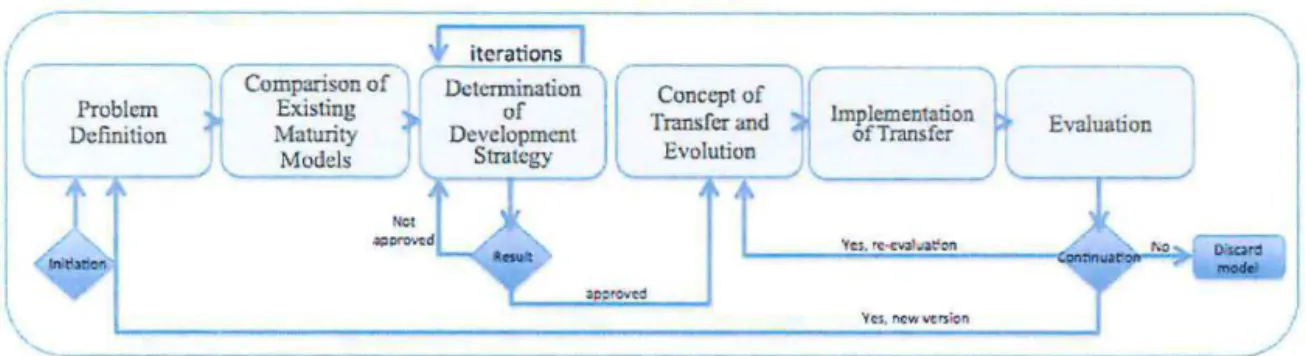
Becker et ai., propose a procedural model for the design o f matwity models based on the guidelines for design science defined by Hevner et ai. (2004). The goal of design science is to develop a problem-solving artifact. Under this approach, "a maturity model is considered as an artifact. which serves to solve the problem of determining a company "s status quo of its
capabilities and deriving measures for improvement therefrom". Becker et ai. procedural model
distinguishes seven phases in the development o f maturity models (See Figure 6).
INSERT FIGURE 6 HERE
2.4.1 Procedure modelfor CTMM development
2.4.1.1 Problem Definition
t\SSESING THE 1\ll t\TUR!T't" LEVEL OF t\N ORGAN IZi\ TI ON IN ITS ADO PTION OF C!Ts 18
Detennining the scope will set the boundari es for its application in a later phase. Detennining the design will provide an answer to the following questions: who the targeted audience is, what tbeir needs are, why they seek to apply the model, who needs to be involved in applying the model and what can be achieved through application of the model (De Bruin et al., 2005)
INSERT TABLE 4 HERE
2.4.1.2 Comparison o f existing maturity models
According to Becker et al., a comprehensive comparison is requisite for a reasoned determination of the development strategy. Several strategies could be followed: to design a completely new model, enhance an existing one, combine several models into one or transfer structures or contents from an existing model into a new one (Becker et al., 2009). Our approach follows the last option.
The need for the development of a new maturity model must be supported by a comparison with existing models. Among the maturity models described in previous sections, we considered the following three for a comparison exercise relevant to our work: the IT-CMF (Curley, 2008); CollabMM (Magalhaes et ai., 2009); and the proprietary model from Gartner (20 11 ), ECMMS ~ . Table 5 summarizes the comparison among these tbree maturity models.
INSERT TABLE 5 HERE
IT-CMF developed and introduced by Curley (2008) and currently under the umbrella of the Innovation Value Institute in Ireland9, is well known among practitioners and academics and
9
;\SSESWU Til E ivl;\ TURITY LEVI::I~ OF i\N ORGANIZ!\TION IN ITS ADOPTIOl" OF CITs 19
have gained the status of standard compliance, which means certified professionals are required to run a company's appraisal. IT -CMF provides a blueprint for incrementai improvement in managing IT for business value. IT -CMF is based on a maturity model approach with four macro-capabilities (IT budget, IT capability, IT value, IT like a business) measured on tive maturity leveis ranging from Initial through Optimizing. We consider IT -CMF very relevant to the CTMM development strategy as the foundation to define the IT capabilities required to successfully deploy CITs.
Between the collaboration process specific maturity models, we found CollabMM (Magalhaes et al. 2009) and Col-MM (Boughzala & De Vreede 2012,), both relevant to our work. They were developed by academics and mainly focused on team performance and application of collaboration practices into business processes. Both, CollabMM and ColMM use a methodological procedure for its development. CollabMM is grounded on De Bruin et al. (2005) design guidelines and ColMM is grounded on Becker et al. (2009) procedure model for designing maturity models. Neither o f them has reached the levei of compliance standard, nor do they address the technology standpoint. We consider these models are still in an early stage of the evolutionary lifecycle (total citations for main authors range 200-400 according to Web of Science and Google Scholar July 2015). However, they are relevant to our work providing the foundation to define the collaboration processes specifics as part of the CTMM development strategy.
Finally, Gartner's ECMMSS" is a maturity model that explicitly addresses CITs and is considered relevant among practitioners. This is a proprietary model, intended to serve as a comparative model for benchmarking across companies. However, due to its proprietary notion, we found no available infonnation on the methodological procedure for its development, nor results of its application. ECMMSS" is relevant to our work in the sense it provides the foundation to understand the benefits of deploying certain IT capabilities at each levei of CTMM.
2.4.1.3 Determination o f the development strategy
/\SSESINéi Til E IVI/\TURITY lYVEL OF 1\N ORG/\NIZ/\TIO" 1:\ ITS /\DOPTION OF Clh 20
characteristics) and measures for each stage. The nurnber o f stages may vary, but they should be well defined and provide the sense of logical progression through stages. This work will use a four-stage model, namely: lnitial. Intermediate, Advanced and Pervasive, which carry out some concepts from IT -CMF and ECMMSS regarding the labels used for the leveis. The literature
revealed that most maturity models are structured in a uni-dimensional manner (Mettler, 2009).
However, many factors (dimensions) could be used when assessing maturity: process, people, culture, Information Technology/Information Systems (De Bruin and Rosemann, 2005). In the case of CTMM, we propose using four factors or dimensions: Range of Technologies, IT Capability, Business V alue and Collaboration (Practice).
The Range of Technologies dimension examines the CITs employed at each levei. The Collaboration dimension examines the collaboration practices within the Organization based on
the CollabMM levei definitions. The IT capability dimension is founded on one of the IT-CMF processes for effective delivering of new strategic applications. Finally, the Business Value dimension is carried out from IT -CMF and some contents transferred from ECMMSS to describe
the Business V alue you can get at each levei by implementing the aggregated C!Ts.
We decided to use pieces of the maturity models listed in Table 5 as a starting point for the design process. In this order, the IT capability dimension is influenced by the IT-CMF model; the Business V alue dimension is build upon concepts from IT-CMF and ECMMSS and finally Collaboration Practice is influenced by CollabMM. Furthermore, severa! rounds of focus groups with collaboration-technology experts took place to be able to map teclmologies to each one of the phases prosed and define the key characteristics of each phase. Table 6 introduces CTMM framework including key characteristics for each levei and its dimensions.
ASSES!N() T!!l: MATUR!TY LEVr:L OF i\N ORGANIZATION li': !TS ADOPTION OF C!Ts 21
3.
Research background and hypothesis
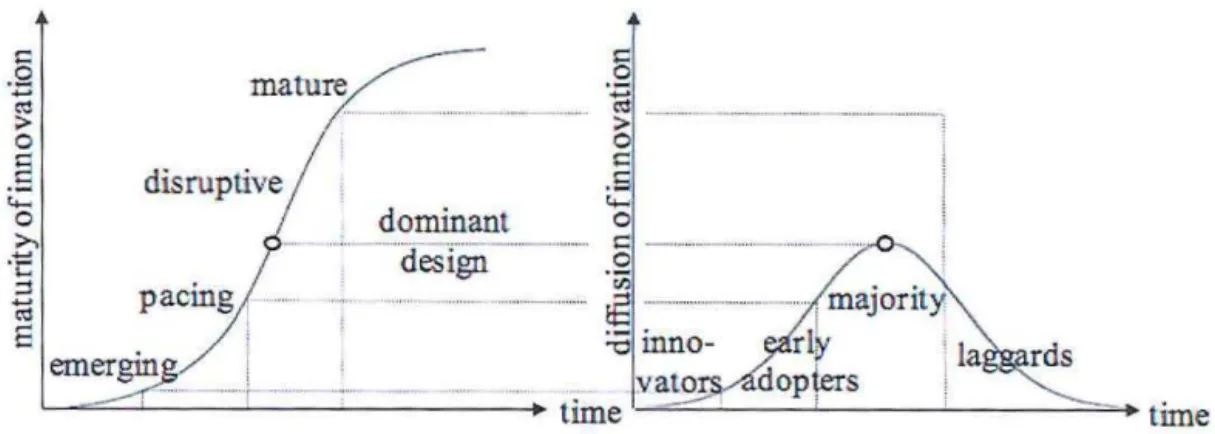
The theory of innovation diffusion has been widely used to study the adoption of IT solutions. As discussed by Mettler (2009), we also believe the theory of innovation diffusion and the concepts o f maturity are interrelated. Mettler (2009) proposes this interrelation is founded on the basis of Rogers (1995, 2010) and Uterback & Abernathy (1975) work (see Figure 7). According to Utterback & Abernathy (1975), a product or process innovation passes through different stages in which the final leve! is called a mature phase. According to Roger' s theory and in the contexto f IT, diffusion is the stage in which the technology has spread for general use and application. We could say, that it is a stage in which the technology or solution has reached 'maturity'. Both theories refer to a state of completeness and readiness, which is basically the concept we are referring to in this work as maturity.
INSERT FIGURE 7 HERE
Rogers distinguishes diffusion from adoption by stating that adoption refers to the stage in the diffusion process in which a technology is selected for use, either by individuais or the organization. The focus of our research is on the adoption (acquisition) of C!Ts and we use the innovation diffusion theory as the theoretical premise to validate our research model and at the same time evaluate CTMM by conducting a field application.
ASSFS!NG THE MATUR!TY LEVEL O f AN ORGANIZATJON 1:\ ITS ADOPTION O r C!Ts 22
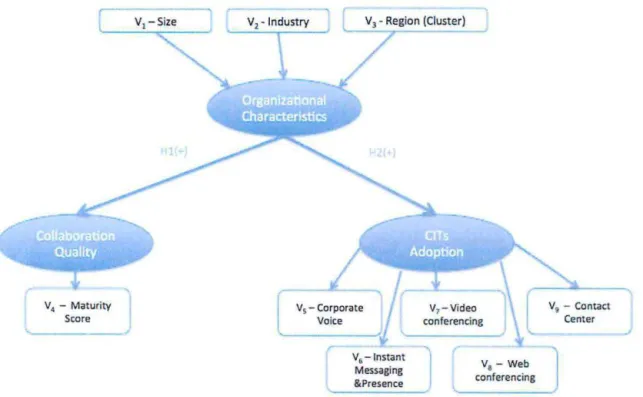
Contact Center. The las! teclmology was not initially considered but was added during the exploratory research, as it was advised to be very relevant in the overall CIT strategy of an Organization. Collaboration technologies are also used to getting in touch with customers, which is considered in the category o f externai collaboration.
INSERT FIGURE 8 HERE
3.1 Hypothesis
Many factors can influence diffusion behavior. Kwon and Zmud (1987) (as cited in Bajwa et ai., 2005, p. 131) identified five variable categories that may influence diffusion ofiT innovations: externai environment forces, organizational factors, task characteristics, technology attributes, and user characteristics. In this study we focus on two specific organizational factors: Company Size and Industry Type. We also decided to include a third factor, the Region to which the company belongs. This factor has been added to the research model after reviewing the data collected and as a result of grouping the companies per geographical proximity in three regional clusters. The aim is to provide some conclusions on CIT adoption among clusters (the criteria we used to define the clusters is discussed in the Data Collection section).
;\SSl:SJ:"Ci Til I' lvli\TURITY LEVEL OF M\ ORGANIZATION IN ITS ADOPTION (Jf"" C!Ts 23
Hl-1. The Company size is positively related to the maturity score achieved by a
company
Besides Company Size, we wanted to investigate another organizational factor that might influence adoption. Based on the assumption that some industries are more likely to adopt a CIT than others, the following hypothesis will explore the relationship between the Industry sector to which a company belongs and its maturity score according to the CTMM scale.
Hl-2. The lndustry Type is positively related to the maturity score achieved by a
company
Finally, the following hypothesis will explore the relationship between the Region to which a company belongs and its maturity score based on the CTMM scale. Based on the assumption that are some countries more likely to adopt advanced technologies than others, we would like to understand i f there is a pattem between the maturity score achieved by companies in higher-income countries among the clusters.
HJ-3. The Region is positively related to the maturity score achieved by a company
Following same arguments as presented above, the next group of hypothesis pretends to explore the relationship between the independent variables and the adoption status of an individual ( or aggregated) CIT. In this case, we will test the organizational factors: Company size, Industry and Region against the individual or aggregated adoption ofCITs. We believe the results between Hl and H2 hypothesis should be related, as the maturity score is a result of an aggregated CIT adoption under the CTMM scale we developed under the present work.
The following hypothesis will explore the relationship between Company size and CIT adoption.
:\SSF,S!Mí THI.1, édATURITY LEVEL 01' ;\N ORC!r\NIZATION IN ITS ADOPT!Oi\ OF CITs 24
The following hypothesis will explore the relationship between the industry type and CIT adoption_
H2-2. The lndustry Type is positively related to the adoption ofCITs_
The following hypothesis will explore the relationship between the Regions and CIT adoption_
;\SSESING TllE !VL\TURJTY LEVI"'L OF !li\ ORGANIZJ\'T'ION IN ITS ADOPTION OF
cn,
254. Research method
4.1 Empírica) study methodology
A research project was initiated to evaluate CTMM and at the same time investigate the adoption patterns of severa! Information technologies that support workgroup collaboration in Latin American organizations. Based upon literature review for existing synchronous CITs, four specific CITs were selected for the study: Corporate Voice (Tele Conferencing), Instant Messaging and Presence, Video Conferencing, Web Conferencing and Contact Center. Selection was based on the following criteria:
• Recent reports from Jndustry Analysts and Consultants (Gartner10, Frost and
Sullivan11, Accenture12) on changing patterns at the workplace towards a more digital workplace
that responds to increasing demands for flexibility, mobility and community-oriented tools. • 2015 Key Predictions for Col!aboration Technologies in Latin America by Frost and Sullivan13, which point out that 'mobility' is still at an initial stage in Latin America. However, remote workers (telec01mnuters) are expected to increase. Thus, an increase in the use of video tools, especially in large companies, is also anticipated.
• Whitepapers on how to shape collaborative behavior through technology12 and how to embed collaborative Techno/ogies into a business process11
•
Recent Academic studies on CIT adoption: Heidrich, et al. (2013) about synchronous Technologies (web-based Technologies) that affect team collaboration; Romano et al. (2010) about Technologies to promote cross-organizational and cross-border collaboration; Denstadli et al., (2012) about a comparative study ofthe use ofVideo Conferencing and Face-to-Face meetings.10
Gartner. (2014, April). Create a Digital Workplace to respond to critica/ changes in the workforce
11
Frost and Sullivan. Se!ection and Use ofCo!laboration Tools to Maximize Team Performance
12 Accenture. (2013, October). From Talking to Transforming: Getting Real Valuefrom Enterprise Col/aboration Technology
13
;\SSI'SIN(; THI' tvli\TURITY LEVf'L OF ;\N ORGi\NlZATION 1!\ ITS ADOPTION OF CITs 26
4.2 Measurements
The formal process to develop the measurement instruments started in 2013. This included a questionnaire and an assessment tool. Severa! focus group meetings with industry experts took place to develop the instrwnents. The final questionnaire (See Appendix) was basically a resulto f these discussions, which included defining the questions, item-measures and appropriateness of CITs to be included in CTMM.
Along with the questionnaire, a CTMM assessment tool was designed. This tool consists of a customized MS Excel application that represents the implementation of the CTMM framework and allows the execution of an organization's appraisal. The tool takes into consideration the questionnaire answers, along with mathematical formulas to rate the company according to the CTMM scale. The ultimate goal is to detennine the maturity levei of the Organization with respect ofthe adoption ofthe evaluated CITs. As an output ofthe appraisal, a snapshot report is handed out to the respondents. This report includes the maturity levei achieved by the Organization, along with general characteristics of the current levei with respect to the upper leveis. This could be seen by the evaluated Organization as the evolutionary roadmap towards achieving a higher maturity levei (prescriptive model).
In order to test the clarity o f the questions and measures, an exploratory application o f the instruments took place in early 2013. In this opportunity, an appraisal exercise was completed with a South American company from the financiai sector. This allowed us to a) test both instruments, the questionnaire and the assessment tool and b) collect feedback and make modifications to favor clarity o f item-questions and measures.
;\SSI,SING Til E MATURITY LEVFL OF AN ORGANIZATION TN ITS ADOPTION OF C!Ts 27
4.2.1 Dependent Variables
The dependent variables in our research model include: maturity score and adoption status. Table 7 summarizes the variables for the study.
Maturity score is a numeric value computed by aggregating the scores of ali CITs
considered in the study according to the CTMM framework described in Section 2. Four categories were defined according to the CTMM maturity leveis, namely: Initial, Intennediate, Advanced and Pervasive.
Adoption status has a nominal value and was measured by requiring respondents to
indicate if the CIT was available in their organization. A binary measure (I for adopters, O for non-adopters) was used for the adoption analysis. A CIT adopter is an Organization that has been acquired the CIT and is available to end-users. This variable could be seen for each individual CIT, oras an aggregate o f CITs.
4.2.2 Jndependent Variables
The independent variables in our research model include: Company Size, Jndustry and Region.
For Company size, four categories o f number o f employees were defined for practicality of the analysis: less than 50 (small), 51-500 (medium), 501-5,000 (large) and over 5,000 (very large). Very large companies are mostly MNCs (Multinational Companies).
For Jndustry Type, nme categories were identified: serv1ce provider, technical services/consulting, govenunent, manufacturing, education (private/public), financiai services, wholesaie/distribution, energy/utilities and others (for the remaining unclassified industries).
ASSESING THE M;ITURITY LEVEL OI' AN ORGANIZATION IN ITS ADOPTION Of' C!Ts 28
INSERT TABLE 7 HERE
4.3 Data Collection
A non-probability sampling method was used to collect data for the study. More specifically a convenience sampling technique was used. Data were collected during two IT Industry events that took place in Costa Rica and Mexico in 2013. During the events, the subjects of the study were chosen based on their accessibility to respond the questionnaire ( see Appendix). We are aware that this process of gathering responses does not give ali the individuais in the population equal chances for being selected. Our sample is taken from the Latin American companies that were able to attend these two events. Our research is not intended to generate results that will be used to create generalizations pertaining the entire population of Latin American companies. This is intended to be an exploratory study at this point in the research. Our motivation is to collect historica! data to be used ]ater in evolving CTMM in to a benchmarking model ( comparative model).
The questionnaire, now in a digital form, was used in both !ocations along with the assessment tool, so respondents conld get a snapshot repor! oftheir Organization's maturity leve! according to CTMM. This repor! was immediately emailed to the respondents for their future reference. Respondents were randomly selected from the crowd and advised on the purpose of the questionnaire in order to engaged them with the activity. A trained person guided them through the questions and helped in providing clarity on any ofthe item-measures.
:\SSFS!Hj TI !I' Mi\TURITY U'VELOF ;\N ORGANIZ;\TJON IN ITS ADOPTION OF C!Ts 29
In the case ofMexico, from a total of2,114 attendees from 15 different Latin American countries, 45 usable responses were collected. The responses included companies of ali industries and sizes, but predominantly large (65% belonging to large and very large categories). In this case, the majority of responses belonged to IT Staff (87%) against 13% from IT management.
Overall, 103 usable responses were collected between Mexi co and Costa Rica events. However, we found some cases in which we got more than one answer from the same company. We decided to leave only one answer per company, which implied discarding some responses14.
The discarding criteria were mainly based on tl1e position levei of the respondents. The higher the position, the less likely to be discarded. By disregarding those cases, we managed to collect a total o f 89 usable responses from 11 different Latin American countries.
14
A disturbance was found since respondents from the same company reported a different adoption status for the CITs in the study. We believe this is because many tools/technologies are accessible at different user leveis in an Organization. We decided to use the responses from the IT managers ora higher category respondent, discarding the
ASSI'SINCJ THE fviATURITY LEVEL OF AN ORGANIZATION T?\ ITS ADOPTION OF CITs 30
5. Data analysis and results
Overall, 89 usable responses were collected. With this data, we decided to create tbree separate clusters based on a geographical proximity: Mexico, Central America and the Caribbean (Costa Rica, the Dominican Republic, Guatemala, Nicaragua, E! Salvador) and North of South America (Colombia, Venezuela, Ecuador, Peru, Bolivia). Table 8 shows the respondent pro files o f the samples in all three clusters. About a third o f our respondents belonged to the IT management tier. The majority (60.7%) belonged to the staff tier. The respondent profile fits well with regards to the CTMM scope defined in section 2.4.1.1, targeted to IT managers and staff. Table 9 shows the company size (number of employees) of the responding companies, while Table 1 O shows tl1e type o f industries o f the responding companies.
INSERT TABLE 8 HERE
INSERT TABLE 9 HERE
INSERT TABLE 10 HERE
The adoption status of CITs per cluster and the overall adoption of C!Ts across all three clusters are reported on Tab1e 11. Contact Center has the highest adoption rate, followed by Voice (te1econferencing). We found that every sing1e company in the study, regardless of its size, had already deployed a customer care strategy. Note also that Video Conferencing has the lowest adoption rate across all the three clusters. From interviews to some o f the respondents we confirmed that the availability of C!Ts was highly related to its relative cost (See Figure 4), and Video Conferencing appears to be the costliest o f all C!Ts in the study.
i\SSESING TIII' Mi\TUI<ITY LEVEL OF AN ORGANIZ/\TION IN ITS i\DOPTION OF CITs 31
Table 12 exlübits the maturity score mean per cluster and the overall maturity score among the three clusters. Despite the difference on the scores among the regions, all three are categorized as 'Intermediate' according to the CTMM scale. Notice that the more regular sample is within the Central America cluster with a variation coefficient o f 22.5%.
INSERT TABLE 12 HERE
To test the research hypothesis, severa! statistical procedures were performed15
• First, a
one-way ANOVA was used to test Hl-1, Hl-2 and Hl-3. This procedure was used to test statistical significance in mean maturity scores among the independent variables (V1, V2 , and V3.).
See Table 13 for results. In the case ofHl-1 and Hl-2, with ap-value higher than 5% calculated with a 95% confidence, the null hypothesis is accepted and no further tests are required. This means there is no significant relation in mean maturity scores among the four company size categories defined in the study (Hl-1). This finding supports previous researches that indicated that no positive linear increase existed (Grover and Goslar, 1993 and Pervan et a!., 2005), despite the rationale that suggests that larger organizations are more likely to adopt a CIT than smaller organizations. We also found that no significant relation exists in mean maturity scores among the different industries considered in the study (Hl-2).
INSERT TABLE 13 HERE
In the case of Hl-3, p-value is lower than 5% (ca!culated with a 95% confidence);
,\SSESll\Ci Til L' ivli\TURITY LEY[OL 011 i\N ORGANIZATION IN ITS i\DOPTJOT\ OF C!Ts 32
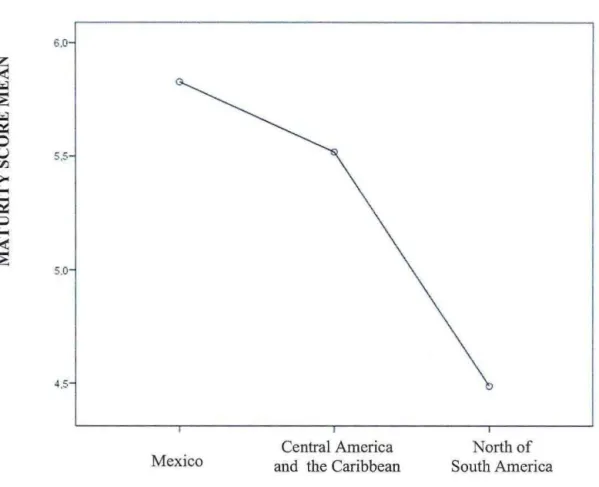
thereby the null hypothesis was rejected. Significant differences were found in mean maturity scores between the clusters, thus a multiple comparison test was completed to further explore the relation. Figure 9 shows results from the Least Siguificant Difference (LSD) test between the dependent variable Maturity Scores and the independent variable Region (Cluster). Notice Mexi co' s cluster appears to have a higher maturity levei than the other two regions. Actually Mexico was the only region including a company that achieved the higher maturity levei (Pervasive) in CTMM. This could explain results in the LSD test.
INSERT FIGURE 9 HERE
Considering that we were dealing with binary data (1 for adopter, O for non-adopter), a Linear Discriminant Analysis (LDA) was perfonned totest the adoption status hypothesis (H2-1, H2-2 and H2-3). Contact Center was excluded at this point, as 100% ofthe companies in ali three clusters were classified as adopters.
First, a Test of Equality of Group Means was conducted to test each CIT independently for H2-3. Table 14 shows the results comparing differences ofthe independent variable Region (Cluster) between adopters and non-adopters for the 4 CITs. According to these results, Video Conferencing is the only CIT with a p-value ofless than 5% (calculated with a 95% confidence). Therefore, the null hypothesis is rejected, thus indicating that tl1ere are significant differences in Video conferencing adoption among the tl1ree clusters in the study. Notice that Video Conferencing is the CIT with tl1e lowest adoption rate and highest variability among tl1e CITs in the study.
1\SSfcSI'JC Til E fv!ATURITY LEVEL OF A f' ORGANIZATION li': ITS ADOPTION o r C! h 33
higher adoption in Mexico, whereas Web Conferencing exhibits a higher adoption in Mexico and North o f South America. Finally, North o f South America exhibits the 1owest adoption score for Video Conferencing among the three regions. This conclusion differs from recent studies conducted by the industry ana1yst IDC16 that indicate that Co1ombia and Peru are among the South American countries 1eading market growth and adoption of Video Conferencing techno1ogies in 2014/2015. In order to fair1y compare our resu1ts to theirs, we recommend having a 1arger samp1e of companies from this region in any future research.
INSERT TABLE 14 HERE
INSERT TABLE 15 HERE
To test H2-1 and H2-2 we used non-parametric methods. First, a Kruska1-Wallis Test was conducted in an attempt to determine if there are statistically significant differences between the grouping variab1e V1 (company size) on each ofthe CITs in the study. Once again, Contact
Center was excluded from the samp1e as it reported a 100% adoption. Tab1e 16 shows results. With p-va/ues higher than 5% (with a 95% confidence) for each one of the CITs, the null hypothesis is accepted indicating that there are no significant differences between the company size and studied CITs. No further tests are required.
INSERT TABLE 16 HERE
16
;\SSl·/SING Til I' IVI/\TURITY LEVLL OF ;\N ORGANIZATION IN ITS ADOPTION OF
crrs
34A Kruska1-Wallis Test was a1so conducted to determine if there are statistically significant differences between lhe grouping Variab1e V, (industry segment) on each ofthe CITs in lhe study. Contact Center was excluded from lhe samp1e as reported 100% adoption. Tab1e 17 reports resu!ts. With p-values higher than 5% (with a 95% confidence) for each one ofthe CITs, lhe null hypothesis is accepted indicating that there are no significant differences between lhe company size and studied CITs. No further tests are required.
INSERT TABLE 17 HERE
H2-1 and H2-2 results are consistent with H1-1 and H1-2 with no significant differences in re1ation to mean maturity scores and lhe independeu! variab1es Company Size (V1) and
Industry Type (V,). It is important to mention that the Maturity Score is calcu1ated considering lhe adoption of aggregated C!Ts in lhe study (V5 to Vg) among some other cri teria presented in
;\SSLSi:'.!Ci Til E MATURITY LloVEI" OF AI' ORGANIZATION IN ITS i\DOPTION OF CJTs 35
6. Discussion and Implications
Our literature rcview showed that there are limited tools available to determine and assess collaboration-technology maturity by teams and organizations, while industry experts and IT professionals also confirmed a clear business need for them" Taking these antecedents into consideration, we can surnmarize the objectives of this study into three" First, we followed the two more sound guidelines (De Bruin et ai., 2005 and Becker et ai., 2009) to develop a well-structured maturity model. This paper proposes a first version of the Collaboration-Technology Maturity Model (CTMM), aiming to serve as diagnostic tool for IT executives to control and
manage thc adoption of Collaboration Information Technologies (CITs) in their companies" Five popular synchronous CITs (voice/Tele Conferencing, IM & Presence, Video Conferencing, Web Conferencing and Contact Center) were identified based upon the review of the literature to be considered in CTMM development. The development was rigorous, using a combination of research methods including an in-depth literature review, focus groups with collaboration experts, and an empírica! field study. Four design artifacts were produced by the application of the design science research (Becker et ai, 2009) when developing CTMM
• •
•
•
The CTMM Framework that describes the levei o f ratings and their related cri teria The CTMM questionnaire
The CTMM method that defines the procedural model on how to run an appraisal exercise in the field
The CTMM assessment tool, which is a customized MS Excel application that represents the implementation ofthe CTMM framework, and enables the execution of a field assessment
;\SSI'51l'G Til L'> iv!ATURITY U'Vi"'L Of AN ORGANIZATION IN JTS ADOPTION OF C!Ts 36
application exercise took place during two IT Indnstry events in 2013, and allowed us to co!lect feedback with respect ofthe clarity ofthe item-questions in the questionnaire and the procedural model. As a result, we found that despite the fact that the respondents were knowledgeable in the field of study, additional clarity in the item-questions was required (i.e. adding product names to exemplizy a CIT and use more popular munes among IT industry). Moreover, we reinforced our design decision on CTMM requiring a third party assisting the appraisal exercise. To successfully conduct the assessment a trained person in the field and also CTMM is required. Furthermore, qualitative data in the form o f an interview, together with the questionnaire, will be required in order to provide a more precise and in-depth snapshot of the evaluated company. Finally, the model should be extended to consider not only the adoption status but also utilization. In this case, the questionnaire and the assessment tools need to be upgraded to include a Likert scale to measure utilization during the appraisal exercise. This will certainly provide richness to the model.
As a last objective, our intention was to use the data collected to investigate the CIT adoption patters in Latin America (89 out of I 03 usable responses were used at this step) in order to start col!ecting enough historical data to further benchmark the maturity model. Building upon work from Pervan et ai., (2005) and Bajwa et ai., (2005) that assesses the adoption pattems of seven CITs in supporting task-oriented collaboration in Organizations in the U.S., Australia and Hong Kong, we propose a research model to validate similar antecedents in CIT adoption but in the context of Latin America and based on state-of-the-art collaboration technologies. In accordance with the data co!lected, three regions (clusters) were defined for the study: Mexico, Central America and the Caribbean and North of South America. Our results indicate that Contact Center and Corporate Voice (Tele Conferencing) are the two CITs most widely adopted, followed by Web Conferencing, IM & Presence and finally Video Conferencing, which have the lowest adoption in all the three regions. Based on the innovation diffusion theory, we decided to investigate two organizational factors that might influence adoption, namely Company Size and Jndustry Type. Also the Region to which the company belongs was added as a variable in the study. A one-way ANO V A, a Linear Discriminant Analysis (LDA) and the Kmskal Wallis test, among others were conducted to test the proposed hypothesis. Overall, 2 out of 6 hypotheses were supported by the analysis.
,\SSFSING THE ?v!IITURJTY LEVEL Or AN ORGANIZATION IN JTS ADOPTION OF C!Ts 37
Score of a company and individual CJT Adoption, However, the tests showed that there was no significant relation adding to the controversy found in the literature review where some previous researches found a positive linear increase between CIT adoption and Company Size, while others did not find any significant relation. We also found that there was no significant relation in the Maturity Score achieved by a company and the individual CIT adoption among the different lndustries considered in the study. Finally, we found that there is a positive relation between the Latin American Region to which a company belongs and the Maturity Score. This is supported by a Least Significant Difference (LSD) test between the dependent variable Maturity Score and the independeu! variable Region (Cluster), where Mexico exhibited a higher maturity levei than the other two regions. Actually, Mexico was the only region that included a company achieving the highest maturity levei in CTMM (Pervasive ). This result was confirmed with the positive relation found between the Region and the aggregated CIT adoption.
;\SSESl'iG Til E rv! A TURITY LEVEI" OF AN ORGANI:;éATION IN ITS ADOPT!ON OF C!Ts 38
7. Conclusions
This paper proposes a first version of the Collaboration-Technology Maturity model (CTMM), intended to serve as a strategic instrument for IT managers to control and manage CIT
adoption among their Organizations" Our contribution is both theoretical and practical, as we not only propose a maturity model but also an application method and assessment instruments. We also completed an empirical evaluation by conducting 113 assessments to Latin American companies of ali sizes and industries. This extensive field exercise al1owed us not only to evaluate the usefulness of the model and artifacts but also collect feedback to further enhance and evolve the model. Furthermore, the collected data allowed us to conduct an exploratory research to understand the CIT adoption pattems in Latin America. 89 out of 103 usable responses were used to provide conclusions on CIT adoption with respect to three specific backgrounds: the Region to which the company belongs, its Size (in number of employees) and the Industry.
Nevertheless, there are limitations related to this study that we recommend to be considered for future enhancements. First, CTMM is mainly a descriptive model at this point. In this sense, CTMM is intended to be used as a diagnostic tool. However, we believe we are at the first step towards a prescriptive model. As the evaluation instrument provides a report representing the characteristics of each of the leveis in the model, this could be seen as an improvement roadmap for the respondeu! organization. This is exactly the expected output of a prescriptive maturity model. In addition, we believe there is still an opportunity to further evolve lhe model into being comparative. We recommend using the historical data o f its application for benchmarking. We also believe that, besides considering the CIT Adoption Status, the model and instruments should also consider CIT Utilization. This will certainly provide robustness to the model and will make it more attractive as a strategic management tool to track the adoption of CITs already deployed. Finally, CTMM cannot yet be used to investigate a correlation between collaboration-technology maturity and organizationallteam perfonnance. CTMM provides a first step into this direction, but there is an opportunity for further enhancements.
;\SSI:SINCí Til F fYIATURITY LEVEL OF AN ORGANJZATJON lêC ITS ADOPTICJN O r CITs 39
;\SSES!Mi Til F MAT\JRITY U'YEl" OF AN ORGANIZATION IN ITS ADOPTION OF ClT, 40
Acknowledgements
My gratitude and appreciation for their help and support are extended to the following people who in one way or another have contributed to making this work possible.
To my beloved husband and son for the vital affection, patience and unconditional support during my time at graduate school.
To my family, for their continued support and encouragement during my lifetime. I could not have done it without them.
To my advisors, for their guidance and valuable suggestions during lhe course of this research.
To my colleagues and managers at work, who supported this research and provided vital contributions throughout its development. Their help and support was quite valuable for this research.
ASSES!I"G T il E lvl t\ TU RITY L EVEL OF A I O RGAN IZA T ION IN ITS ADOPTION OF ClT~ 4 1
References
Anderson J., Costello, R., Fremeijer, M., Lind, A., Rosenberg, L., Vonno, J. V. & Vorisek, M . (2014, Jan). Wor1dwide Unified Communications and Collaboration 2014 Top 10 Predictions. Retrieved from www.idc.com/gctdof.,jsp?containcrld=246474
Bajwa, D. S., Lewis, L. F., Pervan, G., & Lai, V. S. (2005). Tbe adoption and use of collaboration information techno1ogies: Intemationa1 comparisons. Journal of Jnformation Technology, 20(2), 130-140.
Becker, J., Knackstedt, R., & PõppelbuB, D. W. I. J. (2009). Developing maturity models for IT management. Business & Information Systems Engineering, 1(3), 213-222.
Boughzala, I., & De Vreede, G. J. (2012, January). A collaboration maturity model: Development and exploratory application. In System Science (HJCSS), 2012 45th Hawaii International Conference on (pp. 306-31 5). IEEE.
Curley, M. (2008). Introducing an IT capability maturity framework. In Enterprise information systems (pp. 63-78). Springer Berlin Heidelberg.
De Bruin, T., Freeze, R., Kaulkami, U., & Rosemann, M. (2005). Understanding the rnain phases of developing a maturity assessment model.
De Bruin, T. , & Rosemann, M. (2005). Towards a business process management maturity model.
Fraser, P., Farrukh, C., & Gregory, M. (2003). Managing product development collaborations-a process maturity approach. Proceedings o f the Jnstitution o f Mechanical Engineers, Part B: Journal o f Engineering Manufacture, 217( 11 ), 1499-1519.
Gitman, L., & McDaniel, C. (2007). Thefuture ofbusiness: the essentials. Cengage Leaming.
Gonzalez, J. (20 15). 2015 key predictions for collaboration technologies. Retrieved from ww2.frost.com