Activity patterns of mammals at Quedas do Rio
Bonito Ecological Park, Lavras City, Minas Gerais
State, Brazil
Ellen Cristina Mões Oliveira1 Felipe Santana Machado2 Antônio Carlos da Silva Zanzini3
Abstract
The activity patterns present a temporal partition of species cohabiting the same area in order to avoid competition. Moreover, it optimizes capture efforts and provides information on the natural history of species. Nevertheless, anthropic impacts compromise this activity by changing the patterns. Since there is a lack of studies in the last decades, this work demonstrates and discusses the pattern of activity of medium and large mammals in an ecological park in the south of the state of Minas Gerais, Brazil. Photographic trapping registered two species classified as cathemeral, four as nocturnal and two as diurnal. The predominant habit was nocturnal, which is the result of adaptive behaviors related to predation and human actions. The results of this study show the biological importance of the region and the need for new systematized studies focusing on the medium and large local mammal fauna, aiming to contribute to a more comprehensive knowledge of the local biodiversity.
Keywords: Activity pattern. Behavior. Functional activity.
Introduction
In Brazil, the state of Minas Gerais has a biodiversity favored by geocomponents, such as watersheds, relief forms and soils that allows a variety of phytophysiognomies (DRUMMOND et al., 2005). The Cerrado and Atlantic Forest domains, which present high mastofauna richness, with approximately 250 known species, are considered being two hotspots in critical state of conservation (MYERS, 2000). In these regions, a total of 40 species are threatened with extinction, especially medium and large animals; the threaten is mainly due to deforestation (DRUMMOND et al., 2005; LIMA; PASCIANI, 2014).
Medium and large mammals weights over one kilogram (FONSECA; ROBINSON, 1990). The majority of the studies related to this group focuses on descriptions of alpha diversity (e.g. MACHADO et al., 2016; MACHADO et al., 2017, among others). Nevertheless, up to date, there are no studies related to activity patterns.
The activity patterns is part of one of the ecological niche dimensions of a species, the temporal dimension (SCHOENER, 1974). Temporal partition of the species that cohabit the same area is a
1 Universidade Federal do Rio Grande do Norte, - mestranda, Pós-Graduação em Ecologia. [email protected]. Rua do Berilo, 271, Lagoa Nova, Natal-RN, CEP 59078-000.
strategy to avoid competition, especially for species presenting similar habits (SCHOENER, 1974; KRONFELD-SCHOR; DAYAN, 2003). Therefore, animals are rarely active every night and day, as they alter their patterns between activity and rest (PEREIRA et al., 2016). When active, species can forage, seek sexual partners and defend their territory. As for the resting state, the animals prepare themselves for a new active period (HALLE; STENSETH, 2000).
Determining the activity period can optimize capture efforts, which is relevant information for the knowledge of the natural history of a given region (NASCIMENTO et al., 2004). However, anthropic impacts compromise the activity (GÓMEZ et al., 2005; ALFONSO-REYES, 2013), since they alter their rhythmic patterns according to environmental modifications (GRIFFITHS; VAN-SCHAIK, 1993; GOMEZ et al., 2005; ALFONSO-REYES, 2013).
Studies that seek to understand the activity patterns and sharing time of mamals have not been the focus in recent decades (KRONFELD-SCHOR; DAYAN, 2003). Therefore, this paper aimed to determine the activity patterns of medium and large mammals, and also to contribute to the knowledge of species composition at an ecological park. It is hypothesized that, since the study area is preserved, the species can modify their activity patterns when compared with other published studies.
Material and methods
Study area
The present study was conducted at Quedas do Rio Bonito Ecological Park (PEQRB), located in Lavras city, Minas Gerais State, Brazil (coordinates 21°19’45” S, 44°59’00” W, 1,235 m of altitude). The park, which has an area of 235 hectares, is a private property open to the public. It extends over a region of mountains covered by a fluvial tropical forest, near Serra do Carrapato, which represents a disjunction of Serra do Espinhaço. The property is maintained by the Abraham Kasinski Foundation, and constitutes the largest green area of Lavras. In the park, there is a mosaic of phytophysiognomies due to the history of forest fires and the removal of wood over the years (OLIVEIRA-FILHO; FLUMINHAN-FILHO, 1999).
The region is located between the Cerrado and the Atlantic Forest biomes, and it presents the following phytophysiognomies: Semideciduous Alluvial, Semideciduous Seasonal Forest in high montain, Cerrado, Candeia, Rupestrian Fields and high mountain fields (SANTOS et al., 2016). Vilas Boas stream is responsible for the local drainage and its source is within the borders of the reserve. This water course is approximately 17 km long and flows into Capivari river, on the border between the municipalities of Lavras and Itumirim. According to the classification of Köppen, the climate is Cwa, with average annual rainfall of 1,460 mm. The annual average temperature is 20.4 °C, ranging from 17 °C to 23 °C (SANTOS et al., 2016).
Data collection
The survey of the medium and large mammal fauna of the PEQRB was carried out during ten months, from March to December 2016, covering dry and rainy periods. Photographic traps were distributed in eight forest habitat points in duplicates. Each photographic trap was in shooting mode for 24 hours/day, with duration of 10 seconds and intervals of 30 seconds between recordings. In each area where a camera was installed, visits took place at every 10 days, when data were collected from memory cards and stored separately per visit and per camera. The cameras had a horizontal
angle of approximately 90° and a vertical angle of 30°. For image quality, the cameras were installed at a height of 5-10 cm from the ground, in shaded areas. Photographs were captured in the presence of movement or body heat.
The sample effort was calculated by means of the number of photographic traps times the number of hours of operation (SRBEK-ARAUJO; CHIARELLO, 2005). Photographic records were considered independent when the interval between photographs of the same photographic-trap for the same species was one hour or more (SRBEK-ARAUJO; CHIARELLO, 2013). Therefore, during the entire study period, a sampling effort of 14,400 hours and a total effort of 57,600 hours were used for each area. Native species were identified according to Paglia et al. (2012) and exotic species were identified according to Gentry et al. (2004).
Conservation statuses followed the International Union for Conservation Nature (IUCN, 2015) for endangered species at a global level, Brazil (2014) for threatened species at the national level, and the State Environmental Policy Council (COPAM) (2010) for threatened in the state of Minas Gerais.
Data analysis
The cameras were set to record the day, hour and minute of each image. Thus, it was possible to obtain the number of records per species as well as their activity schedules.
The activity pattern of the registered species was elaborated from frequency histograms, considering 24 hours. Rose diagrams were used for species whose number of records was sufficient to obtain the Watson’s U2 test. The rose diagrams representing the period of activity of each species were created according to Kovach (2011). The Watson’s U2 test assumes a null hypothesis that the data distribute evenly around the circular mean. The analysis were performed using Oriana 4.0 software (KOVACH, 2011).
The criterion recommended by Gomez et al. (2005) was used to characterize the recorded species in relation to their activity period, as follows:
• Up to 70 % of records in the daytime period: daytime species.
• With 30 to 70 % of nocturnal records: cathemeral species (active during the day and during the night).
• Up to 70 % of nocturnal records: nocturnal species.
Results
Thirteen species of medium and large mammals were recorded: 12 native species and one exotic species, belonging to seven orders and ten families (TABLE 1). Two species are classified into threat categories (vulnerable) by the Brazilian Ministry of Environment (2014): Chrysocyon
Table 1. List of species, common names and conservation category according to the Brazilian Ministry of
Environment, COPAM and IUCN at Quedas do Rio Bonito Ecological Park, state of Minas Gerais, Brazil.
Taxon Common name COPAM MMA IUCN
DIDELPHIMORPHA DIDELPHIDAE
Didelphis aurita (Wied-Neuwied,
1826) Big-eared opossum - -
-CINGULATA DASYPODIDAE
Euphractus sexcintus (Linnaeus,
1758) Six-banded armadillo - -
-Dasypus sp. - -
-ARTIODACTYLA TAYASSUIDAE
Pecari tajacu (Linnaeus, 1758) Collared peccary Vulnerable -
-PRIMATES CALLITRICHIDAE
Callithrix penicillata (É. Geoffroy,
1812) Black-tufted marmoset - -
-CARNIVORA
CANIDAE
Canis lupus familiaris Linnaeus,
1758 Domestic dog - -
-Chrysocyon brachyurus (Illiger, 1815) Maned wolf Vulnerable Vulnerable Almost endangered FELIDAE
Leopardus pardalis (Linnaeus, 1758) Ocelot Vulnerable -
-Herpailurus yagouaroundi (Geoffroy,
1803) Jaguarundi Vulnerable -
-MUSTELIDAE
Eira barbara (Linnaeus, 1758) Tayra - -
-PROCYONIDAE
Nasua nasua (Linnaeus, 1766) South American
coati - -
-LAGOMORPHA LEPORIDAE
Sylvilagus brasiliensis (Linnaeus,
1758) Tapeti - -
-RODENTIA
CUNICULIDAE
Cuniculus paca (Linnaeus, 1766) Lowland paca - -
-* COPAM = State Environmental Policy Council; IUCN = International Union for Conservation Nature; MMA = Brazilian Ministry of Environment.
Source: Elaborated by the authors (2019).
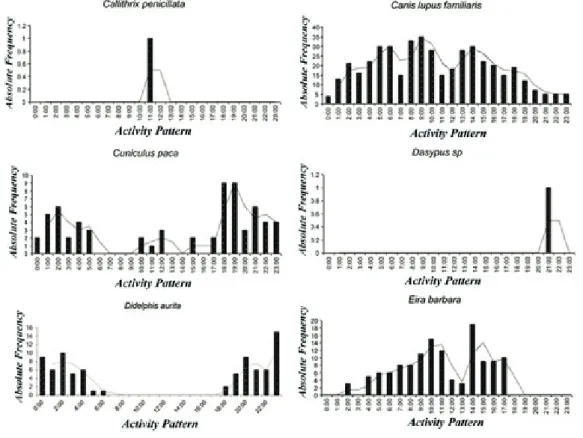
Although this study recorded 13 species (FIGURE 1), it was possible to analyze the activity pattern of only eight species: Canis lupus familiaris Linnaeus, 1758 (448), Cuniculus paca (Linnaeus, 1766) (67), Chrysocyon brachyurus (Illiger, 1815) (13), Didelphis aurita (Wied-Neuwied, 1826) (81), Eira barbara (Linnaeus, 1758) (128), Leopardus pardalis (Linnaeus, 1758) (10), Nasua
nasua (Linnaeus, 1766) (128) and Sylvilagus brasiliensis (Linnaeus, 1758) (24) (FIGURE 2). The
classification of the activity period and uniformity in the distribution of the records (Watson’s test) were performed according to the classification of the phases of the day. Canis lupus familiaris and L.
pardalis are classified as cathemeral species, while C. paca, C. brachyurus, D. aurita and S. brasiliensis
are classified as nocturnal. Only E. barbara and N. nasua are classified as diurnal (TABLE 2).
Figure 1. Activity patterns of six species at Quedas do Rio Bonito Ecological Park, state of Minas Gerais, Brazil.
Source: Elaborated by the authors (2019).
Table 2. Total number of records per species, distribution of records between periods of the day, classification
of activity period and distribution uniformity (Watson’s test) for medium and large mammals at Quedas do Rio Bonito Ecological Park, state of Minas Gerais, Brazil
Taxon Number of Records Total Diurnal
Nocturnal Classification Vector R
p value
(Watson’s test )
Canis lupus familiaris Linnaeus, 1758 448 289 159 Cathemeral 0.248 < 0.005 *
Cuniculus paca (Linnaeus, 1766) 67 10 57 Nocturnal 0.698 < 0.005 *
Chrysocyon brachyurus (Illiger, 1815) 13 3 10 Nocturnal 0.393 > 0.5
Didelphis aurita (Wied-Neuwied,
1826) 81 01 80 Nocturnal 0.726 < 0.005 *
Taxon Number of Records Total Diurnal
Nocturnal Classification Vector R
p value
(Watson’s test )
Leopardus pardalis (Linnaeus, 1758) 10 03 07 Cathemeral 0.109 > 0.5
Nasua nasua (Linnaeus, 1766) 128 121 07 Diurnal 0.633 < 0.005 *
Sylvilagus brasiliensis (Linnaeus,
1758) 24 01 23 Nocturnal 0.637 < 0.005 *
* p values with high statistical significance, indicating a non-uniform distribution in the activity period. Source: Elaborated by the authors (2019).
Figure 2. Activity patterns of seven species at Quedas do Rio Bonito Ecological Park, state of Minas Gerais, Brazil. Figure 2. Activity patterns of seven species at Quedas do Rio Bonito Ecological Park, state of Minas Gerais, Brazil.
The rose diagrams represent the activity period of the species, in which every circular range presents areas proportional to the frequency of records. The arrows indicate the time the species presented greater activity (FIGURES 3; 4).
Figure 3. Rose diagram for the activity period of four species at Quedas do Rio Bonito Ecological Park, state of
Minas Gerais, Brazil.
Figure 4. Rose diagram for the activity period of four species at Quedas do Rio Bonito Ecological Park, state of
Minas Gerais, Brazil. Minas Gerais, Brazil.
Source: Created by the authors (2019).
Discussion
The activity patterns of medium and large mammals of the present work corroborated other studies for N. nasua, E. barbara, C. paca, C. brachyurus and S. brasiliensis (CIOCHETI, 2007; MICHALSKI; NORRIS, 2011; LIRA-TORRES; BRIONES-SALAS, 2012; LUNA, 2014; ROCHA, 2015; PINHEIRO, 2015; SANTIAGO, 2015; PEREIRA et al., 2016; NODARI, 2016). Cuniculus paca was classified as nocturnal, differing from the results observed by Luna (2014). Their predominantly nocturnal behavior (MICHALSKI; NORRIS, 2011; BRAVO; SONTIN, 2012; MORENO; IRINEO, 2013) is associated with behavioral plasticity, since they fit different levels of local impact (MICHALSKI; NORRIS, 2011; LUNA, 2014; BLAKE et al., 2013). L. pardalis, which is classified as cathemeral in the present study, differed from the other studies in which it was classified as nocturnal (MAFFEI et al., 2005; GÓMEZ et al., 2005; DI BITETTI et al., 2006; TOBLER et al., 2009; DI BITETTI et al., 2010; BLAKE et al., 2012; CORTÉS-MARCIAL; BRIONES-SALAS, 2014).
Body size directly influences the pattern of species activity. The smaller mammals tend to be nocturnal, as an antipredatory strategy, whereas the larger mammals tend to be cathemeral since they have greater energetic requirements (SCHAIK; GRIFFITHS, 1996; GOMEZ et al., 2005; OLIVEIRA-SANTOS et al., 2013; NODARI 2016). The results suggest that assertion is true, since cathemeral species were the largest species (L. pardalis and C. familiaris). On the other hand, nocturnal species presented a smaller size (S. brasiliensis, D. aurita and C. paca), with the exception of C. brachyurus, which has a large size, but with nocturnal habits.
Felines are the animals that suffer the most negative effects of human activities (LUNA, 2014).
Leopardus pardalis has its activity pattern altered and confined to some period of the day. Previous
studies have shown similar results (SCOGNAMILLO et al., 2003; DI BITETTI et al., 2010). They use the day because they need a high energy demand, so they present a pattern of cathemeral activity without anthropic disturbances (MAFFEI et al., 2004; GOMEZ et al., 2005; NOSS et al., 2009; HARMSEN et al., 2009, 2011). In anthropic areas, these animals show a change in the activity pattern to avoid periods of greater human activity (DI BITETTI et al., 2008). This shows the study area has aspects of preserved area and the pattern described here is the result of an evolutionary pressure: interspecific competition (GOMEZ et al., 2005; NODARI, 2016).
Other carnivores tend to have a period of activity strongly related to the activity period of their prey (VAUGHAN, 1986). Chrysocyon brachyurus are notorious predators of small mammals (NASCIMENTO et al., 2004) and, because of this fact, they have nocturnal habit. In this study, it was observed the presence of fruits, invertebrates and small vertebrates (NASCIMENTO et al., 2004; PINHEIRO, 2015).
Holistically, predatory and prey animals present temporal segregation. Predators tend to have longer activity periods during the day, while prey are basically nocturnal. However, there is a small overlap in twilight periods, which may favor interspecific interactions such as predation. The condition of the environment favors the occurrence of this heterogeneous community (SANTOS et al., 2016) and agonistic interactions, favoring environmental equilibrium (as predicted by PAINE, 1966, when considering the bottom-up and top-down effects in complex trophic networks).
Conclusion
It is concluded the predominant habit of the species was nocturnal, which is the result of adaptive behaviors due to the pressure of predation and human actions. It is reiterated the high biological importance of the study area and the need to conduct new studies with a focus on the medium and large size mastofauna, aiming to contribute to a more comprehensive knowledge. In addition, a larger sampling effort might facilitate new records, even for species with few or no records.
Períodos de atividades de mamíferos no Parque Ecológico
Quedas do Rio Bonito, Lavras, Minas Gerais, Brasil
Resumo
O período de atividade apresenta uma partição temporal das espécies que coabitam uma mesma área para evitar a competição, além disso, otimiza os esforços de captura e aumenta o conhecimento da história natural das espécies. Os impactos antrópicos comprometem essa atividade, pois alteram seus padrões; mesmo assim, estudos desse tema não estiveram no foco de pesquisas nas últimas décadas. Portanto, este trabalho demonstra e discute o padrão de atividade de mamíferos de médio e grande porte em uma reserva ecológica no sul de Minas Gerais. Por meio de armadilhamento fotográfico, duas espécies foram classificadas como espécies catemerais, quatro como noturnas e outras duas como diurnas. O hábito predominante foi o noturno, que é resultado de comportamentos adaptativos à pressão de predação e ações humanas. Reitera-se que os resultados evidenciam a importância biológica da região e a necessidade de novos estudos sistematizados com foco na mastofauna local de médio e grande porte, objetivando contribuir para um conhecimento mais abrangente da biodiversidade local.
Palavras-chave: Padrão de atividade. Comportamento. Atividade funcional.
Referências
ALFONSO-REYES, A. F. Abundância relativa, padrões de atividade e uso de habitat de onça-pintada
e onça-parda no norte da Amazônia brasileira. 2013. 71 f. Dissertação (Mestrado em Biologia
Animal) - Universidade Federal de Pernambuco, Recife, 2013. Disponível em: https://repositorio. ufpe.br/bitstream/123456789/10488/1/Disserta%c3%a7%c3%a3o%20Andr%c3%a9s%20Reyes. pdf. Acesso em: 16 set. 2015.
ARAÚJO-FILHO. J. C. A. Floresta Estacional Semidecidual. 2009. Disponível em: http:// www.agencia.cnptia.embrapa.br/gestor/territorio_mata_sul_pernambucana/ar vore/ CONT000gt7eon7l02wx7ha087apz2x2zjco4.html. 2009. Acesso em: 16 set. 2015.
BLAKE, J. G.; MOSQUERA, D.; LOISELLE, B. A.; SWING, K.; GUERRA, J.; ROMO, D. Temporal activity patterns of terrestrial mammals in lowland rainforest of eastern, Ecuador. Ecotropica, v. 137, n. 18, p. 137–146, 2012. Disponível em https://www.soctropecol.eu/PDF/Ecotropica_2012/Blake_ et_al_2012_Ecotropica_18_2.pdf. Acesso em: 16 set. 2015.
BLAKE, J. G.; MOSQUERA, D.; SALVADOR, J. Use of mineral licks by mammals and birds in hunted and non-hunted areas of Yasuní National Park, Ecuador. Animal Conservation, v. 16, n. 4, p. 430–437, 2013. Disponível em: https://zslpublications.onlinelibrary.wiley.com/doi/abs/10.1111/ acv.12012. Acesso em: Acesso em: 16 set. 2015.
BRASIL. Lista de espécies ameaçadas de extinção do Brasil. 2014. Disponível em http://www.icmbio. gov.br/portal/images/stories/biodiversidade/faunabrasileira/avaliacao-do-risco/PORTARIA_N%-C2%BA_444_DE_17_DE_DEZEMBRO_DE_2014.pdf. Acesso em: 16 set. 2015.
BRAVO, O. E. R.; SANTIN, L. H. New records of tepezcuincle (Cuniculus paca) in Puebla, Central Mexico. Revista Mexicana de Biodiversidad. v. 83, p. 872-874, 2012. Disponível em: http://www. scielo.org.mx/scielo.php?script=sci_abstract&pid=S1870-34532012000300032&lng=es&nrm=i so. Acesso em: 16 set. 2015.
CIOCHETI, G. Uso de habitat e padrão de atividade de médios e grandes mamíferos e nicho trófico
de Lobo-Guará (Chrysocyon Brachyurus), Onça-parda (Puma concolor) e Jaguatirica (Leopardus
pardalis) numa paisagem agroflorestal, no estado de São Paulo. 2007. 78 f. Dissertação (Mestrado
em Ecologia de Ecossistemas Aquáticos e Terrestres) - Universidade de São Paulo, São Paulo. 2007. Disponível em: http://www.teses.usp.br/teses/disponiveis/41/41134/tde-16062008-135748/pt-br. php. Acesso em: 16 set. 2015.
CONSELHO ESTADUAL DE POLÍTICA AMBIENTAL(COPAM). Deliberação normativa nº 147, de 30
de abril de 2010. Lista de Espécies Ameaçadas de Extinção da Fauna do Estado de Minas Gerais.
2010. Disponível em: http://www.siam.mg.gov.br/sla/download.pdf?idNorma=13192. Acesso em: 16 set. 2015.
CORTÉS-MARCIAL, M.; BRIONES-SALA, M. Diversidad, abundância relativa patrones de actividad de mamíferos medianos y grandes en una selva seca del Istmo de Tehuantepec, Oaxaca, México.
Revista de Biologia Tropical, v. 62, n. 4, p. 1433-1448. Disponível em: https://www.scielo.sa.cr/pdf/
rbt/v62n4/a14v62n4.pdf. Acesso em: 16 set. 2015.
DI BITETTI, M. S.; PAVIOLO, A.; DE ANGELO, C. Density, habitat use and activity patterns of ocelots (Leopardus pardalis) in the Atlantic Forest of Misiones, Argentina. Journal of Zoology, v. 270, n. 1, p. 153–163, 2006. Disponível em: https://zslpublications.onlinelibrary.wiley.com/doi/abs/10.1111/ j.1469-7998.2006.00102.x. Acesso em: 21 ago. 2016.
DI BITETTI, M. S.; PAVIOLO, A.; FERRARI, C. A.; DE ANGELO, C.; DI BLANCO, Y. Differential Responses to Hunting in Two Sympatric Species of Brocket Deer (Mazama americana and M. nana).
Biotropica. v. 40, n. 5, p. 636–645, 2008. Disponível em: https://zslpublications.onlinelibrary.wiley.
com/doi/abs/10.1111/j.1469-7998.2006.00102.x. Acesso em: 21 ago. 2016.
DI BITETTI, M. S.; DE ANGELO, C. D.; DI BLANCO, Y. E.; PAVIOLO, A. Niche partitioning and species coexistence in a Neotropical felid assemblage. Acta Oecologica, v. 36, n. 4, p. 403–412, 2010. Disponível em: https://www.sciencedirect.com/science/article/pii/S1146609X10000548. Acesso em: 21 ago. 2016.
DRUMMOND, G. M. Biodiversidade em Minas Gerais: um atlas para sua conservação. Belo Horizonte: Fundação Biodiversitas, 2005. p. 2-17.
FONSECA, G. A. B.; ROBINSON, J. G. Forest size and structure: competitive and predatory effects on small mammal communities. Biological Conservation, v. 53, p. 265-294, 1990. Disponível em: https:// www.sciencedirect.com/science/article/abs/pii/0006320790900979. Acesso em: 21 ago. 2016.
GENTRY, A.; CLUTTON-BROCK, J.; GROVES, C. P. The naming of wild animal species and their domestic derivatives. Journal of Archaeological Science, v. 31, n. 5, p. 645-651, 2004. Disponível em: https:// www.sciencedirect.com/science/article/pii/S0305440303001638. Acesso em: 21 ago. 2016.
GOMES, L.; LENZA, E.; MARACAHIPES, L.; MARIMON, B. S.; OLIVEIRA, E. A. Comparações florísticas e estruturais entre duas comunidades lenhosas de cerrado típico e cerrado rupestre, Mato Grosso, Brasil. Acta Botanica Brasilica, Nova Xavantina, v. 25, n. 4, p. 865-875, 2011. Disponível em: http://www.scielo.br/scielo.php?pid=S0102-33062011000400013&script=sci_abstract&tlng=pt. Acesso em: 21 ago. 2016.
GOMEZ, H.; WALLACE, B.; AYALA, G.; TEJEDA, R. Dry season activity periods of some Amazonian mammals. Studies on Neotropical Fauna and Environment, v. 40, p. 91-95, 2005. Disponível em: https://www.tandfonline.com/doi/abs/10.1080/01650520500129638. Acesso em: 21 ago. 2016. GRIFFITHS, M. S.; SCHAIK C. P. V. The impact of human traffic on the abundance and activity periods of Sumatran rain forest wildlife. Conservation Biology, v. 7, n. 3, p. 623-626, 1993. Disponível em: https://onlinelibrary.wiley.com/doi/abs/10.1046/j.1523-1739.1993.07030623.x. Acesso em: 23 jun. 2016.
HALLE, S.; STENSETH, N. C. Ecological Studies. In: HALLE, S.; STENSETH, N. C. (Ed.). Activity
Patterns in Small Mammals – an Ecological Approach. Berlin: Springer, 2000. p. 3-17.
HARMSEN, B. J.; FOSTER, R. J.; SILVER, S. C.; OSTRO, L. E. T.; C. P.; DONCASTER. Spatial and temporal interactions of two sympatric cats in a neotropical forest: the jaguar (Panthera onca) and the puma (Puma concolor). Journal of mammalogy, v. 90, n. 3, p. 612-620, 2009. Disponível em: https://academic.oup.com/jmammal/article/90/3/612/874375. Acesso em: 23 jun. 2016.
HARMSEN, B. J.; FOSTER, R. J.; SILVER, S. C.; OSTRO, L. E. T.; DONCASTER, C. P. Jaguar and puma activity patterns in relation to their main prey. Mammalian Biology, v. 76, n. 3, p. 320–324, 2011. Disponível em: https://www.sciencedirect.com/science/article/pii/S1616504710001163. Acesso em: 23 jun. 2016.
INTERNATIONAL UNION FOR CONSERVATION OF NATURE AND NATURAL RESOURCES (IUCN).
Redlist of threatened species. 2015. Disponível em: http://www.iucnredlist.org/. Acesso em: 16
set. 2015.
KOVACH, W. L. Oriana: circular statistics for windows. Pentraeth: Kovach Computing Services, 2011. p. 57-58.
KRONFELD-SCHOR, N.; DAYAN, T. Partitioning of time as an ecological resource. Annual review
of ecology, evolution, and systematics, v. 33, p. 153-181, 2003. Disponível em: https://www.
annualreviews.org/doi/abs/10.1146/annurev.ecolsys.34.011802.132435. Acesso em: 16 set. 2015.
LIMA, J. C. S.; PASCIANI, V. Riqueza de espécies de mamíferos de médio e grande porte na Fundação Jardim Botânico de Poços de Caldas, Minas Gerais, Brasil. Revista Biociências, Taubaté, v. 20, n. 2, p. 62-70, 2014. Disponível em: http://periodicos.unitau.br/ojs/index.php/biociencias/article/ view/1889. Acesso em: 16 set. 2015.
LIRA-TORRES, I.; BRIONES-SALAS, M. Abundancia relativa y patrones de actuvidad de los mamíferos de los chimalpas, Oaxaca, México. Acta Zoológica Mexicana. v. 28, n. 3, p. 566-585, 2012. Disponível
em: http://www.scielo.org.mx/scielo.php?pid=S0065-17372012000300006&script=sci_
arttext&tlng=pt. Acesso em: 16 set. 2015.
LUNA, R. B. Padrão de atividades de duas comunidades de mamíferos no extremo norte da amazônia
brasileira sob diferentes níveis de conservação. 2014. 98 f. Dissertação (Mestrado em Biologia
Animal) – Universidade Federal de Pernambuco, Recife, 2014. Disponível em: https://attena.ufpe.br/ bitstream/123456789/11876/1/DISSERTA%c3%87%c3%83O%20Rodolfo%20Burgos%20de%20 Luna.pdf. Acesso em: 16 set. 2015.
MACHADO, F. S.; ALMEIDA, A. F.; BARROS, D. A.; PEREIRA, J. A. A.; SILVA, R. A.; PEREIRA, A. A. S. Diversity of medium and large-sized mammals at Atlantic Forest remnants in the south of Minas Gerais State, Brazil. Check List, v. 12, p. 1-7, 2016. Disponível em: https://biotaxa.org/cl/article/ view/12.5.1962. Acesso em: 23 jun. 2016.
MACHADO, F. S.; MOURA, A. S.; SANTOS, K. K.; MENDES, P. B.; ABREU, T. C. K.; FONTES, M. A. L. Registros ocasionais de mamíferos de médio e grande porte na microrregião de Lavras e São João del-Rei, Campo das Vertentes, Minas Gerais. Revista Agrogeoambiental, v. 9, n. 1, p. 35-44, 2017. Disponível em: https://200.131.173.22/index.php/Agrogeoambiental/article/view/930. Acesso em: 23 jun. 2016.
MAFFEI, L.; CUELLAR, E.; NOSS, A. One thousand jaguars (Pantheraonca) in Bolivia’s Chaco Camera trapping in the Kaa-Iya National Park. Journal of Zoology, v. 262, n. 3, p. 295–304, 2004. Disponível em: https://www.cambridge.org/core/journals/journal-of-zoology/article/one-thousand-jaguars-panthera-onca-in-bolivias-chaco-camera-trapping-in-the-kaaiya-national-park/0376687953 2F5684924B8F59D4BC53AD. Acesso em: 23 jun. 2016.
MAFFEI, L.; NOSS, A.; CUELLAR, E.; RUMIZ, D. I. Ocelot (Felis pardalis) population densities, activity, and ranging behaviour in the dry forests of eastern Bolivia: data from camera trapping.
Journal of Tropical Ecology, v. 21, n. 3, p. 349–353, 2005. Disponível em: https://www.cambridge.
org/core/journals/journal-of-tropical-ecology/article/ocelot-felis-pardalis-population-densities-activity- and-ranging-behaviour-in-the-dry-forests-of-eastern-bolivia-data-from-camera-trapping/541E4FA-DCBADB9189491F98CB3BCB5FB. Acesso em: 23 jun. 2016.
MICHALSKI, F.; NORRIS, D. Activity pattern of Cuniculus paca (Rodentia: Cuniculidae) in relation to lunar illumination and other abiotic variables in the southern Brazilian Amazon. Zoologia, v. 28, n. 6, p. 701–708, 2011. Disponível em: http://www.scielo.br/scielo.php?script=sci_ arttext&pid=S1984-46702011000600002. Acesso em: 23 jun. 2016.
MORENO, A. S.; IRINEO, G. P. Abundancia de tepezcuintle (Cuniculus paca) y relación de su presencia con la de competidores y depredadores en una selva tropical. Therya, v. 4, n. 1, p. 89-98, 2013. Disponível em:http://www.scielo.org.mx/scielo.php?pid=S2007-33642013000100009&script=sci_ arttext&tlng=en. Acesso em: 23 jun. 2016.
MYERS, N.; MITTERMEIER, A.; MITTERMEIER, C. G.; FONSECA, G. A. B.; KENT, J. Biodiversity hotspots for conservation priorities. Nature, Londres, v. 403, n. 6772, p. 853-858, 2000. Disponível em: https://www.nature.com/articles/35002501. Acesso em: 10 ago. 2016.
NASCIMENTO, V. L.; FERREIRA, J. A.; FREITAS, D. M.; SOUZA, L. L.; BORGES, A. L.; TOMAS, W. M. Período de atividade de alguns vertebrados do Pantanal, estimado por fotografia remota. In: SIMPÓSIO SOBRE RECURSOS NATURAIS E SÓCIO-ECONÔMICOS DO PANTANAL, 4., 2004, Corumbá. Resumos... Corumbá, 2004. Disponível em: http://www.academia.edu/17045752/ Per%C3%ADodo_de_atividade_de_alguns_vertebrados_do_Pantanal_estimado_por_fotografia_ remota. Acesso em: 23 jun. 2016.
NODARI, J. Z. Padrão de atividade e segregação temporal entre mamíferos de médio e grande porte
na Mata Atlântica. 2016. 38 f. Dissertação (Mestrado em Biologia Animal), Universidade Federal do
Espírito Santo, Vitória, ES, 2016. Disponível em: http://repositorio.ufes.br/jspui/bitstream/10/9425/1/ tese_9748_Dissertacao_Final20161227-173552.pdf. Acesso em: 2 dez. 2015.
NOSS, A. J.; KELLY, M. J.; CAMBLOS, H. B.; RUMIZ, D. I. Pumas y Jaguares Simpátricos: Datos de Trampas-Cámara en Bolivia y Belize. Memorias: manejo de fauna silvestre en la Amazonía Y
Latinoamérica. p. 229-237, 2006. Disponível em: http://www.mjkelly.info/Publications/Noss06Cats.
pdf. Acesso em: 2 dez. 2015.
OLIVEIRA-FILHO, A. T.; FLUMINHAN-FILHO, M. Ecologia da vegetação do Parque Florestal Quedas do Rio Bonito. Cerne, v. 5, n. 2, p. 51-64, 1999. Disponível em: http://cerne.ufla.br/site/index.php/ CERNE/article/download/525/452/. Acesso em: 2 dez. 2015.
OLIVEIRA-SANTOS, L. G.; ZUCCO, R. C. A.; AGOSTINELLI, C. Using conditional circular kernel density functions to test hypotheses on animal circadian activity. Animal Behaviour, v. 85, n. 1, p. 269-280. Disponível em: https://facfan.ufms.br/files/2015/09/Using-conditional-circular-kernel-density-functions-to-best-hypotheses-on-animal-circadian-activity.pdf. Acesso em: 2 dez. 2015. PAGLIA, A. P.; FONSECA, G. A.; RYLANDS, A. B.; HERRMANN, G.; AGUIAR, L. M.; CHIARELLO, A. G.; LEITE, Y. L. R.; COSTA, L. P.; SICILIANO, S.; KIERULFF, M. C. M.; MENDES, S. L.; TAVARES, V. C.; MITTERMEIER, R. A.; PATTON, J. L. Lista anotada dos mamíferos do Brasil. 2 ed. Occasional
papers in conservation biology, v. 6, p. 76, 2012. Disponível em: https://web.conservation.org/
global/brasil/publicacoes/Documents/annotated_checklist_of_brazilian_mammals_2nd_edition.pdf. Acesso em: 2 dez. 2015.
PAINE, R. T. Food web complexity of species diversity. American Naturalist, v. 100, p. 65-75. 1966. Disponível em: https://www.journals.uchicago.edu/doi/abs/10.1086/282400. Acesso em: 2 dez. 2015.
PEREIRA, A. D.; BASTIANI, E.; BAZILIO, S. Influência do ciclo lunar no padrão de atividade de
Cuniculus paca (Rodentia: Cuniculidae) em uma floresta de Mata Atlântica no Sul do Brasil. Papéis Avulsos de Zoologia, São Paulo, v. 56, n. 8, p. 97-102, 2016. Disponível em: http://www.scielo.br/
pdf/paz/v56n8/1807-0205-paz-56-08-97.pdf. Acesso em: 2 dez. 2015.
PINHEIRO, J. P. C. Uso e ocupação do hábitat e período diário de atividades de quatis (Nasua nasua) em fragmentos de floresta estacional semidecidual. 2015. 35f. Dissertação (Pós-Graduação
em Biologia Animal) – Universidade Federal de Viçosa, Viçosa, 2015. Disponível em: http://www. locus.ufv.br/bitstream/handle/123456789/7513/texto%20completo.pdf?sequence=1&isAllowed=y. Acesso em: 21 dez. 2016.
ROCHA, D. G. Padrão de atividade e fatores que afetam a amostragem de mamíferos de médio
e grande porte na Amazônia Central. 2015. 83 f. Dissertação (Mestrado em Ecologia) – Instituto
Nacional de Pesquisas da Amazônia, Manaus, Amazonas, 2015. Disponível em: https://bdtd.inpa. gov.br/bitstream/tede/1521/2/Dissertacao_%20Daniel%20Gomes%20Rocha.pdf. Acesso em: 21 dez. 2016.
SANTIAGO, W. T. V. Ecologia de comunidades de mamíferos de médio e grande porte no estado
do Tocantins, Brasil. 2016. 137f. Tese (Doutorado em Biologia e Ecologia das Alterações Globais)
– Universidade de Aveiro, Aveiro, 2016. Disponível em: https://ria.ua.pt/bitstream/10773/22362/1/ TESE_Wagner_Santiago_aprovada_29112016.pdf. Acesso em: 21 dez. 2016.
SANTOS, K. K.; PACHECO, G. S. M.; PASSAMANI, M. Medium-sized and large mammals from Quedas do Rio Bonito Ecological Park, Minas Gerais, Brazil. Check List, Lavras, v. 12, n. 1, p. 1-8, 2016. Disponível em: https://www.biotaxa.org/cl/article/view/12.1.1830. Acesso em: 21 dez. 2016. SCHAIK, C. P.; GRIFFITHS, M. Activity periods of Indonesian rain forest mammals. Biotropica, v. 28, n. 1, p. 105–112, 1996. Disponível em: https://www.jstor.org/stable/2388775. Acesso em: 21 dez. 2016. SCHOENER, T. W. Resource partitioning in ecological communities. Science, v. 185, n. 4.145, p. 27-39, 1974. Disponível em: https://science.sciencemag.org/content/185/4145/27. Acesso em: 21 dez. 2016.
SRBEK-ARAUJO, A. C.; CHIARELLO, A. G. Is camera-trapping an efficient method for surveying mammals in Neotropical forests? A case study in south-eastern Brazil. Journal of Tropical Ecology, v. 21, p. 121-125, 2005. Disponível em: https://www.cambridge.org/core/journals/journal-of-tropical- ecology/article/is-cameratrapping-an-efficient-method-for-surveying-mammals-in-neotropical-forests-a-case-study-in-southeastern-brazil/5BDF54A5F75AAC4B38175CD1BFC8CEA1. Acesso em: 22 dez. 2016.
SCOGNAMILLO, D.; MAXIT, I. E.; SUNQUIST, M.; POLISAR, J. Coexistence of jaguar (Panthera onca) and puma (Puma concolor) in a mosaic landscape in the Venezuelan Ilanos. Journal of Zoology, v. 259, n. 3, p. 269–279, 2003. Disponível em: https://www.cambridge.org/core/journals/journal-of-zoology/
article/coexistence-of-jaguar-panthera-onca-and-puma-puma-concolor-in-a-mosaic-landscape-in-the-SRBEK-ARAUJO, A. C.; CHIARELLO, A. G. Is camera-trapping an efficient method for surveying mammals in Neotropical forests? A case study in south-eastern Brazil. Journal of Tropical Ecology, v. 21, p. 121-125, 2005. Disponível em: https://www.cambridge.org/core/journals/journal-of-tropical- ecology/article/is-cameratrapping-an-efficient-method-for-surveying-mammals-in-neotropical-forests-a-case-study-in-southeastern-brazil/5BDF54A5F75AAC4B38175CD1BFC8CEA1. Acesso em: 24 dez. 2016.
SRBEK-ARAUJO, A. C.; CHIARELLO, A. Influence of camera-trap sampling design on mammal species capture rates and community structures in southeastern Brazil. Biota
Neotropica, v. 13, p. 51-62, 2013. Disponível em: http://www.scielo.br/scielo.php?script=sci_
arttext&pid=S1676-06032013000200051. Acesso em: 25 dez. 2016.
TOBLER, M. W.; CARRILO-PERCASTEGUI, S. E.; POWELL, G. Habitat use, activity patterns and use of mineral licks by five species of ungulate in south-eastern Peru. Journal Tropical Ecology, v. 25, n. 3, p. 261–270, 2009. Disponível em: https://www.cambridge.org/core/journals/journal-of-tropical- ecology/article/habitat-use-activity-patterns-and-use-of-mineral-licks-by-five-species-of-ungulate-in-southeastern-peru/93B7B67FA185E123F4057E48D778FBE1. Acesso em: 26 dez. 2016.
VAUGHAN, T. A. Mammalogy. 3. ed. Saunders College Publishing, Fort Worth. 1986. P 343-346.
Received: November 22, 2017 Accepted: March 28, 2018