A STUDY OF DYNAMIC CAPABILITY
IN CHINESE ONLINE PHARMACY INDUSTRY
Baoxian Feng
Dissertation submitted as partial requirement for the conferral of Master in Business Administration
Supervisor:
Prof. Nelson António, ISCTE Business School
Le
ar
n
fro
m
U
be
r:
a
stu
dy
of
D
yn
am
ic
Ca
pa
bi
lit
y
in
Ch
in
es
e
O
nl
in
e
Ph
ar
m
ac
y
In
du
str
Ba
ox
ia
n
Fe
ng
ABSTRACT
The rapid development of e-commerce in China has resulted in strong competition in medical e-commerce industry, which has made online pharmacies struggling to maintain their competitive advantage. Dynamic capability is the change-oriented capability that can help online pharmacies keep pace with market development, technology development, and consumer demand changes to obtain sustainable competitive advantages thus to survive in the dynamic environment and access to market share.
This dissertation focused on the dynamic capability of Chinese online pharmacy industry. Firstly, we did the literature review of strategy schools and dynamic capability theory, analyzed and summarized the measurements of dynamic capability; secondly, we studied about Uber’s dynamic capabilities; then, as for the field study, we adopted the quantitative method: we distributed questionnaires to investigate the dynamic capability application and importance in Chinese online pharmacy industry; finally, this dissertation drew the conclusion through comparison.
From the study we concluded that: dynamic capability is composed by adaptive capability, absorptive capability, and innovative capability; through data analysis we found that there were distance between current application and corresponding importance of dynamic capabilities in Chinese online pharmacies especially in sensitive observing the environment, accessible knowledge management database and knowledge sharing system, and applying new knowledge into innovation.
Keywords:
Dynamic capability, Absorptive Capability, Innovative Capability, Online Pharmacies.
JEL Classification:
RESUMO
O rápido desenvolvimento do comércio eletrónico na China provocou uma forte concorrência no comércio eletrónico da indústria médica, o que fez com que as farmácias on line tivessem dificuldade em manter as suas vantagens competitivas. A construção de capacidades dinâmicas, as capacidades que permitem reorganizar os recursos para fazer face às mudanças da envolvente, pode ajudar as farmácias a acompanhar as mudanças do mercado e da tecnologia.
Esta dissertação analisou as capacidades dinâmicas da indústria farmacêutica on-line Chinesa. Primeiramente, fizemos a revisão de literatura das escolas de pensamento estratégico e das capacidades dinâmicas; depois estudamos as capacidades dinâmicas da empresa Uber e finalmente realizamos um estudo empírico. No estudo empírico adotamos o método quantitativo. Com base na revisão de literatura referente às capacidades dinâmicas, construímos um questionário que foi enviado a pessoas que trabalham nas farmácias.
Do estudo concluímos que as farmácias on line necessitam de melhorar asa suas capacidades dinâmicas especialmente na observação da envolvente.
Palavras-Chave:
Capacidades Dinâmicas; Capacidade de Absorção, Capacidade de Inovação; Farmácias on line.
Classifação JEL:
Acknowledgments
I take this opportunity to express my appreciation to my supervisor Prof. Nelson António, for helping me, an original pharmaceutical student, to be able to complete the dissertation. He is always patient and generous to provide the guidance of my study.
I gratefully thank my parents, Weiye Feng and Guofang Pang who have provided me with financial and emotional support.
I want to express my sincere thanks to all friends who have directly or indirectly helped me during the preparation and writing of this dissertation.
Index
1. Introduction... 1
2. Literature Review...3
2.1. Ten schools of strategy...3
2.2 Resource-Based View and VRIO...8
2.3 Dynamic Capability...11
2.3.1 Definition...11
2.3.2 Key Components of Dynamic Capability... 12
2.3.3 Dynamic Capability and Competitive Advantages... 18
2.3.4 Application of Dynamic Capability... 18
2.4 Sharing economy...19
3. Methodology... 20
4. Field Study... 22
4.1 Uber’s case... 22
4.2 Macro Environment Analysis...25
4.3 Data Analysis... 28
4.3.1 Questionnaire A for employees in online pharmacies in China...28
4.3.2 Questionnaire B for ordinary people...31
4.3.3 Data Analysis... 34
5. Discussion and Conclusion... 46
5.1 Conclusion...46
5.2 Strategic Suggestions for online pharmacies in China...47
5.3 Limitation of study... 48
5.4 Suggestions for future study...49
Bibliography...50
Appendices... 55
Appendix I: Questionnaire A... 55
Appendix II: Questionnaire B... 59
Appendix III: Validity test of Questionnaire B...63
Index of Tables
Table 1 Source of Adaptive Capability Measurements...14
Table 2 Source of Absorptive Capability Measurements...16
Table 3 Source of Innovative Capability Measurements... 17
Table 4 Dynamic capability of Uber... 23
Table 5 Position in the company... 28
Table 6 Nature of the work in the company...29
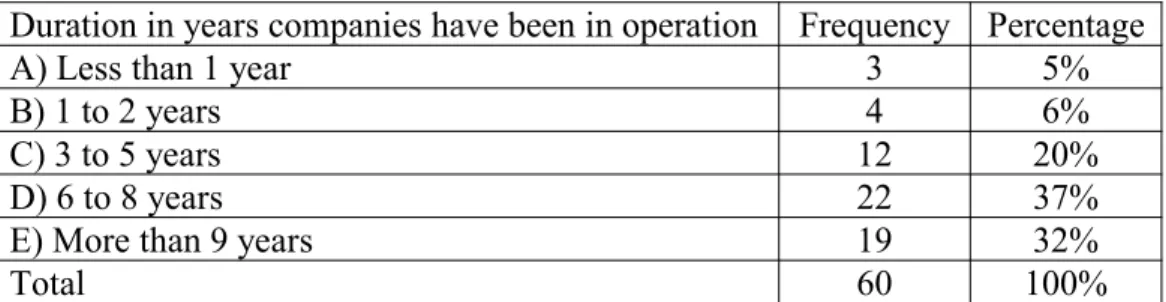
Table 7 Duration in years companies have been in operation...30
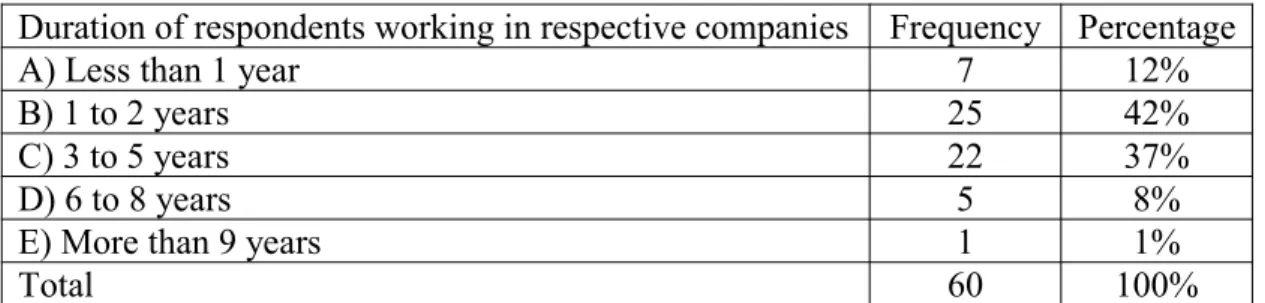
Table 8 Duration of respondents working in respective companies... 31
Table 9 Demographic factors of the respondents...32
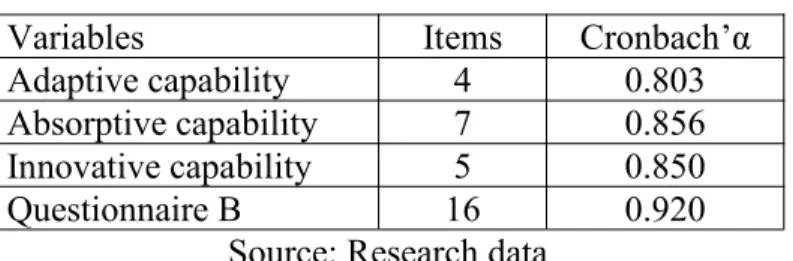
Table 10 Reliability Results... 33
Table 11 KMO and Bartlett's Test...33
Table 12 Validity Results...34
Table 13 Sensitive observation of the environment... 35
Table 14 Identification of consumer demand changes...37
Table 15 Arithmetic Means of Adaptive Capabilities factors...38
Table 16 Knowledge management database for access... 39
Table 17 Arithmetic Means of Absorptive Capabilities factors...41
Table 18 Organization change and improve services based on new knowledge... 42
Table 19 Organization often develop new products or services that are easily accepted by the market...44
Table 20 Arithmetic Means of Innovative Capabilities factors... 45
Index of Graphs Graph 1 GDP growth rate...26
Graph 2 Per capita expenditure on health care for urban households in China... 26
Graph 3 Population structure...27
Graph 4 Population age structure of 2015...27
Graph 5 Position in the company... 29
Graph 6 Nature of the work in the company...29
Graph 7 Duration in years companies have been in operation...30
Graph 8 Duration of respondents working in respective companies...31
List of Abbreviations
B2B Business to Business
B2C Business to Consumer
BCG Boston Consulting Group
CBD Central Business District
CFDA China Food and Drug Administration
DTP Direct-to patient
E-commerce Electronic Commerce
GDP Gross Domestic Product
O2O Online to Offline
1. Introduction
This study mainly researched about the dynamic capabilities in Chinese online pharmacy companies and how online pharmacies should cope with market changes on the perspective of dynamic capabilities.
With 710 million active Internet users, China’s online shopping sales reached ¥5.16 trillion (equal to €688 billion) in 2016, accounting for 15.5% of total Chinese retail sales in the same period (Source: 中国互联网络信息中心, 2016; 网易财经, 2017; National Bureau of Statistics of China, 2016). Reflected on GDP (Gross Domestic Product), the economy in China shows a continuous rising trend and citizens’ expenditure on health care also increased in the past 15 years, shows that people are increasingly concerned about their health. At the same time, with increasing number of chronic diseases patients and aging population, the problem of upgrading medical service is in urgent demand. With online business booming to bring changes in people’s consumption concept, as well as policies encouragement to build the macro background, the medical e-commerce (Electronic Commerce) is now ina developing phase. (Source:National Bureau of Statistics of China, 2016)
Medical e-commerce is for providing comprehensive medicine information, medicine utilized instructions, disease inquiries, and trading service to users base on logistics, including wholesale B2B (Business to Business), platform B2C (Business to Consumer), self-operated B2C, and the newest one O2O (Online to Offline).
Red ocean is known as “ (market) space gets increasingly crowded, profit and growth prospects shrink, products become commoditized (Kim and Mauborgne, 2004)”. The rapid development of China’s e-commerce also drives the growth of Chinese medical e-commerce industry, with the Ministry of Commerce reported the total sales of medical e-commerce has exceeded ¥47.6 billion (equals €6.35 billion) in 2015 and expected the number would reach ¥40 trillion (equals €5.33 trillion) in 2020. (Source: ChinaByte, 2017) The drawbacks of rapid development are more and more market participants entering the online pharmacy industry, and turning the industry into “red ocean”, with immature market and brutal price war, which is not healthy for the industry and even fatal for some pharmacy companies without unique competencies. Until January 2017, 598 enterprises have got the certification to establish online pharmacies, which revealed how highly competitive the industry is. (Source: 托比网, 2017)
Dynamic capabilities are “the abilities to integrate, build, and reconfigure internal and external competences to address rapidly changing environments (Teece and Pisano, 1994)”. In this dissertation, started from Uber’s dynamic capabilities, we will try to figure out the current application and corresponding importance of dynamic capability approaches in online pharmacies in China, specifically to find out the distance in dynamic capability application in online pharmacies, so that to figure out the way to improve dynamic capability and establish competitive advantages.
There are four parts in this dissertation: the first part is a brief literature review about ten schools of strategy theory and dynamic capability theory; the second part is the illustration of methodology we used in this dissertation; the third part is the field analysis, consisted of Uber’s dynamic capability, macro environment analysis, and data analysis; the last part is about conclusion, strategic suggestions, limitations and further development.
With the critical analysis of online pharmacies from the perspective of dynamic capabilities, this research is based on professional business theory and literature review, and hope to achieve deeper understanding and some new insights on business strategy in Chinese online pharmacy industry.
2. Literature Review 2.1. Ten schools of strategy
Strategy is originated from military but widely used in business. As one of the most essential concepts in business field nowadays, the word “strategy” was defined by several scholars in different ways.
Peter Wright (1992) defined strategy as the “top management’s plans to attain outcomes consistent with the organization’s missions and goals”, which emphasized that strategy formulation is among the top managers. According to Andrews (1997), strategy is “the pattern of decisions in a company that determines and reveals its objectives, purposes, or goals...” Strategy is a decision-making process that towards the organizational goal. Porter (1996) argued that strategy is to be different, defined it as “the creation of a unique and valuable position”. Different from the previous definition which focuses on the decision or plan so that to achieve goals, Porter (1996)’s illustration was all about to be unique and to create differentiation, in another word, the competitive advantages.
For better illustration about the strategy formulation, Mintzberg (2005) categorized ten schools of strategy and put them into three different groups:
a) Prescriptive schools: Design school, Planning school, Positioning school.
b) Schools that consider specific aspects of strategy formulation process: Entrepreneurial school, Cognitive school, Learning school, Power school, Cultural school, Environmental school.
c) School that integrates the other schools: Configuration school.
2.1.1 The design school started at 1950s, while the influential representatives were
Selznick (1957) and Chandler (1962). But after a period of twists and turns, by the 1980s, the Harvard’s textbook (1969) with the unique “Harvard strategic thinking” was one of the few left that represented this school. Based on SWOT analysis and the motto of “Establish fit”, this school advocated fitting both internal and external environment. The Harvard’s Business Policy (1969) divided strategy into two parts, formulation and implementation respectively, and indicated that strategy formulation is developing core competency to balance and match external with internal situation. The SWOT analysis model considered the threats and opportunities (external elements) as well as the strengths and weaknesses (internal elements). The design school did a great development of strategy management, especially the SWOT
showed the importance of internal and external relationship in strategy making. But the limitation is that, the thought is separate from the action in this school, which means separation of formulation from implementation. Because this school only focuses on the strategy formulation process and lack of later learning and emergent strategies, thus it would ignore the strategic implementation and control. Furthermore, in different environment, different moments, or even different organizations, competitiveness is not always easy to define, so more practice about observation and improving is in need. The design school can be applied in the transformation period of an organization to achieve operating stability.
2.1.2 The planning school was developed from the middle of 1960s, represented by
Ansoff (1965) who proposed that strategy should consist four elements: Product-market scope, Growth vector, Synergistic effect, and Competitive advantage. Based on the design school, the planning school is equipped with more mathematical and scientific methods, and brought up strategy planning model that are more complex. Different from the design school, this school is a more controlled, conscious and formal strategic formulation process, with well-designed steps. Similar to the design school, this school also separated formulation from implementation. The strategy implementation is too formalized, thus lack of randomness, dynamism, and flexibility. And the prediction mechanism is hard to be perfect all the time, while it relies too much on information collection, thus this school is somehow costly but gain little. The planning school can only be applied in stable, or at least predictable environment.
2.1.3 The positioning school development went through three different phases:
military writings since 400 BC, consulting activities in 1960s, and empirical proposition after late 1970s. Since 1980s, the positioning school, represented by Porter (1980), made strategic analysis a simpler and more standardized process by creating analytical tools like Five forces of Porter. Porter (1980) indicated that, the core of corporate strategy is gaining advantages, which depends on two factors, industry attraction and the competitive position in the industry. Therefore, companies to obtain competitive advantages must select the attractive industry, which becomes the primary task of strategic management. Porter’s five-force analysis is used for analyzing the situation of the industry. This school meets with the economy theory but ignores sociology and politics factors. It too much emphasizes on external environment analysis and research about mature industry, but sometimes ignores the
internal environment and the situation of immature industry, unstable industry, or relatively monopolistic industry. In another word, it tends to take conservative rather than action. The positioning school should be applied in sufficiently established and stable condition with enough information supported.
2.1.4 The entrepreneurial school grew out of economics since 1950s, where the
entrepreneurs enjoy a prominent position. Joseph Schumpeter (1942), who praised the importance of entrepreneurs, fully developed the entrepreneurial school. Schumpeter (1947) indicated that the process of entrepreneurs creating capital is also the process of creative destruction, which refers to entrepreneurs doing new things or doing things in a new way. For him, the entrepreneurs should continuously provide business ideas, create new product portfolios and take the risk. From the perspective of this school, strategy is a concept about perception and direction, that leaders create vision as the future strategy of company. The advantage of this school is that it puts the entrepreneurs in the central of strategy making, which makes the company more flexible and adaptable. However, too much relying on individual leader may lead to potential risks, for example once the entrepreneur suffer from serious illness can set the company in trouble. While the rest are enthusiastically following and being subordinated to what the individual leader planned, this school would hinder the learning and innovation process. This school fits the start-up companies, small ongoing organizations, or organizations in trouble.
2.1.5 The cognitive school founded in the late 1940s from Herbert Simon (1947)’s
research. This school contains two branches. One is positivism, sees the knowledge processing and structuring as the result of producing objective thinking of the world, which can be seen as recreation. The other is more subjective: strategy is the interpretation of the world, which is creation, the cognition creates the world. According to this school, strategy formulation is basically the strategist’s cognitive process. But when the environment is complex, it might limit the strategist’s cognitive ability. Not to mention the huge amount of information and limited time, the strategy process can be distorted. In addition, strategy formulation relies heavily on individual knowledge, but there are significant differences in strategic style among different strategists which may influence the strategy formulation. This school is a pretty good reference when researching psychology, but has limited contribution to strategic management. The cognitive school can only be applied in the initial stage, the strategic re-conception stage, or strategic stage when cognitive fixations happened.
2.1.6 The learning school’s founder was Charles Lindblom (1959). Due to the
limitation of the planning school, many scholars had doubt about the feasibility of planning and turned to find out a school that would pay attention to the unpredictable environment. So it was James Brian Quinn(1980)’s book that signaled the milestone of the learning school, and further promote the development of the theory. Logical incrementalism is that top management team first settle the future develop direction, then constantly adjust their core business, to achieve the aim by controlling the growth of new business. Dynamic capability is one of the new directions of the learning school. The dynamic capabilities approaches of Prahalad and Hamel (1990) emphasized their development essentially through a process of strategic learning. However, the strategy of learning school is like non-strategy, that decentralized learning may lose viable strategy at the end. There might be some wrong strategies, and the step-by-step thinking pattern may lead the organization into out-of-control. The learning process is so complex that the cost can be expensive. Professional-type organizations, organization that faces a truly novel situation, as well as organizations in dynamic and unpredictable environment are suitable for using this learning school.
2.1.7 This power school is about power and policy, which regards strategy
formulation as a negotiation process that influenced by the power. This school was established in early 1970s, emphasized negotiation through power and political method to gain profits. This school includes two branches, micro power and macro power respectively. Represented by Graham Allison (1971), micro power is about the interrelationships of individuals and groups within the organization, as it is used to deal with internal political issues. Macro power, represented by Pfeffer and Salancik (1978), on the contrary, reflects the codependency between organization and its environment, and concerns about the organization’s application of power. As the power school focuses on power, it may ignore the influence of leaders, culture, or strategy concept. As the power school provides emergent strategy instead of deliberate strategy, this school can cause a great deal of wastage and distortion of energy and assets because it does not have a clear direction. This school can be applied in large and mature organizations or organizations in transformation stage.
2.1.8 The cultural school was developed by American scholars from the perspective
of anthropology, because the Japanese concept “culture” appeared in management in the 1980s and attracted their attention. Actually, the development of the cultural school started in Sweden in late 1960s, represented by Eric Rhenman (1973) and
Richard Normann (1977). After 1990s, the resource-based theory (Barney, 1991, 1995) further enriched and developed the cultural school. Concerned with enterprise core values, national image, and social culture, the cultural school takes strategy formulation as a process that can be influenced by culture, based on the common beliefs and confidence from organization members. Strategy takes the form of concepts rather than positions, while concepts are rooted in the collective intentions and reflected in the organization with resources and potentials, to establish the competitive advantages. But the problems of this school are, the ambiguity of concept thus it discourages necessary changes, which may happen that stagnant strategic thoughts hinder the necessary strategic changing. This school can be used in large established organizations or missionary organizations.
2.1.9 The environmental school was established in late 1970s, and the
representatives were Hannan and Freeman (1977). To a great extent, in this school the strategy formulation is influenced by external environment like markets or policies. For this school, enterprise would observe and try to understand the environment, and fully adapt to the environment. Compared with the other schools, this school focuses on the external environment of the organization to influence the strategy formulation process. During adapting to the environment, organizations can find the the exact way for survival and development. In the environmental school, the environment and leadership as well as organization become the three central forces in strategy formulating, and leadership as well as organization are subordinated to the external environment, thus the environment is in a dominant position. But the problem is, this school overstates the external environment. As the environment is so complex and unpredictable, that this school cannot always be easy in evaluating the external environment to make the right strategy decision. The environmental school can be applied in the mature stage of an organization.
2.1.10 The configuration school’s origin can be traced back to Chandler’s article
(1962), then later Mintzberg and Miller (1983) engaged in this research field. The configuration school contains all the elements of the other schools, but with its own unique perspectives. This school, on the one hand, describes the organization and it is surrounding as configuration; and on the other hand, describes the process of strategy making as transformation. That reflects two aspects of all existing things: configuration and transformation. Organization can be described as some stable configuration, and this configuration can occasionally leap to another configuration,
which is called transformation process. The configuration school provides a method that integrates different schools, pulls together all of the schools and provides ways to see the best in each schools. “Selecting the right degree of configuration is a complex balancing act. Managers must avoid the blandness or chaos of too little configuration while skirting the obsessionality of too much (Miller, 1996a).” The configuration school brings order to the chaotic field of strategic formulation, but the organization may suffer from that, because it may lead to ignorance of small difference in the chaotic world and disability of uncovering the complex relationship between things. To sum up, this school provides a new insight of structuring strategy in harmonious balance and it fits for any environments.
All these ten schools are not just ten different strategy formulation process. Instead, they are ten different aspects of one process. They reveal some essential questions that need to be considered while making strategies, just like providing a checklist for strategist to double check any missing in the whole process of strategy formulation. With all these ten schools considered, the strategy formulation process will be more comprehensive.
2.2 Resource-Based View and VRIO
Since Andrews (1971) built up the SWOT analysis framework, external analysis (opportunities and threats) represented by Porter’s (1980, 1985) industry analysis gained improvement dramatically, which believed that industrial structure is the main determinant of corporate profitability. The resource-based view, on the contrary, pays more attention to internal resources and indicates that internal resource is the major factor that leads to core competency. The origin of the resource-based theory can be found in Penrose (1959)’s article, which emphasized the importance of corporate resources and consisted that resources were the main driving force of enterprise profitability and strategic formulation ability.
Barney (1991) was the first one who introduced the concept of resource-based view and indicated the link between the internal characteristics of a firm and its corporate performance. According to Barney’s (1991) theory, an organization can be regarded as “a bundle of resources” that are simultaneously Valuable, Rare, Imperfectly Imitable and Non-substitutable, which add up to be the VRIN conditions. Later Barney (1995) did adjustment to his theory and introduced the VRIO analysis
framework, which is Value, Rareness, Inimitability, and Organization. The core idea of this framework is that sustainable competitive advantages cannot be achieved by simply assessing environmental opportunities and threats and then to make strategy choice only based on good opportunities and low threats. Sustainable competitive advantages also depend on unique resources that companies can apply to the environmental competition. To discover these resources, managers must seek for valuable, rare, inimitable resources within the organization and then exploit these resources through their organization.
Fleisher and Bensoussan (2002) believed that, a few resources could pass the VRIO test, and only those passed each test can be considered as the competitive and valuable resources so that can help the organization gaining advantages. The VRIO analysis was developed by Barney (1995) as a way of accessing organizational resources from the micro aspect, including financial resources, human resources, material resources, and non-material resources (such as information and knowledge). VRIO is a tool for analyzing the competitive advantages and disadvantages of an organization in terms of internal resources and capabilities:
Valuable:
Defined by Barney (1991), valuable resource is those “enable a firm to conceive of or implement strategies that improve its efficiency and effectiveness”. Miller and Shamsie (1996b) indicated that valuable resources could generate profits and prevent losses. Valuable resources and capabilities can provide important competitive advantages in subsequent market competition (Barney and Zajac, 1994). Valuable resources are the fundamental of organization formulating and implementing strategies to improve efficiency and performance, and will finally turn into profits for the organization. The “value” here is not only the cost but also the potential competitive advantages and profits that managers should consider.
Rare:
“A firm enjoys a competitive advantage when it is implementing a value-creating strategy not simultaneously implemented by large numbers of other firms (Barney, 1991).” “If all other firms have similar resources, resources will be unable to contribute to superior returns because their general availability will neutralize any special advantage. And for the same reason, readily available resources are also valueless (Miller and Shamsie, 1996b).” Thus rare resources are valuable and contribute to the competitive advantages. Rare resources are the unique capabilities
and limited resources that only owned by a few companies. Once the resources become general they lose the rarity so they cannot lead to unique competitive advantages. Rare resources have to meet with consumer needs so that to be valuable, because there are rare resources in the world but only those meet with consumer needs can win the market.
Inimitable:
Imitation would happen in two ways: by directly imitating, such as duplicating, or by offering the similar products/services to substitute. Inimitability, which is difficult for competitors to duplicate or obtain, is the protection of rare resources and the way of maintaining the sustainable competitive advantages. The inimitable resources need to be hard to imitate, and there will be huge cost if a firm was trying to duplicate or obtain. When competitors can copy each other, the competitive advantages will not exist so that companies cannot obtain unusual returns (Miller and Shamsie, 1996b). The inimitable resources can be complicated enough, or hard to be duplicated due to some historic reasons, or due to causal ambiguity or social complexity (Barney, 1995).
Organization:
An organization enjoys the potential of obtaining competitive advantages if it has value, rare and inimitable resources and capabilities. But to fully realize this potential, the organization should organize to exploit the resources/capabilities and to capture value. The organization is a management framework that to create competitive advantages with resources and capabilities. A firm must organize its management systems, processes, policies, organizational structure and culture to be able to fully realize the potential of its valuable, rare and costly to imitate resources and capabilities (Source:Strategic Management Insight, 2013).
Through the analysis of the above VRIO framework we can find that, only the resources meet the valuable, rare, inimitable and fully exploited by the organization can be regarded as the core competencies, and only the core competencies can help enterprises to obtain sustainable competitive advantages. However, the shortcomings of the resource-based theory are:
First of all, it overstates the internal aspect but pays less attention to the external environment, which might happen that the corporate strategy cannot adapt to changes in the market environment. Secondly, the definition of each concept is relatively
vague and abstract, that may cause difficulty in testing VRIO resources. Moreover, the resource-based view is based on a static situation that it cannot fully explain the dynamic environment. And the resource-based view does not adequately illustrate how resources are transformed into competitive advantages. To solve the problem of resource-based view in a dynamic environment, the following comes the dynamic capabilities.
2.3 Dynamic Capability 2.3.1 Definition
Dynamic environment refers to the fast changing in the macroeconomic environment, industrial environment, social environment. Under the dynamic environment, enterprise’s pattern of obtaining sustainable competitive advantages has been transformed from the continuous competitive advantages to continually obtaining a series of temporary competitive advantages. Within the market environment of hypercompetition, the competitive advantages that industry leaders accumulated through resource strength will be exceeded and eroded by the rapid technological innovation. Therefore the enterprise must quickly respond to the external demand and adjust the internal resource allocation in time to catch temporary competitive advantages(D'aveni, 2010).
Scholars like Teece (1997) extended resource-based view to dynamic markets because the resource-based view cannot adequately explain the situation of rapid and unpredictable change. Dynamic capability is a new strategic management theory established on the foundation of the core competencies theory since 1990s, and is still in constant development. It is linked with resource-based view, and all the study about this new theory are mostly within the framework of the resource-based view.
Since Teece and Pisano (1994) proposed the concept of dynamic capability, this theory got further development. They indicated that dynamic capabilities are the “abilities to integrate, build, and reconfigure internal and external competences to address rapidly changing environments (Teece and Pisano, 1997)”. Eisenhardt and Martin (2000) argued that they are “a set of specific and identifiable processes such as product development, strategic decision making, and strategic alliance, neither vague nor tautological”. Teece and Pisano (1997) more focused on the “processes-positions-paths” model, believed that external environment changes rapidly, and enterprises adapt to the external environment through continuously
dynamic adjustment. Eisenhardt and Martin (2000)’s interpretation of dynamic capability is more focus on the specific implementation process.
Defined by many scholars, the concept of dynamic capability has been interpreted in many different ways:
Winter (2003) stated that dynamic capabilities are “those that operate to extend, modify or create ordinary (substantive) capabilities”.
Dynamic capabilities enable firms to “create new products and processes and respond to changing market conditions (Helfat, 1997).”
Dynamic capabilities are “essentially change-oriented capabilities that help firms redeploy and reconfigure their resource base to meet evolving customer demands and competitor strategies (Zahra and George, 2002).”
In summary, dynamic capability is the change-oriented capability that organizations create new products/processes through resources reconfiguration and respond to changing market conditions.
Lee (2002) explained that dynamic capability is “a newer source of competitive advantage in conceptualizing how firms are able to cope with environmental changes”. In this way, organizations can cope with environmental changes with dynamic capabilities, which is a “learned and stable pattern of collective activity”, to achieve more effective operating routines as well as obtain continually temporary competitive advantages (Zollo and Winter, 2002).
Regrettably, literature about dynamic capability is mostly about abstract concepts or discussion of the framework, but lack of systematic and deeper empirical research, which means it is only theoretic research that cannot guide enterprises implementation and may limit further development of dynamic capability.
2.3.2 Key Components of Dynamic Capability
Until today, the theory of dynamic capability is concerned by many scholars, and the viewpoints of dynamic capability components are becoming diversified.
Regarding the dimensions of dynamic capability, Teece (1997) divided the dynamic capability definition into integrating, building, and reconfiguration, which scholars have been followed for several decades. But there are significant differences in specific dimension division. Eisenhardt and Martin (2000) decomposed dynamic capability into four aspects of integrating, reconfiguration, gaining, and releasing resources respectively. Teece (2007) further indicated that dynamic capability could
be divided into “the ability of sensing (and shaping) opportunities and threats”, “the ability of seizing opportunity”, and “the ability of managing threats and reconfiguration” respectively. Wu (2007) indicated that dynamic capability could be further divided into perspectives of resource integration capability, resource reconfiguration capability, learning capability.
Based on the above points of view, we can sum up the consensus on the dimensions of dynamic capacity: The ultimate goal of dynamic capability is to enable enterprises to adapt to dynamic environment. Dynamic capability begins with changes in the external environment, while organization sense and access to opportunities, eventually seize opportunities (reconfiguring resources) through learning new knowledge. The output of dynamic capability is resources reconfiguration, and improving performance in short-term and sustainable competitive advantages in long-term. In summary, we can see that the dynamic capability dimensions include the sensation of the environment, learning and seizing the opportunity, as well as the finally resource reconfiguration and competitive advantages as output.
Wang and Ahmed (2007) identified three main component factors of dynamic capability, namely adaptive capability, absorptive capability and innovative capability. Here we take these three factors to be the measurements of dynamic capabilities in this research:
a)Adaptive Capability:
Adaptive capability is defined as a firm’s ability to identify and capitalize on emerging market opportunities (Miles and Snow, 1978; Chakravarthy, 1982). Market-oriented is an essential step for promoting the resource reconfiguration, through confirming and delivering market information and related knowledge. So that organizations can rapidly respond to market and demand changes, as they fully understand the needs of customers and market changes. The adaptive capability lies in quickly changing environment, to determine the direction and objectives of transformation. During the implementation process of strategic transformation, the organization needs to respond to challenges, seize the opportunities, integrate resources effectively so that the transformation can be completed in a trend consistent with the environmental development. Regarding the rapid developing online pharmacy industry, megatrends like aging population, chronic disease management and new IT technologies will provide new challenges for the market, which are the opportunities for managers to pay close attention.
In the existing literature, measures for adaptive capability are multi-dimensional, including the ability to respond quickly to external opportunities; to scan the market, investigate customers and monitor competitors and allocate resources to marketing activities; and to respond to changing market conditions in a speedy manner (Wang and Ahmed,2007; Oktemgil andGreenley,1997; Gibson and Birkinshaw, 2004). The adaptive capability is the main component of dynamic capabilities, as it mainly refers to the market-oriented adaptive capability. Measurements of adaptive capability are all about the organization’ perception and analysis of the environment. Market-oriented adaptive capability is the capability that organization responding to environment and consumer demand changes. This capability can help to discover and identify opportunities and threats through observing and scanning the environment. In particular, the adaptive capability can be summarized as the sensitive observation of the environment, the discovery of market opportunities, the identification of changes in consumer demand, furthermore, the prediction of industry trends. Through adaptive capability, companies can recognize their shortcoming and take measures to avoid falling behind other competitors in the dynamic environment and avoid products/services being sifted out.
Table 1 Source of Adaptive Capability Measurements
Adaptive Capabilities Source
1. Sensitive observation of the environment Li and Liu, 2014; Wang and Li, 2013; 史蕾蕾, 2012
2. Identification of consumer demand changes Chang and Kuo, 2013; Janssenet al, 2012; Li and Liu, 2014; Menguc and Auh, 2006; Osisiomaet al, 2016; 史蕾蕾, 2012
3. Discovery of new opportunities for the market Chang and Kuo, 2013; Li and Liu, 2014; Osisiomaet al, 2016; 史蕾蕾, 2012
4. Accurate prediction of industry trends 史蕾蕾, 2012
b)Absorptive Capability:
Cohen and Levinthal (1990) define absorptive capability as “the ability of a firm to recognize the value of new, external information, assimilate it, and apply it to commercial ends”. Organizational learning can continuously generate economic value
through developing new ideas and renewing existing capabilities (Kogut and Zander, 1992). Similar to the learning school, the absorptive capability needs the organization to keep continuous learning within the complex and unpredictable environment. The dynamic capability approaches of Prahalad and Hamel (1990) emphasized development essentially comes from “collective learning”. With knowledge absorptive capability, the enterprise can complete the preparation of strategic transformation in cognitive perspective.
The prerequisite for absorptive capability is that enterprise acquires knowledge in advance so that to absorb and utilize. Absorptive capability, also known as learning capability, refers to the capability that learning from the useful technology then transforming it into internal resources. With rapid development of science and technology, organization that hopes to maintain competitive advantages needs to continue to absorb the new and unique knowledge and skills. Through understanding, digestion, learning, transformation and utilization, the knowledge acquisition process can help enterprises to absorb and transform external resources into internal resources, to strengthen the existing resources of organizations and establish competitive advantages. In the mean time, organizations can also absorb knowledge from different fields, integrate and reorganize for the specific needs. This absorptive capability shows that the organization is able to use external knowledge as the useful resource and effectively apply them in new products/services and new process development. Absorptive capability is the ability that continuously transforms external knowledge and information into real organizational capabilities. Zahra and George (2002) divided the absorptive capability into two categories, one is the potential absorptive capacity (PACAP), which includes acquiring and assimilating external knowledge; the another one is realized absorptive capacity (RACAP), which reflects the firm’s capability to leverage the knowledge that has been absorbed.
In addition, Zahra and George (2002) proposed four factors of the absorptive capability: knowledge acquisition, assimilation, transformation and exploitation. Knowledge acquisition refers to identification and acquisition of the knowledge that generated external and be essential in organization. Assimilation emphasizes that external knowledge should be explained and understood effectively in organization, while those cannot be understood are difficult to utilize. Transformation is to effectively integrate new external knowledge with existing internal knowledge and
capabilities. Exploitation is developing new knowledge and innovating through the utilization of internal and external knowledge.
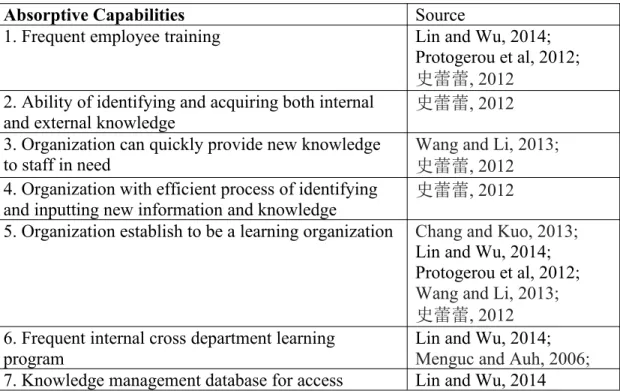
Table 2 Source of Absorptive Capability Measurements
Absorptive Capabilities Source
1. Frequent employee training Lin and Wu, 2014;
Protogerou et al, 2012; 史蕾蕾, 2012
2. Ability of identifying and acquiring both internal
and external knowledge 史蕾蕾, 2012
3. Organization can quickly provide new knowledge
to staff in need Wang and Li, 2013;史蕾蕾, 2012
4. Organization with efficient process of identifying
and inputting new information and knowledge 史蕾蕾, 2012
5. Organization establish to be a learning organization Chang and Kuo, 2013; Lin and Wu, 2014; Protogerou et al, 2012; Wang and Li, 2013; 史蕾蕾, 2012 6. Frequent internal cross department learning
program Lin and Wu, 2014;Menguc and Auh, 2006;
7. Knowledge management database for access Lin and Wu, 2014 c)Innovative Capability:
The innovative capability is the ability that enterprises adjust the strategy to innovation-oriented development and achieve strategic transformation through innovative activities. It is essentially the ultimate goal of adaptive capability and absorptive capability. Innovative capability refers to “a firm’s ability to develop new products and/or markets, through aligning strategic innovative orientation with innovative behaviors and processes (Wang and Ahmed, 2004)”. The innovative capability in here is not just mean the technology innovation (Ho & Tsai, 2006), but also the “changing leadership that promotes transformation through the transmission impact of planning and designing, transformation implementation, and transformation integration (唐孝文, 2015)”.
Dynamic innovation is a process that enterprises accumulate innovative resources, utilize innovative opportunities, achieve innovation and maintain innovation condition. And also it is a dynamic process that organization develops from one stage to another to keep continuously growing. The concept of dynamic innovation is made to deal with dynamic changes in the competitive environment so that to avoid competitors’ imitation and to establish unique competitive advantages.
Innovation can be summed up in two categories, sustaining innovation and disruptive innovation respectively (Christensen, 2013). Sustaining innovation is further improving the performance of existing products in order to better satisfy the existing customers. Disruptive innovation includes two target aspects, the low-end market and emerging market. The former refers to provide a group of different products with different performance to seize some of the existing over-served segments at low cost. The latter refers to develop new markets by producing cheaper, more convenient and easier-to-use new products to attract potential customers so that to earn market share. Innovative capability is mainly reflected in two aspects, respectively the managerial innovation and technological innovation. Managerial innovation refers to the innovation and reform in organizational operation and management, including performance management, leadership style, financial management and customer relationship. Technological innovation refers to innovation in the technical aspects, including service development, equipment development and product development. Furthermore, the organizational culture that encourages innovation would help to contribute the flexible strategy and lead to innovative advantages.
Table 3 Source of Innovative Capability Measurements
Innovative Capabilities Source
1. Organization changes and improves services based on new
knowledge Chang and Kuo,2013;
Osisiomaet al, 2016; 史蕾蕾, 2012
2. Ability of organizational technology innovation and
process innovation 史蕾蕾, 2012
3. Organization often develop new products or services that
are easily accepted by the market 史蕾蕾, 2012
4. Managerial environment for innovation Menguc and Auh,
2006;
史蕾蕾, 2012
5. Organization encourages innovation Menguc and Auh,
2006;
Wang and Li, 2013 “Adaptive capability, absorptive capability and innovative capability are the most important component factors of dynamic capabilities and underpin a firm’s ability to integrate, reconfigure, renew and recreate its resources and capabilities in line with external changes (Wang and Ahmed, 2007).” Through adaptive capability, organization can sense the opportunities in macro environment and find out the
consumer demand changing to prepare for the corresponding strategies, moreover to predict the environmental trends. In order to adapt to the environmental changes, organization acquires, assimilates, transforms and exploits new knowledge with absorptive capability. The output of adaptive capability and absorptive capability is that organization applies new knowledge in innovation activity to cope with the dynamic environment, which is the innovative capability. These three dynamic capability components join together to be the capability that organization applies in dynamic market environment.
2.3.3 Dynamic Capability and Competitive Advantages
Cardeal and Antonio(2012) built a bridge for resource-based review and dynamic capability, indicated that resources are defined as inputs, and dynamiccapabilities as the intermediate output between resources and competitive advantages, while dynamiccapabilities as the way that the company integrates a bundle of resources. So this lead to one of the most basic questions about dynamic capability theory: how to establish sustainable competitive advantages in a dynamic market environment with dynamic capabilities?
With dynamic capability, organizations can integrate internal and external resources effectively, continuously put forward high-quality products/services that meet the market development needs so that to gain continuously competitive advantages. During the process of competitive advantages establishment, dynamic capability plays a role of engine that provides energy for innovation.
Dynamic environment is one of the decisive factors that influences the corporate management and strategy formulation. According to adaptive capability, the enterprise identifies external information, through absorbing and learning new knowledge, then transform and develop new products/services so that to obtain innovative capability and ultimately to enhance the competitive advantages.
For survival in a competitive industry, sustainable competitive advantages are the key while resources have to be maximally utilized in highly dynamic environment. Dynamic capability is the approach that addresses how organizations adapt to their external environment for keeping competitive advantages in strategic management.
“Dynamic capabilities determine the speed and degree to which a firm’s difficult-to-imitate resources can be deployed and re-deployed in line with the firm's strategy and marketplace requirements. Strong dynamic capabilities enable firms to produce not only the best of their product type or service but something that is unique and exceptional in the value created (Pundziene and Teece, 2016).”
Dynamic capabilities could help organizations to identify new opportunities, reconfigure their resources and keep competitive advantages in a dynamic business environment. Rindova and Kotha (2001) found that dynamic capabilities which generate strategic flexibility could be regarded as a prerequisite for E-commerce companies competing in dynamic E-commerce environment. Similarly, the online pharmacy industry as a branch of the e-commerce industry, also faced with rapid dynamic changes in the market environment, can generate competitive dynamic capabilities as the unique advantage to obtain a more favorable strategic position in rapid changing environment.
2.4 Sharing economy
The prototype of the sharing economy should first be traced back to the concept of “Collaborative Consumption”, by economist Felson (1978).
Sharing economy refers to the economic model that sharing the idle resources of individual, collective or enterprise, including goods, services, knowledge and skills, through the Internet platform to achieve the sharing between different entities and then get the benefits from that. Naturally, it is based on the information technology, to achieve the sharing and benefiting from idle resources between owners and requesters. Its ultimate core is exchanging idle resources for economic benefits. Uber and Airbnb are the successful representatives of sharing economy.
For companies, the threshold for accessing sharing economy is low and easy, with lower cost and better flexibility in profitability. For consumers, sharing economy can help to save consuming costs and improve the consuming experience, so that makes consumption activities more convenient. For the society, sharing economy is conducive to improve resource utilization, while promoting employment rate and social equity.
3. Methodology
This dissertation is aimed to conduct the application of dynamic capability approaches in online pharmacies in China and the importance of each dynamic capability factors. Thus we choose descriptive survey in this research because it can help to investigate the situation and generate quantitative data. Data was collected using questionnaires in Appendix I and Appendix II respectively. We distributed and recovered the questionnaires through social media (such as Wechat and Weibo). Due to the distribution method we chose, we did not have an exact number of questionnaires issued, so we only calculate the effective rate.
We took two questionnaires for different target population.
The population for Questionnaire A comprised online pharmacy employees in China to investigate the dynamic capability application in their respective companies. Respondents with all different levels of positions were appropriate for this study because we believed that strategy formulation process is collective instead of only among the top managers. The questionnaire was composed by two parts: a) basic organizational background information; b) questions assessing dynamic capabilities of their respective companies. Questions of this questionnaire required respondents to give their ratings on a 5-point Likert Scale, 1 for Strongly Disagree, 2 for Disagree, 3 for Neutral, 4 for Agree, 5 for Strongly Agree. We took back 71 replies and 60 were effective so the effective rate was 84.5%. From the demographic information of the respondents, more than half of respondents (55%) were top managers or middle level managers, 75% of the respondents, were in the most value-added position (IT, Operation and Maintenance, and Marketing and Sales) in online pharmacy value chain. 69% of the respondents revealed that their respective companies have been in operation for more than 6 years, and majority (79%) of respondents have been work in their respective companies for 1 to 2 years or 3-5 years. This showed that the target population was diversified and resourceful for data collection of this research.
The Questionnaire B was for ordinary people to investigate the importance of each dynamic capability factors in online pharmacy industry. We investigated population with different backgrounds to have a result with diversified opinions. Similar to the Questionnaire A, this questionnaire was also composed by two parts: a) basic demographic information; b) questions assessing the importance of dynamic capabilities. The measurements of dynamic capabilities are the same as in Questionnaire A. Questions of this questionnaire required respondents to gave their
ratings on a 5-point Likert Scale, 1 for Very Unimportant, 2 for Unimportant, 3 for General, 4 for Important, 5 for Very Important. We took back 146 replies and 137 were effective so effective rate was 93.8%. From the demographic information of the respondents, the male to female ratio was almost 1:1, and respondents who were below 35 years old were accumulated to 92% of the total population. 83% of the respondents were high education degree holders (bachelor, master, or PhD degrees). We regarded the target population was from diversified background and highly educated to make an appropriate judgment
We used statistical software SPSS 22 for data analysis, to provide the statistical result of dynamic capability. We used Cronbach’α to evaluate questionnaire’s reliability and factor analysis to assess validity. Regarding the data analysis, percentages, frequencies, standard deviation and arithmetic mean were used for data analysis and comparison. Tables and graphs were used in presentation of data findings.
4. Field Study 4.1 Uber’s case
Uber, is the outstanding representative of sharing economy and creates business value with information technology to make better resources reconfiguration and solve the pain point of “difficulty and high cost of taking a taxi at peak time even with low-quality service”.
Born in Silicon Valley in 2009, the mobile application Uber hopes to provide the ride-sharing service. Uber drivers use their own cars when providing taxi service and Uber gets certain percentage of the fare. Without cars in this company, Uber as the platform is good at integrating various resources and providing better ride-sharing service. Through the powerful algorithm, it connects drivers with car and passengers, to achieve a balance of supply and demand, and makes the allocation of resources more reasonable. Uber’s target customers are very clear, the white collar employees, with the needs of taking a taxi at peak time, which is the failing of traditional taxi industry and also the market pain point.
Unlike the traditional taxi drivers who are not willing to work in CBD (Central Business District) area at peak time because the traffic jam would waste time and oil but earn little, Uber’s drivers usually prefer to work in that situation (according to Uber’s algorithm, with longer distance or more passengers, the payment for Uber driver will be higher, and they can get extra bonus at peak time). Because Uber drivers do not participate in the price calculation process, so the situation that they ask for higher payment would not happen when the distance is too far or in late night. Moreover, most of the Uber cars are private cars, so the car condition would be better, and the drivers are also with good manner, that leads to better service and better user experience.
Regarding the marketing, Uber adapts to the different characteristics of each city to do localization, and does partnership with map applications, uses lots of media marketing, event marketing, word of mouth marketing, including coupons and lots of roadshows to promote brand awareness.
Following are the examples of how Uber applied dynamic capabilities in corporate operation.
Table 4 Dynamic capability of Uber Adaptive Capabilities Sensitive observation of the environment
Uber focus on two aspects while expending market in new cities: economic development situation, and ground transportation demand.
For the developing countries, Uber carried out services with local demand, for example Uber Pakistan launched a rickshaw service called “UberAUTO”. For developed countries Uber carried out advanced services, such as “UberBLACK” in San Francisco. For countries with large population and relatively few cars, Uber focus on carpool services (Source:Uber Newsroom, 2016).
Uber very valued Chinese market, so dedicated an engineering team in China to develop products specifically according to Chinese user experience, to fit the market culture. The other teams are supplement based on the core engineering team, which is a very professional team to build the core technology.
In the legal perspective, Uber also adjust according to the provisions of different regions. For example, paying VAT in Europe is mandatory but in US it is unnecessary (Source: 腾讯科 技, 2016).
Identification of consumer demand changes
In September 2014, Uber launched the “UberENGLISH” service (Uber driver with excellent English) in Shanghai, which aimed to solve the problem of language barrier for foreigners living in Shanghai. In January 2016, Uber China launched the Uberpool service during Spring Festival, to ease the pressure of traffic jam for users on the way home during Chinese New Year. In April 2016 Uber Canada launched the “UberCHINESE” service in Toronto ((Uber driver with excellent Chinese), to break the language barriers for Chinese living there (刘尊旎, 2017). Discovery of
new
opportunities for the market
a) Idle resources:
Uber provided efficient services by creating a sharing economic platform and using large data, cloud computing and other technical means to create value efficiently. Uber made the
resources the most reasonable configuration and at the same time satisfied user’s demand.
b) Personalized needs and social trust:
According to PwC’s report in 2014, 57% of new generation consumers agreed with “sharing is owning”, believed that
“experience” is much more valuable than “owning” (刘扬, 2016). So Uber as a sharing economy company, to a certain extent, reflects the society value, and tries to reshape the social trust relationship.
Accurate prediction of industry trends
With increasing vehicle maintenance costs and cities becoming more congested, people in the future would rely more on car services. This made self driving car as a tendency for Uber and the industry future. Uber CEO, Travis Kalanick, has indicated in a tweet that he expected Uber to be driverless by 2030. The service will be inexpensive and ubiquitous that car ownership will be obsolete (Source: Mobility Lab, 2015).
Absorptive Capabilities Frequent employee training & Knowledge management database for access
Every month, Uber would hold a three-day training session at “Uberversity” that every new Uber employee (not drivers) around the world fly to San Francisco to learn about the company, and Uber CEO Travis Kalanick will attend to answer questions (Source: Business Insider, 2015).
Regarding drivers, Uber has an online training course for
instructing how to be a Uber driver step by step,including how to show good etiquette, how to introduce Uber to guests, how to use the Uber app to work and bonus issues(Source:Rideshare
Academy, 2016).
Uber launched a free mobile game “Uber Drive” in App Store to help Uber drivers learn the best route around the city. In the game, users are asked to drive a car to the assigned area on San
Francisco virtual map provided by Google Maps, so users need to choose the fastest route based on their knowledge and familiarity of the city. Anyone can download “Uber Drive” and play for free (Source: 新浪科技, 2015). Ability of identifying and acquiring both internal and external knowledge
a) Internal: After each campaign, Uber will collect successful experience in Play BOOK as internal knowledge sharing system. Uber summarized the experience of these activities into words and spread internally, made it as reference case while copying
activities to other cities (Source:PMCAFF, 2016). b) External: Besides sensitive observation of the external
environment, Uber acquires external resource through acquisition. For example, Uber launched an artificial intelligence lab and acquired Geometric Intelligence, an AI start-up, to improve its driverless technology (Source:BBC news, 2016).
Organization establish to be a learning organization
The Uber learning strategy is enabling employees to have more choices. It increases engagement, knowledge retention and ultimately encourages learning application while working. In the optional environment, the learning organization lets the
employee/learner know what skills are in demand now and in the future. This culture motivates the employee/learner to acquire skills that best fit both them and the organization. The return is increased motivation, high priority skills development and more targeted human capital investment (Source: Chief Learning Officer, 2016). Frequent internal cross department learning program
Uber’s “three-pronged leadership model” is entering a new city with only three employees: the marketing manager responsible for marketing, the operation manager responsible for recruiting drivers and managing driver-related matters, and the other person for other issues ( Source: 果壳网, 2015). Because this human resource structure is simple and efficient, it is easy to achieve knowledge sharing within the organization.
Innovative Capabilities
Organization change and improve services based
In the short history of Uber, employees have to establish
self-initiative learning, although without any successful companies to learn from. Uber established to be learning organization and encouraged employees to learn, is because new knowledge they
on new
knowledge learn can be used in output (better services) and lead to economicbenefits. Based on new knowledge they learn, like consumer demand, local market, laws, regulations, and customs, Uber changes and improves services to better fit the local market (Source: The Performance Improvement Blog, 2014). Ability of organizational technology innovation and process innovation
The most innovative system “Surge pricing” is, algorithms monitor traffic conditions and journey times in real time, that prices can be adjusted for the demand change. In this way, there will be more drivers to provide services when they are needed, and when demand falls, they will stay at home. It is an implementation of “dynamic pricing” which uses predictive modeling to estimate demand in real time. As Uber CEO said, this not only changed the way people book a taxi, but also reduced the traffic congestion problem(Source:Data Science Central, 2015).
Organization often develop new products or services that are easily accepted by the market
In October 2015 Uber launched city express service
“UberRUSH”; in June 2016, Uber launched “Uber + TRAVEL” for travelers; in November 2016 Uber launched wedding cars service in India, and will soon launch food distribution service “UberEATS”; in January 2017, Uber launched driverless project; in the same month Uber China launched new features of blind support. As an Internet startup company, Uber keeps on innovating new services with the support of big data analysis technology. Uber is committed to creating independent and personalized services, providing highly specialized innovation services, and infiltrate the innovative services throughout the travel service (刘尊旎, 2017).
Since Uber is still in developing, and the innovative activities help to win brand awareness and reputation, so we can see that Uber’s continuous innovative servicesare easily accepted by the market. Organization
encourages innovation
There is no specific and settled innovation procedure in Uber, but Uber gives the employee team 100% autonomy right in their base city, thus stimulating the team more on promoting good ideas of brand promotion , such as “Uber-boat”, “Uber-helicopter” and other new services. Therefore it can be seen as the relax innovative culture in Uber.
4.2 Macro Environment Analysis Political:
Since the political issues are the main constraints in Chinese medical industry, what online pharmacies can do is just to comply with policies and regulations.
The policy Measures for the Administration and Management of Internet Food and
Drugs (Draft for Soliciting Opinions) allowed Internet platform with legal
qualification to sale medicine online and third-party logistics distribution platforms can do the distribution of medicine or medical devices. “Internet Plus” policy in 2015 further promoted medical e-commerce, and Opinions of the State Council on
accelerating the development of electronic commerce to speed up the development of new economic power in 2015 showed the political megatrends of government
encouraged the development of pharmaceutical e-commerce.
Economic:
Chinese GDP continued to grow in the past 15 years, and also the national per capita income increased. At the same time, along with economic growth, the overall national awareness of health continued to increase.
Graph 1 GDP growth rate
Source: National Bureau of Statistics of China, 2016
Per capita expenditure on health care for urban households in China (referring to the total cost of pharmaceuticals and health care products, medical devices and medical services) showed an increasing trend year by year. Among the past 15 years, this expenditure on health care increased 254%, and in 2015 it has reached the proportion of 6.75% of total expenditure per capita. The increasing of health care expenditure, on the one hand was due to rising health care costs, on the other hand it reflected that people were increasingly concerned about their own health (Source: National Bureau of Statistics of China, 2016).
Graph 2 Per capita expenditure on health care for urban households in China
Source: National Bureau of Statistics of China, 2016
China’s e-commerce industry is accelerating expansion of market segments, so that the differentiation development towards consumer demand will become the core of product competition.
China’s pharmaceutical e-commerce has great market potential. In 2016, China’s pharmaceutical retail total sales have reached ¥1.4975 trillion (equals €199.67 billion), while the B2C medical e-commerce sales in 2016 is about ¥28.5 billion (equals €3.8 billion), only accounting for about 2% of the former, which indicated that the industry has huge market potential to be excavated (Source: 米内网, 2017).
Investment and financing on mobile health care dramatically increased in these years, capital markets will continue to heat up. Mobile health care field gained much more attention and resources than ever before.
Demographic:
Aging trend in China is serious. International practice for defining aging population is the proportion of people over the age of 65 accounted for 7% of the total population. According to National Bureau of Statistics of China, the proportion of the population over the age of 65 of the total population continued to rise in the past 20 years, which shows the severity of the population aging problem. By 2015, this proportion has reached 10.47% (Source: National Bureau of Statistics of China, 2016). With this, the growing demand for health care and medicine for older people also increased.
Graph 3 Population structure
Source: National Bureau of Statistics of China, 2016 Graph 4 Population age structure of 2015
Source: National Bureau of Statistics of China, 2016
Many patients with chronic disease have great demand in pharmaceutical products. According to the data of National Health and Family Planning Commission of China, by the end of June 2015, there were more than 260 million people with chronic
disease (Source: 央 视 网 新 闻 , 2015), and pharmaceutical treatment is still an important means of auxiliary treatment of chronic diseases.
Technical:
The basic service system of medical e-commerce has been gradually improved. The establishment of medical e-commerce platform, the popularity of smart phones, the mature development of mobile Internet, service system such as distribution service continued to improve, all promote the medical e-commerce to become a new pharmaceutical purchasing channel. Advanced logistics equipment and management software and tools were constantly applied to the pharmaceutical logistics industry.
4.3 Data Analysis
To do this research of dynamic capabilities in Chinese online pharmacies, we distributed two questionnaires for different target population. The Questionnaire A is for online pharmacy employees to investigate the dynamic capability application in their respective companies. The Questionnaire B is for ordinary people form diversified background to investigate the importance of each dynamic capability factors in online pharmacy industry.
4.3.1 Questionnaire A for employees in online pharmacies in China
As for this questionnaire, we took back 71 replies and 60 are effective respondents thus the effective rate was 84.5%. Because of the small sample size, we did not do the reliability and validity test.
Position in the company
The respondents who work in online pharmacy industry were asked to describe their position in their respective companies. This was used to figure out which kind of management level they were in. The findings were displayed in Table 5.
Table 5 Position in the company
Position Frequency Percentage
A) Top manager 3 5%
B) Middle level manager 30 50%
C) Common staff 27 45%
D) Others 0 0%
Total 60 100%