Chromosome divergence and NOR polymorphism in
Bryconamericus
aff.
iheringii
(Teleostei, Characidae) in the hydrographic systems of the
Paranapanema and Ivaí Rivers, Paraná, Brazil
Thiago Gomes Capistano
1, Ana Luiza de Brito Portela Castro
2and Horácio Ferreira Julio-Junior
21
Departamento de Biologia Celular e Genética, Universidade Estadual de Maringá, Maringá, PR, Brazil.
2
Departamento de Biologia Celular e Genética, Universidade Estadual de Maringá, Nupélia, Maringá,
PR, Brazil.
Abstract
Cytogenetic studies were carried out in three populations ofBryconamericus aff. iheringii from two hydrographic sys-tems of the Paranapanema and Ivaí Rivers, separated by a watershed, both belonging to the upper Paraná River ba-sin. Specimens had a constant diploid number 2n = 52 chromosomes. However, three karyotype formulae were identified in the three populations:B. aff. iheringii from the Maringá stream had 12M+18SM+8ST+14A (FN = 90); specimens from Keller River showed 8M+28SM+6ST+10A (FN = 94) and specimens from the Tatupeba stream had 8M+20SM+8ST+16A (FN = 88). Nucleolar organizer regions (NORs) were identified by silver nitrate staining and flu-orescentin situ hybridization (FISH) with an 18S rDNA probe. Specimens from Tatupeba stream had a simple NOR system located in a terminal position of the short arm of a pair of large submetacentric chromosomes. Ag-NOR and FISH methodologies revealed multiple NORs in specimens of the Maringá stream and Keller River. Differences in chromosome structure and in NOR patterns in the three populations ofB. aff. iheringii revealed fixed evolutionary chromosome divergence. Aspects related to karyotypic variations and to geographic isolation of these populations are discussed.
Key words: Bryconamericus, Characid fish, chromosome divergence, fluorescentin situhybridization, NOR polymorphism.
Received: August 22, 2006; Accepted: May 11, 2007.
Introduction
An important characteristic of nucleolar organizer re-gions (NORs) in fish is its inter- and intra-species polymor-phism. NOR characterization can be a cytogenetic marker of for cytotaxonomic studies and can even aid in construct-ing phylogenetic hypotheses (cytosystematics) for several fish groups (Amemyia and Gold, 1988; Galetti Jr, 1998; Almeida-Toledo, 2000). Some fish groups present a simple NOR system characterized by ribosomal cistrons on only one chromosome pair, whereas others have a multiple NOR system composed of cistrons dispersed over several chro-mosomes (Galetti Jr., 1998).
Small characids are characterized by extensive heter-ogeneity with regard to NOR patterns. A simple NOR sys-tem was identified in the speciesGymnocorymbus ternetzi
(Alberdi and Fenocchio, 1997),Tetragonopterus argenteus
(Alberdi and Fenocchio, 1997),Moenkhausia intermedia
(Portelaet al., 1988; Portela-Castro and Julio Júnior, 2002)
andMoenkhausia costae(Portela et al., 1988). In others
characids, occurrence of a multiple NOR system is com-mon, as has been observed in the genusAstyanax, chiefly in
the Astyanax scabripinnis complex (e.g., Maistro et al.,
1998; Mizoguchi and Martins-Santos, 1998; Mantovaniet al., 2000; Marco-Ferro et al., 2001; Souza et al., 2001;
Kavalco and Moreira-Filho, 2003; Mantovaniet al., 2005).
Both conditions have been reported in some cases: speci-mens of Moenkhausia sanctaefilomenae from the Tietê
River (SP, Brazil) analyzed by Forestiet al.(1989) had a
multiple NOR system, whereas Moenkhausia sanctaefilomenaefrom the Paraná River (PR, Brazil)
ana-lyzed by Portela-Castro and Júlio Jr. (2002) exhibited a simple NOR pattern. Differentiation in the localization of 18S and 5S ribosomal sites was detected between two
Hyphessobrycon anisitsipopulations which presented
sim-ilar karyotype in number and formulae (Centofanteet al.,
2003).
Bryconamericus is one of the 88 genera listed as
“Incertae sedis” group of the Characidae family with 51 valid species (Limaet al., 2003). Actual diversity in the
ge-www.sbg.org.br
Send correspondence to Ana Luiza de Brito Portela Castro. Depar-tamento de Biologia Celular e Genética, Universidade Estadual de Maringá, Av. Colombo 5790, 87020-900 Maringá, PR, Brazil. E-mail: [email protected].
nusBryconamericusis unknown and its systematics is
un-resolved. The genus comprises small-sized species, not more than 10 cm in length, that are distributed throughout several continental aquatic ecosystems in South and Cen-tral America (Vari and Siebert, 1990).
Chromosome analyses of the genusBryconamericus
are rare and the diploid number of the species studied up to the moment is restricted to 2n = 52 (Portelaet al., 1988; Waskoet al., 1996; Wasko and Galetti Jr., 1998; Paintner-Marqueset al., 2002a, 2003), although great diversity in chromosome structure has been revealed.
In the current study three populations of
Bryconamericusaff.iheringiifrom two hydrographic
sys-tems of the Paranapanema and Ivaí River basins, separated by a watershed were studied. Karyotypes were analyzed with emphasis on the identification of NORs by silver ni-trate staining (AgNO3) and fluorescentin situhybridization (FISH) with 18S rDNA probes.
Material and Methods
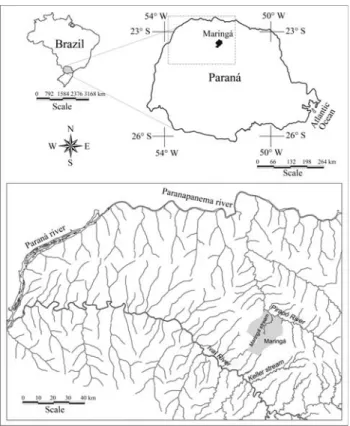
Cytogenetic studies were carried out in three popula-tions of Bryconamericus aff. iheringii from two hydro-graphic system of the upper Paraná River basin in the state of Paraná, Brazil (Figure 1): the Maringá stream belongs to the Paranapanema River basin; Keller River and the Tatu-peba stream belong to the Ivaí River basin. Amongst the 54 specimens analyzed, 21 (8 males and 13 females) were col-lected from the Tatupeba stream; 16 specimens (5 males and 11 females) were collected from Maringá stream and 17 specimens (10 males and 7 females) were collected from Keller River. Mitotic metaphases were obtained from kid-ney cells by air-drying, as described by Bertollo et al.
(1978). NORs were identified by silver nitrate (AgNO3) following the Howell and Black (1980) method, and by flu-orescent in situ hybridization (FISH) method with 18S rDNA probes. Two types of probes were used to detect 18S rDNA segments in FISH analysis: (1) genomic DNA of
Astyanax scabripinnisamplified by PCR using the primers NS1 GTAGTCATATGCTTGTCTC-3’) and NS8 (5’-TCCGCAGGTTCACCTACGGA-3’), recommended by Whiteet al.(1990); (2) amplified and cloned fragments of
Oreochromis niloticus(kindly provided by Dr. Cesar Mar-tins of the Universidade Estadual Paulista, Botucatu, SP, Brazil). The probes were labeled with biotin 14-dATP by nick translation (Bio Nick Labeling System- Gibco, BRL). The FISH protocol followed the methods of Heslop-Harrisonet al.(1991) and Cuadrado and Jouve (1994).
Results
Bryconamericusaff. iheringiispecimens had a
con-stant diploid number of 2n = 52 chromosomes, however, three karyotype formulae were identified. No chromosome differences were found between the sexes.
Bryconamericusaff.iheringiipopulation of the Maringá stream (Cytotype I)
This karyotype is composed of 12M+18SM+8ST+ 14A with fundamental number (FN) of 90, (Figure 2a). Sil-ver nitrate-stained metaphases (Ag-NOR) showed terminal labeling on the short arm of two to four chromosomes, with inter- and intra-individual variation in signal numbers (Fig-ure 3a). By FISH we detected six fluorescent signals of which four corresponded to Ag-NOR chromosomes (Fig-ure 3b). Four fluorescent signals on the telomeres of the short arm of the submetacentric pairs 7 and 10 showed greater intensity, whereas a low intensity fluorescent spot was detected on the telomere of the short arm of submeta-centric pair 14. A size heteromorphism occurred on pair 7.
Population ofBryconamericusaff.iheringiifrom Keller River (Cytotype II)
This karyotype is composed of 8M+28SM+6ST+ 10A and FN = 94, (Figure 2b). Silver nitrate staining re-vealed terminal labels in the short arm of two to four chro-mosomes (Figure 3c), with inter- and intra-individual numerical variations. Ag-NORs sites were eventually de-tected in the telomere of the long arm of one of the homo-logs of the large subtelocentric pair. FISH revealed ten ribosomal sites that included Ag-NOR markings (Figure 3d). Intense fluorescent signals were detected in the short
arm of submetacentric telomeres (pairs 7 and 8). In addition to the above chromosomes, smaller signs were visible in six more chromosomes which included the Ag-NOR region in a subtelocentric chromosome. Size heteromorphism was detected in chromosome pair 7.
Population ofBryconamericusaff.iheringiifrom Tatupeba stream (Cytotype III)
The karyotype structure of these specimens consists of 8M+20SM+8ST+16A, FN = 88 (Figure 2c). Silver ni-trate-stained metaphases showed only one pair of NOR-bearing submetacentric chromosomes (n. 7) with labeling on the short arm, coinciding with a secondary constriction (Figure 3e). Fluorescent signals confirmed the Ag-NOR
pair by FISH. This chromosome pair also had a NOR-size heteromorphism (Figure 3f).
Discussion
Although the diploid number of 2n = 52 chromo-somes is the most frequent one in the genus
Bryconamericus, karyotype formulae are variable even at
the intra-specific level. Structural chromosome diversity is corroborated by results of the current analysis. Paintner-Marqueset al.(2003) reported 2n = 52 chromosomes inB.
aff.iheringiispecimens from the Água da Floresta River
(Tibagi River basin, Paraná) distributed as 8M+22SM+ 10ST+12A (FN = 92). The three karyotype formulae ob-tained in the present study and the karyotype reported by Paintner-Marqueset al. (2003) suggest the occurrence of
fixed extensive evolutionary chromosome diversification in this species. The fundamental number in this genus ranges from 84 to 102 (Portelaet al., 1988; Waskoet al.,
1996; Wasko and Galetti Jr., 1998; Paintner-Marqueset al.,
2002a, 2003). Differences in karyotype structure have been
Figure 2- Giemsa-stained karyotypes ofBryconamericusaffiheringii(a) cytotype I, population from Maringá stream; (b) cytotype II, population from Keller River; (c) cytotype III, population from Tatupeba stream.
Figure 3- Metaphases ofBryconamericusaffiheringiispecimens show-ing Ag-NOR – bearshow-ing chromosomes (a, c and e) and fluorescentin situ
evidenced mainly as divergence in acrocentric chromo-somes number. Variation in the fundamental number (FN) may be the result of chromosome rearrangements of the pericentric inversion type which are considered to be the main mechanism of karyotype evolution in this fish group (Wasko and Galetti Jr., 1998).
Chromosome banding inBryconamericusspecies has
contributed towards a better understanding of the structural chromosome diversity of the group. Bryconamericus
showed extensive variability of NORs (Wasko and Galetti Jr., 1999; Paintner-Marqueset al., 2002b), and each species
could be characterized by a specific C-banding pattern (Wasko and Galletti Jr., 1998).
A multiple NOR system is the most frequent condi-tion in the genusBryconamericus. Although the two
popu-lations of B. aff. iheringii from the Maringá stream and
Keller River have multiple ribosomal sites, they differ in the number of NOR-bearing chromosomes, as revealed by the FISH technique. Chromosome rearrangements, such as transposition and/or translocations resulting in dispersion of ribosomal genes, seem to occur in several fish species (Galetti Jret al., 1995; Castroet al., 1996; Mantovaniet al.,
2000). These mechanisms may explain NOR variation in each isolated population of B. aff. iheringii. Silver
ni-trate-stained chromosomes (Ag-NOR) in populations ofB.
aff. iheringii with multiple NORs (Maringá stream and
Keller River) are less than the number of FISH-identified ribosomal sites. This variation shows that not all ribosomal sites (Ag-NOR) are active. A similar condition has been re-ported inBryconamericus aff. exodon, where 2 to 5
Ag-NOR sites and eight 18S rDNA sites were detected (Paintner-Marqueset al., 2002b). The FISH approach using
an 18S rDNA probe was extremely important for the dis-tinction between cytotypes I and II with regard to numbers of structural NORs. Additionally, both methodologies re-vealed a simple NOR pattern in the Tatupeba streamB. aff. iheringiipopulation. Although a single nucleolar pair is an
uncommon condition in the genus, results are in accordance with the simple NOR system reported inB. aff.iheringiiof
the Tibagi River basin analyzed by Paintner-Marqueset al.
(2003).
The three populations analyzed have a common NOR phenotype, or rather a pair of large submetacentric chromo-somes is always labeled. This submetacentric pair in the three studied populations also showed a more intense fluo-rescent signal, suggesting that it contains a larger number of rDNA gene copies. These chromosomes may be considered as the main nucleolus organizer and probably contain a cytogenetic marker preserved in this species. Wasko and Galetti Jr. (1999) detected up to 9 Ag-NOR phenotypes in fourBryconamericusspecies and registered the occurrence
of a NOR phenotype (NOR in the short arm of a medium acrocentric chromosome) in three species, indicating that this pair may be an ancient NOR feature among these fishes.
The karyotype divergence and NOR polymorphism detected between the populations ofB.aff.iheringii
sug-gests that their geographic isolation could favor the fixation of chromosomal rearrangements that probably occurred during karyotype evolution of the genusBryconamericus.
Differential selective pressures in each environment may have been decisive for karyotype differentiation and may have produced the detected chromosome diversification. The above hypothesis is based on the biological character-istics of small characids, which is a group that comprises species with high levels of endemism and fast speciation rates (Böhlkeet al., 1978).
According to Silva (2004),Bryconamericusis a poly-phyletic genus with many groups of species. Based mainly on the position and shape of maxillary teeth, this author rec-ognized three groups ofBryconamericusspecies in South America; the groupsexodon,microcephalusandiheringii. The latter includes all species found in the southern region of South America. The occurrence of different B. aff.
iheringiicytotypes requires a detailed taxonomic evalua-tion of this species, and cytogenetic data can be important tools in their identification.
Acknowledgments
We would like to thank Dra. Carla S. Pavanelli for taxonomic identification and CNPq (Conselho Nacional de Desenvolvimento Científico e Tecnológico) for financial support.
References
Alberdi AJ and Fenocchio AS (1997) Karyotypes of five Tetra-gonopterinae species (Pisces, Characidae) from Argentina. Cytologia 62:171-176.
Almeida-Toledo LF (2000) Karyotypic evolution in Neotropical freshwater fish. Chrom Today 13:169-182.
Amemiya CT and Gold JR (1988) Chromosomal NORs taxo-nomic and systematic characters in North American cypri-nid fishes. Genetica 76:81-90.
Bertollo LAC, Takahashi CS and Moreira-Filho O (1978) Cyto-taxonomic consideration on Hoplias lacerdae (Pisces, Erythrinidae). Rev Bras Genet 1:103-120.
Bölke JE, Weitzman SH and Menezes NA (1978) Estado atual da sistemática dos peixes de água doce da América do Sul. Acta Amazônica 8:657-677.
Castro J, Viñas A, Sánchez L and Martínez P (1996) Characteriza-tion of an atypical NOR site polymorphism in brown trout (Salmo trutta) with Ag- and CMA3-staining, and
fluores-centin situhybridization. Cytogenet Cell Genet 75:234-239.
Centofante L, Bertollo LAC, Miyazawa CS and Moreira-Filho O (2003) Chromosomal differentiation among allopatric popu-lations ofHyphessobrycon anisitsi (Pisces, Tetragonopte-rinae). Cytologia 68:283-288.
Foresti F, Almeida-Toledo LF and Toledo SA (1989) Supernu-merary chromosome system, C-banding pattern character-ization and multiple nucleolus organizer regions in
Moenkhausia sanctaefilomenae(Pisces, Characidae). Gene-tica 79:107-114.
Galetti Jr PM, Mestriner CA, Monaco PJ and Rasch EM (1995) Post-zygotic modifications and intra -and-inter individual nucleolar organizing regions variations in fish: Report of a case involvingLeporinus friderici. Chrom Res 3:285-290.
Galetti Jr PM (1998) Chromosome diversity in neotropical fish. NOR studies. Ital J Zool 65(Suppl):53-56.
Heslop-Harrison JS, Schwarzacher T, Anamthaw-Jónsson K, Leitch AR, Shi M and Leitch IJ (1991)In situhybridization
with automated chromosome denaturation. Technique J Meth Cell Mol Biol 3:109-116.
Howell WM and Black DA (1980) Controlled silver staining of organizer regions with a protective colloidal developer: A 1-step method. Experientia 36:1014-1015.
Kavalco KF and Moreira-Filho O (2003) Cytogenetics analyses in four species of the genus Astyanax (Pisces, Characidae) from Paraíba do Sul River Basin. Caryologia 56:453-461. Lima FCT, Malabarba LR, Buchup PA, Silva JFP, Vari RP,
Har-old A, Benine R, Oyakawa OT, Pavanelli CS, Menezes NA,
et al. (2003) Characidae- genera Incertae sedis in Chara-cidae. In: Reis RE, Kullander SO and Ferraris Jr CJ (eds) Check List of the freshwater fishes of the South and Central America. EDIPUCRS, Porto Alegre, pp 106-169.
Maistro EL, Oliveira C and Foresti F (1998) Comparative cyto-genetic and morphological of Astyanax scabripinnis paranae(Pisces, Characidae, Tetragonopterinae) Genet Mol
Biol 21:201-206.
Mantovani M, Abel LDS, Mestriner CA and Moreira-Filho O (2000) Accentuated polymorphism of heterochromatin and nucleolar regions in Astyanax scabripinnis (Pisces, Characidae): Tools for understanding karyotypic evolution. Genetica 109:161-168.
Mantovani M, Abel LDS and Moreira-Filho O (2005) Conserved 5S and variable 45S rDNA chromosomal localization re-vealed by FISH in Astyanax scabripinnis (Pisces,
Characidae). Genetica 123:211-216.
Marco-Ferro DA, Neo DM, Moreira-Filho O and Bertollo LAC (2001) Nucleolar organizing regions, 18S and 5S rDNA in
Astyanax scabripinnis (Pisces, Characidae): Populations
distribution and functional diversity. Genetica 110:55-62. Mizoguchi SMHN and Martins-Santos IC (1998) Activation
pat-terns of the nucleolar organizer region in Astyanax
scabripinnis populations (Pisces, Characidae) Cytologia
63:259-265.
Paintner-Marques TR, Giuliano-Caetano L and Dias AL (2002a) Karyotypic diversity in aBryconamericusaff.exodon popu-lation (Characidae, Tetragonopterinae). Cytologia 67:397-402.
Paintner-Marques TR, Giuliano-Caetano L and Dias AL (2002b) Multiple NORs in Bryconamericus aff. exodon
(Osteichthyes, Characidae, Tetragonopterinae). Hereditas 137:107-112.
Paintner-Marques TR, Giuliano-Caetano L and Dias AL (2003) Cytogenetic characterization of a population of
Bryconamericusaff.iheringii(Characidae, Tetragonopteri-nae). Genet Mol Biol 26:145-149.
Portela ALBS, Galetti Jr PM and Bertollo LAC (1988). Consider-ations on the chromosome evolution of Tetragonopterinae (Pisces, Characidae). Rev Bras Genet 11:307-316.
Portela-Castro ALB and Júlio-Júnior HF (2002) Karyotype rela-tionships among species of the subfamily Tetragonopterinae (Pisces, Characidae): Cytotaxonomic and evolution aspects. Cytologia 67:329-336.
Silva JFP (2004) Two new species ofBryconamericusEigenmann (Characiformes, Characidae) from Southern Brazil. Neotrop Ichthyol 2:55-60.
Souza IL, Galían J, De La Rua P, Bertollo LAC and Moreira-Filho O (2001) Non-random distribution and nucleolar rDNA sites on Astyanax scabripinnischromosomes. Cytologia 66:85-91.
Vari RP and Siebert DJ (1990) A new unusually sexually dimor-phic species of Bryconamericus (Pisces, Ostariophysi,
Characidae) from the Peruvian Amazon. Proc Biol Soc Wash 103:516-524.
Wasko AP, Vênere PC and Galetti Jr PM (1996) Chromosome di-vergence between two sympatric characid fishes of the ge-nusBryconamericus.Braz J Genet 19:225-230.
Wasko AP and Galetti Jr PM (1998) Karyotype diversity in the neotropical fishBryconamericus(Characidae, Tetragonop-terinae). Cytobios 94:185-193.
Wasko AP and Galetti Jr PM (1999) Extensive NOR variability in fishes of the genusBryconamericus(Characidae). Cytologia
64:63-67.
White TJ, Bruns T, Lee S and Taylor J (1990) Amplification and direct sequencing of fungal ribosomal RNA genes for phylo-genetics. In: Innis MA, Gelfand DH, Shinsky JJ and White TJ (eds) PCR Protocols: A Guide to Methods and Applica-tions. Academic Press, New York, pp 315-322.
Associate Editor: Fausto Foresti