Universidade Federal de Ouro Preto
Programa de Pós-Graduação em Ecologia de Biomas Tropicais
GAPS IN MARINE TURTLE RESEARCH: A 30-YEAR REVIEW
Dissertação apresentada ao Programa de Pós-Graduação em Ecologia de Biomas Tropicais do Instituto de Ciências Exatas e Biológicas da Universidade Federal de Ouro Preto como requisito parcial para obtenção do Título de Mestre em Ecologia.
Candidata: Thaís Viégas Rabelo Rocha Orientador: Prof. Dr. Cristiano Schetini de Azevedo
“Todas as vitórias ocultam uma abdicação”.
Agradecimentos
Primeiramente ao Raul, meu filho, simplesmente por existir. Ao meu eterno companheiro Fabiano (Nerso) pelo incondicional apoio. À minha mãe Glória e ao meu pai Eduardo, por sempre acreditarem e investirem no meu potencial, e nunca desistirem de mim. Aos costarriquenhos que ficarão para sempre no meu coração: Elvia (minha segunda mãe), Nefertiti e Ingrid.
Às Pacas por serem as melhores amigas do mundo em todos os momentos. À Polly por ter me recebido e sido minha companheira na vida ouro-pretana. Às Tchanas pela amizade. Às Repúblicas Tananóia, Sagatiba e 4doses por terem sido minha segunda casa e pelos rocks. À Paulete (e Joana), Fala e Mel por me acolherem com carinho na reta final.
Ao Julinho por ter me apresentado ao Programa de Pós-Graduação em Ecologia de Biomas Tropicais (PPGEBT) e confiado numa completa desconhecida. Aos amigos da turma de 2013 pelo companheirismo e o melhor curso de campo de todos os tempos. Ao Cris por ter me aceitado de portas abertas, compreendendo todos os percalços da minha jornada e sempre me aconselhando da melhor forma possível. À Grazi pela ajuda na estatística.
Lacunas no estudo de tartarugas marinhas: uma revisão de 30 anos
Resumo: Tartarugas marinhas são um grupo carismático de répteis que são distribuídas globalmente, habitam todos os oceanos, ocupam nichos ecológicos únicos e exibem variações intraespecíficas em tamanho populacional, reprodução e morfologia. Todas as sete espécies estão presentes na Lista Vermelha da IUCN, em diferentes níveis de risco. Publicações recentes mostraram que as espécies não estão sendo estudadas em parâmetros iguais, por isso, o presente estudo realizou uma revisão bibliométrica que utilizou a plataforma internacional The Web of Science© para realizar uma análise de lacunas (Gap Analysis) com as publicações sobre
tartatugas marinhas nos últimos 30 anos; classificando e analisando as mesmas de acordo com categorias selecionadas. Nossos resultados mostraram que o número de publicações cresceu significativamente entre as décadas, mas as espécies não estão sendo estudadas na mesma proporção. Essa grande diferença nos levou a focar nossas análises nas três espécies menos estudadas e as lacunas no conhecimento das mesmas, apontando as áreas de deficiência em cada uma. Nós discutimos porque as publicações estão extremamente concentradas em países desenvolvidos (principalmente Estados Unidos da América), e as possíveis soluções para ajudar os países em desenvolvimento a aumentar sua significância no estudo de tartarugas marinhas, levando em conta que esses países abrigam a maioria dos sítios de reprodução.
Gaps in marine turtle research: a 30-year review
Abstract: Sea turtles are a group of marine reptiles that are globally distributed, occupy unique ecological niches, and exhibit intra-specific variations in population sizes, reproduction and morphology. All seven species are present at different levels of risk at IUCN Red List. The present study was a bibliometric review that used The Web of Science© platform to do a Gap Analysis with marine turtle publications of the last 30 years. The publications were classified and analyzed according to several categories, with the objective to understand the trends and gaps in marine turtle research. The number of publications grew significantly through decades, but the species are not being studied at the same proportion. This difference leaded us to focus our analysis on the three less studied species and its lack of knowledge, showing promising areas of study. We discussed why the publications are highly concentrated in developed countries, and the possible solutions to help developing countries to increase their significance in this field, since they host the majority of sea turtles nesting sites. We identified data that is being systematically collected in these nesting sites but is not being well published, which leads the conservation assessments to be based in grey literature and personal communications.
Additional keywords: bibliometric analysis, conservation, sea turtle, Testudines.
T. Viegas, R. R. A,B and C. S. de Azevedo A,B,C
A = Post-Graduate program in Ecology of Tropical Biomes, Federal University of Ouro Preto (UFOP), Morro do Cruzeiro Campus, Ouro Preto, MG, 35400000, Brazil
Introduction
Sea turtles (Chelonoidea) are a charismatic group of marine reptiles (Jones et al. 2012). Despite consisting of only seven species, they are globally distributed, inhabiting all oceans (except polar regions), occupying unique ecological niches, and exhibiting intra-specific variations in population sizes, as well as in reproduction and morphology (Wallace et al. 2010). State of the World’s Sea Turtles (SWOT) database (SWOT 2016) maps global distribution of sea turtle
nesting sites, and actually shows 3,344 nesting sites and 7,749 nesting records for all species.
The Olive ridley, Lepidochelys olivacea (Eschscholtz 1829) has a circumtropical distribution and nest in more than 60 countries (Abreu-Grobois and Plotkin 2008). It is the only species that exhibit two types of reproductive behavior: females can either emerge in mass nesting events called arribadas, or they will emerge solitarily or in a small group without synchrony (Kalb 1999). Leatherbacks, Dermochelys coriacea (Vandelli 1761) nest along the tropical Atlantic and Pacific coasts, with an important concentration in Central Africa (Fretey et al. 2007). They are the biggest sea turtles, and are known for its deep diving capacity (Eckert et al. 1986) and capability of inhabit cold waters (Hodge 1979). The Hawksbill turtle, Eretmochelys imbricata (Linnaeus 1766)is a highly specialized turtle, and usually lives associated with coral reefs and other hard-bottom habitats in tropical and subtropical seas (Wood et al. 2013). The most restricted species in nesting areas are the Kemp’s ridley, Lepidochelys kempii (Garman 1880)
and the Flatback, Natator depressus (Garman 1880). The former nests in the Gulf of Mexico and in a few beaches along the east coast of the USA (Marquez et al. 2005), and the latter nests in tropical and subtropical northern Australian coast (Schäuble et al. 2006). Green turtles, Chelonia
1989). The Loggerhead turtle, Caretta caretta (Linnaeus 1758) is globally distributed throughout the subtropical and temperate regions of the Mediterranean Sea and Pacific, Indian, and Atlantic Oceans (Wallace et al. 2010).
On a global scale, marine turtle species are currently listed as Vulnerable (Olive ridley, L. olivacea; Leatherback, D. coriacea and Loggerhead, C. caretta), Endangered (Green turtle, C.
mydas), Critically Endangered (Kemp’s ridley, L. kempii and Hawksbill, E. imbricata), and Data
Deficient (Flatback, N. depressus) on the Red List (IUCN 2016). Two species jumped down on the risk on the last review: Leatherback and Loggerhead went from Critically Endangered and Endangered (respectively) to a Vulnerable status. It is important to consider that Kemp’s ridley
and Flatback had their last assessments in 1996 (RLS&PS 1996; MTSG 1996) and Green turtles in 2004 (Seminoff 2004), which indicates the need of updating in their classifications. A major hurdle for Red Listing efforts is the lack of reliable studies that have been published and assessments that have had far too much emphasis on grey literature and personal communications (Seminoff and Shanker 2008).
publication trends and highlight knowledge gaps. The aim of the present study was to evaluate trends in the marine turtle research in the last 30 years, pinpointing gaps in the knowledge of this important group of vertebrates.
Materials and Methods
The bibliometric review was made in The Web of Science© platform because it has truly international coverage, an important characteristic since national databases show biases toward particular types of research (Melfi 2005). The Marine Turtle Newsletter (MTN) provides current information on marine turtle research, but the manuscripts submitted to the MTN are processed using single blind reviewer software (MTN 150, 2016); that is why we did not include these publications on our review.
First, the search was made using the keywords ‘sea turtle*’ and ‘marine turtle*’ (*matching
singular and plural). Then, all the seven scientific names of the living species of marine turtles were used as keywords. The search was limited to the past three decades (1986 to 2016). Before 1986, less than 20 articles were published per year on the subject of marine turtle research according to the database consulted, and we considered a yearly sample of less than 20 articles to be inadequate to analyze publishing trends.
Our first search found 10,198 references to articles. Combining the nine searches using the toll “OR” (that excludes duplicities), 4,826 references to articles remained. Due to the big amount of
indeed about our subject. Although it would be better to analyze full articles, this proved to be logistically impossible. The use of abstracts can produce highly satisfactory results in bibliometric analyses, since they usually contain all relevant information (Azevedo et al. 2010).
Eight-hundred-and-thirty articles were rejected from our database (many from other marine animals, marine pollution, fresh-water turtles and fishery). Thus, our study was finally based on 3,374 abstracts. In EndNote X7© we manually organized the references by groups according to the studied species. The groups were exported in .XML format to Microsoft Excel 2010© to filter the results accordingly to our objectives.
In The Web of Science© platform is possible to analyze the results according to some categories. We selected eight categories available: (1) year of publication; (2) type of publication (article or review); (3) author; (4) country (based in author’s addresses); (5) Institution (organization); (6)
Domestic Product (GDP) and the economic region of the countries as explanatory variables and the number of published papers as a response variable (model of distribution: quasipoisson). Contrast analysis was run to evaluate in which region publications concentrated. The GVP table by country and region is available in World Bank database <http://data.worldbank.org/indicator/NY.GDP.MKTP.CD>.
Results
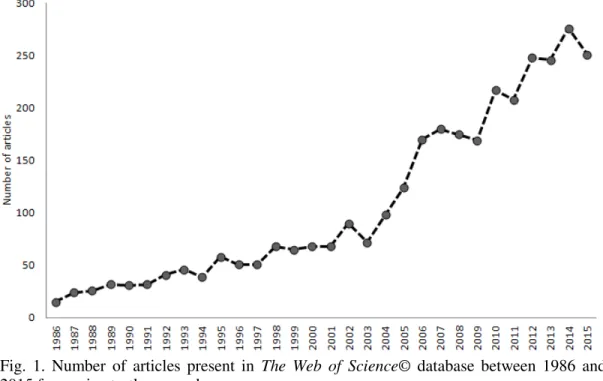
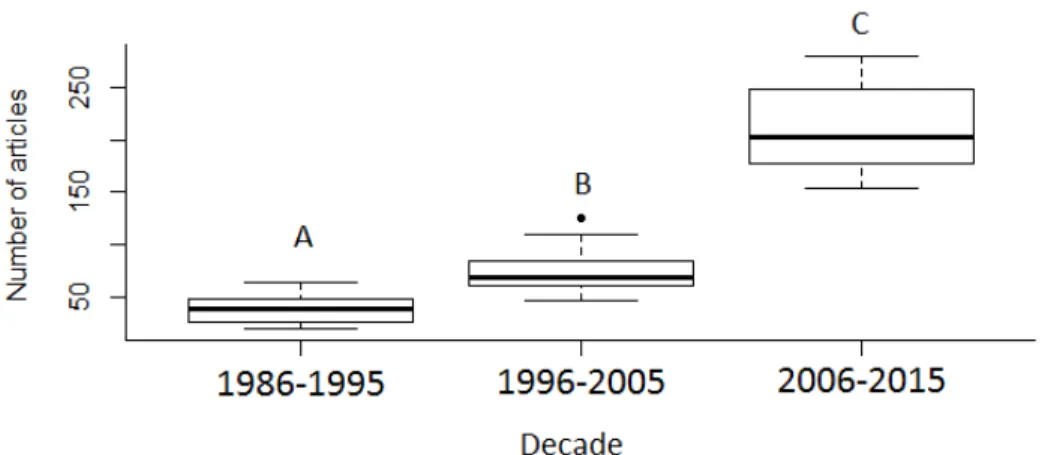
The number of articles published in marine turtle research has increased in the past 30 years (Fig. 1), showing a significant positive correlation between year and number of articles published (rs =0.990; N=30; p<0.0001). The year of 2016 was excluded from the analysis because publications were downloaded in July, which could underestimate the number for this year. There was a significant difference on the number of publications between all decades (GLM: F=99.99; p<0.0001), and a contrast analysis showed a concentration on the third decade (2006-2015), with a big increase in the number of publications (Fig. 2).
Fig. 2. Number of articles by decade present in The Web of Science© database between 1986 and 2015 for marine turtle research. Different letters means statistical differences.
Since only articles and reviews entered in our analysis, we tested the number of articles (N=3,259; 96.59%) per review (N=115; 3.4%); which showed that one review is made to every 28.3 articles.
In total, 6,206 authors have written the 3,374 articles. Two-hundred authors have written ten articles or more, and three authors have more than one-hundred publications each. They are Godley, B. J. (4.26%; N=144); Hays, J. C. (3.55%; N=120); and Broderick, A. C. (3.11%; N=105). The top twenty authors together detain 39.59% of all publications (N=1,336).
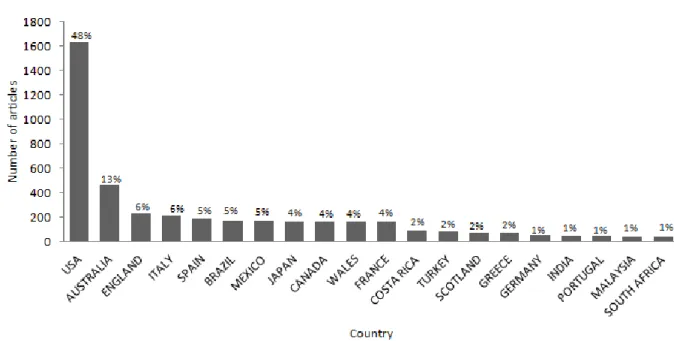
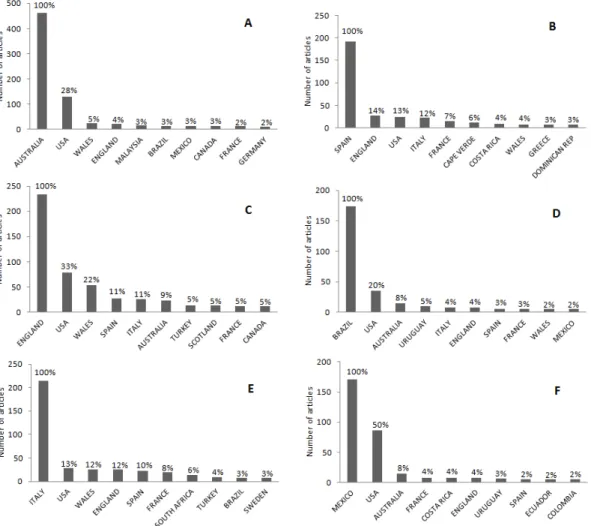
To understand if USA was a significant contributor in other countries’ publications, we ran the
analysis again using the six subsequent countries with more publications after USA. In Figure 4 we showed the amount of publications that USA coauthors with these countries, and USA is in the first position of coauthoring in five of the six countries. Authors from USA are present in more than fifty-percent of the total articles in Mexico (50.29%; N=86), thirty-percent in England (33.33%, N=78), twenty-five-percent in Australia (28.2%; N=130), twenty-percent in Brazil (20.11%; N=35), thirteen-percent in Italy (13.08%; N=28) and thirteen-percent in Spain (13.08%; N=25).
Fig. 4. Number of articles published by country highlighting the coauthoring of United States of America (USA) in (A) Australia, (B) Spain, (C) England, (D) Brazil, (E) Italy and (F) Mexico; in articles present in The Web of Science© database between 1986 and 2016 for marine turtle research.
The number of nesting sites is not correlated to the number of publications in each country (rs=0.135; p=0.097), but the number of articles published by country is influenced by its economic development and economic region (GLM: F=366.729, p<0.01; F=17.028, p<0.0002). A contrast analysis confirmed the concentration of publications in North America.
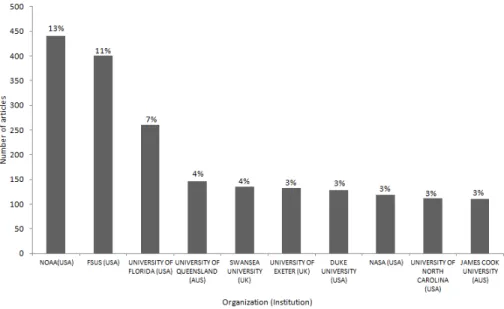
N=440) and Florida State University System (FSUS) (11.85%; N=400), both from USA. The top ten organizations together were related to 58.74% of all publications (N=1,982; Fig. 5).
Fig. 5. Number of articles published by organizations present in The Web of Science© database between 1986 and 2016 for marine turtle research. NOAA= National Oceanic and Atmospheric Administration; FSUS= Florida State University Schools; NASA= National Aeronautics and Space Administration; USA= United States of America; UK= United Kingdom; AUS= Australia.
Publications were written in nine languages, almost all in English (97.57%; N=3292). There were thirty-seven publications written in Spanish (1.09%); sixteen in French (0.47%); twelve in Portuguese (0.35%); and eleven in Japanese (0.32%). The other languages had less than 0.1% of the total (N=3,374).
and Biodiversity Conservation (10.61%; N=358). The distribution of articles by subject area (with more than one-percent of publications) is shown in Figure 6.
Fig. 6. Number of articles published by subject areas present in The Web of Science© database between 1986 and 2016 for marine turtle research.
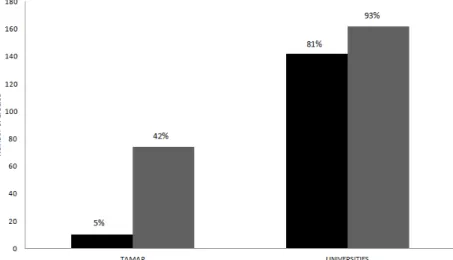
universities, they are attached to 93.1% of publications (N=162) and fund 81.6% of them (N=142; Fig. 8).
Fig. 7. Number of articles funded by agencies present in The Web of Science© database between 1986 and 2016 for marine turtle research. NOAA=National Oceanic and Atmospheric Administration; NERC= National Environment Research Council; CNPQ=National Counsel of Technological and Scientific Development; NFWF= National Fish and Wildlife Foundation; NSERC= Natural Sciences and Engineering Research Council of Canada; NMFS= National Marine Fisheries Service; PADI=Professional Association of Diving Instructors; USA=United States of America; UK=United Kingdom.
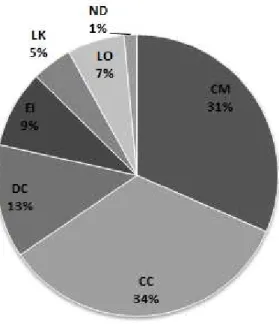
In 657 abstracts (19.47%), it was not possible to identify the species studied, and 422 (12.5%) publications studied more than one species. Ninety-one studies were about Paleontology, and were not classified by species. Nine studies were about hybrid individuals or populations, and if it was clear what species were involved in the hybridizations, the article was classified in the species group. The Loggerhead turtle (C. caretta) was the species with more publications related, with the amount of 1,145 articles (33.93%). Green turtle (C. mydas and outdated classifications of morphotypes C. mydas agassizi, C. agassizi and C. mydas japonica) was the second species with more articles, 1,062 (31.47%). The two species together were present in 65.4% of all publications (N=2,207). All other species summed were cited in 1,163 studies (34.46%), but with a big difference between each one. Leatherbacks were studied in 438 articles (12.98%); Hawksbills in 299 articles (8.86%); Olive ridleys in 221 articles (6.55%), Kemp’s ridleys in 156
Fig. 9. Rounded percentage of articles published by marine turtle species studied present in The Web of Science© database between 1986 and 2016 for marine turtle research. CM=Chelonia mydas; CC=Caretta caretta; DC=Dermochelys coriacea; EI=Eretmochelys imbricata; LO=Lepidochelys olivacea; LK=Lepidochelys kempii; ND=Natator depressus.
Analyzing the percentage of articles by species per year of publication, we observed that the beginning of the second decade (1996) had a more equal distribution in the number of articles per species. N. depressus only appears in 1993, and always with less than five percent of representation. L. kempii had a decrease in percentage along the years, being more representative on the first decade; the peak observed in 2005 is due to a special edition with eighteen articles published for this species in the Journal of Chelonian Conservation and Biology. L. olivacea and E. imbricata presented a general increase in papers along the years, being more representative in
Fig. 10. The distribution of marine turtle articles present in The Web of Science© database between 1986 and 2016, according to the species studied, these being: Caretta caretta (black squares); Chelonia mydas (black dots); Dermochelys coriacea (vertical lines); Eretmochelys imbricata (light gray); Lepidochelys olivacea (dark gray); Lepidochelys kempii (white) and Natator depressus (black).
between 2 and 3%. Behavioral Sciences are considered as a gap for all species, with only 1% in each one.
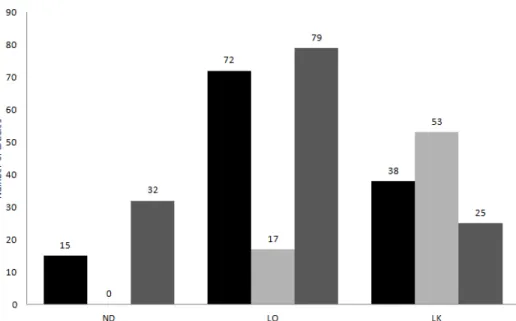
On the 49 abstracts that contemplated Flatbacks, 15 studied adult subjects (30.61%), 32 studied hatchlings/eggs (65.3%), and none studied juveniles (Fig. 11). In ten abstracts (20.4%), it was not possible to identify the stage of development of the studied subjects. In 13 of the 30 years analyzed there were no publications about Flatbacks (1986-1992, 1994, 1997-1999 and 2004-2005), and the year with more publications was 2014, with seven papers (14.28%); the mean of publications per year was 1.54 for this species. We did a Spearman rank (excluding the period 1986-1992) and founded a significant positive correlation between year and number of articles published (rs=0.648; N=24; p=0.001). The most prominent area of research with Flatbacks was physiology (16.32%; N=8), followed by reproductive studies (12.24%; N=6). With four articles each we had behavior, migration and conservation studies (8.16%). Three articles studied pollution (6.12%) and the other areas had two or just one article each. It is relevant to mention that just one author (Hewavisenthi, S.) has five articles published, all reproductive studies analyzing incubation of eggs in different environments.
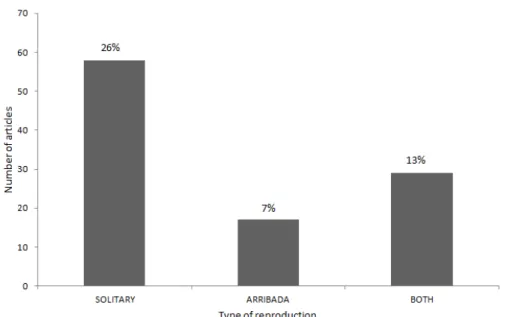
L. olivacea had a similar distribution of studies between adult and hatchlings/eggs stages (32%,
followed by threats (18%, N=40). Veterinary and biochemistry were the areas with almost no papers published.
Differently from the two former species, the most studied stage of Kemps’ ridley is juveniles,
with 34% (N=53) of publications, then adults with 24% (N=38) and hatchlings/eggs with 16% (N=25). There was not possible to identify the stage of development in 66 abstracts (42.3%; Fig 11). The most prominent area of research was veterinary, with 23 articles (14%), ten of them about coldstunned turtles. We then had physiology and conservation with 12% each (N=20, N=19). There was only one study about biochemistry, and there were no studies about predation.
Fig. 11. Number of articles by stage of development and specie studied, present in The Web of Science© database between 1986 and 2016 for marine turtle
research. ND= Natator depressus; LO=Lepidochelys olivacea;
Discussion
Marine turtle research has grown rapidly, especially on the last decade. On the 80’s decade, huge
marine turtle conservation programs were starting around the globe (Marcovaldi and Marcovaldi 1999; Martínez et al. 2007). Considering that evaluation of trends in sea turtle nesting populations requires many years of data because of the large degree of annual variation in nesting numbers (Bjorndal et al. 1999), data from this projects probably started to be effectively published in the last decade, increasing the total number of publications in it. In spite of the growth in number of published articles through decades, the species are not being studied in the same proportion.
study this specie in all aspects. Only with investment on studies about this specie would be possible to do an assessment about its conservation status.
Contrarily to previous studies of Olive ridleys, that say that arribadas have been relatively well documented compared to limited information of solitary nesting (Matos et al. 2012), our study founded that solitary nesters are more well documented than arribada nesters. This result reflects that rookeries with non-arribada behavior are many times more numerous than those that nest as arribadas (Abreu-Grobois and Plotkin 2008), and that is easier to manage few turtles nesting and few nests than even small samples from thousands of turtles or nests. The most prominent area of research in this specie reflects the curiosity of researchers in its special behavior; reproductive studies only lost to threats studies. Reproductive studies are probably more abundant because monitoring sea turtles is easier during their terrestrial life-history phase, during nesting activity (Seminoff and Shanker 2008). The inaccessibility of open ocean habitat and the cryptic nature of smaller animals are fundamental problems when assessing oceanic-stage of sea turtles (Putman et al. 2013).
On the opposite way of the last two species, Kemps’ ridley juveniles are more studied than the
Rehabilitation centers are not common in developing countries, but there are several visitation centers of environmental education that have captive turtles for exhibition. Only in Brazil there are at least seven visitation centers with captive turtles (TAMAR 2016), and these turtles’
behaviors are not studied. Environmental enrichment, for example, was studied only once for sea turtles (Therrien et al. 2007), showing that this is a promising area of study for captive marine turtles of all species.
Taking in count that the number of nesting sites is not related to the number of publications and that the economic status of the country is related to its relevance on publishing, there is a huge disparity between publishing countries. This shows that scientists from more developed countries (especially USA) are doing their researches abroad, but still attached to their homing country universities. This situation leads us to advise the developing countries: they need more government funding in universities and conservation programs, giving the opportunity to local researchers to study the sea turtles in their own country.
This highlights another problem in marine turtle research in developing countries: they have big amounts of data collected, but few were analyzed and published. One thing that leads to it, is the poor inspection made by the funding agencies that supports the conservation projects. The projects are focusing on environmental education and volunteering and forgetting about the academic part of publishing their data. A possible solution is to make partnerships between these projects and Universities. In this way, projects that are not capable of paying qualified people to analyze their data can allow University researchers to scrutinize and publish their data. We do need a better inspection from organizations and funding agencies that are affording this conservation projects. They need to know where the money was invested and charge a response in the form of high quality publications, not accepting only local papers and symposium abstracts and presentations.
We conclude that although the number marine turtle publications are increasing along the years, more efforts should be directed to the three less studied species. Taking in count that two of them have restricted ranges of distribution, this effort is urgent to make conservation assessments and decisions possible and effective. In general, there is a tendency in researchers to follow the areas with more bibliography available, but sometimes it is necessary to swim against the current. We need to fill the gaps that were presented on this article, generating high quality publications in marine turtle research. In this way we will facilitate the assessments for all species, not basing them on personal communications and grey literature.
Acknowledgements
References
Abreu-Grobois, A and Plotkin, P. (2008) (IUCN SSC Marine Turtle Specialist Group). Lepidochelys olivacea. The IUCN Red List of Threatened Species 2008: e.T11534A3292503. Avaliable at http://dx.doi.org/10.2305/IUCN.UK.2008.RLTS.T11534A3292503.en [Accessed 08 september 2016].
Azevedo, P.G., Mesquita, F.O., and Young, R.J. (2010) Fishing for gaps in science: a bibliographic analysis of Brazilian freshwater ichthyology from 1986 to 2005. Journal of Fish Biology 76(9), 2177-2193.
Beange, M., Clift, A., and Arauz, R. (2015). PRETOMA 2015 Report: Southern Nicoya Peninsula Sea Turtle Nesting Beach Conservation Projects. 28p. Avaliable at
http://turtle-trax.com/wp-content/uploads/2013/12/PRETOMA-Report-2015-Final.pdf [Accessed 08
September 2016].
Bjorndal, K.A., Wetherall, J.A., Bolten, A.B., and Mortimer, J.A. (1999) Twenty-six years of green turtle nesting at Tortuguero, Costa Rica: An encouraging trend. Conservation Biology 13(1), 126-134.
Burke, V.J., and Standora, E.A. (1991) Factors affecting strandings of cold-stunned juvenile Kemps ridley and Loggerhead sea-turtles in Long-Island, New-York. Copeia(4), 1136-1138.
Burke, V.J., Morreale, S.J., and Standora, E.A. (1994) Diet of the Kemps ridley sea-turtle, Lepidochelys kempii, in New-York waters. Fishery Bulletin 92(1), 26-32.
de Azevedo, C.S., Cipreste, C.F., and Young, R.J. (2007) Environmental enrichment: A GAP analysis. Applied Animal Behaviour Science 102(3-4), 329-343.
Eckert, S.A., Nellis, D.W., Eckert, K.L., and Kooyman, G.L. (1986) Diving patterns of two Leatherback sea-turtles during interesting intervals at Sandy Point, St-Croix, United-States-Virgin_Islands. Herpetologica 42(3), 381-388.
Fretey, J., Billes, A., and Tiwari, M. (2007) Leatherback, Dermochelys coriacea, nesting along the Atlantic coast of Africa. Chelonian Conservation and Biology 6(1), 126-129.
Groombridge, B. and Luxmoore, R. (1989). The Green Turtle and Hawksbill (Reptilia: Cheloniidae): World Status, Exploitation and Trade. Secretariat of the Convention on International Trade in Endangered Species of Wild Fauna and Flora, Lausanne, Switzerland, 601 pp.
Hirth, H.F. (1997). Synopsis of the biological data on the green turtle, Chelonia mydas (Linnaeus 1758). United States Fish and Wildlife Service Biological Report 97-1. 120 pp.
Hodge, R. P. (1979). Geographic distribution: Dermochelys coriacea schlegeli. Herpetological Reviews 10: 102.
Ikonomopoulou, M.P., Olszowy, H., Limpus, C., Francis, R., and Whittier, J. (2011) Trace element concentrations in nesting flatback turtles (Natator depressus) from Curtis Island, Queensland, Australia. Marine Environmental Research 71(1), 10-16. [In English]
Ikonomopoulou, M.P., Hodge, M., and Whittier, J.M. (2012) An Investigation of Organochlorine and Polychlorobiphenyl Concentrations in the Blood and Eggs of the Carnivorous Flatback Turtle, Natator depressus, from Queensland, Australia. Chelonian Conservation and Biology 11(2), 255-259.
Jones, M.E.H., Werneburg, I., Curtis, N., Penrose, R., O'Higgins, P., Fagan, M.J., and Evans, S.E. (2012) The Head and Neck Anatomy of Sea Turtles (Cryptodira: Chelonioidea) and Skull Shape in Testudines. Plos One 7(11).
Kalb, H.J. (1999). Behaviour and Physiology of Solitary and Arribada Olive Ridley Sea Turtle (Lepidochelys olivacea) During the Internesting Period.PhD Thesis, Texas A&M University, USA.
Marcovaldi, M.A., and dei Marcovaldi, G.G. (1999) Marine turtles of Brazil: the history and structure of Projeto TAMAR-IBAMA. Biological Conservation 91(1), 35-41.
Marquez, R., Burchfield, P.M., Diaz, J., Sanchez, M., Carrasco, M., Jimenez, C., Leo, A., Bravo, R., and Pena, J. (2005) Status of the Kemp's ridley sea turtle, Lepidochelys kempii. Chelonian Conservation and Biology 4(4), 761-766.
Martinez, L.S., Barragan, A.R., Munoz, D.G., Garcia, N., Huerta, P., and Vargas, F. (2007) Conservation and biology of the leatherback turtle in the Mexican Pacific. Chelonian Conservation and Biology 6(1), 70-78.
Matos, L., Silva, A., Castilhos, J.C., Weber, M.I., Soares, L.S., and Vicente, L. (2012) Strong site fidelity and longer internesting interval for solitary nesting olive ridley sea turtles in Brazil. Marine Biology 159(5), 1011-1019.
Mazaris, A.D., Almpanidou, V., Wallace, B.P., Pantis, J.D., and Schofield, G. (2014) A global gap analysis of sea turtle protection coverage. Biological Conservation 173, 17-23.
Melfi, V. (2005) The appliance of science to zoo-housed primates. Applied Animal Behaviour Science 90(2), 97-106.
Marine Turtle Newsletter (2016). (150):1-23. Available at
http://www.seaturtle.org/mtn/PDF/MTN150.pdf [Accessed 02 september 2016]
Marine Turtle Specialist Group. 1996. Lepidochelys kempii. The IUCN Red List of Threatened
Species 1996. Available at
http://dx.doi.org/10.2305/IUCN.UK.1996.RLTS.T11533A3292342.en [Accessed 11 August
2016].
Parmenter, C.J., and Limpus, C.J. (1995) Female recruitment, reproductive longevity and inferred hatchling survivorship for the Flatback turtle (Natator depreesus) at a major eastern Australian rookery. Copeia(2), 474-477.
Pendoley, K., and Kamrowski, R.L. (2016) Sea-finding in marine turtle hatchlings: What is an appropriate exclusion zone to limit disruptive impacts of industrial light at night? Journal for Nature Conservation 30, 1-11.
Pendoley, K.L., Bell, C.D., McCracken, R., Ball, K.R., Sherborne, J., Oates, J.E., Becker, P., Vitenbergs, A., and Whittock, P.A. (2014) Reproductive biology of the flatback turtle Natator depressus in Western Australia. Endangered Species Research 23(2), 115-123.
Putman, N.F., Mansfield, K.L., He, R.Y., Shaver, D.J., and Verley, P. (2013) Predicting the distribution of oceanic-stage Kemp's ridley sea turtles. Biology Letters 9(5).
R Core Team (2016). R: A language and environment for statistical computing. R Foundation for Statistical Computing, Vienna, Austria. Available at https://www.R-project.org/ [Accessed 28 august 2016].
Red List Standards & Petitions Subcommittee. 1996. Natator depressus. The IUCN Red List of
Threatened Species 1996: Available at
http://dx.doi.org/10.2305/IUCN.UK.1996.RLTS.T14363A4435952.en [Accessed 11 August
2016].
Salmon, M., Hamann, M., and Wyneken, J. (2010) The Development of Early Diving Behavior by Juvenile Flatback Sea Turtles (Natator depressus).Chelonian Conservation and Biology 9(1), 8-17.
Schauble, C., Kennett, R., and Winderlich, S. (2006) Flatback Turtle (Natator depressus) Nesting at Field Island, Kakadu National Park, Northern Territory, Australia, 1990-2001. Chelonian Conservation and Biology 5(2), 188-194.
Scott, J.M., Davis, F., Csuti, B., Noss, R., Butterfield, B., Groves, C., Anderson, H., Caicco, S., Derchia, F., Edwards, T.C., Ulliman, J., and Wright, R.G. (1993) GAP Analysis - A geographic approach to protection of biological diversity. Wildlife Monographs(123), 1-41.
Seminoff, J.A. (2004). Chelonia mydas. The IUCN Red List of Threatened Species 2004. Avaliable at http://dx.doi.org/10.2305/IUCN.UK.2004.RLTS.T4615A11037468.en. [Accessed 11 August 2016].
Seminoff, J.A., and Shanker, K. (2008) Marine turtles and IUCN Red Listing: A review of the process, the pitfalls, and novel assessment approaches.Journal of Experimental Marine Biology and Ecology 356(1-2), 52-68.
Schwartz, F. (1978) Behavioral and tolerance responses to cold water temperatures by three species of sea turtles (Reptilia, Cheloniidae) in North Carolina. Florida Marine Research Publications 33:16–18.
State of the World’s Sea Turtles (SWOT) (2016). Available at http://seamap.env.duke.edu/swot [Accessed 28 july 2016].
Projeto TAMAR. (2016). Available at http://www.tamar.org.br/ [Accessed 12 september 2016].
Therrien, C.L., Gaster, L., Cunningham-Smith, P., and Manire, C.A. (2007) Experimental evaluation of environmental enrichment of sea turtles. Zoo Biology 26(5), 407-416.
Troeng, S., and Rankin, E. (2005) Long-term conservation efforts contribute to positive green turtle Chelonia mydas nesting trend at Tortuguero, Costa Rica. Biological Conservation 121(1), 111-116.
Walker, T.A., and Parmenter, C.J. (1990) Absence of a pelagic phase in the life-cycle of the flatback turtle, Natator depressa (Garman). Journal of Biogeography 17(3), 275-278.
M.A., Mortimer, J.A., Musick, J.A., Nel, R., Pilcher, N.J., Seminoff, J.A., Troeng, S., Witherington, B., and Mast, R.B. (2010) Regional Management Units for Marine Turtles: A Novel Framework for Prioritizing Conservation and Research across Multiple Scales. Plos One 5(12).
Whiting, A.U., Thomson, A., Chaloupka, M., and Limpus, C.J. (2008) Seasonality, abundance and breeding biology of one of the largest populations of nesting flatback turtles, Natator depressus: Cape Domett, Western Australia. Australian Journal of Zoology 56(5), 297-303.
Whittock, P.A., Pendoley, K.L., and Hamann, M. (2014) Inter-nesting distribution of flatback turtles Natator depressus and industrial development in Western Australia. Endangered Species Research 26(1), 25-38.