983 983 983 983 983 Mem Inst Oswaldo Cruz, Rio de Janeiro, Vol. 102(8): 983-990, December 2007
An in vitro model for dengue virus infection that exhibits human
monocyte infection, multiple cytokine production and
dexamethasone immunomodulation
Sônia Regina Nogueira Ignácio Reis, André Luiz Franco Sampaio*,
Maria das Graças Muller Henriques*, Mariana Gandini, Elzinandes Leal Azeredo,
Claire Fernandes Kubelka/
+Laboratório de Imunologia Viral, Instituto Oswaldo Cruz-Fiocruz *Departamento de Farmacologia Aplicada, Farmanguinhos-Fiocruz, Av. Brasil 4365, 21045-900 Rio de Janeiro, RJ, Brasil
An important cytokine role in dengue fever pathogenesis has been described. These molecules can be asso-ciated with haemorrhagic manifestations, coagulation disorders, hypotension and shock, all symptoms impli-cated in vascular permeability and disease worsening conditions. Several immunological diseases have been treated by cytokine modulation and dexamethasone is utilized clinically to treat pathologies with inflammatory and autoimmune ethiologies. We established an in vitro model with human monocytes infected by dengue virus-2 for evaluating immunomodulatory and antiviral activities of potential pharmaceutical products. Flow cytometry analysis demonstrated significant dengue antigen detection in target cells two days after infection. TNF-α, IFN-α, IL-6 and IL-10 are produced by in vitro infected monocytes and are significantly detected in cell culture supernatants by multiplex microbead immunoassay. Dexamethasone action was tested for the first time for its modulation in dengue infection, presenting optimistic results in both decreasing cell infection rates and inhibiting TNF-α, IFN-α and IL-10 production. This model is proposed for novel drug trials yet to be applyed for dengue fever.
Key words: dengue - dexamethasone - monocytes - cytokines - therapeutics
Dengue fever (DF) is an acute infectious viral disease that presents a broad severity spectrum from asymptomatic or oligosymptomatic to extremely severe clinical manifestations. It is believed that immunologi-cal mechanisms play a key role in pathogenesis (WHO 1997, Gubler 2002). Proinflammatory cytokines have been associated with haemodynamic and coagulation dis-orders that may lead to increased vascular permeability and leakage and to hypovolemic shock resulting eventu-ally in death (Green & Rothman 2006). No specific treat-ment exists for dengue and research has been unsuccess-ful in finding improved conditions with steroids, antivirals or substances that decrease capillary permeability (Sumarmo et al. 1982, Tassniyom et al. 1993, Pea et al. 2001, Gibbons & Vaughn 2002, Ligon 2005). In patients, fluid-replacement therapy should be administrated ac-cording to the severity and paracetamol/metamizole has been prescribed for fever and analgesia.
Glucocorticoids are widely adopted as anti-inflam-matory drugs for several inflamanti-inflam-matory diseases and are known to suppress of inflammatory mediators expres-sion (Barnes & Adcock 1995, Joyce et al. 1997).
Dex-amethasone inhibits cytokine gene expression such as TNF-α by blocking transcription factors NF-κB and acti-vator factor-1 (Steer et al. 2000). IL-1β, iNOS, ciclooxi-genase-2 and monocyte chemoattractant protein-1 have also been described to destabilize mRNAs during this treat-ment (Amano et al. 1993, Ristimaki et al. 1996, Poon et al. 1999, Lasa et al. 2001, Korhonen et al. 2002).
Dexamethasone is applied in the clinics to treat pa-thologies with inflammatory and autoimmune origins, such as rheumatoid arthritis, multiple melanomas and bacterial meningitis (Jimenez-Zepeda & Dominguez-Martinez 2006, van de Beek & de Gans 2006, Schutt et al. 2007) despite some described adverse effects (Stoll et al. 1999, Hempen et al. 2002, Vardy et al. 2006). Re-ports concerning corticosteroids are yet inconclusive regardin their benefits during DF (Panpanich et al. 2006). Herein we present an in vitro model with human pri-mary monocytes infected with dengue virus serotype 2 (DENV-2). We evaluated virus load by detecting antigen positive cell rates through flow cytometry and cytokine secretion profile after cell infection by a multiple fluo-rescent microbead immunoarray. This model is proposed for DF novel drug trials, and dexamethasone was tested for the first time, presenting successful modulation by decreasing infected monocyte frequencies and inhibit-ing TNF-α, IFN-α and IL-10 production in cell culture supernatants.
MATERIALS AND METHODS
Cell cultures, preparation of virus stock and virus titration - An Aedes albopictus C6/36 cell clone was grown as monolayers at 28°C on Leibovitz medium (L-15) Financial support: PDTIS-Fiocruz, CNPq (50.1567/03-8), ICGEB
(CRP.LA/ARG03-01)
+Corresponding author: [email protected]
984 984 984 984
984 Dengue immunomodulation by dexamethasone • Sônia Regina NI Reis et al.
supplemented with 200 mM glutamine, 1% non-essen-tial amino acids solution, 0.5% tryptose phosphate broth, 100 U/ml penicillin, 10 mg/ml streptomycin and 5% foetal calf serum (FCS). DENV-2 strain 16681 was pro-vided by Dr. Scott B. Halstead (Naval Medical Research Center, USA). The virus was titrated by serial dilution cultures in microtiter plates and detected by immunofluo-rescence as previously described (Miagostovich et al. 1993). Virus titre was calculated as 50 percent tissue culture infectious dose (TCID50/ml) (Reed & Muench 1938, Schoepp & Beaty 1984). The inactivated virus was prepared by incubating the inoculum for 30 min/56°C. Titrated virus stock was obtained at a concentration of 5.5 x 10¹⁰ TCID50/ml.
Preparation of human peripheral blood mono-nuclear leukocytes (PBMLs) - Human peripheral blood was obtained from the Hospital Universitário Clementino Fraga, Rio de Janeiro. Human PBMLs from healthy donors were isolated from buffy coat cells through density gradient centrifugation (350 g/30 min in Ficoll-Paque Plus, Amersham Biosciences Corp) ac-cording to standard procedures. Cells were suspended in RPMI 1640 supplemented with 200 mM glutamine, 100 U/ml penicillin and 10 mg/ml streptomycin, after-wards incubated at 37oC under humid atmosphere with 5% CO2 and allowed to adhere on uncoated polystyrene flasks (150 cm3) during 90 min for monocyte enrich-ment. Non-adherent cells were removed by washing, and adherent cells were detached by mechanical cell harvest-ing with cell scrapers in cold cell culture medium, then resuspended in supplemented RPMI plus 10% FBS.
Infection of adherent PBMLs and treatment with dexamethasone - Enriched monocytes suspended in supplemented RPMI 1640 medium plus 10% FCS were seeded at 2 x 10⁶ cells/ml on 96 or 24-well plates. After an overnight incubation, infection was performed with inoculum diluted in cell culture medium (30 or 300 µl) containing 2.2 x 10⁹ TCID50/ml. After a 2 h-incubation period for adsorption, the cell culture supernatant was replaced with cell culture medium plus 2% FCS and in-cubated with dexamethasone 0,05 mM at 37ºC with 5% CO2. After 48 h, supernatants were collected and stocked at -20ºC until cytokine measurement and cells were re-covered for viral antigen determination by flow cytometry. Cell viability was verified in culture by Trypan blue exclusion and presented ≥ 95% viability. Wells with cell control, inactivated and infectious DENV were assayed.
Cytokine detection in cell culture supernatant by multiplex microbead immunoassay - A multiplex bio-metric immunoassay, containing fluorescent dyed microspheres conjugated with a monoclonal antibody specific for a target protein, was adopted for cytokine measurement according to the manufacturer’s instruc-tions (Upstate), measured cytokines being: IL-1β, IL-6, CXCL8 (IL-8), IL-10, IL- 12 (p70), IL-15, IFN-α, and TNF-α. Briefly, cell culture supernatant (50 ml) was in-cubated overnight with antibody-coupled beads. Com-plexes were washed and then incubated with biotinylated detection antibody and streptavidin-phycoerythrin prior
to assessing cytokine concentration titres, the concen-trated human recombinant cytokine provided by the ven-dor. A broad range 1.95 - 8,000 pg/ml recombinant cytokines was used to establish standard curves as well as maximize assay sensitivity and dynamic range. Cytokine levels were determined using a multiplex ar-ray reader from Luminex™ Instrumentation System (Bio-Plex Workstation from Bio-Rad Laboratories). The analyte concentration, calculated with the software from the manufacturer (Bio-Plex Manager Software), provided a regression analysis to derive the equation prediction of the cytokine concentrations in plasma samples.
Determination of viral antigen by flow cytometry in monocytes - Adherent monocytes were recovered by scraping with a plastic microtip using cold cell culture medium, then set at 1 x 10⁶ cells/microtube, centrifuged (350 g/10 min) and washed once with 1ml phosphate-buffered saline pH 7.4 containing 1% bovine serum al-bumin with 0.1% NaN3 (PBS/BSA). Cells were fixed with a solution containing 2% paraformaldehyde PBS/BSA at 4ºC/20 min and permeabilized with a solution contain-ing 0.15% saponin in PBS/BSA. Permeabilized cells were then blocked with 5% inactivated plasma in PBS/ BSA at 4ºC/30 min and incubated with mouse anti-den-gue complex monoclonal antibody (Chemicon, USA) at 4ºC/60 min. Cells were then washed and incubated with anti-mouse IgG labelled with phycoerythrin (DAKO, USA) for 30 min/4ºC. After incubation, cells were washed with PBS/BSA and resuspended in 2% paraform-aldehyde. Cells were acquired (5,000 events for gated monocytes) on a FACS Calibur flow cytometer (Beckon & Dickinson, USA) and analysed with FlowJo Software (TreeStar Inc, CA, USA). Isotype-matched antibody was adopted as a staining negative control.
Statistical analyses - Data were firstly tested for normality with the GraphPad Prism version 4.02 for Windows, GraphPad™ Software (San Diego, CA, USA, http://www.graphpad.com) in order to determine the sig-nificance of differences in DENV antigen positive (DENV-Ag+) cell rates under culture treatment condi-tions. Data values passed the Kolmogorow-Smirnov nor-mality test and were evaluated for significance using the paired t test (two-tailed). However, the cytokine detection data values obtained by multiplex bead assay did not pass the normality test and was therefore analysed by the non-parametric Wilcoxon matched pairs test (two-tailed). Altered parameters were considered significant at p < 0.05.
RESULTS
985 985 985 985 985 Mem Inst Oswaldo Cruz, Rio de Janeiro, Vol. 102(8), December 2007
which constitute approximately 95% cells in the mono-cyte region from cell population size and granularity (FCS x SSC) dotplots in FACS analysis as described pre-viously (Neves-Souza et al. 2005).
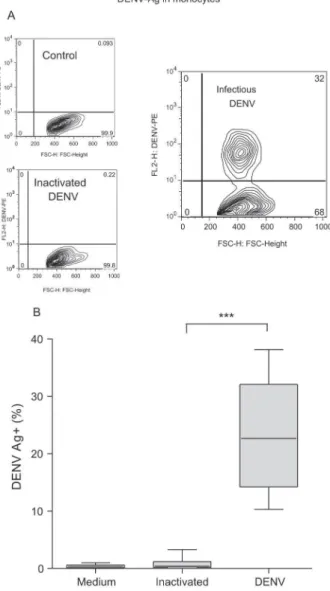
We also observed that only infectious DENV, but not heat-inactivated DENV, was effective in DENV-Ag de-tection (Fig. 1A). Heat-inactivated DENV incubation with monocytes presented data equivalent to those of cell culture medium indicating that the antigen detected when the infectious virus is present might be a result of virus replication. Infected monocytes from 15 different PBML donors varied, however DENV-Ag expression was statistically significant when compared with heat-inac-tivated DENV (Fig. 1B). Infection rates from the second day ranged from 10 to 38% total monocytes.
After DENV monocyte infection, cell culture super-natant was collected and tested for the presence of eight different cytokines by multiplex microbead immuno-fluoroscent assay (LuminexTM technology), while the mock inoculum with heat-inactivated DENV did not stimulate monocytes cytokine production (Table). In 10-16 PBML donors tested on the second day after infec-tion, TNF-α, IL-6, IL-10 and IFN-α were detected at statistically significant, increased levels when compared to control monocyte supernatants (Fig. 2). These cytokines were still present in subsequent days varying their detec-tion levels, while other cytokines (IL-1β, IL-8, IL-12, and IL-15) did not alter their levels during seven days in tested cultures. The two-day time point was determined to evaluate drug effect for both antiviral and immunomodu-lating activities.
Dexamethasone-induced reduction of DENV-Ag+ cell rates on monocytes detected by FACS - Dexam-ethasone has been reported to be an immunomodulating agent and experimentally demonstrated to decrease vi-ral titres, as well as reducing virus-induced inflamma-tion (Moreno et al. 2003). DENV infected human mono-cytes from 11 different PBML donors were treated with dexamethasone for two days in culture. DENV-Ag+ cell expression was detected by FACS (Fig. 3A) and exhib-ited a highly significant inhibiting effect on infected cell frequencies (Fig. 3B). Hence, the dexamethasone effect results in viral protein downregulation, indicating that virus particle load is decreased in monocytes after treatment.
Dexamethasone-induced inhibition of cytokine detec-tion in DENV infected monocyte supernatants - Gluco-corticoids, such as dexamethasone, inhibit the expression of inflammatory mediators such as pro-inflammatory cytokines (Joyce et al. 1997). The dexamethasone immunomodulating activity was tested on DENV-in-fected human monocytes cultured for two days. TNF-α, IL-6, IL-10, and IFN-α were measured in cell superna-tants from 10-15 different PBML donors with the mul-tiplex bead immunoassay. Significant TNF-α, IL-10 and IFN-α inhibition was achieved in treated cultures in con-trast to untreated (Fig. 4). IL-6 levels in supernatants from dexamethasone-treated cell cultures were not sta-tistically different from infected control cultures, although eight out of 15 PBML donors presented ≥ 35%
IL-6 inhibition rates (total averages: untreated, 1,883 ± 379 and dexamethasone-treated, 1,347 ± 244 pg/ml), five had unchanged levels and two had ≥ 35% increased levels. Dexamethasone was acknowledged to be an effec-tive in vitro treatment to downregulate cytokines pro-duced during monocyte infection by DENV.
986 986 986 986
986 Dengue immunomodulation by dexamethasone • Sônia Regina NI Reis et al.
DISCUSSION
Clinical investigations report an important role for cytokines during DF pathogenesis. Among others, TNF-α, IL-1β, IL-6 and IL-8 have been associated with severity in various studies (Vitarana et al. 1991, Hober et al. 1993, Bethell et al. 1998, Raghupathy et al. 1998, Braga et al. 2001, Fink et al. 2006). Cytokines can be related to haemorrhagic manifestations (Azeredo et al. 2001), co-agulation activation, fibrinolysis (Suharti et al. 2002) and may be implicated in vascular permeability and worsen-ing morbidness (Green & Rothman 2006). These
condi-Fig. 2: model for DENV in vitro infection: cytokine production profile in DENV infected monocytes detected by multiplex bead assay. Human monocytes were infected with DENV-2 virus during 2 days, and supernatants were collected. Multiplex cytokine analysis technologies (LuminexTM)
as an immunoassay was used for cytokine detection of TNF-α , IL-1b , IL-6 , IFN-α, IL-10, IL-15, IL-8, and IL-12 in cultured monocyte supernatants. Uninfected cell culture supernatants were used as controls. Box-and-whiskers graphs represent data from 10-16 PBML donors. Wilcoxon matched pairs test was used to evaluate differences between cytokine concentration produced by uninfected and DENV-infected monocytes; * p < 0.05.
tions are most striking in severe patients, nevertheless may appear during mild disease as well (Avila-Aguero et al. 2004, Nguyen et al. 2004).
987 987 987 987 987 Mem Inst Oswaldo Cruz, Rio de Janeiro, Vol. 102(8), December 2007
natural infection in DF (Neves-Souza et al. 2005). Here we present an in vitro model that detects DENV positive cell frequencies in human primary monocytes and four different cytokines, which are participating in disease de-velopment. We demonstrated that after in vitro interven-tion with dexamethasone this model is successfully modu-lated for DENV-Ag expression and cytokine production.
TNF-α (Espina et al. 2003) and IL-8 (Bosch et al. 2002) production by human primary monocytes were earlier reported after DENV infection. In vitro differ-entiated macrophages secrete TNF-α, IFN-α, IL-1β, IL-8, IL-12, MIP-1 α, and RANTES after infection but not IL-6, IL-15, or nitric oxide (Chen & Wang 2002). We infected freshly isolated human monocytes from 15 healthy PBML Brazilian donors, and our results revealed that DENV induced in these target cells a different cytokine pattern, TNF-α, IFN-α, IL-6, and IL-10 being upregulated as detected earlier in DF patients. On the other hand IL-1 β, IL-8, IL-12, and IL-15 were not significantly detected in monocyte cultures, these cytokines being produced at low levels during DF in most Brazilian patients studied (un-published observations) and remarkable absent in reports (Green & Rothman 2006) except for IL-8. IFN-α is markedly elevated during defervescense in dengue haemorrhagic fever (DHF) (Kurane et al. 1993). Since the DENV-2 strain used is the same as that from Chen Fig. 4. dexamethasone effect on cytokine levels produced by DENV in-fection in monocytes. DENV-2 infected human monocytes were incu-bated with dexamethasone during 2 days. The box-and-whiskers graph represents data from 10-15 PBML donors. The Wilcoxon matched pairs test was used to evaluate differences between cytokine concentration produced in cell culture supernatants by non-treated and dexametha-sone-treated DENV-infected monocytes. Cytokines were measured si-multaneously by multiplex microbead immunoassay; * p < 0.05. TABLE
Cytokine production by infected monocytesa compared to mock-infected cells
Control Inactivated DENV
TNF-α (pg/ml) 2 ± 1 2 ± 0 68 ± 5 IL-10 (pg/ml) 16 ± 11 21 ± 10 389 ± 145 IFN-α (pg/ml) 28 ± 8 36 ± 6 189 ± 118 IL-6 (pg/ml) 144 ± 119 197 ± 71 682 ± 207
a: human monocytes were obtained from healthy PBML donor buffy coats and infected cell culture medium, heat-inactivated or infectious DENV-2 (strain 16681). Cytokine concentration produced in cell culture supernatants was measured simultaneously by multiplex microbead immunoassay. Data represent average ± standard error from 15 PBML donors.
988 988 988 988
988 Dengue immunomodulation by dexamethasone • Sônia Regina NI Reis et al.
and Wang’s report, we can speculate that differences in cytokine production may be related to target cell origin and that monocytes may change their cytokine produc-tion after in vitro differentiaproduc-tion. In addiproduc-tion, cytokine genetic polymorphism may also explain these differ-ences considering that the former study was performed in Southeast Asia, in contrast to our South American population, which corroborates the evidence that DF pro-files change among several geographic/ethnic regions (Moraes et al. 2006).
Some authors (Chareonsirisuthigul et al. 2007) have exhibited the simultaneous production of several cytokines after DENV infection as herein delineated, but their target cells were derived from a transformed cell line, not primary isolated monocytes. We describe for the first time the dexamethasone inhibitory effects for both DENV-induced cytokine production and virus load reduction on monocytes. There have been several reports ofin vitro DENV infection inhibition by different treat-ments, but human monocytes or other primary cells were not described as targets in these earlier studies. Some treatments inhibited the glycan-processing enzyme en-doplasmic-reticular glycosidase and the morphogenesis of viruses that bud from the endoplasmic reticulum (Gu et al. 2007). Others, such as the virus inhibitor ribavirin, act on the enzyme IMP dehydrogenase (IMPDH) that catalyzes the de novo biosynthesis of guanine nucleotides affecting dengue replication (Markland et al. 2000). It is still unknown whether or not the antiviral effect ob-served here is a direct effect on virus replication steps or an indirect effect stimulating antiviral cytokines/factors.
We demonstrated a novel inhibitory effect induced by dexamethasone that has a striking impact on TNF-α, IFN-α and IL-10 production in human monocyte cultures after DENV-2 infection. This drug is known for its modu-lating activity on TNF-α production and NF-κB nuclear translocation, which is an essential step for TNF-α in-duction on stimulated monocytes (Steer et al. 2000). We suggest that NF-κB may exert as well an activation func-tion on TNF-α synthesis after DENV infection and may be one target for dexamethasone. IL-1β (Jeon et al. 2000), IL-6 (Amano et al. 1993), and IL-10 (Bessler et al. 2001) are inhibited by dexamethasone after mono-cyte induction by LPS, a bacterial product involved in septic shock. Contrastingly, IL-6 is induced during DENV in vitro infection, but dexamethasone does not change significantly its levels in culture. This lack of effect on IL-6 by dexamethasone may be undermined due to the evidence that no important role was found for IL-6 in Brazilian patient severity during recent epidemics (un-published observations). Other cytokines were also as-sociated with severity, such as IL-18 and TGF-β (Azeredo et al. 2006), and the dexamethasone effect deserves to be studied for these factors as well.
We observed IFN-α downregulation, which may rep-resent an effective immunomodulatory procedure by dexamethasone. This effect is not interfering with virus clearance which can be explained by the antiviral effect from other molecules such as nitric oxide, known to control DENV replication in monocytes (Neves-Souza et al. 2005, Chareonsirisuthigul et al. 2007). IL-10 is
known for its blocking effect on STAT-1 and IRF-1 (Mahalingam & Lidbury 2002), relevant factors for iNOS activation (Dell’Albani et al. 2001), and its expression during DENV infection may result in enzyme inhibition together with reduced nitric oxide effect on DENV rep-lication. After IL-10 downregulation by dexamethasone, iNOS activation may occur, generating nitric oxide that would more efficiently exert its antiviral effects on mono-cytes. We can not rule out that the antiviral effect was in-duced by the drug direct interference on virus replication or that cytokine downregulation may be a result from less intense monocyte activation by the virus. Further investi-gation on theses mechanisms deserve to be performed.
One must be aware of adverse effects described in clinical immunotherapeutic procedures during some se-vere infectious diseases (Hempen et al. 2002, Vardy et al. 2006). Although dexamethasone presented very in-teresting effects on the in vitro dengue infection model described here, there is insufficient clinical evidence to justify the use of corticosteroids in managing dengue shock syndrome. A recent report evaluates death, blood transfusion need, convulsions and pulmonary haemorrhage concluding that there was no overall benefit attributed to corticosteroids, but the number of participants in the analy-sis was small (Panpanich et al. 2006).
We believe that this model will be useful to track new substances with therapeutic properties, however further investigations will be mandatory in order to achieve a safe immunomodulatory intervention in which pro-inflammatory factors will be downregulated to a moderate level still enabling virus replication control. This would result in more efficient restoration of host homeostasis, ultimately consummating in avoidance of the most deleterious clinical manifestations during DF.
ACKNOWLEDGEMENTS
To Dr. Jussara P. Nascimento (In memoriam) for her con-stant encouragement. To the technical support of Alessandro Souza, Maryrose Lavatori, and Mariana Lopes. To Mitchell Raymond Lishon for reviewing the manuscript.
REFERENCES
Amano Y, Lee SW, Allison AC 1993. Inhibition by glucocorti-coids of the formation of interleukin-1 alpha, interleukin-1 beta, and interleukin-6: mediation by decreased mRNA sta-bility. Mol Pharmacol 43: 176-182.
Avila-Aguero ML, Avila-Aguero CR, Um SL, Soriano-Fallas A, Canas-Coto A, Yan SB 2004. Systemic host inflammatory and coagulation response in the Dengue virus primo-infec-tion. Cytokine 27: 173-179.
Azeredo EL, Zagne SM, Santiago MA, Gouvea AS, Santana AA, Neves-Souza PC, Nogueira RM, Miagostovich MP, Kubelka CF 2001. Characterisation of lymphocyte response and cytokine patterns in patients with dengue fever. Immunobiology 204: 494-507.
Azeredo EL, Zagne SMO, Alvarenga AR, Nogueira RMR, Kubelka CF, Oliveira-Pinto LM de 2006. Activated periph-eral lymphocytes with increased expression of cell adhesion molecules and cytotoxic markers are associated with den-gue fever disease. Mem Inst Oswaldo Cruz 101: 437-449.
989 989 989 989 989 Mem Inst Oswaldo Cruz, Rio de Janeiro, Vol. 102(8), December 2007
Bessler H, Kagazanov S, Punsky I, Sirota L 2001. Effect of dex-amethasone on IL-10 and IL-12p40 production in newborns and adults. Biol Neonate 80: 262-266.
Bethell DB, Flobbe K, Cao XT, Day NP, Pham TP, Buurman WA, Cardosa MJ, White NJ, Kwiatkowski D 1998. Patho-physiologic and prognostic role of cytokines in dengue hem-orrhagic fever. J Infect Dis 177: 778-782.
Bosch I, Xhaja K, Estevez L, Raines G, Melichar H, Warke RV, Fournier MV, Ennis FA, Rothman AL 2002. Increased pro-duction of interleukin-8 in primary human monocytes and in human epithelial and endothelial cell lines after dengue virus challenge. J Virol 76: 5588-5597.
Braga EL, Moura P, Pinto LM, Ignacio SR, Oliveira MJ, Cordeiro MT, Kubelka CF 2001. Detection of circulant tumor necro-sis factor-alpha, soluble tumor necronecro-sis factor p75 and inter-feron-gamma in Brazilian patients with dengue fever and den-gue hemorrhagic fever. Mem Inst Oswaldo Cruz 96: 229-232.
Chareonsirisuthigul T, Kalayanarooj S, Ubol S 2007. Dengue vi-rus (DENV) antibody-dependent enhancement of infection upregulates the production of anti-inflammatory cytokines, but suppresses anti-DENV free radical and pro-inflammatory cytokine production, in THP-1 cells. J Gen Virol 88: 365-375.
Chen YC, Wang SY 2002. Activation of terminally differentiated human monocytes/macrophages by dengue virus: productive infection, hierarchical production of innate cytokines and chemokines, and the synergistic effect of lipopolysaccharide. J Virol 76: 9877-9887.
Dell’Albani P, Santangelo R, Torrisi L, Nicoletti VG, de Vellis J, Giuffrida Stella AM 2001. JAK/STAT signaling pathway mediates cytokine-induced iNOS expression in primary astroglial cell cultures. J Neurosci Res 65: 417-424.
Espina LM, Valero NJ, Hernandez JM, Mosquera JA 2003. In-creased apoptosis and expression of tumor necrosis factor-alpha caused by infection of cultured human monocytes with dengue virus. Am J Trop Med Hyg 68: 48-53.
Fink J, Gu F, Vasudevan SG 2006. Role of T cells, cytokines and antibody in dengue fever and dengue haemorrhagic fever. Rev Med Virol 16: 263-275.
Gibbons RV, Vaughn DW 2002. Dengue: an escalating problem. BMJ 324: 1563-1566.
Green S, Rothman A 2006. Immunopathological mechanisms in dengue and dengue hemorrhagic fever. Curr Opin Infect Dis 19: 429-436.
Gu B, Mason P, Wang L, Norton P, Bourne N, Moriarty R, Mehta A, Despande M, Shah R, Block T 2007. Antiviral profiles of novel iminocyclitol compounds against bovine viral diarrhea virus, West Nile virus, dengue virus and hepatitis B virus. Antivir Chem Chemother 18: 49-59.
Gubler DJ 2002. Epidemic dengue/dengue hemorrhagic fever as a public health, social and economic problem in the 21st cen-tury. Trends Microbiol 10: 100-103
Halstead SB 1988. Pathogenesis of dengue: challenges to mo-lecular biology. Science 239: 476-481.
Hempen C, Weiss E, Hess CF 2002. Dexamethasone treatment in patients with brain metastases and primary brain tumors: do the benefits outweigh the side-effects? Support Care Cancer 10: 322-328.
Hober D, Poli L, Roblin B, Gestas P, Chungue E, Granic G, Imbert
P, Pecarere JL, Vergez-Pascal R, Wattre P, Maniez-Montreuil M 1993. Serum levels of tumor necrosis factor-alpha (TNF-alpha), interleukin-6 (IL-6), and interleukin-1 beta (IL-1 beta) in dengue-infected patients. Am J Trop Med Hyg 48: 324-331.
Hotta H, Wiharta AS, Hotta S, Homma M 1984. Dengue type 2 virus infection in human peripheral blood monocyte cultures. Microbiol Immunol 28: 1099-1109.
Jeon YJ, Han SH, Lee YW, Lee M, Yang KH, Kim HM 2000. Dexamethasone inhibits IL-1 beta gene expression in LPS-stimulated RAW 264.7 cells by blocking NF-kappa B/Rel and AP-1 activation. Immunopharmacology 48: 173-183.
Jimenez-Zepeda VH, Dominguez-Martinez VJ 2006. Vincristine, doxorubicin, and dexamethasone or thalidomide plus dexam-ethasone for newly diagnosed patients with multiple myeloma? Eur J Haematol 77: 239-244.
Joyce DA, Kloda A, Steer JH 1997. Dexamethasone suppresses release of soluble TNF receptors by human monocytes con-currently with TNF-alpha suppression. Immunol Cell Biol 75: 345-350.
Korhonen R, Lahti A, Hamalainen M, Kankaanranta H, Moilanen E 2002. Dexamethasone inhibits inducible nitric-oxide syn-thase expression and nitric oxide production by destabilizing mRNA in lipopolysaccharide-treated macrophages. Mol Pharmacol 62: 698-704.
Kurane I, Innis BL, Nimmannitya S, Nisalak A, Meager A, Ennis FA 1993. High levels of interferon alpha in the sera of children with dengue virus infection. Am J Trop Med Hyg 48: 222-229.
Lasa M, Brook M, Saklatvala J, Clark AR 2001. Dexamethasone destabilizes cyclooxygenase 2 mRNA by inhibiting mitogen-activated protein kinase p38. Mol Cell Biol 21: 771-780.
Ligon BL 2005. Dengue fever and dengue hemorrhagic fever: a review of the history, transmission, treatment, and preven-tion. Semin Pediatr Infect Dis 16: 60-65.
Mahalingam S, Lidbury BA 2002. Suppression of lipopolysac-charide-induced antiviral transcription factor (STAT-1 and NF-kappa B) complexes by antibody-dependent enhancement of macrophage infection by Ross River virus. Proc Natl Acad Sci USA 99: 13819-13824.
Markland W, McQuaid TJ, Jain J, Kwong AD 2000. Broad-spec-trum antiviral activity of the IMP dehydrogenase inhibitor VX-497: a comparison with ribavirin and demonstration of antivi-ral additivity with alpha interferon. Antimicrob Agents Chemother 44: 859-866.
Miagostovich MP, Nogueira RM, Cavalcanti SM, Marzochi KB, Schatzmayr HG 1993. Dengue epidemic in the state of Rio de Janeiro, Brazil: virological and epidemiological aspects. Rev Inst Med Trop São Paulo 35: 149-154.
Moraes MO, Da-Cruz AM, Kubelka CF, Lannes J, Quirico T 2006. Tropical Diseases. In H Vanderbroeck (ed), Cytokyne gene Polymorphisms in multifatorial conditions, CRC Press LLC, London, p. 413-430.
Moreno L, Jacoby DB, Fryer AD 2003. Dexamethasone pre-vents virus-induced hyperresponsiveness via multiple mecha-nisms. Am J Physiol Lung Cell Mol Physiol 285: 451-455.
990 990 990 990
990 Dengue immunomodulation by dexamethasone • Sônia Regina NI Reis et al.
Nguyen TH, Lei HY, Nguyen TL, Lin YS, Huang KJ, Le BL, Lin CF, Yeh TM, Do QH, Vu TQ, Chen LC, Huang JH, Lam TM, Liu CC, Halstead SB 2004. Dengue hemorrhagic fever in infants: a study of clinical and cytokine profiles. J Infect Dis 189: 221-232.
Panpanich R, Sornchai P, Kanjanaratanakorn K 2006. Corticos-teroids for treating dengue shock syndrome. Cochrane Da-tabase Syst Rev 3: CD003488.
Pea L, Roda L, Moll F 2001. Desmopressin treatment for a case of dengue hemorrhagic fever/dengue shock syndrome. Clin Infect Dis 33: 1611-1612.
Poon M, Liu B, Taubman MB 1999. Identification of a novel dexamethasone-sensitive RNA-destabilizing region on rat monocyte chemoattractant protein 1 mRNA. Mol Cell Biol 19: 6471-6478.
Raghupathy R, Chaturvedi UC, Al-Sayer H, Elbishbishi EA, Agarwal R, Nagar R, Kapoor S, Misra A, Mathur A, Nusrat H, Azizieh F, Khan MA, Mustafa AS 1998. Elevated levels of IL-8 in dengue hemorrhagic fever. J Med Virol 56: 280-285.
Reed LJ, Muench H 1938. A simple method of estimating fifty per cent endpoints. Am J Hyg 27: 493-497.
Ristimaki A, Narko K, Hla T 1996. Down-regulation of cytokine-induced cyclo-oxygenase-2 transcript isoforms by dexam-ethasone: evidence for post-transcriptional regulation. Biochem J 318: 325-331.
Schoepp RJ, Beaty BJ 1984. Titration of dengue viruses by im-munofluorescence in microtiter plates. J Clin Microbiol 20: 1017-1019.
Schutt P, Passon J, Ebeling P, Welt A, Muller S, Metz K, Moritz T, Seeber S, Nowrousian MR 2007. Ifosfamide, etoposide, cytarabine, and dexamethasone as salvage treatment followed by high-dose cyclophosphamide, melphalan, and etoposide with autologous peripheral blood stem cell transplantation for relapsed or refractory lymphomas. Eur J Haematol 78: 93-101.
Scott RM, Nisalak A, Cheamudon U, Seridhoranakul S, Nimmannitya S 1980. Isolation of dengue viruses from pe-ripheral blood leukocytes of patients with hemorrhagic fever. J Infect Dis 141: 1-6.
Steer JH, Kroeger KM, Abraham LJ, Joyce DA 2000. Glucocor-ticoids suppress tumor necrosis factor-alpha expression by human monocytic THP-1 cells by suppressing transactivation through adjacent NF-kappa B and c-Jun-activating transcrip-tion factor-2 binding sites in the promoter. J Biol Chem 275: 18432-18440.
Stoll BJ, Temprosa M, Tyson JE, Papile LA, Wright LL, Bauer CR, Donovan EF, Korones SB, Lemons JA, Fanaroff AA, Stevenson DK, Oh W, Ehrenkranz RA, Shankaran S, Verter J 1999. Dexamethasone therapy increases infection in very low birth weight infants. Pediatrics 104: 63.
Suharti C, van Gorp EC, Setiati TE, Dolmans WM, Djokomoeljanto RJ, Hack CE, ten CH, van der Meer JW 2002. The role of cytokines in activation of coagulation and fibrinolysis in den-gue shock syndrome. Thromb Haemost 87: 42-46.
Sumarmo D, Talogo W, Asrin A, Isnuhandojo B, Sahudi A 1982. Failure of hydrocortisone to affect outcome in dengue shock syndrome. Pediatrics 69: 45-49.
Tassniyom S, Vasanawathana S, Chirawatkul A, Rojanasuphot S 1993. Failure of high-dose methylprednisolone in established dengue shock syndrome: a placebo-controlled, double-blind study. Pediatrics 92: 111-115.
van de Beek D, de Gans J 2006. Dexamethasone in adults with community-acquired bacterial meningitis. Drugs 66: 415-427.
Vardy J, Chiew KS, Galica J, Pond GR, Tannock IF 2006. Side effects associated with the use of dexamethasone for pro-phylaxis of delayed emesis after moderately emetogenic che-motherapy. Br J Cancer 94: 1011-1015.
Vitarana T, de Silva H, Withana N, Gunasekera C 1991. Elevated tumour necrosis factor in dengue fever and dengue haemorrhagic fever. Ceylon Med J 36: 63-65.
WHO-World Health Organization 1997. Dengue hemorrahagic fever diagnosis treatment and control. 2nd ed., Geneva. Avaliable from: http://www.who.int/csr/resources/publica-tions/dengue/Denguepublication/en/print.html.