Need for Tat-Dependent Secretion of the YwbN Protein
in
Bacillus subtilis
Rene´ van der Ploeg1, Ulrike Ma¨der2, Georg Homuth2, Marc Schaffer2, Emma L. Denham1, Carmine G. Monteferrante1, Marcus Miethke3, Mohamed A. Marahiel3, Colin R. Harwood4, Theresa Winter5, Michael Hecker5, Haike Antelmann5, Jan Maarten van Dijl1*
1Department of Medical Microbiology, University Medical Center Groningen and University of Groningen, Groningen, The Netherlands,2Interfaculty Institute for Genetics and Functional Genomics, Department for Functional Genomics, Ernst-Moritz-Arndt-University Greifswald, Greifswald, Germany,3Department of Chemistry/ Biochemistry, Philipps-University Marburg, Marburg, Germany,4Centre for Bacterial Cell Biology, Institute of Cell and Molecular Biosciences, Newcastle University, Newcastle upon Tyne, United Kingdom,5Institut fu¨r Mikrobiologie und Molekularbiologie, Ernst-Moritz-Arndt-Universita¨t Greifswald, Greifswald, Germany
Abstract
Twin-arginine protein translocation (Tat) pathways are required for transport of folded proteins across bacterial, archaeal and chloroplast membranes. Recent studies indicate that Tat has evolved into a mainstream pathway for protein secretion in certain halophilic archaea, which thrive in highly saline environments. Here, we investigated the effects of environmental salinity on Tat-dependent protein secretion by the Gram-positive soil bacteriumBacillus subtilis, which encounters widely differing salt concentrations in its natural habitats. The results show that environmental salinity determines the specificity and need for Tat-dependent secretion of the Dyp-type peroxidase YwbN inB. subtilis. Under high salinity growth conditions, at least three Tat translocase subunits, namely TatAd, TatAy and TatCy, are involved in the secretion of YwbN. Yet, a significant level of Tat-independent YwbN secretion is also observed under these conditions. WhenB. subtilisis grown in medium with 1% NaCl or without NaCl, the secretion of YwbN depends strictly on the previously described ‘‘minimal Tat translocase’’ consisting of the TatAy and TatCy subunits. Notably, in medium without NaCl, bothtatAyCyandywbNmutants display significantly reduced exponential growth rates and severe cell lysis. This is due to a critical role of secreted YwbN in the acquisition of iron under these conditions. Taken together, our findings show that environmental conditions, such as salinity, can determine the specificity and need for the secretion of a bacterial Tat substrate.
Citation:van der Ploeg R, Ma¨der U, Homuth G, Schaffer M, Denham EL, et al. (2011) Environmental Salinity Determines the Specificity and Need for Tat-Dependent Secretion of the YwbN Protein inBacillus subtilis. PLoS ONE 6(3): e18140. doi:10.1371/journal.pone.0018140
Editor:Pierre Cornelis, Vrije Universiteit Brussel, Belgium
ReceivedNovember 9, 2010;AcceptedFebruary 24, 2011;PublishedMarch 30, 2011
Copyright:ß2011 van der Ploeg et al. This is an open-access article distributed under the terms of the Creative Commons Attribution License, which permits unrestricted use, distribution, and reproduction in any medium, provided the original author and source are credited.
Funding:This research was supported by the Commission of the European Union (CEU) projects LSHG-CT-2004-503468, LSHG-CT-2004-005257, LSHM-CT-2006-019064, LSHG-CT-2006-037469 and PITN-GA-2008-215524, the transnational Systems Biology of Microorganisms (SysMO) initiative through projects BACELL SysMO1 and 2, the European Science Foundation under the EUROCORES Programme EuroSCOPE, and grant 04-EScope 01-011 from the Research Council for Earth and Life Sciences of the Netherlands Organization for Scientific Research, the "Deutsche Forschungsgemeinschaft", the "Fonds der Chemischen Industrie" and the "Bundesministerium fu¨r Bildung und Forschung" (03ZIK012). The funders had no role in study design, data collection and analysis, decision to publish, or preparation of the manuscript.
Competing Interests:The authors have declared that no competing interests exist.
* E-mail: [email protected]
Introduction
The transport of proteins across biological membranes and their subsequent secretion into external milieus are vital processes for all known microorganisms. These processes depend on the activity of dedicated molecular machines. A first critical step in protein secretion is the passage of transported proteins through the cytoplasmic membrane, which can occur either in an unfolded stateviathe general secretion (Sec) machinery, or in a folded state via the twin-arginine translocation (Tat) machinery [1,2,3,4,5]. Accordingly, the Sec and Tat machines work independently of each other, using distinct mechanisms for protein translocation. Acceptance of a protein by the Sec or Tat complexes is dictated by the presence of an N-terminal signal peptide with or without a selective recognition motif for Tat (i.e. the twin-arginine motif) [6], and the folding state of the transported protein [7,8]. In general, Tat-dependent proteins fold prior to translocation, while the
folding of Sec-dependent proteins occurs post-translocationally [7].
mechanism of Tat-dependent protein translocation is currently unknown, but studies in E. coli and the thylakoids of plant chloroplasts have shown that RR-signal peptide recognition involves a TatB-TatC complex [22,23,24]. Subsequently, TatBC-precursor complexes merge with TatA sub-complexes to facilitate the translocation process in such a way that folded proteins of varying sizes and complexity can pass across the membrane [24,25].
Notably, some organisms contain multiple Tat translocases [26]. This was shown for the Gram-positive bacteriumBacillus subtilis, which contains two minimal TatAC translocases named TatAdCd and TatAyCy that can function independently of each other [20]. ThetatAd-tatCdandtatAy-tatCygenes coding for these translocases are organised in operons at separate genomic loci [18]. In what follows these operons are referred to as tatAdCd and tatAyCy, respectively. B. subtiliscontains a third tatA gene (tatAc) with no demonstrable role in Tat-dependent protein transport [19,20]. The specificities of the TatAdCd and TatAyCy translocase complexes are non-identical, but overlapping. Only twoB. subtilis proteins, YwbN and PhoD, have been shown to be secreted in a strictly Tat-dependent manner [19,20]. YwbN is a member of the family of Dyp-type peroxidases that contain an iron-heme co-factor [27]. This protein is a preferred substrate for the constitutively expressed TatAyCy translocase when cells are grown in standard Luria-Bertani (LB) medium. In contrast, secretion of the phosphodiesterase PhoD is strictly dependent on the TatAdCd translocase. Notably, the phoD gene is located upstream of thetatAd-tatCdgenes, and all three genes are induced under phosphate starvation conditions [18].
In silico analyses suggested that 69 proteins of B. subtilishave signal peptides with potential RR-motifs [19]. However, proteo-mics and molecular biological analyses revealed that only two of these - YwbN and PhoD – were strictly dependent on a functional Tat translocase for secretion. The signal peptides of theB. subtilis QcrA and YkuE proteins were shown to direct Tat-dependent protein secretion inStreptomyces [28], but the Tat-dependence of these proteins in B. subtilis remains to be shown. Recently, we demonstrated that the esterase LipA can be secreted via both the Sec and Tat pathways of B. subtilis [29]. This became evident under conditions of LipA hyperproduction, indicating that an overflow mechanism exists to re-direct LipA from the normally used Sec-dependent export route into the Tat-dependent route. Importantly, if LipA is produced at wild-type levels this protein is secreted Sec-dependently and, in accordance with this view, no Tat-dependent secretion of the LipA protein can be demonstrated in the sequencedB. subtilisstrain 168 [19,29]. These observations on LipA secretion suggest that seemingly Sec-dependent proteins can be targeted to the Tat pathway depending on intracellular and perhaps even extracellular conditions. In this context, it is noteworthy that the Tat machinery is extensively used for protein secretion by certain halophilic archaea, such as Haloferax volcanii and Haloarcula hispanica, indicating that Tat has evolved into a mainstream secretion pathway for some organisms that grow in highly saline milieus [30,31,32,33,34,35]. This raised the question as to what extent salinity can impact on Tat-dependent protein secretion by microorganisms, like the soil bacteriumB. subtilis, that live in ecological niches where the salinity can fluctuate markedly. As a first approach to address this question, we studied the influence of different NaCl concentrations in the growth medium ofB. subtilison the Tat-dependent secretion of the YwbN protein. The results show that the NaCl content of the growth medium has a strong impact on the Tat-dependency of YwbN secretion. Remarkably, when cells were grown at high salinity some independent secretion of YwbN was observed. Moreover, the
Tat-dependent secretion of YwbN at high salinity does not only involve the TatAy and TatCy subunits as previously shown, but also the TatAd subunit. If no NaCl is included in the LB medium, only TatAy and TatCy are required for YwbN secretion. Under these conditions TatAy and TatCy are of major importance for growth and cell viability, which relates to an important role of YwbN in iron acquisition.
Results
TatAyCy-independent secretion of YwbN at high salinity To investigate whether high salinity might impact on Tat-dependent secretion, we investigated the secretion of YwbN in LB medium with a final salt concentration of 6%, which is comparable to that of highly saline environments or brine. It should be noted that the ‘standard’ LB medium, as originally defined by Luria and Bertani and used in all our previously published secretion studies, already contains 1% NaCl. Thus, its salinity resembles that of brackish water or the cytoplasm. LB with no added salt would reflect the situation encountered in fresh water. To facilitate YwbN detection, this protein was provided with a C-terminal Myc-epitope, and the corresponding gene construct was expressed ectopically from the xylose-induciblexylA promoter. The cassette encoding the xylA-ywbN-myc fusion was named X-YwbN (Table 1). When the cells reached an OD600of 2,
It should be noted that the cellular amounts of YwbN-Myc decreased when the salt concentration in the growth medium was reduced (Figure 1). It is currently not known why this occurs, but it may relate to the xylose-induced expression of thexylA-ywbN-myc cassette. Furthermore, we also observed that the total yields of secreted LipA became lower when the NaCl concentration in the medium was reduced (Figure 1). This decrease seems specific for LipA as the total amounts of secreted proteins were not substantially affected by differing salt concentrations (Figure S2). Again, this may relate to variation in gene expression under the different conditions, but it is also conceivable that salt has an impact on certain stages in the LipA secretion process.
TatAd, TatAy and TatCy are required for efficient YwbN secretion at high salinity
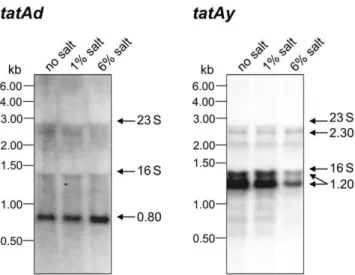
Recent studies by Eijlanderet al. [36] indicated that engineered tatAdCdexpression was able to compensate for the absence of the tatAyCygenes in the secretion of YwbN. We therefore investigated the levels oftatAdCd-andtatAyCy-specific transcripts in cells grown in LB media with varying NaCl concentrations by Northern blotting. Interestingly, we identified a 0.8 kb tatAd-specific
transcript that was detectable at comparable amounts in cells grown in the presence of 1% NaCl or without NaCl (Figure 2). When cells were grown in LB with 6% NaCl, the level of thistatAd transcript was elevated. Most likely, it corresponds to the complete tatAdgene and part of thetatCdgene (data not shown). Conversely, the levels of atatAyCy-specific transcript of,1.2 kb showed a clear
decrease in cells grown in medium with 6% salt compared to cells grown in medium with 1% salt or no salt. The same is true for sometatAyCy-specific read-through transcripts that accumulate in the zone of the rRNA bands, where the electrophoretic separation of mRNAs is somewhat impaired. The,1.2 kb transcript and the
read-through transcripts originate from a promoter immediately upstream of tatAy ([37]; data not shown). The levels of a less abundant,2.3 kb transcript corresponding tomoaC,rex,tatAyand
tatCy were not affected by growth medium salinity (Figure 2). These findings imply that the relative levels of TatAd and TatAyCy production can differ in cells grown in LB media of high or low salinity, which may explain the altered Tat component specificity observed for YwbN secretion in medium with 6% salt as shown in Figure 1. Notably, the finding that there was notatCd transcript detectable when cells were grown in LB with 6% salt Table 1.Strains and Plasmids used in this study.
Plasmids Relevant properties Reference
pGDL48 Contains multiple cloning site to place genes under the control of the erythromycin promoter; 6.8 kb; ApR; KmR [54]
pCAd pGDL48 containing thetatAdgene; 7.0 kb; ApR; KmR [36]
pCCd pGDL48 containing thetatCdgene; 7.5 kb; ApR; KmR [36]
pCACd pGDL48 containing thetatAd-tatCdoperon; 7.7 kb; ApR; KmR [36]
pCAy pGDL48 containing thetatAygene; 7.0 kb; ApR; KmR [20]
pCCy pGDL48 containing thetatCygene; 7.5 kb; ApR; KmR [20]
pCACy pGDL48 containing thetatAy-tatCyoperon; 7.7 kb; ApR; KmR [20]
pXTc Expression vector with the xylose-induciblexylApromoter; ApR; TcR [55]
pXTc-ywbN-myc pXTc with theywbN-mycgene; results in the production of YwbN with a C-terminal Myc tag This study
B. subtilis
168 trpC2 [56]
tatAy trpC2;tatAy::Em; EmR [20]
tatCy trpC2;tatCy::Sp; SpR [18]
tatAyCy trpC2;tatAy-tatCy::Sp; SpR [19]
tatCd trpC2;tatCd::Km; KmR [18]
tatAdCd trpC2;tatAd-tatCd::Km; KmR; [20]
tatAy-tatAd trpC2;tatAy::Em; EmR; tatAd::Km; KmR [20] tatCy-tatCd trpC2;tatCy::Sp; SpR;tatCd::Km; KmR
total-tat trpC2, tatAc::Em; EmR
; tatAy-tatCy::Sp; SpR
; tatAd-tatCd::Cm; CmR [19]
total-tat2 trpC2;tatAd-tatCd::Km; KmR;tatAy-tatCy::Sp; SpR;tatAc::Em; EmR [20]
168X-ywbN trpC2; amyE::xylA-ywbN-myc; CmR [19]
tatAyCy X-ywbN trpC2;tatAy-tatCy::Sp; SpR;
amyE::xylA-ywbN-myc; CmR [19]
tatAdCd X-ywbN trpC2;tatAd-tatCd::Km; KmR;amyE::xylA-ywbN-myc; CmR [19] tatAdCd X-ywbN2 trpC2;tatAd-tatCd::Cm; CmR;amyE::xylA-ywbN-myc; TcR This study
total-tat2X-ywbN trpC2;tatAd-tatCd::Km; KmR;tatAy-tatCy::Sp; SpR;tatAc::Em; EmR;amyE::xylA-ywbN-myc; CmR [19]
ywbL trpC2, ywbL::pMutin2::Em; EmR(BFA3211) [57]
ywbM trpC2, ywbM::pMutin2::Em; EmR(BFA3212) [57]
ywbN trpC2, ywbN::pMutin2::Em; EmR(BFA3213) [57]
ywbNX-ywbN trpC2, ywbN::pMutin2::Em; EmRamyE::xylA-ywbN-myc:CmR This study
indicated that TatCd has no, or only a very minor role in YwbN secretion during growth at high salinity.
Consistent with the view that TatAd has a role in YwbN secretion when cells are grown in LB medium with 6% NaCl, the plasmid-directed expression of tatAd was sufficient for full restoration of the secretion of YwbN by tatAdCd mutant cells under these conditions (Figure 3, compare the first two lanes for thetatAdCdmutant strain with the control). Furthermore, YwbN secretion under these conditions was also fully restored by the expression of plasmid-bornetatAdCdortatAyCygenes. Conversely, no restoration of YwbN secretion was observed in the tatAdCd mutant upon expression of a plasmid-bornetatCdgene alone, and YwbN secretion by the tatAdCd mutant was even completely suppressed by the presence of a plasmid-borne copy oftatCy. The reduced secretion of YwbN by atatAyCymutant grown in LB with 6% NaCl was complemented by plasmid-bornetatAyCy, but it was completely inhibited by the presence of plasmid-borne copies of either tatAy or tatCy alone (Figure 3, rightside panels). Lastly,
expression of plasmid-bornetatAdCdgenes in thetatAyCymutant did not restore secretion of YwbN, which contrasts with the afore-mentioned findings by Eijlanderet al. [36]. Taken together, these observations show that TatAd, TatAy and TatCy are involved in the Tat-dependent secretion of YwbN by cells growing in LB with 6% NaCl. This is reminiscent of the situation in Gram-negative bacteria that contain a three-component TatABC translocase. Furthermore, the results indicate that a separate expression oftatAy ortatCycan strongly interfere with YwbN secretion by cells grown at high salinity.
TatAyCy is required for optimal growth of B. subtilis and entry into stationary phase at low salinity
The experiments to monitor Tat-dependent secretion of YwbN by thetatAdCd,tatAyCyor total-tatmutant strains cultivated in LB medium without added salt revealed an unexpectedly strong growth phenotype for mutant strains lacking thetatAyand/ortatCy genes (Figure 4A and Figure S3). Compared to the parental strain
Figure 1. Tat-dependence of YwbN secretion in media with differing salinity.Cell and growth medium fractions ofB. subtilis tatmutant strains and the parental strain 168 were separated by centrifugation and used for SDS-PAGE, Western blotting and immunodetection of YwbN-Myc and LipA with specific antibodies. From top to bottom the panels show results obtained for cells grown in LB with 6%, 1% or no added NaCl. Protein loading was corrected for OD600. The YwbN-Myc (YwbN and preYwbN) and LipA proteins, and Mw markers are indicated. A slight ‘smiling effect’ as
observed for the YwbN and LipA bands in the growth medium sample of the total-tat2 mutant grown in LB with 6% NaCl is due to some residual salt in the sample (see also Figure S2).
168 andtatAdCd mutant strains, thetatAyCyand total-tat mutant strains showed significantly reduced growth rates during the exponential growth phase. Most strikingly, thetatAyCyand total-tat
mutants exhibited a lower growth yield as compared to thetatAyCy proficient strains and they were even unable to enter directly into a stationary phase of growth. Instead, mutants lacking tatAyCy displayed a severe lysis phenotype as reflected by a significant drop in the OD600 of the culture. Interestingly, the surviving tatAyCy
mutant cells resumed (or continued) growth about 1.5 hours after the onset of cell lysis, but at a lower rate than during the initial exponential growth. This growth phenotype could be reversed by complementation of the chromosomal tatAyCy mutations with plasmid-borne copies of the tatAyCygenes (Figure S3, panel B). Specifically, the growth defect of cells lackingtatAyandtatCyat low salinity was only reversed when both thetatAyandtatCygenes were present on the complementing plasmid. SincetatAyCymutant cells that had recovered from the lysis phase showed the same phenotype upon re-cultivation under low salinity conditions, it seems that the cells that resumed growth had adapted to these conditions rather than expressing a suppressor mutation. Impor-tantly, the observed phenotype revealed thatB. subtilis needs to have an active TatAyCy translocase for optimal growth and entry into stationary phase at low salinity.
TatAyCy-dependent secretion of YwbN has an important role in iron acquisition
To test whether the known TatAyCy substrate YwbN was implicated in the growth kinetics observed at low salinity, experiments were performed with a ywbN mutant. Indeed, the ywbNmutant strain displayed a similar growth phenotype as strains lackingtatAyCyin the absence of added salt (Figure 4, panels A and
Figure 2. Northern blotting analysis of tatAd and tatAy transcription in cells grown in LB media of differing salinity.
RNA isolation and Northern blotting were performed as described in the Materials and Methods section. For each sample, 5mg of RNA per
lane were loaded as indicated. Molecular markers and the positions of the 16S and 23S rRNA are indicated.
doi:10.1371/journal.pone.0018140.g002
Figure 3. Complementation analysis oftatAdCdortatAyCymutant strains grown at high salinity.Growth medium and cell fractions ofB. subtilis tatmutant strains and the parental strain 168 grown in LB with 6% added NaCl were separated and used for SDS-PAGE, Western blotting and immunodetection of YwbN-Myc and LipA using specific antibodies. ThetatAdCdortatAyCymutant strains (marked at the bottom of the Figure) were complemented with plasmid-bornetatgenes as indicated at the top of the Figure. The plasmids used for this purpose were pCAd, pCCd, pCACd, pCAy, pCCy, pCACy (see Table 1). Note that thetatAdCdmutant strains contained an X-ywbNcassette in which the original CmRmarker had been replaced by a TcRmarker (tatAdCdX-ywbN
2), whereas the 168 strain and thetatAyCymutant strains contained the previously published X-ywbN
B; Figure S3, panel C), while its growth phenotype was normal in the presence of 1% salt (Figure S3, panel F). Furthermore, the growth phenotype of theywbN mutant strain was fully comple-mented by xylose-induced ectopic expression of a copy of ywbN-Mycthat was integrated into the chromosomalamyElocus (Figure S3, panel C). Consistent with these findings, the secretion of Myc-tagged YwbN was strictly dependent on TatAyCy under conditions of low salinity (Figure 1, lower panels). SinceywbNis part of a well-conserved cluster of three genes of which the two other genes,ywbLandywbM, have been implicated in iron uptake [20,38,39], we also investigated whether ywbL or ywbMmutant strains have a growth defect at low salinity. Indeed, this was the case (Figure 4B; Figure S3, panel C), suggesting that YwbL (a homologue of known iron permeases) and YwbM (a lipoprotein), as well as TatAyCy-dependently secreted YwbN could be required for the uptake of sufficient amounts of iron to sustain growth under conditions of low salinity. To test this idea, all growth experiments at low salinity were repeated in the presence of 10mM FeCl3
(Figure S3, panel D) or FeSO4(Figure S3, panel E). The results
showed that addition of 10mM Fe2+to the low salinity LB medium strongly stimulated the growth of thetatAyCy,ywbL,ywbM, orywbN mutants to levels that were indistinguishable from growth in the presence of 1% salt (Figure S3, compare panels E and F). Importantly, the addition of FeSO4totatAyCyor total-tatmutant
cells growing exponentially in LB without salt completely prevented the occurrence of the lysis phase (Figure S4). This implies that the resumed growth after the lysis phase is most likely due to the release of iron by the lysed cells that can then be used by the surviving cells to resume or continue growth. The addition of 10mM Fe3+
to the low salinity medium had only a moderately stimulating effect on the growth of thetatAyCy, ywbM or ywbN mutant strains, while Fe3+
had barely any growth-promoting effect on theywbLmutant strain (Figure S3, panel D). Limited rescue of the mutants by addition of Fe3+
is consistent with the previously reported lack of Fe3+-specific bacillibactin-dependent iron acqui-sition in the B. subtilis 168 strain [40], while excess of Fe2+ is directed towards low affinity uptake by divalent cation importers [41,42]. The results imply that YwbL is the decisive Fe3+permease for elemental iron uptake as previously suggested [43], and that theB. subtilisTatAyCy translocase and its substrate YwbN are of pivotal importance for the acquisition of iron during growth at low salinity. Since this suggests a possible general role for theB. subtilis Tat pathway in growth under iron-limited conditions, we tested the growth of two independently constructed B. subtilis total-tat mutants in synthetic iron-limited BOC medium. The results in Figure 4C show that, indeed, the growth rates of total-tatmutants in BOC medium were significantly lower than that of the parental strain 168. This growth defect was largely relieved by the addition of 10mM Fe2+
to the medium (Figure 4C), showing that theB. subtilisTat pathway is required for optimal growth under iron-limited conditions.
Discussion
In the present studies we have addressed the question as to whether the salinity of the growth medium is a determinant in Tat-dependent secretion of the YwbN protein byB. subtilis. The results show that this is indeed the case. Intriguingly, high growth medium
Figure 4. Growth phenotypes oftatAyCyandywbLMNmutant strains at low salinity. A. Growth of theB. subtilisstrainstatAdCd
(filled rectangles),tatAyCy(open triangles), and 168 (open squares) in LB medium without NaCl. B. Growth ofB. subtilis strains ywbN (open circles), ywbN XywbN plus xylose (closed rectangles), ywbL (closed
diamonds), tatAyCy (open triangles), and 168 (open squares) in LB medium without NaCl. C. Growth of the B. subtilis strains total-tat
(triangles), total-tat2(circles) and 168 (squares) in BOC medium: open symbols, no added iron; closed symbols, addition of 10mM FeSO4.
salinity had a strong impact on the specificity of the Tat pathway of B. subtilis, as shown by the role of the TatAd component in YwbN secretion. The observation that, at high salinity, TatAd was involved in YwbN secretion to a similar extent as TatAyCy implies that the TatAd, TatAy and TatCy subunits ofB. subtiliscan cooperate under these conditions. This contrasts strongly with the previously demonstrated exclusive dependence of YwbN secretion on the TatAyCy translocase, when cells were grown in LB with 1% salt [20]. It was recently reported that YwbN can be secreted in a TatAdCd-dependent manner by cells growing in LB medium with 1% NaCl. However, this only occurs when the TatAdCd translo-case is produced ectopically from plasmid-bornetatAdCdgenes [36]. In this somewhat artificial situation, TatAdCd was able to sustain YwbN secretion in the absence of TatAyCy, which is clearly not the case for the parental 168 strain growing at high salinity (Figure 3, last lane), where cooperation between TatAd, TatAy and TatCy appears to be necessary for optimal YwbN secretion via Tat. Interestingly, our Northern blotting analyses indicate thatB. subtilis is able to fine-tune the levels of TatAd, TatAy and TatCy in cells grown in high salinity medium through an as yet unidentified transcriptional regulatory mechanism. The present findings thus show that the TatAd subunit is not only involved in Tat-dependent protein secretion upon phosphate starvation, but also when high levels of salt are present in the growth medium. To date, it is not known whether the observed cooperativity between TatAd, TatAy and TatCy is triggered directly by high levels of salt (e.g.high ionic strength), or by the altered expression levels oftatAdandtatAyCy.
Cells grown at high salinity secreted substantial amounts of YwbN in a Tat-independent manner. Most likely, this YwbN secretion takes place via the B. subtilis Sec pathway since this pathway has been shown to accept proteins with RR-signal peptides [44]. We attempted to confirm the involvement of Sec in the Tat-independent secretion of YwbN by growing cells in the presence of the SecA inhibitor sodium azide. Unfortunately however, sodium azide interfered significantly with the growth of B. subtilis in LB with 6% salt making it impossible to carefully verify a role for the Sec pathway in YwbN secretion. Furthermore, it is presently difficult to say whether the observed Tat-independent secretion of YwbN under high salinity growth conditions relates to indirect effects of these growth conditions on the pre-translocational folding or assembly of YwbN. Since the internal NaCl concentration is unlikely to change in a significant way when cells are grown in LB medium with 6% salt, any possible folding or assembly defects of YwbN could perhaps relate to changes in the intracellular concentrations of as yet unidentified salt stress-dependent proteins, compatible solutes (osmolytes) or ions [45,46]. Clearly, impaired folding of pre-YwbN would make this protein a potential substrate for the Sec pathway.
The present experiments revealed an essential role of the TatAyCy-secreted YwbN in the acquisition of iron during growth in LB at low salinity and in iron-limiting synthetic BOC medium. At low salinity, the growth defects and post-exponential growth lysis phenomenon oftatAyCyorywbNmutants could be fully suppressed by the addition of Fe2+
, and to a lesser extent Fe3+
, to the growth medium. This implies that cells lacking TatAyCy and/or YwbN are iron-starved at low salinity. The same turned out to be true for cells lacking the lipoprotein YwbM and the integral membrane protein YwbL. Interestingly, theE. colihomologue of YwbM, named EfeO, is a periplasmic protein that has been implicated in high-affinity iron-binding [37]. YwbL is a homologue of the EfeU iron permease in the E. coliinner membrane [37,47], and the high-affinity iron permease Ftr1p of fungi and yeast [48]. While Ftr1p is an Fe3+ permease [48,49], EfeU was shown to permeate Fe2+
in vitrointo proteoliposomes [47]. The present study shows impaired growth of
aywbLmutant in the presence of Fe3+
, but not in the presence of Fe2+
, indicating thatB. subtilisYwbL is specific for Fe3+
uptake like Ftr1p. Taken together, our findings show that severe iron limitation is the reason why cells lacking YwbLMN or TatAyCy grow at reduced rates in low salinity LB medium, and start to lyse instead of entering the stationary growth phase. The finding that such mutants resume growth after the lysis phase indicates that cell lysis results in the liberation of iron, which can be reused by the surviving cells. This view is confirmed by the observation that the lysis phenomenon can be largely prevented if iron is added to the culture during exponential growth. The precise role of YwbN in making iron available for the cells is not entirely clear but, being a homologue of the Dyp-type iron-dependent peroxidase EfeB, it seems most likely that this enzyme is involved in oxidation of Fe2+ for subsequent uptake of Fe3+by YwbL, which is analogous to the yeast Fet3p-Ftr1p high-affinity iron uptake system [27,37]. Furthermore, recent studies have shown that EfeB ofE. coli can extract iron from heme without affecting the protoporphyrin ring [50], which suggests a role forB. subtilisYwbN in the liberation of complexed iron. A function of YwbN in iron metabolism in B. subtilis is fully consistent with the finding by Helmann and co-workers that the ywbN gene is part of the Fur regulon [43]. By contrast,tatAyCydoes not seem to be controlled by Fur, which is consistent with a ‘‘mainstream’’ role in Tat-dependent protein translocation, as documented in the present studies. It is remarkable to note that an iron starvation response was previously documented forB. subtiliscells grown at high salinity [51,52]. This apparent iron limitation at high salinity growth conditions did not result in a requirement for the TatAyCy translocase or YwbLMN as observed under low salinity growth conditions. However, it should be noted thattatAyCymutants do secrete YwbN when grown in LB medium with 6% NaCl, which might suffice for iron acquisition.
Taken together, our present results show for the first time that environmental salinity is a critical determinant for Tat-dependent protein secretion inB. subtilis.Depending on the salinity levels, the YwbN protein is seemingly directed from the Tat pathway into the Sec pathway. This observation is reminiscent of our previous observation that theB. subtilisesterase LipA can be redirected from the Sec to the Tat pathway under conditions of hyperproduction viaan overflow mechanism [29]. This suggests that there may be additional, as yet unidentified factors that can impact on the choice between Sec or Tat pathway usage. A parameter that can impact strongly on the rates of protein (un-)folding is temperature. Nevertheless, growth temperature by itself does not seem to be a factor determining secretion pathway dependency, since we did not detect any obvious differences in Tat-dependence of YwbN secretion when cells were grown at 15, 30, 37 or 48uC (unpublished observations). However, being an organism that lives in the soil, B. subtilis can be exposed to a plethora of environmental insults that may either directly influence the activity and specificity of the Tat translocases, or that may indirectly impact on the pre-translocational folding of secretory precursor proteins. We are therefore convinced that more proteins will use the Sec and/or Tat pathways ofB. subtilisin a growth condition-dependent manner. Identification of such conditions will be of interest not only from a fundamental scientific point of view, but also for the biotechnological application of B. subtilis as a cell factory for the production of high-value proteins.
Materials and Methods
Luria Bertani (LB) medium consisting of 1% tryptone, 0.5% yeast extract and 0%, 1% or 6% added NaCl, pH 7.4. Belitsky minimal medium without citrate (BOC medium) was prepared as described [53]. If appropriate, media for were supplemented with the following antibiotics: erythromycin (Em), 2mg ml21; chloramphenicol (Cm), 5mg ml21; tetracycline (Tc), 10mg ml21; spectinomycin (Sp), 100mg ml21; kanamycin (Km), 20mg ml21.
Growth experiments
Strains were pre-cultured in LB medium containing 1% NaCl and subsequently diluted in LB medium without salt or with 1% or 6% NaCl to an optical density at 600 nm (OD600) of ,0.01.
Growth was continued in triplicate wells of a 96-well microtiter plate (Greiner) that was incubated in a Biotek Synergy 2 plate reader (37uC, variable shaking). OD600readings were recorded for
8 or 14 hours.
SDS-PAGE and Western blotting
Cells were separated from the growth medium by centrifuga-tion. Cellular or secreted proteins were separated by SDS-PAGE using pre-cast Bis-Tris NuPAGE gels (Invitrogen). Separated proteins were stained with SYPRO Ruby protein gel stain (Molecular Probes Inc.). The presence of YwbN-Myc, LipA, or TrxA in cellular or growth medium fractions was detected by Western blotting. For this purpose, proteins separated by SDS-PAGE were semi-dry blotted (75 min at 1 mA/Cm2) onto a nitrocellulose membrane (ProtranH, Schleicher & Schuell). Subse-quently, the LipA and TrxA proteins were detected with specific polyclonal antibodies raised in rabbits. YwbN-Myc was detected with monoclonal antibodies against the Myc-tag (Gentaur). Visualisation of bound antibodies was performed with fluorescent IgG secondary antibodies (IRDye 800 CW goat anti-rabbit or goat anti-mouse from LiCor Biosciences) in combination with the Odyssey Infrared Imaging System (LiCor Biosciences). Fluores-cence was recorded at 800 nm. Quantification of the recorded data was done using the ImageJ software package (http://rsbweb. nih.gov/ij/).
Northern blotting analyses
For Northern blotting, cells from overnight cultures in LB medium with 1% NaCl were used to inoculate LB medium without NaCl or with 1% or 6% NaCl. Growth was continued till an OD600 of ,2 and then the cells were harvested for RNA
extraction and blotting. Preparation of total RNA and Northern blot analysis using specific RNA probes were performed as described previously [29]. The RNA preparations (5 or 10mg per lane) were separated electrophoretically in a 1.2% agarose gel. After hybridization of the blotted RNA with gene-specific probes, chemiluminescence was detected using a Lumi-Imager (Roche Diagnostics). Transcript sizes were determined by comparison with an RNA size marker (Fermentas RiboRuler High Range RNA Ladder). Digoxygenin-labeled specific RNA probes were synthesized byin vitrotranscription using T7 RNA polymerase and a specific PCR product as template. Synthesis of the DNA template was performed by PCR using the following pairs of oligonucleotides: tatAd-for (59-ATGTTTTCAAACATTGGAAT-39) and tatAd-rev (59-CTAATACGACTCACTATAGGGA-GAGCCCGCGTTTTTGTCCTGCT-39), tatAy-for (59- ATGC-CGATCGGTCCTGGAAG-39) and tatAy-rev (59-CTAATAC- GACTCACTATAGGGAGACTGATCTTCTTTCTTTTTTT-39). The underlined sequence indicates the T7 promoter region.
Supporting Information
Figure S1 TrxA control for cell lysis in media with differing salinity. Cell and growth medium fractions of B. subtilis tat mutant strains and the parental strain 168 were separated by centrifugation and used for SDS-PAGE, Western blotting and immunodetection of the cytoplasmic marker protein TrxA with specific antibodies. The panels show results obtained for cells grown in LB with 1% or 6% NaCl. Protein loading was corrected for OD600. The positions of TrxA and Mw markers are
indicated. The samples correspond to those of the experiment depicted in Figure 1. No TrxA can be detected in the growth medium fractions indicating that cell lysis was negligible in this experiment.
(TIF)
Figure S2 Tat-dependence of YwbN secretion in media with differing salinity.Cell and growth medium fractions ofB. subtilis tat mutant strains and the parental strain 168 were separated by centrifugation and used for SDS-PAGE and Sypro Ruby staining (left panels) or SDS-PAGE, Western blotting and immunodetection of YwbN-Myc and LipA with specific antibodies (right panels). From top to bottom the panels show results obtained for cells grown in LB with 6%, 1% or no added NaCl. Protein loading was corrected for OD600. The YwbN-Myc (YwbN) and
LipA proteins, and Mw markers are indicated. A slight ’smiling effect’ as observed for the YwbN and LipA bands in the growth medium sample of the total-tat2 mutant grown in LB with 6% NaCl is due to some residual salt in the sample (compare also left and right panels). The samples correspond to those of the experiment depicted in Figure 1.
(TIF)
Figure S3 Growth phenotypes oftatAyCyandywbLMN
mutant strains at low salinity.B. subtilis tatmutant strains or the parental strain 168 were grown for 7.5 to 14 hours in LB medium without NaCl (panelsA-E), or 1% NaCl (panelF). For the experiments in panelD, LB medium was supplemented with 10 mM FeCl3, and for the experiments in panelFwith 10mM FeSO4
(panelE).A. Growth of tat mutant strains:tatAd tatAy (+), tatCd (filled diamonds),tatCy (filled triangles),tatCd tatCy (filled circles), tatAdCd(filled rectangles),tatAyCy(open triangles), total-tat2 (filled squares). Parental strain 168 (open squares). B. Growth of the tatAyCy mutant strain complemented with tatAy (pCAy; open triangles), tatCy (pCCy; X), or tatAyCy (pCACy; filled circles). Controls: tatAyCy mutant with empty vector pGDL48 (closed squares), parental strain 168 (open squares). C-F. Growth of mutant strains:tatAyCy (open triangles),ywbL (closed diamonds), ywbM(X),ywbN(open circles),ywbNXywbN(no xylose; +),ywbN XywbN(plus xylose; closed rectangles). Control: parental strain 168 (open squares).
(TIF)
Figure S4 Iron additions can prevent the growth defects oftatAyCyand total-tatmutantB. subtilisstrains in LB medium without salt. B. subtilis tat mutant strains or the parental strain 168 were grown for 11 hours in LB medium without NaCl. Growth was monitored by OD600readings. The
cultures were supplemented with 100mM FeCl3or 100mM FeSO4
filled circles, FeSO4was added at T1; filled squares, FeCl3 was
added at T2; crosses, FeSO4was added at T2.
(TIF)
Acknowledgments
We thank Dirk Ho¨per for early stage contributions to the present studies, Robyn Eijlander and Oscar Kuipers for plasmids and strains, Jette Anklam for technical assistance, and Thijs Kouwen, Albert Bolhuis and Erhard Bremer for helpful discussions.
Author Contributions
Conceived and designed the experiments: RvdP UM GH ELD MM JMvD. Performed the experiments: RvdP MS ELD CGM MM TW HA. Analyzed the data: RvdP UM GH HA JMvD. Contributed reagents/ materials/analysis tools: GH MAM CRH MH JMvD. Wrote the paper: RvdP UM MM HA JMvD.
References
1. Robinson C, Bolhuis A (2004) Tat-dependent protein targeting in prokaryotes and chloroplasts. Biochim Biophys Acta 1694: 135–147.
2. Palmer T, Sargent F, Berks BC (2005) Export of complex cofactor-containing proteins by the bacterial Tat pathway. Trends Microbiol 13: 175–180. 3. Driessen AJ, Nouwen N (2008) Protein translocation across the bacterial
cytoplasmic membrane. Annu Rev Biochem 77: 643–667.
4. Natale P, Bruser T, Driessen AJ (2008) Sec- and Tat-mediated protein secretion across the bacterial cytoplasmic membrane—distinct translocases and mecha-nisms. Biochim Biophys Acta 1778: 1735–1756.
5. Sargent F (2007) The twin-arginine transport system: moving folded proteins across membranes. Biochem Soc Trans 35: 835–847.
6. Berks BC, Sargent F, Palmer T (2000) The Tat protein export pathway. Mol Microbiol 35: 260–274.
7. DeLisa MP, Tullman D, Georgiou G (2003) Folding quality control in the export of proteins by the bacterial twin-arginine translocation pathway. Proc Natl Acad Sci U S A 100: 6115–6120.
8. Panahandeh S, Maurer C, Moser M, Delisa MP, Muller M (2008) Following the path of a twin-arginine precursor along the TatABC translocase of Escherichia coli. J Biol Chem 283: 33267–33275.
9. Wexler M, Bogsch EG, Klosgen RB, Palmer T, Robinson C, et al. (1998) Targeting signals for a bacterial Sec-independent export system direct plant thylakoid import by the delta pH pathway. FEBS Lett 431: 339–342. 10. Berks BC (1996) A common export pathway for proteins binding complex redox
cofactors? Mol Microbiol 22: 393–404.
11. Chaddock AM, Mant A, Karnauchov I, Brink S, Herrmann RG, et al. (1995) A new type of signal peptide: central role of a twin-arginine motif in transfer signals for the delta pH-dependent thylakoidal protein translocase. Embo J 14: 2715–2722.
12. Brink S, Bogsch EG, Edwards WR, Hynds PJ, Robinson C (1998) Targeting of thylakoid proteins by the delta pH-driven twin-arginine translocation pathway requires a specific signal in the hydrophobic domain in conjunction with the twin-arginine motif. FEBS Lett 434: 425–430.
13. Stanley NR, Palmer T, Berks BC (2000) The twin arginine consensus motif of Tat signal peptides is involved in Sec-independent protein targeting in Escherichia coli. J Biol Chem 275: 11591–11596.
14. Cristobal S, de Gier JW, Nielsen H, von Heijne G (1999) Competition between Sec- and TAT-dependent protein translocation in Escherichia coli. Embo J 18: 2982–2990.
15. DeLisa MP, Samuelson P, Palmer T, Georgiou G (2002) Genetic analysis of the twin arginine translocator secretion pathway in bacteria. J Biol Chem 277: 29825–29831.
16. Sargent F, Bogsch EG, Stanley NR, Wexler M, Robinson C, et al. (1998) Overlapping functions of components of a bacterial Sec-independent protein export pathway. Embo J 17: 3640–3650.
17. Bogsch EG, Sargent F, Stanley NR, Berks BC, Robinson C, et al. (1998) An essential component of a novel bacterial protein export system with homologues in plastids and mitochondria. J Biol Chem 273: 18003–18006.
18. Jongbloed JD, Martin U, Antelmann H, Hecker M, Tjalsma H, et al. (2000) TatC is a specificity determinant for protein secretion via the twin-arginine translocation pathway. J Biol Chem 275: 41350–41357.
19. Jongbloed JD, Antelmann H, Hecker M, Nijland R, Bron S, et al. (2002) Selective contribution of the twin-arginine translocation pathway to protein secretion in Bacillus subtilis. J Biol Chem 277: 44068–44078.
20. Jongbloed JD, Grieger U, Antelmann H, Hecker M, Nijland R, et al. (2004) Two minimal Tat translocases in Bacillus. Mol Microbiol 54: 1319–1325. 21. Jongbloed JD, van der Ploeg R, van Dijl JM (2006) Bifunctional TatA subunits in
minimal Tat protein translocases. Trends Microbiol 14: 2–4.
22. Bolhuis A, Mathers JE, Thomas JD, Barrett CM, Robinson C (2001) TatB and TatC form a functional and structural unit of the twin-arginine translocase from Escherichia coli. J Biol Chem 276: 20213–20219.
23. Cline K, Mori H (2001) Thylakoid DeltapH-dependent precursor proteins bind to a cpTatC-Hcf106 complex before Tha4-dependent transport. J Cell Biol 154: 719–729. 24. Alami M, Luke I, Deitermann S, Eisner G, Koch HG, et al. (2003) Differential interactions between a twin-arginine signal peptide and its translocase in Escherichia coli. Mol Cell 12: 937–946.
25. Mori H, Cline K (2002) A twin arginine signal peptide and the pH gradient trigger reversible assembly of the thylakoid [Delta]pH/Tat translocase. J Cell Biol 157: 205–210.
26. Yen MR, Tseng YH, Nguyen EH, Wu LF, Saier MH, Jr. (2002) Sequence and phylogenetic analyses of the twin-arginine targeting (Tat) protein export system. Arch Microbiol 177: 441–450.
27. Sturm A, Schierhorn A, Lindenstrauss U, Lilie H, Bruser T (2006) YcdB from Escherichia coli reveals a novel class of Tat-dependently translocated hemoproteins. J Biol Chem 281: 13972–13978.
28. Widdick DA, Eijlander RT, van Dijl JM, Kuipers OP, Palmer T (2007) A Facile Reporter System for the Experimental Identification of Twin-Arginine Translocation (Tat) Signal Peptides from All Kingdoms of Life. J Mol Biol. 29. Kouwen TR, van der Ploeg R, Antelmann H, Hecker M, Homuth G, et al.
(2009) Overflow of a hyper-produced secretory protein from the Bacillus Sec pathway into the Tat pathway for protein secretion as revealed by proteogenomics. Proteomics.
30. Rose RW, Bruser T, Kissinger JC, Pohlschroder M (2002) Adaptation of protein secretion to extremely high-salt conditions by extensive use of the twin-arginine translocation pathway. Mol Microbiol 45: 943–950.
31. Bolhuis A (2002) Protein transport in the halophilic archaeon Halobacterium sp. NRC-1: a major role for the twin-arginine translocation pathway? Microbiology 148: 3335–3346.
32. Thomas JR, Bolhuis A (2006) The tatC gene cluster is essential for viability in halophilic archaea. FEMS Microbiol Lett 256: 44–49.
33. Hutcheon GW, Bolhuis A (2003) The archaeal twin-arginine translocation pathway. Biochem Soc Trans 31: 686–689.
34. Dilks K, Gimenez MI, Pohlschroder M (2005) Genetic and biochemical analysis of the twin-arginine translocation pathway in halophilic archaea. J Bacteriol 187: 8104–8113.
35. Gimenez MI, Dilks K, Pohlschroder M (2007) Haloferax volcanii twin-arginine translocation substates include secreted soluble, C-terminally anchored and lipoproteins. Mol Microbiol 66: 1597–1606.
36. Eijlander RT, Jongbloed JD, Kuipers OP (2009) Relaxed specificity of the Bacillus subtilis TatAdCd translocase in Tat-dependent protein secretion. J Bacteriol 191: 196–202.
37. Rasmussen S, Nielsen HB, Jarmer H (2009) The transcriptionally active regions in the genome of Bacillus subtilis. Mol Microbiol 73: 1043–1057.
38. Cao J, Woodhall MR, Alvarez J, Cartron ML, Andrews SC (2007) EfeUOB (YcdNOB) is a tripartite, acid-induced and CpxAR-regulated, low-pH Fe2+ transporter that is cryptic in Escherichia coli K-12 but functional in E. coli O157:H7. Mol Microbiol 65: 857–875.
39. Biswas L, Biswas R, Nerz C, Ohlsen K, Schlag M, et al. (2009) Role of the twin-arginine translocation pathway in Staphylococcus. J Bacteriol 191: 5921–5929. 40. May JJ, Wendrich TM, Marahiel MA (2001) The dhb operon of Bacillus subtilis encodes the biosynthetic template for the catecholic siderophore 2,3-dihydrox-ybenzoate-glycine-threonine trimeric ester bacillibactin. J Biol Chem 276: 7209–7217.
41. Hantke K (1997) Ferrous iron uptake by a magnesium transport system is toxic for Escherichia coli and Salmonella typhimurium. J Bacteriol 179: 6201–6204. 42. Moore CM, Helmann JD (2005) Metal ion homeostasis in Bacillus subtilis. Curr
Opin Microbiol 8: 188–195.
43. Ollinger J, Song KB, Antelmann H, Hecker M, Helmann JD (2006) Role of the Fur regulon in iron transport in Bacillus subtilis. J Bacteriol 188: 3664–3673. 44. Kolkman MA, van der Ploeg R, Bertels M, van Dijk M, van der Laan J, et al.
(2008) The twin-arginine signal peptide of Bacillus subtilis YwbN can direct either Tat- or Sec-dependent secretion of different cargo proteins: secretion of active subtilisin via the B. subtilis Tat pathway. Appl Environ Microbiol 74: 7507–7513.
45. Hoper D, Bernhardt J, Hecker M (2006) Salt stress adaptation of Bacillus subtilis: a physiological proteomics approach. Proteomics 6: 1550–1562. 46. Bursy J, Pierik AJ, Pica N, Bremer E (2007) Osmotically induced synthesis of the
compatible solute hydroxyectoine is mediated by an evolutionarily conserved ectoine hydroxylase. J Biol Chem 282: 31147–31155.
47. Grosse C, Scherer J, Koch D, Otto M, Taudte N, et al. (2006) A new ferrous iron-uptake transporter, EfeU (YcdN), from Escherichia coli. Mol Microbiol 62: 120–131.
48. Kosman DJ (2003) Molecular mechanisms of iron uptake in fungi. Mol Microbiol 47: 1185–1197.
50. Letoffe S, Heuck G, Delepelaire P, Lange N, Wandersman C (2009) Bacteria capture iron from heme by keeping tetrapyrrol skeleton intact. Proc Natl Acad Sci U S A 106: 11719–11724.
51. Hoffmann T, Schutz A, Brosius M, Volker A, Volker U, et al. (2002) High-salinity-induced iron limitation in Bacillus subtilis. J Bacteriol 184: 718–727. 52. Steil L, Hoffmann T, Budde I, Volker U, Bremer E (2003) Genome-wide
transcriptional profiling analysis of adaptation of Bacillus subtilis to high salinity. J Bacteriol 185: 6358–6370.
53. Miethke M, Klotz O, Linne U, May JJ, Beckering CL, et al. (2006) Ferri-bacillibactin uptake and hydrolysis in Bacillus subtilis. Mol Microbiol 61: 1413–1427.
54. Tjalsma H, Bolhuis A, van Roosmalen ML, Wiegert T, Schumann W, et al. (1998) Functional analysis of the secretory precursor processing machinery of
Bacillus subtilis: identification of a eubacterial homolog of archaeal and eukaryotic signal peptidases. Genes Dev 12: 2318–2331.
55. Darmon E, Dorenbos R, Meens J, Freudl R, Antelmann H, et al. (2006) A disulfide bond-containing alkaline phosphatase triggers a BdbC-dependent secretion stress response in Bacillus subtilis. Appl Environ Microbiol 72: 6876–6885.
56. Kunst F, Ogasawara N, Moszer I, Albertini AM, Alloni G, et al. (1997) The complete genome sequence of the gram-positive bacterium Bacillus subtilis. Nature 390: 249–256.