Multi-fractal Analysis for Riemann Serie and Mandelbrot
Binomial Measure with
(
min
,
+
)
-Wavelets
M. GONDRAN1, A. KENOUFI2* and T. LEHNER3
Received on September 29, 2014 / Accepted on August 9, 2016
ABSTRACT.One introduces first the so-called(min,+)-wavelets which are lower and upper hulls build from(min,+)analysis in order to perform multi-fractal analysis. In a second step it is applied to func-tions such as the Riemann serie and binomial Mandelbrot measure for numerical computafunc-tions of their singularities spectrum, and comparisons with well-known theoretical and to WTMM method results.
Keywords:(min,+)-wavelets, fractal and multi-fractal analysis, H¨older exponent, scaling function, singu-larities spectrum.
1 INTRODUCTION
In the end of the 19thand in the beginning of the 20thcenturies, many mathematicians studied the behaviour of functions which are continuous everywhere and nowhere differentiable such as Weierstrass functions [43], or brownian motions [18] for instance. Their common features is to be irregular in the same way everywhere. Those properties have been formalised by Mandelbrot within the fractal theory.
Before him, Kolmogorov [21, 22], Kadanoff [19, 24] and others have already builded models and theories to explain some phenomena in physics exhibiting such kind of irregularities with scale invariant properties [20]. Particularly, Kolmogorov modelled in his famous K41’s theory, small fluctuations of flow spatial velocity fieldvbetween two pointsxandx+lin a domain⊂R3
expressed inLqnorm,q ∈N∗, with fractional Brownian motion and Hurst exponentH∈R+∗:
vlqLq =
v(x+l)−v(x)qd3x∼ lξv(q), (1.1)
and he found that thescaling functionξvbehaves asξv(q)=H qwithH = 13whenl →0, where · is the euclidianR3-norm.
*Corresponding author: Abdelouahab Kenoufi.
1University Paris-Dauphine (Lamsade), Paris, France. E-mail: [email protected]
Some recent experiments have exhibited the so-called intermittency phenomenon which is charactherised by the fact that ξv is much more complex than in K41’s theory, and exhibits particular properties such as concavity [14]. In fluid turbulence, intermittency is defined as the existence of observed strong fluctuations at small scales, it causes the deviation to the turbulence statistics due to the Kolmogorov prediction [21] which mainly relies on self-similarity. The first generalization of self-similarity as “refined similarity hypothesis” to account for possible non Gaussianity of the velocity field has been proposed by Kolmogorov and Oboukhov [22, 35]. It is believed that the origin of intermittency may come from the coupling between inertial and dissipate scales in spectralk-space, which is the usual reciprocal (Fourier) space [20, 21, 22, 35, 40], this can be shown by using a refined self similarity approach [34], but our comprehension remains still elusive. Some other models have been recently proposed such as a phenomenolog-ical theory relying on the so-called singularity spectrum in both the Eulerian (spatial) and the related Lagrangian (temporal) description of the fluid velocity [23]. In 1985, Frisch and Parisi proposed to explain such scaling function’s behavior in a heuristic way, in order to link the fast fluctuations of the flow velocity field regularity to the H¨older exponents variations [40].
Multi-fractal analysis or approach (MFA) is a well-suited way to study and quantify those local variations [1, 4, 6, 7, 8, 10, 11, 19, 25, 26, 42]. Historically, it was introduced first in mathe-matical and theoretical physics to understand local behaviour and invariant scaling properties of functions, measures, and stochastic process trajectories [4, 6, 18, 32, 39, 43]. BeforeMFA, it was admitted that fractality was the possible signature of an underlying well-organised structure. But some mathematical researches have invalidated this approach and showed that natural and experimental signals are in general fractal, fractality is thus just a special case of multi-fractal behavior [2, 6, 26].
This has opened a new branch of applied and computational mathematics in order to study phe-nomena which exhibit spatial and/or time dynamical structures such as in physics and chemistry, geophysics, astrophysics, telecommunications, meteorology, biology, economics and finance for instance. A good review is given in [1, 6].
2 FRACTALS
2.1 Self-similar sets and Hausdorff dimension
According to B. Mandelbrot [26],a fractal is an object a part of which is in some way similar to the whole. Fractal objects are present everywhere in Nature. The fractal behavior is common to hydrodynamic turbulence [26, 37], the Feynman paths in quantum mechanics [9], financial time series [36], terrestrial landscape and thin film surfaces [3, 5], etc. The most remarkable mathematical examples of fractal sets are: triadic Cantor set, Sierpinski gasket, Koch triadic curve etc (see e.g. [12] for more detailed account).
In contrast to classical geometrical objects, the dimension of a fractal set is not an integer number. For a classical object, if covered with balls (or boxes) of sizeδ, the total number of balls required for the minimal covering increases as
N(δ)∼δ−D, forδ→0. (2.1)
For regular geometrical objects the dimension Dis always integer: D = 1 for line, D = 2 for surface, etc. In general case D may, or may not be an integer. It is then convenient to characterize fractal sets by the power behavior of corresponding measures. Let us consider a setAand a functionM(d)=
iδd, which is a measure defined on the coverage of the setA
byδ-balls,δ → 0. If there exists suchd ∈ R, that the measure Md(A)has a discontinuity at
d =DF
lim δ→0Md(
A)=
xi∈A
δdx
i ∼N(δ)δ
d =
0 for d >DF
∞ for d <DF, , (2.2)
the setAis said to have Hausdorff (or fractal) dimensionDH.
For example, the fractal dimension of the 13-Cantor set is easily derived from its construction procedure. In thei-th generation as shown in Figure 1, we haveN = 2i equal parts of length
l =3−i. Thus, one getsN =2i =2−ln 3lnl =exp(−ln 2/ln 3)⇒DH = ln 2
ln 3 ≈0.6309. DF is less than 1, which is the dimension of a differentiable curve[6, 39].
2.2 Multifractals
The theory of multi-fractals (fractal objects), with the dimensions of subsets dependent on the singularity strengths – stems from the Mandelbrot papers and was developed by several au-thors [10, 37].
2.2.1 H¨older exponents and multi-fractal spectrum
There are two types of fractals: regular(or geometric) fractals, as those mentioned above, and
random fractals[41], i.e. self-similar objects without any regular geometrical structure, e.g. the path of Brownian particle. Both of them are characterized bysingularity strength(or Lipschitz-H¨older exponent) and the fractal (Hausdorff) dimensions D(α)of all subsetsIα with the singu-larity strength equal toα. Some functions can exhibit different properties of regularity at each point. Usually some notions such as continuity and derivability at a point are used to quantify the regularity of a function. H¨older exponent is a well-suited quantity which permits to merge and link such pointwise properties. Let’s remind first some definitions.
Definition 1.Letx∈Rm, f ∈ L∞loc(Rm,Rn). f ∈Cα(x)if and only if it exists a constant C>0 andα∈ [0,1], such as forysufficiently close tox,f(y)− f(x) ≤Cy−xα.
Definition 2.H¨older exponent hf of a function f at pointx∈Rmis defined as hf(x)=sup{α≥
0: f ∈Cα(x)}
Definition 3. The iso-H¨older exponents of h-order singularities for a function f is defined as Sf(h)= {x:hf(x)=h}.
Remark 1. Since some interesting phenomena exhibit setsSf(h)which are often fractal, dense
or random, therefore the Lebesgue measure and the Minskowski dimension are not well-suited to distinguish different Sf(h) [6]. Thus, the relevant dimension which has to be used is the
Hausdorff dimension dimH.
Definition 4. The multi-fracal (or singularities) spectrum Df of a function f is defined as the real positive number Df(h)=dimHSf(h).
Definition 5.If Df is constant according to h, the signal will be called mono-fractal.
2.2.2 Heuristic approach of multi-fractal analysis
The most educational and simple example to figure out what multi-fractal sets are, is the heuristic approach of Frisch and Parisi in hydrodynamic turbulence. They postulated that for a particular
h and for each pointx ∈ Sf(h), the small fluctuations of the flow velocity fieldv between the
two pointsxandx+lbehave like
v(x+l)−v(x) ∼ lh.
IfDv(h) >0, one can state from (1.1) and with geometrical arguments that
vlqLq =
v(x+l)−v(x)qd3x
∼
lqh−Dv(h)+3dh= lξv(q)
Forl →0, the main contribution to this integral is obtained for
ξv(q)= min
h∈[0,1]{qh−Dv(h)+3},
which shows thatξv is the Legendre transform ofDv, and explains therefore its concavity. Its inverse Legendre transform has the same property of concavity since
Dv(h)=min
q∈R{qh−ξv(q)+3}. (2.3)
This heuristic approach can be generalized for functions f :Rm →R:
ξv(q)= min
h∈[0,1]{qh−Dv(h)+m}andDv(h)=minq∈R{qh−ξv(q)+m}. (2.4)
2.2.3 Thermodynamic formalism
TheMFA has been established and developed to account separately for the subsets of different singularity strength and to reveal the scaling properties of singular measures arising in different physical situations [17, 27], first of all in hydrodynamic turbulence. It accounts for the statistical scaling properties of singular measures by means of singularity spectrum, which determines the behavior ofD(h)just like the poles of a complex variable function define its behavior [13].
If a fractal subset
Bx0 = {x|ρ(x,x0)≤l}
of the setA, whereρis a metric on Aandl is the diameter ofB, is covered byδ-balls centered atxi, then the measure ofAis
µ(Bx0)=
ρ(xi,x0)≤l
whereδxi is a ball centered atxi. For a mono-fractal setBthe power behavior ofµ(B)inδ→0
limit is described by thesingularity strength of the measure
lim
δ→0µ(B)∼l
h,
whereαdoes not depend onx0. In generalmulti-fractalcase the power behavior of the measure can be dependent on the point. One definesD(h)as the fractal dimension of the set of all points xi ∈ A, such that µ(Bxi) ∼ δ
α, where B
xi is a sufficiently small neighborhood ofxi. The
simplest measure (2.2) is incapable to account for the variety of all multi-fractal properties. In MFA [1, 10, 13, 29] the properties of singular objects are described in terms of the weighted measure Md(q, δ), more general thanMd(δ):
Md(q, δ)=
xi∈A
µqiδd=Z(q, δ)δd∝δd−ξ(q). (2.6)
The practical reason for introducing a weighted measure (2.6) is clear enough [6]. If one con-siders a setA covered with the cells of sizeδ, it may happen that some cells contain only a few points ofA, while some other cells contain plenty of them. The Hausdorff measure (2.2)
accounts for all non empty cells with the same weight. This is unfair either to low populated cells or to densely populated cells. What one needs is a method separately sensitive to both extreme cases. This method, calledweighted curdling, is based on the measure (2.6), withµi = Ni/N
being the relative population of thei-thδ-cell, whereN = #A. In the case of negativeq the measure is more sensible to low populated cells, the positiveq measures are more sensitive to densely populated cells [6].
The multi-fractal formalism associates the fractal dimensionD(h)to the fractal subset of a given singularity strengthhof the considered set. By thermodynamic analogy it is possible to consider
Z(q, δ)=
i
µqi ∝δ−ξ(q) (2.7)
as apartition function, withqregarded as a counterpart of the inverse temperature.
The power behavior of the partition function (2.7) inδ → 0 limit is expressed in terms of the
mass exponentξ(q), an analog of free energy in thermodynamics. The scaling exponentξ(q) and the fractal dimensionD(h)are related then by means of the Legendre transform:
ξ(q)=min
h [qh−D(h)], D(h)=minq [qh−ξ(q)].
2.3 Wavelet-transform modulus-maxima method (WTMM)
As it was shown in [28, 30], the partition functionZ(q,a)can be directly evaluated using the calculated set of linear wavelet coefficientsWψ(a,b):
Z(q,a0)=
over all maxima(b,a≤a0)
In this construction, to calculate the partition function for a given scalea0one has to sum up over all maxima linesl : (b,a ≤ a0)starting from(b,a0)and going to smaller scalesa < a0. In practice, this often means that it is sufficient to take a sectionWψ(a =a0,b)and sum up over all maxima inb. The wavelet coefficients in the partition function (2.8) are taken in accordance to [28, 30] in L1normWψ(a,b)[f] = a1ψ¯ x−ab f(x)dxand are based on usual linear wavelets basis set such as gaussian derivatives wavelets for instance [6, 1]. It is named Wavelet-Transform Modulus-Maxima method (WTMM) [6, 1].
3 (min,+)-WAVELETS ANALYSIS
We aim to present in this paper an alternative scheme which uses (min,+)-wavelets rather than linear wavelets.
According to equations (2.3) and (2.4), (min,+) transform, which has been already defined within(min,+)analysis [15, 16, 31, 32] is an interesting potential candidate to perform multi-fractal analysis. One tries in this article to test it on well-known multi-multi-fractals signals such as Mandelbrot cascades and Riemann’s one.
This one consists to replace in the scalar product definition of two real-valued functions f
andg defined on a domain X, the real number field(R,+,×)with the(min,+)dioid(R∪ {+ ∞},min,+). The classical scalar product f,g =
x∈X f(x)g(x)dx becomes then the
(min,+)scalar product [15, 32]:
f,g(min,+)= inf
x∈X{f(x)+g(x)}.
In(min,+)analysis, a set of non-linear transforms has been introduced for lower semi-continuous functions [15, 31], the so-called (min,+)-wavelets transforms which are defined for a function f :Rn→Rand for alla∈R+andb∈Rnsuch as:
Tf−(a,b)= inf
x∈Rn f(x)+ ˆh
x−b a
, (3.1)
where hˆ is a basis analysing function (upper semi-continuous and inf-compact) verifying ˆ
h(0)=, like the following functions:
ˆ
hα(x)= 1 α|x|
α
with α >1 and hˆ∞(x)= {0 if |x|<1,+∞ else}.
SinceT−f (a,x)≤ f(x)for alla >0,T−f (a,x)is a lower hull of f(x). For any lower bounded and lower semi-continuous function, one has a reconstruction formula like in the linear wavelets theory [6]:
f(x)= sup
a∈R+,b∈Rn
Tf−(a,b)− ˆhx−b a
, (3.2)
which can be simplified within the(min,+)theory in
f(x)= sup
a∈R+
The (min,+)-wavelets analysis will be based on simultaneous analysis of lower hulls
T−f (a,b), and upper hulls of f represented byT+f (a,b)defined by:
Tf+(a,b)= sup x∈Rn
f(x)− ˆhx−b a
. (3.4)
For the upper hullsT+f (a,b), we have a reconstruction formula which is symmetric to lower hullsT−f (a,b)(3.2, 3.1):
f(x)= inf
a∈R+,b∈Rn T +
f (a,b)+ ˆh x−b
a
, (3.5)
which simplifies as well as:
f(x)= inf
a∈R+T
+
f (a,x). (3.6)
Definition 6. -(min,+)-waveletis defined as the couple{Tf−(a,x),T+f (a,x)}. ∀a ∈ R+, the
a-oscillationof f is defined as:
Tf(a,x)=Tf+(a,x)−T−f (a,x). (3.7)
T−f (a,x)(respectivelyT+f (a,x)) are functions decreasing with scales (respectively increasing) and converging to f∗(x)(respectively f∗(x)), the lower semi-continuous closure of f
(respec-tively upper semi-continuous closure) when the scale tends to 0 [15, 16, 31, 32]. An example of (min,+)-wavelets decomposition is shown on Figure 2. The following theorem guarantees that the(min,+)-wavelets decomposition is well-defined.
Theorem 1.For each analysing functionh, one has [16]:ˆ
T−f (a,x)≤ f∗(x)≤ f(x)≤ f∗(x)≤Tf+(a,x).
Remark 2. In the case of analysing function hˆ∞, one has Tf+(a,x) = sup|x−y|≤a f(y),
T−f (a,x) = inf|x−y|≤a f(y)andTf(a,x) = sup|x−y|≤a f(y)−inf|x−z|≤a f(z)corresponds to thea-oscillation defined in one dimension by Tricot [39]:
oscaf(x)= sup
∈[x−a,x+a]
[f(y)− f(z)].
We remind another important result linking local oscillations to H¨older exponents which is stated in the following theorem [32]:
Theorem 2.The function f is H¨olderian at pointx0, with exponent H ,0<H ≤1, if and only if
it exists a constant C such as for all a, one has one of the following conditions:
Tf(a,x)≤C(aH + |x−x0|H), if hˆ= ˆh∞ (3.8)
Tf(a,x)≤C(a
αH
α−H + |x−x0|H), if hˆ= ˆhα and α >H. (3.9)
Figure 2: (min,+)-waveletsdecomposition for the Weierstrass function W(t) =
m≥0
2−m2cos(2mt)with the analysing functionhˆ2for scalesk·10−1withkfrom 1 to 10.
4 CALCULATIONS OF MULTI-FRACTAL SPECTRUM
H¨older exponent gives an incomplete information about the singularities’ nature at a point. One needs then another analysing tool to quantify and classify them. The H¨older exponent calcula-tions can be numerically unstable since it can be everywhere discontinuous. Thus, the compu-tation of singularities spectrum is not possible directly from its definition, and one has to get it from other quantities. The(min,+)-wavelets permits to generalise results established for mono-fractal functions [1, 6] to multi-mono-fractal ones and to compute directly the scaling functionξf
for f defined on a domainT ⊂Rm: ξf(p)= lim
s→0 logT
Tf(s,t)pdt
logs , ∀p∈P⊂R. (4.1)
The scaling function value for each p∈Rcan be viewed as the slope of linear part of the curve
at small scales representing the logarithm of oscillations p-order moment
T
Tf(s,t)pdt
according to the logarithm of scaless.
Thus, within the(min,+)-analysis framework and because of theorem (2), one can defineα -Legendre transformswhich yields to another definition of the scaling function and the singu-larities spectrum:
ξf(q)= min h∈[0,1]
q αh
α−h −Df(h)+m
and
Df(h)=min q∈R
q αh
α−h −ξf(q)+m
. (4.3)
Remark 4. When α → ∞, one recovers the usual Legendre transforms (2.4). Numerical calculations are more stable withα ≫ 1. Therefore, we will only useh∞as analysing
func-tion in the numerical calculafunc-tions.
The basic flowchart is very simple
1. ComputeTf(s,t)with(min,+)-wavelets for scaless∈S⊂R+∗and fort ∈T ⊂Rm.
2. Perform linear regression at small scales s (s → 0+) with mean of relation (4.1) and classical integration methods in order to obtainξf,(min,+)(p)[32].
3. Minimisation of equation (4.3) in order to get singularities spectrumDf,(min,+).
We exhibit below the numerical applications of this flowchart to Riemann serie and Mandelbrot binomial measure.
4.1 Riemann serie
Riemann proposed in 1854 in his research thesis the definition of his famous integral. Cauchy had already established that the integral of a piecewise continuous function is well-defined. In order to show that his integral generalises the Cauchy’s one, Riemann applied it to the so-called Riemann serie
R(x)= ∞
m=1
nx− [nx]
n2 ,
wherex → [x]is the ceiling function which gives the smallest integer not less thanx. One can immediately prove that it is Riemann-integrable but has dense discontinuities set, which means that it is not Cauchy-integrable. It is one of the first example of multi-fractal function and it has been proved that its singularities spectrum isD(h)=hforh∈ [0,1], and scaling function is
ξR(p)= p·I[0,1](p)+I[1,+∞](p) for p≥0.
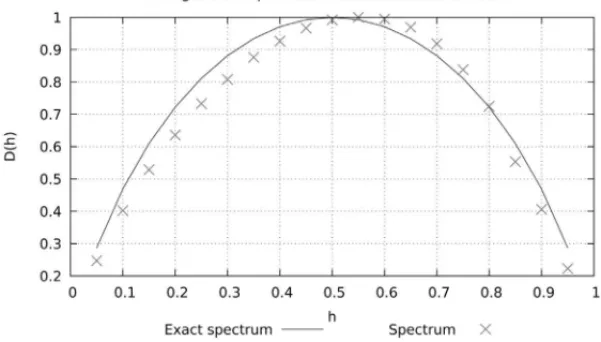
The previous flowchart is applied to Riemann serie with 210 points in Figure 3. Numerical re-sults are exhibited on Figures 4 and 5 and proves thatMFAof Riemann function with(min,+ )-wavelets decomposition is well-suited and efficient to find the right spectrum and scaling function for the Riemann serie.
4.2 Mandelbrot binomial measure
Figure 3: Representation of the Riemann serieR(x)= ∞
m=1
nx−[nx]
n2 with 210points.
Figure 4: Exact and numerical scaling functions of the Riemann serieR(x)= ∞
m=1
nx−[nx]
n2 with
ˆ
h∞analysing function. Relative error inl2-norm is about≃2.50%.
binomial multiplicative processorMandelbrot cascadeand is the simplest example of a multi-fractal set. This model describes a non-equal sharing of the energy flux from a large eddy of sizel to 2dsmall ones of sizel/2, whered is space dimension. Let us give an example in one dimension by considering a population of arbitrary objects, initially distributed homogeneously on a unit interval[0,1]and a process, which redistributes the population with the probability
Figure 5: Exact and numerical singularities spectra of the Riemann serie R(x) = ∞
m=1
nx−[nx]
n2
withhˆ∞analysing function. Relative error inl2-norm is about≃4.92%.
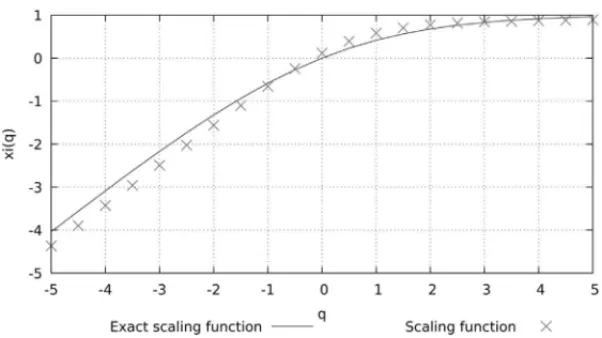
iteration(p2,pq,q p,q2), etc. An example of such cascade is shown on Figure 6 withp=0.25. It is easy to write the exact multi-fractal spectrum of this process as [6]:
D(h)= −{hlog2h+(1−h)log2(1−h)}, ∀h ∈]0,1[, (4.4)
which is obviously concave since it is the opposite of a convex combination.
Figure 6: Mandelbrot cascade in one dimension for probabilityp=0.25 and 10 levels.
Figure 7: Mandelbrot cascade exact and numerical scaling function for probabilityp=0.25 and 10 levels withhˆ∞analysing function. Relative error inl2-norm is about≃2.50%.
Figure 8: Mandelbrot cascade exact and numerical spectra for probabilityp=0.25 and 10 levels withhˆ∞analysing function. Relative error inl2-norm is about≃5.62%.
5 COMPARISON BETWEEN (min,+)-WAVELETS AND WTMM METHODS ON MANDELBROT CASCADE
One would like to illustrate efficiency of(min,+)-wavelets approach compared to WTMM one. Thus, we applied to the Mandelbrot cascade the WTMM method with mean of gaussian wavelet of level 7, which is defined as the function
∀t ∈R, t −→ d 7exp
−t22
dt7 = −texp
t2
2
·
t6−21t4+105t2−105
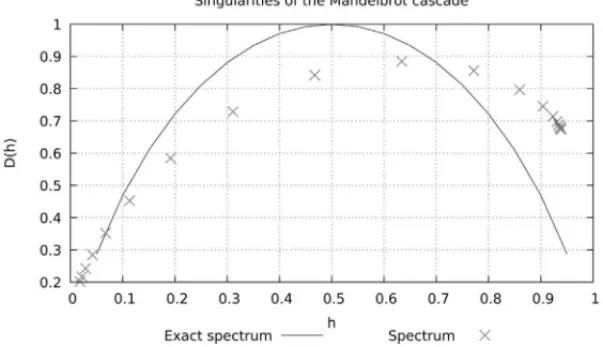
Results are exhibited in Figures 9 and 10. The errors are respectively for the scaling function and the singularities spectrum about 11.65% and 37.68%. This has to be compared to the(min,+ )-wavelets method ones which are respectively about 2.50% and 5.62% as shown in the previous section. Those results prove clearly that for the Mandelbrot cascade,(min,+)-wavelets method is clearly much more accurate than WTMM one, which uses linear wavelets decompositions, which depend of basis set used, and of the way integrals are computed to get decomposition coefficients. Such usual methods are in the best cases Nlog22(N)where N is the number of real space points used in discretization [38, 6]. With (min,+)-wavelets decomposition, com-putational time scales linearly likeO(N), since it only uses minimization of a set of values. Moreover,(min,+)-wavelets method can deal with larger set of functions.
Figure 9: Mandelbrot cascade exact and numerical scaling function for probability p = 0.25 and 10 levels computed with WTMM method using continuous gaussian wavelet of level 7 as analysing function. Relative error inl2-norm is about≃11.65%.
6 CONCLUSION
Figure 10: Mandelbrot cascade exact and numerical spectra for probability p = 0.25 and 10 levels computed with WTMM method using continuous gaussian wavelet of level 7 as analysing function. Relative error inl2-norm is about≃37.68%.
especially for MandelBrot cascade, which is the toy model for hydrodynamic turbulence and other phenomena, have shown that multi-resolution analysis with mean of(min,+)-wavelets is relatively efficient and accurate, easy to implement method and that it can be interesting to test it eventually to other kinds of data.
7 ACKNOWLEDGEMENTS
We thank Mikhail Altaisky, Janos Polonyi, Ren´e Voltz for useful and helpful discussions about turbulence and wavelets.
RESUMO. Em primeiro lugar, introduz-se os chamados (min,+)-wavelets que s˜ao limi-tantes inferior e superior constru´ıdos para an´alise (min,+), utilizados em an´alise multi-fractal.
Em segundo lugar, esta an´alise ´e aplicada a func¸ ˜oes tais como s´erie de Riemann e medida
bi-nomial de Mandelbrot, para o c´alculo num´erico do espectro de singularidades, e comparac¸˜oes com a teoria bem conhecida e com resultados do m´etodo WTMM.
Palavras-chave: (min,+)-wavelets, an´alise fractal e multi-fractal, expoente de H¨older, func¸ ˜oes de escala, espectro de singularidades.
REFERENCES
[1] A. Arneodo, F. Argoul, E. Bacry, J. Elezgaray & J.-F. Muzy.Ondelettes, multifractales et turbulence. Diderot, Paris, (1995).
[3] M.V. Altaisky, L.P. Chernenko, V.M. Balebanov, N.S. Erokhin & S.S. Moiseev. Multifractal analysis of AFM images of Nb thin film surfaces.Particles and Nuclei Letters,2(99) (2000), 14–26.
[4] A. Arneodo, G. Grasseau & M. Holschneider. Wavelet transform of multifractals.Phys. Rev. Lett., (1988), 2281–2284.
[5] M.V. Altaisky, V.V. Ivanov, S.A. Korenev, O.L. Orelovich, I.V. Puzynin & V.V. Chernik. Fractal structure formation on the surfaces of solids subjected to high intensity electron and ion treatment.
JINR Rapid Communications,82(1997), 37–46.
[6] M. V. Altaisky.Wavelets, Theory, Applications and Implementation. Universities Press, (2005).
[7] A. Aldroubi & M. Unser. Families of multiresolution and wavelet spaces with optimal properties.
Num. Func. Anal. Optim.,14(1993), 417–446.
[8] A. Aldroubi & M. Unser.Wavelets in biology and medicine. CRC Press, (1999).
[9] L.F. Abbott & M.B. Wise. Dimension of quantum-mechanical path.Am. J. Phys.,49(1981), 37–39.
[10] R. Benzi, G. Paladin, G. Parizi & A. Vulpiani. On multifractal nature of fully developed turbulence and chaotic systems.J. Phys. A,17(1984), 3521–3531.
[11] S. Dahlke, W. Dahmen & I. Weinreich. Multiresolution analysis and wavelets ons2ands3.Numer. Funct. Anal. and Optimiz.,16(1995), 19–41.
[12] J. Feder.Fractals. Plenum Press, (1988).
[13] U. Frish, M. Nelkin & P. L. Sulem. A simple dynamical model of intermittent fully developed turbu-lence.J. Fluid. Mech.,87(1978), 719–736.
[14] Y. Gagne.Etudes exp´erimentales de l’intermittence et des singularit´es dans le plan complexe et tur-bulence d´evelopp´ee.Th`ese de l’Universit´e de Grenoble, (1987).
[15] M. Gondran. Analyse minplus.C. R. Acad. Sci. Paris,323(323) (1996), 371–375.
[16] M. Gondran. Convergences de fonctions `a valeurs dansRket analyse minplus complexe.C. R. Acad. Sci. Paris,329(1999), 783–788.
[17] T.C. Halsey, M.H. Jensen, L.P. Kadanoff, I. Procaccia & B.I. Shraiman. Fractal measures and their singularities: the characterization of strange sets.Phys. Rev. A.,33(2) (1986), 1141–1151.
[18] B.R. Hunt. The hausdorff dimension of graphs of weierstrass functions.Proceedings of the American Mathematical Society,126(1998), 791–800.
[19] L.P. Kadanoff.Scaling and Multiscaling: Fractals and Multifractals.Number 29. Chinese Journal of Physics, (1991).
[20] A. Kenoufi.PhD Thesis: “Density functional Theory and Renormalisation Group”.University of Strasbourg, (2004).
[21] A.N. Kolmogorov.The local structure of turbulence in incompressible viscous fluid for very large Reynolds number.Number 30. Dokl. Akad. Nauk, SSSR, (1941).
[22] A.N. Kolmogorov.A refinement of previous hypotheses concerning the local structure of turbulence in a viscous incompressible fluid at high Reynolds number.Number 13. JFM, (1962).
[24] P.C. Martin & L.P. Kadanoff.Hydrodynamic Equations and Correlation Functions.Number 24. Ann. Phys., (1963).
[25] S. Mallat. A theory for multiresolution signal decomposition: wavelet transform. Preprint GRASP Lab. Dept. of Computer an Information Science, Univ. of Pensilvania, (1986).
[26] B. Mandelbrot.The fractal geometry of Nature. Freeman, San Francisco, (1982).
[27] B. Mandelbrot.Fractals and Multifractals: Noise, Turbulence and non-fractal Patterns in Physics. Nijhof, Dordrecht, (1986).
[28] J.F. Muzy, E. Bacry & A. Arneodo. Wavelets and multifractal formalism for singular signals: Appli-cation to turbulence data.Phys. Rev. Lett.,67(1991), 3515–3518.
[29] J.F. Muzy, E. Bacry & A. Arneodo. Multifractal formalism for fractal signals: The structure-function approach versus the wavelet-transform modulus-maxima method.Phys. Rev. E,47(1993), 875–884.
[30] J.F. Muzy, E. Bacry & A. Arneodo. Singularity spectrum of fractal signals: Exact results.J. Stat. Phys.,70(3/4) (1993), 635–674.
[31] M. Minoux & M. Gondran.Graphs, Dioids and Semirings. Springer, (2008).
[32] A. Kenoufi & M. Gondran.Numerical calculations of Holder exponents for the Weierstrass functions with (min,+)-wavelets.Number 3. Tend. Mat. Apl. Comput.,15(2014).
[33] C. Meneveau & K.R. Sreenivasan. Simple multifractal cascade model for fully developed turbulence.
Phys. Rev. Lett.,59(1987), 1424–1427.
[34] N.T. Ouelette, R. Friedrich, M. Wilczek, H. Xu & E. Bodenschatz.Generation of Lagrangian inter-mittency in turbulence by a self similar mechanism.Number 15. New Journal of Physics, (2013).
[35] A.M. Oboukhov.Some specific features of atmospheric turbulence.Number 13. JFM, (1962).
[36] E.E. Peters.Chaos and order in Capital Markets. John Wiley & Sons Inc., (1991).
[37] G. Parisi & U. Frish. On the singularity structure of fully developed turbulence. In M. Chil, R. Benzi, and G. Parisi, editors,Turbulence and predictability in geophysical fluid dynamics, Proc. Int. School of Physics ’E.Fermi’, pages 84–87, Varenna, Italy, 1985. North-Holland, Amsterdam.
[38] B. Torr´esani.Analyse continue par ondelettes. Inter´editions/Editions du CNRS, (1995).
[39] C. Tricot.Courbes et dimension fractale. Springer-Verlag, (1993).
[40] G. Parisi & U. Frisch. Fully developed turbulence and intermittency.Proc. Internat. Summer School Phys. Enrico Fermi, pages 84–88, (1985).
[41] R.F. Voss. Random fractals: characterization and measurement. InScaling Phenomena in Disordered Systems, volume 133 ofNATO Advanced Study Institute series B. Plenum Press, New York, (1985).
[42] O.V. Vasilyev, S. Paolucci & M. Sen. A multilevel wavelet collocation method for solving partial differential equations in a finite domain.J. Comp. Phys.,120(1995), 33–47.
[43] K. Weierstrass. Uber continuirliche funktionen eines reellen arguments, die f¨ur keinen werth des letzteren einen bestimmten differentialquotienten besitzen. Karl Weiertrass Mathematische Werke,

![Figure 3: Representation of the Riemann serie R(x) = ∞ m=1 nx−[nx]n2 with 2 10 points.](https://thumb-eu.123doks.com/thumbv2/123dok_br/18983844.458085/11.1063.264.874.153.513/figure-representation-riemann-serie-r-nx-nx-points.webp)
![Figure 5: Exact and numerical singularities spectra of the Riemann serie R(x) = ∞ m=1 nx−[nx]n2](https://thumb-eu.123doks.com/thumbv2/123dok_br/18983844.458085/12.1063.166.841.167.567/figure-exact-numerical-singularities-spectra-riemann-serie-r.webp)