686 Brazilian Journal of Physics, vol. 33, no. 4, December, 2003
Superconductivity in Magnetically Ordered
Ru
1
−
x
Ir
x
Sr
2
GdCu
2
O
8
Compounds
S. Andrade, F. C. Fonseca
∗, R. F. Jardim,
Instituto de F´ısica, Universidade de S˜ao Paulo, CP 66318, 05315-970, S˜ao Paulo, SP, Brazil
I. Bossi, M. S. Torikachvili,
Department of Physics, San Diego State University, CA 92123-3344, San Diego, USA
A. H. Lacerda,
National High Magnetic Field Laboratory, Los Alamos National Laboratory, Los Alamos, NM 87545, USA
and L. Ben-Dor
Department of Inorganic and Analytical Chemistry, Hebrew University, Jerusalem 91904, Israel
Received on 1st July, 2003.
We have performed a systematic study of the structural, transport, and magnetic properties of polycrystalline samples of the magnetic superconductors Ru1−xIrxSr2GdCu2O8;x= 0, 0.02, 0.05, 0.10, and 0.15. The samples were prepared by solid state reaction and sintered at 1060◦C for 72 h under O
2flow. X-ray diffraction analysis shows that all samples are nearly single phase and that the lattice parameters are independent of Ir content. Transport properties measurements revealed that the Ru substitution by Ir results in a decrease of Tc,onsetfrom
∼50 K (x= 0) to∼30 K (x= 0.10). Further addition of Ir (x >0.10) causes an evolution from metallic to
non-metallic behavior ofρ(T). We have also found that magnetic order develops in the undoped Ru-1212 materials near TM ∼130 K. This temperature decreases linearly with increasing Ir content at the rate of∼-1.6 K / Ir
at.%, suggesting that Ir effectively substitutes Ru in the RuO planes. A subtle drop inρ(T) is observed close to TM, probably due to the suppression of the spin-flip scattering. The magnetoresistivity measurements revealed
that the temperature Tc,zero, in whichρ(T)∼0, decreases rapidly for low applied magnetic fields (H<2 T),
and that this drop becomes much less pronounced in higher magnetic fields (2≤H≤18 T). The appreciable broadening ofρ(T) curves at low magnetic fields is reminiscent of the behavior in high-Tcmaterials showing
granular behavior, as for example in Sm1.85Ce0.15CuO4−y.
1
Introduction
A considerable research effort has been devoted re-cently to the understanding of the physical properties of the ruthenocuprate compounds with general composition RuSr2LnCu2O8 and RuSr2(Ln1+xCe1−x)Cu2O10 (Ln =
Sm, Eu, and Gd). [1, 2] The interest in these materi-als was triggered by the observation of coexisting super-conductivity (SC) and long-range magnetic order, includ-ing weak-ferromagnetism (wFM), at moderately high tem-peratures (T). [3, 4] The occurrence of long-range mag-netic order has been determined by means of magmag-netic susceptibility, and muon spin relaxation, while details of the magnetic and crystal structure have been studied by neutron diffraction. [5] Heat capacity measurements and diamagnetic shielding fraction data indicate that SC is a bulk property, coexisting in a microscopic scale with mag-netism in these materials. [6, 7] The crystal structure of the
RuSr2LnCu2O8 compound (Ru-1212) is closely related to the one of the LnBa2Cu3O7 (Ln-123), [1] in which the in-termediate layer consists of vertex sharing RuO6octahedra replacing the CuO4 squares of the Ln-123 structure. [4, 5] The coexistence of SC and FM can be sustained possibly because of the weak coupling between the Ru-O magneti-cally ordered layers and the SC Cu-O planes.
An important point concerning the superconducting and magnetic properties in these ruthenocuprates is the valence of the Ru ions. X-ray absorption near-edge structure spec-troscopy in the Ru-1212 compounds yields 40-50% of Ru4+ and 60-50% of Ru5+
. [8] In light of the proximity of the superconducting Cu-O and the magnetically ordered Ru-O layers, and taking into account that the superconducting transition temperature (Tc) is lower than the magnetic
order-ing temperature (TM), it has been suggested that the onset of
superconductivity is accompanied by a spontaneous vortex phase. [9]
S. Andradeet al. 687
Another relevant feature of these superconductors is the strong dependence of parameters like the normal-state elec-trical resistivity (ρ), the superconducting transition temper-ature (Tc), and the width of the superconducting transition
(∆Tc) on the synthesis conditions. [6] Nevertheless, the on-set of SC (Tc,onset) for the Ru-1212 RuSr2GdCu2O8
com-pound is usually∼45 K and the Curie temperature TM ∼
132 K. [4]
The weak coupling that allows the coexistence of SC and FM is strongly affected by both high pressure and chemi-cal substitutions. Thus, an approach to study the coexisting phenomena in these superconductors is via chemical substi-tution. Some results regarding different cation substitutions in Ru-1212 have already been reported. [6,10-14] However, only a fraction of them concern substitutions at the Ru site, in spite of their relevance, and given the currently unsolved configuration of spin and charge of Ru ions in Ru-1212 com-pounds. [11] Reported Ru substitutions include Sn+4, Nb+5, and Ta+5
. [10-16] More recently, Mo and Sb substitutions for Ru were performed on the Ru-1222 compounds and a competition of SC and magnetism was observed. [17, 18] These experiments probe the effect of the changes in ionic radius, valence, and magnetic character of the substituting ion. Both the superconducting and magnetic properties of Ru-1212 are affected by these substitutions. Carriers can be either introduced or removed from the CuO planes, de-pending on the valence of the substituting ion, modifying the transport properties relative to the parent compound. How-ever, the majority of these substitutions resulted in changes in the structural parameters due to differences in the ionic radius.
In this work we have investigated the magnetic and transport properties of RuSr2GdCu2O8specimens in order to study the effect of the dilution of the magnetic Ru sub-lattice by substituting Ir for Ru. Since the ionic radii of Ir and Ru are close, it is reasonable to expect that partial substitutions of Ir for Ru can be made without appreciable structural changes.
2
Experimental
Polycrystalline samples of Ru1−xIrxSr2GdCu2O8 (0 ≤ x
≤ 0.15) were prepared using a two-step solid state reac-tion procedure. [19] Initially, stoichiometric amounts of high-purity Ru, Ir, SrCO3, Gd2O3 were ground together and reacted in air at 1250 ◦C for 12 h in order to obtain
Sr2GdRu1−xIrxO6 (Sr-2116) precursors. Then, CuO was
added to the Sr-2116 powders and ground together exten-sively, followed by pelletizing and sintering at 1060◦C for
72 h in flowing O2. The two-step route yielded samples with better quality than when the materials were prepared by di-rect solid state synthesis of all ingredients.
Ground samples were analyzed by X-ray powder diffrac-tion (XRD) measurements at room temperature using Cu Kα radiation in the 20≤ 2θ ≤ 80◦ interval with a 0.05◦ (2θ)
step size.
Magnetization M(T) measurements were performed us-ing a SQUID magnetometer from Quantum Design. The values of M(T) in the remanent field of the
superconduct-ing magnet (∼1 Oe) were recorded in the T-range from 5 to 300 K, both with decreasing and increasing T. The temper-ature dependence of theacmagnetic susceptibilityχac(T)
was measured at 155 Hz using an excitation field of 2 Oe. Four-wire dc electrical resistivity ρ(T) measurements were performed in the temperature range 2≤T≤300 K and applied magnetic fields (H) to 18 T, utilizing a LR-700 Lin-ear ResLin-earchacresistance bridge operating at 16 Hz. The high field measurements were carried out at the National High Magnetic Field Laboratory in Los Alamos.
3
Results and Discussion
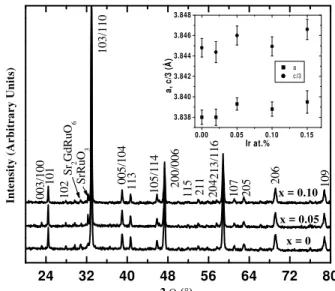
The XRD analysis of the polycrystalline samples of Ru1−xIrxSr2GdCu2O8(0≤x≤0.15) revealed that all
sam-ples are nearly single-phase, while exhibiting very small fractions of SrRuO3(<2 %) and Sr-2116 (<2 %) impurity phases (Fig. 1). The impurity content shows no appreciable dependence on the Ir concentration. The diffraction patterns of the Ir-doped materials are nearly identical to that of the parent compound, and they were all indexed according to theP4/mmmspace group. [1]
24 32 40 48 56 64 72 80
0.00 0.05 0.10 0.15 3.838
3.840 3.842 3.844 3.846 3.848
a, c
/3 (
Å
)
Ir at.% a c /3
x = 0 x = 0.05
x = 0.10 109
206
205
S
r2
G
d
R
u
O6
S
rR
u
O3
003/
100
107
102 204
213/
116
211
115
200/
006
105/
114
113
103/
110
005/
104
101
In
te
n
si
ty (
A
r
b
it
r
a
r
y U
n
it
s)
2 ΘΘ (°)
Figure 1. X-ray diffraction patterns for Ru1−xIrxSr2GdCu2O8
polycrystalline samples for Ir contentx= 0, 0.05, and 0.10. The main diffraction peaks of RuSr2GdCu2O8are indexed by the [hkl]
indexes and the arrows point to the main lines of the impurity phases. The inset shows the calculated lattice parametersaand c.
The lattice parameters for the pure Ru-1212 composition were calculated to bea =b= 3.839 (1) ˚A, andc= 11.536 (1) ˚A. These values were nearly unchanged due to Ir substi-tutions, as indicated in the inset of Fig. 1. The six-fold coor-dinated Ir+5
and Ir+4
(0.57 and 0.625 ˚A, respectively) have ionic radii values very close to the Ru+5
and Ru+4 (0.565 and 0.62 ˚A, respectively), which suggests that Ir can sub-stitute for Ru in the Ru-1212 structure with no appreciable changes of the lattice parameters. [20]
Since the partial substitution of Ir+5/+4
sublat-688 Brazilian Journal of Physics, vol. 33, no. 4, December, 2003
tice. Its implications on both magnetic and transport proper-ties of the Ru-1212 magnetic superconductors are discussed below.
The effect of Ir substitutions on the temperature depen-dence of the electrical resistivityρ(T) is displayed in Fig. 2. Theρ(T) data show that the electrical resistivityρ(T) close to the onset of the critical temperature Tc,onset ∼50 K is
∼10 mΩcm, a value within the range of other reported val-ues for the pristine compound. [11-13] In addition, the com-monly observed upturn in ρ(T) close to Tc,onset is hardly
seen in lightly doped samples, which attests to the high qual-ity of the samples. However, an upturn in the x = 0.1 sam-ple close to Tc,onset is quite noticeable. Also, the lightly
Ir-doped materials have lowerρ(T) values and a more pro-nounced metallic behavior, as gauged by the values of dρ/dT in the normal phase. The Ru substitution by Ir results in a decrease of Tc,onset from∼50 K (x= 0) to∼30 K (x=
0.10). Further addition of Ir (x >0.10) causes an evolution from metallic to non-metallic behavior of ρ(T). However, the SC transition width∆Tcwas found to decrease with Ir addition from∆Tc ∼17 K for the pristine compound to∼
11 K for thex= 0.10 sample. The onset of magnetic order-ing is accompanied by a subtle drop inρ(T) close to TM,
probably due to the suppression of the spin-flip scattering. This discontinuity can be determined from the maximum in the dρ(T, H = 0)/dT curves of the studied compounds, close to the magnetic ordering temperature TM (see inset of Fig.
2).
0 10 20 30 40 50 60 70 80
0 5 10 15
75 100 125 150 175 200 225 250 x = 0 - TM ~ 130 K
x = 0.02 - TM ~ 126 K
d
ρρρρ
/
d
T
H = 0 T H = 18 T
Ir x=0.02 Ir x=0
Ir x=0.10
ρρρρ
(
m
ΩΩΩΩ
c
m
)
T (K)
Figure 2. Temperature dependence of the electrical resistivity for Ru1−xIrxSr2GdCu2O8(Irx= 0, 0.02, and 0.10) polycrystalline
samples in applied magnetic fields H = 0, 1, and 18 T. The inset shows the derivatives of theρ(T) curves near Tcfor H = 0.
The magnetoresistivity measurements revealed that all studied samples attained the zero-resistance state at T>2 K up to the highest applied magnetic field of H = 18 T. From these curves one observes that the temperature Tc,zero, in whichρ(T)∼0 decreases rapidly for low applied magnetic fields (H<2 T) and much more slowly thereafter (2 ≤H
≤18 T). The appreciable broadening ofρ(T) curves at low magnetic fields resembles features of granular superconduc-tors, as for example in Sm1.85Ce0.15CuO4−y. [21]
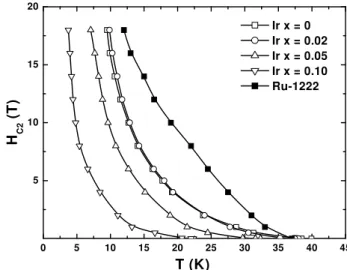
Using the magnetoresistivity data, we estimated the Hc2,T phase diagram of the Ir substituted Ru-1212 com-pounds (Fig. 3), by considering the same Tc,onset for all H, and by taking the 50% drop ofρ(T) as the criteria for the Hc2 determination. The obtained results are shown in Fig. 3, which also exhibits the Hc2vs T data for the Ru-1222 for comparison. [22] The Ru1−xIrxSr2GdCu2O8 curves show the same behavior with a steeper increase at low T in sam-ples with high Ir content.
0 5 10 15 20 25 30 35 40 45
5 10 15 20
H C
2
(
T
)
T (K)
Ir x = 0 Ir x = 0.02 Ir x = 0.05 Ir x = 0.10 Ru-1222
Figure 3. Temperature dependence of the upper critical field of the magnetic superconductor Ru1−xIrxSr2GdCu2O8(x= 0, 0.02,
0.05, and 0.10) and Ru-1222 polycrystalline samples. [22] The solid lines are guides to the eye.
S. Andradeet al. 689
cooling data is possibly due to the magnetization of the Gd-sublattice under field of the Ru-Gd-sublattice. Heat capacity measurements (not shown) revealed that the Gd sublattice ordering takes place at the same temperature TGd∼2.5 K
for samples with Ir x = 0 and 0.10. These results further sug-gest that Ir substitutes for Ru in the Ru-O planes, resulting in a lower TM, and in a smeared out magnetic transitions.
0 50 100 150
-0.010 -0.005 0.000 0.005 0.010 0.018
90 100 110 120 130 140 150 160 0
5 10 15 20 25
TM
χχχχ
'ac
(
A
rb
. U
n
it
s) x = 0 x = 0.02 x = 0.05 x = 0.10 x = 0.15
x = 0 x = 0.05 x = 0.15
M
(
em
u
/g
)
T (K)
H = remanent warming cooling
Figure 4. Temperature dependence of the magnetic susceptibil-ityχ, measured during warming (full symbols) and cooling (open
symbols) under the remanent field of the magnet for Irx= 0, 0.05, and 0.15 samples. The inset shows the in-phase component of the
χac(T) for the Ir-substituted samples.
In summary, our results suggest that Ir substitutes for Ru in the Ru1−xIrxSr2GdCu2O8compounds. The main ob-served features due to the substitution of Ir for Ru in the structural, transport, and magnetic properties of the parent compound are: 1) no appreciable dependence on the lattice parameters; 2) the inducement of a more metallic behavior for lightly doped samples; 3) the decrease of both the su-perconducting transition temperature and the SC transition width; 4) the linear decrease of the magnetic ordering tem-perature; and 5) the suppression of superconductivity forx >0.15. Since the lattice parameters are nearly independent of the Ir content, one can expect that the valence of the sub-stituting Ir matches the valence of the replaced Ru. These isovalent substitutions can be accompanied by a dilution of the ordered magnetic moments, if substituting Ir is in a low spin state. However, the effect of these substitutions on Tc is still puzzling, and a more thorough investigation consid-ering the band structure, and the pairing mechanism is in order.
This work was supported by the Brazilian agency FAPESP under Grants Nos. 99/10798-0, 01/01455-4, and 01/04231-0, and by the US National Science Foundation un-der Grants No. INT-9725929 (IB, MST, AHL) and DMR-0306165 (IB, MST). Work at the NHMFL was performed under the auspices of the NSF, the State of Florida, and the U.S. Department of Energy. RFJ is a CNPq fellow under Grant No. 304647/90-0.
References
[1] L. Bauernfeind, W. Widder, and H. F. Braun, Physica C254, 151 (1995).
[2] L. Bauernfeind, W. Widder, and H. F. Braun, J. Low Temp. Phys.105, 1605 (1996).
[3] I. Felner, U. Asaf, Y. Levi, and O. Millo, Phys. Rev. B55, R3374 (1997)
[4] C. Bernhard, J. L. Tallon, C. Niedermayer, T. Blasius, A. Gol-nik, E. Br¨ucher, R. K. Kremer, D. R. Noakes, C. E. Stronach, and E. J. Ansaldo, Phys. Rev. B59, 14099 (1999).
[5] J. W. Lynn, B. Keimer, C. Ulrich, C. Bernhard, and J. L. Tal-lon, Phys. Rev. B61, R14964 (2000).
[6] C. Bernhard, J. L. Tallon, E. Br¨ucher, and R. K. Kremer, Phys. Rev. B61, R14960 (2000).
[7] J. L. Tallon, J. W. Loram, G. V. M. Williams, and C. Bern-hard, Phys. Rev. B61, R6471 (2000).
[8] R. S. Liu, L.-Y. Jang, H.-H. Hung, and J. L. Tallon, Phys. Rev. B63, 212507 (2001).
[9] E. B. Sonin and I. Felner, Phys. Rev. B57, R14000-3 (1998).
[10] P. W. Klamut, B. Dabrowski, S. M. Mini, M. Maxwell, J. Mais, I. Felner, U. Asaf, F. Ritter, A. Shengelaya, R. Khasanov, I. M. Savic, H. Keller, A. Wisniewski, R. Puzniak, I. M. Fita, C. Sulkowski, and M. Matusiak, Physica C387, 33 (2003).
[11] J. E. McCrone, J. L. Tallon, J. R. Cooper, A. C. MacLaughlin, J. P. Attfield, and C. Bernhard, cond-mat/0302499v1.
[12] A. C. McLaughlin and J. P. Attfield, Phys. Rev. B60, 14605 (1999).
[13] Z. Sun, S. Y. Li, Y. M. Xiong, and X. H. Chen, Physica C
349, 289 (2001).
[14] V. P. S. Awana, T. Kawashima, and E. Takayama-Muromachi, Phys. Rev. B67, 172502 (2003).
[15] P. W. Klamut, B. Dabrowski, S. Kolesnik, M. Maxwell, and J. Mais, Phys. Rev. B63, 224512 (2001).
[16] A. C. McLaughlin, V. Janowitz, J. A. McAllister, and J. P. Attfield, Chem. Comm.14, 1331 (2000).
[17] L. Shi, G. Li, X. D. Zhang, S. J. Feng, and X.-G. Li, Physica C383,450 (2003).
[18] I. Felner and E. Galstyan, cond-mat/0304552.
[19] T. P. Papageorgiou, T. Herrmannsdorfer, R. Dinnebier, T. Mai, T. Ernst, M. Wunschel, and H. F. Braun, Physica C377, 383 (2002).
[20] R. D. Shannon, Acta Cryst. A32, 751 (1976).
[21] R. F. Jardim, M. C. de Andrade, E. A. Early, M. B. Maple, and D. Stroud, Physica C232, 145 (1994).