Assessing the impact
adenotonsilectomy has on
the lives of children with
hypertrophy of palatine and
pharyngeal tonsils
Summary
Bernard Soccol Beraldin1, Tatiana Rocha Rayes2,
Paulo Henrique Villela3, Denise Marchi Ranieri4
1 Student.
2 Medical Student - UNIVALI, SC. 3 MSc. Professor of Otolaryngology - UNIVALI, SC. 4 MSc. Professor of Otolaryngology - UNIVALI, SC. Universidade Do Vale Do Itajaí, Santa Catarina.
Send correspondence to: Bernard Soccol Beraldin [email protected]
This paper was submitted to the RBORL-SGP (Publishing Manager System) on 16 August 2007. Code 4719. The article was accepted on 11 November 2007.
T
he hypertrophy of the palatine and pharyngeal tonsils is extremely common in children, being one of the most frequent causes of visits to otolaryngologists and such problem can impair the child’s quality of life. Aim: to evaluate the impact of adenotonsillectomy on the lives of children with hypertrophied tonsils. Materials and methods: Contemporary longitudinal cohort study. A specific questionnaire used to evaluate the quality of life - OSD-6, was given to seventy five parents or guardians of children previously submitted to adenotonsillectomy, before the surgery and thirty days afterwards. Results: The adenotonsillectomy provided a significant reduction in the questionnaire score. Discussion: Snoring and nasal obstruction were the symptoms with the highest scores. There is a great concern from the parents with the snoring of the children and a poor statistic correlation between the degree of obstruction degree and a worse quality of life. Conclusion: Adenotonsillectomy causes a relevant impact in the quality of life of children with tonsil hypertrophy.Keywords: adenoids, children, quality of life.
original article
INTRODUCTION
One of the most frequent disorders encountered in the otolaryngologist’s office is the enlargement of palatine and pharyngeal tonsils. It is the main cause of sleep disor-ders in children, and responsible for 75% of cases of sleep apnea1. Surgical removal of the tonsils is the treatment of
choice, being of the procedure more commonly performed by otolaryngologists2.
Respiratory disorders during sleep are entities kno-wn in the medical field and has been constantly studied because of its high prevalence and important morbimor-tality. Since it is such a common occurrence, often times it is not considered a disease and, therefore, is not reported in routine puericulture papers3,4. Not treating children with
this disorder can bring about a number of problems: low school performance, non-specific behavior disorders, lack of attention, development delays, problems with mastica-tion and swallowing, oral breathing and its craniofacial repercussions, day sleepiness, enuresis, cor pulmonale and height-weight deficit5,6.
Symptoms and complications caused by upper airway obstruction lead to a significant reduction in the quality of life of these patients7. There are some treatment
possibilities such as CPAP (Continuous Positive Airway Pressure) and weight loss in obese patients; however, these alternatives are not well tolerated by children and are rarely adopted as primary treatment8. Despite the
controversies between otolaryngologists and pediatricians, adenotonsillectomy is curative for the majority of patients9.
Indications for this surgical procedure are well established; however, there are only a few studies about its impact on the patient’s quality of life.
The physical consequences in general, represent the greatest concerns physicians have regarding the disease’s impact7. Nonetheless, the disease impact on the quality
of life of patients and their guardians must also be taken into account when treatment choice is being considered.
When we talk about public health, there is the need to guide treatment decision as to the best deployment of resources from the health care system. Thus, it is important to stress life quality impairment of a given pathology so as to show its importance for the individual at a social level or at a health care level within a community.
Having discussed the aforementioned remarks, the present study aims at assessing the impact adenotonsillec-tomy has on the quality of life of children with enlarged pharyngeal and palatine tonsils, by comparing the results obtained from a specific questionnaire about quality of life, employed before and after the surgical procedure.
MATERIALS AND METHODS
Contemporary longitudinal cohort study carried out through a life quality questionnaire with children with
pharyngeal and palatine tonsil enlargement, OSD-6, before and after adenotonsillectomy was performed.
The population was submitted to the study from October 2005 to August 2006. 75 children with adenoton-sillectomy indication because of pharyngeal tonsil hyper-plasia obstructing over 50% of the rhinopharynx (based on cavum radiography findings), and palatine tonsils enlargement (grade II or more seen through the physical exam), associated with sleep disorders and respiratory complaints. Patients from both genders were included, from 3 to 14 years of age.
The patients’ parents or guardians were interviewed by means of a specific questionnaire - OSD-6, based on the work of Di Fransesco et al.7 (Figure 1), one day before and
one month after the surgery, after they were duly informed about the study and signed the Free and Informed Consent. Such questionnaire included the following domains: physi-cal suffering (1), sleep disorder (2), speech and swallowing disorders (3), emotional discomfort (4), physical activity limitations (5) and concerns from parents and guardians about the child’s snoring (6) and there are three legends that serve to quantify each item on the domains, in other words, how the guardians believe the symptoms affect their children. The first (0=never, 1=almost never, 2=sometimes, 3=frequently, 4=very much, 5=could not have been worse) can be used for all domains, except the fifth. The second (0=always, 1=almost always, 2=most of the times, 3=once in a while, 4=almost never, 5=never) for the first four items of the fifth domain, and the third (0=great, 1=good, 2=regular, 3=bad, 4=very bad, 5=terrible) for the last item of the same domain. Thus, the higher the score obtained in the questionnaire, the worse is the child’s quality of life. Since the maximum score for each item is five and the number of patients interviewed was 40, the domain already has four items (1) that may yield a maximum score of 1,500 points, now, the domains which have five items (2, 3, 4 and 5) produce 1,875 points and the last domain (6) 375 points, since it does not have items.
Patients with craniofacial, neurologic disorders, those with surgery indication only due to recurrent ton-sillitis and the patients who would be submitted to some other surgical intervention on the same date were taken off the study. None of the guardians refused to participate in this study.
QUALITY OF LIFE OF CHILDREN WITH PHARYNGEAL AND PALATINE TONSIL HYPERTROPHY QUESTIONNAIRE
Name:______________________________ Age:_______________
Race: White Brown Black Gender: Male. Fem.
Pharyngeal tonsils: Nasopharynx obstruction seen in the side view X-Ray:
0-25% 25-50% 50-75% 75-100%
Palatine tonsils: oropharynx obstruction
Grau I II III IV
Legend 1:0=never,1=almost never,2=sometimes,3=frequent,4=very much, 5=could not be worse
Legend 2:0=always,1=almost always,2=most of the times,3=once in a while, 4=almost never,5=never*
Legend 3:0=great,2=good,3=regular,4=very bad,5=terrible**
1-Physical suffering Total:________
Nasal obstruction 0 1 2 3 4 5
Daily tiredness 0 1 2 3 4 5
Low weight 0 1 2 3 4 5
Low stamina 0 1 2 3 4 5
2-Sleep disorders Total:_______
Snoring 0 1 2 3 4 5
Gagging/chocking 0 1 2 3 4 5
Inefficient sleep 0 1 2 3 4 5
Difficulty to wake up in the morning 0 1 2 3 4 5
Deep chest during sleep 0 1 2 3 4 5
3-Problems with speech/swallowing Total:_______
Difficulty swallow solids 0 1 2 3 4 5
Gagging 0 1 2 3 4 5
Stuffed speech 0 1 2 3 4 5
Nasal speech 0 1 2 3 4 5
Bad pronunciation 0 1 2 3 4 5
4-Emotional discomfort Total:_______
Irritability 0 1 2 3 4 5
Lack of patience 0 1 2 3 4 5
Bad appetite 0 1 2 3 4 5
Lack of attention 0 1 2 3 4 5
Ridiculed because of snoring 0 1 2 3 4 5
5-Limitations in activities Total:______
Plays normally* 0 1 2 3 4 5
Participates in sports* 0 1 2 3 4 5
Plays with friends* 0 1 2 3 4 5
Goes to school/day care* 0 1 2 3 4 5
the questionnaire’s domains, p ≤ 0.05 by means of the Spearman’s method.
After the end of the study, the results were given to those in charge of the research and the interviewees who were interested in them.
The current study was delivered to the Ethics in Re-search Committee in September of 2006 and was approved in October of the same year, under protocol # 448/2005.
RESULTS
We interviewed 75 guardians of patients, with ages varying between 3 and 14 years (mean of 7.05), 30 (40%) were males and 45 (60%) females, 18 (24%) were brown, 11 (15%) back and 46 (61%) white. As to the pharyngeal tonsil, 33 (45%) and 42 (55%) had nasal-pharyngeal obs-tructions that varied between 50 and 75% and 75 and 100%, seen through cavum radiography, respectively. Seven (10%) patients had level II obstruction of the oropharynx through the physical exam, 12 (15%) level III obstruction and 56 (75%) had level IV obstruction.
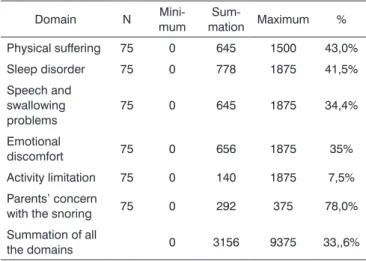
On Tables 1 and 2 we see the scores obtained in each domain before and after adenotonsillectomy, respec-tively. We observed that the parents/guardians concern with the child’s snoring was the domain that, proportio-nally, obtained the highest score (78%) in the preoperative period, followed by physical suffering (43%) and sleep disorders (41.5%). Now, the domain associated with activity limitation was the one with the lowest score, obtaining only 140 (7.5%) points from a total of 1,875 possible.
On Table 2 we see that all the domains reduced significantly the score percentage obtained, except for the activity limitation domain, which kept almost the same percentage obtained in the preoperative (6.1%).
On Table 3 we see the variations among pre and postoperative percentages. The domain of parents’ concern
Table 1. Score obtained in the pre-adenotonsillectomy period.
Domain N
Mini-mum
Sum-mation Maximum %
Physical suffering 75 0 645 1500 43,0%
Sleep disorder 75 0 778 1875 41,5%
Speech and swallowing problems
75 0 645 1875 34,4%
Emotional
discomfort 75 0 656 1875 35%
Activity limitation 75 0 140 1875 7,5%
Parents’ concern
with the snoring 75 0 292 375 78,0%
Summation of all
the domains 0 3156 9375 33,,6%
Table 2. Score obtained in the post-adenotonsillectomy domains.
Domain N
Mini-mum
Sum-mation
Maxi-mum %
Physical suffering 75 0 112 1500 7,5%
Sleep disorder 75 0 125 1875 6,7%
Speech and swallowing problems
75 0 120 1875 6,4%
Emotional
discomfort 75 0 262 1875 14,0%
Activity limitation 75 0 116 1875 6,1%
Parents’ concern
with the snoring 75 0 8 375 2,0%
Summation of all
the domains 0 743 9375 7,9%
Table 3. Percentage values before and after adenotonsillectomy.
Domain Pre-op. Post-op. Variation
Physical suffering 43,0% 7,5% 35,5%
Sleep disorder 41,5% 6,7% 34,0%
Speech and swallowing
problems 34,4% 6,4% 28,0%
Emotional discomfort 35% 14,0% 21,0%
Activity limitation 7,5% 6,1% 1,4%
Parents’ concern with the snoring 78% 2% 76,0%
Summation of all the domains 33,6% 7,9% 25,7%
Table 4. Items from the domain that got the highest scores.
Items Pre-op. Post-op.
Nasal obstruction 275 22
Snoring 307 18
Nasal voice 172 31
Lack of patience 180 97
School and day-care attendance 58 58
Parents’ concern with snoring 290 5
with the child’s snoring was the most significant one (76%), followed by physical suffering (35.5%) and sleep disorder (34.0%). The emotional discomfort had the second lowest difference (21.0%), behind only that of activity limitations (1.4%). In relation to the summation of all the domains, the difference was of 25.7%.
adenotonsillectomy were: nasal obstruction (275), snoring (307), nasal voice (172), lack of patience (180) and school and day-care attendance (58). All had low postoperative score, except the item associated with school and day-care attendance which kept the same score.
These items were responsible for 41.29%, 38.77%, 26.74%, 28.57% and 44.29% of all the domains before the surgery (Fig. 2).
As we correlate the level of palatine tonsil obstruc-tion with the domains, we found a statistically positive and significant correlation between the level of obstruction and physical suffering, speech and swallowing problems and the summation of all the domains. Now, as we correlate the level of pharyngeal tonsil obstruction in the same fashion, we found a correlation with physical suffering, sleep disorders and parents’ concern with the child’s snoring (Table 5).
DISCUSSION
Historically, adenotonsillectomy has been the most commonly performed surgical procedure in otorhinolaryn-gology, mainly involving the pediatric population10. Thus, most children will suffer their first surgical intervention within otorhinolaryngology.
Physicians tend to be concerned only with the phy-sical consequences of diseases, and with the laboratorial repercussions that such affection can cause.
Recently, quality of life has been used to try to assess the impact diseases have on their patients and guardians, adding such consideration to the treatment decision process10-15. The questionnaire used in this study
is a specific instrument and aims at assessing the impact a disease may have on a patient, in an attempt to incorporate such criterion to the medical indications for severity and importance of assessing children with tonsilar enlargement and to add such fact to the treatment decision process.
Disease-specific questionnaires such as this one focus on areas or functions which belong to particular diseases or conditions and are used to describe the impact diseases have on individuals, going beyond the usual mor-bidity investigation patterns used to assess the severity of a certain particular disease or condition16.
In our study, 100% of the children submitted to the surgical procedure had a score reduction in all the do-mains, in other words, life quality improvement showing the benefits of adenotonsillectomy in children with tonsil hypertrophy, respiratory complaints and sleep disorders.
Parents’ concern with the child’s snoring; physi-cal suffering and sleep disorders were the domains that achieved the highest scores in the pre-adenotonsillectomy questionnaire. These are the same domains that stood out in a similar paper published by Serres et al.11; however,
the author also firstly found sleep disorders, followed by physical suffering and parents’ concern with the child’s
Figure 2. Distribution of the percentages from items of the pre-ade-notonsillectomy domains.
Table 5. Correlation between the level of tonsil obstruction and the domains.
Palatine tonsils Pharyngeal tonsils
Physical suffering p coefficient p coefficient
Sleep disorders 0.45230 0.0034 0.43922 0.0046
Speech and swallowing
problems 0.18398 0.2558 0.29135 0.0482
Emotional discomfort 0.31241 0.0497 0.05239 0.7482
Activities limitations 0.02754 0.8661 0.10497 0.5192
Parents’ concern with
snoring 0.15275 0.3467 0.27733 0.0832
Summation of all the
domains 0.06596 0.6860 0.31153 0.0204
Soma de todos os
domínios 0.37358 0.0176 0.28328 0.0765
snoring, which may have occurred because of cultural differences. Analyzing the score obtained after surgery in these domains, we notice that they keep the same order, in other words, parents’ concern was the domain which obtained the highest percentage difference, afterwards was physical suffering and finally, sleep disorders. Thus, the domains responsible for the worst quality of life (highest score) for these children were the ones that most improved after adenotonsillectomy.
The activity limitation domain was the one that scored the lowest in the preoperative period, coinciding with the findings from Serres et al.11. Its percentage
varia-tion in relavaria-tion to the post-adenotonsillectomy score was also the one with the lowest score, only 1.4%. This can be explained by the fact that the parents’ concern was more often associated with physical problems and sleep disor-ders because they were deemed of having the highest risk for health or because of the fact that a volume increase in tonsils is not able to limit the daily activities of children, at least among the ones included in our study.
When we analyze the items of each domain sepa-rately in order to know which of them was responsible for the highest score, we found: nasal obstruction, sno-ring, nasal voice, lack of patience and school or day-care attendance with the highest percentages associated with their specific domains. We did not find similar data in the literature for possible comparisons.
In relation to the nasal obstruction items and sno-ring, they were responsible for 41.29% and 38.77% of the total of their domains. This represents almost twice the item that had the second highest score in its respective domains, which were daily tiredness and bad stamina, both with 22.19% in the physical domain and non-effective sleep. Such fact shows the extreme attention that parents pay regarding the children’s lack of capacity to breathe through the nose (oral breathing) and with noisy breathing during sleep, and such fact can be decisive for treatment indication.
As we correlate the level of tonsilar obstruction with the score obtained in the questionnaire domains, we noticed that there is an association between physical sufferings with both tonsils. However, a larger palatine tonsil volume is still associated with speech and swallo-wing disorders and domain summation, while pharyngeal tonsils were associated with sleep disorders and parents’ concern. Although this correlation exists, it is weak. Such fact is similar to the findings by Di Fransesco et al.7 who
besides correlating the obstruction level of the upper
airways, also correlated craniofacial morphological altera-tions and concluded that both factors were not responsible for a worse quality of life.
CONCLUSION
Adenotonsillectomy causes a positive impact, in other words, a significant improvement in the quality of life of children with tonsil hypertrophy.
REFERENCES
1. Paradise J. Tonsillectomy and Adenoidectomy. In Bluestone C. pe-diatric Otoryngology. Philadelphia: W. B. Saunders ;1996.
2. Fukuchi I, Morato MMM, Rodrigues REC, Moretti GMM, Júnior S, Rapoport PB, Fukuchi M. Perfil psicológico de crianças submetidas a adenoidectomia e/ou amigdalectomia no pré e pós-operatório. Rev Bras Otorrinolaringol. 2005;71(4):521-5.
3. Ali N, Pitson D, Stradling J. Snoring, sleep disturbance, and behaviour in 4-5 year olds. Arch Dis Child. 1993;68:360-6.
4. Niemem P, Tolonen u, Lopponen H. Snoring and obstructive sleep apnea. Arch Otoloryngol Head Neck Surg. 2000;126:481-6.
5. Saffer M. A criança respiradora bucal. In: Chinski A, Sih T. II Manual de otorrinolaringologia pediátrica da IAPO. IAPO- International Association of Pediatric Otorhinolaryngology;1999. p.170-81. 6. Guilleminault C, Khramtsov A. upper airway resistance syndrome in
children:a clinical review. Semin Pediatr Neurol. 2001;8:207-15. 7. Di Francesco RC, Komatsu CL. Melhora da qualidade de vida em
crianças após adenoamigdalectomia. Rev Bras Otorrinolaringol . 2004;70(6):748-51.
8. Flanary, VA. Long-term effect of adenotonsillectomy on quality of life in pediatric patients. Laryngoscope . 2003;113(10):1639-44. 9. Pirara S, Bento RF, Camas J. Consensos e controversas nas indicações
de adenoamigdalectomia entre pediatras e otorrinolaringologistas (indicações de adenoamigdalectomia). Rev Bras Otorrinolaringol. 1999;65(4):308-15.
10. Verlade-Jurado E, Avila-Figueroa C. Consideraciones metodo-lógicas para evaluar la calidad de vida. Salud Publ Méx. 2002; 44(5):448-62.
11. De Serres LM, Derkay C, Astley S, Deyo RA, Rosenfeld RM, Gates GA. Measuring quality of life in children with obstructive sleep disorders. Arch Otolaryngol Head Neck Surg . 2000;126(12):1423-9.
12. De Serres LM, Derkay C, Astley S, Sie K, Biavati M, Jones J, et al. Impact of adenotonsillectomy on quality of life in children with obstructive sleep disorders. Arch Otolaryngol Head Neck Surg . 2002;128(5):489-96.
13. Stewart, MG. Pediatric outcomes research: development of an ou-tcomes instrument for tonsil and adenoid disease. Laryngoscope.2000;110(3 pt. 3):12-5.
14. Stewart MG, Friedman EM, Sulek M, Hulka GF, Kuppersmith RB, Harril WC, Bautista MH. Quality of life and health status in pe-diatric tonsil and adenoid disease. Arch Otolaryngol Head Neck Surg.2000;126(1):45-8.
15. Stewart MG, Friedman EM, De Jong A, Hulka GF, Bautista MH, Ander-son SE. Validation of an outcomes instrument for tonsil and adenoid disease. Arch Otolaryngol Head Neck Surg . 2001;127(1):29-35. 16. Uruma Y, Suzuki K, Háttori C, Nishimura T. Obstructive sleep apnea