ACCUMULATION AND DISTRIBUTION OF METALS IN THE TISSUES OF TWO
CATFISH SPECIES FROM CANANÉIA AND SANTOS-SÃO VICENTE ESTUARIES
Juliana de Souza Azevedo*, Marcos Antônio Hortellani and Jorge Eduardo de Souza Sarkis
Instituto de Pesquisas Energéticas e Nucleares, Centro de Química e Meio Ambiente (Av. Prof. Lineu Prestes, 224, São Paulo, SP, Brasil)
*Corresponding author: [email protected]
A
B S T R A C TPb, Cd, Zn, and Cu concentrations and their distribution in liver, gill, and muscle tissues of the catfish Cathorops spixii and Genidens genidens were investigated in order to provide information concerning the bioaccumulation processes in these species. Fish were collected in one estuary subject to slight human influence (Cananéia) and in two regions within the Santos-São Vicente estuary, São Paulo, Brazil, subject to distinct anthropogenic influences: 1) industrial and 2) domestic. In general, the highest concentrations of Cu, Zn, Cd, and Pb were found in the liver tissue. Muscle showed the lowest values of metal accumulation for all the elements investigated. Regarding the distribution and the metal pollution index (MPI), the levels of the metals analyzed decreased in the following order: liver>gill>muscle. MPI results suggest that gill and liver are important organs to exemplify the bioaccumulation process and are also better able to reflect both recent and chronic exposure to metals.
R E S U M O
Concentrações de Pb, Cd, Zn e Cu e sua distribuição no fígado, brânquias e músculo dos bagres
Cathorops spixii e Genidens genidens foram determinadas visando fornecer informações sobre os processos de bioacumulação desses metais nas espécies. Os peixes foram coletados no estuário de Cananéia e em duas regiões do estuário de Santos-São Vicente, ambos em São Paulo, Brasil. Esses estuários apresentam distintas influências antropogênicas, sendo o primeiro deles submetido a impacto industrial e o segundo a impacto doméstico. Em geral, as maiores concentrações de Cu, Zn, Cd e Pb foram obtidas no tecido hepático. No músculo foram encontrados os menores valores de acumulação para todos os elementos investigados. Quanto à distribuição dos metais e ao seu índice de poluição (Índice de Poluição por Metais- IPM), os níveis diminuíram na seguinte ordem: fígado>brânquias>músculo. Resultados do IPM sugerem que as brânquias e o fígado são importantes órgãos para indicar processos de bioacumulação, sendo também os melhores para refletir exposições crônica e recente a metais.
Descriptors: Bioaccumulation, essential and non-essential metals, Metal pollution index, Estuaries,
Cathorops spixii, Genidens genidens.
Descritores: Bioacumulação, Metais essenciais e não essenciais, Índice de poluição por metais, Estuários, Cathorops spixii, Genidens genidens.
INTRODUCTION
The characterization of the accumulation of metals in different organs or body compartments in fish has proved to be a representative measure of exposure (SERAFIM; BEBIANNO, 2001) and is used to monitor the bioavailability of these pollutants (KNAPEN et al., 2007). The distribution of metals within the body of a fish may vary considerably, depending on the species (HEATH, 1990). Muscles are not always a good indicator for the whole body, but can indicate chronic exposure (JARÍC et al., 2011). It is possible to identify different
excretion routes of harmful chemicals in fish, including the gills, bile, kidney and skin.
and, therefore, make them less toxic to other cellular constituents (HEATH, 1990). With the liver’s tendency to accumulate several metals, the association of large amounts of MT with this tissue is not surprising.
Zn and Cu are known as essential elements that activate many enzymatic systems. Zn especially has an important function since it is a component of metallothionein. This latter protein is very important in the detoxification of toxic metals through the dismutation of zinc-binding by, for example, Cd and Cu (although at lower levels, Cu also has a significant importance in MT metal-biding). In contrast to Zn, Cu and Cd, there is no evidence that Pb produces the metal-binding protein metallothionein (SMIRNOV et al., 2005).
Metals such as zinc (Zn) and copper (Cu) are essential to the metabolism of living organisms such as fish, while some others such as lead (Pb) and cadmium (Cd) play an unknown role in biological systems and have, therefore, been extensively studied (DURAL et al., 2007; KARADEDE-AKIN; ÜNLÜ, 2007; YILMAZ et al., 2010; JARÍC et al., 2011). Essential and non-essential metals must be collected from water, sediment, or food, especially in the feeding of benthic-foraging fish. However, the metals in sediments are not always bioavailable, since their bioavailability depends on a series of factors such as pH, Eh, granulometry and organic matter content. Nonetheless, metals in the environment are taken up by fish and can accumulate in tissues such as muscle and liver (HEATH, 1990).
The Santos-São Vicente estuary is located in the central coastal area of Brazil in the southeastern area of São Paulo state. Industrial activities and tourism are economically important to the region and its dense population produces large quantities of domestic sewage. This estuary also contains the largest commercial harbor in South America and, with approximately 1100 industries (such as fertilizers and pharmaceuticals), it is one of the most important petrochemical and metallurgical industrial areas in Brazil. Some authors have reported high concentrations of different chemical pollutants, for instance metals such as Pb, Cd, Zn and Cu introduced into this coastal aquatic system as a result of the various industrial activities undertaken in the inner area of the estuary (BOLDRINI; NAVAS-PEREIRA, 1987; AZEVEDO et al., 2011; AZEVEDO et al., 2012a). The rapid increase in urbanization and industrialization, mainly in the last 50 years, has led to the degradation of the coastal mangrove habitat through contamination with effluents from industrial and domestic sources and solid waste. All of these anthropogenic sources contribute directly or indirectly to the concentration of metal contaminants in the local environment.
Unlike that of Santos-São Vicente, the Cananéia estuary is subject to slight anthropogenic influence and is frequently used as an example of a non-impacted environment for marine biomonitoring studies in the State of São Paulo (AZEVEDO et al., 2009b). However, some studies have indicated the presence of toxic metals, including Pb, Cd, Cu, Zn and Hg in this region in recent years (AZEVEDO et al., 2011; AZEVEDO et al., 2012a; AZEVEDO et al., 2012b). The presence of Hg in this estuary is partly to be explained by the presence of an abandoned gold mine and the fertilizer factory located in Iguape, in the northern portion of the estuary.
Ariidae catfish feed on detritus and some organisms such as polychaetes and mollusks present in the sediment. This compartment is very important in bioaccumulation studies due to its contaminant retention capacity and the high bioavailability of metals (LANA et al., 2006). The Ariidae catfish Cathorops spixii and Genidens genidens are found over a wide area in the Atlantic coast off South America, ranging from Belize to southern Brazil (TIJARO et al., 1998). Previous studies have demonstrated the ability of this species as a bioindicator capable of accumulating some trace metals, especially in the Santos-São Vicente and Cananéia estuaries (BOLDRINI; NAVAS-PEREIRA, 1987; AZEVEDO et al., 2009a; AZEVEDO et al., 2009b; AZEVEDO et al., 2012a).
In this study, the Ariidae catfish sampled were assumed to have been exposed to the metals assayed as a result of the various industrial activities in the Santos-São Vicente estuary. The main goal of this study was, therefore, to evaluate the accumulation of Zn, Cu, Pb and Cd in the liver, muscle and gills of two Ariidae catfish species used as bioindicators in regions subject to different kinds of chemical waste disposal such as industrial sewage, domestic wastes and slight human influence. The Metal Pollution Index (MPI) was used to compare the total levels of metals in the different tissues of catfish species and at different sampling sites.
M
ATERIAL ANDM
ETHODSSampling Sites and Collection
sewage) – region of raised (stilted) housing and previously the location of an off dump. For the purpose of comparison, fish were also sampled in the Cananéia estuary (n = 17) (Fig. 1), an aquatic system located in the southeastern area of the São Paulo State, Brazil, since it has presented low levels of human influence. The specific numbers of the fish analyzed for each of the sample sites in the two estuaries are given in Table 2. Due to the logistic difficulties encountered in sampling G. genidens in Cananéia, the data on metals in tissues and the biometric measurements of fish from this site are not shown.
After the sampling, individuals were anesthetized with benzocaine (2% in water), killed by spinal section, and identified in accordance
with FIGUEIREDO; MENEZES (1978). The
biometric data of each fish were taken and the epaxial muscle from dorsal fish surface, liver and gill samples were dissected, washed with distilled water, packed in identified polyethylene bags, and kept at -20°C for subsequent metal analysis.
Hepatic somatic index (HSI) was calculated by [liver weight (g)/body weight]*100 and
the condition factor (CF) determined by [body weight (g)/length (cm)3]*100. Metal pollution Index (MPI) was calculated in accordance with Usero et al. (1996) as (Cf1* Cf2* Cf3.Cfn)1/n, where Cf is the concentration of the metal in the sample.
Metal Analysis by ICP-MS and AAS
Metal determinations were undertaken in accordance with Visnijic-Jeftic et al. (2010) with some modifications. About 1.0 g of muscle, 0.2 g of liver, and gill tissue were placed in pre-weighed 100 mL Teflon tubes. 5 mL of concentrated HNO3 and 3 mL of H2O2 were then added and pre-digested for 4 h. Seven blank samples and two certified standard reference fish tissue materials (Dogfish liver - DOLT-2, NRCC and Oyster Tissue, NIST) were also analyzed. 2 mL of milli-Q water were added to the individual samples and were then further digested by heating in a microwave oven (CEM Corporation, Mars 5 model) with the following parameters: 600 W, 100 %, 9 min of temperature ramp, 145 PSI, 145°C temperature, and 5 min hold.
After digestion, the solutions were diluted by adding milli-Q water to a total, of 25 mL. Cu and Zn concentrations were measured using the flame mode of a Fast-Sequential Atomic Absorption Spectroscope Varian, model Spectr-AAS-220-FS. For the Cd and Pb determinations, the samples were diluted again (4 mL sample with up to 10 mL of milli-Q water). 5 µg kg-1 of Indium was added to each sample and the Cd and Pb concentrations were then measured using an inductively coupled plasma mass spectrometer ICP-MS (Element, Finnigan). The values of detection and the quantification limits for each metal analyzed were 0.156 µg kg-1 and 0.243 µg kg-1 for Cd; 1.43 µg kg-1 and 2.00 µg kg-1 for Pb; 12 µg kg-1 and 20 µg kg-1 for Cu, and 45 µg kg-1 and 63 µg kg-1 for Zn, respectively. Results were expressed on a wet weight basis. In order to facilitate the observation of the data, environmental data of metal concentrations were expressed as ppm (µg g-1). Data on quality control using the standard reference materials are show in Table 1.
Statistical Analysis
Biometric data are presented as mean, minimum and maximum values. The non-parametric Kruskal-Wallis test was used to identify differences in
the somatic indices and concerning metal concentrations for all the tissues of both the Ariidae catfish species from each sampling site. p<0.05 was taken as determining statistical significance. In the graphs, metals have been displayed on the logarithmic axis scale due to the great differences in magnitude observed in the values for each tissue.
R
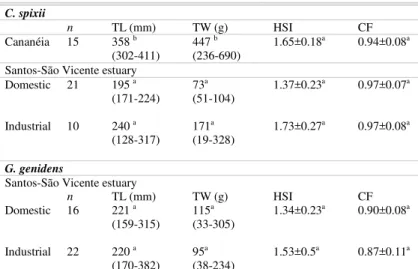
ESULTSData on total length (TL), total weight (TW) and somatic indices such as condition factor (CF) and hepatic somatic index (HSI) are given in Table 2. C. spixii from Cananéia estuary presented higher total length and total weight (TL: 302-411 mm, TW: 236-690 g) than did the specimens from industrial (TL: 128-317 mm, TW: 19-328 g) and domestic (TL: 171-224 mm, TW: 51-104 g) areas in the Santos-São Vicente estuary. In general, G. genidens had a similar variation of total length and total weight to individuals from industrial (TL: 170-382 mm, TW: 38-234 g) and domestic (TL: 159-315 mm, TW: 33-305 g) areas. All the fish collected were adults and no evidence of sexual maturity for reproductive purposes was to be observed.
Table 1. Analysis of Cd, Pb, Cu and Zn in reference materials (Dogfish liver - DOLT-2, NRCC and Oyster Tissue, NIST). Data represent mean concentrations (µg kg-1) ± sdv (
n = 3) and recovery (%).
DOLT-2 Oyster Tissue
Certified values Found values % Recovery Certified values Values Found % Recovery Cd 20.8 ± 0.5 18.69 ± 0.05 90 4.15 ± 0.38 3.66 ± 0.07 88 Pb 0.22 ± 0.02 0.20 ± 0.01 93 0.371 ± 0.014 0.37 ± 0.06 99 Cu 25.8 ± 1.1 20.45 ± 0.71 79 66.3 ± 4.3 61.49 ± 0.85 93
Zn 85.8 ± 2.5 82.86 ± 2.56 97 830 ± 57 788.96 ± 16.71 95
Table 2. Biometric data of C. spixii and G. genidens from each sampling site. Values of TL and TW shown as mean, minimum and maximum; and HSI and CF as mean±sdv. n
= number of samples.
C. spixii
n TL (mm) TW (g) HSI CF
Cananéia 15 358 b (302-411)
447 b (236-690)
1.65±0.18a 0.94±0.08a
Santos-São Vicente estuary Domestic 21 195 a
(171-224) 73 a
(51-104) 1.37±0.23
a 0.97±0.07a
Industrial 10 240 a (128-317)
171a (19-328)
1.73±0.27a 0.97±0.08a
G. genidens
Santos-São Vicente estuary
n TL (mm) TW (g) HSI CF
Domestic 16 221 a (159-315)
115a (33-305)
1.34±0.23a 0.90±0.08a
Industrial 22 220 a (170-382)
95a (38-234)
1.53±0.5a 0.87±0.11a
Concerning somatic indices, there were no statistically significant differences in the CF and HSI values between the sampling sites 1 and 2 or between the two Ariidae catfish species.
The concentrations of the metals analyzed in the liver, gill, and muscle of both Ariidae catfish species for each sampling site are shown for C. spixii and G. genidens, respectively, in Figures 2 and 3. Essential metals such as Zn and Cu presented higher concentrations than Pb and Cd in both Ariidae species. The Zn content: in muscle of C. spixii ranged from 7.12 to 12.74 ppm in specimens from Cananeía, 4.66 to 11.22 ppm in individuals from the domestic area, and from 6.84 to 17.20 ppm in fish from the industrial area; in liver from 100.15 to 850.77 ppm in specimens from Cananeía, from 46.51 to 169.73 ppm in individuals from the domestic area, and from 266.92 to 580.47 ppm in fish from the industrial area; and in gill, from 145.56 to 926.62 ppm in specimens from Cananeía, from 26.67 to 115.98 ppm in individuals from the domestic area, and from 107.70 to 926.62 ppm in fish from the industrial area, respectively.
Cu concentrations in muscle, liver, and gill of C. spixii ranged from <DL to 0.12 ppm, 1.08 to 4.78 ppm and 0.15 to 0.83 ppm in fish collected in Cananéia; from 0.09 to 0.64 ppm, 7.15 to 116.02 ppm, and 0.26 to 0.87 ppm in specimens from the domestic
site; and from 0.26 to 0.38 ppm, 3.19 to 10.57 ppm, and 0.39 to 0.93 ppm in animals from the industrial area, respectively.
Pb and Cd contents in the tissues were low. Cd in muscle of C. spixii from Cananéia, and the domestic and industrial areas ranged from 0.005 to 0.009 ppm, from 0.006 to 0.012 ppm, and from 0.001 to 0.004 ppm, respectively. The Cd content in liver ranged from 0.019 to 1.24 ppm, from 0.11 to 0.13 ppm, and from 0.06 to 0.07 ppm in fish from Cananéia, and the domestic, and industrial areas, respectively. The concentrations in the gill of C. spixii ranged from 0.001 to 0.005 ppm, 0.004 to 0.328 ppm, and from 0.005 to 0.009 ppm in animals from Cananéia and the domestic and industrial areas, respectively. Levels of Pb in muscle of all C. spixii from the industrial area were below the limit of detection and were not, therefore, included in Figure 2. Pb in muscle of C. spixii from Cananéia and the domestic area ranged from <DL to 0.12 µg g-1 and from <DL to 0.18 ppm. Pb levels in liver ranged from 0.02 to 0.58 ppm, 0.02 to 0.09 ppm, and 0.24 to 0.36 ppmto fish from Cananéia, domestic, and industrial areas, respectively. Additionally, concentrations of Pb in gill of C. spixii ranged from 0.04 to 0.41 ppm, 0.27 to 1.74 ppm, and 0.23 to 0.45 ppmin animals from Cananéia, domestic, and industrial areas, respectively.
Fig. 3. Metal concentrations in muscle, liver and gill of G. genidens from two sites within the Santos-São Vicente estuary
subject to such distinct anthropogenic influences as Domestic and Industrial effluents. Results are expressed as mean values displayed on the logarithmic axis scale. Different letters indicate significant differences between the groups. p<0.05.
With the exception of Cu, as regards the contents of metals in the liver of fish from the domestic area in the Santos-São Vicente estuary, it is worth noting that, in general, no differences were observed between C. spixii and G. genidens, for liver, muscle or gill. Due to the logistic difficulties encountered in sampling G. genidens in Cananéia, data on metals in the tissues of fish from this site are not shown. Zn levels in muscle of G. genidens from the domestic area ranged from 7.01 to 15.57 ppm and in those from the industrial area from 7.53 to 19.89 ppm. Zn in liver ranged from 99.86 to 232.17 ppm in specimens from the domestic area and from 158.37 to 477.22 ppm in G. genidens from the industrial area; Zn contents in gill ranged from 66.34 to 238.47 ppm in individuals from the domestic area and from 70.12 to 567.14 ppm in fish from the industrial area, respectively.
For Cu levels, muscle, liver, and gill ranged from <DL to 0.57 ppm, 3.77 to 11.59 ppm,and 0.25 to 0.85 ppm in fish collect in the domestic site and from <DL to 0.57 ppm, 4.75 to 14.84 ppm, and 0.27 to 0.64 ppm in animals from the industrial area, respectively. As in C. spixii, Pb and Cd contents in the tissues of G. genidens were low. Cd in muscle of fish from the domestic and the industrial areas ranged from 0.006 to 0.01 ppm and from 0.005 to 0.01 ppm, respectively. Cd contents in liver ranged from 0.08 to 0.14 ppm and from 0.06 to 0.25 ppmin fish from the domestic and industrial areas, respectively. Contents in gill of G. genidens ranged from 0.005 to 0.03 ppm and from
industrial areas, respectively. Pb concentrations in muscle of G. genidens ranged from <DL to 0.02 ppm and from <DL to 0.02 ppmin fish from the domestic and industrial areas, respectively. Pb contents in liver ranged from 0.37 to 6.29 ppm in specimens from the domestic area and from 0.30 to 2.62 ppm in animals from industrial area. Finally, Pb levels in gill ranged from 0.41 to 1.64 ppm in G. genidens from the domestic area and from 0.27 to 0.68 ppm in fish from the industrial areas, respectively.
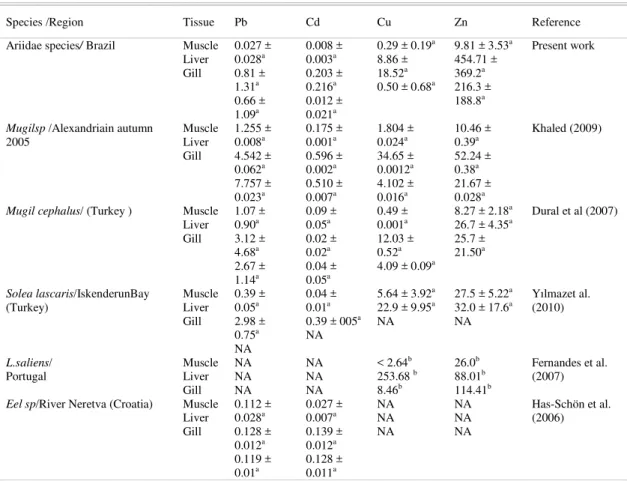
As in the case of C. spixii, there were no noteworthy statistical differences in the metal profile distribution in the tissues of G. genidens. In general, a similar profile was observed for the metal distribution in the fish tissues from the industrial and domestic areas in the Santos-São Vicente estuary in both Ariidae species. In relation to metal distribution in the tissues, concentrations diminished successively from liver>gill>muscle. However, no significant differences were observed, in general, between liver and gill for Zn and Pb in either species. The data on metals analyzed in this study are in accordance with those obtained for other fish species around the world with similar habitats and feeding habits (Table 3).
Table 3. The mean metal concentration (µg g-1 wet weight) and associated standard deviation (means ± sdv) in muscle, liver and gill tissues of some estuarine/marine fish from benthic habitats.
Species /Region Tissue Pb Cd Cu Zn Reference
Ariidae species/ Brazil Muscle Liver Gill 0.027 ± 0.028a 0.81 ± 1.31a 0.66 ± 1.09a 0.008 ± 0.003a 0.203 ± 0.216a 0.012 ± 0.021a
0.29 ± 0.19a 8.86 ± 18.52a 0.50 ± 0.68a
9.81 ± 3.53a 454.71 ± 369.2a 216.3 ± 188.8a
Present work
Mugilsp /Alexandriain autumn 2005 Muscle Liver Gill 1.255 ± 0.008a 4.542 ± 0.062a 7.757 ± 0.023a 0.175 ± 0.001a 0.596 ± 0.002a 0.510 ± 0.007a 1.804 ± 0.024a 34.65 ± 0.0012a 4.102 ± 0.016a 10.46 ± 0.39a 52.24 ± 0.38a 21.67 ± 0.028a Khaled (2009)
Mugil cephalus/ (Turkey ) Muscle Liver Gill 1.07 ± 0.90a 3.12 ± 4.68a 2.67 ± 1.14a 0.09 ± 0.05a 0.02 ± 0.02a 0.04 ± 0.05a 0.49 ± 0.001a 12.03 ± 0.52a 4.09 ± 0.09a
8.27 ± 2.18a 26.7 ± 4.35a 25.7 ± 21.50a
Dural et al (2007)
Solea lascaris/IskenderunBay
(Turkey) Muscle Liver Gill 0.39 ± 0.05a 2.98 ± 0.75a NA 0.04 ± 0.01a 0.39 ± 005a NA
5.64 ± 3.92a 22.9 ± 9.95a NA
27.5 ± 5.22a 32.0 ± 17.6a NA
Yılmazet al. (2010)
L.saliens/
Portugal Muscle Liver
Gill NA NA NA NA NA NA
< 2.64b 253.68 b 8.46b
26.0b 88.01b 114.41b
Fernandes et al. (2007)
Eel sp/River Neretva (Croatia) Muscle Liver Gill 0.112 ± 0.028a 0.128 ± 0.012a 0.119 ± 0.01a 0.027 ± 0.007a 0.139 ± 0.012a 0.128 ± 0.011a NA NA NA NA NA NA
Has-Schön et al. (2006)
a Mean value ± standard deviation. b Mean
NA not analyzed
Table 4. Metal pollution index (MPI) value of the total metal accumulation levels in Ariidae Catfish.
C. spixii G. genidens
Sites Muscle Gill Liver Muscle Gill Liver
Cananéia 0.14 0.45 2.01 --- --- ---
Domestic 0.13 0.88 1.88 0.14 0.82 2.26
Industrial 0.15 0.62 2.38 0.14 0.65 3.76
D
ISCUSSIONC. spixii spawns in late spring/early summer, has total spawning with synchronic development of
the similar values found for these indices. However, the HSI and CF presented in this study are more homogeneous that those observed by Azevedo et al. (2009b). This might be explained by the sampling period, different abiotic influences, and more specifically by the high levels of individual variations in HSI. Furthermore, it could indicate the absence of the negative effects which would result from the presence of chemicals, in these fish and/or be due to the better environmental conditions in the Santos-São Vicente estuary.
Biological factors such as length, weight and sexual maturity may affect the levels of metal bioaccumulation in aquatic organisms (LOMBARDI et al., 2010). In view of this, it is very important to investigate the metal contents in their relationship to biological variables. In general, the fish analyzed in this study showed some differences in their biological characteristics such as length and weight. However, the inconspicuous differences observed in the length and weight was insufficient to produce significant changes, for example, in the values of the somatic indices.
In general, the decrease in metal concentrations in the order liver>gill>muscle was observed in this study by using metal distribution in the tissues and the metal pollution index (MPI). This profile is in accordance with that obtained for other fish species (DURAL et al., 2007; KHALED, 2009; JARÍC et al., 2011).
The lowest concentrations of all metals in both the Ariidae catfish species were observed in the muscle. This can be explained by the low binding to the SH group, the low solubility of salts restricting movement across cell membranes (KHALED, 2009) and finally by the typical disposal of contaminants that were neither detoxified nor eliminated.
Data on metal distribution in muscle, liver, and gill of both Ariidae catfish species were similar. High levels of Zn and Cu in the liver were obtained for all the sampling areas in both Ariidae species. Bioaccumulation in the liver was observed for all the metals analyzed, since liver is the major organ of xenobiotic metabolism in fish (GILL et al., 1992; VIJVER et al., 2004). Compared to those of other fish species, the concentrations of these metals were also much higher and can be attributed to the feeding type, dietary sources, habitat and possibly to the detoxification mechanism with the metallothionein (MT) participation in the metal-binding between Zn, Cd and Pb.
Similar Zn content in the tissues of fish from Cananéia and the Industrial area can be an indication of natural levels of this element in the aquatic environment studied. Furthermore, it is possible that the low Zn levels in fish from the
consequence, for example, of the competitive mechanism with other metals such as Pb and Cd, which occur in higher concentrations in fish from the domestic area. This is a hypothesis which can be confirmed by the sampling of fish from other regions with higher levels of metals.
The higher Pb concentrations in the gill than in the muscle and liver of C. spixii from the domestic area are within the levels approved by the NRCC (1973) and are also in accordance with Khaled (2009). This latter author considers that this finding may be attributed to the possibility of particulate or organic Pb being adsorbed by the gills in a soluble form such as could diffuse into the gill. Furthermore, fish from the domestic area in the Santos-São Vicente estuary are exposed to a myriad of metals from sources such as garbage dumps and refuse discarded by residents in stilt houses, very common dwellings in this region of the estuary. Further, the metals found in the domestic area may reflect a movement from the industrial toward the domestic area because this latter region has more geographical decay (o que é geographical decay?) than the industrial area, which may favor the persistence of metals in the environment.
The MPI results presented in this study suggest that gill and liver are good indicators of the bioaccumulation process and may be the best at reflecting recent and chronic metal exposure in gill and liver, respectively. Differences between MPI in the liver of C. spixii and G. genidens may be related to the differences in the detoxification mechanisms and/or metabolic activities between these Ariidae catfish. In a study of some fish species, Khaled (2009) presented MPI results similar to those given in the present paper. The high values observed in the liver may be another evidence of differences in the detoxification mechanisms between species impacted by different anthropogenic activities.
A
CKNOWLEDGMENTSThe authors wish to thank the São Paulo Foundation for Research Support-FAPESP for the post-doctoral fellowship granted to J.S. Azevedo (Process 2008/58261-6).
R
EFERENCESAZEVEDO, J. S.; FERNANDEZ, W. S.; FARIAS, L. A.; FÁVARO, D.T.; BRAGA, E. S. Use of the tropical brazilian fish Cathorops spixii as a bioindicator of trace metals pollution in Santos Bay. Ecotoxicol., v. 18, p. 577-586, 2009a.
AZEVEDO, J. S.; SERAFIM, A.; COMPANY, R.; BRAGA,
E.; FÁVARO, D. T.; BEBIANO, M. J. Biomarkers of exposure to metal contamination and
lipid peroxidation in the benthic fish Cathorops spixii
from two estuaries in South America, Brazil.
Ecotoxicol., v. 18, p. 1001-1010, 2009b.
AZEVEDO, S. S.; BRAGA, E. S. ; FÁVARO, D. T.; PERRETI, A. R.; REZENDE, C. E.; SOUZA, C. M. M. Total mercury in sediments and in Brazilian Ariidae catfish from two estuaries under different anthropogenic influence. Mar. Pollut. Bull., v. 62, p. 2724-2731, 2011.
AZEVEDO, J. S.; SARKIS, J. E. S.; HORTELLANI, M. A.; LADLE, R. J. Are catfish (Ariidae) effective
bioindicators for Pb, Cd, Hg, Cu and Zn? Water Air Soil
Pollut., DOI: 0.1007/s11270-012-1160-2, 2012a.
AZEVEDO, J. S.; SARKIS, J. E. S.; OLIVEIRA, T. A.; ULRICH, J. C. Tissue-specific mercury concentrations in two catfish species from the Brazilian coast. Braz. J. Oceanogr., v. 60, n. 2, p. 211-219, 2012b.
BOLDRINI, C. V.; NAVAS-PEREIRA, D. N. Metais pesados na baía de Santos e estuário de Santos e São Vicente. Ambiente, v. 1, n. 3, p. 118-127, 1987.
DURAL, M.; GÖKSU, M. Z. L.; ÖZAK, A. A. Investigation of heavy metal levels in economically important fish species captured from the Tuzla lagoon. Food Chem., v. 102, p. 415-421, 2007.
FÁVARO, L. F.; FREHSE, F.A.; OLIVEIRA, R. N.; SCHWARZ-JÚNIOR, R. Reprodução do bagre amarelo,
Cathorops spixii (Agassiz) (Siluriformes, Ariidae), da Baía de Pinheiros, região estuarina do litoral do Paraná, Brasil. Rev. Bras. Zool., v. 22, n. 4, p. 1022-1029, 2005.
FIGUEIREDO, J. L.; MENEZES, N. A. Manual de peixes marinhos do sudeste do Brasil. II. Teleostei (1). São Paulo: Museu de Zoologia da Universidade de São Paulo, 1978. 110 p.
GILL, T. S.; BIANCHI, C. P.; EPPLE, A. Trace metal (Cu and Zn) adaptation of organ system of the American Eel,
Anguilla rostrata, to external concentrations of cadmium. Comp. Biochem. Phys.., v. 102C, n. 3, p. 361-371, 1992.
GOMES, I. D.; ARAÚJO, F. G.; AZEVEDO, M. C. C.; PESSANHA, A. L. M. Biologia reprodutiva dos bagres marinhos Genidens genidens (Valenciennes) e Cathorops spixii (Agassiz) (Siluriformes, Ariidae), na Baía de Sepetiba, Rio de Janeiro, Brasil. Rev. Bras. Zool., v. 16, n. 2, p. 171-180, 1999.
HEATH, A. G. Water pollution and fish Physiology. 2. ed. Boca Raton; Boston: CRC Press, 1990. 245 p. JARÍC, I.; VISNJIAE-JEFTIAE, Z.; CVIJANOVIAE, G.;
GAÈIAE, Z.; JOVANOVIAE, L.; SKORIAE, S.;
LENHARDT, M. Determination of differential heavy metal and trace element accumulation in liver, gills, intestine and muscle of sterlet (Acipenser ruthenus) from the Danube River in Serbia by ICP-OES. Microchem. J., v. 98, p. 77-81, 2011.
KARADEDE-AKIN, H.; ÜNLÜ, E. Heavy metal concentrations in water, sediment, fish and some benthic organisms from Tigris river, Turkey. Environ. Monit. Assess., v. 131, p. 323-337, 2007.
KHALED, A. Trace metals in fish of economic interest from the west of Alexandria, Egypt. Chem. Ecol., v. 25, n. 4,
p. 229-246, 2009.
KNAPEN, D.; REYNDERS, H.; BERVOETS, L.; VERHEYEN, E.; BLUST, R. Metallothionein gene and protein expression as a biomarker for metal pollution in natural gudgeon populations. Aquat. Toxicol., v. 82, p.
163-172, 2007.
LANA, P. C.; BIANCHINI, A.; OLIVEIRA RIBEIRO, C. A.; NIENCHESKI, L. F. H.; FILLMANN, G.; SANTOS, C. S. G. Avaliação ambiental de estuários brasileiros:
Diretrizes metodológicas. In: Projeto RECOS: Uso e apropriação de recursos costeiros. Grupo Temático Biodiversidade e Qualidade Ambiental. Rio de Janeiro: Museu Nacional., 2006. 155 p. (Série Livros, 22). LOMBARDI, P. E.; PERI, S. I.; GUERRERO, N. R. V.
Trace metal levels in Prochilodus lineatus collected from
the La Plata River, Argentina. Environ. Monit. Assess.,
v. 160, p. 47-59, 2010.
NRCC – National research council of Canada. Lead in Canadian environment. Ottawa: NRCC Association, Committee on Scientific criteria for Environmental Quality, National Research Council of Canada, 1973. SERAFIM, M. A.; BEBIANNO, M. J. Variation of
metallothionein and metal concentrations in the digestive gland of the clam Ruditapes decussatus: sex and seasonal effects. Environ. Toxicol. Chem., v. 20, p. 544-552,
2001.
SMIRNOV, L. P.; SUKHOVSKAYA, I. V.; NEMOVA, N. N. Effects of environmental factors on low-molecular-weight peptides of fishes: a revue. Russ. J. Ecol., v. 36, n. 1, p. 48-54, 2005.
TIJARO, R.; RUEDA, M.; SANTOS-MARTINEZ, A. Dinâmica poblacional del chivo mapalé Cathorops spixii
em la Ciénaga Grande de Santa Marta y complejo de Pajarales, Caribe Colombiano. Boln Invest. Mar. Cost., v. 27, p. 87-102, 1998.
USERO, J.; GONZÁLEZ-REGALADO, E.; GRACIA, I. Trace metals in the bivalve mollusc Chamelea gallina
from the Atlantic Coast of Southern Spain. Mar. Pollut. Bull., v. 32, n. 3, p. 305-310, 1996.
VIJVER, M. G.; GESTEL, C. A. M. V.; LANNO, R. P.; STRAALEN, N. M. V.; PEIJNENBURG, W. J. G. M. Internal metal sequestration and its ecotoxicological relevance: a review. Environ. Sci. Technol., v.38, n. 18, p. 4705-4712, 2004.
YILMAZ, A. B.; SANGÜN, M. K.; YAGCLÝOGCLU, D.; TURAN, C. Metals (major, essential to non-essential) composition of the different tissues of three demersal species from Iskenderun Bay, Turkey. Food Chem., v. 123, p. 410-415, 2010.
(Manuscript received 01 December 2011; revised 12 November 2012; accepted 13 December 2012)