http://dx.doi.org/10.1590/0104-07072017002820017
STORIES ABOUT ALCOHOL DRINKING IN A QUILOMBOLA
COMMUNITY: PARTICIPATORY METHODOLOGY FOR
CREATING-VALIDATING A COMIC BOOK BY ADOLESCENTS
1Adriana Nunes Moraes Partelli2, Ivone Evangelista Cabral3
1 Article extracted from the dissertation - Adolescents of Quilombola Community participation on constructing the educational material
about alcohol, submitted to the Graduate Program in Nursing, Escola de Enfermagem Anna Nery (EEAN), Universidade Federal do Rio de Janeiro (UFRJ), in 2016.
2 Ph.D. in Nursing. Professor, Universidade Federal do Espírito Santo. São Mateus, Espírito Santo, Brazil. E-mail: adrianamoraes@
hotmail.com
3 Ph.D. in Nursing. Professora, Maternal-Child Nursing Department, EEAN/UFRJ. Researcher of CNPq. Rio de Janeiro, Rio de
Janeiro, Brazil. E-mail: [email protected]
ABSTRACT
Objective: describe the participatory methodology of adolescents in the creation-validation process of a comic book that addresses alcohol experimentation, and analyze the experiences of these adolescents that were portrayed in the comic book.
Method: participatory, applied between 2015 and 2016, using the dynamics of creativity and sensitivity for comic books, of the creative sensitive method, in two groups of adolescents (G1 and G2), totaling 17 participants, aged from 10 to 17 years, all of them living in a Quilombola community in the north region of the state of Espírito Santo, Brazil. G1 participated in the creation of the comic book with content deinition and production. G2 validated the experiential content of the comic book.
Results: community info-geography and sociocultural information contributed to the creation of the scenery and characters; the narrative of boys (ive) and girls (ive) provided the storyboard script which a contracted designer changed into “A possible story.” In the validation, boys (two) and girls (ive) created the cultural identity with the plot, since alcohol is part of the everyday life of the community, stimulating experimentation among adolescents.
Conclusion: the creation-validation methodology of a comic book about alcohol experimentation stimulated a critical thinking of adolescents who created and validated it.
DESCRIPTORS: Educational and promotional materials. Adolescent. African continental ancestry group. Nursing. Methodology.
HISTÓRIAS SOBRE ÁLCOOL EM COMUNIDADE QUILOMBOLA:
METODOLOGIA PARTICIPATIVA DE CRIAÇÃO-VALIDAÇÃO DE
QUADRINHOS POR ADOLESCENTES
RESUMO
Objetivo: descrever a metodologia de participação de adolescentes no processo de criação-validação de uma história em quadrinhos que retrata a experimentação do álcool e analisar as experiências e vivências desses adolescentes que foram incorporadas às histórias em quadrinhos.
Método: pesquisa participante, implementada entre 2015 e 2016, com a dinâmica de criatividade-sensibilidade “Almanaque” do método
criativo-sensível, em dois grupos de adolescentes (G1 e G2), totalizando 17 participantes, entre 10 e 17 anos de idade. Todos residentes numa comunidade Quilombola ao norte do Estado do Espírito Santo, Brasil. O G1 participou da criação da história em quadrinhos com o diagnóstico e a produção do seu conteúdo. O G2 validou o conteúdo vivencial e experiencial da história.
Resultados: a infogeograia da comunidade e as informações socioculturais contribuíram para a criação do cenário e dos personagens; a
narrativa de meninos (cinco) e meninas (cinco) forneceu o roteiro do storyboard transformado pelo designer contratado em “Uma história
possível”. Na validação, meninos (dois) e meninas (cinco) criaram identidade cultural com o enredo da história, pois o álcool integra-se ao cotidiano de vida da comunidade, estimulando a experimentação entre os adolescentes.
Conclusão: a metodologia de criação-validação da história em quadrinhos, sobre o álcool estimulou a criticidade, tanto de quem a criou como de quem a validou.
HISTORIAS SOBRE ALCOHOL EN COMUNIDAD QUILOMBOLA:
METODOLOGÍA PARTICIPATIVA DE CREACIÓN-VALIDACIÓN DE
HISTORIETAS POR ADOLESCENTES
RESUMEN
Objetivo: describir la metodología de participación de adolescentes en el proceso de creación-validación de una historieta que retrata la experimentación del alcohol y analizar las experiencias y vivencias de esos adolescentes que fueron incorporadas a las historietas.
Método: investigación participante implementada entre 2015 y 2016, con la dinámica de creatividad-sensibilidad “Almanaque” del método
creativo-sensible, en dos grupos de adolescentes (G1 y G2), totalizando 17 participantes, entre 10 y 17 años de edad. Todos los residentes en una comunidad quilombola al norte del Estado del Espíritu Santo, Brasil. El G1 participó en la creación de la historieta con el diagnóstico y la producción de su contenido. El G2 validó el contenido vivencial y experiencial de la historia.
Resultados: la info-geografía de la comunidad y las informaciones socioculturales contribuyeron a la creación del escenario y de los personajes; la narrativa de varones (cinco) y las mujeres (cinco) proporcionó el guion de la historia transformado por el diseñador contratado en “Una historia posible”. En la validación, varones (dos) y mujeres (cinco) crearon identidad cultural con el enredo de la historia, pues el alcohol se integra al cotidiano de vida de la comunidad, estimulando la experimentación entre los adolescentes.
Conclusión: la metodología de creación-validación del cómic, sobre el alcohol estimuló la criticidad, tanto de quien la creó y de la que la validó.
DESCRIPTORES: Materiales educativos y de divulgación. Adolescente. Grupo de Ascendencia continental africana. Enfermería. Metodología.
INTRODUCTION
Alcohol is a low-cost product of wide social acceptance, easily available at parties, commercial facilities (stores, bars, supermarkets, and others),
and at home. In this paper, we will use the terms “experience/experimentation” and “alcohol con
-sumption” to designate alcohol drinking start time
and frequency of use.1-3
A study conducted in 2012 on alcohol experi-mentation and consumption among Brazilian ado-lescents, based on data from the Pesquisa Nacional de Saúde do Escolar (PENSE), reports that more than half of them, from both private and public schools, had experienced one or two shots of alcoholic drinks; 26.1% had consumed alcoholic drinks in the month prior to the survey, and 28.1% reported drunken-ness. Those over 14 years of age experienced the
irst shot of alcoholic drinks between 12 and 13
years. As age increases, alcohol experimentation also increases, particularly among boys.1 Data from
this research did not analyze their ethnicity or place of residence, whether rural or urban area.
In this context, preventive nursing care, as
part of total health care, should include the training of adolescents on self-care practices, health educa-tion, and production of educational materials, for example. However, a process of autonomy should be considered, involving dialogue and listening so that the decision-making on alcohol experimenta-tion is conscious and not impulsive.
In the teenage phase, experimentation is in -herent to the desire to learn about the world and with peers. However, the risks associated with the regular and continued consumption of alcoholic
drinks can cause social, physical, and mental
dam-ages, which require collective and critical relection, in the “I-you” relationship, focused on historical
and sociocultural conditions. These assumptions are implied in a movement to (re)formulate health and health education practices for this target audience
of many speciicities.1-2
The theme of alcohol in adolescence is little discussed in educational materials or presented with other subjects.3-4 The content is usually more
focused on adolescents living in urban areas, with the lifestyle of large cities, not taking into account their ethnicity, particularly disregarding black
ado-lescents in public health issues. Scientiic content
and illustrations of these materials show more of the urban life3-4 and do not involve the experiences of
black adolescents living in rural areas whose daily life and history are unique to that place. Any mate-rial based on this logic does not favor the access of adolescents living in Quilombola communities to health information that considers ethnic/racial and geographical components and would allow them to create a reader identity with the characters, scener-ies, and stories.
Materials that show the view of the informa-tion producer, instead of producing knowledge, are cultural invaders, that is, they are the thinkers (not the invaded ones), based on their own values and references, imposing their word and silencing the invaded ones. They think for the other, not
with the other. “The invader prescribes and the invaded ones just follow the prescription.”6:26-27 The
creation of educational, interactive, and culturally non-invasive educational materials represents a great challenge to be addressed in public health
policies. In this context, the Política Nacional de Saúde Integral da População Negra (National Policy
of Integral Health of the Black Population) en -courages, among other actions, the development of informative, communicational and educational materials on the health of this population, respect-ing the diverse knowledge and values, with the aim of socializing information and actions to promote the integral health of black people.7
The process of nursing care, within the scope of the policy of integral attention to the health of the black population, involves interpersonal relationships and is based on cooperation and mutual trust, from both the caregiver and the care receiver, developing from humanistic values
and scientiic knowledge.8 Considering care from
this perspective requires new guidelines, propos-als and methodologies of intervention through current methods to understand the subjective, biological, and sociocultural processes that are impacted by cultural invasion.
We understand that a comic book9 can be a
powerful educational tool because it allows
adoles-cents to relect on social practices of experimenta -tion and alcohol consump-tion in society, mediated by ludicity and critical thinking. Considering the above, this study analyzed the participation of black adolescents from a Quilombola community in the north region of the state of Espírito Santo in the construction of stories about alcohol drinking as a comic book. The objectives of this study were: to describe the participatory methodology of adoles-cents in the creation-validation process of a comic book that addresses alcohol experimentation, and analyze the experiences of the adolescents that were portrayed in the comic book.
METHOD
This is a participatory research10-11 that used
the Creative Sensitive Method (MCS) for arts-based group research.12 While participatory research
favors shared knowledge production, using the
social reality of participants, the MCS values artis-tic expression to access human experience.10-12 The
active participation of adolescents in all stages of knowledge production and construction, focused on the stories and culture of adolescents from a Quilombola community, was associated with the playfulness and critique of creative and sensitive art to generate a new methodology for the production and validation of educational material in a comic book format by and for adolescents.
To complement the narratives, ethnographic records were adopted to show the world with greater clarity from the point of view of the partici-pants. As a constant need for anthropological search,
the concepts inherent to their “close experiences” were analyzed, with clariication and articulation of “distant experience” theoretically created to
understand social life.13 On these occasions, the irst author for eight days (including the weekend)
spent 64 hours in the community between April and December 2015. The conversation with the nurse and the Community Health Agent (ACS), the fam-ily health team from the assigned area, community leadership, residents, and local school teachers, about the habits, stories, and legends of that social
group were recorded in the ield log of the study as
an ethnographic note. This information helped cre-ate the characters of the story (info-biography) and the daily life (info-sociocultural aspect) in the comic
books. In addition, the access to the community, the types of houses, churches, soccer ield and school,
the crops and animals were captured in the form of relevant pictures to build the scenery and scenes (info-geography) of the comic book.
The study was conducted in a Quilombola community, in the rural area, 44 kilometers from the municipality of São Mateus, in the north region of the state of Espírito Santo, Brazil, after approval of the Ethics Committee of the Escola de Enfermagem Anna Nery and the Instituto de Atenção Francisco de Assis (CEP EEAN/HESFA) of the Universidade Fed-eral do Rio de Janeiro (protocol 856.682/2014).
The community leadership and the ACS dis-tributed invitations to families with adolescents for
meetings that took place on Sunday, when the irst
author presented the research proposal, which was also for the participation of adolescents. The content of the study terms (informed consent for parents/ guardians and agreement for adolescents) was then read and explained.
elementary and/or middle school attendance in a public school located in the rural area; live in the Quilombola community; of either sex; aged 10 to 19 years, according to the World Health Organization (WHO), and with preserved cognitive and motor skills. Adolescents with acute diseases and chronic conditions, or not attending a public school in rural areas, and those living outside the Quilombola community were excluded. The adolescents who attended the meetings in March 2015 (G1) and October 2016 (G2) with their legal representatives, were placed in G1 and G2, respectively. G1 had ren
adolescents (ive girls and ive boys), and G2 had seven (ive girls and two boys).
Data generation was implemented in two of the three stages by G1, corresponding to the diagnosis and creation of the comic book; G2 was responsible for the general comic book valida-tion in the third stage. The three stages were developed using the creativity and sensitivity dynamics of the MCS.12
The diagnostic stage was performed in two meetings whose minimum duration was 1 hour and 7 minutes, and maximum duration
was 1 hour and 45 minutes. In the irst meeting,
G1 participated in the Dynamics of Creativity
and Sensitivity (DCS) “Shortening Distances.”
After welcoming the participants, boys and girls elaborated the individual artistic production and
answered the question for debate (QGD): “I am... I stay... I want...”At the end, each participant pre -sented and discussed with the group what he/she had produced, synthesizing and validating the
debate themes codiied in the biographies of the
characters in the comic book. These procedures helped raise the group awareness of the theme, created a group identity, and provided materials that subsequently inspired the comic book.
In the second meeting, the group participated in the DCS “Building My World” for the comic book, based on the following QGD: “Near my house, I see alcoholic drinks in...” With the mate -rial provided (Styrofoam boards, modeling paste, glue, scissors, and popsicle sticks) and several images (showing alcohol at parties, in bars, and
at home) from the public domain of the Internet,
G1 developed the individual artistic production, presenting and discussing it afterwards. The dy-namics generated an image bank and narratives with the diagnosis of the alcohol scene in the social environment in which the participants live.
The second stage, creation of the comic book, started with the analysis of the thematic content14
of the written text corpus and images of the DCS
and the ethnographic records. The irst analysis
corresponded to successive readings for material
impregnation. In the second analysis, the materials
were explored, encoding them through words, ex-pressions, and text fragments linked with alcohol-related experiences. The text elements with com-mon characteristics were grouped by theme (rural environment, sociocultural aspects, people, family
members, what they drink, behavior). In the last stage, the various themes were reduced to only ive, which were transformed into the storyboard “A possible story,” which is part of the “Comic Book:
Alcohol and Rites of Adolescents in a Quilombola
Community.” Also in this stage, scientiic and
legal bases were used to involve critiques and the experiential content of the adolescents, which
were presented in the format of “curiosities”, using
direct language and short text.
In the storyboard,9 the stories could be
in-vented or based on everyday events, characterized by narration of facts with natural dialogue, through which the characters interact with words, gestures, and facial expressions. The speech is direct, in bal-loons, aided by legends and linguistic (onomato-poeic words, punctuation marks), paralinguistic (intensity of sounds, speed of pronunciation, and expression of emotions), and visual resources
(pictorial iguration of emotions in the characters,
balloons, and letters). To narrate the content of the
story, a simpliied and contemporary presentation
was used, with few rules, to facilitate the work of illustrators and layout designers.15
The storyboard presented to G1 adolescents in the qualitative evaluation rounds of info-geo-graphic (scenery), info-sociocultural (the story itself), and info-biographic (caricature) contents of the characters. Each version of the comic book, previously illustrated and designed by a profes-sional contractor, was projected on multimedia equipment to be read by G2 adolescents, frame by frame. This group validated the material in
the DCS “Shortening distances between what was produced and the comic book,” with the follow
-ing question for debate: “The characters are...the scenes are...the stories are...” No changes were
proposed by the group. The whole meeting lasted 1 hour and 15 minutes.
The narratives of the participants were
identi-ied by the irst letter of their names, followed by
RESULTS
The narratives of the stories of G1 adolescents inspired the production of the biographies of the comic book characters. They were boys and girls aged 10 to 14 years, from extended biparental, single parent, and nuclear families. All of them had con-sanguinity links (third and fourth-generation cous-ins and brothers) and they said they were Catholics or evangelicals. The students in the elementary school attended the multi-teacher school of the community; those who were in the middle school attended the Escola Família Agrícola. Two persons presented schooling level that was incompatible with their chronological ages, as they had failed and dropped out of school. The family income was less than four minimum wages (in March 2015 one minimum wage corresponded to R$788.00), whose
income came from rural work and social beneits
from the Sistema Único de Assistência Social (SUAS)
(Family Allowance, Continued Provision Beneit)
and rural retirement. After school, boys and girls played only after their school assignments, rural work, and helping around the house.
The following items describe the production-validation methodology of the storyboard of dia-logic and interactive basis.
1. From diagnostic stage to comic book
creation - a dialogic and participative process
The info-biography of the characters from the story was based on the characteristics of the
participants, but a ictitious biographical character
was maintained. The caricature of the characters preserved the sociocultural identity compatible with the lifestyle of the boys and girls, men and women, of the Quilombola community where they lived.
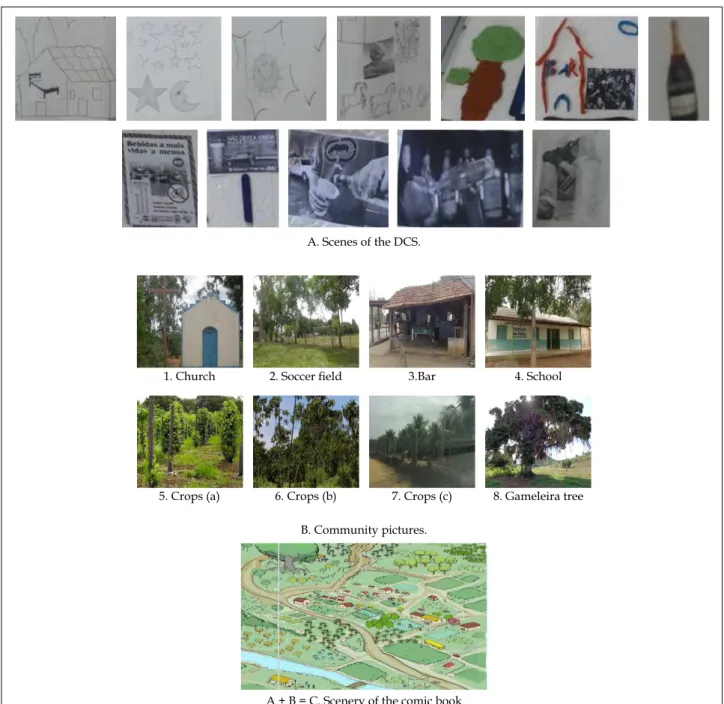
The scenery of the story (Figure 1) was cre-ated using the community info-geography, that is, a collection of images selected by the adolescents in
the DCS “Constructing my world...,” which express
scenes of the life of a Quilombola rural community (house, crops, animals, bars, availability of alcoholic drinks(A); B) with photo-ethnography(B); C) to
constitute the inal version of the story scenery (C).
Chiumbo appears after combining scenes
A and pictures B, a ictitious name chosen by G1 participants for the scenario of “A possible story” about alcohol and its effects on human behavior. In
the story, Chiumbo is the name of a rural
Quilom-bola community, located near the Cricaré river, in
the municipality of São Mateus, in the north region of Espírito Santo, in Brazil. The access to the
com-munity is by an unpaved road, crossing the coconut plantation of a company that hires people from the community and also sponsors the only local soc-cer team. Conilon coffee, pepper, and many fruit trees are planted there to support the community as family farming.
The community has Catholic and Evangelical
churches, a soccer ield, a multi-teacher municipal public school, ive bars that sell several alcoholic
beverages, and houses.
Info-sociocultural data from the comic book
emerged from narratives about lifestyles of adoles-cents and insertion in the context of families. Men and women buy fermented (beer) and distilled (cachaça) drinks to consume at home or at the bar near their homes.
Near my house there is a bar, which sells cachaça and beer. Men go there to drink and the women buy beer for the husbands to drink at home (L., boy, 10 years old). Near my house there are two bars (C. and Z.), where drinks are sold (J., girl, 13 years old).
Bars are places where friends meet to drink in a glass or directly from the bottle and get drunk walking around the community. Daily scenes show the experience of boys and girls with social drinking and that gather people, family members, and friends.
[...] At T.’s bar, several friends meet and drink (C., boy, 12 years old). [...] At the bars, there are bottles of alcoholic drinks and people drinking, there are also soft drinks (T., boy, 10 years old). At the bar, I see a man pouring his drink in a glass and some people drink from the bottle. There are a lot of people drinking at the bar and they leave the bar drunk (U., boy, 11 years old).
The analysis of these narratives led to the
theme “behavior change with alcohol drinking,”
inspiring the creation of an adult character for the story, who regularly drinks alcohol and works in crops, which are the main source of income in family agriculture of the region, captured in the
photo-eth-nography of the irst researcher. The main character of “A possible story” is Afro-descendent, married,
and head of a nuclear family with six children. One
of his habits is “to drink with friends or alone in bars near his house” after the rural work. Then he
leaves the bar drunk, and walks the unpaved streets, stopping at the other bars farther from his house to continue drinking.
[...] Uncle C. has a bar that is not so close to my home. In Uncle M.’s bar, there is a sign that says: “Don’t let alco-hol change your life.” Even so, I see several empty bottles of beer, drunk people... (T., boy, 11 years old)[...] The older
people go from bar to bar drinking until they fall to the loor (G., boy, 13 years old). There are many people drinking at the bar and getting drunk (U., boy, 11 years old).
The behavior of drunken staggering adults who drink until they fall to the ground led to the
development of a preliminary storyboard of “A possible story,” which reproduces the speech of
characters in a social and historical context. The
organization and layout of the preliminary
sto-ryboard script deined the size of the production
of the researchers and technical team in charge of story illustration and design. The characters, scenes, scenery, and narratives provided by the participants led to the construction of dialogical educational materials, interactively and culturally focused on their lives.
In one of the ethnographic immersions, a resident told the “Gameleira tree story,” which was added to the DCS material to create the inal argu -ment of the comic book.
A. Scenes of the DCS.
B. Community pictures.
A + B = C. Scenery of the comic book 1. Church
5. Crops (a)
2. Soccer ield
6. Crops (b)
3.Bar
7. Crops (c)
4. School
8. Gameleira tree
Figure 2 - Arrangement of the preliminary storyboard for the comic book “A possible story” and sequence of narratives and images (A, B, C). Version developed by professionals (D, frames 1 to 20). Rural Quilombola Community. São Mateus, ES, Brazil, 2015.
One night a man returned to the community from another nearby community. On the road there was a gameleira tree (the tree was said to be haunted, the people walked by and they heard voices, whispering,
and many saw igures). That was the only road. There
was a swamp, the gameleira tree, the road, and a very large white cashew tree. When the man was walking by, the road reversed and he ended up in the middle of Airi bushes and stayed there all night trying to get out of the
bushes and ind his way home. As the day was dawning, the sunshine lit up the road and the man inally found
his way home. Then, he told everyone that the gameleira tree made the road disappear! (Ethnographic journal, local resident, 2015).
And so, the plot (scenes, scenery, characters, arguments, and narratives) was created for the
comic book titled “A possible story” (Figure 2), still
as a storyboard.
“Tukufu, a young man descending from
slaves, married and father of six children, every day
after working his land, where he lives and plants as a family farm, goes before the sun goes down, to a bar near his home to drink, relax, and meet friends. One day, he decided to go to another bar, and as he walked by the roots of a large gameleira tree, he stumbled, fell, and hit his head on a root, and was unconscious, falling asleep. During his deep sleep, he saw several images that made him rethink his life, his alcohol consumption and his family. He sought
help to try to stop drinking.”
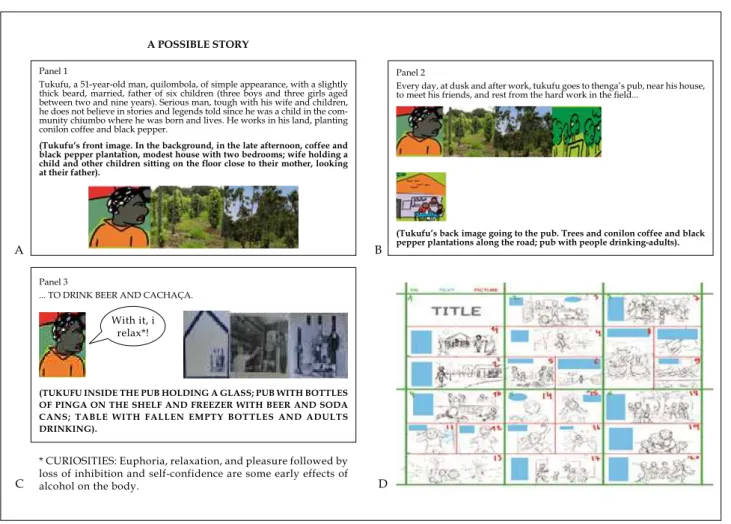
The process of comic book development involved permanent dialogue, the illustrated sto-ryboard coming and going for the appreciation of the adolescents, and changes whenever necessary. After the G1 participants read the storyboard and the text and image alterations made by the group, the material (A, B, and C) was delivered to a contrac-tor (that converted it into D). Besides the image, the frames described actions, site, time, moments, and other information that guided the work of all of the professionals (Figure 3).
A B
C D
Panel 1
Tukufu, a 51-year-old man, quilombola, of simple appearance, with a slightly thick beard, married, father of six children (three boys and three girls aged between two and nine years). Serious man, tough with his wife and children, he does not believe in stories and legends told since he was a child in the com-munity chiumbo where he was born and lives. He works in his land, planting conilon coffee and black pepper.
Panel 3
... TO DRINK BEER AND CACHAÇA.
Panel 2
Every day, at dusk and after work, tukufu goes to thenga’s pub, near his house,
to meet his friends, and rest from the hard work in the ield...
(Tukufu’s front image. In the background, in the late afternoon, coffee and black pepper plantation, modest house with two bedrooms; wife holding a child and other children sitting on the loor close to their mother, looking at their father).
(TUKUFU INSIDE THE PUB HOLDING A GLASS; PUB WITH BOTTLES OF PINGA ON THE SHELF AND FREEZER WITH BEER AND SODA CANS; TABLE WITH FALLEN EMPTY BOTTLES AND ADULTS DRINKING).
* CURIOSITIES: Euphoria, relaxation, and pleasure followed by
loss of inhibition and self-confidence are some early effects of alcohol on the body.
With it, i relax*!
(Tukufu’s back image going to the pub. Trees and conilon coffee and black pepper plantations along the road; pub with people drinking-adults).
Figure 3 - Fragments of the storyboard that is part of the comic book “Alcohol and Rites of Adolescents in a Quilombola Community.” São Mateus, ES, Brazil, 2016
After the characters presented the situation/ problem, two curious facts about the effects of alcohol on people’s behavior were inserted in the
story, representing the translated scientiic knowl
-edge. CURIOUS FACT 1: Euphoria, relaxation,
and pleasure plus loss of shyness and increased
self-conidence are some initial effects of alcohol on people’s bodies. CURIOUS FACT 2: With increased
amount of alcohol, the movements become slower, uncoordinated, the person becomes sleepy and, if he keeps drinking, he can lose consciousness, fall into a coma, and die.
2. Validation of the comic book by peers
In the validation stage, the comic book was
evaluated by other adolescents (G2), according to
the cultural identiication with the characters, the
scenes and the narratives of the story. Regarding the characters, the adolescents found similarities between the story characters and the community
people. Two participants reported the character reminded them of their grandfather.
Tukufu reminds me of my grandfather (EAN, girl, 11 years old) and (AMO, boy, 10 years old).
Others said that Tukufu reminds them of people who spend their life drinking, are always at the bar, and never go to church. Some of these people stopped drinking, but others continued forever. The info-geographical characteristics also helped create the identity of the character with the community, in addition to the sociocultural issues, as highlighted by three adolescents.
Tukufu reminds of some men who are always drinking here in the community, who are always at the bar and never go to church (ANS, boy, 12 years old). Tukufu reminds of some people from the community. Some have stopped drinking, but others continue (LTS, girl, 16 years old). Tukufu reminds of some people from the community, because of the alcohol consumption and the family farming (CTS, girl, 17 years old).
The rural environment portrayed in the scenes of the story represents the community where they live, as alcoholic drinks are sold at bars, a place where friends meet to drink every day, on week-ends, and at parties.
In the countryside, with alcoholic drinks at bars and with friends (SNS, girl, 14 years old). The scenes are real situations of the community. It happens every day, more on weekends and at parties (ANS, boy, 12 years old). The scenes seem to show our community (EAN, girl, 11 years old and CTS, girl, 17 years old).
Regarding the story, they identiied it as ic -tion, but very similar to the cases reported by older
people in the community. It can be anyone who lives
in the neighboring Quilombola community and does not think about the family when he starts drinking. The story seems to tell what happened to a person from the neighboring community (KS, girl, 10 years old and EAN, girl, 11 years old). // They portray some people who live in the community, for example, there are many people who drink and do not think about the family (LTS, girl, 16 years old). // The story shows the reality of the community, because it really happens (CTS, girl, 17 years old, LTS, girl, 16 years old, and SNS, girl, 14 years old).
The validation of the info-geography of the community scenery, the info-biography of the characters, and the social and cultural information
presented in the narratives promoted the relection
of the adolescents who understood the meaning of
the comic book “A possible story.” The story of the
gameleira tree was a cultural instrument of media-tion of informamedia-tion regarding the effects of alcohol on the behavior of the human being, in a playful and artistically represented manner. No changes were requested by the group, and the comic book was qualitatively validated.
DISCUSSION
The participatory diagnosis was the irst step
in the production-validation methodology of the comic book, since it provided the info-geography of the Quilombola community and the sociocultural information, which created the scenery and the caricatures of the comic book characters. The nar-ratives of the adolescents showed the social place of alcohol in the community and its effects on human behavior systematized to constitute the storyboard that originated the comic book.
A comic book, in addition to being a didac-tic technology, entertains and can mediate health
education. In its construction, texts and images
preserve bordering characteristics between the
forms of scientiic systematization, considered by the popular conception of “useful information.”16
At the same time, they act as an environment for the expression of popular culture, maintaining, creat-ing, and recreating the universe of life and science.17
The adolescents were challenged to understand the
meaning of their experiences by relecting on their
social practice in their meeting with their family members and community members in relation to alcohol. Thus, the naive curiosity about alcohol, perceived as such, became critical, evidenced by the
demand for scientiic content: namely the effects of
alcohol on behavior, which was represented in the comic book as a curious fact.
Brazilian adolescents, either boys or girls, whether living in urban or rural communities, are im-mersed in a sociocultural context of daily experience with alcohol as a means to gather people, and whose
consumption is understood as “legal” by adults, and
with small restriction regarding the target audience of adolescents.18-19 However, their experimentation re-lects the reality as part of their rites of passage.8 From
this perspective, this stage of life is highlighted as a
period of intense experience and experimentation. In
this transition phase, new personal relationships are created through interaction with peers, generating mediated interpersonal learning.
The knowledge acquired by adolescents is socially constructed in their community practice; it is constituted in and of mediated cultural and social relations. For such knowledge to emerge, conditions should exist for its production and
con-struction through criticism and relection. Accord -ing to Freire,6 relections promote human being’s
awareness and learning. The ability to learn drives reality transformation, leading to interference and re-creation of the reality. The material, economic, and sociocultural conditions of people almost always involve obstacles to be overcome to accom-plish the historical task of changing the world. But, critically thinking, today’s or yesterday’s practice can improve the next practice, because the more an
adolescent relects, the more he or she will be able
to change his/her story.
Regarding the production of educational
technologies presented in the scientiic literature
with the aim of improving the cognitive process
in learning, sometimes readers and students ind speciic content about health and illness processes abstract. It often contains previously structured
of producing educational materials, the circularity of knowledge was a characteristic of this methodol-ogy for comic book construction. The knowledge of the researcher in participatory research, and of the adolescent, was also respected; the process ensured autonomy to include and exclude what did
not constitute cultural identity. In addition, they
valued knowledge built by them during the pro-cess, with ethical and negotiating dialogue during the production of educational material as a comic book. With dialogue, democracy, and the plurality of voices of adolescents and the researcher,6 the
product of this technology materialized for use in health education environments.
The educational actions were recognized by
the users of the Uniied Health System (SUS) as
a place for listening and dialogue. However, they emphasized that educational actions are centered on
the hegemonic medical model, with speciic themes
for certain population groups, emphasizing knowl-edge transfer, not valuing the social and historical context where the user is inserted and the impact on his/her health.22
Nurses involved in educational activities are constantly challenged to seek optional ma-terials to support them in health education with individuals, groups, and communities, with those more dialogic materials as strong allies in this process.23-25 However, for professionals to
effec-tively use this educational tools, they have to be developed and then validated by representatives of the target audience to increase the credibility
and acceptance of scientiic knowledge mediated by educational technology. In Brazil, a large coun -try of different cultures, considering the diversity of the contexts where the adolescents live (rural and urban areas), taking into account the different ethnic groups, will imply different experiences
and speciic meanings,26 which is a condition to
understand Brazilian adolescents and develop health policies and strategies.
This study had limitations regarding the fact that it was based on only one of the 18 Quilombola communities in the north region of the state of
Es-pírito Santo, which makes it dificult to generalize the indings and extend them to other similar eth -nic communities. Thus, further studies should be conducted to explore the theme, addressing other aspects not covered by this study. Another study limitation referred to the high cost of color
produc-tion for the inal version of the comic book.
CONCLUSION
The participatory research methodology for the shared production of a comic book combined the popular knowledge of adolescents living in a
Quilom-bola community with scientiic knowledge of alcohol
drinking. One differentiation of this technology ap-plied to health is the participation of potential read-ers in the construction of the story content as a comic book, from the diagnostic stage to the validation of the
inal product. Boys and girls constructed the comic
book based on a sociocultural and sociogeographic
identity, having relected in each story their personal
experiences and experiences in the family and com-munity with occasional experimentation or continued alcohol consumption. The dialogical and participatory character of comic book creation-validation addressing alcohol experimentation for Quilombola adolescents allowed the narrative to present stories from this com-munity in the rite of passage of adolescents living in rural areas close to urban centers.
The circularity of knowledge valued in the comic book took ethnicity into account, inserting the black people into public health discussions,
in agreement with the National Policy of Integral
Health of the Black Population. The approach to
the theme of “alcohol with adolescents” required
(re-)invention of a methodology for the creation of educational material that was dialogical, interactive, creative, sensitive and close to their reality, with the potential to promote the habit of reading and interest in health education when used by health and education professionals, particularly when it refers to materials for black adolescents living in rural Quilombola communities.
Acknowledgments
The authors would like to thank the
Coordi-nation for the Improvement of Higher Education
Personnel – CAPES (AUXPE 0266/2013) and the
Espírito Santo Research and Innovation Foundation
– FAPES (protocol 0494/2015) for the doctor’s de-gree scholarship and research funding, respectively. The authors also thank Mrs. Silvia Lucindo (community health agent), Maria Luísa Lucindo (professor), and Mr. Sebastião (community leader), for their support in the ethnographic immersion in the community.
REFERENCES
Brazilian Adolescents according to the National Adolescent School-based Health Survey (PeNSE 2012). Rev Bras Epidemiol [Internet]. 2014 [cited 2017 Aug 07]; 17(Supp1):203-14. Available from: http://dx.doi. org/10.1590/1809-4503201400050016
2. Neves KC, Teixeira MLO, Ferreira MA. Factors and motivation for the consumption of alcoholic beverages in adolescence. Esc Anna Nery [Internet]. 2015 [cited 2016 Dec 15]; 19(2):286-91. Available from: http://www.scielo.br/scielo.php?script=sci_ arttext&pid=S1414-81452015000200286&lng=en&nr m=iso&tlng=en
3. Ministério da Justiça (BR), Secretaria Nacional de Políticas sobre Drogas. Tina na Prevenção do Uso de Álcool e Outras Drogas. Maurício de Sousa Produções. São Paulo (SP): Editora Maurício de Sousa LTDA; 2012. 4. Ministério da Justiça (BR), Secretaria Nacional de
Políticas sobre Drogas. Turma da Mônica Jovem na Prevenção do Uso de Álcool e Outras Drogas. São Paulo (SP): Editora Maurício de Sousa LTDA; 2012. 5. Presidência da República (BR), Decreto n. 4.887, de 20
de novembro de 2003. Regulamenta o procedimento para identificação, reconhecimento, delimitação, demarcação e titulação das terras ocupadas por remanescentes das comunidades dos quilombos de que trata o art. 68 do Ato das Disposições Constitucionais Transitórias [Internet]. 2003 [cited 2016 Feb 15]; Available from: http://www.planalto. gov.br/ccivil_03/decreto/2003/d4887.htm
6. Freire P. Pedagogia do Oprimido. 55ª ed. Rio de Janeiro (RJ): Paz e Terra; 2013.
7. Ministério da Saúde (BR), Secretaria de Gestão Estratégica e Participativa, Departamento de Apoio à Gestão Participativa. Política Nacional de Saúde Integral da População Negra: uma política para o SUS. 2ª ed. Brasília (DF): Editora do Ministério da Saúde; 2013 [cited 2014 May 15]. Available fom: http://bvsms.saude.gov.br/bvs/publicacoes/ politica_nacional_saude_integral_populacao.pdf 8. Collière MF. Cuidar. A primeira arte da vida. 2ª ed.
St. Loures (PT): Lusociência; 2003.
9. Presser ATR, Schlögl L. Histórias em quadrinhos enquanto meio de comunicação eficaz. Razón y Palabra [Internet]. 2013 [cited 2015 May 20]; (83):1-18. Available from: http://www.razonypalabra.org. mx/N/N83/V83/22_TeixeiraSchlogl_V83.pdf 10. Brandão CR, Streck DR. Pesquisa participante: o saber
da partilha. Aparecida (SP): Ideias & Letras; 2006. 11. Dias S, Gama A. Investigação participativa baseada
na comunidade em saúde pública: potencialidades e desaios. Rev Panam Salud Pública [Internet]. 2014 [cited 2017 Jan 22]; 35(2):150-4. Available from: http:// www.scielosp.org/pdf/rpsp/v35n2/a10v35n2.pdf 12. Cabral IE, Neves ET. Pesquisar com o método
criativo e sensível na enfermagem: fundamentos teóricos e aplicabilidade. In: Lacerda RM, Costenaro RGS organizador. Metodologia da pesquisa para a
enfermagem: da teoria à prática. Porto Alegre (RS): Moriá; 2016. p.325-50.
13. Geertz CJ. A Interpretação da Cultura. Rio de Janeiro (RJ): LTC; 2008.
14. Bardin L. Análise de Conteúdo. São Paulo (SP): Edições 70; 2011.
15. Campos FR. Roteiro de Cinema e Televisão: a arte e a técnica de imaginar, perceber e narrar uma história. Rio de Janeiro (RJ): Zahar; 2007.
16. Marteleto RM, David HMSL. Almanaque do Agente Comunitário de Saúde: uma experiência de produção compartilhada de conhecimentos. Interface [Internet]. 2014 [cited 2017 Jan 22]; 18(Suppl 2):1211-26. Available from: Available from: http://www.scielo.br/pdf/ icse/v18s2/1807-5762-icse-18-s2-1211.pdf
17. Soratto J, Pires DEP, Cabral IE, Lazzari DD, Witt RR, Sipriano CAS. A maneira criativa e sensível de pesquisar. Rev Bras Enferm [Internet]. 2014 [cited 2017 Mar 29]; 67(6):994-9. Available from: http:// www.scielo.br/pdf/reben/v67n6/0034-7167-reben-67-06-0994.pdf
18. Pinsky I, Sanches M, Zaleski M, Laranjeira R, Caetano R. Patterns of alcohol use among Brazilian adolescents. Rev Bras Psiquiatr [Internet]. 2010 [cited 2016 Dec 05]; 32(3):242-9. Available from: http://www.scielo.br/ pdf/rbp/v32n3/aop0710.pdf
19. Gomes MRB, Nascimento LC, Silva MAI, Campos EA, Pillon SC. The context of alcohol consumption among adolescents and their families. Int J Adolesc Med Health. 2014; 26(3):393-402.
20. Cramer J, Quigley E, Hutchins T, Shah L. Educational material for 3D visualization of spine procedures: methods for creation and dissemination. J Digit Imaging [Internet]. 2017 Jun [cited 2017 Jan 22];30(3):296-300. Available from: http://www-periodicos-capes-gov-br
21. Rodrigues PMS,Albuquerque MCS,Brêda MZ, Bittencourt IGS, Melo GB,Leite AA. Self-care of a child with autism spectrum by means of Social Stories. Esc Anna Nery. [Internet]. 2017 [cited 2017 Feb 20]; 21(1):1-9. Available from: http://www.scielo.br/pdf/ean/ v21n1/1414-8145-ean-21-01-e20170022.pdf
22. Couto TA, Santos FPA, Rodrigues VP, Vilela ABA, Machado JC, et al. Health education under perspective of family health teams users. J Nurs UFPE [Internet]. 2016 [cited 2017 Aug 03]; 10(5):1606-14. Available from: http://www.revista.ufpe.br/ revistaenfermagem/index.php/revista/article/ view/9147/pdf_10142
23. Berardinell LM, Guedes NA, Ramos JP, Silva MG. Tecnologia educacional como estratégia de empoderamento de pessoas com enfermidades crônicas. Rev Enferm UERJ [Internet]. 2014 [cited 2017 Jan 20]; 22(5):603-9. Available from: http://www. facenf.uerj.br/v22n5/v22n5a04.pdf
cultural adaptation of the self-eficacy and their child’s level of asthma control scale: brazilian version. Texto Contexto Enferm [Internet]. 2016 [cited 2017 Jan 20]; 25(3):1-9. Available from:http://www.scielo.br/pdf/ tce/v25n3/pt_0104-0707-tce-25-03-2950015.pdf 25. Reberte LM, Hoga LAK, Gomes ALZ. Process of
construction of an educational booklet for health promotion of pregnant women. Rev Latino-Am Enfermagem [Internet]. 2012 [cited 2016 Nov 22];
20(1):101-8. Available from: http://www.scielo.br/ pdf/rlae/v20n1/pt_14.pdf
26. Meneses RCT, Zeni PF, Oliveira CCC, Melo CM. Promoção de saúde em população quilombola nordestina – análise de intervenção educativa em anemia falciforme. Esc Anna Nery [Internet]. 2015 [cited 2016 Nov 23]; 19(1):132-9. Available from: http://www.scielo.br/pdf/ean/v19n1/1414-8145-ean-19-01-0132.pdf
Correspondence: Adriana Nunes Moraes Partelli.
Universidade Federal do Espírito Santo, Centro Universitário Norte do Espírito Santo.
Rodovia BR 101 Norte, Km 60
29932-540 – Litorâneo, São Mateus, ES, Brasil E-mail: [email protected]