32
Universidade de São PauloFaculdade de Saúde Pública
VO LUM E 32
NÚM ERO 6
DEZEM BRO 1998
Revista de Saúde Pública
J O
U
R N
A L O
F P U
B L I C H
E A L T H
© Copyright Faculdade de Saúde Pública da USP. Proibida a reprodução mesmo que parcial sem a devida autorização do Editor Científico. Proibida a utilização de matérias para fins comerciais. All rights reserved.
514-18
Epidemiological aspects of centipede
(Scolopendromorphae: Chilopoda) bites registered in
Greater S. Paulo, SP, Brazil*
Aspectos epidemiológicos de acidentes de lacraias
(Scolopendromorphae: Chilopoda) em região urbana
de São Paulo, Brasil
Irene Knysak, Rosana M artins and Carlos R. Bertim
Laboratório de Artrópodes do Instituto Butantan. São Paulo, SP - Brasil
Epidemiological aspects of centipede
(Scolopendromorphae: Chilopoda) bites registered
in Greater S. Paulo, SP, Brazil*
Aspectos epidemiológicos de acidentes de lacraias
(Scolopendromorphae: Chilopoda) em região urbana
de São Paulo, Brasil
Irene Knysak, Rosana M artins and Carlos R. Bertim
Laboratório de Artrópodes do Instituto Butantan. São Paulo, SP - Brasil
Abstract
Introduction The lack of basic knowledge on venomous arthropods and the benignity of the clinical manifestations contribute to the centipede bite victims’ not being taken to a treatment reference center, leading to underestimation of the number of cases and minimizing the possibility of a broader epidemiological view. An inventory of the centipede bite occurrences in Greater S. Paulo, Brazil, and the therapeutic methods employed, by the main Brazilian medical center for the notification of poisoning by venomous animals, is presented.
Method All patient cards of the period 1980-1989 have been checked as to place, month and time of occurrence; sex, age, affected part of the body, signs and symptoms have been observed, as well as the therapeutic methods employed. The centipedes that caused the accidents were identified at the Arthropods Laboratory.
Results It was registered 216 accidents, with a 69% predominance of the Greater S. Paulo and in only 63% of the cases (136) was the agent brought in by the victim for identification. The genera most frequently represented were Cryptops (58%), Otostigmus (33%) and Scolopendra (4%). Of the 136 cases, 87% showed erythema, edema, hemorrhage, burns, cephalalgia, and intense pain. There was a predominance of accidents in the warm rainy season, in the morning and for females between 21 and 60 years of age. Hands and feet were the parts of the body most affected. The benign evolution of the clinical picture (54%) made therapeutical treatment unnecessary. Only the victims of Scolopendra and Otostigmus (46%) were medicated with anesthetics (51%), analgesics (25%), antihistamines and cortisone (24%).
Conclusion The reproductive period of the centipedes, associated with their sinanthropic habits, contributes to the greater incidence of accidents in urban areas in the warm rainy season. Only patients bitten by Scolopendra and Otostigmus require therapeutical treatment.
Arthropod venoms. Bites and stings, therapy.
*Resumo apresentado no XV Congresso Brasileiro de Parasitologia, Salvador, BA, 1997.
Correspondence to: Irene Knysak - Av. Vital Brasil, 1500 - 05503-900 São Paulo, SP - Brasil. E-mail: [email protected] The publication of this article was supported by FAPESP (Process n. 97/09815-2).
Rev. Saúde Pública, 32 (6), 1998 515
Epidemiological aspects of centipede bites, Brazil Knysak, I. et al.
Resumo
Introdução A falta de conhecimentos básicos e a benignidade clínica contribuem para que o acidentado por lacraia não seja encaminhado a um centro de referência para tratamento. Assim, realizou-se estudo para inventariar os acidentes por lacraias na Grande São Paulo, Brasil, e apresentar a terapêutica utilizada.
Método Entre 1980 e 1989 investigaram-se os prontuários médicos quanto ao local, mês e horário dos acidentes; sexo, idade e região do corpo atingida, sinais, sintomas e terapêutica.
Resultados Dos 216 acidentes, 69% ocorreram na Grande São Paulo e, em 63%, o agente causal foi identificado. Os gêneros Cryptops, Otostigmus e Scolopendra foram os mais representativos, apresentando em 87% dos casos sintomatologia evidente. Os acidentes predominaram na estação chuvosa quente, período matutino, no sexo feminino entre 21 e 60 anos nas extremidades das mãos e pés. Somente os picados por Scolopendra e Otostigmus, receberam tratamento terapêutico.
Conclusão O período de reprodução na estação chuvosa-quente, associado ao sinantropismo, favorece o aumento dos acidentes em áreas urbanas. Os acidentados por Scolopendra e Otostigmus requerem tratamento terapêutico.
Venenos de artrópodes. Mordeduras e picadas, terapia.
IN TRO D U CTIO N
The Scolopendra, whose venom is potentially dangerous for humans, has been the most common-ly studied genus of the Scolopendromorphae (Bücherl2,4-, 1939; 1971; Minelli9, 1978; Jangi7,1984).
For other genera, studies on cases and poisoning are rare. According to Bücherl3 (1946), accidents in
Brazil are mainly caused by centipedes of the
Cryptops, Otostigmus and Scolopendra genera. Nocturnal, they prefer dark, moist places, taking shelter under stones, leaves and in underground galleries, feeding on other arthropods and small rodents (Jangi7, 1984). In urban areas, they are well
adapted around and inside dwellings, where the variety of hideouts and abundance of food favor the occurrence of accidents involving human.
The Vital Brazil Hospital of the Butantan Institute (HVB-IB) is considered the main Brazilian medical center for notification of cases of poisoning by venomous animals. Of the HVB-IB’s 3,000 annual cases, 5% are caused by centipedes. These arthropods are taken to the Arthropods Laboratory for identification.
Due to the scarcity of information on accidents involving centipedes in Brazil, a retrospective study of the 1980-1989 period on epidemiological and clinical aspects, as well as the treatment given at the HVB-IB for the accidents which occurred in the urban area of Greater S. Paulo area, is presented.
M ETH O D
The HVB-IB’s file-cards for 216 centipede-bitten patients of the period from 1980 to 1989 have been analyzed. Data have been gathered from each patient card, regarding the month, time and place at which the accident occurred in the Greater S. Paulo area, number of accidents according to the parts of the body commonly affected, signs and symptoms seen after the bite and therapeutical treatment. The centipedes brought by the victims were identified at the Arthropods Laboratory of the Butantan Institute.
The chi-square test was applied for the analysis of the significance of the data obtained, according to Glass & Stantley6 (1980).
RESU LTS
A 69% predominance of accidents in the Greater S. Paulo was shown by the analysis of the 216 medical patient cards.
The causing agent in 136 cases (63%) was identified as belonging to Cryptops (n=79),
Otostigmus (n=45), Scolopendra (n=5) and other (n=7) Scolopendromorphae genera. In 37% of the cases, the centipedes could not be identified due to their poor state of preservation or to the victim’s not bringing the insect in.
The number and percentage of cases, by age and sex, are given in Table 2.
The parts of the body commonly affected, according to the centipede genus, as well as the number and percentage of occurrences by time at which accident occurred are given in Tables 3 and 4 respectively.
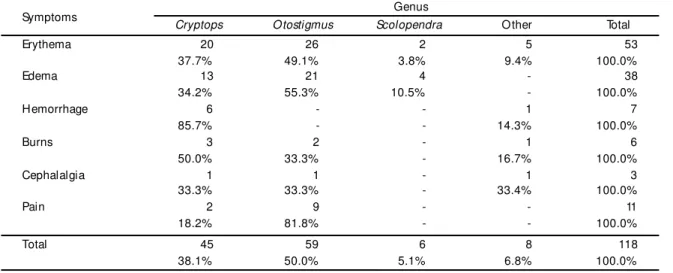
The diagnosis of evident symptoms was made for 118 of the 216 victims and the most frequent clinical manifestations were erythema, edema, discreet lo-cal hemorrhage, burns, cephalalgia and intense pain (Table 5).
Table 1 - Annual distribution of centipede bites in Greater S. Paulo 1980 - 1989 by season.
Season
Year Warm rainy Dry cold Total
1980 12 5 17
1981 20 6 26
1982 18 12 30
1983 13 10 23
1984 13 9 22
1985 11 4 15
1986 20 9 29
1987 12 7 19
1988 10 6 16
1989 12 7 19
Total 141 75 216
Table 3 - Parts of the body bitten by centipedes identified at the Arthropod Laboratory.
Part of the Centipedes
body Cryptops Otostigmus Scolopendra Scolopocryptops Rhysida Other Total
Hands 33 (41.8) 18 (40.0) 2 (40.0) 3 (60.0) - 1 (50.0) 57 (41.6)
Arms 1 (1.3) 1 (2.2) - - - - 2 (1.5)
Feet 36 (45.5) 18 (40.0) 3 (60.0) 1 (20.0) 1 (100.0) - 59 (43.1)
Legs 3 (3.8) 2 (4.4) - - - - 5 (3.6)
Thorax/Back 2 (2.5) 1 (2.2) - 1 (20.0) - - 4 (2.9)
Others 4 (5.1) 5 (11.1) - - - 1 (50.0) 10 (7.3)
Total 79 (100.0) 45 (100.0) 5 (100.0) 5 (100.0) 1 (100.0) 1 (100.0) 137 (100.0)
Table 2 - Number and percentage of centipede bites in Greater S. Paulo by age and sex, 1980 - 1989. Sex
Age Females Males Total
(years) N % N % N %
0 - 10 9 (6.4) 26 (34.2) 35 (16.2)
11 - 20 10 (7.1) 11 (14.5) 21 (9.7)
21 - 30 32 (22.9) 10 (13.2) 42 (19.4)
31 - 40 38 (27.2) 9 (11.8) 47 (21.8)
41 - 50 31 (22.1) 9 (11.8) 40 (18.5)
51 - 60 11 (7.9) 8 (10.6) 19 (8.8)
over 60 9 (6.4) 3 (3.9) 12 (5.6)
Total 140 (100.0) 76 (100.0) 216 (100.0)
D ISCU SSIO N
It is probable that the number of centipede accidents in the period studied presente a low percentage due to the lack of medical knowledge on human poisoning caused by these animals. The medical community’s not sending the victims to a reference center for treatment results in their under-registration. The benignity of the clinical mani-festations seems to contribute to the undernotification of the accidents, as the victim does not always seek medical assistance.
All the cases registered for Greater S. Paulo, occurred in urban areas, and reveal these venomous animals’ sinanthropic and domestic habits.
Bücherl2 (1939) considered the impossibility of
the occurrence of accidents with small sized centipedes. According to Minelli9 (1978) and Jangi7
(1984), and in conformity with Bücherl2 (1939), small
Table 4 - Number of cases and % of centipede bites in Greater S. Paulo 1980 - 1989, by time of occurrence.
Time No. of cases %
0-6h 28 12.9
6-12h 81 37.6
12-18h 47 21.7
18-24h 60 27.8
Rev. Saúde Pública, 32 (6), 1998 517
Epidemiological aspects of centipede bites, Brazil Knysak, I. et al.
sized specimens find it difficult to insert their mandibles into the human skin. Nevertheless, this study has shown contrary results as some of the accidents occurred with the Cryptops and Otostigmus
genera, both under 5 cm in lenght. The annual distribution of centipede bites in the Greater S.Paulo area, between 1980 and 1989, showed the greatest frequencies for Cryptops (57.7%) and Otostigmus
(33.6%). The chi-square test showed significance (X2= 109.2; p= 0.001) for both genera.
As for seasonality, Duboscq 1894, 1898 (apud Minelli9, 1978), in his study on Scolopendra
cingulata, observed differentiated reactions in the victims’ symptoms, showing that during the European winter the clinical aspects are milder than in the summer. This was not evident, in the present study, though an increase in the number of accidents between December and January has been registered, perhaps related to the greater availability of food and to the centipedes’ reproductive period that occur in the warm rainy season.
There was a threefold dominance of females between 21 and 60 years of age (X2= 35.25; p= 0.001)
among the victims, these accidents being related to household activities, according to the patient cards. Between 0 and 10 years of age, males have been more frequently bitten. The more commonly affected parts of the body are the extremities of the upper and lower limbs, although no significant difference in per-centages for Otostigmus and Cryptops genera have been found (X2= 1.87; p=0.866) in terms of the
affected part of the body.
The frequency of centipede accidents by time of
Table 5 - Main symptoms presenting after centipede bite, by genus.
Genus Symptoms
Cryptops Otostigmus Scolopendra Other Total
Erythema 20 26 2 5 53
37.7% 49.1% 3.8% 9.4% 100.0%
Edema 13 21 4 - 38
34.2% 55.3% 10.5% - 100.0%
Hemorrhage 6 - - 1 7
85.7% - - 14.3% 100.0%
Burns 3 2 - 1 6
50.0% 33.3% - 16.7% 100.0%
Cephalalgia 1 1 - 1 3
33.3% 33.3% - 33.4% 100.0%
Pain 2 9 - - 11
18.2% 81.8% - - 100.0%
Total 45 59 6 8 118
38.1% 50.0% 5.1% 6.8% 100.0%
occurrence is significant (X2= 27.59; p= 0.001),
indicating greater frequency in the morning, between 6 and 12 o’clock, when human activity starts.
The main symptoms shown after the bite were erythema and edema. The proportions by symptoms analyzed for the Otostigmus and Cryptops genera are significant (X2= 11.6; p= 0.040), these proportions
differing according to genus. Nevertheless, this result must be taken as tentative, due to the number of empty table cells, with expected frequencies <5 (low frequencies).
For 63 patients, HVB-IB’s therapeutic methods were: anesthetic (51%), analgesic (25%), anti-histamine and cortisone (24%). Local infection is not uncommon as a complication (Blay1, 1955).
According to Haneveld5 (1957), there is the
possibility of secondary contamination by the bacterial antigen Spirullum minus at the moment of the bite, justifying the cortisone treatment. When the anesthetic block is necessary, subcutaneous in-filtration of lidocaine 2%, or derivatives, without vasoconstrictor at the place of the bite or at the neural branch is recommended (Knysak et al.8, 1994). Only
patients bitten by Scolopendra and Otostigmus have received such treatment.
REFERENCES
1. BLAY, E.R. Treatment of centipede bites. Br. Med. J.,
2: 1619, 1955.
2. BÜCHERL, W. Quilópodos do Brasil. Mem. Inst. Butantan.,
23: 1-320, 1939.
3. BÜCHERL, W. Ação do veneno dos escolopendromorfos do Brasil sobre alguns animais de laboratório. Mem. Inst. Butantan.,
19: 181-98, 1946.
4. BÜCHERL. W. Venomous chilopods or centipedes. In: Bücherl, W. & Buckley, E.E. Venomous animals and their venoms. New York, Academic Press, 1971. p. 169 - 96. 5. HANEVELD, G.T. Centipides bites. Br.Med.J.,
2: 592, 1957.
ACKNO W LEDGM ENTS
To Dr. Eunice A. Galati of the Epidemiology Department, “Faculdade de Saúde Pública da Uni-versidade de São Paulo”, for the valuable suggestions;
Dr. João Luiz Costa Cardoso of the Hospital Vital Brazil, Instituto Butantan, for permission to exami-ne the patient cards, and Darci M.B.Battesti of the Arthropods Laboratory, Instituto Butantan, for her valuable suggestions and encouragement.
6. GLASS, G.V. & STANLEY, J.C. Metodos estatisticos aplicados a las ciencias sociales. Madrid, Editorial Prentice/Hall International, 1980.
7. JANGI, B. S. Centipede venoms and poisoning. In: Tu, A.T.
Handbook ofnatural toxins: insect poisons, allergens, and other invertebrate venoms.New York, Marcel Dekker, 1984.p. 333-68. 8. KNYSAK, I.; MARTINS, R.; BERTIM, C. R.; WEN, F.H. Lacraias deimportância médica no Estado de São Paulo: biologia e aspectos epidemiológicos. São Paulo. Centro de Vigilância Epidemiológica. Secretaria de Estado da Saúde, 1994. [Documento Técnico].
9. MINELLI, A. Secretions of centipedes. In: Bettini, S.