O
RIGINAL
A
R
TICLE
1 Post-Doctorate in Nursing. Associate Professor, Department of Nursing and the Graduate Program in Nursing, Federal University of Santa Catarina. Leader
of Clinical Research, Technology, Information, and Computing in Health and Nursing Study Group. Florianópolis, SC, Brazil. [email protected] 2 Doctorate in Nursing from Post-Graduate Nursing Program, Federal University of Santa Catarina. Fellow of CNPq Group. Member of Clinical Research, Technology, Information, and Computing in Health and Nursing Study Group. Florianópolis, SC, Brazil. [email protected] 3 Nurse. Doctorate in Nursing from Post-Graduate Nursing Program, Federal University of Santa Catarina. Member of Clinical Research, Technology, Information, and Computing in Health and Nursing Study Group. Florianópolis, SC, Brazil. [email protected] 4 Nurse. Master in Nursing from Post-Graduate Nursing Program, Federal Uni-versity of Santa Catarina. Member of Clinical Research, Technology, Information and Computing in Health and Nursing Study Group. Florianópolis, SC, Brazil. [email protected] 5 Nurse. Member of Clinical Research, Technology, Information, and Computing in Health and Nursing Study Group. Florianópolis, SC, Brazil. [email protected] 6 Nurse. Master in Nursing from Post-Graduate Nursing Program, Federal University of Santa Catarina. Member of Caring
7 RESUMO
O Processo de Enfermagem é uma tecnolo-gia do cuidado que orienta a sequência do raciocínio clínico e melhora a qualidade do cuidado. Este ar go trata-se do relato do desenvolvimento de um Processo de En-fermagem Informa zado (PEI) para Unida-de Unida-de Terapia Intensiva. O presente estudo foi desenvolvido em três principais etapas: discussão e compreensão da norma Inter-na oInter-nal Organiza on for Standard 18.104; aprofundamento teórico sobre a CIPE® 1.0; associação das informações aos diagnós -cos e intervenções de Enfermagem. A base do conhecimento foi organizada segundo a CIPE® Versão 1.0. O resultado foi a rees-truturação do PEI a par r da associação das avaliações clínicas aos diagnós cos e intervenções que permitem documentar a prá ca clínica de enfermagem, além de for-necerem apoio para a tomada de decisão. As etapas metodológicas empregadas per-mi ram fazer a associação entre a avaliação clínica, os diagnós cos, as intervenções e os resultados da CIPE® 1.0 com a ISO 18.104.
DESCRITORES
Informá ca em enfermagem Processos de enfermagem Terminologia
Classifi cação
Unidades de Terapia Intensiva
ABSTRACT
The Nursing Process is a technology of care that guides the sequence of clinical reasoning and improves the quality of care. This ar cle discusses the development of a computerized nursing process (CNP) for the intensive care unit. The study was conducted in three main steps: discussion and understanding of the In-terna onal Standards Organiza on’s standard 18.104; an evalua on of the theore cal
se of Interna onal Classifi ca on for Nursing Prac ce - ICNP® 1.0; and the associa on of pa ent informa on with diagnoses and nurs-ing interven ons. The knowledge base was organized according to ICNP® Version 1.0. The result was a restructuring of the CNP that documents the clinical prac ce of nursing and provides support for decision making based on the associa on between clinical assess-ments, diagnoses and interven ons. The suc-cess of this technology lies in its achievement of the integra on of research, professional prac ce and teaching. The methodology es-tablishes associa ons between clinical ons, diagnoses, interven ons and the results of the ICNP ® 1.0 with ISO 18.104.
DESCRIPTORS
Nursing informa cs Nursing process Terminology Classifi ca on Intensive Care Units
RESUMEN
El Proceso de Enfermería es una tecnología que orienta la secuencia del razonamiento clínico y mejora la calidad del cuidado. Este ar culo relata el desarrollo de un Proceso de Enfermería Informa zado (PEI) para Unidad de Terapia Intensiva. El estudio se desarrolló en tres etapas principales: dis-cusión y comprensión de la norma Inter-na oInter-nal Organiza on for Standardiza on 18.104; profundización teórica de la CIPE® 1.0; asociación de las informaciones a los diagnós cos e intervenciones de Enferme-ría. La base del conocimiento se organizó según CIPE® 1.0. El resultado fue la rees-tructuración del PEI a par r de la asocia-ción de las evaluaciones clínicas a los diag-nós cos e intervenciones que permite do-cumentar la prác ca clínica de enfermería, además de brindar respaldo para la toma de decisiones. Las etapas metodológicas empleadas permi eron hacer la asociación entre la evaluación clínica, los diagnós -cos, las intervenciones y los resultados de la CIPE® 1.0 con la ISO 18.104.
DESCRIPTORES
Informática aplicada a la enfermería Procesos de enfermería
Terminología Clasificación
Unidades de Terapia Intensiva
Computerized nursing process:
methodology to establish associations
between clinical assessment, diagnosis,
interventions, and outcomes
Grace Teresinha Marcon Dal Sasso1, Daniela Couto Carvalho Barra2, Fernanda Paese3, Sônia Regina Wagner de Almeida4, Greize Cristina Rios5, Monique Mendes Marinho6, Marilin Gallizi Debétio7
PROCESSO DE ENFERMAGEM INFORMATIZADO: METODOLOGIA PARA ASSOCIAÇÃO DA AVALIAÇÃO CLÍNICA, DIAGNÓSTICOS, INTERVENÇÕES E RESULTADOS
INTRODUCTION
Nursing care, especially in an intensive care context, is complex, comprehensive, and challenging. In intensive care units (ICUs), nurses are exposed to diffi cult clinical situa ons that require a en on and control, and nurses must work with various technological innova ons that need to be integrated in a consistent, correct, and safe system of care. From this perspec ve, it is evident that nurses should target their ac vi es toward the development of competence and skills for making safe decisions that are free from unneces-sary risk and based on scien fi c evidence(1-3).
Among the various technologies in the ICU environ-ment, the nursing process (NP) stands out as a care tech-nology that guides the sequence of logical reasoning and improves the quality of care through the systema c clinical assessments, diagnoses, interven ons, and outcomes of nursing. The NP is a tool that should be used by nurses to demonstrate the thought process and judgments they de-velop during the course of care. It integrates,
organizes, and ensures the continuity of
informa on, enabling nursing staff to
evalu-ate their effi ciency and eff ec veness and
to modify their performance according to pa ent recovery results. The NP also serves as a permanent founda on for educa on,
research, and management in nursing(1-2,4-5).
However, the volume of informa on in the ICU is substan al and can be described as heterogeneous, complex, and unstructured. Informa on is central to the care process, and access to informa on empowers nurses with evidence to support their contribu ons to pa ent outcomes. Therefore, a
on is proposed between access to essen al informa on through the NP and the results
and safety of the pa ent(6-7). In this context, informa on
technology and communica on (ITC) have been used to support the development of the NP, integra ng it into a logical structure of data, informa on, and knowledge for
decision making in nursing care(7).
Informa on technologies and communica on, coupled with the nursing process in the ICU, can promote improve-ments in the quality of direct care, pa ent results, and nursing prac ce by reducing the me spent on clinical
records and documenta on(3). ITC can also foster the
de-velopment of cri cal thinking and inves ga ve reasoning among nurses; ITC approaches these professionals with care by promo ng clinical discussion among peers, using mul disciplinary teams, and fostering the con nuous search for informa on and scien fi c evidence(3:8-9).
Therefore, it is well known that the main objec ve in nurs-ing informa cs is to specify the requirements of the clinical informa on system and to incorporate the needs of nurses
prac ce. This informa on system is necessary to integrate people, informa on, processes, and compu ng resources with a common goal of maximizing the technological capabili es and the benefi ts to the individuals involved in the system(6-7,10).
To integrate informa on related to the nursing process, several nursing terminologies have been developed and studied in recent years, especially for the Interna onal Clas-sifi ca on for Nursing Prac ce (ICNP®). In Version 1.0 of the
ICNP®, which was structured for computeriza on, there is a model with seven axes that establish nursing diagnoses, nursing interven ons, and nursing care outcomes according
to the priority health needs of the pa ent(11).
Based on these considera ons, fi ve studies conducted
since 1999 have sought to develop and evaluate computerized NP in the ICU in accordance with the ICNP®(1-2,12-15). Early studies
adopted the ICNP® Beta 2 Version. In each study, the NP was
evaluated, and new modifi ca ons were implemented(12-13). In
2006, a proposed structure was reached that included the in-forma onal needs of nursing care in the ICU us-ing ICNP® Version 1.0. The results indicated that the computerized system employs ergonomic criteria and content, and the system interface,
content, and data security were rated as Very
Good by the study par cipants. This study
concluded that the web-based computerized
system (fi xed system), based on ICNP® Version
1.0, is an informa on system structure that promotes the organiza on, control, and logical visualiza on of nurses’ clinical reasoning during
pa ent care using ICU computer resources(1).
In 2008, con nuing the studies ini ated in 1999, another study further developed the structure of the informa on system and implemented NP on a personal digital assistant (PDA) mobile device that was integrated with the previously developed web-based com-puterized system. This study aimed to assess, using input from nurses in two general ICUs, the criteria of ergonom-ics, content, and usability of computerized NP on a mobile device, which was developed according to ICNP® Version 1.0. The results indicated that the mobile computerized NP system exceeded the established criteria (on a scale of 1–5) for content, technical organiza on, and interface related to ergonomics (mean 4.51; ± 0.24) and usability
(mean 4.65, ± 0.25); the ra ngs were considered excellent
by the evaluators. It was concluded that this computerized
system for the PDA environment was a coherent, eff ec ve,
and consistent system because, in addi on to allowing the integra on of research, teaching, and professional ce, it allowed nurses to more closely address pa ents’ bedside care(14-15).
It is worth resta ng that the development and imple-menta on of this technological product—the nursing pro-cess system—is the most complete and only computerized
...the nursing process (NP) stands out as a care technology that guides the sequence
of logical reasoning and improves the quality of care through
the systematic clinical assessments,
noteworthy that this technological product closed the cycle, and it is possible to conclude from the posi ve evalua on by
the professionals involved that both the fi xed system
(Web-based)(1) and the mobile system (PDA)(14) are accessible and
applicable for the implementa on of a computerized NP in the ICU. It should also be noted that some ons were suggested for future work, including the resizing of data and informa on in the NP web-based and mobile device-based systems.
The aim of the present study was to examine the onship between the data and informa on in the nursing process, which were computerized according to ICNP® Version 1.0, and to establish associa ons between detailed clinical evalua ons of each human system and diagnoses, interven ons, and pa ent outcomes.
METHODS
This is both a study of a technological product and a
methodological study(16). The study was conducted as part
of a course (Linked Research Project: AssociaƟ on -
Diagno-sis and IntervenƟ on of ICNP® 1.0 on computerized systems for ICU and Emergency) in the Graduate Nursing Program, Federal University of Santa Catherine (PEN / UFSC), during the second half of 2010. The par cipa ng researchers were a teacher and six students, for a total of seven researchers. The par cipants in the course were also the study evalu-ators, as they are specialists in ICU and emergency room nursing and have been developing research ac vi es with ICNP® Version 1.0 through the Clinical Research, Technol-ogy, and Informa cs in Health and Nursing Group (GIATE / PEN / UFSC) since 2003.
This study was submi ed to the Ethics Commi ee of the Universidade Federal de Santa Catarina and was approved without restric ons by members of the en ty (protocol # 947/10).
The study was conducted between March and Septem-ber 2010 and comprised the following steps:
Step 1: discussion and understanding of the applica-tion of the Internaapplica-tional Standards Organizaapplica-tion (ISO) standard 18.104 for Brazilian nursing. This standard includes the reference terminology model for diagnoses and nursing actions, thus making the standard a tool that facilitates the mapping of various terminologies and promoting the integration of information systems
and electronic medical records(17).
Step 2: discussion and theore cal expansion of the ICNP® version 1.0, which was conducted by rela ng it to the prac ce of intensive care nursing. The historical evolu on
of this classifi ca on of nursing was addressed, from the
alpha version to the most current version, 2.0. In addi on,
studies on computerized NP that began in 1999(1-2,12-15) using
Step 3: presenta on of the current structure of com-puterized NP according to ICNP® version 1.0. The system is available at h p://www.nfrinfor.ufsc.br and h p://www. nfrinfor.ufsc.br/movel for both web and mobile devices, and it can be accessed using a login name and password provided by the computer system administrators.
In the current structure, a er registering a new ent and/or selec ng a previously registered pa ent, the iden ty screen opens, and users can perform a clinical evalua on to record the following data: vital signs (inva-sive or noninva(inva-sive), numeric pain scale, pulse oximetry, capnography, height, weight, subjec ve data from the pa ent and/or family, and links to hydroelectroly c/blood/
fl uid balance.
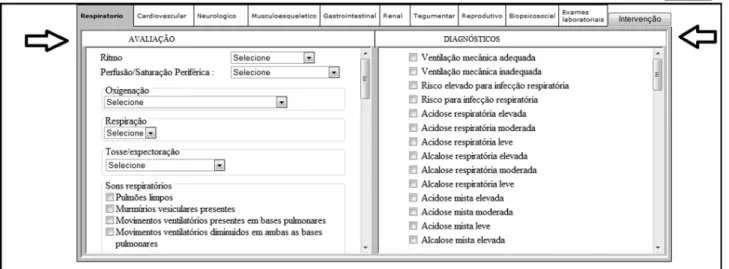
After registration of the data mentioned above, the nurse initiates the clinical assessment of the following patient systems: respiratory, cardiovascular, neurological, musculoskeletal, gastrointestinal, renal, integumentary, reproductive (male and female), and biopsychosocial. Laboratory test results are also recorded. Data for the clinical assessments are as comprehensive and de-tailed as possible to ensure that the electronic record is complete and provides all information essential to the achievement of nursing care. In the current system, nurses must select each clinical evaluation and, based on each evaluation, select the respective diagnoses, as shown in Figure 1.
From the selec on of nursing diagnoses submi ed concerning the pa ent, the nurse selects the necessary interven ons, as explained in Figure 2. Importantly, at this stage, the system is restructured so that nursing diagnoses
are specifi c to the clinical evalua on and not just to the
pa ent systems evaluated.
Step 4: associa on/linkage of data and informa on with diagnoses and nursing interven ons, according to ICNP® version 1.0. Data from the clinical assessments, diagnoses, interven ons, and outcomes of nursing for each system were printed out. This step was performed at biweekly mee ngs and was considered to be more complex because it required the nurses to integrate theory and prac ce and to develop clinical reasoning and clinical judgment based on the numerous possible associa ons that could be established in accordance with each clinical condi on presented by the pa ent. This step also required conduc ng a comprehensive and thorough review of the data, diagnoses and interven ons listed in the computerized NP.
The methodology used for the associa on/linkage of data involved the grouping of possible clinical situa ons (three or four situa ons) in increasing order of complexity for each pa ent system. From the colla on of data from the clinical evalua on, we selected a list of specifi c diagnoses for
At this stage, the musculoskeletal, cutaneous, biopsy-chosocial, gastrointes nal, male reproduc ve, and female reproduc ve systems presented three clinical situa ons, and the respiratory, cardiovascular, neurological, and renal systems presented four clinical situa ons.
Step 5: A general mee ng was conducted to review ons and enter data into a spreadsheet using Excel® so ware.
Step 6: The previous structure of the NP was changed to a new computerized structure based on the associa ons/ linkages established by the nurses. This step was performed in collabora on with a systems programmer specializing in computer science.
RESULTS
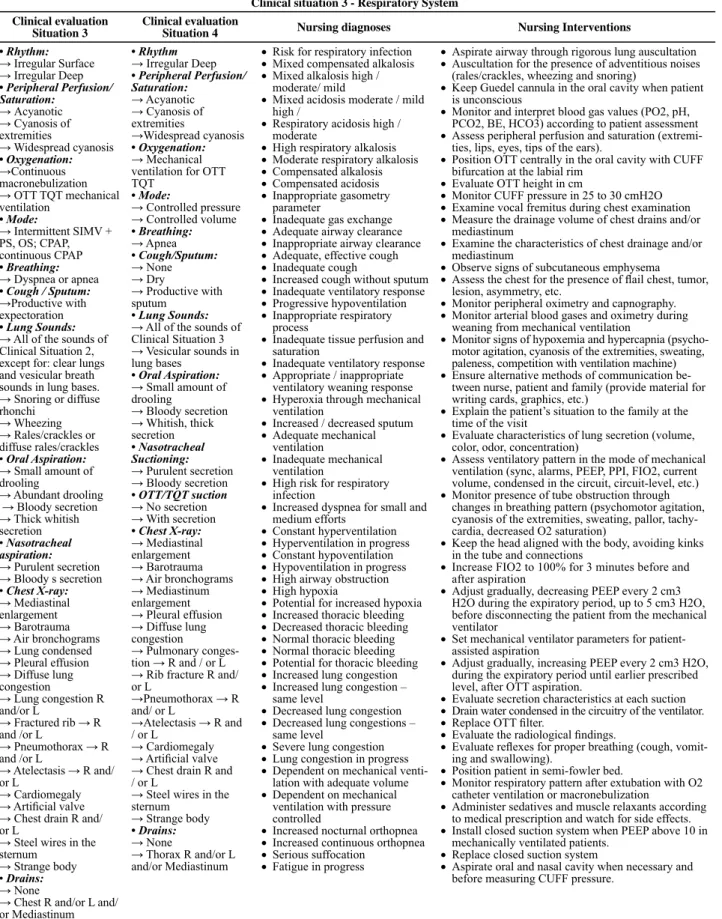
The results are presented in Table 1. The results address
system to perform the associa on/linkage of data based on clinical evalua ons, diagnos cs, and nursing interven ons using ICNP® version 1.0.
The associa on/linkage of data from the clinical assess-ments, diagnoses and nursing interven ons was performed using the steps described above.
The fi rst and second stages addressed the theore cal
expansion and discussion of ISO 18.104 and ICNP® ver-sion 1.0. ISO 18.104, developed in 2003, accommodates
the various terminologies and classifi ca ons currently
used by nurses to document pa ent data. This standard cons tutes a reference terminology that represents the concepts that facilitate the mapping of nursing terms to other health terminologies, promotes the integra on of informa on systems, and enables compara ve research and analysis to improve results and strengthen the body
Figure 1 - Screenshot of the nursing respiratory clinical evaluation and diagnosis from the ICNP® 1.0 computerized NP - Florianópolis, 2011
Table 1 – Association of the data from nursing clinical evaluations, diagnoses, and interventions: clinical situation 3 and 4, respiratory system
Computerized Nursing Process as per CIPE® version 1.0
Clinical situation 3 - Respiratory System
Clinical evaluation Situation 3
Clinical evaluation
Situation 4 Nursing diagnoses Nursing Interventions
• Rhythm:
→ Irregular Surface
→ Irregular Deep
• Peripheral Perfusion/ Saturation:
→ Acyanotic
→ Cyanosis of
extremities
→ Widespread cyanosis
• Oxygenation:
→Continuous
macronebulization
→ OTT TQT mechanical
ventilation • Mode:
→ Intermittent SIMV +
PS, OS; CPAP, continuous CPAP • Breathing:
→ Dyspnea or apnea
• Cough / Sputum:
→Productive with
expectoration • Lung Sounds:
→ All of the sounds of
Clinical Situation 2, except for: clear lungs and vesicular breath sounds in lung bases.
→ Snoring or diffuse
rhonchi
→ Wheezing
→ Rales/crackles or
diffuse rales/crackles • Oral Aspiration:
→ Small amount of
drooling
→ Abundant drooling
→ Bloody secretion
→ Thick whitish
secretion • Nasotracheal aspiration:
→ Purulent secretion
→ Bloody s secretion
• Chest X-ray:
→ Mediastinal
enlargement
→ Barotrauma
→ Air bronchograms
→ Lung condensed
→ Pleural effusion
→ Diffuse lung
congestion
→ Lung congestion R
and/or L
→ Fractured rib → R and /or L
→ Pneumothorax → R
and /or L
→ Atelectasis → R and/ or L
→ Cardiomegaly
→ Artifi cial valve
→ Chest drain R and/
or L
→ Steel wires in the sternum
→ Strange body
• Drains:
→ None
→ Chest R and/or L and/
or Mediastinum
• Rhythm
→ Irregular Deep
• Peripheral Perfusion/ Saturation:
→ Acyanotic
→ Cyanosis of
extremities
→Widespread cyanosis
• Oxygenation:
→ Mechanical
ventilation for OTT TQT
• Mode:
→ Controlled pressure
→ Controlled volume
• Breathing:
→ Apnea
• Cough/Sputum:
→ None
→ Dry
→ Productive with
sputum • Lung Sounds:
→ All of the sounds of
Clinical Situation 3
→ Vesicular sounds in
lung bases • Oral Aspiration:
→ Small amount of
drooling
→ Bloody secretion
→ Whitish, thick
secretion • Nasotracheal Suctioning:
→ Purulent secretion
→ Bloody secretion
• OTT/TQT suction
→ No secretion
→ With secretion
• Chest X-ray:
→ Mediastinal
enlargement
→ Barotrauma
→ Air bronchograms
→ Mediastinum
enlargement
→ Pleural effusion
→ Diffuse lung
congestion
→ Pulmonary
conges-tion → R and / or L
→ Rib fracture R and/
or L
→Pneumothorax → R
and/ or L
→Atelectasis → R and
/ or L
→ Cardiomegaly
→ Artifi cial valve
→ Chest drain R and
/ or L
→ Steel wires in the sternum
→ Strange body
• Drains:
→ None
→ Thorax R and/or L
and/or Mediastinum
Risk for respiratory infection
Mixed compensated alkalosis
Mixed alkalosis high / moderate/ mild
Mixed acidosis moderate / mild
high /
Respiratory acidosis high / moderate
High respiratory alkalosis
Moderate respiratory alkalosis
Compensated alkalosis
Compensated acidosis
Inappropriate gasometry
parameter
Inadequate gas exchange
Adequate airway clearance
Inappropriate airway clearance
Adequate, effective cough
Inadequate cough
Increased cough without sputum
Inadequate ventilatory response
Progressive hypoventilation
Inappropriate respiratory process
Inadequate tissue perfusion and
saturation
Inadequate ventilatory response
Appropriate / inappropriate
ventilatory weaning response
Hyperoxia through mechanical
ventilation
Increased / decreased sputum
Adequate mechanical
ventilation
Inadequate mechanical
ventilation
High risk for respiratory infection
Increased dyspnea for small and
medium efforts
Constant hyperventilation
Hyperventilation in progress
Constant hypoventilation
Hypoventilation in progress
High airway obstruction
High hypoxia
Potential for increased hypoxia
Increased thoracic bleeding
Decreased thoracic bleeding
Normal thoracic bleeding
Normal thoracic bleeding
Potential for thoracic bleeding
Increased lung congestion
Increased lung congestion –
same level
Decreased lung congestion
Decreased lung congestions –
same level
Severe lung congestion
Lung congestion in progress
Dependent on mechanical
venti-lation with adequate volume
Dependent on mechanical
ventilation with pressure controlled
Increased nocturnal orthopnea
Increased continuous orthopnea
Serious suffocation
Fatigue in progress
Aspirate airway through rigorous lung auscultation
Auscultation for the presence of adventitious noises
(rales/crackles, wheezing and snoring)
Keep Guedel cannula in the oral cavity when patient
is unconscious
Monitor and interpret blood gas values (PO2, pH,
PCO2, BE, HCO3) according to patient assessment
Assess peripheral perfusion and saturation
(extremi-ties, lips, eyes, tips of the ears).
Position OTT centrally in the oral cavity with CUFF
bifurcation at the labial rim
Evaluate OTT height in cm
Monitor CUFF pressure in 25 to 30 cmH2O
Examine vocal fremitus during chest examination
Measure the drainage volume of chest drains and/or
mediastinum
Examine the characteristics of chest drainage and/or
mediastinum
Observe signs of subcutaneous emphysema
Assess the chest for the presence of fl ail chest, tumor, lesion, asymmetry, etc.
Monitor peripheral oximetry and capnography.
Monitor arterial blood gases and oximetry during
weaning from mechanical ventilation
Monitor signs of hypoxemia and hypercapnia
(psycho-motor agitation, cyanosis of the extremities, sweating, paleness, competition with ventilation machine)
Ensure alternative methods of communication
be-tween nurse, patient and family (provide material for writing cards, graphics, etc.)
Explain the patient’s situation to the family at the time of the visit
Evaluate characteristics of lung secretion (volume,
color, odor, concentration)
Assess ventilatory pattern in the mode of mechanical
ventilation (sync, alarms, PEEP, PPI, FIO2, current volume, condensed in the circuit, circuit-level, etc.)
Monitor presence of tube obstruction through
changes in breathing pattern (psychomotor agitation, cyanosis of the extremities, sweating, pallor, tachy-cardia, decreased O2 saturation)
Keep the head aligned with the body, avoiding kinks
in the tube and connections
Increase FIO2 to 100% for 3 minutes before and
after aspiration
Adjust gradually, decreasing PEEP every 2 cm3
H2O during the expiratory period, up to 5 cm3 H2O, before disconnecting the patient from the mechanical ventilator
Set mechanical ventilator parameters for
patient-assisted aspiration
Adjust gradually, increasing PEEP every 2 cm3 H2O,
during the expiratory period until earlier prescribed level, after OTT aspiration.
Evaluate secretion characteristics at each suction Drain water condensed in the circuitry of the ventilator. Replace OTT fi lter.
Evaluate the radiological fi ndings.
Evaluate refl exes for proper breathing (cough, vomit-ing and swallowvomit-ing).
Position patient in semi-fowler bed.
Monitor respiratory pattern after extubation with O2
catheter ventilation or macronebulization
Administer sedatives and muscle relaxants according
to medical prescription and watch for side effects.
Install closed suction system when PEEP above 10 in
mechanically ventilated patients.
Replace closed suction system
Aspirate oral and nasal cavity when necessary and
This reference terminology discusses a model for the development of diagnoses and nursing ac ons. Accord-ing to ISO 18.104, the nursAccord-ing diagnosis is considered to be a judgment in a focus or a judgment in a par cular dimension of a focus. In other words, the combina on of a descriptor for a focus and a descriptor for a judgment is
mandatory to sa sfy the defi ni on of a nursing diagnosis.
Nursing ac ons are conceptualized as a process during which a service is inten onally applied to a care recipient; the process is o en represented in compound expressions
of verbs or verbal expressions that can be qualifi ed by
me. Therefore, it appears that this terminology model was developed to be a common basis for the recording,
analysis, and transfer of nursing data(17).
In 1989, the ICNP® developed from of a recognized need for nurses to describe the phenomena, interven ons, and respec ve results presented by pa ents for whom these professionals are responsible. In its original form, the ICNP® aimed to provide a tool for describing and documen ng the clinical prac ce of nursing by using the instrument as a basis for clinical decision making and by providing nursing with
a vocabulary and a classifi ca on system that can be used
with computerized informa on systems(11).
In this context, several studies, mee ngs, and confer-ences have been conducted in various parts of the world to
improve this classifi ca on system. In 1996, the ICNP® Alpha
version was published, followed by ICNP® Beta in 1999, ICNP® Beta 2 in 2001, and fi nally, in 2005, ICNP® version 1.0. In 2006, ICNP® Version 1.0 was translated into Portuguese
through the eff orts of the Portuguese Associa on of Nurses,
and in 2007, this classifi ca on was translated into Brazilian
Portuguese(11). In 2008, ICNP® version 1.1 was published,
and in July 2009, ICNP® version 2.0 was launched.
In essence, the components of the ICNP® are the ele-ments of nursing prac ce that address what nurses do to meet certain human needs and produce certain outcomes (diagnoses, interven ons, and nursing outcomes). It is a
unifi ed language that expresses the elements of nursing
prac ce and that enables 1) comparisons between clinical se ngs, pa ent popula ons, geographic areas and mes;
2) the iden fi ca on of mul disciplinary nursing teams; 3)
the diff eren a on of prac ce by levels of prepara on and
experience in nursing; and 4) establishment of the
ons between nursing ac vi es and health outcomes(11).
It is noteworthy that ICNP® Version 1.0 refl ects the major reformula ons pointed out by nurses, providing a more
robust and technologically more accessible classifi ca on
system for these professionals. ICNP® Version 1.0 allowed nurses to systema cally document their prac ces using
diagnoses, interven ons, and nursing outcomes in diff erent
popula on contexts(11).
The third stage of this study was performed by present-ing the current structure of the computerized NP accordpresent-ing
allowed nursing students to review all the work performed to date as well as understand how the data from clinical assessments, diagnoses, interven ons, and outcomes
(ex-plained in the form of change of a specifi c diagnosis) are
structured in the computerized pla orm.
The fourth and fi h steps involved building a
methodol-ogy for conduc ng the associa on/ joint data/diagnoses/ nursing interven ons according to ICNP® Version 1.0 by exploring possible clinical situa ons for every system that are presented by pa ents in ICU scenarios.
In the comple on of these steps, the nurses’ clinical reason-ing and clinical judgment were key factors in matchreason-ing the clini-cal situa ons with their diagnoses and nursing interven ons.
DISCUSSION
Here, we present the contribu ons of ICNP® Version 1.0, applied to the computerized nursing process, both to the organiza on and development of nurses’ clinical reasoning in the care of ICU pa ents and to the nurses’ health knowledge.
Clinical reasoning is conceptualized as a thought process that guides prac ce; it is a dynamic process composed of a sequence of thoughts by nurses that are used to make
decisions about their ac ons(18) and to apply clinical
judg-ment to the clinical situa on presented by each pa ent(19).
This is divided into procedural reasoning, meaning how; interac ve reasoning, which focuses on the pa ent as an individual with unique perspec ves; and condi onal rea-soning, which involves mul dimensional, complex forms of thinking and requires experience. These three forms of reasoning are integrated in prac ce and are developed progressively along with knowledge and experience. They also combine with narra ve reasoning, which drives others and involves the stories created by professionals about ents and, ul mately, pragma c reasoning, which involves the environment, the pa ent’s social support, professional
knowledge and skills, and professional values(20).
Clinical judgment includes the process of analysis and complex decision making about the pa ent’s condi on,
family, and contextual situa on (which all aff ect the
re-sponses provided by the pa ent or family) by using data and
knowledge to interpret these factors(19,21). In this manner,
the nursing diagnosis is understood to be a clinical judgment about the responses, family or community, and exis ng or poten al problems and life situa ons of the pa ent. These nursing diagnoses provide a basis for indica ng the goals and nursing interven ons that are required to achieve the
results that are expected of nurses(19).
The computerized NP and the proposed methodology allowed us to understand ICNP® version 1.0, and the refer-ence terminology provided a basis for the clinical reasoning
of ICU nurses. The fi eld experts indicated that they were
REFERENCES
1. Antunes CR. Processo de enfermagem informatizado ao paciente politraumatizado de terapia intensiva via web [dissertação]. Florianópolis: Programa de Pós-Graduação em Enfermagem, Universidade Federal de Santa Catarina; 2006.
2. Barra DCC, Sasso GTMD. Tecnologia móvel à beira do lei-to: processo de enfermagem informa zado em terapia intensiva a par r da CIPE 1.0. Texto Contexto Enferm. 2010;19(1):54-63.
3. Zuzelo PR, Ge s C, Hansell AW, Thomas L. Describing the infl uence of technologies on registered nurses’ work. Clin
Nurse Spec. 2008;22(3):132-40.
4. Amante LN, Rosse o AP, Schneider DG. Nursing care system-a zsystem-a on system-at the IntensiveCare Unit (ICU) based on Wanda Horta’s theory. Rev Esc Enferm USP [Internet]. 2009 [cited 2011 Apr 5];43(1):54-64. Available from: h p://www.scielo. br/pdf/reeusp/v43n1/en_07.pdf
5. Leadebal ODCP, Fontes WD, Silva CC. Learning process of nursing: planning and insert into matrizes curriculum. Rev Esc Enferm USP [Internet]. 2010 [citado 2011 Apr 5]; 44(1):190-198. Available from: h p://www.scielo.br/pdf/
6. Hannah KJ, Ball MJ, Edwards MJA. Introdução à informá ca em enfermagem. Porto Alegre: Artmed; 2009.
7. Organización Panamericana de la Salud (OPAS). Desarrollo de sistemas normalizados de información de enfermería. Washington: OPS; 2001.
8. Mar ns CR, Dal Sasso GTM. Tecnologia: defi nições e refl
e-xões para a prá ca em saúde e enfermagem. Texto Contexto Enferm. 2008;17(1):11-2.
9. Brandt K. Poor quality or poor design? A review of the litera-ture on the quality of documenta on within the electronic medical record [paper presenta on]. Comput Inform Nurs. 2008;26(5):302-3.
10. Marin HF, Cunha ICKO. Perspec vas atuais da informá ca em enfermagem. Rev Bras Enferm. 2006;59(3):354-7.
11. Interna onal Council of Nurses (ICN). Classifi cação
Inter-nacional para a Prá ca de Enfermagem – CIPE® versão 1.0. Trad. de Marin HF. São Paulo: Algol; 2007.
12. Sasso GTMD. Uma proposta do processo de enfermagem in-forma zado em terapia intensiva a par r da CIPE versão β1. São José: Ins tuto de Cardiologia, Secretaria de Estado da
of complexity and to establish logical diagnoses and nursing interven ons using ICNP® Version 1.0 by integra ng data, informa on, and knowledge.
The methodology used for data associa on provided an
eff ec ve approach to clinical situa ons in which a pa ent
presents a condi on with increasing levels of complexity.
At the fi rst level, the pa ent had spontaneous respira on
or used an oxygen catheter, exhibited lung sounds with or without minor changes, and underwent an X-ray
on appropriate to the clinical situa on. At the last level, the pa ent had a high degree of respiratory complica ons that required mechanical ven la on using pressure- or
volume-controlled methods, and the pa ent also had signifi cant
changes in respiratory sounds, X-rays, and blood gasometry.
CONCLUSION
A restructuring of the computerized nursing process according to ICNP® Version 1.0, based on the associa ons between clinical evalua ons, diagnoses, and interven ons, permits documenta on of the clinical prac ce of nursing in the ICU environment. It is noteworthy that this computer-ized system is a permanent space where informa on and knowledge can be stored. The system allows nurses to establish dialogue among peers and on mul disciplinary teams, to enhance reasoning and clinical judgment, and to
promote safe clinical decision making that refl ects safety
improvements in ICU nursing prac ces.
The warning systems that are currently programmed in the computerized NP—for example, the same nursing diagnosis for more than 3 days, the poten al for pressure
ulcers, and vasoac ve drugs at dosage α and β
adrener-gic—allow nurses to prevent damage and adverse events specifi c to these situa ons in order to promote safe clinical
decision-making by the nurse.
We stress the applicability of the computerized NP only to the emergency and ICU environments. However, the structured database allows the extension of the system to other scenarios of professional prac ce. The data currently stored will allow future studies to measure the main out-comes of nursing interven ons in diff erent clinical situa ons of pa ents, and the current data will facilitate integra on
with diff erent hospital informa on systems, con nuous
upgrading, and the construc on of quality indicators for pa ent safety.
The use of the worldwide classifi ca on system, the
13. Zabo C, Souza J. Metodologia eletrônica de cuidados de enfermagem aos pacientes em terapia intensiva com alte-rações respiratórias u lizando a CIPE [monografi a]. Palhoça: Faculdade de Enfermagem, Universidade do Sul de Santa Catarina; 2002.
14. Barra DCC. Processo de enfermagem informa zado em tera-pia intensiva em ambiente PDA (Personal Digital Assistant) a par r da CIPE® versão 1.0 [dissertação]. Florianópolis: Programa de Pós- Graduação em Enfermagem, Universidade Federal de Santa Catarina; 2008.
15. Barra DCC, Sasso GTMD, Mon celli M. Processo de enferma-gem informa zado em Unidade de Terapia Intensiva: uma prá ca educa va com enfermeiros. Rev Eletr Enferm [Inter-net]. 2009 [citado 2011 abr. 5];11(3):579-89. Disponível em: h p://www.fen.ufg.br/revista/v11/n3/v11n3a15.htm
16. Polit DF, Beck C, Hungler BP. Fundamentos de pesquisa em enfermagem: métodos, avaliação e u lização. Porto Alegre: Artmed; 2004.
17. Marin HF. Terminologia de referência em enfermagem: a Nor-ma ISO 18104. Acta Paul Enferm. 2009;22(4):445-8.
18. Corrêa CG. Raciocínio clínico: o desafi o de cuidar [tese
douto-rado]. São Paulo: Escola de Enfermagem, Universidade de São Paulo; 2003.
19. Alfaro-Lefevre R. Aplicação do processo de enfermagem: pro-moção do cuidado colabora vo. Porto Alegre: Artmed; 2005.
20. Mendez L, Neufeld J. Clinicalreasoning - what is it and why should I care? Otawa:CAOT Publica ons; 2003.