Colposcopic triage methods for detecting cervical
intraepithelial neoplasia grade 3 after cytopathological
diagnosis of low-grade squamous intraepithelial lesion: a
systematic review on diagnostic tests
Métodos de triagem colposcópica para detecção de neoplasia intraepitelial cervical
grau 3 após diagnóstico citopatológico de lesão intraepitelial escamosa de baixo
grau: uma revisão sistemática de testes diagnósticos
Flávia de Miranda Corrêa
I, Fábio Bastos Russomano
II, Caroline Alves de Oliveira
IIIPostgraduate Program on Children and Women’s Health, Instituto Nacional de Saúde da Mulher, Criança e Adolescente Fernandes
Figueira (IFF), Fundação Instituto Oswaldo Cruz (Fiocruz), Rio de Janeiro, Brazil
ABSTRACT
CONTEXT AND OBJECTIVE: The age-stratiied performance of the oncogenic HPV-DNA (human papillo-mavirus deoxyribonucleic acid) test for triage of low-grade squamous intraepithelial lesions (LSIL) requires investigation. The objective of this study was to evaluate and compare the age-stratiied performance (cutof point: 35 years) of oncogenic HPV-DNA testing and repeated cytological tests, for detecting cervical intraepithelial neoplasia grade 3 (CIN3), in order to triage for LSIL.
DESIGN AND SETTING: Systematic review. Studies were identiied in nine electronic databases and in the refer-ence lists of the articles retrieved.
METHODS: The eligibility criteria consisted of initial cytological indings of LSIL; subsequent oncogenic HPV-DNA testing and repeated cytological tests; and CIN3 detection. The Quality Assessment of Diagnostic Accuracy Stud-ies (QUADAS) guidelines were used for quality assessment. Qualitative information synthesis was performed.
RESULTS: Out of 7,776 studies, 284 were identiied as pertinent and three fulilled the eligibility criteria. The CIN3 prevalence ranged from 6% to 12%. The HPV-DNA positivity rate ranged from 64% to 83%; sensitivity for CIN3 detection ranged from 95.2% to 100%; and speciicity was available in two studies (27% and 52%). The sensitivity of repeated cytological tests, in relation to the threshold for atypical squamous cells of unde-termined signiicance (ASCUS), was available in two studies (33% and 90.8%); and speciicity was available in one study (53%).
CONCLUSIONS: Currently, there is no scientiic evidence available that would prove that colposcopic triage us-ing oncogenic HPV-DNA testus-ing to detect CIN3 performs better than repeated cytological tests, among women with LSIL aged 35 years and over.
RESUMO
CONTEXTO E OBJETIVO: O desempenho do teste de DNA-HPV (ácido desoxirribonucleico-papilomavírus humano) oncogênico estratiicado por idade para triagem de lesão intraepitelial escamosa de baixo grau (LSIL) demanda investigação. O objetivo do estudo foi avaliar e comparar o desempenho, para detecção de neoplasia intraepitelial cervical (NIC3), do teste de DNA-HPV oncogênico e da citologia de repetição estratiicados por idade (ponto de corte 35 anos), para triagem de LSIL.
TIPO DE ESTUDO E LOCAL: Revisão sistemática da literatura. Foram identiicados estudos em nove bases de dados eletrônicas e listas de referências dos artigos recuperados.
MÉTODOS: Critérios de elegibilidade: citologia inicial LSIL, realização do teste de DNA-HPV oncogênico e da citologia de repetição e detecção de NIC3. A diretriz QUADAS (Quality Assessment of Diagnostic Accuracy Studies) foi utilizada para avaliação da qualidade. As informações foram sintetizadas qualitativamente.
RESULTADOS: Dentre 7.776 estudos, 284 eram pertinentes ao tema e três atenderam aos critérios de elegibilidade. A prevalência de NIC3 apresentou variação entre 6% e 12%. A taxa de positividade do teste de DNA-HPV apresentou variação entre 64% e 83%; a sensibilidade para NIC3 apresentou variação entre 95,2% e 100%; a especiicidade estava disponível em dois estudos (27% e 52%). A sensibilidade da citologia de repetição (ponto de corte ASCUS — células escamosas atípicas de signiicado indeterminado) estava disponível em dois estudos (33% e 90,8%); a especiicidade estava disponível em um estudo (53%).
CONCLUSÕES: Não existem, atualmente, evidências cientíicas disponíveis para comprovar que, em mu-lheres com 35 anos ou mais e citologia LSIL, a triagem colposcópica com teste de DNA-HPV oncogênico apresenta melhor desempenho para detecção de NIC3 do que a repetição citológica.
IMD, MSc. Senior Analyst, Cancer Control
Program, Divisão de Apoio à Rede de Atenção Oncológica (DARAO), Instituto Nacional do Câncer (INCA), Rio de Janeiro, Brazil.
IIIMD, MSc. Gynecologist and Obstetrician, Hospital
Geral de Bonsucesso, Rio de Janeiro, Brazil.
IIMD, MSc, PhD. Head of Cervical Pathology Unit,
Instituto Nacional de Saúde da Mulher, Criança e Adolescente Fernandes Figueira (IFF), Fundação Instituto Oswaldo Cruz (Fiocruz), Rio de Janeiro, Brazil.
KEY WORDS:
Cervical intraepithelial neoplasia. Triage.
Colposcopy. Vaginal smears. DNA probes, HPV. Sensitivity and speciicity.
PALAVRAS-CHAVE:
Neoplasia intra-epitelial cervical. Triagem.
systematic review on diagnostic tests | SYSTEMATIC REVIEW
INTRODUCTION
Rationale
In 2009, according to data from the Brazilian Information Sys-tem for Cervical Cancer (SisSys-tema de Informação do Câncer do Colo do Útero, SISCOLO),1 low-grade squamous intraepithelial lesion (LSIL) diagnoses represented 31% of abnormal Papanico-laou (Pap) test results in Brazil. he Brazilian Ministry of Health2 recommends cytological test repetition six months ater the ini-tial LSIL diagnosis, with referral for colposcopy if the second cytological test shows atypical squamous cells of undetermined signiicance (ASC-US) or worse (ASC-US+), but there is no con-sensus worldwide regarding this practice.
LSIL cytology presents a challenge to guidelines or clinical recommendation outlines. he majority of these lesions sponta-neously regress, thereby relecting the cytological manifestations of human papillomavirus (HPV) infection, which are highly prev-alent and transitory.3 However, the low sensitivity of cytological tests may cause underdiagnosis: up to 23% of LSIL cases are ater-wards histologically conirmed as cervical intraepithelial neopla-sia grade 2 or 3 (CIN2 or CIN3).4 Consequently, it is necessary to distinguish which women with LSIL cytology are at greater risk of presenting a truly potential precursor lesion. Because of the high prevalence of LSIL, colposcopic referral for all cases is not cost-efective and, above all, this may induce anxiety, overdiag-nosis, overtreatment and even obstetric adverse efects.5 Conse-quently, an intermediate step between screening and colposcopy named triage has been proposed.6 he currently available triage methods are oncogenic HPV-DNA detection testing and cyto-logical test repetition.
he results from the ASCUS-LSIL Triage Study (ALTS),7 a trial conducted by the United States National Cancer Institute, led to the conclusion that HPV-DNA testing does not serve the purpose of triage for LSIL cases well, because the positivity rate for oncogenic types in LSIL specimens is very high, thus mak-ing triage for LSIL an unproductive clinical step. hese data have been conirmed by recent meta-analyses,4,8,9 which also demon-strated that the sensitivity of oncogenic HPV-DNA testing for CIN2 or worse (CIN2+) was not signiicantly higher than that of repeated cytological tests. Moreover, its speciicity was substan-tially and statistically signiicantly lower.
Still, some aspects of LSIL triage deserve further con-sideration. The effectiveness of HPV-DNA testing for triage depends on its positivity rate, which depends on HPV infec-tion prevalence, which in turn is age-related. In the ALTS trial, the HPV-DNA positivity rate among women with LSIL was indeed very high, but 91% of these women were less than 35 years old. Other studies10-12 found lower HPV-DNA positivity rates in women aged 30-35 years or older, and one study12 also concluded that triaging by means of HPV testing performed better among women aged over 35 years.
Furthermore, it is now accepted that CIN3 represents a more relevant surrogate endpoint for studies evaluating cervical can-cer prevention strategies.13 Concerning the relative accuracy of HPV-DNA testing, compared with repeated cytological tests for LSIL triage, the endpoint was CIN2+ in the previously published meta-analyses. he points enumerated above show that eforts towards clariication are needed.
OBJECTIVE
he main objective of the present study was to evaluate and com-pare the age-stratiied performance (cutof point at 35 years of age) of oncogenic HPV-DNA testing and repeated cytological tests, for histologically detecting and conirming CIN3, with the aim of undertaking colposcopic triage on women presenting ini-tial LSIL cytological indings, through a systematic review of the literature.
METHODS Protocol
his systematic review was based on a protocol developed a priori, which is available from the corresponding author upon request. he Preferred Reporting Items for Systematic Reviews and Meta-analyses (PRISMA) statement14 was used to guide the reporting of this review.
Eligibility criteria
Studies were eligible if the women included presented initial cytological indings of LSIL, subsequently underwent oncogenic HPV-DNA testing and repeated cytological tests (independent of the technique used), and then underwent colposcopy. he end-point was CIN3 detection and the reference standard for its veri-ication was based on absence of abnormal colposcopic indings from satisfactory examinations or histological evaluations of tis-sue specimens obtained through colposcopy-directed biopsies, endocervical curettage, large loop excision of the transformation zone (LLETZ) or conization. Eligibility was not conditional on the study design, publication year or language.
Information sources
July 31, 2009. MEDLINE and Embase automatically retrieved newer references published after the original search. The ref-erence lists of all the articles retrieved were also reviewed.
Search
he search strategies were grounded in evidence-based prac-tice guidelines15 and customized according to speciic tools and indexed terms available in each database.
he search strategy used for the MEDLINE database was translated into the following sentence: ((“Uterine Cervical Neoplasms”[Mesh] OR “Cervical Intraepithelial Neoplasia”[Mesh] OR “Uterine Cervical Dysplasia”[Mesh]) OR (“CIN” OR “SIL” OR “LSIL” OR “Squamous Intraepithelial Lesions” OR grade Squamous Intraepithelial Lesions” OR “Low-grade Atypia” OR “Mild Atypia” OR “Mild Dyskaryosis”) OR (“Papillomaviridae”[Mesh] OR “Papillomavirus Infections”[Mesh]) OR (“HPV” OR “Human Papillomavirus”)) AND ((“DNA Probes, HPV”[Mesh] OR “Vaginal Smears”[Mesh] OR “Triage”[Mesh]) OR (“HPV-DNA” OR “Pap” OR “Papanicolaou” OR “Smear” OR “Cytology”)) AND ((“Sensitivity and Speciicity”[Mesh] OR “Pre-dictive Value of Tests”[Mesh]) OR (“Accuracy” OR “Test-positive Rate” OR “Sensitivity” OR “Speciicity” OR “Positive Predictive Value” OR “Negative Predictive Value” OR “Positive Likelihood Ratio” OR “Negative Likelihood Ratio”)). he other search strat-egies developed can be provided upon request.
Study selection
he irst author independently screened the titles and abstracts of all the records identiied, in order to evaluate their relation-ship to the topic. Attempts to retrieve the full text were made if the abstract was missing or did not contain suicient informa-tion. Excluded records were assembled in separate digital iles, together with the reasons for exclusion, which were documented in all cases.
Full-text articles for all potentially pertinent records were thoroughly searched. he methodology section of each study, or the full text if the necessary data were not available in the meth-odology section, was subsequently assessed for eligibility, in accordance with the criteria described above. A questionnaire was developed for this purpose. In the event of lack of informa-tion or uncertainty regarding inclusion or exclusion decisions, the main or corresponding author of the study was contacted by e-mail or letter, for elucidation. Excluded studies were archived together with documented reasons for exclusion, in all cases.
Data-gathering process
Data abstraction was done using a form developed and piloted independently by the irst author. Additional data were requested from the main authors by e-mail or letter when the report had insuicient data.
Data items
he data gathered from each selected study included character-istics pertaining to the study population (study location; place, time and type of participant recruitment; inclusion and exclu-sion criteria; sample size; and participants’ ages), investigative tests and reference standards (technique, nomenclature, test cut-of and colposcopic referral threshold) and results (age-stratiied numbers of CIN3 cases, true positives, false positives, true nega-tives and false neganega-tives; and number of follow-up losses).
Risk of bias in individual studies
The Quality Assessment of Diagnostic Accuracy Studies (QUADAS) guidelines16 were used for quality assessment. Two reviewers separately examined the methodology sec-tion of each study included and answered the QUADAS ques-tionnaire, blinded to information regarding identification of authors, publication journal, funding sources, results and con-clusions. Disagreements in quality assessments were resolved by means of discussion, to reach a consensus.
Synthesis of results
A qualitative synthesis of the abstracted data was made descrip-tively through a structured summary on the characteristics and results from the studies included. Although envisaged in the pro-tocol, quantitative synthesis was precluded because data for accu-racy measurement calculations were available in just one study.
RESULTS Study selection
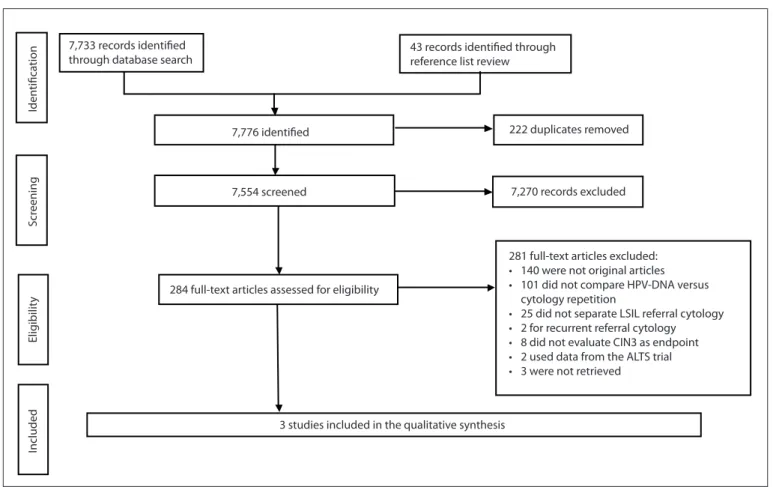
A low diagram detailing the process for selecting records rele-vant to the review is outlined in Figure 1.
Out of the 7,776 records initially identified through the full search strategy, 222 were duplicates and were therefore removed. A total of 7,554 articles were screened and 7,270 were subsequently excluded because they were not related to the topic. The remaining 284 full-text articles were assessed for eligibility. At this point, the most common reasons for exclusion were that the studies were not original or did not compare the performance of oncogenic HPV-DNA testing and repeated cytological tests. Twenty-five studies did not sepa-rate the initial LSIL findings from other cytological diagno-ses; eight studies did not evaluate the endpoint of CIN3; and three studies could not be retrieved. Consequently, these stud-ies were excluded. Before final exclusion, the authors of 23 studies that were candidates for inclusion pending additional information or full-text retrieval were contacted. Five of these authors (22%) replied, but only one of them made available the original raw data, thereby allowing study inclusion. Three studies7,17,18 were included in the systematic review.
systematic review on diagnostic tests | SYSTEMATIC REVIEW
Study characteristics
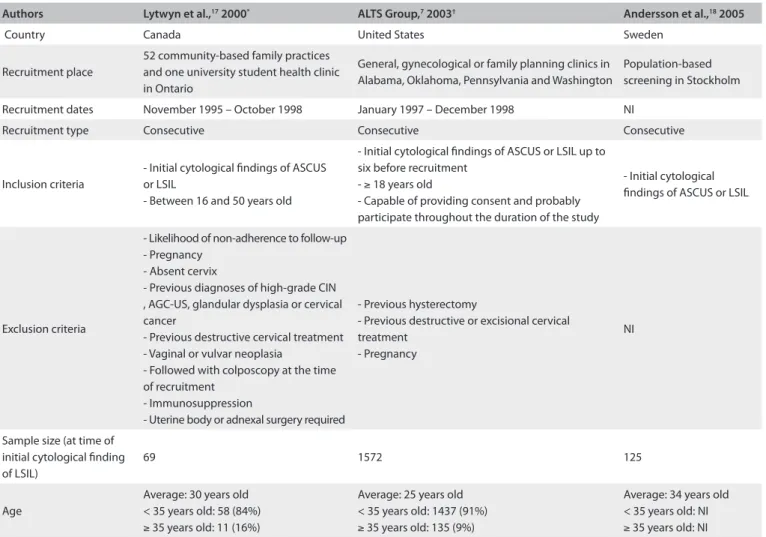
Tables 1 and 2 summarize, respectively, the characteristics of the
study populations and the investigative tests and reference stan-dards used.
Two studies were randomized controlled trials (RCTs)7,17 and one had a cross-sectional design.18 In all the studies included, the participants were recruited consecutively within routine cervical cancer screening practice. The sample sizes ranged from 69 to 1572. There were no differences in demo-graphic characteristics among the participants included in each arm of the RCTs (data not shown), but the cross-sec-tional study did not report on this subject. The participants’ mean ages ranged from 25 to 34 years. The main inclusion criterion was the initial ASCUS or LSIL cytology. The RCTs excluded women who had previously undergone cervical abla-tive or excisional treatment.
In all the studies included, the repeated cytological tests were classified in accordance with the 1991 Bethesda Sys-tem.19 With regard to technique, conventional cytological tests were used in two studies17,18 and liquid-based cyto-logical tests in one.7 The colposcopic referral threshold was ASCUS in two studies17,18 and high-grade squamous intraepi-thelial lesion (HSIL) in one.7
Hybrid capture-2 B-probe (HC2; Qiagen Gaithersburg, Inc., Maryland, United States; previously Digene Corporation) at a cutof of 1 pg/ml was used in all three of the studies included, for HPV-DNA detection.
he reference standard was based on histological examination of colposcopy-directed biopsies,7,17,18 endocervical curettage7,17 and loop electrosurgical excision procedures (LEEP).7 Colposcopy results were accepted as negative in the absence of specimens forwarded for histological evaluation, in two studies.7,17 In one study,18 a biopsy was taken close to the squamocolumnar junction, at 12 o’clock, if there were no abnormal colposcopic indings.
Risk of bias within studies
A methodological quality diagram was used, which was adapted from the Cochrane Library Guide to the Graphs in a Cochrane Diagnostic Test Accuracy Review.20 his is shown in Figure 2, presenting the review authors’ judgments about the method-ological quality items presented in the QUADAS questionnaire, across all the studies included.
All three studies were of high methodological quality, although the items concerning blinded interpretation of the investigative tests and reference standards used were considered unclear, from the information reported in the studies.
#*&*1*7$!7$*-)8 -$:'$; !
6!;$-$!%+&!-$&-'$:$#!
7,733 records identified through database search
43 records identified through reference list review
7,776 identified 222 duplicates removed
7,554 screened
284 full-text articles assessed for eligibility
7,270 records excluded
281 full-text articles excluded:
t XFSFOPUPSJHJOBMBSUJDMFT
t EJEOPUDPNQBSF)17%/"WFSTVT
cytology repetition
t EJEOPUTFQBSBUF-4*-SFGFSSBMDZUPMPHZ t GPSSFDVSSFOUSFGFSSBMDZUPMPHZ t EJEOPUFWBMVBUF$*/BTFOEQPJOU t VTFEEBUBGSPNUIF"-54USJBM t XFSFOPUSFUSJFWFE
3 studies included in the qualitative synthesis
Included
Elig
ibilit
y
4DS
FFOJOH
Iden
tifica
tion
Authors Lytwyn et al.,17 2000* ALTS Group,7 2003† Andersson et al.,18 2005
Country Canada United States Sweden
Recruitment place
52 community-based family practices and one university student health clinic in Ontario
General, gynecological or family planning clinics in Alabama, Oklahoma, Pennsylvania and Washington
Population-based screening in Stockholm Recruitment dates November 1995 – October 1998 January 1997 – December 1998 NI
Recruitment type Consecutive Consecutive Consecutive
Inclusion criteria
- Initial cytological indings of ASCUS or LSIL
- Between 16 and 50 years old
- Initial cytological indings of ASCUS or LSIL up to six before recruitment
- ≥ 18 years old
- Capable of providing consent and probably participate throughout the duration of the study
- Initial cytological indings of ASCUS or LSIL
Exclusion criteria
- Likelihood of non-adherence to follow-up - Pregnancy
- Absent cervix
- Previous diagnoses of high-grade CIN , AGC-US, glandular dysplasia or cervical cancer
- Previous destructive cervical treatment - Vaginal or vulvar neoplasia
- Followed with colposcopy at the time of recruitment
- Immunosuppression
- Uterine body or adnexal surgery required
- Previous hysterectomy
- Previous destructive or excisional cervical treatment
- Pregnancy
NI
Sample size (at time of initial cytological inding of LSIL)
69 1572 125
Age
Average: 30 years old < 35 years old: 58 (84%)
≥ 35 years old: 11 (16%)
Average: 25 years old < 35 years old: 1437 (91%)
≥ 35 years old: 135 (9%)
Average: 34 years old < 35 years old: NI
≥ 35 years old: NI
Table 1. Characteristics of the populations included in the selected studies
*Some data obtained from the author; †Data pertaining demographic characteristics were obtained from Schifman & Adrianza, 200021; NI = Not informed;
ASCUS = Atypical Squamous Cells of Undetermined Signiicance; LSIL = Low Grade Squamous Intraepithelial Lesions; CIN = Cervical intraepithelial neoplasia; AGC-US = Atypical GlandularCells of Undetermined Signiicance.
Authors Lytwyn et al.,17 2000 ALTS Group,7 2003 Andersson et al.,18 2005
Repeated cytological test:
Technique Conventional Liquid-based ThinPrep* Conventional
Nomenclature Bethesda, 1991 Bethesda, 1991 Bethesda, 1991 Colposcopic
referral threshold ASCUS, HSIL HSIL Any abnormality
HPV-DNA test:
Technique HC2 HC2 HC2
Positivity cutof 1 pg/ml 1 pg/ml 1 pg/ml
Reference standard
- Histological examination of colposcopy-directed biopsies and/or endocervical curettage
- Colposcopy taken to be negative in the absence of specimens forwarded for histological evaluation
- Histological examination of colposcopy-directed biopsies, endocervical curettage and/or LEEP
- Colposcopy taken to be negative in the absence of specimens forwarded for histological evaluation
- Histological examination of colposcopy-directed biopsies (in the absence of abnormal colposcopic indings, a biopsy was taken close to the squamocolumnar junction, at 12 o’clock)
Table 2. Characteristics of investigated tests and reference standard used in selected studies
*Cytyc Corporation, Boxborough, Massachusetts, United States; ASCUS = Atypical Squamous Cells of Undetermined Signiicance; HSIL = High Grade Squamous
systematic review on diagnostic tests | SYSTEMATIC REVIEW
Results from individual studies
Table 3 summarizes the results from the studies included. One
RCT17 originally reported combined results for women present-ing initial ASCUS/LSIL cytology, and CIN2+ as the outcome. he main author made the raw data available, which made it possible to separate out the LSIL data necessary for making accuracy mea-surement calculations according to age strata, CIN3 outcome and number of follow-up losses. Sixty-nine women were included: 84% were less than 35 years of age and 16% were 35 years old or over. hirty-four were allocated to the HPV-DNA test arm and 35 to the repeated cytological test arm. Fity women completed the study (27.5% losses); four losses (12.5%) occurred in the HPV-DNA test arm and 15 losses (43%) occurred in repeated cytologi-cal test arm. Six women presented CIN3 (12% prevalence): three in each arm of the study. All CIN3 cases were detected through a positive HPV-DNA test. he sensitivity and speciicity of the HPV-DNA tests were, respectively, 100% and 52%. Regarding data availability, age-stratiied HPV-DNA test performance eval-uation could not be carried out, because all the women who pre-sented CIN3 in this study arm were less than 35 years of age. he positivity rate in the HPV-DNA test was 64%. Repeated cytologi-cal tests with the ASCUS threshold detected only one of the CIN3
cases. he sensitivity and speciicity of repeated cytological tests at the ASCUS threshold were, respectively, 33% and 53%.
he other RCT7 did not report HPV-DNA tests and repeat cytological results separately for each arm of the study. he attempts to contact the main author, to requesting data for accu-racy measurement calculations did not produce any reply, and therefore only the information available in the article is repro-duced here. his trial enrolled 1,572 women presenting initial cytological indings of LSIL: 91% were less than 35 years of age and 9% were 35 years of age or over. he randomization resulted in 673 women in the arm of the study with immediate colpo-scopic referral, 675 women in the arm with repeated cytologi-cal tests and 224 women in the arm with HPV-DNA testing. he smaller number of women placed in this last arm was because this arm was closed before the end of the study consequent to the observed high positivity rate in the HPV-DNA test (83%). Eight-two percent of the women completed the study, and the percent-ages of losses were similar in the three arms. he cumulative CIN3 prevalence over the two-year study period was 15%, but considering just the detection rate upon study entry, the preva-lence dropped to 8%. he sensitivity for CIN3 detection deined a priori in the protocol was 55.9% in the immediate colposcopic Figure 2. Methodological quality summary diagram. On the left side of the igure, the individual quality items are listed. On top of the igure, the individual studies included are listed. Adapted from Guide to the Graphs in a Cochrane Diagnostic Test Accuracy Review.20
Representative spectrum? Acceptable reference standard? Acceptable delay between tests? Partial veriication avoided? Incorporation avoided?
Reference standard results blinded? Index test results blinded? Relevant clinical data available? Uninterpretable results reported? Withdrawals explained?
Lytwyn et al.17 ALTS Group7 Andersson et al.18
referral arm, 65.9% in the HPV-DNA test arm (both taken at the time of study entry) and 48.4% in the repeated cytological test arm (including follow-up during the study, at the HSIL thresh-old). he HPV-DNA test sensitivity for CIN3 detection upon study entry, calculated for a theoretical situation that disregarded missing visits or tests results, was 95.2%. In the same theoretical situation, the sensitivity of the irst-visit (six months ater study entry) repeated cytological test for CIN3 detection was 90.8% at the ASCUS threshold. Speciicities were not reported. Age-strati-ied HPV-DNA test accuracy evaluation could not be performed because of lack of data.
In the cross-sectional study,18 the results from repeated cyto-logical tests were reported aggregated for women initially pre-senting cytological indings of ASCUS/LSIL, and therefore it was impossible to perform accuracy measurement calculations rel-ative to this test in the LSIL group. here was no reply to our request for data unavailable in the published study. he results from HPV-DNA testing were reported separately for women pre-senting initial ASCUS and LSIL cytological indings, and accu-racy measurements could be calculated. his study included 125 women presenting initial cytological indings of LSIL. hese women underwent HPV-DNA testing, repeated cytological tests, colposcopy and colposcopy-directed biopsies. In cases without abnormal colposcopic indings, a biopsy was taken close to the squamocolumnar junction, at 12 o’clock. No follow-up losses
occurred. he CIN3 prevalence was 6%. he HPV-DNA test was positive in the seven women who presented CIN3. No patient with a negative HPV-DNA test presented CIN3. he sensitivity and speciicity of the HPV-DNA test was 100% and 27%, respec-tively. No evaluation of the performance of the age-stratiied HPV-DNA test could be carried out because data were not avail-able. he HPV-DNA test was positive in 93 patients (74%).
DISCUSSION
Summary of evidence
Following the initial cytological inding of LSIL in the stud-ies included in the present review, the CIN3 prevalence was 6%,18 8%7 and 12%.17 he rate reported in the literature is 7.4% (95% CI: 2.9–12.0%).4
In the studies included, the positivity rates in the oncogenic HPV-DNA tests among the women presenting initial cytological indings of LSIL were high (64%,17 74%18 and 83%7), which is in agreement with the 74.4% (95% CI: 67.0-81.9%; range: 58-85%) rate reported in the literature.4 he HPV-DNA test sensitivities for CIN3 detection were very high (95.2%7 and 100%17,18), while the speciicities were low (27%18 and 52%17). he most recent meta-analysis on this subject reported sensitivity and speciicity, pooled from six studies for the same endpoint, of 97.1% (95% CI: 94.0-100%) and 26.1% (95% CI: 15.1-37.1%), respectively.4 Using a tri-age method of low speciicity may induce anxiety, overdiagnosis,
Authors Lytwyn et al.,17 2000 ALTS Group,7 2003 Andersson et al.,18 2005
HPV-DNA test:
True positives 3 NA 7
False negatives 0 NA 0
False positives 13 NA 86
True negatives 14 NA 32
Sensitivity 100% 65.9%* 100%
Speciicity 52% NA 27%
Positivity 64%† 83% 74%
Age stratiication 3 cases of CIN3 HPV+ < 35 years old NA NA
Losses 4 (12.5%) NA 0
Repeated cytological test:
True positives 1 NA NA
False negatives 2 NA NA
False positives 8 NA NA
True negatives 9 NA NA
Sensitivity 33%‡ 48.4%* NA
Speciicity 53%‡ NA NA
Losses 15 (43%) NA NA
CIN3 prevalence 12%‡ 15%§ 6%
Total losses 27.5% 18% 0
Table 3. Numbers of true positives, true negatives, false positives and false negatives, accuracy measurements, positivity rate, age stratiication and number of losses from the investigative tests; cervical intraepithelial neoplasia grade 3 (CIN3) prevalence and total losses in the selected studies
NA = Data not available; *Two-year cumulative CIN3 detection; †Results available for 69 patients included in the study; ‡Based on the number of
systematic review on diagnostic tests | SYSTEMATIC REVIEW
overtreatment and even adverse efects. As a result, more speciic tests, like HPV genotyping, HPV-mRNA and p-16 have been increasingly investigated.22
he repeated cytological test sensitivities for CIN3 detection at the ASCUS threshold were 33%17 and 90.8%.7 he speciicity was 53%.17 hese data are not reliable because in one included study,17 there were selective losses in the repeat cytology arm, and in the other,7 they were calculated based on a theoretical sit-uation. No reports are available in the literature to make com-parisons, because in the previously published meta-analyses,8,9 which evaluated repeat cytological test accuracy, the endpoint was CIN2+.
Another factor that can inluence triage test performance is the adherence to the proposed strategy. he potential follow-up losses need to be taken into consideration, especially if the inves-tigation is done at a later time, as in the case of cytological test repetition. No losses occurred in the cross-sectional study,18 but the losses in the RCTs were 18%7 and 27.5%.17 In one study included,17 greater losses occurred in the repeated cytological test arm, possibly indicating that this strategy is less efective within clinical practice. On the other hand, HPV-DNA tests can be pro-cessed using the original liquid-based cytological residual speci-men, thus reducing the costs and follow-up losses.
Limitations
Data for accuracy measurement calculations were available in just one study, thus limiting the qualitative synthesis and pre-cluding quantitative synthesis.
Even if the missing data had been obtained, age-stratiied analyses would probably not have been conclusive because the studies included did not report age-speciic data and were not designed to address this point. In the present review, the mean age of the women in one included study18 was 34 years, and only 9%7 and 16%17 of the women enrolled in the other two included studies were 35 years of age or over. As a matter of fact, although age-stratiied data were available in one study,17 no age-strati-ied HPV-DNA test performance evaluation could be carrage-strati-ied out because all the women who presented CIN3 in this arm of the study were less than 35 years old. Despite the high methodolog-ical quality attained in the QUADAS assessment, one included study7 failed to report the absolute numbers of false and true pos-itives and negatives, which is considered to be a basic method-ological criterion for studies relating to diagnostic test accuracy.
Further limitations occurred because, going back to the study selection step, 25 studies did not separate initial indings of LSIL from other cytological diagnoses, eight studies did not evalu-ate the CIN3 endpoint and three studies could not be retrieved. he attempts to contact the main or corresponding authors to request additional information or full-text retrieval achieved a low response rate indeed. Although the abstract screening on the
three studies that were not retrieved suggested that they were not eligible and would not have been included, there exists the pos-sibility of selection bias. Regarding the systematic review meth-odology, a very broad search was conducted in order to avoid the risk of losing potentially pertinent articles. As a result, the search achieved great sensitivity but poor speciicity.
Strict observance of basic methodological criteria for design-ing, conducting and, particularly, reporting diagnostic test accu-racy studies is essential in order to ensure quality and enable comparison between results and inclusion in systematic reviews. Eforts to facilitate access to relevant and valid studies, in order to develop and evaluate strategies that provide better bal-ance between search sensitivity and accuracy, and eforts towards establishing ethical standards that may encourage the scientiic community to share information are welcomed, in the pursuit of improvements in systematic review methodology.
CONCLUSIONS
It was found that currently there is no scientiic evidence avail-able that would determine which triage method for colpo-scopic referral performs best in detecting CIN3 among women aged over 35 years who initially present cytological indings of LSIL. Consequently, any strategy deinition will not be evidence-based. he clinical decision on which test to use in this situation should take into consideration other factors, such as patients’ values, prospects for adherence within a conservative follow-up approach, cost and technology access. he possibility of carrying out a relex HPV-DNA test, if liquid-based cytological tests were used, may represent an advantage in clinical practice, through reducing costs and follow-up losses. Where this technology is not available or is economically impracticable, cytological test repeti-tion still seems to be an acceptable oprepeti-tion.
Regarding efective assessment of triage method performance in future research, uniform age-strata deinition for investiga-tion, use of the CIN3 endpoint, data separation according to ini-tial cytological diagnoses and searching for more speciic meth-ods are the main characteristics that should be prioritized.
REFERENCES
1. Brasil. Ministério da Saúde. SISCOLO/SISMAMA. Sistema de Informação
do câncer do colo do útero e Sistema de Informação do câncer de
mama. Informações estatísticas. Available from: http://w3.datasus.
gov.br/siscam/index.php?area=0401. Accessed in 2011 (Aug 9).
2. Brasil. Ministério da Saúde. Secretaria de Atenção à Saúde. Instituto
Nacional de Câncer. Coordenação de Prevenção e Vigilância.
Nomenclatura brasileira para laudos cervicais e condutas
preconizadas: recomendações para proissionais de saúde. 2a ed.
Rio de Janeiro: INCA; 2006. Available from: http://www1.inca.gov.br/
inca/Arquivos/Titulos/Nomenclatura_colo_do_utero.pdf. Accessed
3. World Health Organization. International Agency for Research on
Cancer. IARC Monographs on the Evaluation of Carcinogenic Risks
to Humans. Volume 90. Human papillomaviruses. Lyon: IARC Library
Cataloguing in Publication Data; 2007.
4. Cuzick J, Arbyn M, Sankaranarayanan R, et al. Overview of human
papillomavirus-based and other novel options for cervical cancer
screening in developed and developing countries. Vaccine. 2008;26
Suppl 10:K29-41.
5. Arbyn M, Kyrgiou M, Simoens C, et al. Perinatal mortality and
other severe adverse pregnancy outcomes associated with
treatment of cervical intraepithelial neoplasia: meta-analysis. BMJ.
2008;337:a1284.
6. Solomon D. Chapter 14: Role of triage testing in cervical cancer
screening. J Natl Cancer Inst Monogr. 2003;(31):97-101.
7. ASCUS-LSIL Triage Study (ALTS) Group. A randomized trial on the
management of low-grade squamous intraepithelial lesion cytology
interpretations. Am J Obstet Gynecol. 2003;188(6):1393-400.
8. Arbyn M, Paraskevaidis E, Martin-Hirsch P, Prendiville W, Dillner J.
Clinical utility of HPV-DNA detection: triage of minor cervical lesions,
follow-up of women treated for high-grade CIN: an update of pooled
evidence. Gynecol Oncol. 2005;99(3 Suppl 1):S7-11.
9. Arbyn M, Sasieni P, Meijer CJ, et al. Chapter 9: Clinical applications
of HPV testing: a summary of meta-analyses. Vaccine. 2006;24 Suppl
3:S3/78-89.
10. Cuzick J, Szarewski A, Cubie H, et al. Management of women who test
positive for high-risk types of human papillomavirus: the HART study.
Lancet. 2003;362(9399):1871-6.
11. Kitchener HC, Almonte M, Wheeler P, et al. HPV testing in routine
cervical screening: cross sectional data from the ARTISTIC trial. Br J
Cancer. 2006;95(1):56-61.
12. Ronco G, Cuzick J, Segnan N, et al. HPV triage for low grade (L-SIL)
cytology is appropriate for women over 35 in mass cervical cancer
screening using liquid based cytology. Eur J Cancer. 2007;43(3):476-80.
13. Schifman M, Rodríguez AC. Heterogeneity in CIN3 diagnosis. Lancet
Oncol. 2008;9(5):404-6.
14. Moher D, Liberati A, Tetzlaf J, Altman DG; PRISMA Group. Preferred
reporting items for systematic reviews and meta-analyses: the
PRISMA statement. PLoS Med. 2009;6(7):e1000097.
15. Sampson M, McGowan J, Cogo E, et al. An evidence-based practice
guideline for the peer review of electronic search strategies. J Clin
Epidemiol. 2009;62(9):944-52.
16. Whiting P, Rutjes AW, Reitsma JB, Bossuyt PM, Kleijnen J. The
development of QUADAS: a tool for the quality assessment of studies
of diagnostic accuracy included in systematic reviews. BMC Med Res
Methodol. 2003;3:25.
17. Lytwyn A, Sellors JW, Mahony JB, et al. Comparison of human
papillomavirus DNA testing and repeat Papanicolaou test in women
with low-grade cervical cytologic abnormalities: a randomized trial.
HPV Efectiveness in Lowgrade Paps (HELP) Study No. 1 Group. CMAJ.
2000;163(6):701-7.
18. Andersson S, Dillner L, Elfgren K, et al. A comparison of the human
papillomavirus test and Papanicolaou smear as a second screening
method for women with minor cytological abnormalities. Acta
Obstet Gynecol Scand. 2005;84(10):996-1000.
19. Luf RD. The Bethesda System for reporting cervical/vaginal cytologic
diagnoses: report of the 1991 Bethesda workshop. The Bethesda
System Editorial Committee. Hum Pathol.1992;23(7):719-21.
20. Guide to the graphs in a Cochrane diagnostic test accuracy
review. Available from: http://onlinelibrary.wiley.com/store/
mrw_content/cochrane/homepages/guidetographs.pdf?v=1&t
=gk5qhyo0&s=6e226d8c64962552738489869354fe3f31f4cae8.
Accessed in 2011 (Aug 9).
21. Schifman M, Adrianza ME. ASCUS-LSIL Triage Study. Design, methods
and characteristics of trial participants. Acta Cytol. 2000;44(5):726-42.
22. Cox JT. History of the use of HPV testing in cervical screening and in
the management of abnormal cervical screening results. J Clin Virol.
2009;45 Suppl 1:S3-S12.
Acknowledgements: We are especially grateful to Dr. Alice Lytwyn and Prof. Michelle Howard, for their support in providing the raw data from
their study, and to Dr. Marc Arbyn and Prof. Eduardo Franco, for the
opportunity to exchange views upon the topic researched. We are also
thankful to Dr. Alex Ferenczy, Prof. Christine Bergeron, Prof. Jack Cuzick,
Dr. Ken Hatch and Dr. Margaret Cruickshank, the authors who replied to
our requests to obtain additional data or information.
Sources of funding: The main author received inancial support in the form of a scholarship granted by Coordenação de Aperfeiçoamento de
Pessoal de Nível Superior (Capes)
Conlict of interest: None
Date of irst submission: January 31, 2011
Last received: August 27, 2011
Accepted: September 23, 2011
Address for correspondence: Flávia de Miranda Corrêa
Rua Marquês do Pombal, 125 — 7º andar
Centro – Rio de Janeiro (RJ) – Brasil
CEP 20230-240
Tel. (+55 21) 3207-5638